

Paper Menu >>
Journal Menu >>
 World Journal of Mechanics, 2013, 3, 1-5 http://dx.doi.org/10.4236/wjm.2013.35A001 Published Online August 2013 (http://www.scirp.org/journal/wjm) Attitude Control of an Axi-Symmetric Rigid Body Using Two Controls without Angular Velocity Measurements Paper Tawfik El-Sayed Tawfik Department of Mathematics, Faculty of Science, Mansoura University, Mansoura, Egypt Email: [email protected] Received March 23, 2013; revised April 23, 2013; accepted May 1, 2013 Copyright © 2013 Tawfik El-Sayed Tawfik. This is an open access article distributed under the Creative Commons Attribution Li- cense, which permits unrestricted use, distribution, and reproduction in any medium, provided the original work is properly cited. ABSTRACT This paper considers the problem of controlling the rotational motion of an axi-symmetric rigid body using two inde- pendent control torques without angular velocity measurements. The control law which stabilizes asymptotically this motion is obtained only in terms of the orientation parameters. Global asymptotic stability is shown by applying LaSalle invariance principal. Numerical simulation is introduced. Keywords: Attitude Control; Rigid Body; Stabilization; Two Controls 1. Introduction A rigid body in general (non-symmetric) is controlled with three independent controls without angular velocity measurements [1-3]. If one of the controls is failure, the rigid body is not controllable. Thus the attitude control of a rigid body motion using two controls is an important control problem. The angular velocity along the symmetric axis of the rigid body is fixed to its initial value. In this case, two control torques are used to stabilize asymptotically the rotational motion about the symmetric axis. Moreover, the orientation of the symmetric axis is described using stereographic coordinates form direction cosines [4]. Many authors have discussed the attitude control of a rigid body motion using two controls that depend in terms of the angular velocities of the rigid body and the orientation parameters. The stabilization of a zero total angular momentum satellite using two reaction wheels has been shown in [5,6]. Two controls which stabilize asymptotically a rigid body motion using matching con- dition are obtained in terms of the angular velocities of the rigid body [7]. Two controls which stabilize asymp- totically an axi-symmetric rigid spacecraft are obtained in terms of the angular velocities of the rigid body and the orientation parameters [8-11]. The angular velocity measurement is noisy. It contains high frequency and random fluctuations. In this paper, two control torques which stabilize asymptotically the rotational motion of an axi-symmetric rigid body are obtained only in terms of the orientation parameters. The present paper is organized as follows: Section 2 presents dynamic and kinematic equations of an axi- symmetric rigid body with two control torques. Section 3 is devoted to obtain the two control torques which stabi- lize asymptotically the rotational motion of an axi-sym- metric rigid body in terms of the orientation parameters. The asymptotic stability of this motion is proved by ap- plying LaSalle invariance principal. Section 4 contains numerical simulation to illustrate the theoretical results of the paper. 2. Dynamics and Kinematics Consider the rotational dynamics of an axi-symmetric rigid body controlled by two independent control torques. Two reference frames are introduced. The first 123 ˆˆˆˆ ,,nnnn is an inertial reference frame, and the second 123 ˆˆ ,,bb 1 ˆ b ˆˆ bb is a body-fixed reference frame and coincident with the principal axes of inertia of the body. The unit vector 3 lies along the axis of symme- try. Two control torques 1 and 2 u are applied along the unit vectors and 2, respectively (Figure 1). Let i ˆ b ˆ bu A and 1, 2,3 ii be the principal moments of iner- tia of the rigid body and the components of the angular velocity of the body referred to the frame, respec- tively. The dynamic equations take the form: ˆ b C opyright © 2013 SciRes. WJM 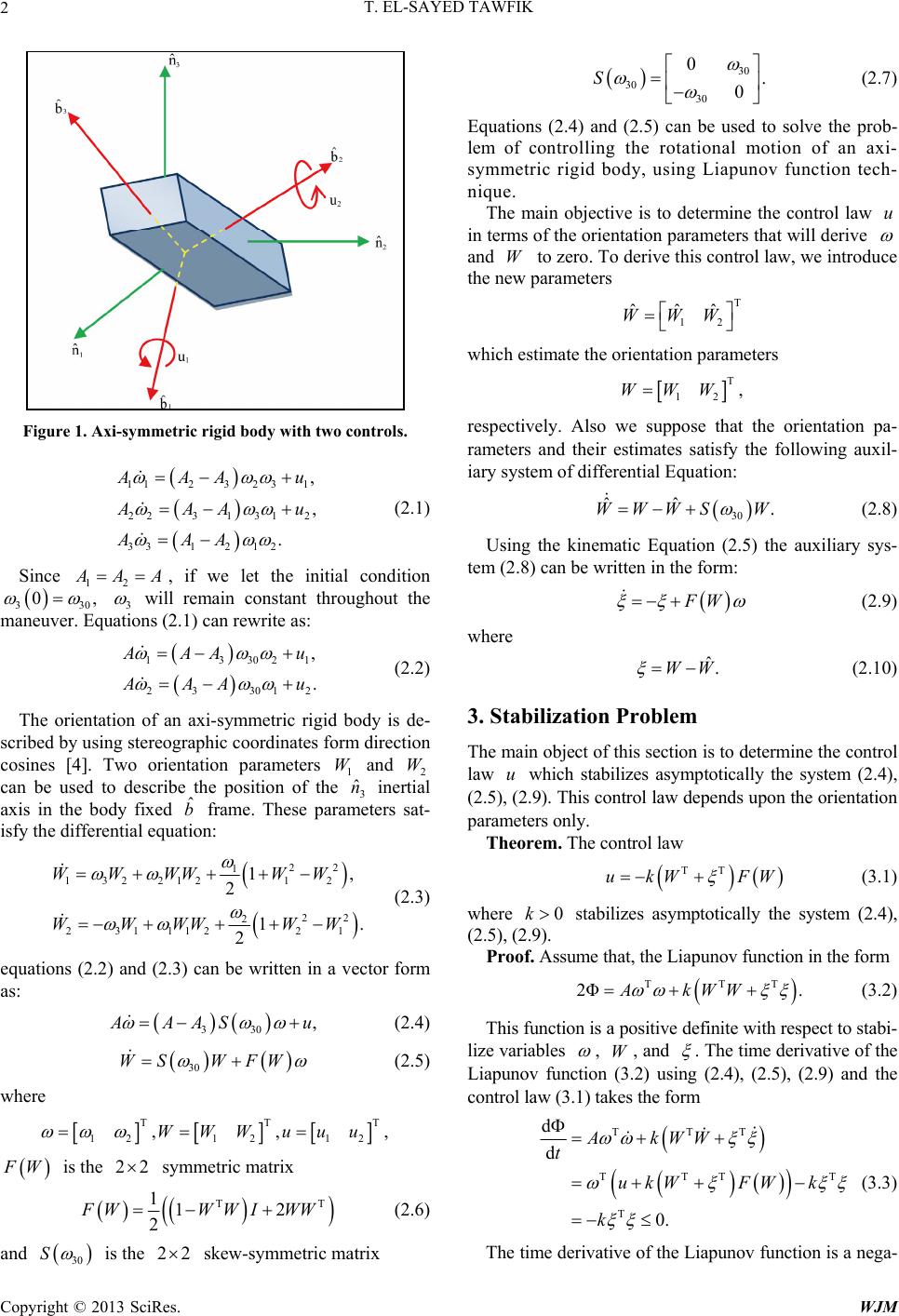 T. EL-SAYED TAWFIK 2 Figure 1. Axi-symmetric rigid body with two controls. 11232 31 2231 312 3312 12 , , . A AA u A AA u AAA (2.1) Since 12 A AA , , if we let the initial condition 30 3 0 3 will remain constant throughout the maneuver. Equations (2.1) can rewrite as: 13302 23 301 , . 1 2 A AA u A AA u (2.2) The orientation of an axi-symmetric rigid body is de- scribed by using stereographic coordinates form direction cosines [4]. Two orientation parameters and 2 can be used to describe the position of the 3 inertial axis in the body fixed frame. These parameters sat- isfy the differential equation: 1 W ˆ nW ˆ b 22 1 1322121 2 22 2 23111221 1, 2 1. 2 WWWW WW WWWW WW (2.3) equations (2.2) and (2.3) can be written in a vector form as: 330 , A AAS u (2.4) 30 WS WFW (2.5) where TT 121 212 ,,WWWuuu T , F W is the 2 symmetric matrix 2 T 112 2 FWWW IWWT (2.6) and 30 S is the skew-symmetric matrix 22 30 30 30 0. 0 S (2.7) Equations (2.4) and (2.5) can be used to solve the prob- lem of controlling the rotational motion of an axi- symmetric rigid body, using Liapunov function tech- nique. The main objective is to determine the control law in terms of the orientation parameters that will derive u and to zero. To derive this control law, we introduce the new parameters W T 12 ˆˆˆ WWW which estimate the orientation parameters T 12 ,WWW respectively. Also we suppose that the orientation pa- rameters and their estimates satisfy the following auxil- iary system of differential Equation: 30 ˆˆ.WWWS W (2.8) Using the kinematic Equation (2.5) the auxiliary sys- tem (2.8) can be written in the form: FW (2.9) where ˆ.WW (2.10) 3. Stabilization Problem The main object of this section is to determine the control law which stabilizes asymptotically the system (2.4), (2.5), (2.9). This control law depends upon the orientation parameters only. u Theorem. The control law TT ukW FW (3.1) where stabilizes asymptotically the system (2.4), (2.5), (2.9). 0k Proof. Assume that, the Liapunov function in the form TTT 2Φ.AkWW (3.2) This function is a positive definite with respect to stabi- lize variables , , and W . The time derivative of the Liapunov function (3.2) using (2.4), (2.5), (2.9) and the control law (3.1) takes the form TTT TTT T d d 0. AkWW t ukWFW k k T (3.3) The time derivative of the Liapunov function is a nega- Copyright © 2013 SciRes. WJM 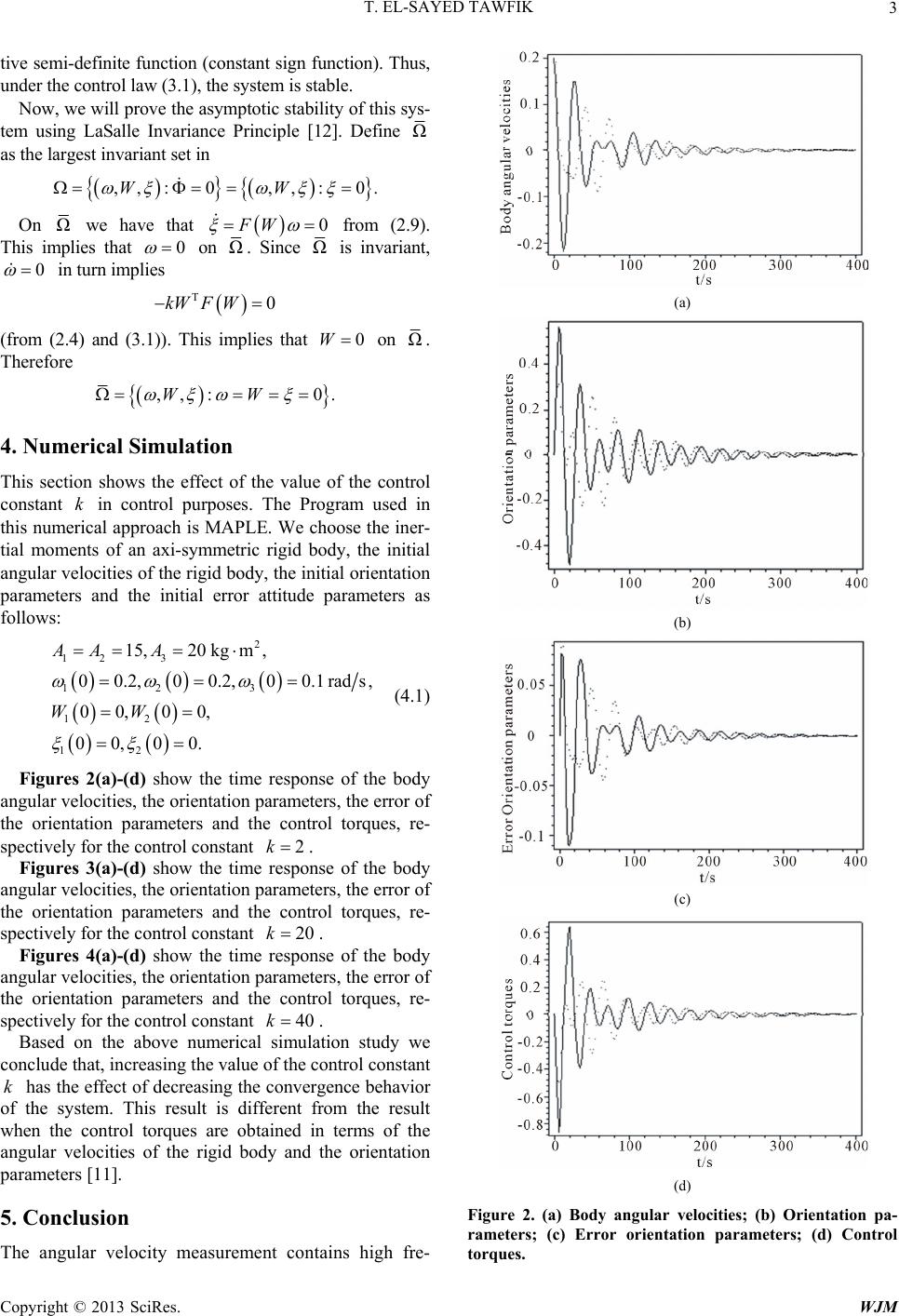 T. EL-SAYED TAWFIK 3 tive semi-definite function (constant sign function). Thus, under the control law (3.1), the system is stable. Now, we will prove the asymptotic stability of this sys- tem using LaSalle Invariance Principle [12]. Define Ω as the largest invariant set in ,, :0,, :0.WW On Ω we have that 0FW from (2.9). This implies that 0 on Ω. Since Ω is invariant, 0 in turn implies T0kWF W (from (2.4) and (3.1)). This implies that on 0WΩ. Therefore ,, :0.WW 4. Numerical Simulation This section shows the effect of the value of the control constant in control purposes. The Program used in this numerical approach is MAPLE. We choose the iner- tial moments of an axi-symmetric rigid body, the initial angular velocities of the rigid body, the initial orientation parameters and the initial error attitude parameters as follows: k 2 12 3 123 12 12 15,20 kgm, 00.2, 00.2, 00.1rads 00, 00, 00, 00. AA A WW , (4.1) Figures 2(a)-(d) show the time response of the body angular velocities, the orientation parameters, the error of the orientation parameters and the control torques, re- spectively for the control constant . 2 k Figures 3(a)-(d) show the time response of the body angular velocities, the orientation parameters, the error of the orientation parameters and the control torques, re- spectively for the control constant . 20 k Figures 4(a)-(d) show the time response of the body angular velocities, the orientation parameters, the error of the orientation parameters and the control torques, re- spectively for the control constant . 40 k Based on the above numerical simulation study we conclude that, increasing the value of the control constant has the effect of decreasing the convergence behavior of the system. This result is different from the result when the control torques are obtained in terms of the angular velocities of the rigid body and the orientation parameters [11]. k 5. Conclusion The angular velocity measurement contains high fre- (a) (b) (c) (d) Figure 2. (a) Body angular velocities; (b) Orientation pa- rameters; (c) Error orientation parameters; (d) Control torques. Copyright © 2013 SciRes. WJM 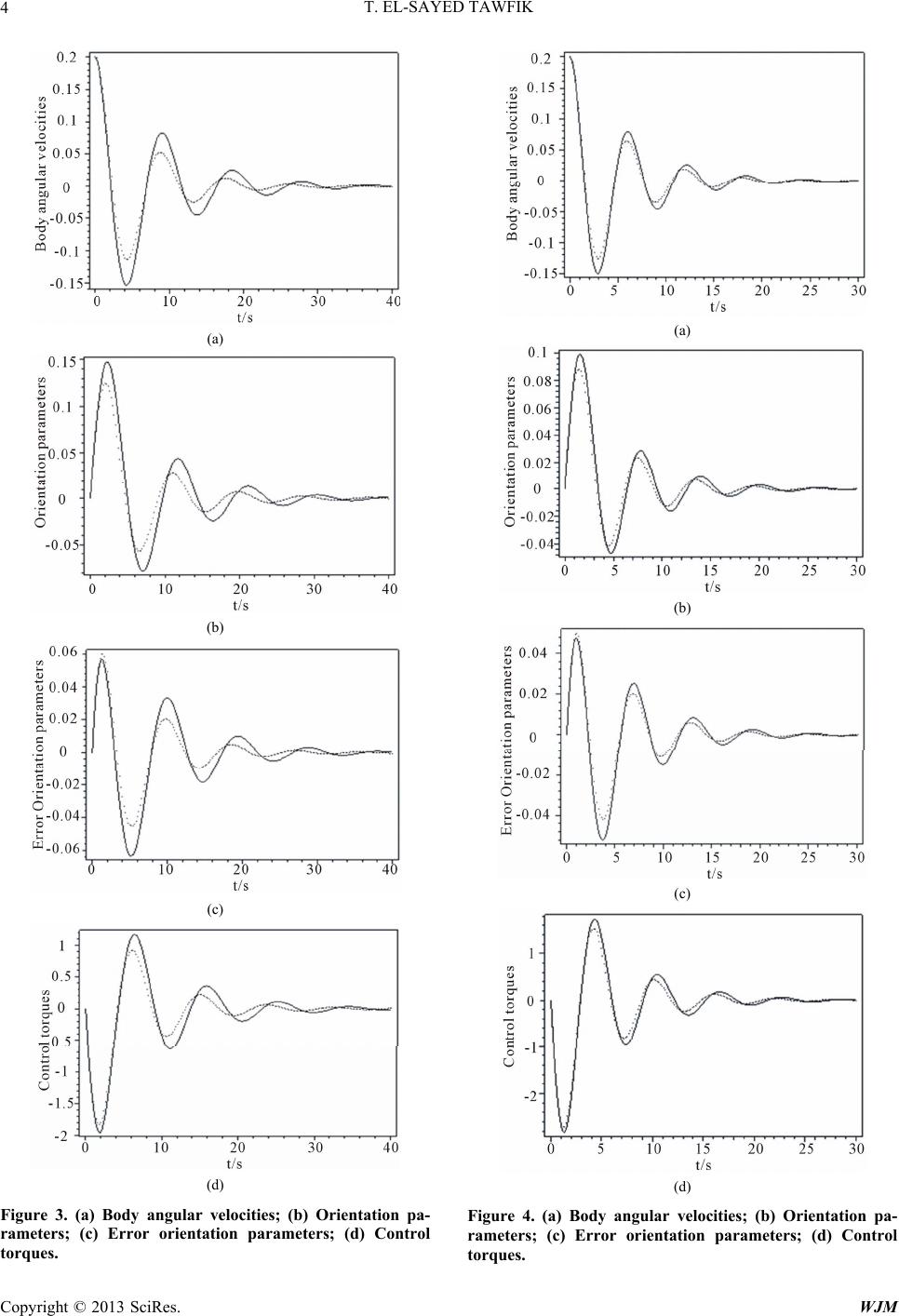 T. EL-SAYED TAWFIK 4 (a) (b) (c) (d) Figure 3. (a) Body angular velocities; (b) Orientation pa- rameters; (c) Error orientation parameters; (d) Control torques. (a) (b) (c) (d) Figure 4. (a) Body angular velocities; (b) Orientation pa- rameters; (c) Error orientation parameters; (d) Control torques. Copyright © 2013 SciRes. WJM  T. EL-SAYED TAWFIK Copyright © 2013 SciRes. WJM 5 nd noises or random fluctuations. Two control [1] A. AbdessamGlobal Traj quency a torques (3.1) which stabilize asymptotically the rotational motion of an axi-symmetric rigid body are obtained in terms of the orientation parameters without angular ve- locity measurements. Global asymptotic stability is shown by applying LaSalle invariance principal. REFERENCES eud and A. Tayebi, “ectory Tracking Control of VTOL-UAVs without Linear Veloc- ity Measurements,” Automatica, Vol. 46, No. 6, 2010, pp. 1053-1059. doi:10.1016/j.automatica.2010.03.010 [2] S. Ding, S. Li and Q. Li, “Adaptive Set Stabilization of the Attitude of a Rigid Spacecraft without Angular Ve- locity Measurements,” Journal of Systems Science and Complexity, Vol. 24, No. 1, 2011, pp. 105-119. doi:10.1007/s11424-011-8214-1 [3] A. El-Gohary and T. S. Tawfik, “Attitude Stabilization Using Modified Rodrigues Parameters without Angular Velocity Measurements,” World Journal of Mechanics, Vol. 1, No. 2, 2011, pp. 57-63. doi:10.4236/wjm.2011.12008 [4] P. Tsiotras and J. M. Longuski, “A New Parameterization the on the Attitude Kinematics,” Journal of the Astronautical Sciences, Vol. 43, No. 3, 1995, pp. 243-262. [5] F. Boyer and M. Alamir, “Further Results on Con- trollability of a Two-Wheeled Satellite,” Journal of Guid- ance, Control, and Dynamics, Vol. 30, No. 2, 2007, pp. 611-619. doi:10.2514/1.21505 [6] N. M. Horri and S. Hodgart, “Attitude Stabilization of an under Actuated Satellite Using Two Wheels,” IEEE Aero- space Conference, Vol. 6, 2003, pp. 2629-2635. [7] C. Aguilar-Ibaez, M. S. Suarez-Castanon and F. Guzman- Aguilar, “Stabilization of the Angular Velocity of a Rigid Body System Using Two Torques: Energy Matching Condition,” American Control Conference, Seattle, 11-13 June 2008, pp. 4845-4849. [8] H. Shen and P. Tsiotras, “Time-Optimal Control of Axi- symmetric Rigid Spacecraft Using Two Controls,” Jour- nal of Guidance, Control, and Dynamics, Vol. 22, No. 5, 1999, pp. 682-694. doi:10.2514/2.4436 [9] K. Sungpil and K. Youda, “Spin-Axis Stabilization of a Rigid Spacecraft Using Two Reaction Wheels,” Journal of Guidance, Control, and Dynamics, Vol. 24, No. 5, 2001, pp. 1046-1049. doi:10.2514/2.4818 [10] R. Tammepõld, P. Fiorini and M. Kruusmaa, “Attitude Control of Small Hopping Robots for Planetary Explora- tion: A Feasibility Study,” 11th Symposium on Advanced Space Technologies in Robotics and Automation (ASTRA 2011) ESA/ESTEC, Noordwijk, April 2011, pp. 12-14. [11] P. Tsiotras, “Optimal Regulation and Passivity Results for Axisymmetric Rigid Bodies Using Two Controls,” Jour- nal of Guidance, Control, and Dynamics, Vol. 20, No. 3, 1997, pp. 457-463. doi:10.2514/2.4097 [12] H. Khalil, “Nonlinear Systems,” MacMillan, Princeton, 1992. |