

Paper Menu >>
Journal Menu >>
 Psychology 2013. Vol.4, No.9, 677-681 Published Online September 2013 in SciRes (http://www.scirp.org/journal/psych) http://dx.doi.org/10.4236/psych.2013.49096 Copyright © 2013 SciRes. 677 Encoding Organizational Source and Associative Source under Incidental and Intentional Learning Conditions Lei Zhu Department of Psychology, Fudan University, Shanghai, China Email: [email protected] Received May 24th, 2013; revised July 15th, 2013; accepted August 6th, 2013 Copyright © 2013 Lei Zhu. This is an open access article distributed under the Creative Commons Attribution License, which permits unrestricted use, distribution, and reproduction in any medium, provided the original work is properly cited. The present study aimed at providing a plausible answer for the controversy whether organizational source or associative source could be encoded in a more automatic manner through incidental learning. In the experiment, subjects were asked to learn organizational and associative sources under incidental or intentional learning conditions. It turned out that only associative source accuracy increased when sub- jects were instructed to intentionally learn that source, which implied that associative source might be encoded in a more effortful way, whereas processing of organizational source might be performed inci- dentally. Keywords: Organizational Source; Associative Source; Incidental Learning; Intentional Learning Introduction People encounter lots of information from various sources every day. Sometimes, when they retrieve the remembered information, they are also required to identify the related source of this information. In the typical source memory tasks, sub- jects were presented with items from at least two different sources (e.g., Zhu et al., 2010). The items to be learned include words, pictures, statements, and so on. And the source refers to a variety of characteristics which specify the conditions under which the learning items are presented, such as their color, shape, size, spatial location, temporal order and the media or modality of presentation. In the recent decades, there is increasing evidence which sug- gested that source memory might be fundamentally different from memory for the item. That is, compared to memory for- mation for item, encoding source is a more effortful task which is performed intentionally and requires considerable attentional resources (Spencer & Raz, 1995; Troyer & Craik, 2000). For example, the population with decline of frontal executive sys- tems and reduced attentional resources, such as older adults and amnesia patients showed more deficits in remembering the sources than in remembering the items (Schacter, 1987; Schac- ter et al., 1991; Ferguson et al., 1992; Hashtroudi et al., 1994; Chalfonte et al., 1996; Wegesin et al., 2000). In addition, en- coding source was interfered more severely by the secondary tasks under divided attention condition than was encoding item (Troyer et al., 1999; Troyer & Craik, 2000). Similarly, com- pared with intentional learning conditions, source accuracy decreased under incidental learning conditions (Chalfonte & Johnson, 1996; Marsh et al., 2004; Kuo & Van Petten, 2006; Uncapher & Rugg, 2009). However, not all the source is encoded in the same way. One insight comes from the dichotomy between automatic and ef- fortful processes proposed by Hasher and Zacks (1979). Ac- cording to Hasher and Zacks (1979), automatic memory proc- esses which require minimal attentional resources can occur without intention and do not benefit from practice. Contrarily, effortful memory processes such as rehearsal or elaborative mnemonic activities which require considerable attentional resources are initiated intentionally and show benefits from practice. Based on that, Hasher and Zacks (1979) further pro- posed that different from other source, spatial locations, tem- poral orders tend to be encoded incidentally by automatic memory processes. Yet, on the contrary, other researchers clas- sified source into two categories (Geiselman & Bjork, 1980; Baddeley, 1982; Moscovitch, 1992; Spencer & Raz, 1995; Staresina & Davachi, 2008). Opposite to Hasher and Zacks (1979), source, such as spatial locations or temporal orders, is thought to be extrinsic to the item and not be encoded concur- rently with the item. Thus, more intentional effort is required to bind it to the item. This type of source has been named as ex- trinsic (Geiselman & Bjork, 1980; Baddeley, 1982), organiza- tional (Moscovitch, 1992), spatiotemporal (Spencer & Raz, 1995), or item-context (Staresina & Davachi, 2008) source. On the other hand, source, such as color, font, shape, is likely to be encoded automatically without conscious intention, because it is directly bound to the item itself and is encoded concurrently with the item. This type of source is denominated as intrinsic (Geiselman & Bjork, 1980; Baddeley, 1982), associative (Mos- covitch, 1992), stimulus bound (Spencer & Raz, 1995), or item- feature (Staresina & Davachi, 2008) source. Thus, it is still an open question whether organizational source or associative source could be encoded in a more automatic manner through incidental learning. To test this, participants were asked to encode organizational source (i.e., location) and associative source (i.e., color) under incidental or intentional learning conditions. They first studied a list of colored objects presented in the top or bottom of the 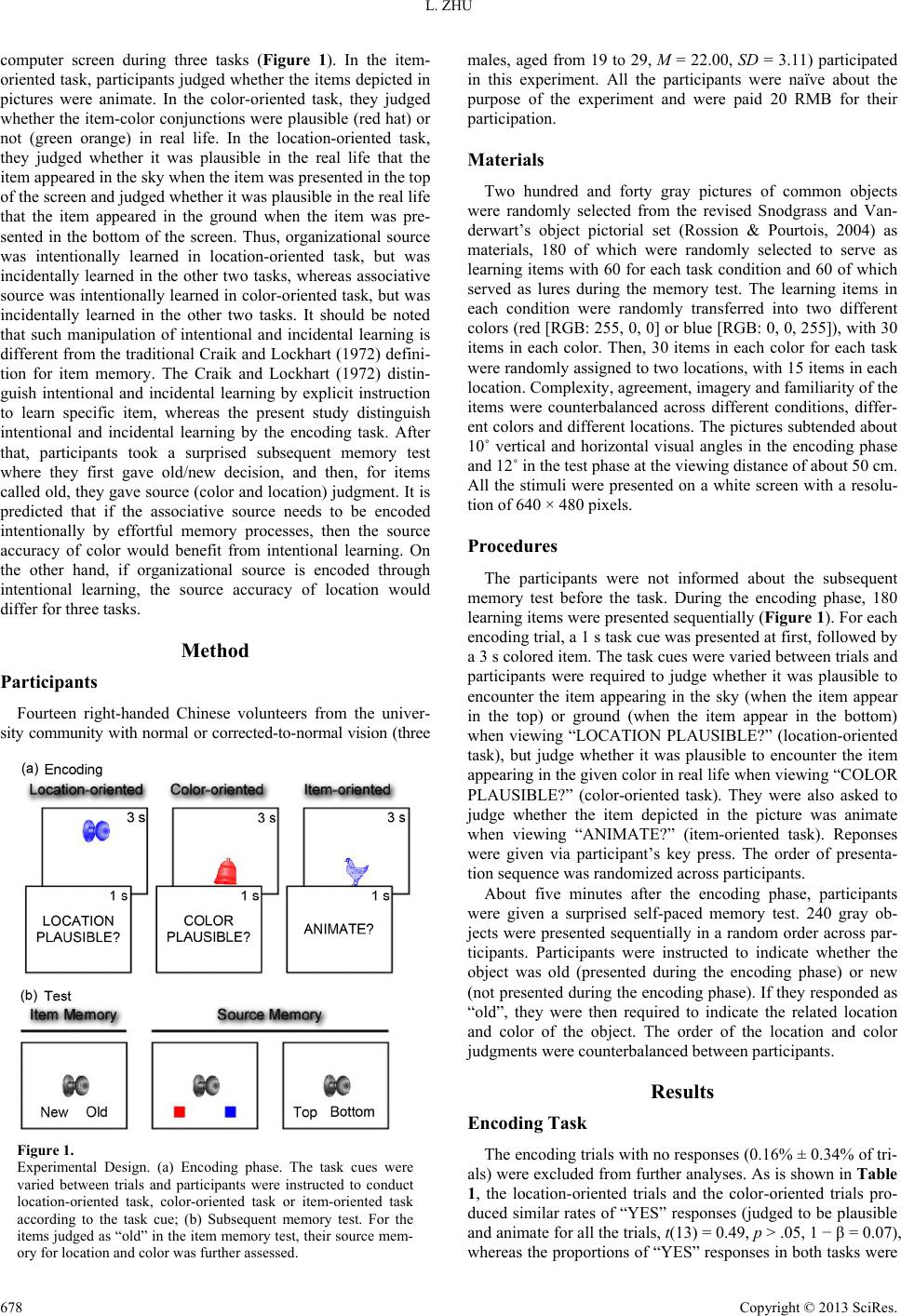 L. ZHU computer screen during three tasks (Figure 1). In the item- oriented task, participants judged whether the items depicted in pictures were animate. In the color-oriented task, they judged whether the item-color conjunctions were plausible (red hat) or not (green orange) in real life. In the location-oriented task, they judged whether it was plausible in the real life that the item appeared in the sky when the item was presented in the top of the screen and judged whether it was plausible in the real life that the item appeared in the ground when the item was pre- sented in the bottom of the screen. Thus, organizational source was intentionally learned in location-oriented task, but was incidentally learned in the other two tasks, whereas associative source was intentionally learned in color-oriented task, but was incidentally learned in the other two tasks. It should be noted that such manipulation of intentional and incidental learning is different from the traditional Craik and Lockhart (1972) defini- tion for item memory. The Craik and Lockhart (1972) distin- guish intentional and incidental learning by explicit instruction to learn specific item, whereas the present study distinguish intentional and incidental learning by the encoding task. After that, participants took a surprised subsequent memory test where they first gave old/new decision, and then, for items called old, they gave source (color and location) judgment. It is predicted that if the associative source needs to be encoded intentionally by effortful memory processes, then the source accuracy of color would benefit from intentional learning. On the other hand, if organizational source is encoded through intentional learning, the source accuracy of location would differ for three tasks. Method Participants Fourteen right-handed Chinese volunteers from the univer- sity community with normal or corrected-to-normal vision (three Figure 1. Experimental Design. (a) Encoding phase. The task cues were varied between trials and participants were instructed to conduct location-oriented task, color-oriented task or item-oriented task according to the task cue; (b) Subsequent memory test. For the items judged as “old” in the item memory test, their source mem- ory for location and color was further assessed. males, aged from 19 to 29, M = 22.00, SD = 3.11) participated in this experiment. All the participants were naïve about the purpose of the experiment and were paid 20 RMB for their participation. Materials Two hundred and forty gray pictures of common objects were randomly selected from the revised Snodgrass and Van- derwart’s object pictorial set (Rossion & Pourtois, 2004) as materials, 180 of which were randomly selected to serve as learning items with 60 for each task condition and 60 of which served as lures during the memory test. The learning items in each condition were randomly transferred into two different colors (red [RGB: 255, 0, 0] or blue [RGB: 0, 0, 255]), with 30 items in each color. Then, 30 items in each color for each task were randomly assigned to two locations, with 15 items in each location. Complexity, agreement, imagery and familiarity of the items were counterbalanced across different conditions, differ- ent colors and different locations. The pictures subtended about 10˚ vertical and horizontal visual angles in the encoding phase and 12˚ in the test phase at the viewing distance of about 50 cm. All the stimuli were presented on a white screen with a resolu- tion of 640 × 480 pixels. Procedures The participants were not informed about the subsequent memory test before the task. During the encoding phase, 180 learning items were presented sequentially (Figure 1). For each encoding trial, a 1 s task cue was presented at first, followed by a 3 s colored item. The task cues were varied between trials and participants were required to judge whether it was plausible to encounter the item appearing in the sky (when the item appear in the top) or ground (when the item appear in the bottom) when viewing “LOCATION PLAUSIBLE?” (location-oriented task), but judge whether it was plausible to encounter the item appearing in the given color in real life when viewing “COLOR PLAUSIBLE?” (color-oriented task). They were also asked to judge whether the item depicted in the picture was animate when viewing “ANIMATE?” (item-oriented task). Reponses were given via participant’s key press. The order of presenta- tion sequence was randomized across participants. About five minutes after the encoding phase, participants were given a surprised self-paced memory test. 240 gray ob- jects were presented sequentially in a random order across par- ticipants. Participants were instructed to indicate whether the object was old (presented during the encoding phase) or new (not presented during the encoding phase). If they responded as “old”, they were then required to indicate the related location and color of the object. The order of the location and color judgments were counterbalanced between participants. Results Encoding Task The encoding trials with no responses (0.16% ± 0.34% of tri- als) were excluded from further analyses. As is shown in Table 1, the location-oriented trials and the color-oriented trials pro- duced similar rates of “YES” responses (judged to be plausible and animate for all the trials, t(13) = 0.49, p > .05, 1 − β = 0.07), whereas the proportions of “YES” responses in both tasks were Copyright © 2013 SciRes. 678 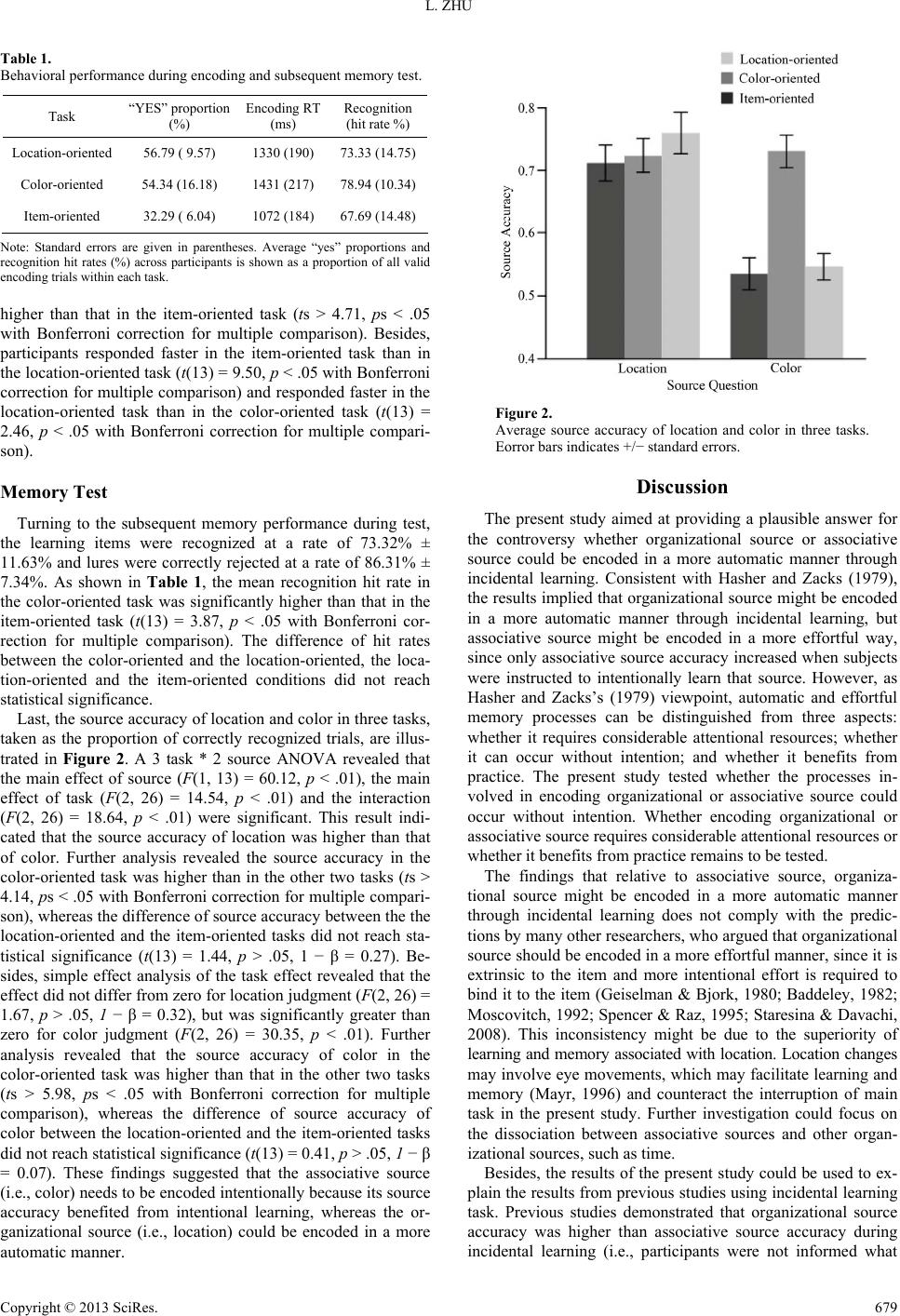 L. ZHU Table 1. Behavioral performance during encoding and subsequent memory test. Task “YES” proportion (%) Encoding RT (ms) Recognition (hit rate %) Location-oriented 56.79 ( 9.57) 1330 (190) 73.33 (14.75) Color-oriented 54.34 (16.18) 1431 (217) 78.94 (10.34) Item-oriented 32.29 ( 6.04) 1072 (184) 67.69 (14.48) Note: Standard errors are given in parentheses. Average “yes” proportions and recognition hit rates (%) across participants is shown as a proportion of all valid encoding trials within each task. higher than that in the item-oriented task (ts > 4.71, ps < .05 with Bonferroni correction for multiple comparison). Besides, participants responded faster in the item-oriented task than in the location-oriented task (t(13) = 9.50, p < .05 with Bonferroni correction for multiple comparison) and responded faster in the location-oriented task than in the color-oriented task (t(13) = 2.46, p < .05 with Bonferroni correction for multiple compari- son). Memory Test Turning to the subsequent memory performance during test, the learning items were recognized at a rate of 73.32% ± 11.63% and lures were correctly rejected at a rate of 86.31% ± 7.34%. As shown in Table 1, the mean recognition hit rate in the color-oriented task was significantly higher than that in the item-oriented task (t(13) = 3.87, p < .05 with Bonferroni cor- rection for multiple comparison). The difference of hit rates between the color-oriented and the location-oriented, the loca- tion-oriented and the item-oriented conditions did not reach statistical significance. Last, the source accuracy of location and color in three tasks, taken as the proportion of correctly recognized trials, are illus- trated in Figure 2. A 3 task * 2 source ANOVA revealed that the main effect of source (F(1, 13) = 60.12, p < .01), the main effect of task (F(2, 26) = 14.54, p < .01) and the interaction (F(2, 26) = 18.64, p < .01) were significant. This result indi- cated that the source accuracy of location was higher than that of color. Further analysis revealed the source accuracy in the color-oriented task was higher than in the other two tasks (ts > 4.14, ps < .05 with Bonferroni correction for multiple compari- son), whereas the difference of source accuracy between the the location-oriented and the item-oriented tasks did not reach sta- tistical significance (t(13) = 1.44, p > .05, 1 − β = 0.27). Be- sides, simple effect analysis of the task effect revealed that the effect did not differ from zero for location judgment (F(2, 26) = 1.67, p > .05, 1 − β = 0.32), but was significantly greater than zero for color judgment (F(2, 26) = 30.35, p < .01). Further analysis revealed that the source accuracy of color in the color-oriented task was higher than that in the other two tasks (ts > 5.98, ps < .05 with Bonferroni correction for multiple comparison), whereas the difference of source accuracy of color between the location-oriented and the item-oriented tasks did not reach statistical significance (t(13) = 0.41, p > .05, 1 − β = 0.07). These findings suggested that the associative source (i.e., color) needs to be encoded intentionally because its source accuracy benefited from intentional learning, whereas the or- ganizational source (i.e., location) could be encoded in a more automatic manner. Figure 2. Average source accuracy of location and color in three tasks. Eorror bars indicates +/− standard errors. Discussion The present study aimed at providing a plausible answer for the controversy whether organizational source or associative source could be encoded in a more automatic manner through incidental learning. Consistent with Hasher and Zacks (1979), the results implied that organizational source might be encoded in a more automatic manner through incidental learning, but associative source might be encoded in a more effortful way, since only associative source accuracy increased when subjects were instructed to intentionally learn that source. However, as Hasher and Zacks’s (1979) viewpoint, automatic and effortful memory processes can be distinguished from three aspects: whether it requires considerable attentional resources; whether it can occur without intention; and whether it benefits from practice. The present study tested whether the processes in- volved in encoding organizational or associative source could occur without intention. Whether encoding organizational or associative source requires considerable attentional resources or whether it benefits from practice remains to be tested. The findings that relative to associative source, organiza- tional source might be encoded in a more automatic manner through incidental learning does not comply with the predic- tions by many other researchers, who argued that organizational source should be encoded in a more effortful manner, since it is extrinsic to the item and more intentional effort is required to bind it to the item (Geiselman & Bjork, 1980; Baddeley, 1982; Moscovitch, 1992; Spencer & Raz, 1995; Staresina & Davachi, 2008). This inconsistency might be due to the superiority of learning and memory associated with location. Location changes may involve eye movements, which may facilitate learning and memory (Mayr, 1996) and counteract the interruption of main task in the present study. Further investigation could focus on the dissociation between associative sources and other organ- izational sources, such as time. Besides, the results of the present study could be used to ex- plain the results from previous studies using incidental learning task. Previous studies demonstrated that organizational source accuracy was higher than associative source accuracy during incidental learning (i.e., participants were not informed what Copyright © 2013 SciRes. 679 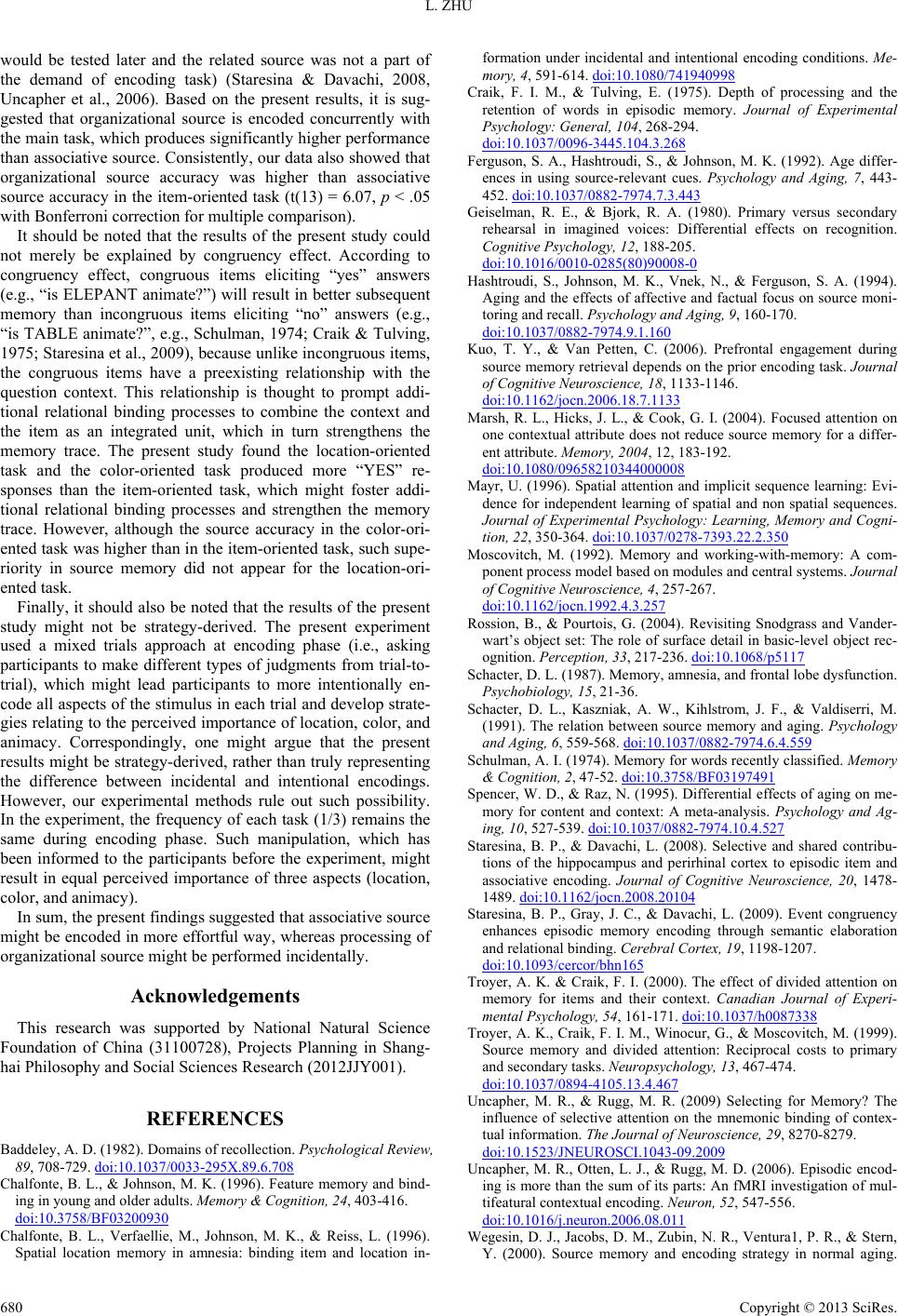 L. ZHU would be tested later and the related source was not a part of the demand of encoding task) (Staresina & Davachi, 2008, Uncapher et al., 2006). Based on the present results, it is sug- gested that organizational source is encoded concurrently with the main task, which produces significantly higher performance than associative source. Consistently, our data also showed that organizational source accuracy was higher than associative source accuracy in the item-oriented task (t(13) = 6.07, p < .05 with Bonferroni correction for multiple comparison). It should be noted that the results of the present study could not merely be explained by congruency effect. According to congruency effect, congruous items eliciting “yes” answers (e.g., “is ELEPANT animate?”) will result in better subsequent memory than incongruous items eliciting “no” answers (e.g., “is TABLE animate?”, e.g., Schulman, 1974; Craik & Tulving, 1975; Staresina et al., 2009), because unlike incongruous items, the congruous items have a preexisting relationship with the question context. This relationship is thought to prompt addi- tional relational binding processes to combine the context and the item as an integrated unit, which in turn strengthens the memory trace. The present study found the location-oriented task and the color-oriented task produced more “YES” re- sponses than the item-oriented task, which might foster addi- tional relational binding processes and strengthen the memory trace. However, although the source accuracy in the color-ori- ented task was higher than in the item-oriented task, such supe- riority in source memory did not appear for the location-ori- ented task. Finally, it should also be noted that the results of the present study might not be strategy-derived. The present experiment used a mixed trials approach at encoding phase (i.e., asking participants to make different types of judgments from trial-to- trial), which might lead participants to more intentionally en- code all aspects of the stimulus in each trial and develop strate- gies relating to the perceived importance of location, color, and animacy. Correspondingly, one might argue that the present results might be strategy-derived, rather than truly representing the difference between incidental and intentional encodings. However, our experimental methods rule out such possibility. In the experiment, the frequency of each task (1/3) remains the same during encoding phase. Such manipulation, which has been informed to the participants before the experiment, might result in equal perceived importance of three aspects (location, color, and animacy). In sum, the present findings suggested that associative source might be encoded in more effortful way, whereas processing of organizational source might be performed incidentally. Acknowledgements This research was supported by National Natural Science Foundation of China (31100728), Projects Planning in Shang- hai Philosophy and Social Sciences Research (2012JJY001). REFERENCES Baddeley, A. D. (1982). Domains of recollection. Psychological Review, 89, 708-729. doi:10.1037/0033-295X.89.6.708 Chalfonte, B. L., & Johnson, M. K. (1996). Feature memory and bind- ing in young and older adults. Memory & Cognition, 24, 403-416. doi:10.3758/BF03200930 Chalfonte, B. L., Verfaellie, M., Johnson, M. K., & Reiss, L. (1996). Spatial location memory in amnesia: binding item and location in- formation under incidental and intentional encoding conditions. Me- mory, 4, 591-614. doi:10.1080/741940998 Craik, F. I. M., & Tulving, E. (1975). Depth of processing and the retention of words in episodic memory. Journal of Experimental Psychology: General, 104, 268-294. doi:10.1037/0096-3445.104.3.268 Ferguson, S. A., Hashtroudi, S., & Johnson, M. K. (1992). Age differ- ences in using source-relevant cues. Psychology and Aging, 7, 443- 452. doi:10.1037/0882-7974.7.3.443 Geiselman, R. E., & Bjork, R. A. (1980). Primary versus secondary rehearsal in imagined voices: Differential effects on recognition. Cognitive Psychology, 12, 188-205. doi:10.1016/0010-0285(80)90008-0 Hashtroudi, S., Johnson, M. K., Vnek, N., & Ferguson, S. A. (1994). Aging and the effects of affective and factual focus on source moni- toring and recall. Psychology and Aging, 9, 160-170. doi:10.1037/0882-7974.9.1.160 Kuo, T. Y., & Van Petten, C. (2006). Prefrontal engagement during source memory retrieval depends on the prior encoding task. Journal of Cognitive Neuroscience, 18, 1133-1146. doi:10.1162/jocn.2006.18.7.1133 Marsh, R. L., Hicks, J. L., & Cook, G. I. (2004). Focused attention on one contextual attribute does not reduce source memory for a differ- ent attribute. Memory, 2004, 12, 183-192. doi:10.1080/09658210344000008 Mayr, U. (1996). Spatial attention and implicit sequence learning: Evi- dence for independent learning of spatial and non spatial sequences. Journal of Experimental Psychology: Learning, Memory and Cogni- tion, 22, 350-364. doi:10.1037/0278-7393.22.2.350 Moscovitch, M. (1992). Memory and working-with-memory: A com- ponent process model based on modules and central systems. Journal of Cognitive Neuroscience, 4, 257-267. doi:10.1162/jocn.1992.4.3.257 Rossion, B., & Pourtois, G. (2004). Revisiting Snodgrass and Vander- wart’s object set: The role of surface detail in basic-level object rec- ognition. Perception, 33 , 217-236. doi:10.1068/p5117 Schacter, D. L. (1987). Memory, amnesia, and frontal lobe dysfunction. Psychobiology, 15, 21-36. Schacter, D. L., Kaszniak, A. W., Kihlstrom, J. F., & Valdiserri, M. (1991). The relation between source memory and aging. Psychology and Aging, 6, 559-568. doi:10.1037/0882-7974.6.4.559 Schulman, A. I. (1974). Memory for words recently classified. Memory & Cognition, 2, 47-52. doi:10.3758/BF03197491 Spencer, W. D., & Raz, N. (1995). Differential effects of aging on me- mory for content and context: A meta-analysis. Psychology and Ag- ing, 10, 527-539. doi:10.1037/0882-7974.10.4.527 Staresina, B. P., & Davachi, L. (2008). Selective and shared contribu- tions of the hippocampus and perirhinal cortex to episodic item and associative encoding. Journal of Cognitive Neuroscience, 20, 1478- 1489. doi:10.1162/jocn.2008.20104 Staresina, B. P., Gray, J. C., & Davachi, L. (2009). Event congruency enhances episodic memory encoding through semantic elaboration and relational binding. Cer e br a l C o r tex, 19, 1198-1207. doi:10.1093/cercor/bhn165 Troyer, A. K. & Craik, F. I. (2000). The effect of divided attention on memory for items and their context. Canadian Journal of Experi- mental Psychology, 54, 161-171. doi:10.1037/h0087338 Troyer, A. K., Craik, F. I. M., Winocur, G., & Moscovitch, M. (1999). Source memory and divided attention: Reciprocal costs to primary and secondary tasks. Neuropsychology, 13, 467-474. doi:10.1037/0894-4105.13.4.467 Uncapher, M. R., & Rugg, M. R. (2009) Selecting for Memory? The influence of selective attention on the mnemonic binding of contex- tual information. The Journal of Neuroscience, 29, 8270-8279. doi:10.1523/JNEUROSCI.1043-09.2009 Uncapher, M. R., Otten, L. J., & Rugg, M. D. (2006). Episodic encod- ing is more than the sum of its parts: An fMRI investigation of mul- tifeatural contextual encoding. Neuron, 52, 547-556. doi:10.1016/j.neuron.2006.08.011 Wegesin, D. J., Jacobs, D. M., Zubin, N. R., Ventura1, P. R., & Stern, Y. (2000). Source memory and encoding strategy in normal aging. Copyright © 2013 SciRes. 680  L. ZHU Copyright © 2013 SciRes. 681 Journal of Clinical and Experim ent al N eu ro ps ych ology, 22, 455-464. doi:10.1076/1380-3395(200008)22:4;1-0;FT455 Zhu, L., Guo, X., Zheng, L., Li, J., Pei, M., Dienes, Z., & Yang, Z. (2010). Graded contribution of hippocampus to multifeature binding across temporal delay. Neuroreport, 21, 902-906. doi:10.1097/WNR.0b013e32833dddb4 |