

Paper Menu >>
Journal Menu >>
 World Journal of Cardiovascular Diseases, 2013, 3, 17-20 WJCD http://dx.doi.org/10.4236/wjcd.2013.35A003 Published Online August 2013 (http://www.scirp.org/journal/wjcd/) The rationale for pre-race aspirin to protect susceptible runners from sudden cardiac death during marathons: Deconstructing the Pheidippides conundrum Arthur J. Siegel Internal Medicine, McLean Hospital, Belmont, USA Email: [email protected] Received 22 May 2013; revised 27 June 2013; accepted 13 July 2013 Copyright © 2013 Arthur J. Siegel. This is an open access article distributed under the Creative Commons Attribution License, which permits unrestricted use, distribution, and reproduction in any medium, provided the original work is properly cited. ABSTRACT Objectives: While endurance exercise such as train- ing for marathons is cardioprotective, cardiac arrests and sudden death occur in previously healthy runners during races predominantly in middle-aged males due to atherosclerotic heart disease. Recent evidence related to this problem is reviewed herein including epidemiologic studies and findings related to acute cardiac risk in asymptomatic middle-aged male run- ners during races. Method: Literature review related to the above. Findings: The risks of cardiac arrest and sudden death were 1 in 57,002 and 1 in 171,005 respec- tively in runners with a mean age of 49.7 years among 1,710,052 participants in marathons in the United States since 1980. Atherosclerotic heart disease was the cause of death in over 90% of cases in two retro- spective studies and a greater than two-fold increase in cardiac arrests was observed in middle-aged men in the latter half of a 10-year prospective registry be- ginning in the year 2000. Asymptomatic middle-aged male runners sho wed elevated bioma rkers of inflamma- tion such as interleukin-6, C-reactive protein together with procoagulant effects including in vivo platelet ac- tivation, indicating susceptibility to atherothrombosis. Conclusions: Antithrombotic prophylaxis is evidence- based by validated clinical paradigms to prevent car- diac arrest and sudden death in susceptibile mara- thon runners at high risk for atherothrombosis dur- ing races. Keywords: Marathon Running; Cardiac Arrest; Acute Myocardial In f a rct i on; At herothrombosis; Aspiri n Prophylaxis 1. INTRODUCTION While endurance exercise such as marathon training is cardioprotective, an increased risk for sudden cardiac death during races has been demonstrated predominantly in middle-aged male participants. The conundrum of how runners at low resting cardiovascular risk become vul- nerable to cardiac arrest during races is explored herein together with consideration of strategies for prevention. 2. MATERIAL AND METHODS Review of medical literature related to the epidemiology and pathogenesis of sudden cardiac death in marathon runners during marathon races. Rates of cardiac arrest and sudden death were 1 in 57,002 and 171,005, respec- tively, in runners with a mean age of 49.7 years among 1,710,052 participants in United States marathons since 1980. Atherosclerotic heart disease was the cause of death in over 90% of cases in those over age 40 in two retro- spective studies. A greater than two-fold increase in car- diac arrests events was observed in middle-aged males in the latter half of a 10-year prospective registry ending in the year 2010. Regarding pathogenesis, neutrophilia and elevated biomarkers of inflammation including interleu- kin-6 and C-reactive protein occurred in asymptomatic middle-aged males during races as a likely consequence of exertional rhabdomyolysis. Inflammation was accom- panied by a hemostatic imbalance with procoagulant ef- fects including elevated fibrinogen, D-dimer and in vivo activation of platelets, conferring a transient risk for atherothrombosis. 3. DISCUSSION Because of concerns generated by the legacy of Pheidi- ppides’ sudden cardiac death in 490 B.C. (Figure 1), the first of many studies on Boston marathon runners in 1899 postulated an adverse effect of skeletal muscle injury on the heart [1]. Epidemiological evidence regar- ding such events during races in the modern era has re- OPEN ACCESS 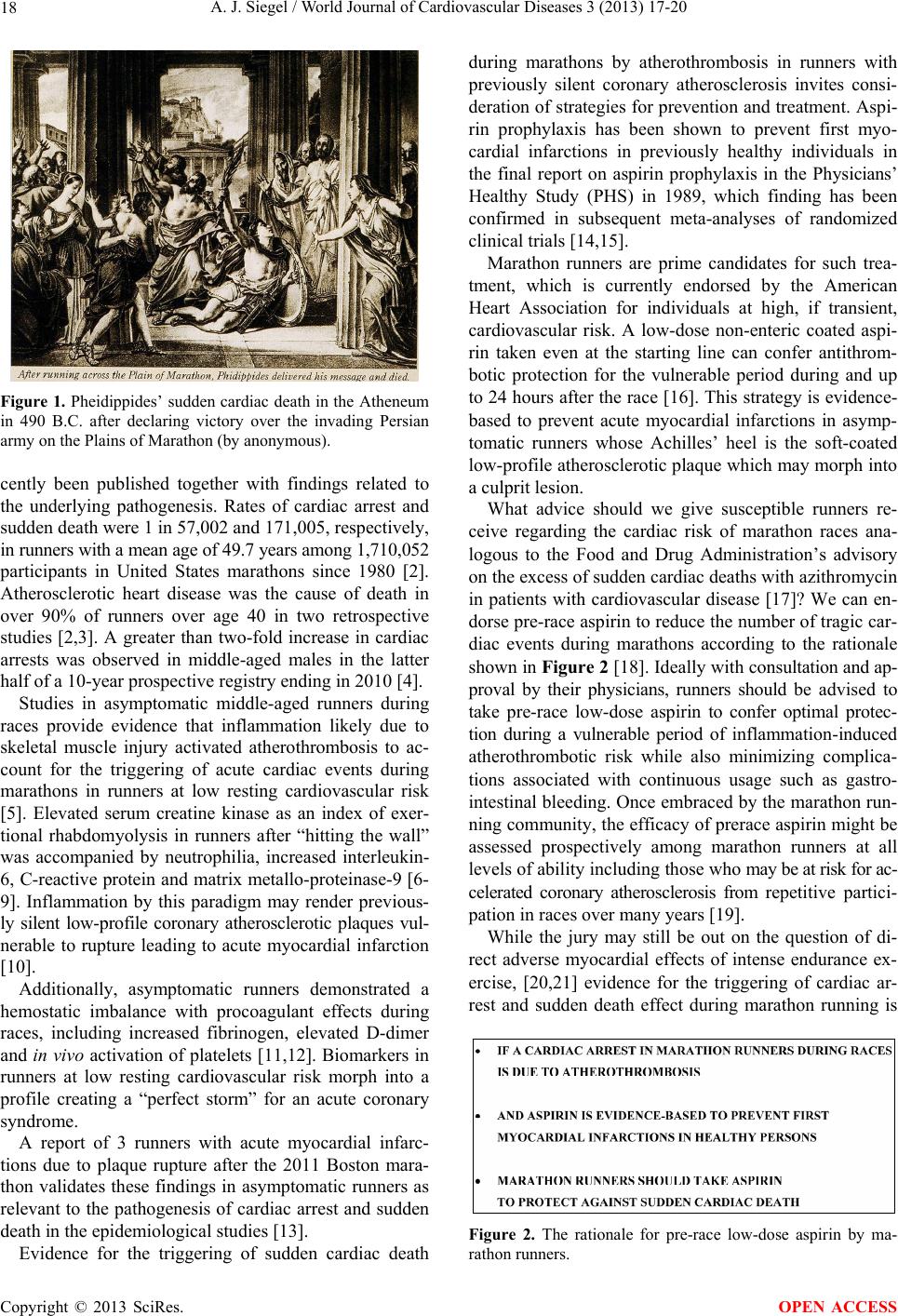 A. J. Siegel / World Journal of Cardiovascular Diseases 3 (2013) 17-20 18 Figure 1. Pheidippides’ sudden cardiac death in the Atheneum in 490 B.C. after declaring victory over the invading Persian army on the Plains of Marathon (by anonymous). cently been published together with findings related to the underlying pathogenesis. Rates of cardiac arrest and sudden death were 1 in 57 ,002 an d 171 ,0 05 , resp ectively, in runners with a mean age of 49.7 years among 1,710,052 participants in United States marathons since 1980 [2]. Atherosclerotic heart disease was the cause of death in over 90% of runners over age 40 in two retrospective studies [2,3]. A greater than two-fold increase in cardiac arrests was observed in middle-aged males in the latter half of a 10-yea r pr ospective registry en di n g in 20 1 0 [4] . Studies in asymptomatic middle-aged runners during races provide evidence that inflammation likely due to skeletal muscle injury activated atherothrombosis to ac- count for the triggering of acute cardiac events during marathons in runners at low resting cardiovascular risk [5]. Elevated serum creatine kinase as an index of exer- tional rhabdomyolysis in runners after “hitting the wall” was accompanied by neutrophilia, increased interleukin- 6, C-reactive protein and matrix metallo-protein ase-9 [6- 9]. Inflammation by this paradigm may render previous- ly silent low-profile coronary atherosclerotic plaques vul- nerable to rupture leading to acute myocardial infarction [10]. Additionally, asymptomatic runners demonstrated a hemostatic imbalance with procoagulant effects during races, including increased fibrinogen, elevated D-dimer and in vivo activation of platelets [11,12]. Biomarkers in runners at low resting cardiovascular risk morph into a profile creating a “perfect storm” for an acute coronary syndrome. A report of 3 runners with acute myocardial infarc- tions due to plaque rupture after the 2011 Boston mara- thon validates these findings in asymptomatic runners as relevant to the pathogenesis of cardiac arrest and sudden death in the epidemiological studies [13]. Evidence for the triggering of sudden cardiac death during marathons by atherothrombosis in runners with previously silent coronary atherosclerosis invites consi- deration of strategies for prevention and treatment. Aspi- rin prophylaxis has been shown to prevent first myo- cardial infarctions in previously healthy individuals in the final report on aspirin prophylaxis in the Physicians’ Healthy Study (PHS) in 1989, which finding has been confirmed in subsequent meta-analyses of randomized clinical trials [14,15]. Marathon runners are prime candidates for such trea- tment, which is currently endorsed by the American Heart Association for individuals at high, if transient, cardiovascular risk. A low-dose non-enteric coated aspi- rin taken even at the starting line can confer antithrom- botic protection for the vulnerable period during and up to 24 hours after the race [16]. This strategy is evidence- based to prevent acute myocardial infarctions in asymp- tomatic runners whose Achilles’ heel is the soft-coated low-profile atherosclerotic plaque which may morph into a culprit lesion. What advice should we give susceptible runners re- ceive regarding the cardiac risk of marathon races ana- logous to the Food and Drug Administration’s advisory on the excess of sudden cardiac deaths with azithromycin in patients with cardiovascular disease [17]? We can en- dorse pre-race aspirin to reduce the number of tragic car- diac events during marathons according to the rationale shown in Figure 2 [18]. Id ea lly wi th consultation and ap- proval by their physicians, runners should be advised to take pre-race low-dose aspirin to confer optimal protec- tion during a vulnerable period of inflammation-induced atherothrombotic risk while also minimizing complica- tions associated with continuous usage such as gastro- intestinal bleeding. Once embraced by the marathon run- ning community, the efficacy of prerace aspirin might be assessed prospectively among marathon runners at all levels of ability including those who may be at risk for ac- celerated coronary atherosclerosis from repetitive partici- pation in races over many years [19]. While the jury may still be out on the question of di- rect adverse myocardial effects of intense endurance ex- ercise, [20,21] evidence for the triggering of cardiac ar- rest and sudden death effect during marathon running is Figure 2. The rationale for pre-race low-dose aspirin by ma- rathon runners. Copyright © 2013 SciRes. OPEN ACCESS 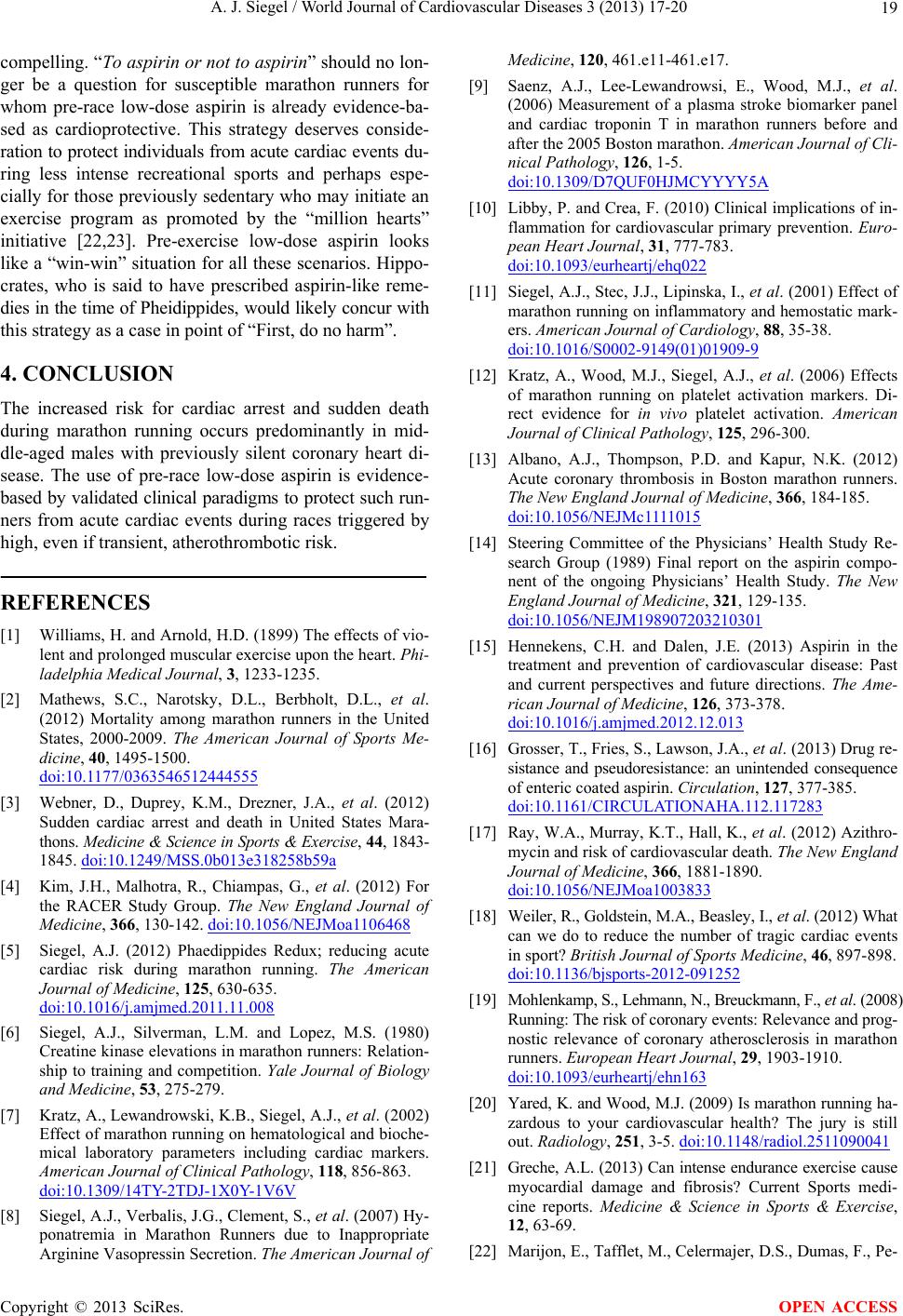 A. J. Siegel / World Journal of Cardiovascular Diseases 3 (2013) 17-20 19 compelling. “To aspirin or not to aspirin” should no lon- ger be a question for susceptible marathon runners for whom pre-race low-dose aspirin is already evidence-ba- sed as cardioprotective. This strategy deserves conside- ration to protect individuals from acute cardiac events du- ring less intense recreational sports and perhaps espe- cially for those previously seden tary who may initiate an exercise program as promoted by the “million hearts” initiative [22,23]. Pre-exercise low-dose aspirin looks like a “win-win” situation for all these scenarios. Hippo- crates, who is said to have prescribed aspirin-like reme- dies in the time of Pheidippides, would likely concur with this strategy as a case in point of “First, do no harm”. 4. CONCLUSION The increased risk for cardiac arrest and sudden death during marathon running occurs predominantly in mid- dle-aged males with previously silent coronary heart di- sease. The use of pre-race low-dose aspirin is evidence- based by validated clinical paradigms to protect such run- ners from acute cardiac events during races triggered by high, even if transient, atherothrombotic risk. REFERENCES [1] Williams, H. and Arnold, H.D. (1899) The effects of vio- lent and prolonged muscular exercise upon the heart. Phi- ladelphia Medical Journal, 3, 1233-1235. [2] Mathews, S.C., Narotsky, D.L., Berbholt, D.L., et al. (2012) Mortality among marathon runners in the United States, 2000-2009. The American Journal of Sports Me- dicine, 40, 1495-1500. doi:10.1177/0363546512444555 [3] Webner, D., Duprey, K.M., Drezner, J.A., et al. (2012) Sudden cardiac arrest and death in United States Mara- thons. Medicine & Science in Sports & Exercise, 44, 1843- 1845. doi:10.1249/MSS.0b013e318258b59a [4] Kim, J.H., Malhotra, R., Chiampas, G., et al. (2012) For the RACER Study Group. The New England Journal of Medicine, 366, 130-142. doi:10.1056/NEJMoa1106468 [5] Siegel, A.J. (2012) Phaedippides Redux; reducing acute cardiac risk during marathon running. The American Journal of Medicine, 125, 630-635. doi:10.1016/j.amjmed.2011.11.008 [6] Siegel, A.J., Silverman, L.M. and Lopez, M.S. (1980) Creatine kinase elevations in marathon runners: Relation- ship to training and competition. Yale Journal of Biology and Medicine, 53, 275-279. [7] Kratz, A., Lewandrowski, K.B., Siegel, A.J., et al. (2002) Effect of marathon running on hematological and bioche- mical laboratory parameters including cardiac markers. American Journal of Clinical Pathology, 118, 856-863. doi:10.1309/14TY-2TDJ-1X0Y-1V6V [8] Siegel, A.J., Verbalis, J.G., Clement, S., et al. (2007) Hy- ponatremia in Marathon Runners due to Inappropriate Arginine Vasopressin Secretion. The American Journal of Medicine, 120, 461.e11-461.e17. [9] Saenz, A.J., Lee-Lewandrowsi, E., Wood, M.J., et al. (2006) Measurement of a plasma stroke biomarker panel and cardiac troponin T in marathon runners before and after the 2005 Boston marathon. American Journal of Cli- nical Pathology, 126, 1-5. doi:10.1309/D7QUF0HJMCYYYY5A [10] Libby, P. and Crea, F. (2010) Clinical implications of in- flammation for cardiovascular primary prevention. Euro- pean Heart Journal, 31, 777-783. doi:10.1093/eurheartj/ehq022 [11] Siegel, A.J., St ec, J.J., Lipinska, I., et al . (2001) Effect of marathon running on inflammatory and hemostatic mark- ers. American Journal of Cardiology, 88, 35-38. doi:10.1016/S0002-9149(01)01909-9 [12] Kratz, A., Wood, M.J., Siegel, A.J., et al. (2006) Effects of marathon running on platelet activation markers. Di- rect evidence for in vivo platelet activation. American Journal of Clinical Pathology, 125, 296-300. [13] Albano, A.J., Thompson, P.D. and Kapur, N.K. (2012) Acute coronary thrombosis in Boston marathon runners. The New England Journal of Medicine, 366, 184-185. doi:10.1056/NEJMc1111015 [14] Steering Committee of the Physicians’ Health Study Re- search Group (1989) Final report on the aspirin compo- nent of the ongoing Physicians’ Health Study. The New England Journal of Medicine, 321, 129-135. doi:10.1056/NEJM198907203210301 [15] Hennekens, C.H. and Dalen, J.E. (2013) Aspirin in the treatment and prevention of cardiovascular disease: Past and current perspectives and future directions. The Ame- rican Journal of Medicine, 126, 373-378. doi:10.1016/j.amjmed.2012.12.013 [16] Grosser, T., Fries, S., Lawson, J.A., et al. (2013) Drug re- sistance and pseudoresistance: an unintended consequence of enteric coated aspirin. Circulation, 127, 377-385. doi:10.1161/CIRCULATIONAHA.112.117283 [17] Ray, W.A., Murray , K.T., Hall, K., et al. (2012) Azithro- mycin and risk of cardiovascular death. The New England Journal of Medicine, 366, 1881-1890. doi:10.1056/NEJMoa1003833 [18] Weiler, R., Goldstein, M.A., Beasley, I., et al. (2012) What can we do to reduce the number of tragic cardiac events in sport? British Journal of Sports Medicine, 46, 89 7 - 89 8 . doi:10.1136/bjsports-2012-091252 [19] Mohlenkamp, S., Lehmann, N., Breuckmann, F., et al. (2008) Running: The risk of coronary events: Relevance and prog- nostic relevance of coronary atherosclerosis in marathon runners. European Heart Journal, 29, 1903-1910. doi:10.1093/eurheartj/ehn163 [20] Yared, K. and Wood, M.J. (2009) Is marathon running ha- zardous to your cardiovascular health? The jury is still out. Radiology, 251, 3-5. doi:10.1148/radiol.2511090041 [21] Greche, A.L. (2013) Can intense endurance exercise cause myocardial damage and fibrosis? Current Sports medi- cine reports. Medicine & Science in Sports & Exercise, 12, 63-69. [22] Marijon, E., Tafflet, M., Celermajer, D.S., Dumas, F., Pe- Copyright © 2013 SciRes. OPEN ACCESS  A. J. Siegel / World Journal of Cardiovascular Diseases 3 (2013) 17-20 Copyright © 2013 SciRes. 20 OPEN ACCESS rier, M.C., Mustafic, H., Toussaint, J.F., De snos, M., Fieu, M., Benameur, N., LeHeuzey, J.Y., Empana, J.P. and Jou- ven, X. (2011) Sports-related sudden death in the general population. Circulation, 124, 672-681. doi:10.1161/CIRCULATIONAHA.110.008979 [23] Frieden, T.R. and Berwick, D.M. (2011) The “Million Hearts” initiative—Preventing heart attacks and strokes. The New England Journal of Medicine, 365, e27. doi:10.1056/NEJMp1110421 |