

Paper Menu >>
Journal Menu >>
 Open Journal of Gastroenterology, 2013, 3, 249-251 OJGas doi:10.4236/ojgas.2013.34042 Published Online August 2013 (http://www.scirp.org/journal/ojgas/) Gallbladder carcinoma associated with anomalous union of pancreatobiliary ductal system* Sun Young Yi Division of Gastroenterology, Internal Medicine, School of Medicine, Ewha Womans University, Seoul, South Korea Email: [email protected] Received 11 June 2013; revised 16 July 2013; accepted 28 July 2013 Copyright © 2013 Sun Young Yi. This is an open access article distributed under the Creative Commons Attribution License, which permits unrestricted use, distribution, and reproduction in any medium, provided the original work is properly cited. ABSTRACT A 64-year-old woman was admitted with mild right upper quadrant abdominal pain. Her physical ex- amination revealed a moderately nourished female with normal vital sign and no evidence of jaundice or anemia. Preoperative diagnosis was choledochal cyst with anomalous union of pancreaticobiliary duct (AUPBD), long Y-shaped type and gallbladder (GB) cancer. An extended cholecystectomy, excision of the common bile duct and biliary diversion via Roux-en Y hepaticojejunostomy was performed. The gallblad- der cancer showed invasion to perimuscular connec- tive tissue and no extension beyond serosa. Twelve months after curative resection, the patient had no evidence of tumor recurrence. Keywords: Choledochal Cyst; Gallbladder Cancer 1. INTRODUCTION In anomalous union of pancreaticobiliary duct (AUPBD), the common chann el is abnormally long and the connec- tion between the common bile duct and pancreatic duct is outside of the duodenal wall [1]. Th is congen ital d isord er is frequently associated with choledochal cystst [1]. More- over, AUPBD is prone to have benign as well as malign- nant complications including carcinoma of biliary tract [2]. I describe here a case of a choledochal cyst com- bined with Y-shaped AUPBD that was detected in a pa- tient in her sixties as a primary cancer of the gallbladder. 2. CASE REPORT A 64-year-old woman was admitted with mild right up- per quadrant abdominal pain. On abdominal physical examination, no palpable mass or tenderness was noted. Laboratory results revealed an elevated serum aspartate aminotransferase of 472 IU/L, alanine aminotransferase of 240 IU/L, alkaline phosphatase of 677 IU/L and total bilirubin of 4.0 mg%. Serum carcinoembryonic antigen (CEA) was within normal limits and serum carbohydrate antigen 19-9 (CA19-9) level was slightly elevated (61.3 IU/L). Endoscopic ultrasound and abdominal computed tomography showed moderate dilated gallbladder with huge mass (38 mm) and marked dilated common bile duct (CBD) and abruptly narrowed far distal CBD (Fig- ures 1 and 2). Endoscopic retrograde cholangiopancrea- tography (ERCP) and magnetic resonance cholangiopan- creatogram (MRCP) revealed choledochal cyst with ano- malous union of pancreatobiliary system (Figures 3 and 4). This patient presented with gallbladder mass and choledochal cyst associated with AUPBD, lon g Y-shaped type. An extended cholecystectomy, excision of the com- mon bile duct and biliary d iversion via Roux-en Y heap- ticojejunostomy was performed. On pathologic evalua- tion, the CBD was markedly dilated, measuring 3 cm in inner circumferences and 6 cm in length, and choledo- chal cyst type IA was revealed. Microscopic examination revealed papillay carcinoma of gallbladder, moderately differentiated and invades peri muscluar connective tissue without extensio n beyond (Figure 5). The patient’s post- operative course was eventful, and she has had no clini- cal symptoms. Twelve months after curative resection, the patient had no evidence of tumor recurrence. 3. DISCUSSION AUPBD is a congenital malformation of the pancreato- biliary tree in which the confluence of the common bile duct and pancreatic duct is outside the duodenal wall. The mode of anomalous union is classified into two types: the pancreatico-choledochal (P-C) type, in which the main pancreatic duct enters the common bile duct, and the C-P type, where the CBD enters the main pan- creatic duct [1]. AUPBD has been regarded to be the etiologic factor of the choledochal cyst. However, chole- dochal cyst is not always associated with AUPBD. *No conflicts of interest exis t . Published Online August 2013 in SciRes. http://www.scirp.org/journal/ojgas 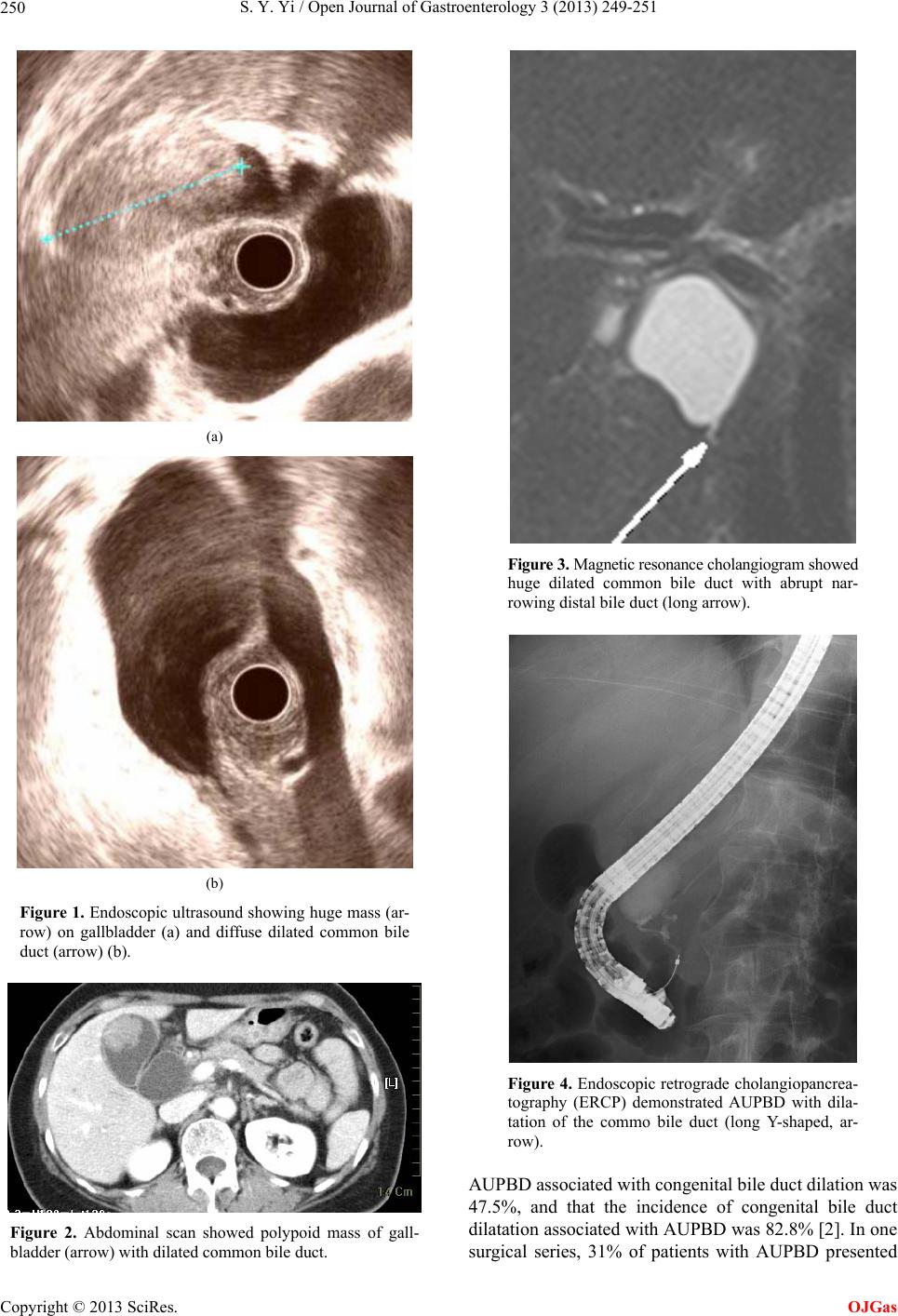 S. Y. Yi / Open Journal of Gastroenterology 3 (2013) 249-251 250 (a) (b) Figure 1. Endoscopic ultrasound showing huge mass (ar- row) on gallbladder (a) and diffuse dilated common bile duct (arrow) (b). Figure 2. Abdominal scan showed polypoid mass of gall- bladder (arrow) with dilated common bile duct. Figure 3. Magnetic reso nance cholangi ogram sho w ed huge dilated common bile duct with abrupt nar- rowing distal bile duct (long arrow). Figure 4. Endoscopic retrograde cholangiopancrea- tography (ERCP) demonstrated AUPBD with dila- tation of the commo bile duct (long Y-shaped, ar- row). AUPBD associated with congenital bile duct dilatio n was 47.5%, and that the incidence of congenital bile duct dilatation associated with AUPBD was 82.8% [2]. In one surgical series, 31% of patients with AUPBD presented Copyright © 2013 SciRes. OJGas 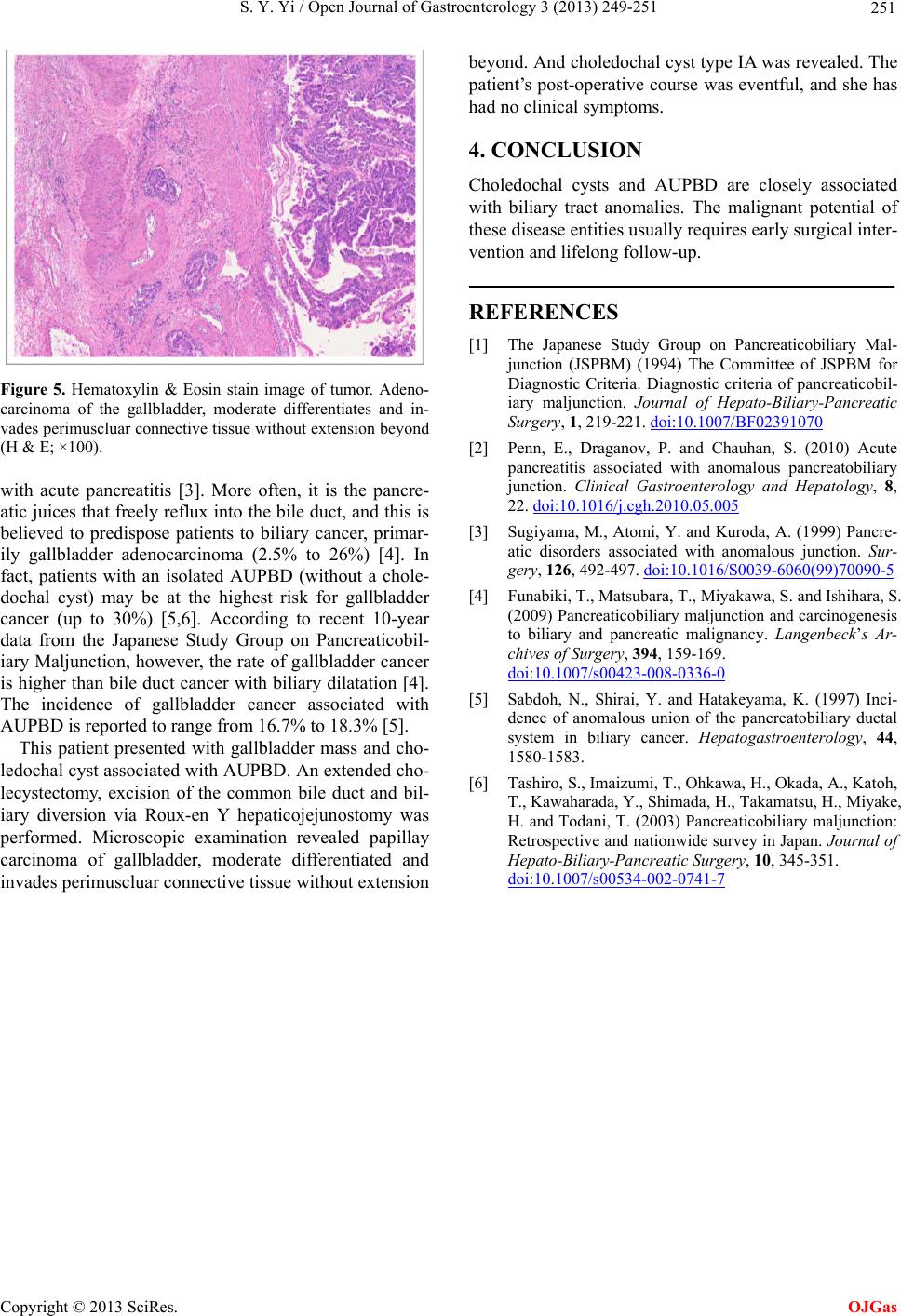 S. Y. Yi / Open Journal of Gastroenterology 3 (2013) 249-251 Copyright © 2013 SciRes. OJGas 251 Figure 5. Hematoxylin & Eosin stain image of tumor. Adeno- carcinoma of the gallbladder, moderate differentiates and in- vades perimuscluar connective tissue without extension beyond (H & E; ×100). with acute pancreatitis [3]. More often, it is the pancre- atic juices that freely reflux into the bile duct, and this is believed to predispose patients to biliary cancer, primar- ily gallbladder adenocarcinoma (2.5% to 26%) [4]. In fact, patients with an isolated AUPBD (without a chole- dochal cyst) may be at the highest risk for gallbladder cancer (up to 30%) [5,6]. According to recent 10-year data from the Japanese Study Group on Pancreaticobil- iary Maljunction, howeve r, the rate of gallbladder cancer is higher than bile duct can cer with biliary dilatation [4]. The incidence of gallbladder cancer associated with AUPBD is reported to range from 16.7% to 18.3% [5]. This patient presented with gallbladder mass and cho- ledochal cyst associated with AUPBD. An extended cho- lecystectomy, excision of the common bile duct and bil- iary diversion via Roux-en Y hepaticojejunostomy was performed. Microscopic examination revealed papillay carcinoma of gallbladder, moderate differentiated and invades perimuscluar connectiv e tissue without extension beyond. And choledochal cyst type IA was revealed. The patient’s post-operative course was eventful, and she has had no clinical symptoms. 4. CONCLUSION Choledochal cysts and AUPBD are closely associated with biliary tract anomalies. The malignant potential of these disease entities usually requ ires early surgical inter- vention and lifelong follow-up. REFERENCES [1] The Japanese Study Group on Pancreaticobiliary Mal- junction (JSPBM) (1994) The Committee of JSPBM for Diagnostic Criteria. Diagnostic criteria of pancreaticobil- iary maljunction. Journal of Hepato-Biliary-Pancreatic Surgery, 1, 219-221. doi:10.1007/BF02391070 [2] Penn, E., Draganov, P. and Chauhan, S. (2010) Acute pancreatitis associated with anomalous pancreatobiliary junction. Clinical Gastroenterology and Hepatology, 8, 22. doi:10.1016/j.cgh.2010.05.005 [3] Sugiyama, M., Atomi, Y. and Kuroda, A. (1999) Pancre- atic disorders associated with anomalous junction. Sur- gery, 126, 492-497. doi:10.1016/S0039-6060(99)70090-5 [4] Funabiki, T., Matsubara, T., Miyakawa, S. and Ishihara, S. (2009) Pancreaticobiliary maljunction and carcinogenesis to biliary and pancreatic malignancy. Langenbeck’s Ar- chives of Surgery, 394, 159-169. doi:10.1007/s00423-008-0336-0 [5] Sabdoh, N., Shirai, Y. and Hatakeyama, K. (1997) Inci- dence of anomalous union of the pancreatobiliary ductal system in biliary cancer. Hepatogastroenterology, 44, 1580-1583. [6] Tashiro, S., Imaizumi, T., Ohkawa, H., Okada, A., Katoh, T., Kawaharada, Y., Shimada, H., Takamatsu, H., Miyake, H. and Todani, T. (2003) Pancreaticobiliary maljunction: Retrospective and nationwide survey in Japan. Journal of Hepato-Biliary-Pancreatic Surgery, 10, 345-351. doi:10.1007/s00534-002-0741-7 |