

Paper Menu >>
Journal Menu >>
 Open Journal of Gastroenterology, 2013, 3, 237-240 OJGas doi:10.4236/ojgas.2013.34040 Published Online August 2013 (http://www.scirp.org/journal/ojgas/) Prevalence of hepatitis B infection and factors associated in children of Ivorian HBsAg carrier subjects Koffi Alain Attia1*, Ya Henriette Kissi1, Stanislas Doffou1, Demba Bangoura1, Roseline Flora Wilson1, Georges Bougha1, Fulgence Yao Bathaix1, Kouame Alassan Mahassadi1, Mohamed Sayegh2, Therese N’dri-Yoman1 1Department of General Medicine and Hepato-Gastroenterology, Teaching Hospital of Yopougon, Abidjan, Côte d’Ivoire 2Medical Private hospital of Danga, Cocody, Abidjan, Côte d’Ivoire Email: *[email protected] Received 13 May 2013; revised 16 June 2013; accepted 1 July 2013 Copyright © 2013 Koffi Alain Attia et al. This is an open access article distributed under the Creative Commons Attribution License, which permits unrestricted use, distribution, and reproduction in any medium, provided the original work is properly cited. ABSTRACT Aims of the Study: 1) Determine the Prevalence of Hepatitis B virus (HBV) infection in children (contact subjects) of chronic Hepatitis B surface antigen (HBsAg) carrier subjects (index subjects); 2) Search for factors associated with HBV infection in these children. Patients and Methods: Retrospective-cross- sectional study (January 5th, 2006 through December 31st, 2012). Studied parameters: biological and clini- cal characteristics of index subjects; Prevalence of HBsAg and Hepatitis B core antibody (HBcAb) in their children. Search for the HBV infection associa- ted factors in the children (univariate analyses through Chi-square or Fisher’s exact test; multivariate analy- sis through a backward logistic regression). Results: Our 44 subjects’ median age was 43.1 ± 7.49 years and 88.6% of them lived with a spouse. Average number of children per index subjects was 2.3 ± 1.1. Our 92 children’s median age was 9.3 ± 4.55 (ranging from 1 to 15 years), and 43 (44.8%) were vaccinated against HBV. HBV infection prevalence was 24% (23/96 of which, 4 were HBsAg positive and 19 HBcAb positive subjects without HBsAg). Independent fac- tors associated with HBV infection in children of in- dex subjects were HBV DNA for index subjects >2000 IU/ml (OR = 11.5; p = 0.001), existence of HBV in two parents (OR = 7.9; p = 0.03) and absence of HBV vaccination in the children (OR = 30.9; p = 0.003). Conclusion: Immunization coverage for children of index subjects was insufficient, especially before the introduction of HBV vaccine into the enlarged vacci- nation program. Outside vertical transmission, those children were more exposed to HBV intrafamilial transmission risk when they were not immunized against HBV, when both parents were infected and when HBV viremia in index subjects was higher than 2000 IU/ml. Keywords: Hepatitis B Infection; Intrafamilial Transmission; Screening 1. INTRODUCTION Hepatitis B virus (HBV) infection is a real public health problem worldwide and more particularly in high preva- lence areas, such as sub-Saharan Africa [1-7], because of its progressive complications (cirrhosis and hepatocellu- lar carcinoma), comorbidity frequency (especially HIV infection) and management difficulties in the particular context of our countries with limited financial resources. In sub-Saharan Africa, both main transmission ways are vertical or perinatal and intrafamilial horizontal in early childhood [5,7]. Introduction of HBV universal immuni- zation for newborns into enlarged vaccination programs (EVP) of our countries in Sub-Sahara dates generally from at least two decades. In most EVP of our countries, HBV immunization only starts from the 6th week after birth (pentavalent or hexavalent vaccine). Moreover, owing to anti-HBs immunoglobulins (Ig) availability problems in our countries, passive immunoprophylaxis is almost never associated with active immunization. Vertical and in- trafamilial horizontal transmission risks of HBV infec- tion remain a concern before HBV immunization, espe- cially during children’s first six weeks of life. This study aims to determine HBV infection prevalence among chil- dren (contact subjects) of hepatitis B surface antigen (HBsAg) chronic carrier subjects (index subjects) through familial screening of HBV infection and search for fac- tors associated with HBV infection in these children. *Corresponding author. Published Online August 2013 in SciRes. http://www.scirp.org/journal/ojgas 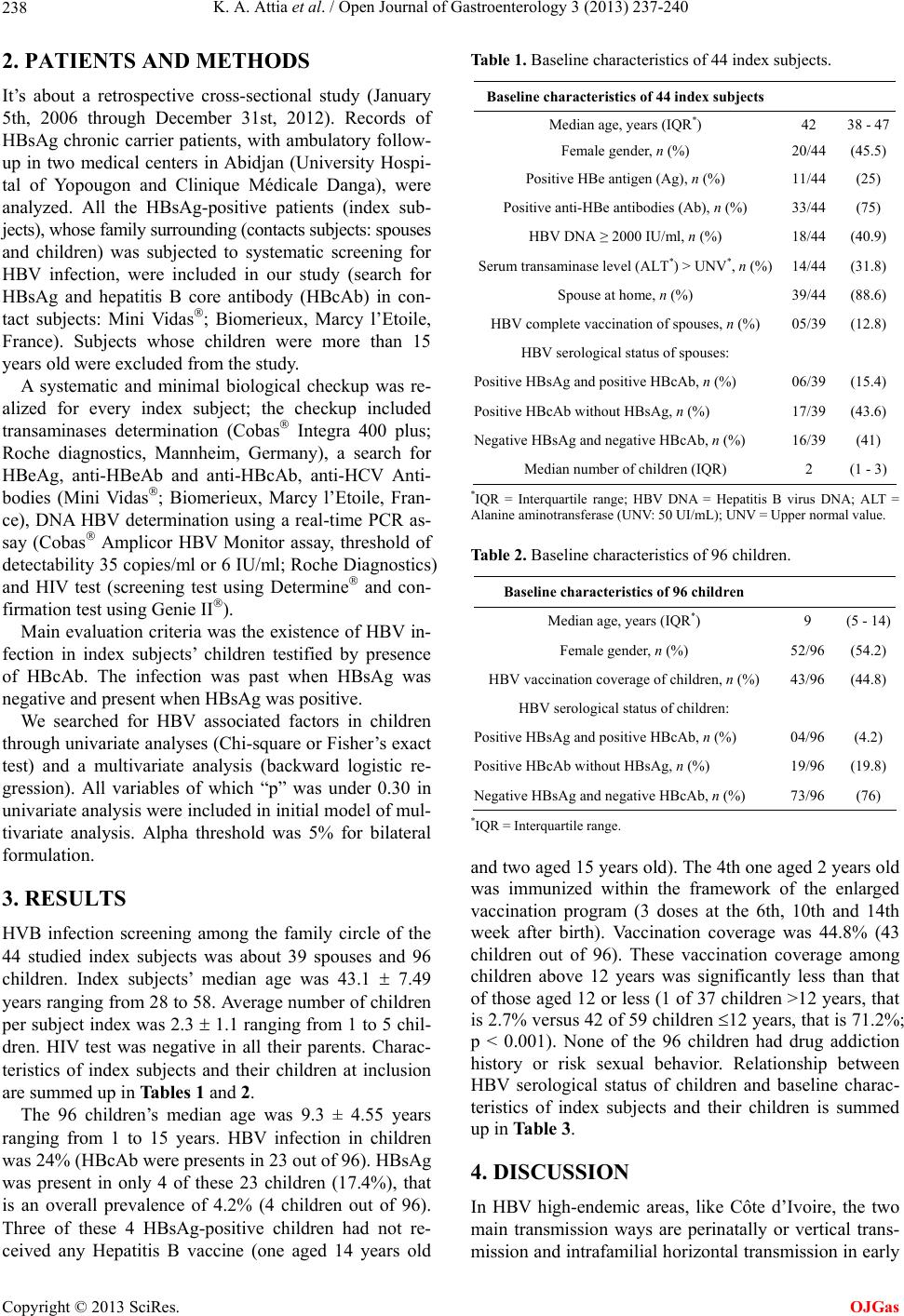 K. A. Attia et al. / Open Journal of Gastroenterology 3 (2013) 237-240 238 2. PATIENTS AND METHODS It’s about a retrospective cross-sectional study (January 5th, 2006 through December 31st, 2012). Records of HBsAg chronic carrier patients, with ambulatory follow- up in two medical centers in Abidjan (University Hospi- tal of Yopougon and Clinique Médicale Danga), were analyzed. All the HBsAg-positive patients (index sub- jects), whose family surrounding (contacts subjects: spouses and children) was subjected to systematic screening for HBV infection, were included in our study (search for HBsAg and hepatitis B core antibody (HBcAb) in con- tact subjects: Mini Vidas; Biomerieux, Marcy l’Etoile, France). Subjects whose children were more than 15 years old were excluded from the study. A systematic and minimal biological checkup was re- alized for every index subject; the checkup included transaminases determination (Cobas Integra 400 plus; Roche diagnostics, Mannheim, Germany), a search for HBeAg, anti-HBeAb and anti-HBcAb, anti-HCV Anti- bodies (Mini Vidas; Biomerieux, Marcy l’Etoile, Fran- ce), DNA HBV determination using a real-time PCR as- say (Cobas Amplicor HBV Monitor assay, threshold of detectability 35 copies/ml or 6 IU/ml; Roche Diagnostics) and HIV test (screening test using Determine and con- firmation test using Genie II). Main evaluation criteria was the existence of HBV in- fection in index subjects’ children testified by presence of HBcAb. The infection was past when HBsAg was negative and present when HBsAg was positive. We searched for HBV associated factors in children through univariate analyses (Chi-square or Fisher’s exact test) and a multivariate analysis (backward logistic re- gression). All variables of which “p” was under 0.30 in univariate analysis were included in initial model of mul- tivariate analysis. Alpha threshold was 5% for bilateral formulation. 3. RESULTS HVB infection screening among the family circle of the 44 studied index subjects was about 39 spouses and 96 children. Index subjects’ median age was 43.1 7.49 years ranging from 28 to 58. Average number of children per subject index was 2.3 1.1 ranging from 1 to 5 chil- dren. HIV test was negative in all their parents. Charac- teristics of index subjects and their children at inclusion are summed up in Tables 1 and 2. The 96 children’s median age was 9.3 ± 4.55 years ranging from 1 to 15 years. HBV infection in children was 24% (HBcAb were presents in 23 out of 96). HBsAg was present in only 4 of these 23 children (17.4%), that is an overall prevalence of 4.2% (4 children out of 96). Three of these 4 HBsAg-positive children had not re- ceived any Hepatitis B vaccine (one aged 14 years old Table 1. Baseline characteristics of 44 index subjects. Baseline characteristics of 44 in d ex su b jects Median age, years (IQR*) 42 38 - 47 Female gender, n (%) 20/44 (45.5) Positive HBe antigen (Ag), n (%) 11/44 (25) Positive anti-HBe antibodies (Ab), n (%) 33/44 (75) HBV DNA ≥ 2000 IU/ml, n (%) 18/44 (40.9) Serum transaminase level (ALT*) > UNV*, n (%) 14/44 (31.8) Spouse at home, n (%) 39/44 (88.6) HBV complete vaccination of spouses, n (%) 05/39 (12.8) HBV serological status of spouses: Positive HBsAg and positive HBcAb, n (%) 06/39 (15.4) Positive HBcAb without HBsAg, n (%) 17/39 (43.6) Negative HBsAg and negative HBcAb, n (%) 16/39 (41) Median number of children (IQR) 2 (1 - 3) *IQR = Interquartile range; HBV DNA = Hepatitis B virus DNA; ALT = Alanine aminotransferase (UNV: 50 UI/mL); UNV = Upper normal value. Table 2. Baseline characteristics of 96 children. Baseline characteristics of 96 children Median age, years (IQR*) 9 (5 - 14) Female gender, n (%) 52/96 (54.2) HBV vaccination coverage of children, n (%) 43/96 (44.8) HBV serological status of children: Positive HBsAg and positive HBcAb, n (%) 04/96 (4.2) Positive HBcAb without HBsAg, n (%) 19/96 (19.8) Negative HBsAg and negative HBcAb, n (%) 73/96 (76) *IQR = Interquartile range. and two aged 15 years old). The 4th one aged 2 years old was immunized within the framework of the enlarged vaccination program (3 doses at the 6th, 10th and 14th week after birth). Vaccination coverage was 44.8% (43 children out of 96). These vaccination coverage among children above 12 years was significantly less than that of those aged 12 or less (1 of 37 children >12 years, that is 2.7% versus 42 of 59 children 12 years, that is 71.2%; p < 0.001). None of the 96 children had drug addiction history or risk sexual behavior. Relationship between HBV serological status of children and baseline charac- teristics of index subjects and their children is summed up in Table 3. 4. DISCUSSION In HBV high-endemic areas, like Côte d’Ivoire, the two main transmission ways are perinatally or vertical trans- mission and intrafamilial hor zontal transmission in early i Copyright © 2013 SciRes. OJGas 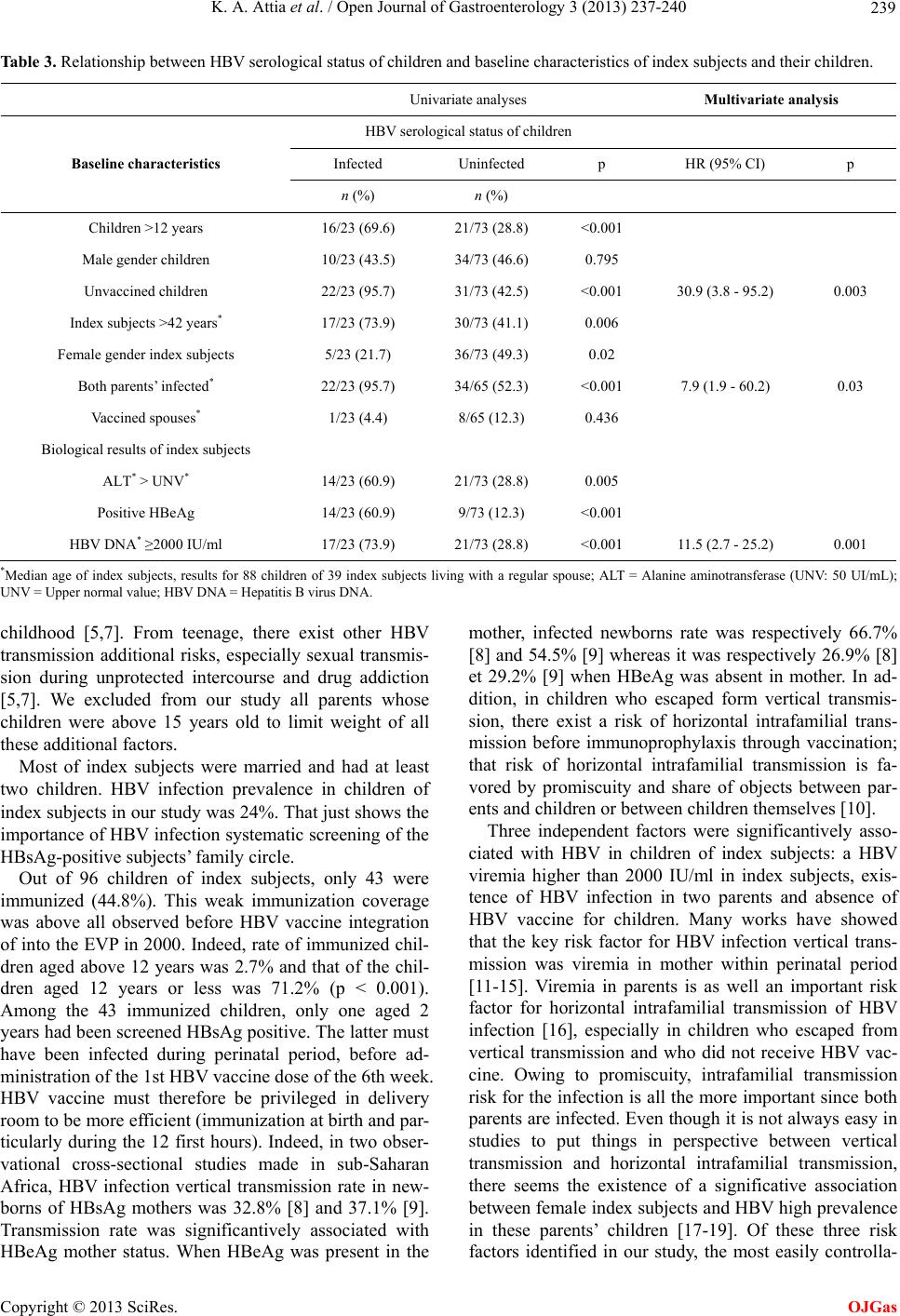 K. A. Attia et al. / Open Journal of Gastroenterology 3 (2013) 237-240 Copyright © 2013 SciRes. 239 OJGas Table 3. Relationship between HBV serological status of children and baseline characteristics of index subjects and their children. Univariate analyses Multivariate analysis HBV serological status of children Infected Uninfected p HR (95% CI) p Baseline characteristics n (%) n (%) Children >12 years 16/23 (69.6) 21/73 (28.8) <0.001 Male gender children 10/23 (43.5) 34/73 (46.6) 0.795 Unvaccined children 22/23 (95.7) 31/73 (42.5) <0.001 30.9 (3.8 - 95.2) 0.003 Index subjects >42 years* 17/23 (73.9) 30/73 (41.1) 0.006 Female gender index subjects 5/23 (21.7) 36/73 (49.3) 0.02 Both parents’ infected* 22/23 (95.7) 34/65 (52.3) <0.001 7.9 (1.9 - 60.2) 0.03 Vaccined spouses* 1/23 (4.4) 8/65 (12.3) 0.436 Biological results of index subjects ALT* > UNV* 14/23 (60.9) 21/73 (28.8) 0.005 Positive HBeAg 14/23 (60.9) 9/73 (12.3) <0.001 HBV DNA* ≥2000 IU/ml 17/23 (73.9) 21/73 (28.8) <0.001 11.5 (2.7 - 25.2) 0.001 *Median age of index subjects, results for 88 children of 39 index subjects living with a regular spouse; ALT = Alanine aminotransferase (UNV: 50 UI/mL); UNV = Upper normal value; HBV DNA = Hepatitis B virus DNA. childhood [5,7]. From teenage, there exist other HBV transmission additional risks, especially sexual transmis- sion during unprotected intercourse and drug addiction [5,7]. We excluded from our study all parents whose children were above 15 years old to limit weight of all these additional factors. Most of index subjects were married and had at least two children. HBV infection prevalence in children of index subjects in our study was 24%. That just shows the importance of HBV infection systematic screening of the HBsAg-positive subjects’ family circle. Out of 96 children of index subjects, only 43 were immunized (44.8%). This weak immunization coverage was above all observed before HBV vaccine integration of into the EVP in 2000. Indeed, rate of immunized chil- dren aged above 12 years was 2.7% and that of the chil- dren aged 12 years or less was 71.2% (p < 0.001). Among the 43 immunized children, only one aged 2 years had been screened HBsAg positive. The latter must have been infected during perinatal period, before ad- ministration of the 1st HBV vaccine dose of the 6th week. HBV vaccine must therefore be privileged in delivery room to be more efficient (immunization at birth and par- ticularly during the 12 first hours). Indeed, in two obser- vational cross-sectional studies made in sub-Saharan Africa, HBV infection vertical transmission rate in new- borns of HBsAg mothers was 32.8% [8] and 37.1% [9]. Transmission rate was significantively associated with HBeAg mother status. When HBeAg was present in the mother, infected newborns rate was respectively 66.7% [8] and 54.5% [9] whereas it was respectively 26.9% [8] et 29.2% [9] when HBeAg was absent in mother. In ad- dition, in children who escaped form vertical transmis- sion, there exist a risk of horizontal intrafamilial trans- mission before immunoprophylaxis through vaccination; that risk of horizontal intrafamilial transmission is fa- vored by promiscuity and share of objects between par- ents and children or between children themselves [10]. Three independent factors were significantively asso- ciated with HBV in children of index subjects: a HBV viremia higher than 2000 IU/ml in index subjects, exis- tence of HBV infection in two parents and absence of HBV vaccine for children. Many works have showed that the key risk factor for HBV infection vertical trans- mission was viremia in mother within perinatal period [11-15]. Viremia in parents is as well an important risk factor for horizontal intrafamilial transmission of HBV infection [16], especially in children who escaped from vertical transmission and who did not receive HBV vac- cine. Owing to promiscuity, intrafamilial transmission risk for the infection is all the more important since both parents are infected. Even though it is not always easy in studies to put things in perspective between vertical transmission and horizontal intrafamilial transmission, there seems the existence of a significative association between female index subjects and HBV high prevalence in these parents’ children [17-19]. Of these three risk factors identified in our study, the most easily controlla-  K. A. Attia et al. / Open Journal of Gastroenterology 3 (2013) 237-240 240 ble is HBV vaccine. Current vaccinal strategy must be modified on the one hand starting immunization from birth in all children whatever HBV status the mother has, on the other hand, prescribing a nucleosidic analogs from the 28th week to HBsAg-positive mothers who have strong HBV viremia. So, even if children are systemati- cally immunized at birth, searching for HBsAg in preg- nant women must be made compulsory and quantify HBV load in HBsAg-positive pregnant women in order to identify those to whom a treatment through nucleosi- dic analogs will be proposed for maximal reduction of HBV infection perinatal transmission. Acquired immu- nization through vaccination will allow to later prevent- ing children from other HBV transmission risks, espe- cially horizontal intrafamilial transmission. 5. CONCLUSION Immunization coverage for children of our index subjects was insufficient, especially before introduction of HBV vaccine into the EVP. Outside vertical transmission, those children were more exposed to HBV intrafamilial transmission when they were not immunized against HBV, when both parents were infected and when HBV viremia of index subjects was higher than 2000 IU/ml. Immunization coverage must therefore be improved, im- munization must be started at birth and nucleosidic ana- logs must be proposed to HBsAg-positive pregnant wo- men with strong viremia. REFERENCES [1] Wright, T.L. and Lau, J.Y.N. (1993) Clinical aspects of hepatitis B virus infection. Lancet, 342, 1340-1344. doi:10.1016/0140-6736(93)92250-W [2] Murray, C.J. and Lopez, A.D. (1997) Mortality by cause for eight regions of the world: Global burden of disease study. Lancet, 349, 1269-1276. doi:10.1016/S0140-6736(96)07493-4 [3] Lai, C.L., Ratziu, V., Yeun, M.F. and Poynard, T. (2003) Viral hepatitis B. Lancet, 362, 2089-2094. doi:10.1016/S0140-6736(03)15108-2 [4] Goldstein, S.T., Zhou, F., Hadler, S.C., et al. (2005) A mathematical model to estimate global hepatitis B disease burden and vaccination impact. International Journal of Epidemiology, 34, 1329-1339. doi:10.1093/ije/dyi206 [5] Hoffmann, C.J. and Thio, C.L. (2007) Clinical implica- tions of HIV and hepatitis B co-infection in Asia and Af- rica. Lancet Infectious Diseases, 7, 402-409. doi:10.1016/S1473-3099(07)70135-4 [6] Shi, Y.H. and Shi, C.H. (2009) Molecular characteristics and stages of chronic hepatitis B virus infection. World Journal of Gastroenterology, 15, 3099-3105. doi:10.3748/wjg.15.3099 [7] Hadziyannis, S.J. (2011) Natural history of chronic hepa- titis B in Euro-Mediterranean and African countries. Journal of Hepatology, 55, 183-191. doi:10.1016/j.jhep.2010.12.030 [8] Lohouès-Kouacou, M.J., Touré, M., Hillah. J., et al. (2009) Materno-fetal transmission of hepatitis B virus in Ivory Coast. Plea for mass vaccination. Sante, 8, 401-404. [9] Sangaré, L., Sombié, R., Combasséré, A.W., et al.(2009) Antenatal transmission of hepatitis B virus in an area of HIV moderate prevalence, Burkina Faso. Bulletin de la Société de Pathologie Exotique, 102, 226-229. [10] Martinson, F.E., Weigle, K.A., Royce, R.A., et al. (1998) Risk factors for horizontal transmission of hepatitis B vi- rus in a rural district in Ghana. American Journal of Epi- demiology, 147, 478-487. doi:10.1093/oxfordjournals.aje.a009474 [11] Candotti, D., Danso, K. and Allain, J.P. (2007) Ma- ternofetal transmission of hepatitis B virus genotype E in Ghana, west Africa. Journal of General Virology, 88, 2686-2695. doi:10.1099/vir.0.83102-0 [12] Wiseman, E., Fraser, M.A., Holden, S., et al. (2009) Peri- natal transmission of hepatitis B virus: An Australian ex- perience. Medical Journal of Australia, 190, 489-492. [13] Xu, W.M., Cui, Y.T., Wang, L., et al. (2009) Lamivudine in late pregnancy to prevent perinatal transmission of hepatitis B virus infection: A multicentre, randomized, double-blind, placebo-controlled study. Journal of Viral Hepatitis, 16, 94-103. doi:10.1111/j.1365-2893.2008.01056.x [14] Zou, H., Chen, Y., Duan, Z., et al. (2012) Virologic fac- tors associated with failure to passive-active immuno- prophylaxis in infants born to HBsAg-positive mothers. Journal of Viral Hepatitis, 19, 1365-2893. doi:10.1111/j.1365-2893.2011.01492.x [15] Pan, C.Q., Duan, Z.P., Bhamidimarri, K.R., et al. (2012) An algorithm for risk assessment and intervention of mother to child transmission of hepatitis B virus. Clinical Gastroenterology and Hepatology, 10, 452-459. doi:10.1016/j.cgh.2011.10.041 [16] Craxì, A., Tinè, F., Vinci, M., et al. (1991) Transmission of hepatitis B and hepatitis delta viruses in the households of chronic hepatitis B surface antigen carriers: A regres- sion analysis of indicators of risk. American Journal of Epidemiology, 134, 641-650. [17] Salkic, N.N., Zildzic, M., Muminhodzic, K., et al. (2007) Intrafamilial transmission of hepatitis B in Tuzla region of Bosnia and Herzegovina. European Journal of Gas- troenterology & Hepatology, 19, 113-118. doi:10.1097/MEG.0b013e32801290f7 [18] Salkic, N. N., Zerem, E., Zildzic, M., et al. (2009) Risk factors for intrafamilial spread of hepatitis B in north- eastern Bosnia and Herzegovina. Annals of Saudi Medi- cine, 29, 41-45. doi:10.4103/0256-4947.51821 [19] Barut, H.S., Günal, Ö., Göral, A. and Etikan, I. (2011) Prevalence of hepatitis B virus infection in children of HBsAg positive parents. Mikrobiyoloji Bülteni, 45, 359- 365. Copyright © 2013 SciRes. OJGas |