

Paper Menu >>
Journal Menu >>
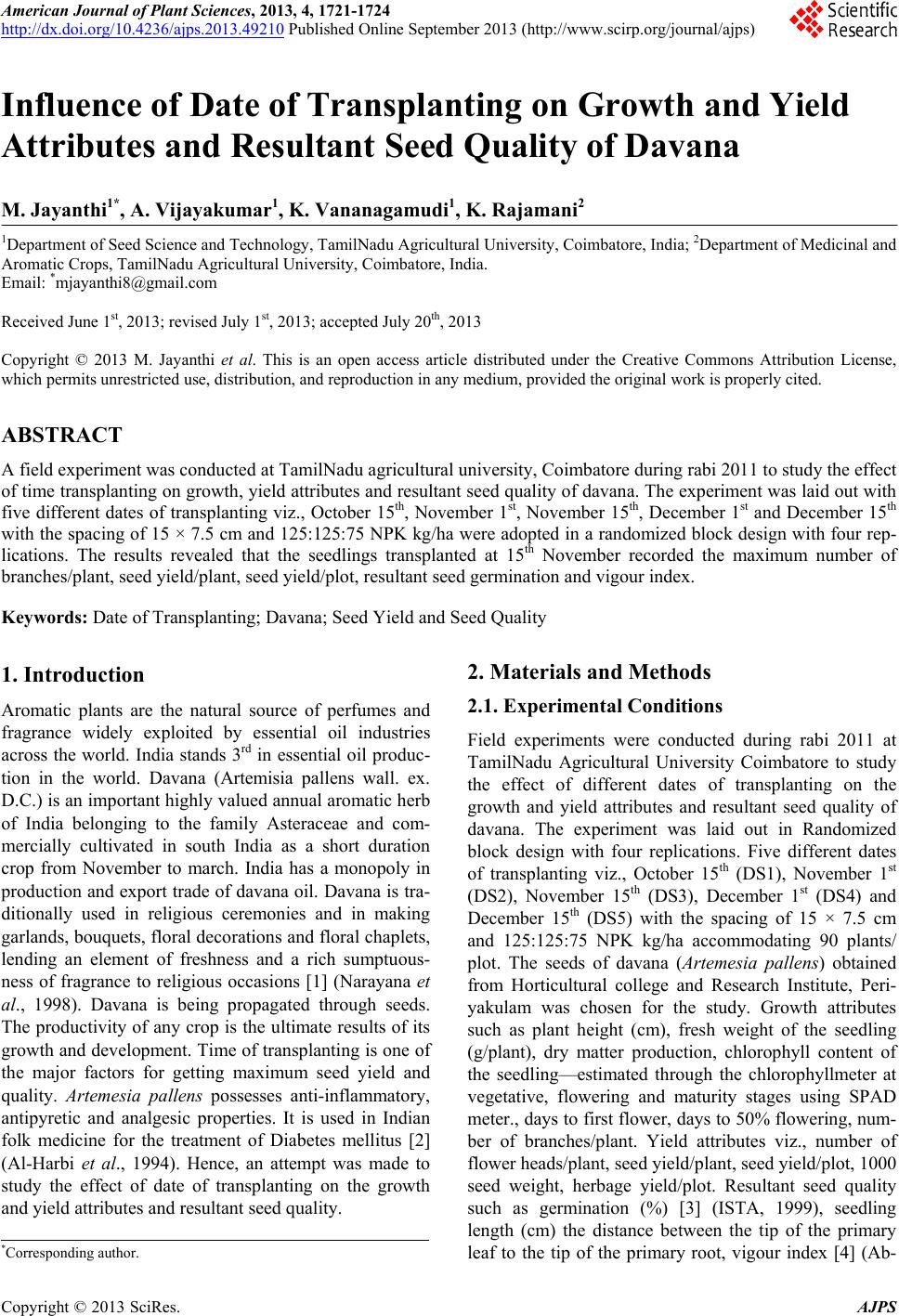 American Journal of Plant Sciences, 2013, 4, 1721-1724 http://dx.doi.org/10.4236/ajps.2013.49210 Published Online September 2013 (http://www.scirp.org/journal/ajps) Influence of Date of Transplanting on Growth and Yield Attributes and Resultant Seed Quality of Davana M. Jayanthi1*, A. Vijayakumar1, K. Vananagamudi1, K. Rajamani2 1Department of Seed Science and Technology, TamilNadu Agricultural University, Coimbatore, India; 2Department of Medicinal and Aromatic Crops, TamilNadu Agricultural University, Coimbatore, India. Email: *[email protected] Received June 1st, 2013; revised July 1st, 2013; accepted July 20th, 2013 Copyright © 2013 M. Jayanthi et al. This is an open access article distributed under the Creative Commons Attribution License, which permits unrestricted use, distribution, and reproduction in any medium, provided the original work is properly cited. ABSTRACT A field experiment was conducted at TamilNadu agricultural university, Coimbatore during rabi 2011 to study the effect of time transplanting on growth, yield attributes and resultant seed quality of davana. The experiment was laid out with five different dates of transplanting viz., October 15th, November 1st, November 15th, December 1st and December 15th with the spacing of 15 × 7.5 cm and 125:125:75 NPK kg/ha were adopted in a randomized block design with four rep- lications. The results revealed that the seedlings transplanted at 15th November recorded the maximum number of branches/plant, seed yield/plant, seed yield/plot, resultant seed germination and vigour index. Keywords: Date of Transplanting; Davana; Seed Yield and Seed Quality 1. Introduction Aromatic plants are the natural source of perfumes and fragrance widely exploited by essential oil industries across the world. India stands 3rd in essential oil produc- tion in the world. Davana (Artemisia pallens wall. ex. D.C.) is an important highly valued annual aromatic herb of India belonging to the family Asteraceae and com- mercially cultivated in south India as a short duration crop from November to march. India has a monopoly in production and export trade of davana oil. Davana is tra- ditionally used in religious ceremonies and in making garlands, bouquets, floral decorations and floral chaplets, lending an element of freshness and a rich sumptuous- ness of fragrance to religious occasions [1] (Narayana et al., 1998). Davana is being propagated through seeds. The productivity of any crop is the ultimate results of its growth and development. Time of transplanting is one of the major factors for getting maximum seed yield and quality. Artemesia pallens possesses anti-inflammatory, antipyretic and analgesic properties. It is used in Indian folk medicine for the treatment of Diabetes mellitus [2] (Al-Harbi et al., 1994). Hence, an attempt was made to study the effect of date of transplanting on the growth and yield attributes and resultant seed quality. 2. Materials and Methods 2.1. Experimental Conditions Field experiments were conducted during rabi 2011 at TamilNadu Agricultural University Coimbatore to study the effect of different dates of transplanting on the growth and yield attributes and resultant seed quality of davana. The experiment was laid out in Randomized block design with four replications. Five different dates of transplanting viz., October 15th (DS1), November 1st (DS2), November 15th (DS3), December 1st (DS4) and December 15th (DS5) with the spacing of 15 × 7.5 cm and 125:125:75 NPK kg/ha accommodating 90 plants/ plot. The seeds of davana (Artemesia pallens) obtained from Horticultural college and Research Institute, Peri- yakulam was chosen for the study. Growth attributes such as plant height (cm), fresh weight of the seedling (g/plant), dry matter production, chlorophyll content of the seedling—estimated through the chlorophyllmeter at vegetative, flowering and maturity stages using SPAD meter., days to first flower, days to 50% flowering, num- ber of branches/plant. Yield attributes viz., number of flower heads/plant, seed yield/plant, seed yield/plot, 1000 seed weight, herbage yield/plot. Resultant seed quality such as germination (%) [3] (ISTA, 1999), seedling length (cm) the distance between the tip of the primary leaf to the tip of the primary root, vigour index [4] (Ab- *Corresponding author. Copyright © 2013 SciRes. AJPS 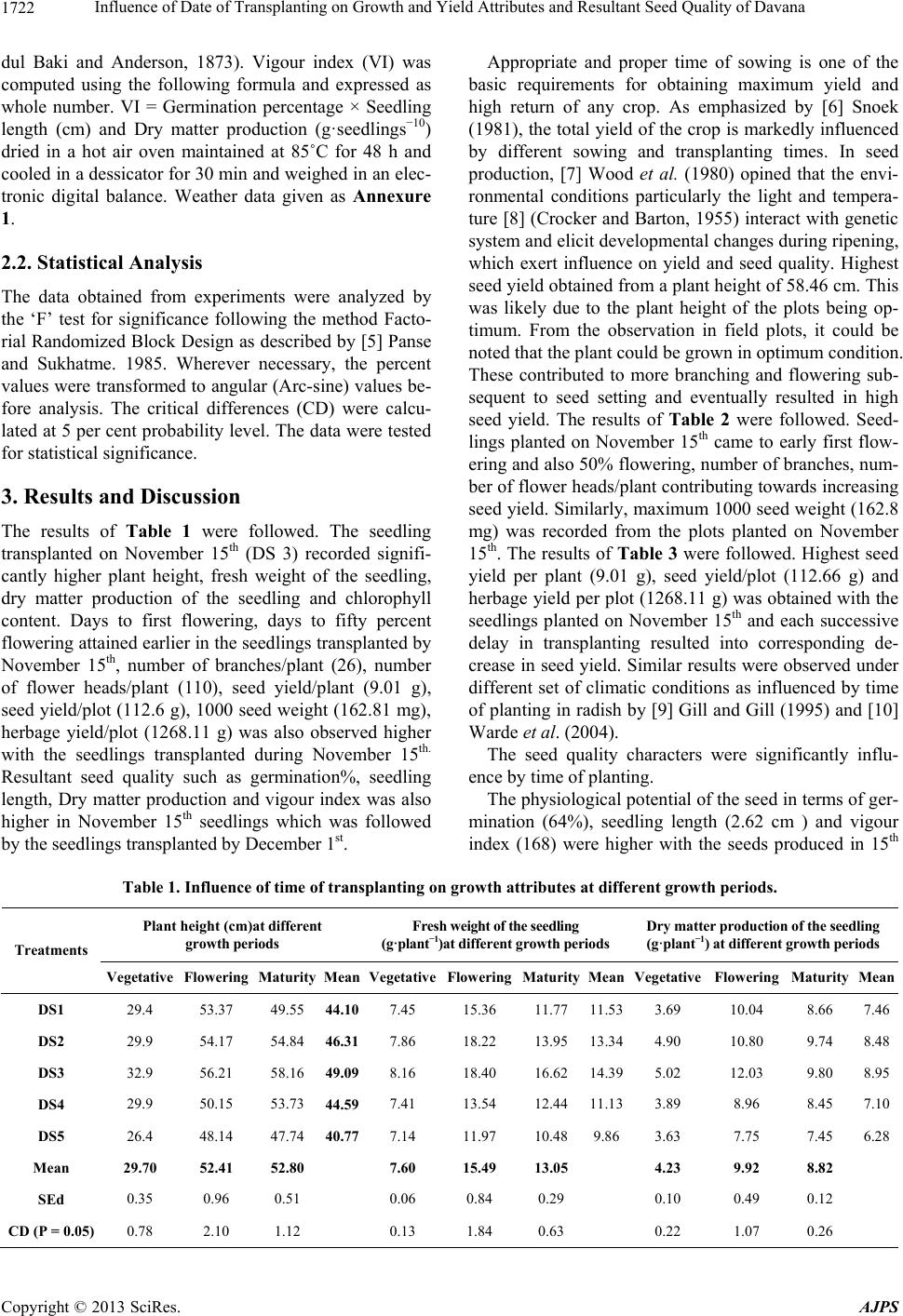 Influence of Date of Transplanting on Growth and Yield Attributes and Resultant Seed Quality of Davana 1722 dul Baki and Anderson, 1873). Vigour index (VI) was computed using the following formula and expressed as whole number. VI = Germination percentage × Seedling length (cm) and Dry matter production (g·seedlings−10) dried in a hot air oven maintained at 85˚C for 48 h and cooled in a dessicator for 30 min and weighed in an elec- tronic digital balance. Weather data given as Annexure 1. 2.2. Statistical Analysis The data obtained from experiments were analyzed by the ‘F’ test for significance following the method Facto- rial Randomized Block Design as described by [5] Panse and Sukhatme. 1985. Wherever necessary, the percent values were transformed to angular (Arc-sine) values be- fore analysis. The critical differences (CD) were calcu- lated at 5 per cent probability level. The data were tested for statistical significance. 3. Results and Discussion The results of Table 1 were followed. The seedling transplanted on November 15th (DS 3) recorded signifi- cantly higher plant height, fresh weight of the seedling, dry matter production of the seedling and chlorophyll content. Days to first flowering, days to fifty percent flowering attained earlier in the seedlings transplanted by November 15th, number of branches/plant (26), number of flower heads/plant (110), seed yield/plant (9.01 g), seed yield/plot (112.6 g), 1000 seed weight (162.81 mg), herbage yield/plot (1268.11 g) was also observed higher with the seedlings transplanted during November 15th. Resultant seed quality such as germination%, seedling length, Dry matter production and vigour index was also higher in November 15th seedlings which was followed by the seedlings transplanted by December 1st. Appropriate and proper time of sowing is one of the basic requirements for obtaining maximum yield and high return of any crop. As emphasized by [6] Snoek (1981), the total yield of the crop is markedly influenced by different sowing and transplanting times. In seed production, [7] Wood et al. (1980) opined that the envi- ronmental conditions particularly the light and tempera- ture [8] (Crocker and Barton, 1955) interact with genetic system and elicit developmental changes during ripening, which exert influence on yield and seed quality. Highest seed yield obtained from a plant height of 58.46 cm. This was likely due to the plant height of the plots being op- timum. From the observation in field plots, it could be noted that the plant could be grown in optimum condition. These contributed to more branching and flowering sub- sequent to seed setting and eventually resulted in high seed yield. The results of Table 2 were followed. Seed- lings planted on November 15th came to early first flow- ering and also 50% flowering, number of branches, num- ber of flower heads/plant contributing towards increasing seed yield. Similarly, maximum 1000 seed weight (162.8 mg) was recorded from the plots planted on November 15th. The results of Table 3 were followed. Highest seed yield per plant (9.01 g), seed yield/plot (112.66 g) and herbage yield per plot (1268.11 g) was obtained with the seedlings planted on November 15th and each successive delay in transplanting resulted into corresponding de- crease in seed yield. Similar results were observed under different set of climatic conditions as influenced by time of planting in radish by [9] Gill and Gill (1995) and [10] Warde et al. (2004). The seed quality characters were significantly influ- ence by time of planting. The physiological potential of the seed in terms of ger- mination (64%), seedling length (2.62 cm ) and vigour index (168) were higher with the seeds produced in 15th Table 1. Influence of time of transplanting on growth attributes at different growth periods. Plant height (cm)at different growth periods Fresh weight of the seedling (g·plant−1)at different growth periods Dry matter production of the seedling (g·plant−1) at different growth periods Treatments Vegetative Flowering Maturity MeanVegetativeFloweringMaturityMeanVegetative Flowering MaturityMean DS1 29.4 53.37 49.55 44.10 7.45 15.36 11.77 11.533.69 10.04 8.66 7.46 DS2 29.9 54.17 54.84 46.31 7.86 18.22 13.95 13.344.90 10.80 9.74 8.48 DS3 32.9 56.21 58.16 49.09 8.16 18.40 16.62 14.395.02 12.03 9.80 8.95 DS4 29.9 50.15 53.73 44.59 7.41 13.54 12.44 11.133.89 8.96 8.45 7.10 DS5 26.4 48.14 47.74 40.77 7.14 11.97 10.48 9.863.63 7.75 7.45 6.28 Mean 29.70 52.41 52.80 7.60 15.49 13.05 4.23 9.92 8.82 SEd 0.35 0.96 0.51 0.06 0.84 0.29 0.10 0.49 0.12 CD (P = 0.05) 0.78 2.10 1.12 0.13 1.84 0.63 0.22 1.07 0.26 Copyright © 2013 SciRes. AJPS 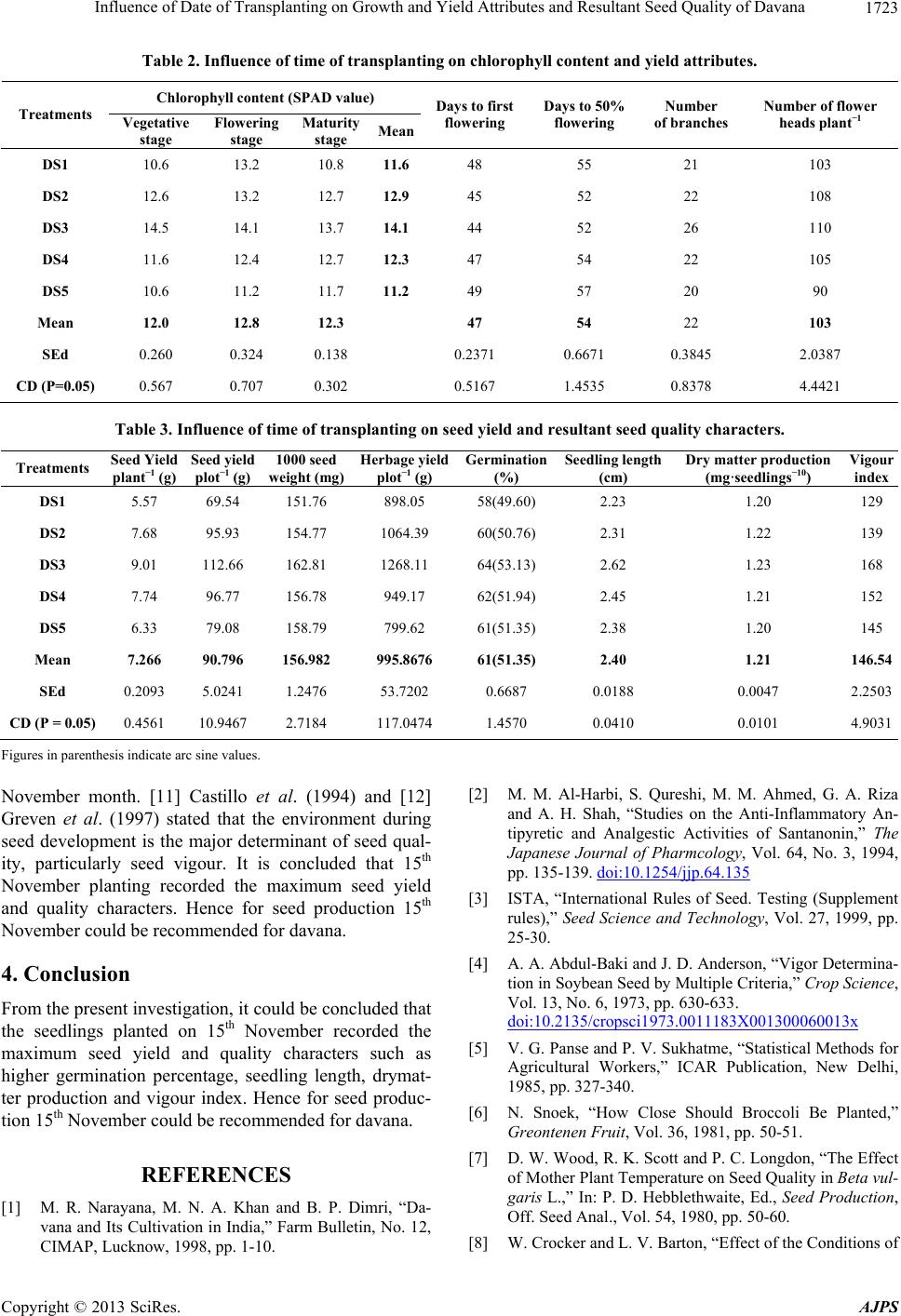 Influence of Date of Transplanting on Growth and Yield Attributes and Resultant Seed Quality of Davana 1723 Table 2. Influence of time of transplanting on chlorophyll content and yield attributes. Chlorophyll content (SPAD value) Treatments Vegetative stage Flowering stage Maturity stage Mean Days to first flowering Days to 50% flowering Number of branches Number of flower heads plant−1 DS1 10.6 13.2 10.8 11.6 48 55 21 103 DS2 12.6 13.2 12.7 12.9 45 52 22 108 DS3 14.5 14.1 13.7 14.1 44 52 26 110 DS4 11.6 12.4 12.7 12.3 47 54 22 105 DS5 10.6 11.2 11.7 11.2 49 57 20 90 Mean 12.0 12.8 12.3 47 54 22 103 SEd 0.260 0.324 0.138 0.2371 0.6671 0.3845 2.0387 CD (P=0.05) 0.567 0.707 0.302 0.5167 1.4535 0.8378 4.4421 Table 3. Influence of time of transplanting on seed yield and resultant seed quality characters. Treatments Seed Yield plant−1 (g) Seed yield plot−1 (g) 1000 seed weight (mg) Herbage yield plot−1 (g) Germination (%) Seedling length (cm) Dry matter production (mg·seedlings−10) Vigour index DS1 5.57 69.54 151.76 898.05 58(49.60) 2.23 1.20 129 DS2 7.68 95.93 154.77 1064.39 60(50.76) 2.31 1.22 139 DS3 9.01 112.66 162.81 1268.11 64(53.13) 2.62 1.23 168 DS4 7.74 96.77 156.78 949.17 62(51.94) 2.45 1.21 152 DS5 6.33 79.08 158.79 799.62 61(51.35) 2.38 1.20 145 Mean 7.266 90.796 156.982 995.8676 61(51.35) 2.40 1.21 146.54 SEd 0.2093 5.0241 1.2476 53.7202 0.6687 0.0188 0.0047 2.2503 CD (P = 0.05) 0.4561 10.9467 2.7184 117.0474 1.4570 0.0410 0.0101 4.9031 Figures in parenthesis indicate arc sine values. November month. [11] Castillo et al. (1994) and [12] Greven et al. (1997) stated that the environment during seed development is the major determinant of seed qual- ity, particularly seed vigour. It is concluded that 15th November planting recorded the maximum seed yield and quality characters. Hence for seed production 15th November could be recommended for davana. 4. Conclusion From the present investigation, it could be concluded that the seedlings planted on 15th November recorded the maximum seed yield and quality characters such as higher germination percentage, seedling length, drymat- ter production and vigour index. Hence for seed produc- tion 15th November could be recommended for davana. REFERENCES [1] M. R. Narayana, M. N. A. Khan and B. P. Dimri, “Da- vana and Its Cultivation in India,” Farm Bulletin, No. 12, CIMAP, Lucknow, 1998, pp. 1-10. [2] M. M. Al-Harbi, S. Qureshi, M. M. Ahmed, G. A. Riza and A. H. Shah, “Studies on the Anti-Inflammatory An- tipyretic and Analgestic Activities of Santanonin,” The Japanese Journal of Pharmcology, Vol. 64, No. 3, 1994, pp. 135-139. doi:10.1254/jjp.64.135 [3] ISTA, “International Rules of Seed. Testing (Supplement rules),” Seed Science and Technology, Vol. 27, 1999, pp. 25-30. [4] A. A. Abdul-Baki and J. D. Anderson, “Vigor Determina- tion in Soybean Seed by Multiple Criteria,” Crop Science, Vol. 13, No. 6, 1973, pp. 630-633. doi:10.2135/cropsci1973.0011183X001300060013x [5] V. G. Panse and P. V. Sukhatme, “Statistical Methods for Agricultural Workers,” ICAR Publication, New Delhi, 1985, pp. 327-340. [6] N. Snoek, “How Close Should Broccoli Be Planted,” Greontenen Fruit, Vol. 36, 1981, pp. 50-51. [7] D. W. Wood, R. K. Scott and P. C. Longdon, “The Effect of Mother Plant Temperature on Seed Quality in Beta vul- garis L.,” In: P. D. Hebblethwaite, Ed., Seed Production, Off. Seed Anal., Vol. 54, 1980, pp. 50-60. [8] W. Crocker and L. V. Barton, “Effect of the Conditions of Copyright © 2013 SciRes. AJPS 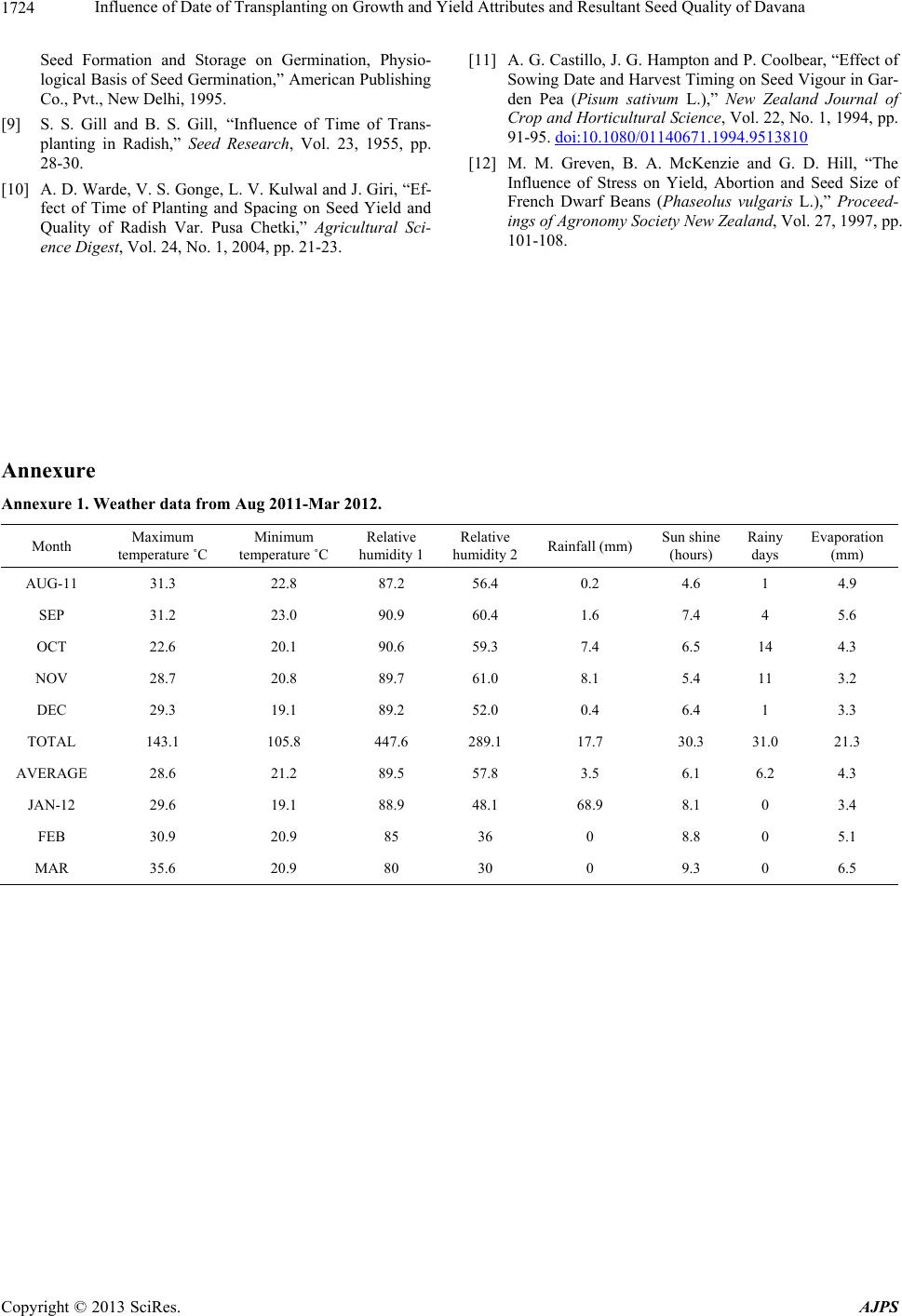 Influence of Date of Transplanting on Growth and Yield Attributes and Resultant Seed Quality of Davana 1724 Seed Formation and Storage on Germination, Physio- logical Basis of Seed Germination,” American Publishing Co., Pvt., New Delhi, 1995. [9] S. S. Gill and B. S. Gill, “Influence of Time of Trans- planting in Radish,” Seed Research, Vol. 23, 1955, pp. 28-30. [10] A. D. Warde, V. S. Gonge, L. V. Kulwal and J. Giri, “Ef- fect of Time of Planting and Spacing on Seed Yield and Quality of Radish Var. Pusa Chetki,” Agricultural Sci- ence Digest, Vol. 24, No. 1, 2004, pp. 21-23. [11] A. G. Castillo, J. G. Hampton and P. Coolbear, “Effect of Sowing Date and Harvest Timing on Seed Vigour in Gar- den Pea (Pisum sativum L.),” New Zealand Journal of Crop and Horticultural Science, Vol. 22, No. 1, 1994, pp. 91-95. doi:10.1080/01140671.1994.9513810 [12] M. M. Greven, B. A. McKenzie and G. D. Hill, “The Influence of Stress on Yield, Abortion and Seed Size of French Dwarf Beans (Phaseolus vulgaris L.),” Proceed- ings of Agronomy Society New Zealand, Vol. 27, 1997, pp. 101-108. Annexure Annexure 1. Weather data from Aug 2011-Mar 2012. Month Maximum temperature ˚C Minimum temperature ˚C Relative humidity 1 Relative humidity 2Rainfall (mm) Sun shine (hours) Rainy days Evaporation (mm) AUG-11 31.3 22.8 87.2 56.4 0.2 4.6 1 4.9 SEP 31.2 23.0 90.9 60.4 1.6 7.4 4 5.6 OCT 22.6 20.1 90.6 59.3 7.4 6.5 14 4.3 NOV 28.7 20.8 89.7 61.0 8.1 5.4 11 3.2 DEC 29.3 19.1 89.2 52.0 0.4 6.4 1 3.3 TOTAL 143.1 105.8 447.6 289.1 17.7 30.3 31.0 21.3 AVERAGE 28.6 21.2 89.5 57.8 3.5 6.1 6.2 4.3 JAN-12 29.6 19.1 88.9 48.1 68.9 8.1 0 3.4 FEB 30.9 20.9 85 36 0 8.8 0 5.1 MAR 35.6 20.9 80 30 0 9.3 0 6.5 Copyright © 2013 SciRes. AJPS |