

Paper Menu >>
Journal Menu >>
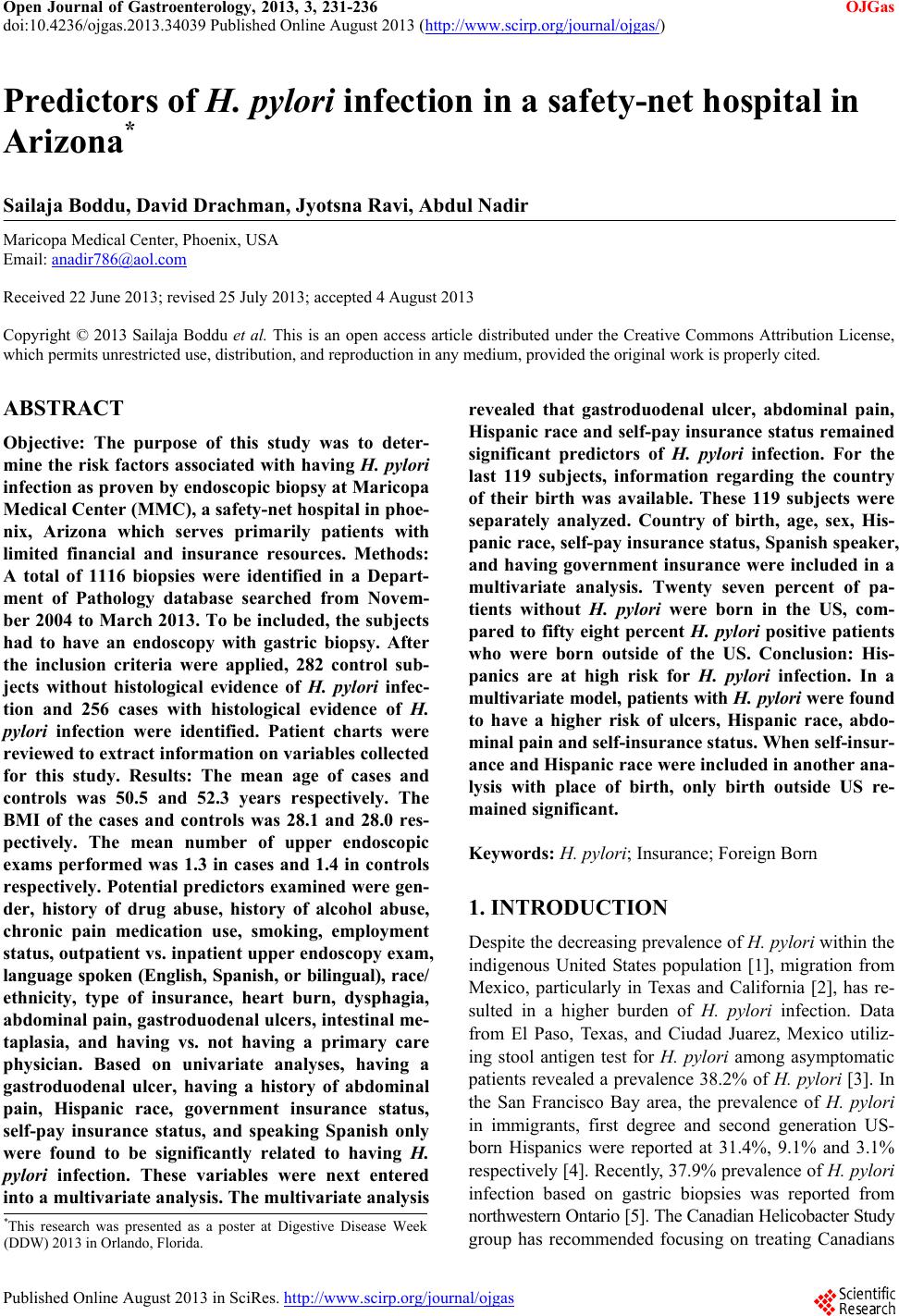 Open Journal of Gastroenterology, 2013, 3, 231-236 OJGas doi:10.4236/ojgas.2013.34039 Published Online August 2013 (http://www.scirp.org/journal/ojgas/) Predictors of H. pylori infection in a safety-net hospital in Arizona* Sailaja Boddu, David Drachman, Jyotsna Ravi, Abdul Nadir Maricopa Medical Center, Phoenix, USA Email: [email protected] Received 22 June 2013; revised 25 July 2013; accepted 4 August 2013 Copyright © 2013 Sailaja Boddu et al. This is an open access article distributed under the Creative Commons Attribution License, which permits unrestricted use, distribution, and reproduction in any medium, provided the original work is properly cited. ABSTRACT Objective: The purpose of this study was to deter- mine the risk factors associated with having H. pylori infection as proven by endoscopic biopsy at Maricopa Medical Center (MMC), a safety-net hospital in phoe- nix, Arizona which serves primarily patients with limited financial and insurance resources. Methods: A total of 1116 biopsies were identified in a Depart- ment of Pathology database searched from Novem- ber 2004 to March 2013. To be included, the subjects had to have an endoscopy with gastric biopsy. After the inclusion criteria were applied, 282 control sub- jects without histological evidence of H. pylori infec- tion and 256 cases with histological evidence of H. pylori infection were identified. Patient charts were reviewed to extract information on variables collected for this study. Results: The mean age of cases and controls was 50.5 and 52.3 years respectively. The BMI of the cases and controls was 28.1 and 28.0 res- pectively. The mean number of upper endoscopic exams performed was 1.3 in cases and 1.4 in controls respectively. Potential predictors examined were gen- der, history of drug abuse, history of alcohol abuse, chronic pain medication use, smoking, employment status, outpatient vs. inpatient upper endoscopy exam, language spoken (English, Spanish, or bilingual), race/ ethnicity, type of insurance, heart burn, dysphagia, abdominal pain, gastroduodenal ulcers, intestinal me- taplasia, and having vs. not having a primary care physician. Based on univariate analyses, having a gastroduodenal ulcer, having a history of abdominal pain, Hispanic race, government insurance status, self-pay insurance status, and speaking Spanish only were found to be significantly related to having H. pylori infection. These variables were next entered into a multivariate analysis. The multivariate analysis revealed that gastroduodenal ulcer, abdominal pain, Hispanic race and self-pay insurance status remained significant predictors of H. pylori infection. For the last 119 subjects, information regarding the country of their birth was available. These 119 subjects were separately analyzed. Country of birth, age, sex, His- panic race, self-pay insurance status, Spanish speaker, and having government insurance were included in a multivariate analysis. Twenty seven percent of pa- tients without H. pylori were born in the US, com- pared to fifty eight percent H. pylori positive patients who were born outside of the US. Conclusion: His- panics are at high risk for H. pylori infection. In a multivariate model, pa tients with H. pylori were found to have a higher risk of ulcers, Hispanic race, abdo- minal pain and self-insurance status. When self-insur- ance and Hispanic race were included in another ana- lysis with place of birth, only birth outside US re- mained significant. Keywords: H. pylori; Insurance; Foreign Born 1. INTRODUCTION Despite the decreasing prevalence of H. pylori within the indigenous United States population [1], migration from Mexico, particularly in Texas and California [2], has re- sulted in a higher burden of H. pylori infection. Data from El Paso, Texas, and Ciudad Juarez, Mexico utiliz- ing stool antigen test for H. pylori among asymptomatic patients revealed a prevalence 38.2% of H. pylori [3]. In the San Francisco Bay area, the prevalence of H. pylori in immigrants, first degree and second generation US- born Hispanics were reported at 31.4%, 9.1% and 3.1% respectively [4]. Recently, 37.9% prevalence of H. pylori infection based on gastric biopsies was reported from northwestern Ontario [5]. The Canadian Helicobacter Study group has recommended focusing on treating Canadians *This research was presented as a poster at Digestive Disease Week (DDW) 2013 in Orland o, Florida. Published Online August 2013 in SciRes. http://www.scirp.org/journal/ojgas 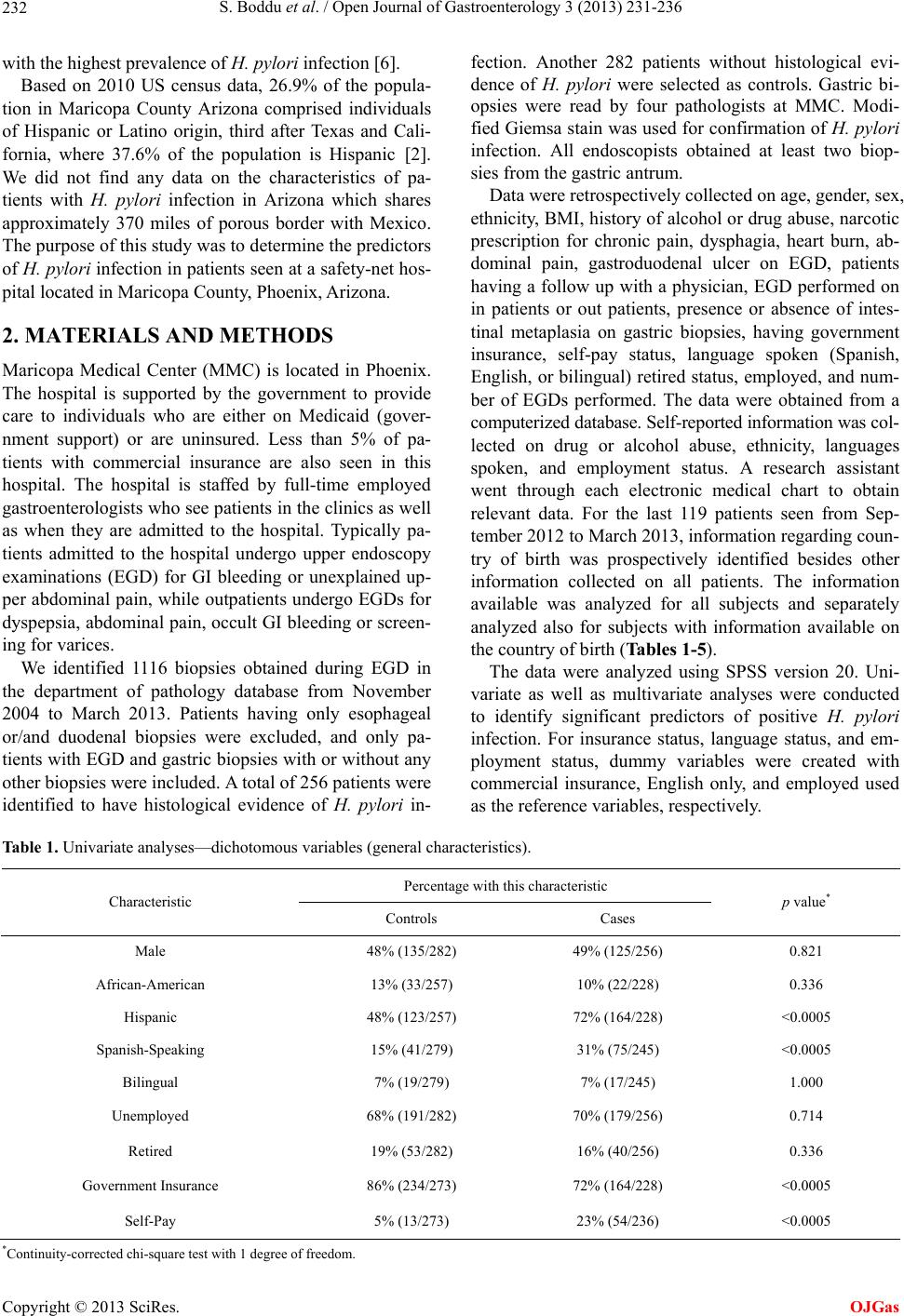 S. Boddu et al. / Open Journal of Gastroenterology 3 (2013) 231-236 232 with the highest prevalence of H. pylori infection [6]. Based on 2010 US census data, 26.9% of the popula- tion in Maricopa County Arizona comprised individuals of Hispanic or Latino origin, third after Texas and Cali- fornia, where 37.6% of the population is Hispanic [2]. We did not find any data on the characteristics of pa- tients with H. pylori infection in Arizona which shares approximately 370 miles of porous border with Mexico. The purpose of this study was to de termine the predicto rs of H. pylori infection in patients seen at a safety-net hos- pital located in Maricopa County, Pho enix, Arizona. 2. MATERIALS AND METHODS Maricopa Medical Center (MMC) is located in Phoenix. The hospital is supported by the government to provide care to individuals who are either on Medicaid (gover- nment support) or are uninsured. Less than 5% of pa- tients with commercial insurance are also seen in this hospital. The hospital is staffed by full-time employed gastroenterologists who see patients in the clinics as well as when they are admitted to the hospital. Typically pa- tients admitted to the hospital undergo upper endoscopy examinations (EGD) for GI bleeding or unexplained up- per abdominal pain, while outpatients undergo EGDs for dyspepsia, abdominal pain, occult GI bleeding or screen- ing for varices. We identified 1116 biopsies obtained during EGD in the department of pathology database from November 2004 to March 2013. Patients having only esophageal or/and duodenal biopsies were excluded, and only pa- tients with EGD and gastric biopsies with or without any other biopsies were included. A total of 256 patient s were identified to have histological evidence of H. pylori in- fection. Another 282 patients without histological evi- dence of H. pylori were selected as controls. Gastric bi- opsies were read by four pathologists at MMC. Modi- fied Giemsa stain was used for confirmation of H. pylori infection. All endoscopists obtained at least two biop- sies from the gastric antrum. Data were retrospectively collected on age, gender, sex, ethnicity, BMI, history of alcohol or drug abuse, narcotic prescription for chronic pain, dysphagia, heart burn, ab- dominal pain, gastroduodenal ulcer on EGD, patients having a follow up with a physician, EGD performed on in patients or out patients, presence or absence of intes- tinal metaplasia on gastric biopsies, having government insurance, self-pay status, language spoken (Spanish, English, or bilingual) retired status, employed, and num- ber of EGDs performed. The data were obtained from a computerized database. Self-reported information was col- lected on drug or alcohol abuse, ethnicity, languages spoken, and employment status. A research assistant went through each electronic medical chart to obtain relevant data. For the last 119 patients seen from Sep- tember 2012 to March 201 3, infor mation r egarding coun - try of birth was prospectively identified besides other information collected on all patients. The information available was analyzed for all subjects and separately analyzed also for subjects with information available on the country of birth (Tables 1-5). The data were analyzed using SPSS version 20. Uni- variate as well as multivariate analyses were conducted to identify significant predictors of positive H. pylori infection. For insurance status, language status, and em- ployment status, dummy variables were created with commercial insurance, English only, and employed used as the reference variables, respectively. Table 1. Univariate analyses—dichotomous variables (general characteristics). Percentage with this characteristic Characteristic Controls Cases p value* Male 48% (135/282) 49% (125/256) 0.821 African-America n 13% (33/257) 10% (22/228) 0.336 Hispanic 48% (123/257) 72% (164/228) <0.0005 Spanish-Speaking 15% (41/279) 31% (75/245) <0.0005 Bilingual 7% (19/279) 7% (17/245) 1.000 Unemployed 68% (191/282) 70% (179/256) 0.714 Retired 19% (53/282) 16% (40/256) 0.336 Government Insurance 86% (234/273) 72% (164/228) <0.0005 Self-Pay 5% (13/273) 23% (54/236) <0.0005 *Continuity-correcte d chi-square test with 1 degree of freedom. Copyright © 2013 SciRes. OJGas 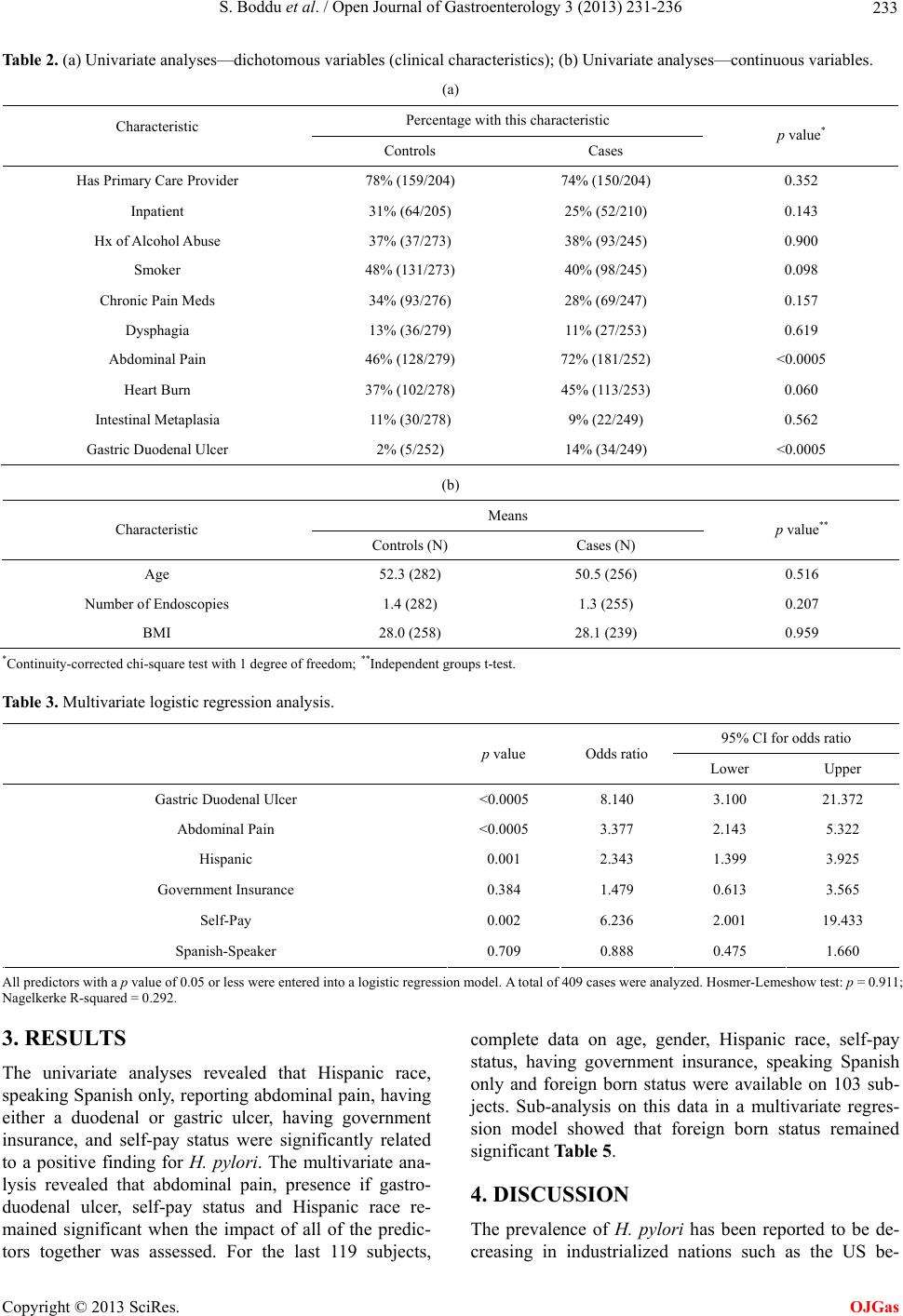 S. Boddu et al. / Open Journal of Gastroenterology 3 (2013) 231-236 233 Table 2. (a) Univariate analyses—dichotomous variables (clinical characteristics); (b) Univariate analyses—continuous variables. (a) Percentage with this characteristic Characteristic Controls Cases p value* Has Primary Care Provider 78% (159/204) 74% (150/204) 0.352 Inpatient 31% (64/205) 25% (52/210) 0.143 Hx of Alcohol Abuse 37% (37/273) 38% (93/245) 0.900 Smoker 48% (131/273) 40% (98/245) 0.098 Chronic Pain Meds 34% (93/276) 28% (69/247) 0.157 Dysphagia 13% (36/279) 11% (27 /25 3) 0.619 Abdominal Pain 46% (128/279) 72% (181/252) <0.0 005 Heart Burn 37% (102/278) 45% (113/253) 0.060 Intestinal Metaplasia 11% (30/278) 9% (22/249) 0.562 Gastric Duodenal Ulcer 2% (5/252) 14% (34/249) <0.0005 (b) Means Characteristic Controls (N) Cases (N) p value** Age 52.3 (282) 50. 5 (256) 0.516 Number of Endoscop ies 1.4 (282) 1.3 (255) 0.207 BMI 28.0 (258) 28.1 (239) 0.959 *Continuity-correcte d chi-square test with 1 degree of freedom; **Independent groups t-test. Table 3. Multivariate logistic regression analysis. 95% CI for odds ratio p value Odds ratio Lower Upper Gastric Duodenal Ulcer <0.0005 8.140 3.100 21.372 Abdominal Pain <0.0005 3.377 2.143 5.322 Hispanic 0.001 2.343 1.399 3.925 Government Insurance 0.384 1.479 0.613 3.565 Self-Pay 0.002 6.236 2.001 19.433 Spanish-Speaker 0.709 0.888 0.475 1.660 All predictors with a p value of 0.05 or less wer e entered into a logistic regression model. A total of 409 cases were analyzed. Hosmer-Lemeshow test: p = 0.911; Nagelkerke R-squar ed = 0.292. 3. RESULTS The univariate analyses revealed that Hispanic race, speaking Spanish only, reporting abdominal pain, having either a duodenal or gastric ulcer, having government insurance, and self-pay status were significantly related to a positive finding for H. pylori. The multivariate ana- lysis revealed that abdominal pain, presence if gastro- duodenal ulcer, self-pay status and Hispanic race re- mained significant when the impact of all of the predic- tors together was assessed. For the last 119 subjects, complete data on age, gender, Hispanic race, self-pay status, having government insurance, speaking Spanish only and foreign born status were available on 103 sub- jects. Sub-analysis on this data in a multivariate regres- sion model showed that foreign born status remained significant Table 5. 4. DISCUSSION The prevalence of H. pylori has been reported to be de- creasing in industrialized nations such as the US be- Copyright © 2013 SciRes. OJGas 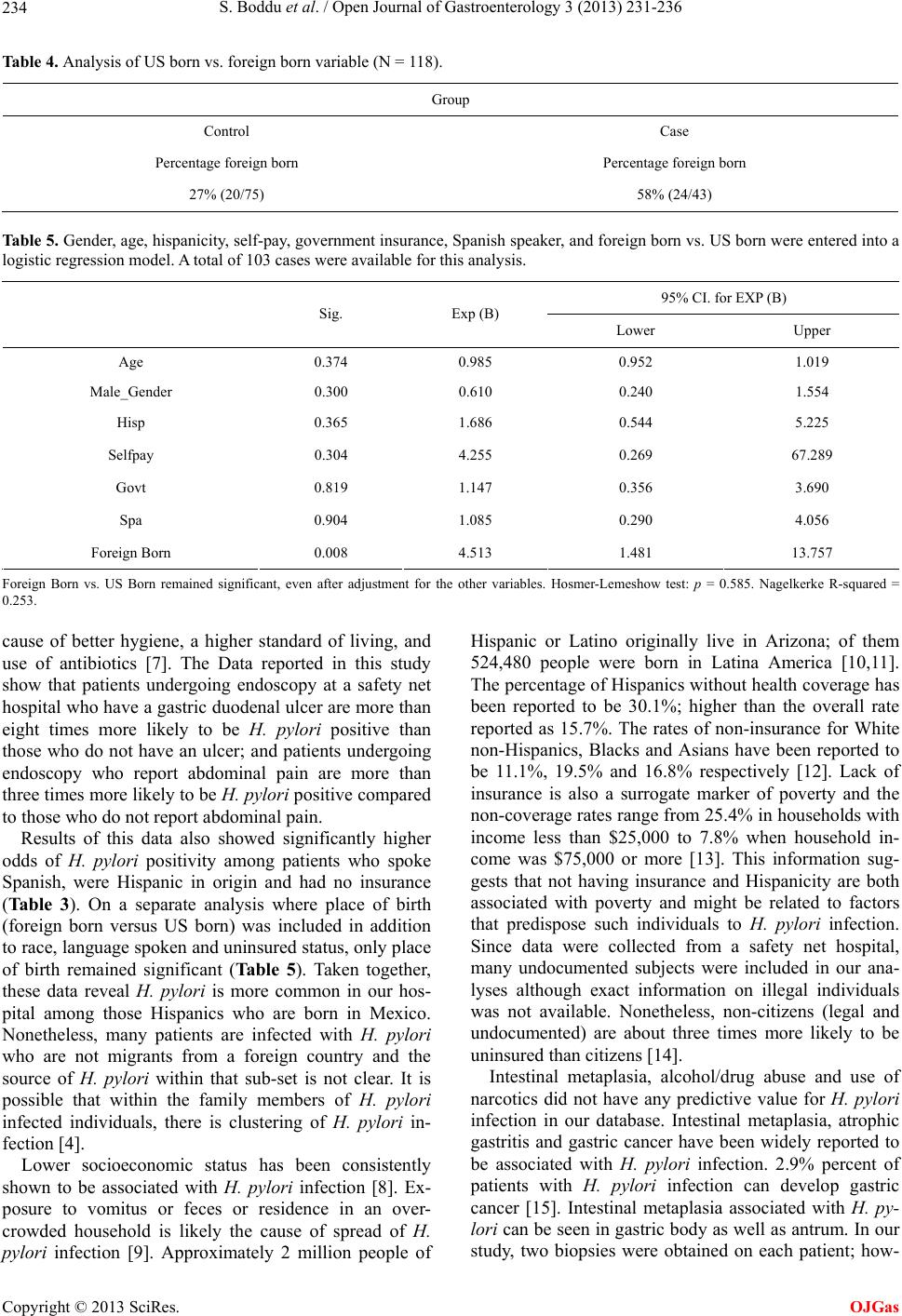 S. Boddu et al. / Open Journal of Gastroenterology 3 (2013) 231-236 234 Table 4. Analysis of US born vs. foreign born variable (N = 118). Group Control Case Percentage foreign born Percentage foreign born 27% (20/75) 58% (24/43) Table 5. Gender, age, hispanicity, self-pay, government insurance, Spanish speaker, and foreign born vs. US born were entered into a logistic regression model. A total of 103 cases were available for this analysis. 95% CI. for EXP ( B) Sig. Exp (B) Lower Upper Age 0.374 0.985 0.952 1.019 Male_Gender 0.300 0.610 0.240 1.554 Hisp 0.365 1.686 0.544 5.225 Selfpay 0.304 4.255 0.269 67.289 Govt 0.819 1.147 0.356 3.690 Spa 0.904 1.085 0.290 4.056 Foreign Born 0.008 4.513 1.481 13.757 Foreign Born vs. US Born remained significant, even after adjustment for the other variables. Hosmer-Lemeshow test: p = 0.585. Nagelkerke R-squared = 0.253. cause of better hygiene, a higher standard of living, and use of antibiotics [7]. The Data reported in this study show that patients undergoing endoscopy at a safety net hospital who have a gastric duodenal ulcer are more than eight times more likely to be H. pylori positive than those who do not have an ulcer; and patients undergoing endoscopy who report abdominal pain are more than three times more likely to be H. pylori positive compared to those who do not report abdominal pain. Results of this data also showed significantly higher odds of H. pylori positivity among patients who spoke Spanish, were Hispanic in origin and had no insurance (Table 3). On a separate analysis where place of birth (foreign born versus US born) was included in addition to race, language spoken and uninsured status, only place of birth remained significant (Table 5 ). Taken together, these data reveal H. pylori is more common in our hos- pital among those Hispanics who are born in Mexico. Nonetheless, many patients are infected with H. pylori who are not migrants from a foreign country and the source of H. pylori within that sub-set is not clear. It is possible that within the family members of H. pylori infected individuals, there is clustering of H. pylori in- fection [4]. Lower socioeconomic status has been consistently shown to be associated with H. pylori infection [8]. Ex- posure to vomitus or feces or residence in an over- crowded household is likely the cause of spread of H. pylori infection [9]. Approximately 2 million people of Hispanic or Latino originally live in Arizona; of them 524,480 people were born in Latina America [10,11]. The percentage of Hispanics without health coverage has been reported to be 30.1%; higher than the overall rate reported as 15.7%. The rates of non-insurance for White non-Hispanics, Blacks and Asians have been reported to be 11.1%, 19.5% and 16.8% respectively [12]. Lack of insurance is also a surrogate marker of poverty and the non-coverage rates range from 25.4% in households with income less than $25,000 to 7.8% when household in- come was $75,000 or more [13]. This information sug- gests that not having insurance and Hispanicity are both associated with poverty and might be related to factors that predispose such individuals to H. pylori infection. Since data were collected from a safety net hospital, many undocumented subjects were included in our ana- lyses although exact information on illegal individuals was not available. Nonetheless, non-citizens (legal and undocumented) are about three times more likely to be uninsured than citizens [14]. Intestinal metaplasia, alcohol/drug abuse and use of narcotics did not have any predictive value for H. pylori infection in our database. Intestinal metaplasia, atrophic gastritis and gastric cancer have been widely reported to be associated with H. pylori infection. 2.9% percent of patients with H. pylori infection can develop gastric cancer [15]. Intestinal metaplasia associated with H. py- lori can be seen in gastric body as well as antrum. In our study, two biopsies were obtained on each patient; how- Copyright © 2013 SciRes. OJGas  S. Boddu et al. / Open Journal of Gastroenterology 3 (2013) 231-236 235 ever, they were uniformly obtained from antrum and gastric body. Because of the retrospective nature of our study and lack of follow up endoscopic biopsies, we did not see any difference in prevalence of H. pylori in cases and controls in reported subjects of this study [16]. Conflicting data have been reported regarding asso- ciation of H. pylori and alcohol consumption. Negative effect on H. pylori has been reported with moderate al- cohol consumption [17]. However, among patients with functional dyspepsia, H. pylori has been shown to be associated with alcohol consumption [18]. Data reported in this database did not show any difference in alcohol use between patients with and without H. pylori, al- though specific amount of alcohol consumption is not available. Similarly, data regarding H. pylori and smok- ing are mixed. One study shows no significant relation- ship between H. pylori serology and smoking [19], while the other one reports a higher prevalence of H. pylori in smokers compared to non-smoker [20]. Our data did not show any relationship between smoking and H. pylori (Table 2(a)). Findings reported in this study are important. First, data reported about predictors of H. pylori have never been reported from Arizona which is bordering Mexico and has one of the highest numbers of Hispanic population who have either emigrated from Mexico or born in US; several Hispanics live undocumented in Arizona and seek medical care at our safety net hospital. Second, this study shows that H. pylori remains a signi- ficant cause of peptic ulcer disease that requires hospita- lization straining an already over stretched health care system. Finally and most importantly, the data reported herein identify a sub-group of patients including those who are uninsured or born outside US, who should be properly screened with either H. pylori stool antigen test or endoscopy, depending on an individual’s circums- tances and treating them accordingly with appropriate medications, particularly because H. pylori besides being a significant cause of peptic ulcer disease has also been classified as a class 1 carcinogen by WHO [6]. REFERENCES [1] Everhart, J.E., Kruszon-Moran, D., Perez-Perez, G.I., Tralka, T.S. and McQuillan, G. (2000) Seroprevalence and ethnic differences in Helicobacter pylori infection among adults in the United States. The Journal of Infec- tious Diseases, 181, 1359-1363. doi:10.1086/315384 [2] US Census Bureau (2012) Resident population by his- panic origin and state: 2010. http://www.census.gov/compendia/statab/2012/tables/12s 0018.pdf [3] Cardenas, V.M., Mena, K.D., Ortiz, M., et al. (2010) Hy- perendemic H. pylori and tapeworm infections in a U.S.- Mexico border population. Public Health Reports, 125, 441-447. [4] Tsai, C.J., Perry, S., Sanchez, L. and Parsonnet, J. (2005) Helicobacter pylori infection in different generations of Hispanics in the San Francisco Bay Area. American Journal of Epidemiology, 162, 351-357. doi:10.1093/aje/kwi207 [5] Sethi, A., Chaudhuri, M., Kelly, L. and Hopman, W. (2013) Prevalence of Helicobacter pylori in a first nations population in northwestern Ontario. Canadian Family Physician, 59, e182-e187. [6] Jones, N., Chiba, N., Fallone, C., et al. (2012) Helico- bacter pylori in first nations and recent immigrant popu- lations in Canada. Canadian Journal of Gastroenterology, 26, 97-103. [7] Grad, Y.H., Lipsitch, M. and Aiello, A.E. (2012) Secular trends in Helicobacter pylori seroprevalence in adults in the United States: Evidence for sustained race/ethnic dis- parities. American Journal of Epidemiology, 175, 54-59. doi:10.1093/aje/kwr288 [8] Leclerc, H. (2006) Epidemiological aspects of Helico- bacter pylori infection. Bulletin de l’Academie Nationale de Medecine, 190, 949-962. [9] Brown, L.M. (2000) Helicobacter pylori: Epidemiology and routes of transmission. Epidemiologic Reviews, 22, 283-297. doi:10.1093/oxfordjournals.epirev.a018040 [10] Pew Hispanic Center (2010) Statistical portrait of the foreign-born population in the United States. http://www.pewhispanic.org/2012/02/21/statistical-portra it-of-the-foreign-born-population-in-the-united-states-201 0/#14 [11] US Census Bureau (2010) Hispanics or latino population for the United States, region, states, and for Puerto Rico. http://www.census.gov/prod/cen2010/briefs/c2010br-04.p df [12] DeNavas-Walt, C., Proctor, B.D. and Smith, J.C. (2012) Income, poverty, and health insurance coverage in the United States: 2011. US Census Bureau, Current Popula- tion Reports, P60-243, US Government Printing Office, Washington DC. [13] US Census Bureau (2011) Uninsured rate by real house- hold income: 1999 to 2011. http://www.census.gov/prod/2012pubs/p60-243.pdf [14] (2010) Statistical portrait of the foreign-born population in the United States Pew Hispanic Center. http://www.pewhispanic.org/2012/02/21/statistical-portra it-of-the-foreign-born-population-in-the-united-states-201 0/#40 [15] Uemura, N., Okamoto, S., Yamamoto, S., et al. (2001) Helicobacter pylori infection and the development of gas- tric cancer. The New England Journal of Medicine, 345, 784-789. doi:10.1056/NEJMoa001999 [16] Kuipers, E.J., Uyterlinde, A.M., Pena, A.S., et al. (1995) Long-term sequelae of Helicobacter pylori gastritis. Lan- cet, 345, 1525-1528. doi:10.1016/S0140-6736(95)91084-0 [17] Brenner, H., Bode, G., Adler, G., Hoffmeister, A., Koe- nig, W. and Rothenbacher, D. (2001) Alcohol as a gastric disinfectant? The complex relationship between alcohol Copyright © 2013 SciRes. OJGas  S. Boddu et al. / Open Journal of Gastroenterology 3 (2013) 231-236 Copyright © 2013 SciRes. 236 OJGas consumption and current Helicobacter pylori infection. Epidemiology, 12, 209-214. doi:10.1097/00001648-200103000-00013 [18] Zhang, L., Eslick, G.D., Xia, H.H., Wu, C., Phung, N. and Talley, N.J. (2010) Relationship between alcohol con- sumption and active Helicobacter pylori infection. Alco- hol and Alcoholism, 45, 89-94. doi:10.1093/alcalc/agp068 [19] Hishida, A., Matsuo, K., Got o, Y., et al. (2010) Smoking behavior and risk of Helicobacter pylori infection, gastric atrophy and gastric cancer in Japanese. Asian Pacific Journal of Cancer Prevention, 11, 669-673. [20] Konturek, S.J., Bielanski, W., Plonka, M., et al. (2003) Helicobacter pylori, non-steroidal anti-inflammato ry drugs and smoking in risk pattern of gastroduodenal ulcers. Scandinavian Journal of Gastroenterology, 38, 923-930. doi:10.1080/00365520310004696 |