

Paper Menu >>
Journal Menu >>
 American Journal of Plant Sciences, 2013, 4, 1709-1712 http://dx.doi.org/10.4236/ajps.2013.49208 Published Online September 2013 (http://www.scirp.org/journal/ajps) Evaluation of Antioxidant and Cy totoxic Capacity of Croton bonplandianum. Baill Muhammad Naeem Qaisar*, Bashir Ahmad Chaudary, Muhammad Uzair, Sajid Nawaz Hussain Faculty of Pharmacy, Bahauddun Zakariya University, Multan, Pakistan. Email: *[email protected] Received June 3rd, 2013; revised July 3rd, 2013; accepted July 31st, 2013 Copyright © 2013 Muhammad Naeem Qaisar et al. This is an open access article distributed under the Creative Commons Attribu- tion License, which permits unrestricted use, distribution, and reproduction in any medium, provided the original work is properly cited. ABSTRACT The antioxidant and cytotoxic activities of Methanolic and Dichloromethane extracts of Croton bonplandianum Baill were evaluated in a bid to provide better scientific basis for the isolation of bioactive compounds from the plant. The DPPH and hydroxyl radical scavenging activities o f the Methanolic extract were 59.62%, and Dichloromethane extract was not toxic. Gallic acid used as reference compounds sho wed higher antioxidant activities to the plant ex tracts. Both methanolic and dichloromethane extracts were evaluated for their brine shrimp lethality. Methanolic extract showed cytotoxic activity in vitro with a LD50 value of 115.76 (0.0048 - 13.76) µg/ml. Etoposide was used as standard drug. Put together, these results confirm that Croton bonplandianum extracts possess appreciable natural antioxidant and cyto- toxic potentials, thereby providing good justification for the isolation of pure bioactive compounds. Keywords: Antioxidant Activity; Scavenging Activity; Cytotoxic Activity; Brine Shrimp; Croton bonplandianum 1. Introduction Plants are serving human needs in the forms of foods and fruits. Plants also provide the important components of medicines, cosmetics and beverages. The most recent study by the World Health Organization (WHO) approxi- mated that for the primary health care needs, four fifths of the total population still put confidence on the plant medicine [1], and most of these plant extracts or their bioactive comp onents. Still tod ay, a huge public is taking interest to use the herbal remedies. Croton bonplan dianum Baill (syn. Croton sparsiflorus Morong ) is a monoecious wood y shrub, which is 1 - 5 m in height, but more usually c. 30 - 40 cm, with whorled branches. The plant grows in sandy clay soil along road- side, irrigation canal banks, in plantations and on waste ground [2]. It has been reported that this plant grows in S. Balivia, Paraguay, S. W. Brazil, N. Argentina, Bangla- desh, South America, South India and Pakistan [3,4]. In Pakistan, this plant is found near Khyber, Attock, Wah, Rawalpindi, Sargodha, Gujarat, Sialkot, Lahore and Ka- rachi. Among the medicinal benefits of plants, antioxidant properties have received increasing attention due to their role in preventing or down-regulating myriads of oxida- tive damages caused by free radicals in the body [5]. Oxidative stress is initiated by free radicals, which seek stability through electron pairing with biological macro- molecules such as proteins, lipids and DNA in healthy human cells and cause protein and DNA damage along with lipid peroxid ation. These changes contribute to can- cer, atherosclerosis, cardiovascular diseases, ageing and inflammatory diseases [6,7]. The antioxidant capacities of Croton bonplandianum Baill consumed locally in Pakistan have not been clearly presented. Such information, if provided, will not only possibly introduce the plants as cost effective and acces- sible sources of natural antioxidants but also justify the need for renewed domestication effor ts on them. Against this back-drop, th is study is aimed at evaluating the anti- oxidant activities of Croton bonplandianum Baill in se- lected in vitro assay systems. Apart from already documented traditional uses, tradi- tional healers claim to be using the leave extracts for treating cancer, although it was difficult to establish the type of cancer being treated. This indicated that the plant might contain potentially useful anticancer compounds. However, up to now there is little phyto chemical or phar- macological work done on this. Therefore in this study *Corresponding a uthor. Copyright © 2013 SciRes. AJPS 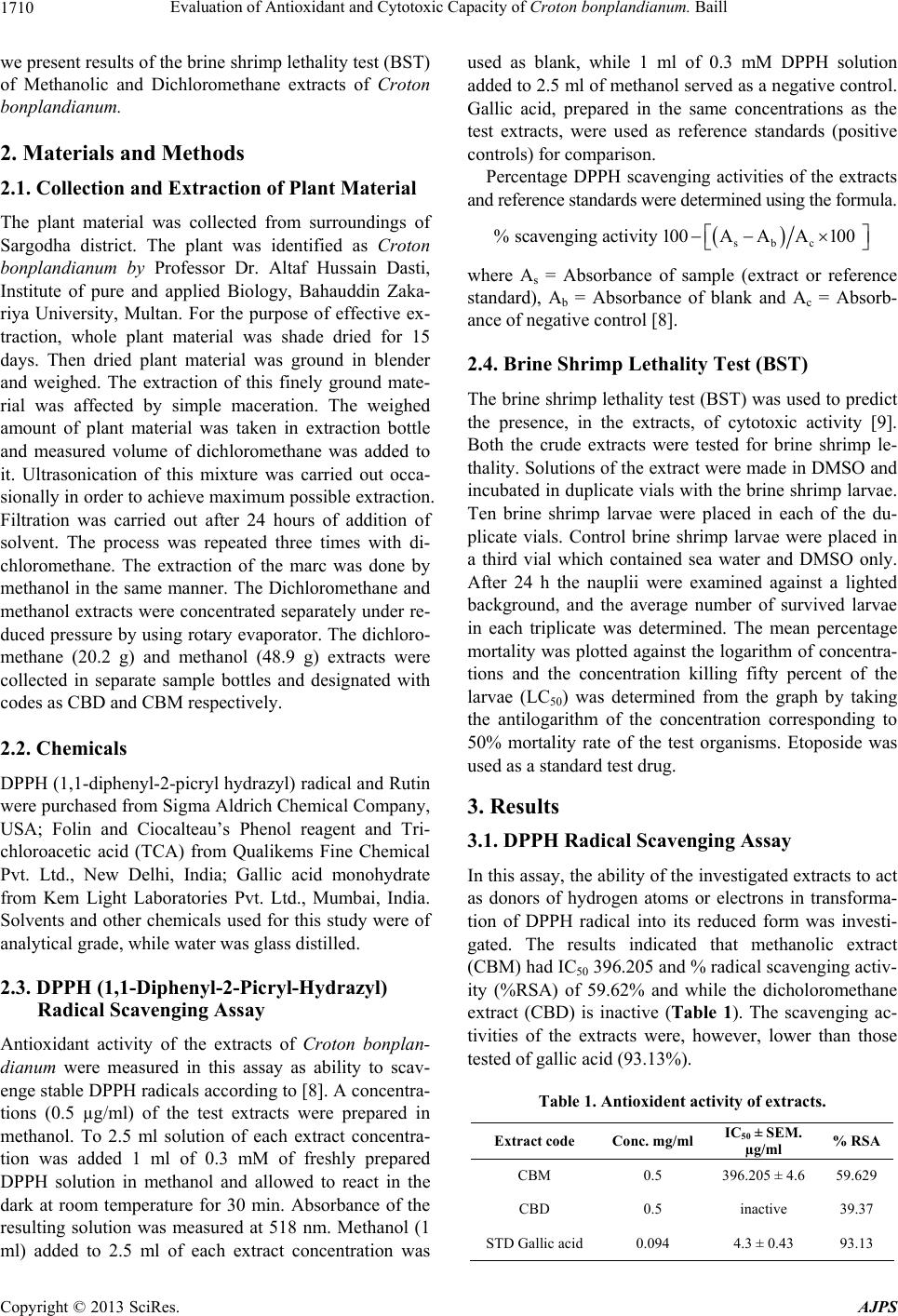 Evaluation of Antioxidant and Cytotoxic Capacity of Croton bonplandianum. Baill 1710 we present results of the brine sh rimp lethality test (BST) of Methanolic and Dichloromethane extracts of Croton bonplandianum. 2. Materials and Methods 2.1. Collection and Extraction of Plant Material The plant material was collected from surroundings of Sargodha district. The plant was identified as Croton bonplandianum by Professor Dr. Altaf Hussain Dasti, Institute of pure and applied Biology, Bahauddin Zaka- riya University, Multan. For the purpose of effective ex- traction, whole plant material was shade dried for 15 days. Then dried plant material was ground in blender and weighed. The extraction of this finely ground mate- rial was affected by simple maceration. The weighed amount of plant material was taken in extraction bottle and measured volume of dichloromethane was added to it. Ultrasonication of this mixture was carried out occa- sionally in order to achieve maximum possible extraction. Filtration was carried out after 24 hours of addition of solvent. The process was repeated three times with di- chloromethane. The extraction of the marc was done by methanol in the same manner. The Dichloromethane and methanol extracts were concentrated separately under re- duced pressure by using rotary evaporator. The dichloro- methane (20.2 g) and methanol (48.9 g) extracts were collected in separate sample bottles and designated with codes as CBD and CBM respectively. 2.2. Chemicals DPPH (1,1-diphenyl-2-picryl hydrazyl) radical and Rutin were purchased from Sigma Aldrich Chemical Company, USA; Folin and Ciocalteau’s Phenol reagent and Tri- chloroacetic acid (TCA) from Qualikems Fine Chemical Pvt. Ltd., New Delhi, India; Gallic acid monohydrate from Kem Light Laboratories Pvt. Ltd., Mumbai, India. Solvents and other chemicals used for this study were of analytical grade, while water was glass distilled. 2.3. DPPH (1,1-Diphenyl-2-Picryl-Hydrazyl) Radical Scavenging Assay Antioxidant activity of the extracts of Croton bonplan- dianum were measured in this assay as ability to scav- enge stable DPPH radicals according to [8]. A con centr a- tions (0.5 µg/ml) of the test extracts were prepared in methanol. To 2.5 ml solution of each extract concentra- tion was added 1 ml of 0.3 mM of freshly prepared DPPH solution in methanol and allowed to react in the dark at room temperature for 30 min. Absorbance of the resulting solution was measured at 518 nm. Methanol (1 ml) added to 2.5 ml of each extract concentration was used as blank, while 1 ml of 0.3 mM DPPH solution added to 2.5 ml of methanol served as a negative control. Gallic acid, prepared in the same concentrations as the test extracts, were used as reference standards (positive controls) for comparison. Percentage DPPH scavenging activities of the extracts and reference standards were determined using the formula. sbc % scavenging activity 100AAA100 where As = Absorbance of sample (extract or reference standard), Ab = Absorbance of blank and Ac = Absorb- ance of negative control [8]. 2.4. Brine Shrimp Lethality Test (BST) The brine shrimp lethality test (BST) was used to predict the presence, in the extracts, of cytotoxic activity [9]. Both the crude extracts were tested for brine shrimp le- thality. Solutions of the extract were made in DMSO and incubated in duplicate vials with the brine shrimp larvae. Ten brine shrimp larvae were placed in each of the du- plicate vials. Control brine shrimp larvae were placed in a third vial which contained sea water and DMSO only. After 24 h the nauplii were examined against a lighted background, and the average number of survived larvae in each triplicate was determined. The mean percentage mortality was plotted against the logarithm of concentra- tions and the concentration killing fifty percent of the larvae (LC50) was determined from the graph by taking the antilogarithm of the concentration corresponding to 50% mortality rate of the test organisms. Etoposide was used as a standard test drug. 3. Results 3.1. DPPH Radical Scavenging Assay In this assay, the ability of the investigated extracts to act as donors of hydrogen atoms or electrons in transforma- tion of DPPH radical into its reduced form was investi- gated. The results indicated that methanolic extract (CBM) had IC50 396.205 and % radical scaven ging activ- ity (%RSA) of 59.62% and while the dicholoromethane extract (CBD) is inactive (Table 1). The scavenging ac- tivities of the extracts were, however, lower than those tested of gallic acid (93.13%). Table 1. Antioxident activity of extracts. Extract code Conc. mg/ml IC50 ± SEM. µg/ml % RSA CBM 0.5 396.205 ± 4.6 59.629 CBD 0.5 inactive 39.37 STD Gallic acid 0.094 4.3 ± 0.43 93.13 Copyright © 2013 SciRes. AJPS 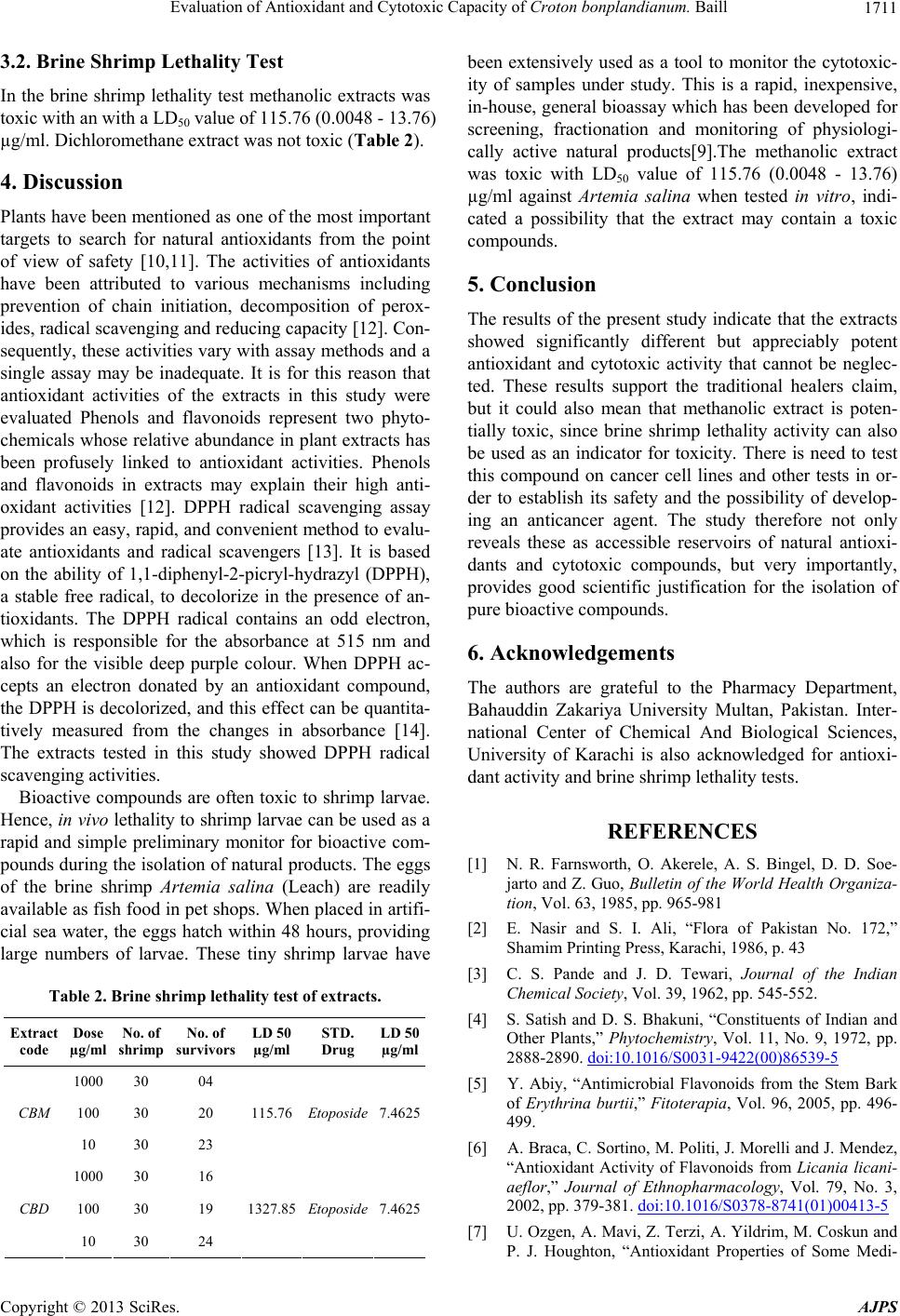 Evaluation of Antioxidant and Cytotoxic Capacity of Croton bonplandianum. Baill 1711 3.2. Brine Shrimp Lethality Test In the brine shrimp lethality test methanolic extracts was toxic with an with a LD50 value of 115.76 (0.0048 - 13.76) µg/ml. Dichloromethane extract was not toxic (Table 2). 4. Discussion Plants have been mentioned as one of the most important targets to search for natural antioxidants from the point of view of safety [10,11]. The activities of antioxidants have been attributed to various mechanisms including prevention of chain initiation, decomposition of perox- ides, radical scavenging and reducing capacity [12]. Con- sequently, these activities vary with assay methods and a single assay may be inadequate. It is for this reason that antioxidant activities of the extracts in this study were evaluated Phenols and flavonoids represent two phyto- chemicals whose relative abundance in plant extracts has been profusely linked to antioxidant activities. Phenols and flavonoids in extracts may explain their high anti- oxidant activities [12]. DPPH radical scavenging assay provides an easy, rapid, and convenient method to evalu- ate antioxidants and radical scavengers [13]. It is based on the ability of 1,1-diphenyl-2-picryl-hydrazyl (DPPH), a stable free radical, to decolorize in the presence of an- tioxidants. The DPPH radical contains an odd electron, which is responsible for the absorbance at 515 nm and also for the visible deep purple colour. When DPPH ac- cepts an electron donated by an antioxidant compound, the DPPH is decolorized, and this effect can be quantita- tively measured from the changes in absorbance [14]. The extracts tested in this study showed DPPH radical scavenging activities. Bioactive compounds are often toxic to shrimp larvae. Hence, in vivo lethality to shrimp larvae can be used as a rapid and simple preliminary monitor for bioactive com- pounds during the isolation of natural products. The eggs of the brine shrimp Artemia salina (Leach) are readily available as fish food in pet shops. When placed in artifi- cial sea water, the eggs hatch within 48 hours, providing large numbers of larvae. These tiny shrimp larvae have Table 2. Brine shrimp lethality test of extracts. Extract code Dose µg/ml No. of shrimp No. of survivors LD 50 µg/ml STD. Drug LD 50 µg/ml 1000 30 04 100 30 20 CBM 10 30 23 115.76 Etoposide 7.4625 1000 30 16 100 30 19 CBD 10 30 24 1327.85 Etoposide 7.4625 been extensively used as a tool to monitor the cytotoxic- ity of samples under study. This is a rapid, inexpensive, in-house, general bioassay which has been developed for screening, fractionation and monitoring of physiologi- cally active natural products[9].The methanolic extract was toxic with LD50 value of 115.76 (0.0048 - 13.76) µg/ml against Artemia salina when tested in vitro, indi- cated a possibility that the extract may contain a toxic compounds. 5. Conclusion The results of the present study indicate that the extracts showed significantly different but appreciably potent antioxidant and cytotoxic activity that cannot be neglec- ted. These results support the traditional healers claim, but it could also mean that methanolic extract is poten- tially toxic, since brine shrimp lethality activity can also be used as an indicator for toxicity. There is need to test this compound on cancer cell lines and other tests in or- der to establish its safety and the possibility of develop- ing an anticancer agent. The study therefore not only reveals these as accessible reservoirs of natural antioxi- dants and cytotoxic compounds, but very importantly, provides good scientific justification for the isolation of pure bioactive compounds. 6. Acknowledgements The authors are grateful to the Pharmacy Department, Bahauddin Zakariya University Multan, Pakistan. Inter- national Center of Chemical And Biological Sciences, University of Karachi is also acknowledged for antioxi- dant activity and brine shrimp lethality tests. REFERENCES [1] N. R. Farnsworth, O. Akerele, A. S. Bingel, D. D. Soe- jarto and Z. Guo, Bulletin of the World Health Organiza- tion, Vol. 63, 1985, pp. 965-981 [2] E. Nasir and S. I. Ali, “Flora of Pakistan No. 172,” Shamim Printing Press, Karachi, 1986, p. 43 [3] C. S. Pande and J. D. Tewari, Journal of the Indian Chemical Society, Vol. 39, 1962, pp. 545-552. [4] S. Satish and D. S. Bhakuni, “Constituents of Indian and Other Plants,” Phytochemistry, Vol. 11, No. 9, 1972, pp. 2888-2890. doi:10.1016/S0031-9422(00)86539-5 [5] Y. Abiy, “Antimicrobial Flavonoids from the Stem Bark of Erythrina burtii,” Fitoterapia, Vol. 96, 2005, pp. 496- 499. [6] A. Braca, C. Sortino, M. Politi, J. Morelli and J. Mendez, “Antioxidant Activity of Flavonoids from Licania licani- aeflor,” Journal of Ethnopharmacology, Vol. 79, No. 3, 2002, pp. 379-381. doi:10.1016/S0378-8741(01)00413-5 [7] U. Ozgen, A. Mavi, Z. Terzi, A. Yildrim, M. Coskun and P. J. Houghton, “Antioxidant Properties of Some Medi- Copyright © 2013 SciRes. AJPS  Evaluation of Antioxidant and Cytotoxic Capacity of Croton bonplandianum. Baill Copyright © 2013 SciRes. AJPS 1712 cinal Laminaceae Species,” Pharmaceutical Biology, Vol. 44, No. 2, 2006, pp. 107-112. doi:10.1080/13880200600592061 [8] L. L. Mensor, F. S. Menezes, G. G. Leitao, A. S. Reis, T. C. dos Santos, C. S. Coube and S. G. Leitao, “Screening of Brazilian Plant Extracts for Antioxidant Activity by the Use of DPPH Free Radical Method,” Phytotherapy Re- search, Vol. 15, No. 2, 2001, pp. 127-130. doi:10.1002/ptr.687 [9] B. N. Meyer, N. R. Ferrigni, L. B. Jacobsen, D. E. Nicho- las and L. McLaughling, “Brine Shrimp: A Convenient General Bioassay for Active Plant Constituents,” Planta Medica, Vol. 45, No. 5, 1982, pp. 31-34. doi:10.1055/s-2007-971236 [10] D. E. Okwu, “Phytochemicals and Vitamin Content of Indigenous Spices of South Eastern Nigeria,” Journal of Sustainable Agriculture and Environment, Vol. 6, No. 2, 2004, pp. 30-34. [11] M. A. Hala, “Comparative Antioxidant Activity Study of Some Edible Plants Used as Spices in Egypt,” Journal of American Science, Vol. 7, No. 1, 2011, pp. 1118-1122 [12] N. C. Cook and S. Samman, “Flavonoids-Chemistry, Me- tabolism, Cardioprotective Effects and Dietary Sources,” Journal of Nutritional Biochemistry, Vol. 7, No. 2, 1996, pp. 66-76. doi:10.1016/0955-2863(95)00168-9 [13] V. Roginsky and E. A. Lissi, “Review of Methods to De- termine Chain-Breaking Antioxidant Activity in Food,” Food Chemistry, Vol. 92, No. 2, 2005, pp. 235-254. doi:10.1016/j.foodchem.2004.08.004 [14] M. R. Saha, S. M. R. Hasan, R. Akter, M. M. Hossa in, M. S. Alam, M. A. Alam and M. E. H. Mazunder, “In Vitro Free Radical Scavenging Activity of Methanol Extract of the Leaves of Mimusops elengi Linn,” Bangladesh Jour- nal of Veterinary Medicine, Vol. 6, No. 2, 2008, pp. 197- 202. |