

Paper Menu >>
Journal Menu >>
 Open Journal of Anesthesiology, 2013, 3, 309-314 http://dx.doi.org/10.4236/ojanes.2013.37068 Published Online September 2013 (http://www.scirp.org/journal/ojanes) 309 Speeds Criteria vs. Modified Aldrete and Fast-Track Criteria for Evaluating Recovery in Outpatients Brent Burke1, Mark Kyker2 1Indiana Surgery Center East, Indianapolis, USA; 2St. Vincent Health, Carmel, USA. Email: [email protected] Received April 13th, 2013; revised May 15th, 2013; accepted June 10th, 2013 Copyright © 2013 Brent Burke, Mark Kyker. This is an open access article distributed under the Creative Commons Attribution License, which permits unrestricted use, distribution, and reproduction in any medium, provided the original work is properly cited. ABSTRACT Background: The authors have developed criteria utilizing the mnemonic “SPEEDS” (saturation, pain, extremity movement, emesis, dialogue, stable vitals signs) to evaluate and predict which patients would not require phase I nurs- ing intervention and could transition to phase II recovery. Methods: Seventy-three adult surgery patients underwent a standardized general anesthetic. Patients were evaluated with the modified Aldrete, Fast-Track and SPEEDS criteria immediately before leaving the OR and then 5, 10, 15 and 30 minutes after arrival in the recovery area. Results: Sig- nificantly more patients met phase I bypass criteria when evaluated with Modified Aldrete (90%) and Fast-Track (94%) as compared to SPEEDS (77%) (p < 0.0429 modified Ald rete vs. SPEEDS, p < 0.0038 Fast-Track vs. SPEEDS). How- ever, SPEEDS was more sensitive having a lower number of patients meeting phase II criteria yet requiring phase I in- tervention (32%) vs. Fast-track (43%) and Modified Aldrete (44%) (p < 0.001 SPEEDS vs. modified Aldrete and Fast-Track). SPEEDS was more accurate (74%) in predicting which patients should move directly to phase II co mpared to modified Aldrete (42%) (p < 0.001) and Fast-track (59%) (p = 0.05). Conclusion: SPEEDS criteria are as specific and more sensitive in determining phase I nursing interventions for ambulatory surgery patients when compared to Fast-Track and modified Aldrete criteria. Keywords: Phase I Bypass; Fast Track; PACU Nursing Interventions 1. Introduction With the advent of fast-track anesthesia, the elimination of the traditional recovery room has become possible [1]. In fact, our ambulatory surgery center has incorporated this type of design. However, in most traditional OR suites, a phase I recovery area and a step-down or phase II recovery exist in separate locations. In order to bypass phase I recovery, surgical patients must be assessed in the operating room immediately upon awakening and determination is made concerning the suitability of by- pass. An efficient assessment tool is needed to allow for a rapid decision as to whether a patient is able to progress to phase II and not require phase I type nursing care. The modified Aldrete criteria [2] have been the traditional method of evaluating patients for discharge to the surgi- cal ward or phase II recovery for outpatients. Recently, White and Song proposed a fast-track scoring system [3] that incorporates not only the modified Aldrete criteria but also an assessment of pain and nausea both of which are typically treated in phase I recovery. We have developed new, simplified criteria for evalu- ating surgical patients recovering from general anesthesia that is easily applied and utilizes the mnemonic “SPEEDS”. This stands for oxygen saturation, pain con- trol, emesis control, extremity movement, dialogue, and stable vital signs. Instead of using a point system, the SPEEDS criteria require a simple “yes” or “no” re- sponse to each parameter. A patient must have a response of “yes” to all parameters to progress to phase II recov- ery (Appendix 1). We compared the new SPEEDS crite- ria to both the modified Aldrete and the Fast-Track sys- tem in an ambulatory surgery center where fast tracking is emphasized. We hypothesized that SPEEDS criteria would be as good as or better than existing scoring sys- tems at predicting which patients would require phase I nursing interventions. 2. Methods After obtaining institutional review board approval and written informed consent from all patients, recovery data Copyright © 2013 SciRes. OJAnes  Speeds Criteria vs. Modified Aldrete and Fast-Track Criteria for Evaluating Recovery in Outpatients 310 was obtained from 73 adult outpatients selected from the general population undergoing a wide range of surgical procedures from April 2001 to July 2001. Exclusion cri- teria included a pre-operative visual analogue pain score greater than 4 or oxygen saturation less than 95% on room air. All patients were premedicated with Rofecoxib 50 mg and Acetomenophen 1000 mg p.o. before induction with propofol (1.5 - 2.0 mg/kg), fentanyl (1 - 1.5 ug/kg) and succinylcholine (1 mg/kg) to facilitate intubation if nec- essary and then maintained with desflurane, nitrous oxide, and oxygen titrated to a BIS of 40 - 50. Droperidol (0.625 mg) and dexamethasone (10 mg) IV were given for anti-emetic prophylaxis. Local anesthetic infiltration was provided with levobupivacaine 1%. Neuromuscular blockade was obtained with mivacurium (2 - 4 mg) IV as needed to maintain TOF ratio less than 0.2. Morphine (up to 0.1 mg/kg) IV was given at the discretion of the anes- thesiologist for post-op analgesia. Also, Fentanyl 50 ug IV (up to 250 ug) or labetolol 5mg IV (up to 20 mg) was given to control noxious and /or hyperdynamic responses as deemed necessary. Patients were evaluated with the modified Aldrete, Fast-Track and SPEEDS criteria im- mediately before leaving the OR by the anesthesiologist and then by the PACU nurse in the post-surgical suite at 5, 10, 15 and 30 minutes post arrival. All patients were transferred directly to the step-down suite as our facility was designed without a phase I recovery area. Phase I interventions (defined as intravenous administration of analgesics, antiemetics, antihypertensives and/or the ad- ministration of oxygen therapy) could be given if neces- sary at that location by a recovery nurse in the pre/post- op suite. In evaluating the SPEEDS criteria, a visual analogue scale (VAS) score of less than 4 was considered a “yes” response for pain control. Systolic blood pressure in the range of 90 - 180 mm and a heart r ate in the rang e of 50 - 110 bpm was necessary to be considered hemodynami- cally stable and receive a “yes” response for stable vital signs. An oxygen saturation greater than 90 on room air was considered adequate for oxygen saturation. Patients were considered fast-track eligible if they achieved a modified Aldrete score of greater than or equal to 9, a Fast-Track score of greater than or equal to 12 (with no score less than 1 in any individual category) or an all “yes” response to the SPEEDS criteria. Individual types of post-op nursing interventions (e.g. IV analgesics, IV anti-emetics) were recorded along with discharge times and any post-op complication s . 3. Data Analysis Methods To summarize the validity and reliability of each of the screening tests, seven measures were used including, sensitivity, false positive rate, specificity, false negative rate, positive predictive value, negative predictive value and accuracy were calculated relative to nurse interven- tion [4]. The positive predictive value is the probability that a patient requires phase I nursing intervention, if th at patient tests positive (does not meet ph ase I bypass crite- ria). Likewise, the negative predictive value is the prob- ability that a patient does not require phase I nursing in- tervention, given that patient tests negative (does meet phase I bypass criteria). Accuracy is the proportion of all correct tests. The method used to calculate the confidence interval for a proportion is the Wilson score method without con- tinuity correction [5]. It is a refinement of the simple asymptotic method, and computationally much simpler than the method of Clopper and Pearson [6] since closed- form solutions for lower and upper limits are available, both without and with [7] continuity correction. It has the theoretical advantage among asymptotic methods of be- ing derived from the “efficient score” approach [8]. Newcombe [9] shows that Wilson score confidence in- tervals have logit scale symmetry property with conse- quent log scale symmetry for certain derived intervals. To test that the effect of several time points among the three scales logistic regression was used. In this model, time was used as a continuous independent variable and scale was categorical. To examine the overall performance between two screening tests, each patient was classified according to the result of their post-operative screening tests. There were two possible agreeing-classifications and two cross- classifications. For example, to assess the performance of SPEEDS relative to the modified Aldrete, patients were classified as, failed-failed, passed-failed, failed-passed, and passed-passed, respectively. The two middle groups were identified as the cross-classifications. The odds of requiring nurse intervention can be calculated for each of the four classifications. If the two screening tests were similar then the odds for the cross-classification groups would be near one. To evaluate performance, we can compare the odds of the cross-classifications. We fit a generalized linear model [10] to the data by the method of maximum likelihood estimation, using a logit link function and binomial vari- ance structure. The independent variable was the scoring test classification and the dependent variable was nurse intervention. The contrast between cross-classifications was tested using the Wald statistic. 4. Results The patient demographic data and distribution of case type show a wide range of ages and procedures in a community setting (Table 1). Phase I bypass rates were significantly higher with Fast-Track (95.4%) and modified Aldrete (90.4%) crite- Copyright © 2013 SciRes. OJAnes 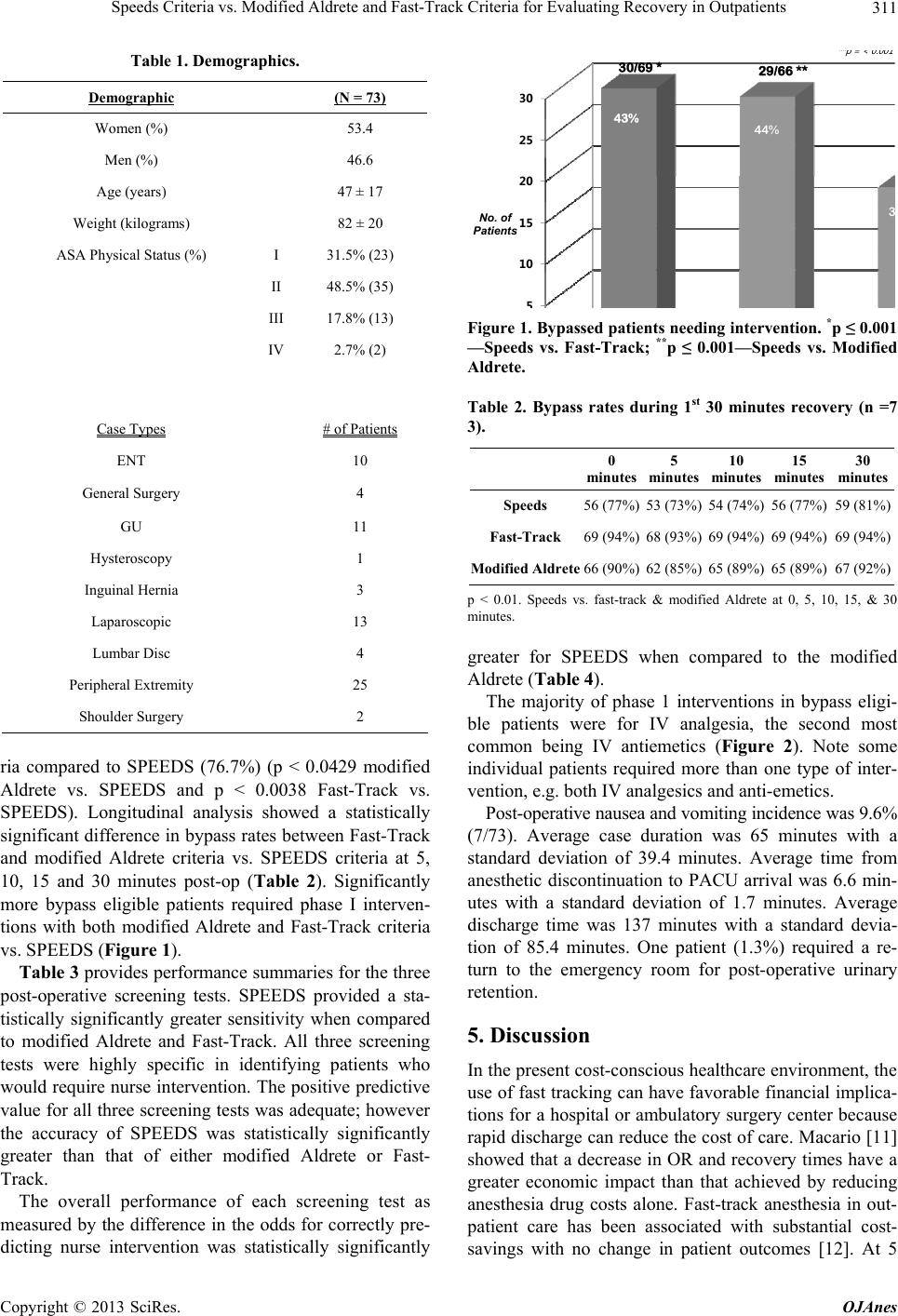 Speeds Criteria vs. Modified Aldrete and Fast-Track Criteria for Evaluating Recovery in Outpatients 311 Table 1. Demographics. Demographic (N = 73) Women (%) 53.4 Men (%) 46.6 Age (years) 47 ± 17 Weight (kilograms) 82 ± 20 ASA Physical Status (%) I 31.5% (23) II 48.5% (35) III 17.8% (13) IV 2.7% (2) Case Types # of Patients ENT 10 General Surgery 4 GU 11 Hysteroscopy 1 Inguinal Hernia 3 Laparoscopic 13 Lumbar Disc 4 Peripheral Extremity 25 Shoulder Surgery 2 ria compared to SPEEDS (76.7%) (p < 0.0429 modified Aldrete vs. SPEEDS and p < 0.0038 Fast-Track vs. SPEEDS). Longitudinal analysis showed a statistically significant difference in bypass rates between Fast-Track and modified Aldrete criteria vs. SPEEDS criteria at 5, 10, 15 and 30 minutes post-op (Table 2). Significantly more bypass eligible patients required phase I interven- tions with both modified Aldrete and Fast-Track criteria vs. SPEEDS (Figure 1). Table 3 provides performance summaries for the three post-operative screening tests. SPEEDS provided a sta- tistically significantly greater sensitivity when compared to modified Aldrete and Fast-Track. All three screening tests were highly specific in identifying patients who would require nurse in tervention. The positive predictiv e value for all three screening tests was adequate; h owever the accuracy of SPEEDS was statistically significantly greater than that of either modified Aldrete or Fast- Track. The overall performance of each screening test as measured by the difference in the odds for correctly pre- dicting nurse intervention was statistically significantly 5 10 15 20 25 30 30/69 *29/66 ** No. of Patients **p = < 0 . 001 43% 44% 3 Figure 1. Bypassed patients needing intervention. *p ≤ 0.001 —Speeds vs. Fast-Track; **p ≤ 0.001—Speeds vs. Modified Aldrete. Table 2. Bypass rates during 1st 30 minutes recovery (n =7 3). 0 minutes 5 minutes 10 minutes 15 minutes 30 minutes Speeds 56 (77%)53 (73%) 54 (74%) 56 (77%)59 (81%) Fast-Track 69 (94%)68 (93%) 69 (94%) 69 (94%)69 (94%) Modified Aldrete 66 (90%)62 (85%) 65 (89%) 65 (89%)67 (92%) p < 0.01. Speeds vs. fast-track & modified Aldrete at 0, 5, 10, 15, & 30 minutes. greater for SPEEDS when compared to the modified Aldrete (Table 4). The majority of phase 1 interventions in bypass eligi- ble patients were for IV analgesia, the second most common being IV antiemetics (Figure 2). Note some individual patients required more than one type of inter- vention, e.g. both IV analgesics and anti-emetics. Post-operative nausea and vomiting incidence was 9.6% (7/73). Average case duration was 65 minutes with a standard deviation of 39.4 minutes. Average time from anesthetic discontinuation to PACU arrival was 6.6 min- utes with a standard deviation of 1.7 minutes. Average discharge time was 137 minutes with a standard devia- tion of 85.4 minutes. One patient (1.3%) required a re- turn to the emergency room for post-operative urinary retention. 5. Discussion In the present cost-conscious healthcare environ ment, the use of fast tracking can have favorable financial implica- tions for a hospital or ambulatory surgery center because rapid discharge can reduce the cost of care. Macario [11] showed that a decrease in OR and recovery times have a greater economic impact than that achieved by reducing anesthesia drug costs alone. Fast-track anesthesia in out- patient care has been associated with substantial cost- avings with no change in patient outcomes [12]. At 5 s Copyright © 2013 SciRes. OJAnes 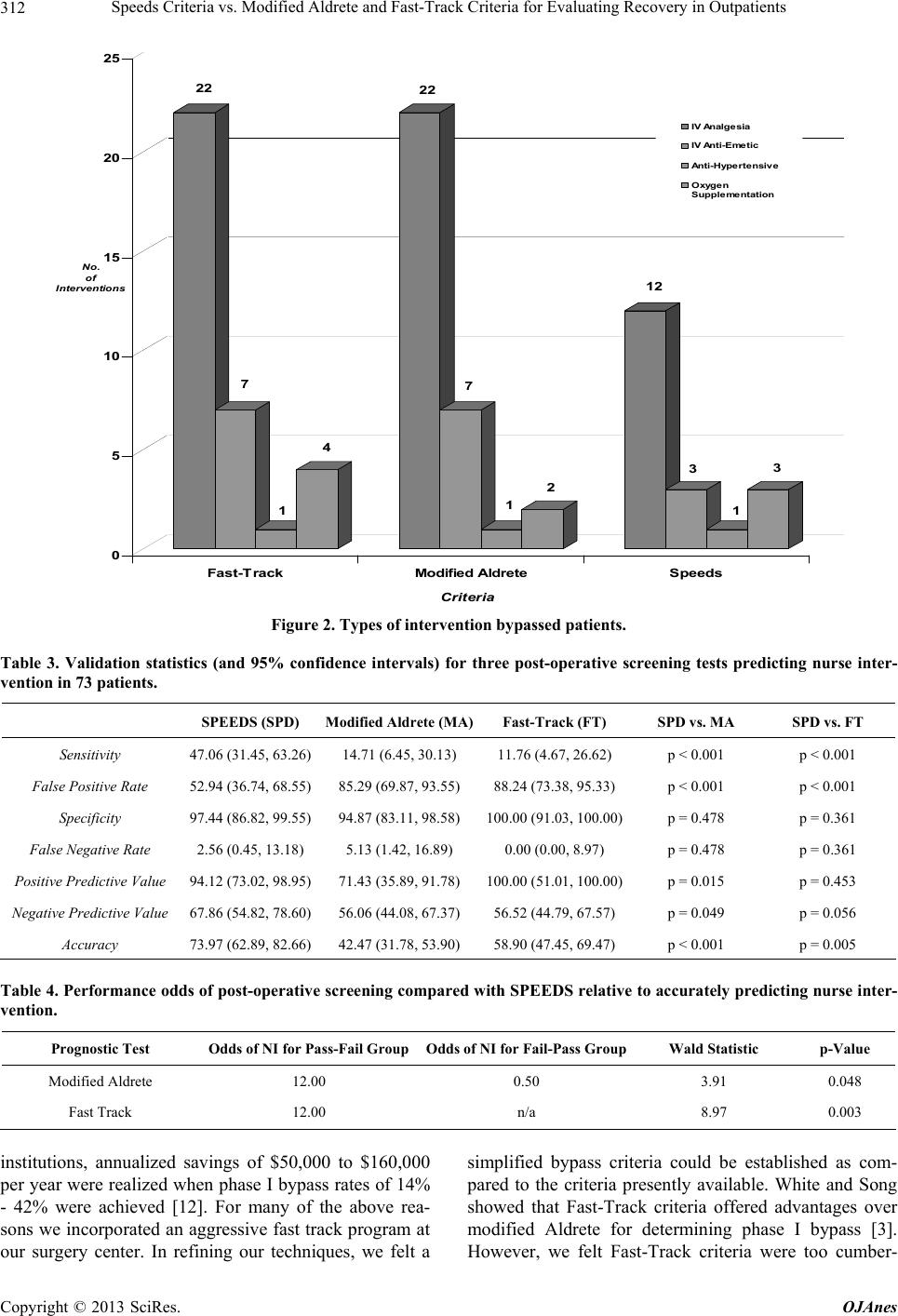 Speeds Criteria vs. Modified Aldrete and Fast-Track Criteria for Evaluating Recovery in Outpatients Copyright © 2013 SciRes. OJAnes 312 22 7 1 4 22 7 1 2 12 3 1 3 0 5 10 15 20 25 Fast-TrackModified Aldr eteSpeeds Criteria IV Analgesia IV Anti-Emetic Anti-Hypertensive Oxy g en Supplementation No. of Interventions Figure 2. Types of intervention bypassed patients. Table 3. Validation statistics (and 95% confidence intervals) for three post-operative screening tests predicting nurse inter- vention in 73 patients. SPEEDS (SPD) Modified Aldrete (MA)Fast-Track (FT) SPD vs. MA SPD vs. FT Sensitivity 47.06 (31.45, 63. 26) 14.71 (6.45, 30. 13) 11.76 (4.67, 26. 62) p < 0.001 p < 0.001 False Positive Rate 52.94 (36.74, 68. 55) 85.29 (69.87, 93. 55) 88.24 (73.38, 95.33) p < 0.001 p < 0.001 Specificity 97.44 (86.82, 99.5 5) 94.87 (83.11, 98.5 8) 100.00 (91.0 3, 100.00)p = 0.478 p = 0.361 False Negative Rate 2.56 (0.45, 13.18) 5.13 (1.42, 16.89) 0.00 (0.00, 8.97) p = 0.478 p = 0.361 Positive Predictive Value 94.12 (73.02, 98. 95) 71.43 (35.89, 91. 78) 100.00 (51. 01, 100.00)p = 0.015 p = 0.453 Negative Predictive Value 67.86 (54.82, 78. 60) 56.06 (44.08, 67. 37) 56.52 (44.79, 67.57) p = 0.049 p = 0.056 Accuracy 73.97 (62.89, 82. 66) 42.47 (31.78, 53. 90) 58.90 (47.45, 69.47) p < 0.001 p = 0.005 Table 4. Performance odds of post-operative screening compared with SPEEDS relative to accurately predicting nurse inter- vention. Prognostic Test Odds of NI for Pass-Fail GroupOdds of NI for Fail-Pass GroupWald Statistic p-Value Modified Aldrete 12.00 0.50 3.91 0.048 Fast Track 12.00 n/a 8.97 0.003 institutions, annualized savings of $50,000 to $160,000 per year were realized when phase I bypass rates of 14% - 42% were achieved [12]. For many of the above rea- sons we in corporated an aggressive fas t track program at our surgery center. In refining our techniques, we felt a simplified bypass criteria could be established as com- pared to the criteria presently available. White and Song showed that Fast-Track criteria offered advantages over modified Aldrete for determining phase I bypass [3]. However, we felt Fast-Track criteria were too cumber- 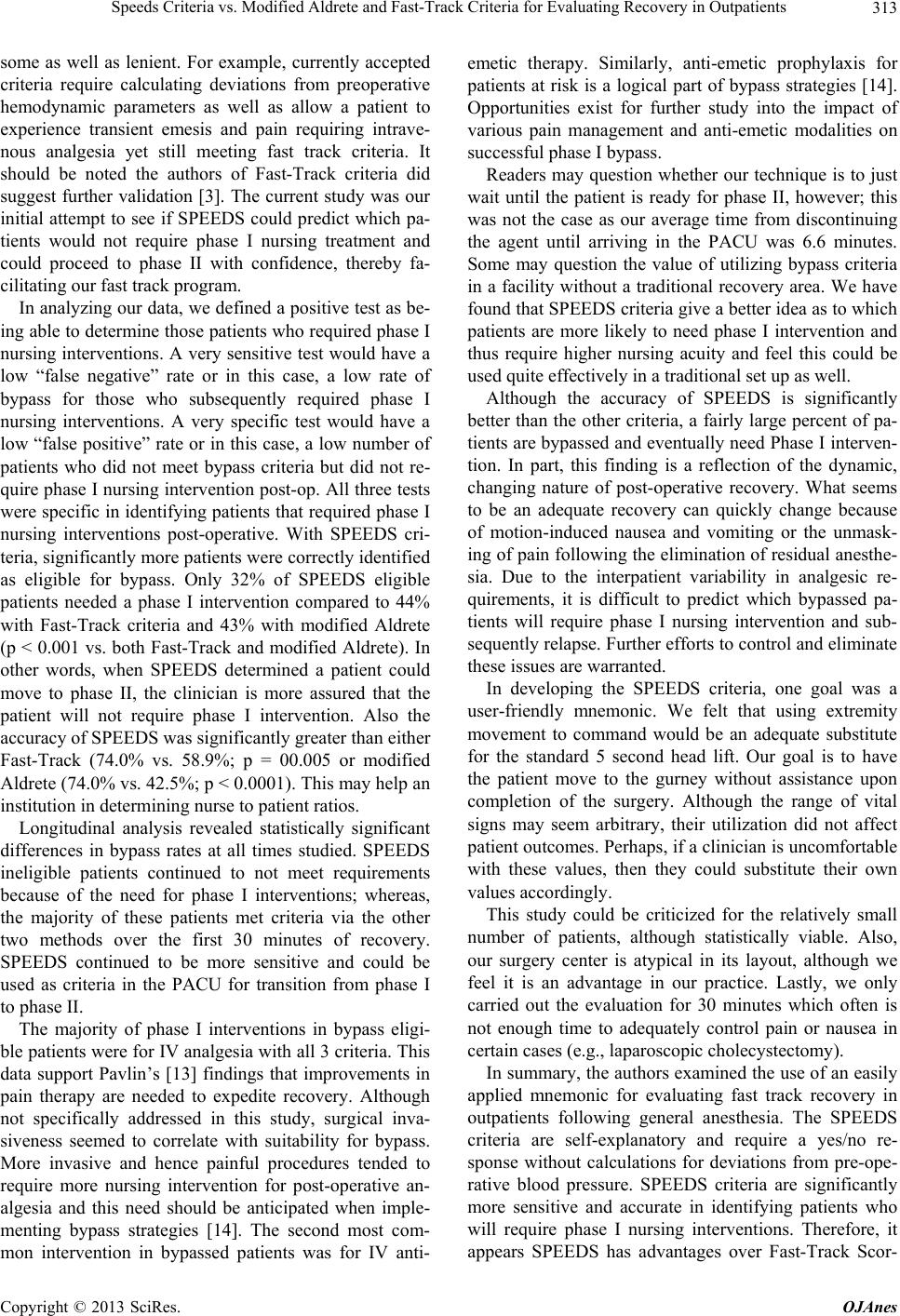 Speeds Criteria vs. Modified Aldrete and Fast-Track Criteria for Evaluating Recovery in Outpatients 313 some as well as lenient. For example, currently accepted criteria require calculating deviations from preoperative hemodynamic parameters as well as allow a patient to experience transient emesis and pain requiring intrave- nous analgesia yet still meeting fast track criteria. It should be noted the authors of Fast-Track criteria did suggest further validation [3]. The current study was our initial attempt to see if SPEEDS could predict which pa- tients would not require phase I nursing treatment and could proceed to phase II with confidence, thereby fa- cilitating our fast track program. In analyzing our data, we defined a po sitive test as be- ing able to determine those patients who required phase I nursing interventions. A very sensitiv e test would have a low “false negative” rate or in this case, a low rate of bypass for those who subsequently required phase I nursing interventions. A very specific test would have a low “false positive” rate or in this case, a low number of patients who did not meet bypass criteria but did not re- quire phase I nursing intervention post-op. All three tests were specific in identifying patients that required phase I nursing interventions post-operative. With SPEEDS cri- teria, significantly more patients were co rrectly identified as eligible for bypass. Only 32% of SPEEDS eligible patients needed a phase I intervention compared to 44% with Fast-Track criteria and 43% with modified Aldrete (p < 0.001 vs. both Fast-Track and modified Aldrete). In other words, when SPEEDS determined a patient could move to phase II, the clinician is more assured that the patient will not require phase I intervention. Also the accuracy of SPEEDS was significantly greater than either Fast-Track (74.0% vs. 58.9%; p = 00.005 or modified Aldrete (74.0% vs. 42.5%; p < 0.0001). Th is may help an institution in determining nurse to patient ratios. Longitudinal analysis revealed statistically significant differences in bypass rates at all times studied. SPEEDS ineligible patients continued to not meet requirements because of the need for phase I interventions; whereas, the majority of these patients met criteria via the other two methods over the first 30 minutes of recovery. SPEEDS continued to be more sensitive and could be used as criteria in the PACU for transition from phase I to phase II. The majority of phase I interventions in bypass eligi- ble patients were for IV analgesia with all 3 criteria. This data support Pavlin’s [13] findings that improvements in pain therapy are needed to expedite recovery. Although not specifically addressed in this study, surgical inva- siveness seemed to correlate with suitability for bypass. More invasive and hence painful procedures tended to require more nursing intervention for post-operative an- algesia and this need should be anticipated when imple- menting bypass strategies [14]. The second most com- mon intervention in bypassed patients was for IV anti- emetic therapy. Similarly, anti-emetic prophylaxis for patients at risk is a logical part of bypass strategies [14]. Opportunities exist for further study into the impact of various pain management and anti-emetic modalities on successful phase I bypa ss. Readers may question whether our technique is to just wait until the patient is ready for phase II, however; this was not the case as our average time from discontinuing the agent until arriving in the PACU was 6.6 minutes. Some may question the value of utilizing bypass criteria in a facility without a traditional recovery area. We have found that SPEEDS criteria give a better idea as to which patients are more likely to need phase I intervention and thus require higher nursing acuity and feel this could be used quite effectively in a traditional set up as well. Although the accuracy of SPEEDS is significantly better than the other criteria, a fairly large percent of pa- tients are bypassed and eventually need Phase I interven- tion. In part, this finding is a reflection of the dynamic, changing nature of post-operative recovery. What seems to be an adequate recovery can quickly change because of motion-induced nausea and vomiting or the unmask- ing of pain following the elimination of residual anesth e- sia. Due to the interpatient variability in analgesic re- quirements, it is difficult to predict which bypassed pa- tients will require phase I nursing intervention and sub- sequently relapse. Further efforts to control and eliminate these issues are warranted. In developing the SPEEDS criteria, one goal was a user-friendly mnemonic. We felt that using extremity movement to command would be an adequate substitute for the standard 5 second head lift. Our goal is to have the patient move to the gurney without assistance upon completion of the surgery. Although the range of vital signs may seem arbitrary, their utilization did not affect patient outcomes. Perhaps, if a clinician is un comfortable with these values, then they could substitute their own values accordingly. This study could be criticized for the relatively small number of patients, although statistically viable. Also, our surgery center is atypical in its layout, although we feel it is an advantage in our practice. Lastly, we only carried out the evaluation for 30 minutes which often is not enough time to adequately control pain or nausea in certain cases (e.g., laparoscopic cholecystectomy). In summary, the authors examined the use of an easily applied mnemonic for evaluating fast track recovery in outpatients following general anesthesia. The SPEEDS criteria are self-explanatory and require a yes/no re- sponse without calculations for deviations from pre-ope- rative blood pressure. SPEEDS criteria are significantly more sensitive and accurate in identifying patients who will require phase I nursing interventions. Therefore, it appears SPEEDS has advantages over Fast-Track Scor- Copyright © 2013 SciRes. OJAnes  Speeds Criteria vs. Modified Aldrete and Fast-Track Criteria for Evaluating Recovery in Outpatients Copyright © 2013 SciRes. OJAnes 314 ing System and modified Aldrete criteria in evaluating suitability for phase I recovery bypass following general anesthesia. REFERENCES [1] D. A. Lubarsky, “Fast Track in the Post-Anesthesia Care Unit: Unlimited Possibilities?” Journal of Clinical Anes- thesia, Vol. 8, No. 3, 1996, pp. 70S-72S. doi:10.1016/S0952-8180(96)90016-1 [2] J. A. Aldrete, “The Post-Anesthesia Score Revisited,” Journal of Clinical Anesthesia, Vol. 7, No. 1, 1995, pp. 89-91. doi:10.1016/0952-8180(94)00001-K [3] P. F. White, “Criteria for Fast-Tracking Outpatients after Ambulatory Surgery,” Journal of Clinical Anesthesia, Vol. 90, No. 6, 1999, pp. 1178-1190. [4] T. Greenhalgh, “How to Read a Paper: Papers That Re- port Diagnostic or Screening Tests,” BMJ, Vol. 315, No. 7107, 1997, pp. 540-543. [5] E. B. Wilson, “Probable Inferenc e, the Law of Succe ssi on, and Statistical Inference,” Journal of the American Statis- tical Association, Vol. 22, No. 158, 1927, pp. 209-212. doi:10.1080/01621459.1927.10502953 [6] C. J. Clopper and E. S. Pearson, “The Use of Confidence or Fiducial Limits Illustrated in the Case of the Bino- mial,” Biometrika, Vol. 26, No. 4, 1934, pp. 404-413. [7] J. L. Fleiss, “Statistical Methods for Rates and Propor- tions,” 2nd Edition, Wiley, New York, 1981. [8] D. R. Cox and D. V. Hinkley, “Theoretical Statistics,” Chapman and Hall, London, 1974. doi:10.1007/978-1-4899-2887-0 [9] R. G. Newcombe, “Two-Sided Confidence Intervals for the Single Proportion: Comparison of Seven Methods,” Statistics in Medicine, Vol. 17, No. 8, 1998, pp. 857-872. doi:10.1002/(SICI)1097-0258(19980430)17:8<857::AID- SIM777>3.0.CO;2-E [10] J. F. Nelder and R. W. M. Wedderburn, “Generalized Linear Models,” Journal of the Royal Statistical Soci e t y A, Vol. 135, No. 3, 1972, pp. 370-384. [11] A. Macario, T. Vitez, B. A. Dunn and T. McDonald, “Where Are the Costs in Perioperative Care? Analysis of Hospital Costs and Charges for Inpatient Surgical Care,” Anesthesiology, Vol. 83, No. 6, 1995, pp. 1138-1144. doi:10.1097/00000542-199512000-00002 [12] J. L. Apfelbaum, C. A. Walawander and the SAFE Study Te am, “Eliminating Intensive Postoperative Care in Same- Day Surgery Patients Using Short-Acting Anesthetics,” Anesthesiology, Vol. 97, No. 1, 2002, pp. 66-74. doi:10.1097/00000542-200207000-00010 [13] D. Pavlin, C. Chen and D. Penaloza, “Pain as a Factory Complicating Recovery and Discharge after Ambulatory Surgery,” Anesthesia & Analgesia, Vol. 95, No. 3, 2002, pp. 627-634. [14] B. A. Williams, M. L. Kentor and J. P. Williams, “PACU Bypass after Outpatient Knee Surgery Is Associated with Fewer Unplanned Hospital Admissions But More Phase 2 Nursing Interventions,” Anesthesiology, Vol. 97, No. 4, 2002, pp. 981-988. doi:10.1097/00000542-200210000-00034 |