

Paper Menu >>
Journal Menu >>
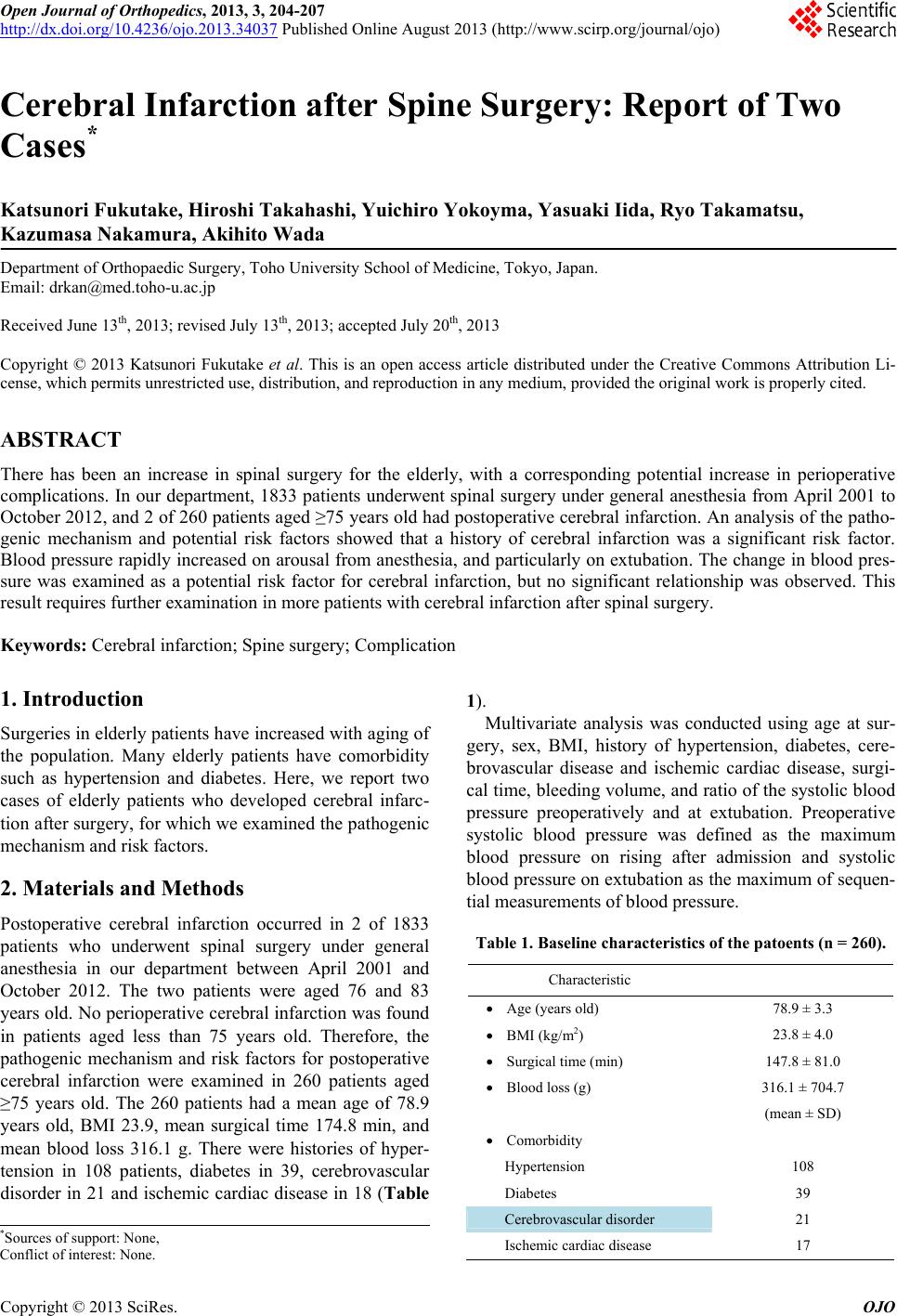 Open Journal of Orthopedics, 2013, 3, 204-207 http://dx.doi.org/10.4236/ojo.2013.34037 Published Online August 2013 (http://www.scirp.org/journal/ojo) Copyright © 2013 SciRes. OJO Cerebral Infarction after Spine Surgery: Report of Two Cases* Katsunori Fukutake, Hiroshi Takahashi, Yuichiro Yokoyma, Yasuaki Iida, Ryo Takamatsu, Kazumasa Na kamura, Akihito Wada Department of Orthopaedic Surgery, Toho University School of Medicine, Tokyo, Japan. Email: [email protected] Received June 13th, 2013; revised July 13th, 2013; accepted July 20th, 2013 Copyright © 2013 Katsunori Fukutake et al. This is an open access article distributed under the Creative Commons Attribution Li- cense, which permits unrestricted use, distribution, and reproduction in any medium, provided the original work is properly cited. ABSTRACT There has been an increase in spinal surgery for the elderly, with a corresponding potential increase in perioperative complications. In our department, 1833 patients underwent spinal surgery under general anesthesia from April 2001 to October 2012, and 2 of 260 patients aged ≥75 years old had postoperative cerebral infarction. An analysis of the patho- genic mechanism and potential risk factors showed that a history of cerebral infarction was a significant risk factor. Blood pressure rapidly increased on arousal from anesthesia, and particularly on extubation. The change in blood pres- sure was examined as a potential risk factor for cerebral infarction, but no significant relationship was observed. This result requires further examination in more patients with cerebral infarction after spinal surgery. Keywords: Cerebral infarction; Spine surgery; Complication 1. Introduction Surgeries in elderly patients have increased with aging of the population. Many elderly patients have comorbidity such as hypertension and diabetes. Here, we report two cases of elderly patients who developed cerebral infarc- tion after surgery, for which we examined the pathogenic mechanism and risk factors. 2. Materials and Methods Postoperative cerebral infarction occurred in 2 of 1833 patients who underwent spinal surgery under general anesthesia in our department between April 2001 and October 2012. The two patients were aged 76 and 83 years old. No perioperative cerebral infarction was found in patients aged less than 75 years old. Therefore, the pathogenic mechanism and risk factors for postoperative cerebral infarction were examined in 260 patients aged ≥75 years old. The 260 patients had a mean age of 78.9 years old, BMI 23.9, mean surgical time 174.8 min, and mean blood loss 316.1 g. There were histories of hyper- tension in 108 patients, diabetes in 39, cerebrovascular disorder in 21 and ischemic cardiac disease in 18 (Table 1). Multivariate analysis was conducted using age at sur- gery, sex, BMI, history of hypertension, diabetes, cere- brovascular disease and ischemic cardiac disease, surgi- cal time, bleeding volume, and ratio of the systolic blood pressure preoperatively and at extubation. Preoperative systolic blood pressure was defined as the maximum blood pressure on rising after admission and systolic blood pressure on extubation as the maximum of sequen- tial measurements of blood pressure. Table 1. Baseline characteristics of the patoents (n = 260). Characteristic Age (years old) 78.9 ± 3.3 BMI (kg/m2) 23.8 ± 4.0 Surgical time (min) 147.8 ± 81.0 Blood loss (g) 316.1 ± 704.7 (mean ± SD) Comorbidity Hypertension 108 Diabetes 39 Cerebrovascular disorder 21 Ischemic cardiac disease 17 *Sources of support: None, Conflict of interest: None. 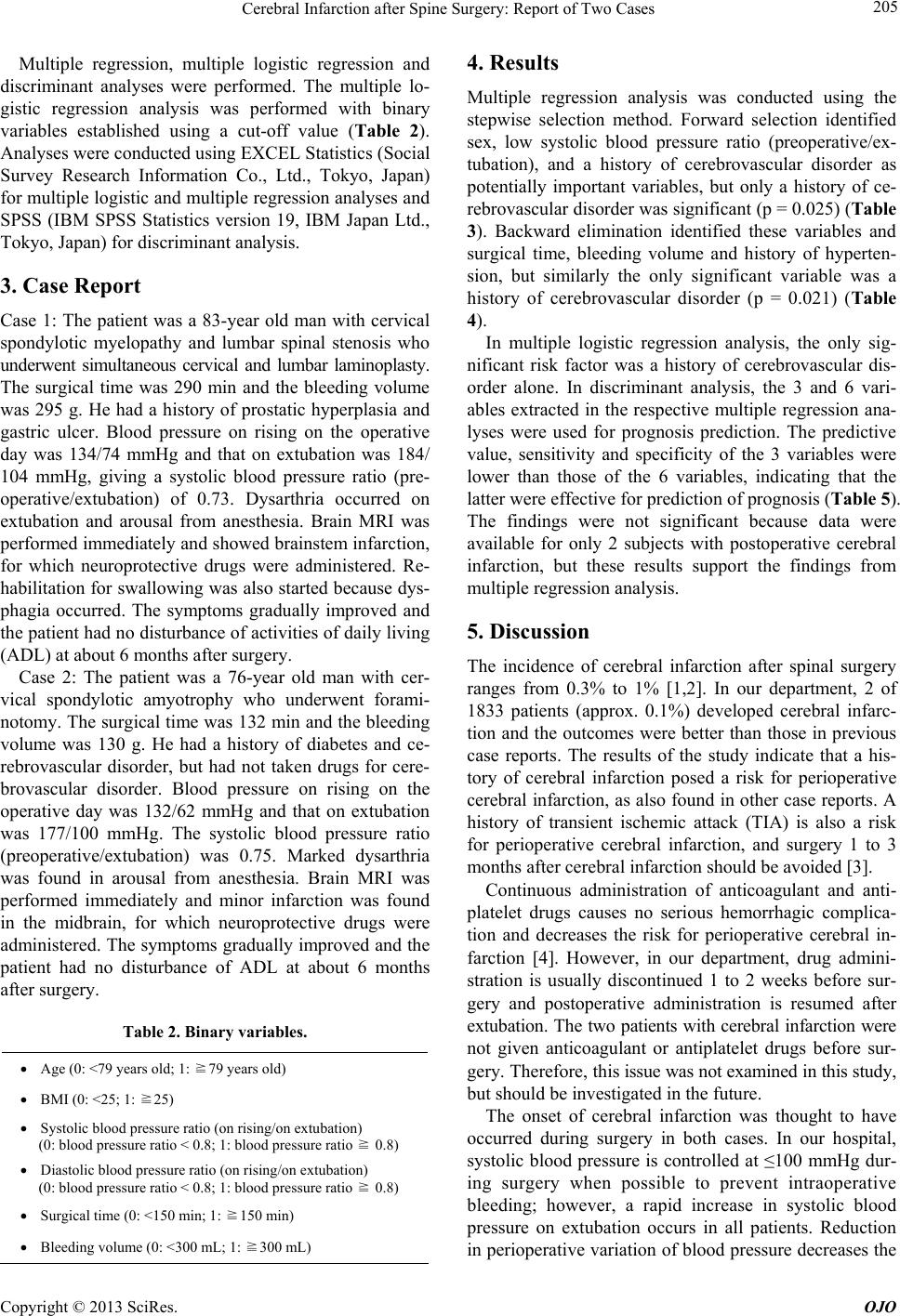 Cerebral Infarction after Spine Surgery: Report of Two Cases Copyright © 2013 SciRes. OJO 205 Multiple regression, multiple logistic regression and discriminant analyses were performed. The multiple lo- gistic regression analysis was performed with binary variables established using a cut-off value (Table 2). Analyses were conducted using EXCEL Statistics (Social Survey Research Information Co., Ltd., Tokyo, Japan) for multiple logistic and multiple regression analyses and SPSS (IBM SPSS Statistics version 19, IBM Japan Ltd., Tokyo, Japan) for discriminant analysis. 3. Case Report Case 1: The patient was a 83-year old man with cervical spondylotic myelopathy and lumbar spinal stenosis who underwent simultaneous cervical and lumbar laminoplasty. The surgical time was 290 min and the bleeding volume was 295 g. He had a history of prostatic hyperplasia and gastric ulcer. Blood pressure on rising on the operative day was 134/74 mmHg and that on extubation was 184/ 104 mmHg, giving a systolic blood pressure ratio (pre- operative/extubation) of 0.73. Dysarthria occurred on extubation and arousal from anesthesia. Brain MRI was performed immediately and showed brainstem infarction, for which neuroprotective drugs were administered. Re- habilitation for swallowing was also started because dys- phagia occurred. The symptoms gradually improved and the patient had no disturbance of activities of daily living (ADL) at about 6 months after surgery. Case 2: The patient was a 76-year old man with cer- vical spondylotic amyotrophy who underwent forami- notomy. The surgical time was 132 min and the bleeding volume was 130 g. He had a history of diabetes and ce- rebrovascular disorder, but had not taken drugs for cere- brovascular disorder. Blood pressure on rising on the operative day was 132/62 mmHg and that on extubation was 177/100 mmHg. The systolic blood pressure ratio (preoperative/extubation) was 0.75. Marked dysarthria was found in arousal from anesthesia. Brain MRI was performed immediately and minor infarction was found in the midbrain, for which neuroprotective drugs were administered. The symptoms gradually improved and the patient had no disturbance of ADL at about 6 months after surgery. Table 2. Binary variables. Age (0: <79 years old; 1≧ : 79 years old) BMI (0: <25; 1: ≧25) Systolic blood pressure ratio (on rising/on extubation) (0: blood pressure ratio < ≧ 0.8; 1: blood pressure ratio 0.8) Diastolic blood pressure ratio (on rising/on extubation) (0: blood pressure ratio < 0.8; 1≧ : blood pressure ratio 0.8) Surgical time (0≧ : <150 min; 1: 150 min) Bleeding volume (0: <300 mL; 1≧ : 300 mL) 4. Results Multiple regression analysis was conducted using the stepwise selection method. Forward selection identified sex, low systolic blood pressure ratio (preoperative/ex- tubation), and a history of cerebrovascular disorder as potentially important variables, but only a history of ce- rebrovascular disorder was significant (p = 0.025) (Table 3). Backward elimination identified these variables and surgical time, bleeding volume and history of hyperten- sion, but similarly the only significant variable was a history of cerebrovascular disorder (p = 0.021) (Table 4). In multiple logistic regression analysis, the only sig- nificant risk factor was a history of cerebrovascular dis- order alone. In discriminant analysis, the 3 and 6 vari- ables extracted in the respective multiple regression ana- lyses were used for prognosis prediction. The predictive value, sensitivity and specificity of the 3 variables were lower than those of the 6 variables, indicating that the latter were effective for prediction of prognosis (Table 5). The findings were not significant because data were available for only 2 subjects with postoperative cerebral infarction, but these results support the findings from multiple regression analysis. 5. Discussion The incidence of cerebral infarction after spinal surgery ranges from 0.3% to 1% [1,2]. In our department, 2 of 1833 patients (approx. 0.1%) developed cerebral infarc- tion and the outcomes were better than those in previous case reports. The results of the study indicate that a his- tory of cerebral infarction posed a risk for perioperative cerebral infarction, as also found in other case reports. A history of transient ischemic attack (TIA) is also a risk for perioperative cerebral infarction, and surgery 1 to 3 months after cerebral infarction should be avoided [3]. Continuous administration of anticoagulant and anti- platelet drugs causes no serious hemorrhagic complica- tion and decreases the risk for perioperative cerebral in- farction [4]. However, in our department, drug admini- stration is usually discontinued 1 to 2 weeks before sur- gery and postoperative administration is resumed after extubation. The two patients with cerebral infarction were not given anticoagulant or antiplatelet drugs before sur- gery. Therefore, this issue was not examined in this study, but should be investigated in the future. The onset of cerebral infarction was thought to have occurred during surgery in both cases. In our hospital, systolic blood pressure is controlled at ≤100 mmHg dur- ing surgery when possible to prevent intraoperative bleeding; however, a rapid increase in systolic blood pressure on extubation occurs in all patients. Reduction in perioperative variation of blood pressure decreases the 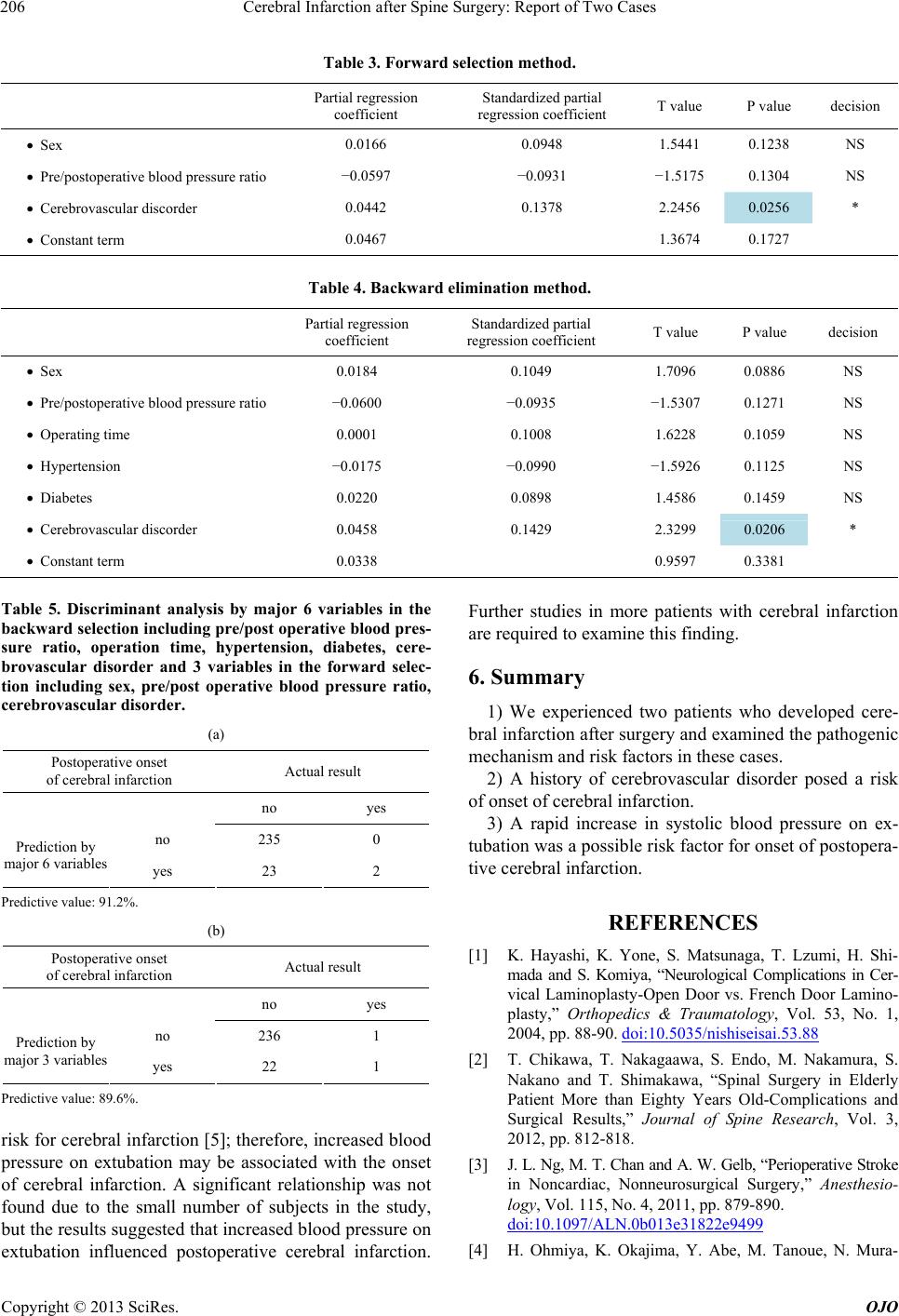 Cerebral Infarction after Spine Surgery: Report of Two Cases Copyright © 2013 SciRes. OJO 206 Table 3. Forward se lection method. Partial regression coefficient Standardized partial regression coefficient T value P value decision Sex 0.0166 0.0948 1.5441 0.1238 NS Pre/postoperative blood pressure ratio −0.0597 −0.0931 −1.5175 0.1304 NS Cerebrovascular discorder 0.0442 0.1378 2.2456 0.0256 * Constant term 0.0467 1.3674 0.1727 Table 4. Backward elimination method. Partial regression coefficient Standardized partial regression coefficient T value P value decision Sex 0.0184 0.1049 1.7096 0.0886 NS Pre/postoperative blood pressure ratio −0.0600 −0.0935 −1.5307 0.1271 NS Operating time 0.0001 0.1008 1.6228 0.1059 NS Hypertension −0.0175 −0.0990 −1.5926 0.1125 NS Diabetes 0.0220 0.0898 1.4586 0.1459 NS Cerebrovascular discorder 0.0458 0.1429 2.3299 0.0206 * Constant term 0.0338 0.9597 0.3381 Table 5. Discriminant analysis by major 6 variables in the backward selection incl uding pre/post operative blood pres- sure ratio, operation time, hypertension, diabetes, cere- brovascular disorder and 3 variables in the forward selec- tion including sex, pre/post operative blood pressure ratio, cerebrovascular disorder. (a) Postoperative onset of cerebral infarction Actual result no yes no 235 0 Prediction by major 6 variables yes 23 2 Predictive value: 91.2%. (b) Postoperative onset of cerebral infarction Actual result no yes no 236 1 Prediction by major 3 variables yes 22 1 Predictive value: 89.6%. risk for cerebral infarction [5]; therefore, increased blood pressure on extubation may be associated with the onset of cerebral infarction. A significant relationship was not found due to the small number of subjects in the study, but the results suggested that increased blood pressure on extubation influenced postoperative cerebral infarction. Further studies in more patients with cerebral infarction are required to examine this finding. 6. Summary 1) We experienced two patients who developed cere- bral infarction after surgery and examined the pathogenic mechanism and risk factors in these cases. 2) A history of cerebrovascular disorder posed a risk of onset of cerebral infarction. 3) A rapid increase in systolic blood pressure on ex- tubation was a possible risk factor for onset of postopera- tive cerebral infarction. REFERENCES [1] K. Hayashi, K. Yone, S. Matsunaga, T. Lzumi, H. Shi- mada and S. Komiya, “Neurological Complications in Cer- vical Laminoplasty-Open Door vs. French Door Lamino- plasty,” Orthopedics & Traumatology, Vol. 53, No. 1, 2004, pp. 88-90. doi:10.5035/nishiseisai.53.88 [2] T. Chikawa, T. Nakagaawa, S. Endo, M. Nakamura, S. Nakano and T. Shimakawa, “Spinal Surgery in Elderly Patient More than Eighty Years Old-Complications and Surgical Results,” Journal of Spine Research, Vol. 3, 2012, pp. 812-818. [3] J. L. Ng, M. T. Chan and A. W. Gelb, “Perioperative Stroke in Noncardiac, Nonneurosurgical Surgery,” Anesthesio- logy, Vol. 115, No. 4, 2011, pp. 879-890. doi:10.1097/ALN.0b013e31822e9499 [4] H. Ohmiya, K. Okajima, Y. Abe, M. Tanoue, N. Mura-  Cerebral Infarction after Spine Surgery: Report of Two Cases Copyright © 2013 SciRes. OJO 207 kami and S. Mori, “Anticoagulant during Perioperaive Stage of Spiral Surgery,” Orthopedics & Traumatology, Vol. 56, No. 2, 2007, pp. 214-216. doi:10.5035/nishiseisai.56.214 [5] M. Selim, “Perioperative Stroke,” The New England Journal of Medicine, Vol. 356, 2007, pp. 706-713. doi:10.1056/NEJMra062668 |