

Paper Menu >>
Journal Menu >>
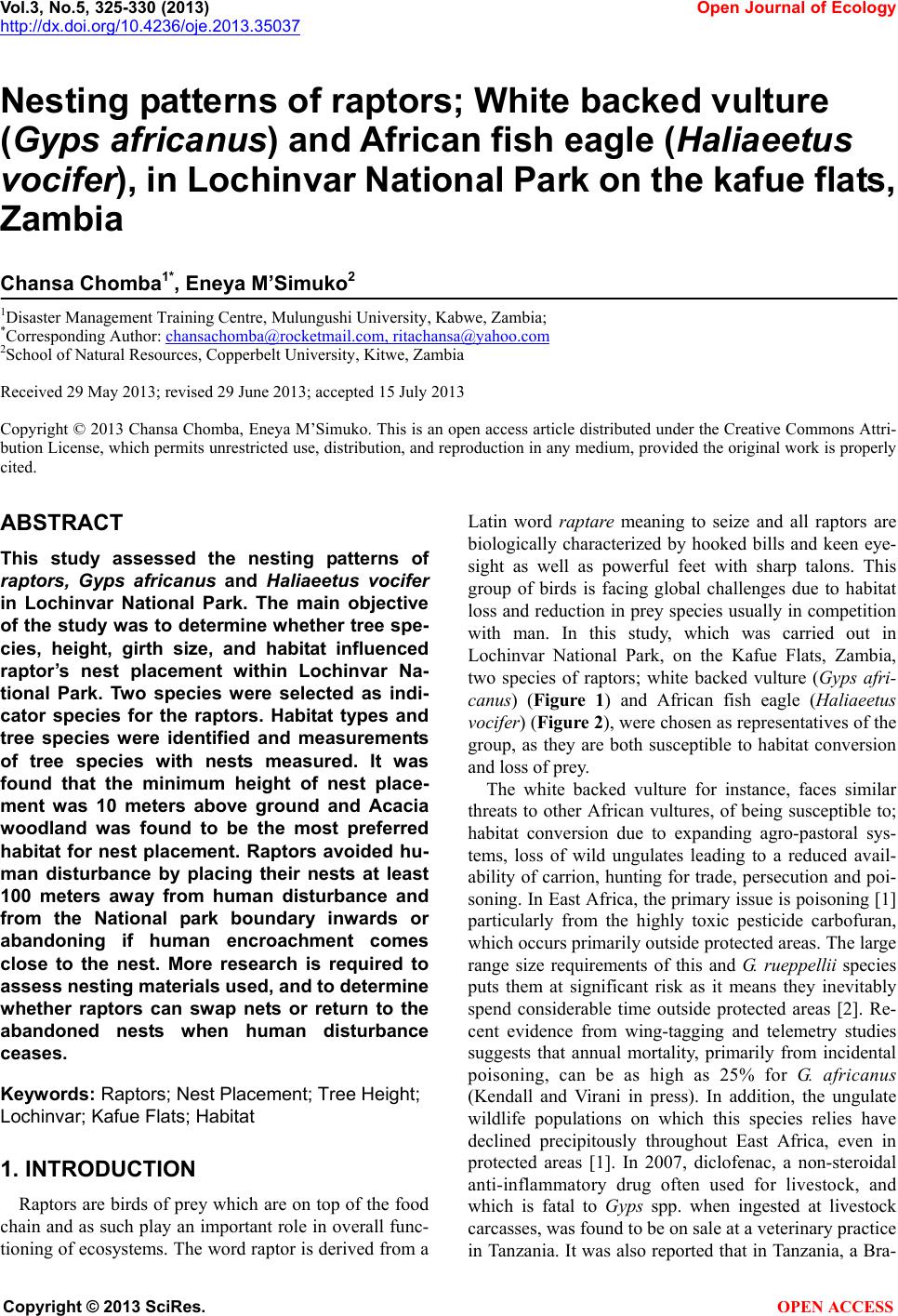 Vol.3, No.5, 325-330 (2013) Open Journal of Ecology http://dx.doi.org/10.4236/oje.2013.35037 Nesting patterns of raptors; White backed vulture (Gyps africanus) and African fish eagle (Haliaeetus vocifer), in Lochinvar National Park on the kafue flat s, Zambia Chansa Chomba1*, Eneya M’Simuko2 1Disaster Management Training Centre, Mulungushi University, Kabwe, Zambia; *Corresponding Auth o r : [email protected]m, [email protected] 2School of Natural Resources, Copperbelt University, Kitwe, Zambia Received 29 May 2013; revised 29 June 2013; accepted 15 July 2013 Copyright © 2013 Chansa Chomba, Eneya M’Simuko. This is an open access article distributed under the Creative Commons Attri- bution License, which permits unrestricted use, distribution, and reproduction in any medium, provided the original work is properly cited. ABSTRACT This study assessed the nesting patterns of raptors, Gyps africanus and Haliaeetus vocifer in Lochinvar National Park. The main objective of the study was to determine whether tree spe- cies, height, girth size, and habitat influenced raptor’s nest placement within Lochinvar Na- tional Park. Two species were selected as indi- cator species for the raptors. Habitat types and tree species were identified and measurements of tree species with nests measured. It was found that the minimum height of nest place- ment was 10 meters above ground and Acacia woodland was found to be the most preferred habitat for nest placement. Raptors avoided hu- man disturbance by placing their nests at least 100 meters away from human disturbance and from the National park boundary inwards or abandoning if human encroachment comes close to the nest. More research is required to assess nesting materials u sed, and to d eterm ine whether raptors can swap nets or return to the abandoned nests when human disturbance ceases. Keywords: Raptors; Nest Placement; Tree Height; Lochinvar; Kafue Flats; Habitat 1. INTRODUCTION Raptors are birds of prey which are on top of the food chain and as such play an important role in overall fun c- tioning of ecosystems. The word raptor is derived from a Latin word raptare meaning to seize and all raptors are biologically characterized by hooked bills and keen eye- sight as well as powerful feet with sharp talons. This group of birds is facing global challenges due to habitat loss and reduction in prey species usually in competition with man. In this study, which was carried out in Lochinvar National Park, on the Kafue Flats, Zambia, two species of raptors; white backed vulture (Gyps afri- canus) (Figure 1) and African fish eagle (Haliaeetus vocifer) (Figure 2), were chosen as representatives of the group, as they are both susceptible to habitat conversion and loss of prey. The white backed vulture for instance, faces similar threats to other African vultures, of being susceptible to; habitat conversion due to expanding agro-pastoral sys- tems, loss of wild ungulates leading to a reduced avail- ability of carrion, hunting for trade, persecution and poi- soning. In East Africa, the primary issue is poison ing [1] particularly from the highly toxic pesticide carbofuran, which o ccur s primar il y ou tsi de pro te cted areas . Th e large range size requirements of this and G. rueppellii species puts them at significant risk as it means they inevitably spend considerable time outside protected areas [2]. Re- cent evidence from wing-tagging and telemetry studies suggests that annual mortality, primarily from incidental poisoning, can be as high as 25% for G. africanus (Kendall and Virani in press). In addition, the ungulate wildlife populations on which this species relies have declined precipitously throughout East Africa, even in protected areas [1]. In 2007, diclofenac, a non-steroidal anti-inflammatory drug often used for livestock, and which is fatal to Gyps spp. when ingested at livestock carcasses, was found to be on sale at a veterinary practice in Tanzania. It was also reported that in Tanzania, a Bra- Copyright © 2013 SciRes. OPEN ACCESS 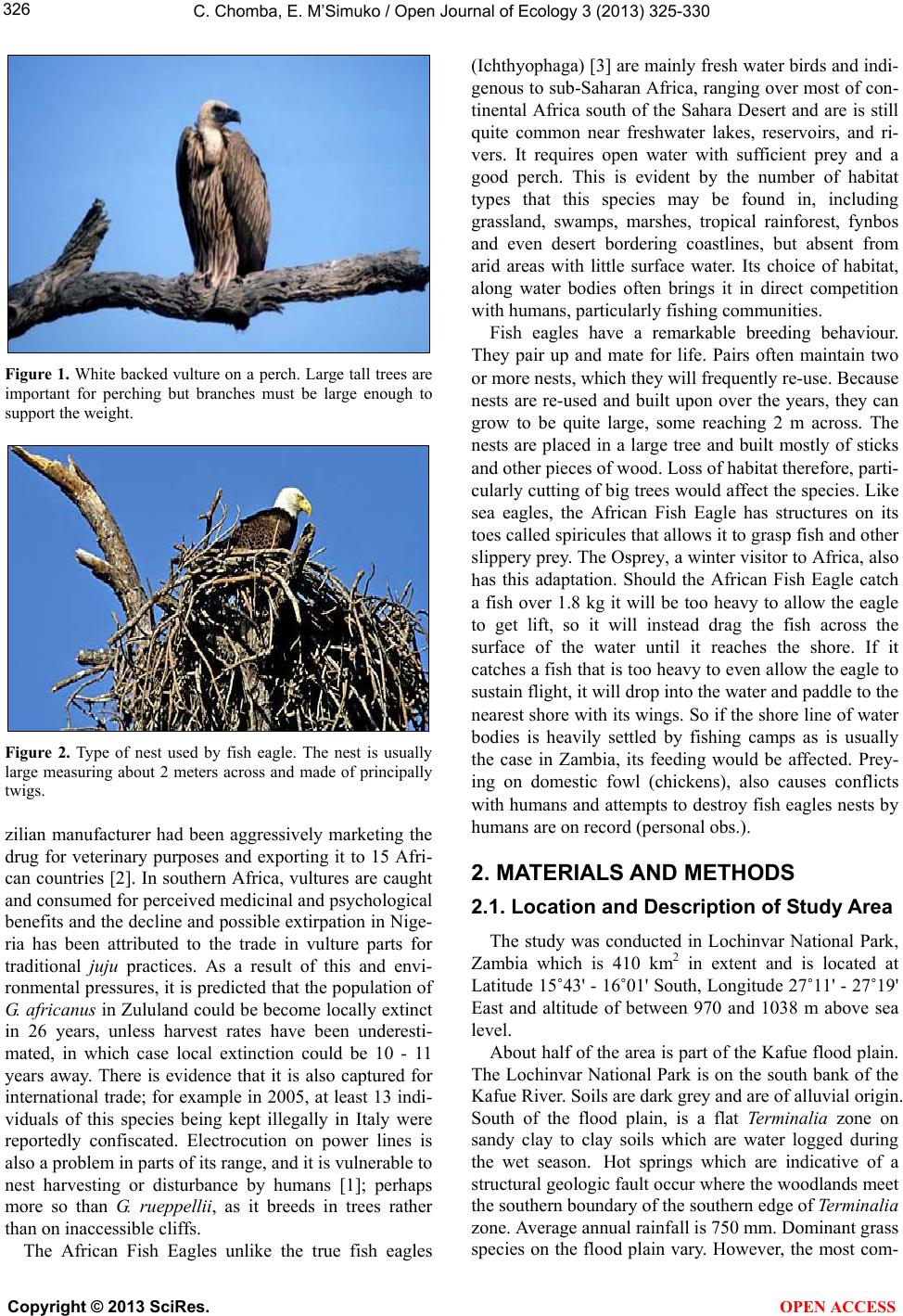 C. Chomba, E. M’Simuko / Open Journal of Ecology 3 (2013) 325-330 326 Figure 1. White backed vulture on a perch. Large tall trees are important for perching but branches must be large enough to support the weight. Figure 2. Type of nest used by fish eagle. The nest is usually large measuring about 2 meters across and made of principally twigs. zilian manufacturer had been aggressively marketing the drug for veterinary purposes and exporting it to 15 Afri- can countries [2]. In southern Africa, vultures are caught and consumed for perceived medicinal and psychological benefits and the decline and possible extirpation in Nige- ria has been attributed to the trade in vulture parts for traditional juju practices. As a result of this and envi- ronmental pressures, it is predicted th at the population of G. africanus in Zululand could be become locally extinct in 26 years, unless harvest rates have been underesti- mated, in which case local extinction could be 10 - 11 years away. There is evidence that it is also captured for international trade; fo r example in 2005, at least 1 3 indi- viduals of this species being kept illegally in Italy were reportedly confiscated. Electrocution on power lines is also a problem in parts of its range, and it is vulnerable to nest harvesting or disturbance by humans [1]; perhaps more so than G. rueppellii, as it breeds in trees rather than on inaccessible cliffs. The African Fish Eagles unlike the true fish eagles (Ichthyoph aga) [3] are mainly fresh water birds and ind i- genous to sub-Saharan Africa, ranging over most of con- tinental Africa south of the Sahara Desert and are is still quite common near freshwater lakes, reservoirs, and ri- vers. It requires open water with sufficient prey and a good perch. This is evident by the number of habitat types that this species may be found in, including grassland, swamps, marsh e s , tropical rainforest, fynbos and even desert bordering coastlines, but absent from arid areas with little surface water. Its choice of habitat, along water bodies often brings it in direct competition with humans, particularly fishing communities. Fish eagles have a remarkable breeding behaviour. They pair up and mate for life. Pairs often maintain two or more nests, which they will frequently re-u se. Because nests are re-used and built upon over the years, they can grow to be quite large, some reaching 2 m across. The nests are placed in a large tree and built mostly of sticks and other pieces of wood. Loss of habitat therefore, parti- cularly cutting of big trees would affect the species. Like sea eagles, the African Fish Eagle has structures on its toes called spiricules that allows it to grasp fish an d other slippery prey. The Osprey, a winter visitor to Africa, also has this adaptation. Should the African Fish Eagle catch a fish over 1.8 kg it will be too heavy to allow the eagle to get lift, so it will instead drag the fish across the surface of the water until it reaches the shore. If it catches a fish that is too heavy to even allow the eagle to sustain flight, it will drop into the water and padd le to the nearest shore with its wings. So if the shore line of water bodies is heavily settled by fishing camps as is usually the case in Zambia, its feeding would be affected. Prey- ing on domestic fowl (chickens), also causes conflicts with humans and attempts to destroy fish eagles nests by humans are on record (personal obs.). 2. MATERIALS AND METHODS 2.1. Location and Description of Study Area The study was conducted in Lochinvar National Park, Zambia which is 410 km2 in extent and is located at Latitude 15˚43' - 16 ˚01' South, Longitude 27˚11' - 27˚19' East and altitude of between 970 and 1038 m above sea level. About half of the area is pa rt of the Kafue flood p lain. The Lochinvar National Park is on the south bank of the Kafue River. Soils are dark grey and are of alluvial origin. South of the flood plain, is a flat Terminalia zone on sandy clay to clay soils which are water logged during the wet season. Hot springs which are indicative of a structural geologic fault occur where the woodlands meet the southern boundary of the southern edge of Terminalia zone. Average annual rainfall is 750 mm. Dominant grass species on the flood plain vary. However, the most com- Copyright © 2013 SciRes. OPEN ACCESS 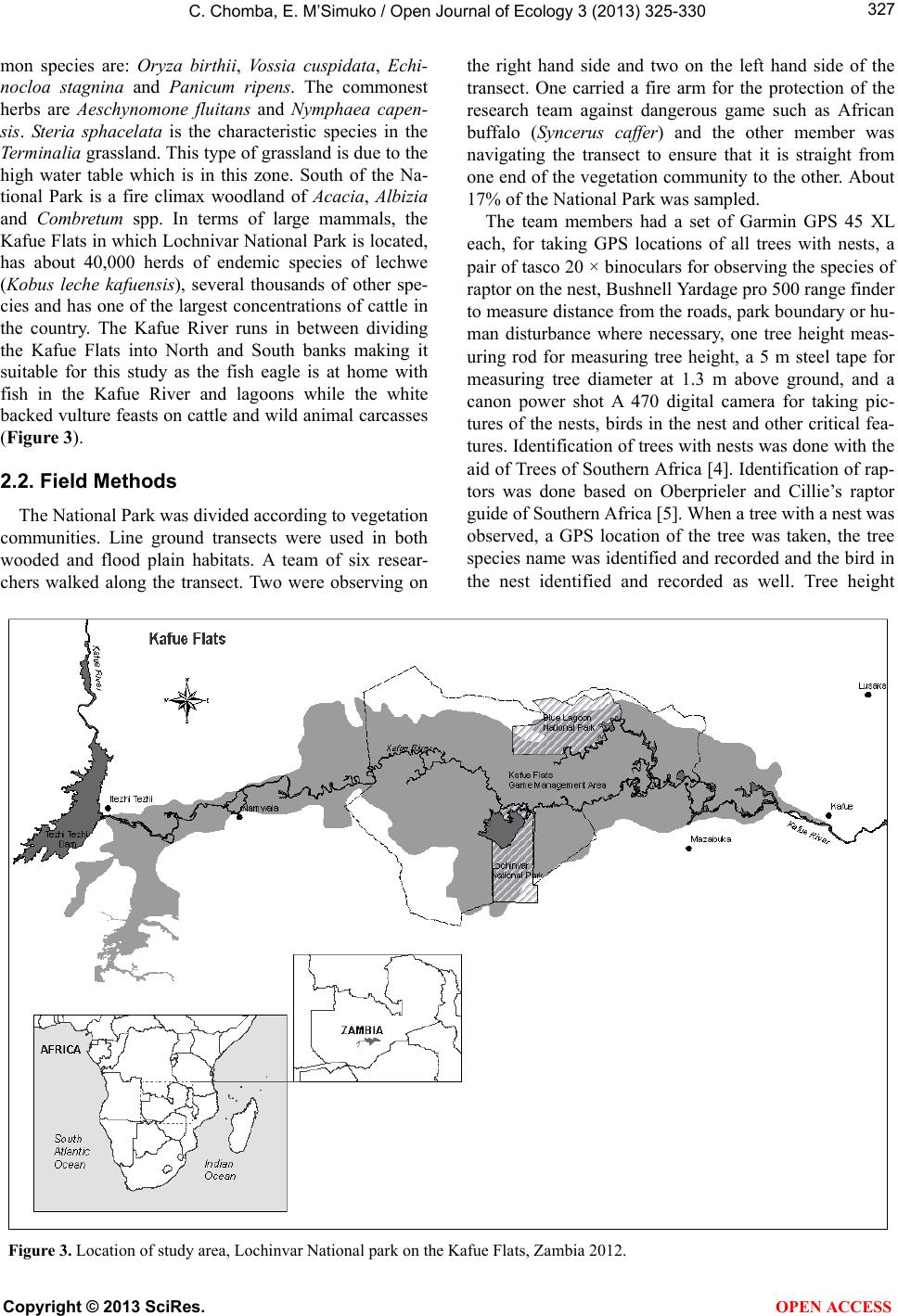 C. Chomba, E. M’Simuko / Open Journal of Ecology 3 (2013) 325-330 Copyright © 2013 SciRes. 327 mon species are: Oryza birthii, Vossia cuspidata, Echi- nocloa stagnina and Panicum ripens. The commonest herbs are Aeschynomone fluitans and Nymphaea capen- sis. Steria sphacelata is the characteristic species in the Terminalia grassland. This type of grassland is du e to the high water table which is in this zone. South of the Na- tional Park is a fire climax woodland of Aca cia, Albizia and Combretum spp. In terms of large mammals, the Kafue Flats in which Lochnivar National Park is lo cated, has about 40,000 herds of endemic species of lechwe (Kobus leche kafuensis), several thousands of other spe- cies and has one of the largest concentrations of cattle in the country. The Kafue River runs in between dividing the Kafue Flats into North and South banks making it suitable for this study as the fish eagle is at home with fish in the Kafue River and lagoons while the white backed vulture feasts on cattle and wild animal carcasses (Figure 3). the right hand side and two on the left hand side of the transect. One carried a fire arm for the protection of the research team against dangerous game such as African buffalo (Syncerus caffer) and the other member was navigating the transect to ensure that it is straight from one end of the vegetation community to the other. About 17% of the National Pa r k was sampled. The team members had a set of Garmin GPS 45 XL each, for taking GPS locations of all trees with nests, a pair of tasco 20 × binoculars for observing the species of raptor on the nest, Bushn ell Yardage pro 500 range finder to measure distance from the roads, park boundary or hu- man disturbance where necessary, one tree height meas- uring rod for measuring tree height, a 5 m steel tape for measuring tree diameter at 1.3 m above ground, and a canon power shot A 470 digital camera for taking pic- tures of the nests, birds in the nest and other critical fea- tures. Identification of trees with nests was done with the aid of Tr ees of Southern Africa [4]. Identification of rap- tors was done based on Oberprieler and Cillie’s raptor guide of Southern Africa [5]. When a tree with a nest was observed, a GPS location of the tree was taken, the tree species name was identified and recor ded and the bird in the nest identified and recorded as well. Tree height 2.2. Field Methods The National Park was divided according to vegetation communities. Line ground transects were used in both wooded and flood plain habitats. A team of six resear- chers walked along the transect. Two were observing on Figure 3. Location of study area, Lochinvar National park on the Kafue Flats, Zambia 2012. OPEN ACCESS 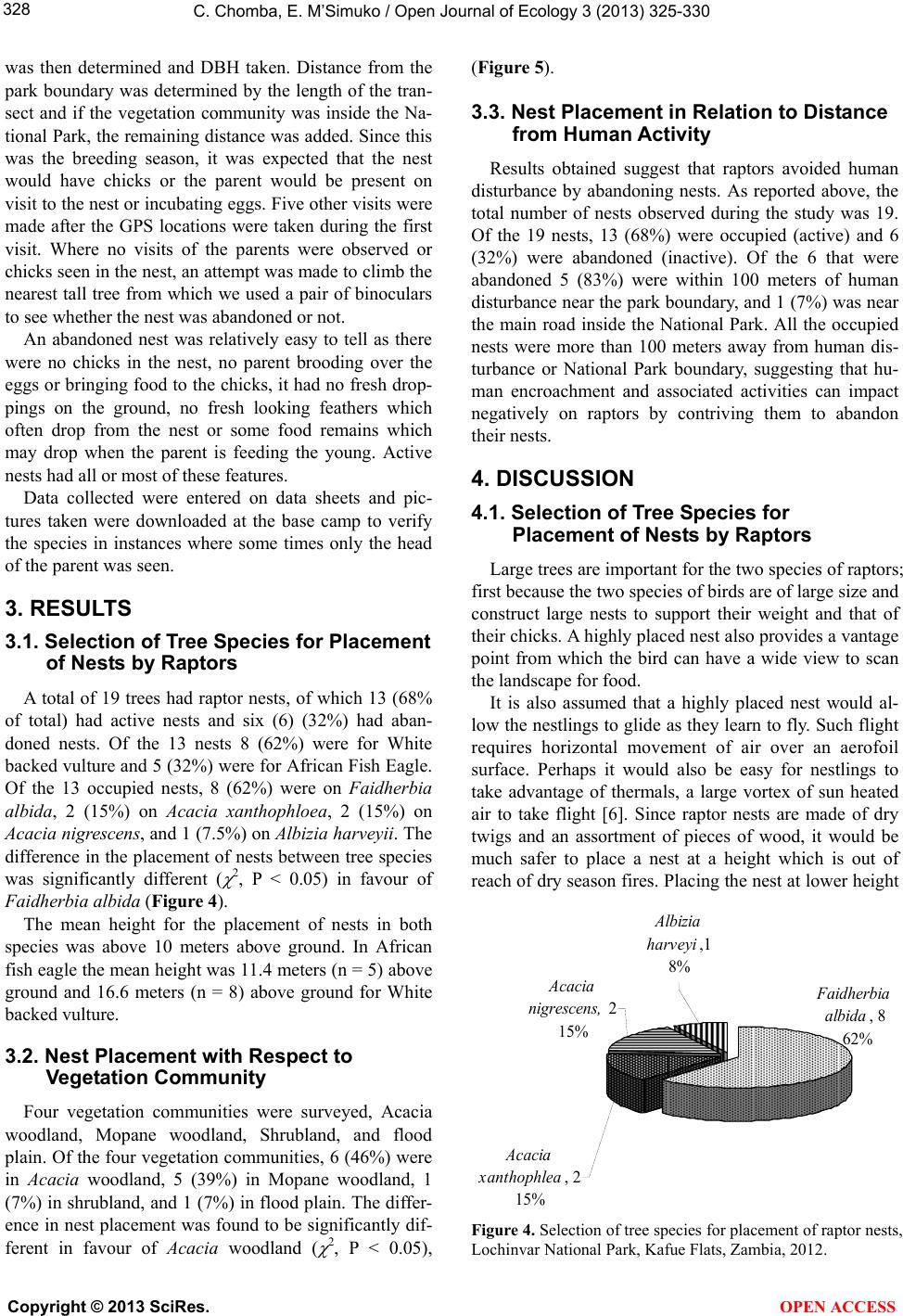 C. Chomba, E. M’Simuko / Open Journal of Ecology 3 (2013) 325-330 328 was then determined and DBH taken. Distance from the park boundary was determined by the length of the tran- sect and if the vegetation community was inside the Na- tional Park, the remaining d istance was added. Since this was the breeding season, it was expected that the nest would have chicks or the parent would be present on visit to the nest or incubating eggs. Five other visits were made after the GPS locations were taken during the first visit. Where no visits of the parents were observed or chicks seen in the n est, an atte mpt was made to climb the nearest tall tree from which we used a pair of binoculars to see whether the nest was abandon ed or not. An abandoned nest was relatively easy to tell as there were no chicks in the nest, no parent brooding over the eggs or bringing food to the chicks, it had no fresh drop- pings on the ground, no fresh looking feathers which often drop from the nest or some food remains which may drop when the parent is feeding the young. Active nests had all or most of these features. Data collected were entered on data sheets and pic- tures taken were downloaded at the base camp to verify the species in instances where some times only the head of the parent w as seen . 3. RESULTS 3.1. Selection of Tree Species for Placement of Nests by Raptors A total of 19 trees had raptor nests, of which 13 (68% of total) had active nests and six (6) (32%) had aban- doned nests. Of the 13 nests 8 (62%) were for White backed vulture and 5 (32%) were for African Fish Eagle. Of the 13 occupied nests, 8 (62%) were on Faidherbia albida, 2 (15%) on Acacia xanthophloea, 2 (15%) on Acacia nigrescens, and 1 (7.5%) on Albizia harveyii. The difference in the placement of nests between tree species was significantly different ( 2, P < 0.05) in favour of Faidherbia al b i da (Figure 4). The mean height for the placement of nests in both species was above 10 meters above ground. In African fish eagle the mean height was 11.4 meters (n = 5) above ground and 16.6 meters (n = 8) above ground for White backed vulture . 3.2. Nest Placement with Respect to Vegetation Community Four vegetation communities were surveyed, Acacia woodland, Mopane woodland, Shrubland, and flood plain. Of the four vegetation co mmunities, 6 (46%) were in Acacia woodland, 5 (39%) in Mopane woodland, 1 (7%) in shrubland, and 1 (7%) in flood plain. The differ- ence in nest placement was found to be significantly dif- ferent in favour of Acacia woodland ( 2, P < 0.05), (Figure 5). 3.3. Nest Placement in Relation to Distance from Human Activity Results obtained suggest that raptors avoided human disturbance by abandoning nests. As reported above, the total number of nests observed during the study was 19. Of the 19 nests, 13 (68%) were occupied (active) and 6 (32%) were abandoned (inactive). Of the 6 that were abandoned 5 (83%) were within 100 meters of human disturbance near the park boundary, and 1 (7%) was near the main road inside the National Park. All the occupied nests were more than 100 meters away from human dis- turbance or National Park boundary, suggesting that hu- man encroachment and associated activities can impact negatively on raptors by contriving them to abandon their nests. 4. DISCUSSION 4.1. Selection of Tree Species for Placement of Nests b y Raptors Large trees are important for the two species of raptors; first because the two species of birds are of large size and construct large nests to support their weight and that of their chicks. A highly placed nest also provides a vantage point from which the bird can have a wide view to scan the landscape for food. It is also assumed that a highly placed nest would al- low the nestling s to glide as they learn to fly. Such flight requires horizontal movement of air over an aerofoil surface. Perhaps it would also be easy for nestlings to take advantage of thermals, a large vortex of sun heated air to take flight [6]. Since raptor nests are made of dry twigs and an assortment of pieces of wood, it would be much safer to place a nest at a height which is out of reach of dry season fires. Placing the nest at lower height Acacia nigrescens, 2 15% Faidherbia albida, 8 62% A lbizia harveyi,1 8% Acacia xanthophlea , 2 15% Figure 4. Selection of tree species for placement of raptor nests, Lochinvar National Park, Kafue Flats, Zambia, 2012. Copyright © 2013 SciRes. OPEN ACCESS 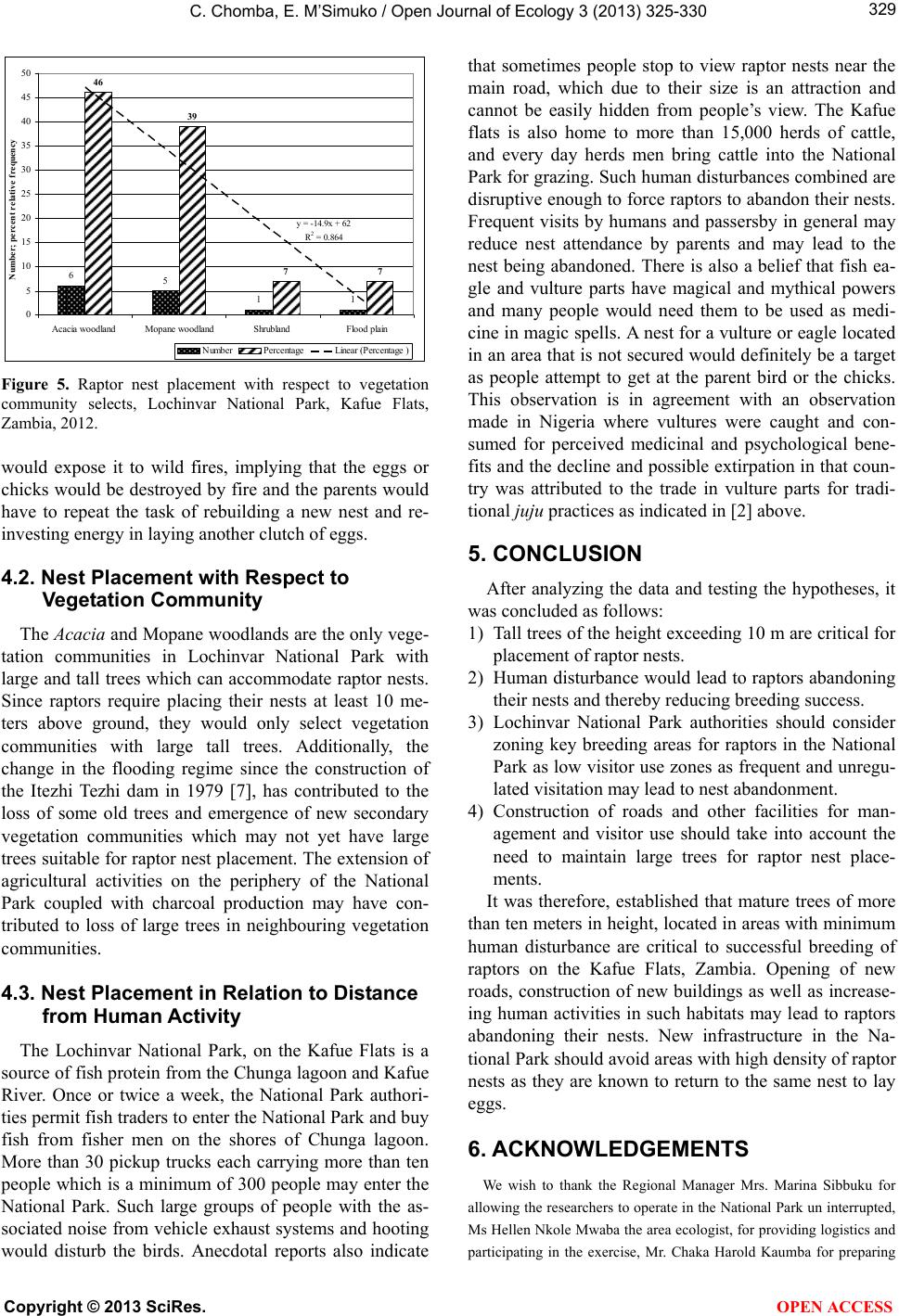 C. Chomba, E. M’Simuko / Open Journal of Ecology 3 (2013) 325-330 329 65 11 46 39 77 y = -14.9x + 62 R2 = 0.864 0 5 10 15 20 25 30 35 40 45 50 Acacia woodland Mopane woodlandShrubland Flood plain Vegetation community Number; percent relative frequency Number Percentage Linear (Percentag e ) Figure 5. Raptor nest placement with respect to vegetation community selects, Lochinvar National Park, Kafue Flats, Zambia, 2012. would expose it to wild fires, implying that the eggs or chicks would be destroyed by fire and the parents would have to repeat the task of rebuilding a new nest and re- investing energy in laying another clutch of eggs. 4.2. Nest Placement with Respect to Vegetation Community The Acacia and Mopane woodlands are the only vege- tation communities in Lochinvar National Park with large and tall trees which can accommodate raptor nests. Since raptors require placing their nests at least 10 me- ters above ground, they would only select vegetation communities with large tall trees. Additionally, the change in the flooding regime since the construction of the Itezhi Tezhi dam in 1979 [7], has contributed to the loss of some old trees and emergence of new secondary vegetation communities which may not yet have large trees suitable for raptor nest placement. The extension of agricultural activities on the periphery of the National Park coupled with charcoal production may have con- tributed to loss of large trees in neighbouring vegetation communities. 4.3. Nest Placement in Relation to Distance from Human Activity The Lochinvar National Park, on the Kafue Flats is a source of fish protein from the Chunga lagoon and Kafue River. Once or twice a week, the National Park authori- ties permit fish traders to enter the National Park and buy fish from fisher men on the shores of Chunga lagoon. More than 30 pickup trucks each carrying more than ten people which is a min imum of 300 p eople may enter the National Park. Such large groups of people with the as- sociated noise from vehicle exhaust systems and hooting would disturb the birds. Anecdotal reports also indicate that sometimes people stop to view raptor nests near the main road, which due to their size is an attraction and cannot be easily hidden from people’s view. The Kafue flats is also home to more than 15,000 herds of cattle, and every day herds men bring cattle into the National Park for gr azing. Such human disturbances combined are disruptive enou gh to force raptors to abandon th eir nests. Frequent visits by humans and passersby in general may reduce nest attendance by parents and may lead to the nest being abandoned. There is also a belief that fish ea- gle and vulture parts have magical and mythical powers and many people would need them to be used as medi- cine in magic spells. A nest for a vulture or eagle located in an area that is not secured would definitely be a target as people attempt to get at the parent bird or the chicks. This observation is in agreement with an observation made in Nigeria where vultures were caught and con- sumed for perceived medicinal and psychological bene- fits and the decline and possible ex tirpation in that coun- try was attributed to the trade in vulture parts for tradi- tional juju practices as indicated in [2] above. 5. CONCLUSION After analyzing the data and testing the hypotheses, it was concluded as follows: 1) Tall trees of the height exceeding 10 m are critical for placement of raptor nests. 2) Human disturbance would lead to raptors abandoning their nests and thereb y reducing breeding success. 3) Lochinvar National Park authorities should consider zoning key breeding areas for raptors in the National Park as low visitor use zones as frequent and unregu- lated visitation may lead to nest aban donment. 4) Construction of roads and other facilities for man- agement and visitor use should take into account the need to maintain large trees for raptor nest place- ments. It was therefore, established that mature trees of more than ten meters in height, located in areas with minimum human disturbance are critical to successful breeding of raptors on the Kafue Flats, Zambia. Opening of new roads, construction of new buildings as well as increase- ing human activities in such habitats may lead to raptors abandoning their nests. New infrastructure in the Na- tional Park should avoid areas with high density of raptor nests as they are known to return to the same nest to lay eggs. 6. ACKNOWLEDGEMENTS We wish to thank the Regional Manager Mrs. Marina Sibbuku for allowing the researchers to operate in the National Park un interrupted, Ms Hellen Nkole Mwaba the area ecologist, for providing logistics and participating in the exercise, Mr. Chaka Harold Kaumba for preparing Copyright © 2013 SciRes. OPEN ACCESS  C. Chomba, E. M’Simuko / Open Journal of Ecology 3 (2013) 325-330 Copyright © 2013 SciRes. 330 the map, Microsoft Incarta Encyclopaedia for the pictures for white backed vulture and African fish eagle. OPEN ACCESS REFERENCES [1] Birdlife International (2009) Haliaeetus vocifer. IUCN Red List of Threatened Species. International Union for Conservation of Nature. [2] Birdlife International (2007) Haliaeetus vocifer. IUCN Red List of Threatened Species. International Union for Conservation of Nature. [3] Wink, M., Heidrich, P. and Fentzloff, C. (1996) A mtDNA phylogeny of sea eagles (genus Haliaeetus) based on nucleotide sequences of the cytochrome b gene. Bioche- mical Systematics and Ecology, 24, 783-791. [4] Palgrave, K.C. (2002) Trees of Southern Africa. New Holland Publishing, Cape Town. [5] Oberprieler, U. and Cillie B. (2009) The raptor guide of Southern Africa, Game Parks Publishing, Pretoria. [6] Maclean, G.L. (1990) Ornithology for Africa. A text book for users on the African continent. University of Natal Press, Pietermaritzburg. [7] Chansa, W. and Kampamba, G. (2009) The population status of the Kafue Lechwe in the Kafue Flats, Zambia. African Journal of Ecology, 48, 837-840. |