

Paper Menu >>
Journal Menu >>
 Open Journal of Orthopedics, 2013, 3, 193-198 http://dx.doi.org/10.4236/ojo.2013.34035 Published Online August 2013 (http://www.scirp.org/journal/ojo) Copyright © 2013 SciRes. OJO 193 Causes of Surgical Delay and Demographic Characteristics in Patients with Hip Fracture* Sjöstrand Desirée1, Hommel Ami1, Johansson Anders2# 1Department of Clinical Sciences, Lund University and Skane University Hospital, Lund, Sweden; 2Sections of Anaesthesiology and Intensive Care, Department of Clinical Sciences, Lund University and Skane University Hospital, Lund, Sweden. Email: #[email protected] Received June 19th, 2013; revised July 15th, 2013; accepted July 25th, 2013 Copyright © 2013 Sjöstrand Desirée et al. This is an open access article distributed under the Creative Commons Attribution License, which permits unrestricted use, distribution, and reproduction in any medium, provided the original work is properly cited. ABSTRACT Background: Several studies analyze how surgical delay affects patien ts with hip fracture. The aim of this study was to identify the causes of surgical delay and demographic characteristics in patients with hip fracture who had delays longer than 24 hours from admission to hospital. Methods: Quantitative retrospective register study of 484 patients was con- secutively included during the period November 1, 2010 and October 31, 2011 in the University Hospital in Lund (Swe- den). Results: A frequen cy of 29.4% had a su rgical delay longer than 24 hours. The main reaso ns for delays to surgery were lack of theatre facilities (54%), medical unstable patient (16%) and anticoagulan t treatment (10%). Of all patients, 69% (n = 332) wer e women and 31% (n = 151) were men. The mean age for women were 83.6 (CI 83 - 85) vs. 79 (CI 77 - 81 ) f or men , re sp ec ti ve ly . T he mos t c o mmo n t yp e o f h ip fr ac tu re wa s di splaced cervical hip fracture (39%, n = 188) with a majority of fractures in male patients. In total, women suffered hip fractures to a greater extent than men (69% vs. 31%, p = 0.016), but no relationship was found with respect to the fracture type and age (p = 0.358). Conclusion: The main result demonstrated that d elays longer than 24 hou rs were due to lack of theatre facilities. Further researches have to be done in order to investigate whether lack of theatre facilities depends on improper operation planning and/or on lack of medical staff. Keywords: Orthopedics; Hip Fracture; Surgical Delay; Register Study 1. Introduction Hip fracture is one of the conditions that have become a major problem with significant post-fracture disability, reduced quality of life as well as increasing mortality [1]. The number and the proportion of older persons are growing in practically all countries [2]. With the in- creasing proportion of elderly in the worldwide popula- tion, the number of cases of hip fracture will inevitably rise [3,4]. It is estimated that the annual number of hip fractures worldwide will rise from 1.7 million in 1990 to around 6.3 million by 2050. Each year in Sweden (with around 9 million inhabitants), approximately 18,000 pa- tients are hospitalized and operated due to hip fractures [5,6]. Despite a growing awareness of the impact on quality of life and on outcome after hip fracture, the surgical delay is still an abundant problem among hip fracture patients [7-11]. Several studies have shown that delayed surgery in patien ts with hip fracture pro longs hospitaliza- tion and increases morbidity, the number of complica- tions, physical and psychological suffering and mortality [10,12,13]. However, some recently published studies have suggested that there is a correlation between early surgery and decrease in postoperative complications. Patients with hip fracture who were operated within 24 hours from admission have fewer complications and lowered mortality risk than those patients who had to wait longer for surgery [3,8,9,14,15]. Regardless of this knowledge, some studies indicate that a significant number of patients suffer according surgical delay and some studies point out improper operation planning and/or staff unavailability at the surgical d epartment [11,16]. To our knowledge, th ere are no publish ed trials with the aim of explicitly identifying the causes of surgical delay in patients with hip fracture. *Conflict of interest: We declare there isn’t any conflict of interest. Funding: This research needed no funding. #Corres p ondin g autho r . 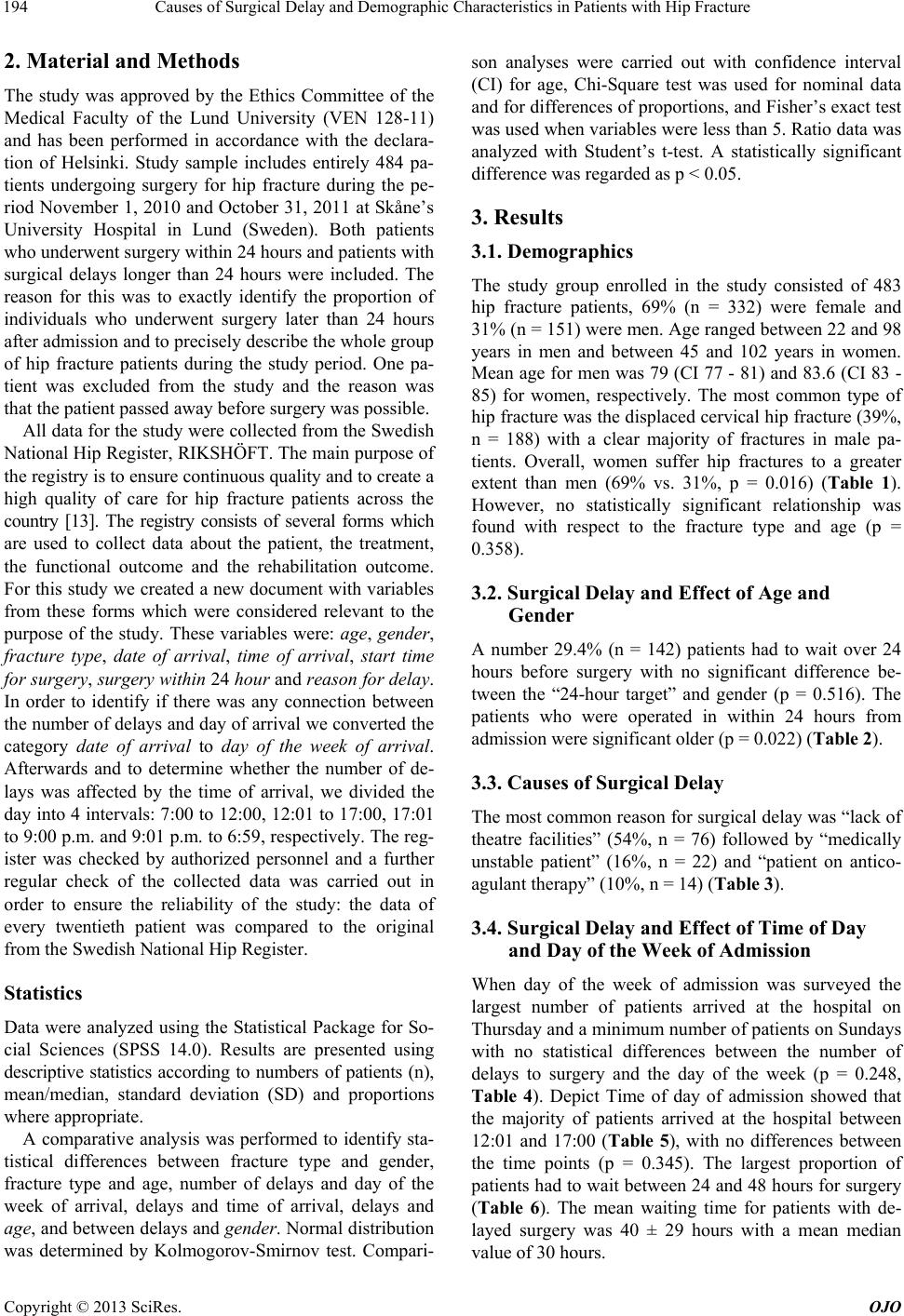 Causes of Surgical Delay and Demographic Characteristics in Patients with Hip Fracture Copyright © 2013 SciRes. OJO 194 2. Material and Methods The study was approved by the Ethics Committee of the Medical Faculty of the Lund University (VEN 128-11) and has been performed in accordance with the declara- tion of Helsinki. Study sample includes entirely 484 pa- tients undergoing surgery for hip fracture during the pe- riod November 1, 2010 and October 31, 2011 at Skåne’s University Hospital in Lund (Sweden). Both patients who underwent surgery within 24 hours and patients with surgical delays longer than 24 hours were included. The reason for this was to exactly identify the proportion of individuals who underwent surgery later than 24 hours after admission and to precisely descr ibe the wh ole group of hip fracture patients during the study period. One pa- tient was excluded from the study and the reason was that the patient passed away before surgery was possible. All data for the study were collected from the Swedish National Hip Register , RIKSHÖFT. The main purpose of the registry is to ensure co n tinu ou s quality and to create a high quality of care for hip fracture patients across the country [13]. The registry consists of several forms which are used to collect data about the patient, the treatment, the functional outcome and the rehabilitation outcome. For this study we created a new document with variables from these forms which were considered relevant to the purpose of the study. These variables were: age, gender, fracture type, date of arrival, time of arrival, start time for surgery, surgery within 24 hour and reason for delay. In order to identify if there was any connection between the number of delays and day of arrival we conv erted the category date of arrival to day of the week of arrival. Afterwards and to determine whether the number of de- lays was affected by the time of arrival, we divided the day into 4 intervals: 7:00 to 12:00, 12:01 to 17:00, 17:01 to 9:00 p.m. and 9:01 p.m. to 6:59, respectively. The reg- ister was checked by authorized personnel and a further regular check of the collected data was carried out in order to ensure the reliability of the study: the data of every twentieth patient was compared to the original from the Swedish National Hip Register. Statistics Data were analyzed using the Statistical Package for So- cial Sciences (SPSS 14.0). Results are presented using descriptive statistics according to numbers of patients (n), mean/median, standard deviation (SD) and proportions where appropriate. A comparative analysis was performed to identify sta- tistical differences between fracture type and gender, fracture type and age, number of delays and day of the week of arrival, delays and time of arrival, delays and age, and between delays and gender. Normal distribution was determined by Kolmogorov-Smirnov test. Compari- son analyses were carried out with confidence interval (CI) for age, Chi-Square test was used for nominal data and for differences of proportions, and Fisher’s exact test was used when variables were less than 5. Ratio data was analyzed with Student’s t-test. A statistically significant differe n ce w a s re garded a s p < 0. 05. 3. Results 3.1. Demographics The study group enrolled in the study consisted of 483 hip fracture patients, 69% (n = 332) were female and 31% (n = 151) were men. Age ranged between 22 and 98 years in men and between 45 and 102 years in women. Mean age for men w as 79 (CI 77 - 81) and 83.6 ( CI 83 - 85) for women, respectively. The most common type of hip fracture was the displaced cervical hip fracture (39%, n = 188) with a clear majority of fractures in male pa- tients. Overall, women suffer hip fractures to a greater extent than men (69% vs. 31%, p = 0.016) (Table 1). However, no statistically significant relationship was found with respect to the fracture type and age (p = 0.358). 3.2. Surgical Delay and Effect of Age and Gender A number 29.4% (n = 142) patients had to wait over 24 hours before surgery with no significant difference be- tween the “24-hour target” and gender (p = 0.516). The patients who were operated in within 24 hours from admission were significant older (p = 0.022) (Table 2). 3.3. Causes of Surgical Delay The most common reason for surgical delay was “lack of theatre facilities” (54%, n = 76) followed by “medically unstable patient” (16%, n = 22) and “patient on antico- agulant th erapy” (10%, n = 14) (Table 3). 3.4. Surgical Delay and Effect of Time of Day and Day of the Week of Admission When day of the week of admission was surveyed the largest number of patients arrived at the hospital on Thursday and a minimum number of patients on Sundays with no statistical differences between the number of delays to surgery and the day of the week (p = 0.248, Table 4). Depict Time of day of admission showed that the majority of patients arrived at the hospital between 12:01 and 17:00 (Table 5), with no differences between the time points (p = 0.345). The largest proportion of patients had to wait between 24 and 48 hours for surgery (Table 6). The mean waiting time for patients with de- layed surgery was 40 ± 29 hours with a mean median value of 30 hours. 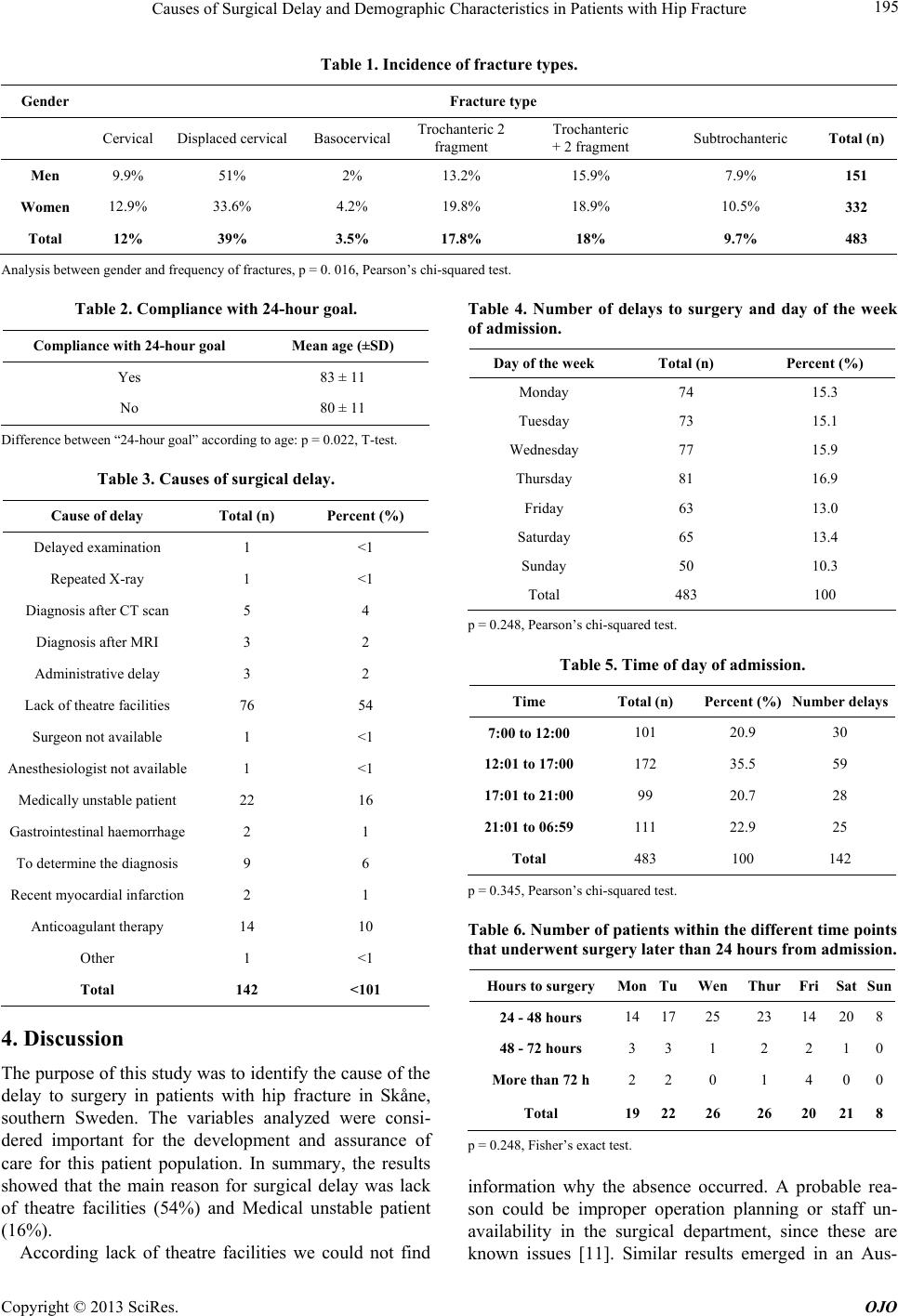 Causes of Surgical Delay and Demographic Characteristics in Patients with Hip Fracture Copyright © 2013 SciRes. OJO 195 Table 1. Incidence of fracture types. Gender Fracture type Cervical Displaced cervical Basocervical Trochanteric 2 fragment Trochanteric + 2 fragment Subtrochanteric Total (n) Men 9.9% 51% 2% 13.2% 15.9% 7.9% 151 Women 12.9% 33.6% 4.2% 19.8% 18.9% 10.5% 332 Total 12% 39% 3.5% 17.8% 18% 9.7% 483 Analysis be t ween gender and frequency of fractures, p = 0. 0 16, Pearson’s chi-squared test. Table 2. Compliance with 24-hour goal. Compliance with 24-hour goal Mean age (±SD) Yes 83 ± 11 No 80 ± 11 Difference between “24-hour goal” according to age: p = 0.022, T-test. Table 3. Causes of surgical delay. Cause of delay Total (n) P ercent (%) Delayed examinati on 1 <1 Repeated X-ray 1 <1 Diagnosis after CT scan 5 4 Diagnosis after MRI 3 2 Administrative delay 3 2 Lack of theatre facilities 76 54 Surgeon not available 1 <1 Anesthesiologist not available 1 <1 Medically unstable patient 22 16 Gastrointestinal haemorrhage 2 1 To determine the diagnosis 9 6 Recent myocardial infarction 2 1 Anticoagulant therapy 14 10 Other 1 <1 Total 142 <101 4. Discussion The purpose of th is study was to identify the cause of the delay to surgery in patients with hip fracture in Skåne, southern Sweden. The variables analyzed were consi- dered important for the development and assurance of care for this patient population. In summary, the results showed that the main reason for surgical delay was lack of theatre facilities (54%) and Medical unstable patient (16%). According lack of theatre facilities we could not find Table 4. Number of delays to surgery and day of the week of admission. Day of the week Total (n) Percent (%) Monday 74 15.3 Tuesday 73 15.1 Wednesday 77 15.9 Thursday 81 16.9 Friday 63 13.0 Saturday 65 13.4 Sunday 50 10.3 Total 483 100 p = 0.248, Pe arson’s c h i-squared te st. Table 5. Time of day of admission. Time Total (n) Percent (%) Number delays 7:00 to 12:00 101 20.9 30 12:01 to 17:00 172 35.5 59 17:01 to 21:00 99 20.7 28 21:01 to 06:59 111 22.9 25 Total 483 100 142 p = 0.345, Pe arson’s c h i-squared te st. Table 6. Number of patients within the different time points that underwent surgery later than 24 hours from admission. Hours to surgery MonTu Wen Thur FriSatSun 24 - 48 hours 141725 23 14208 48 - 72 hours 3 31 2 2 10 More than 72 h 2 20 1 4 0 0 Total 192226 26 20218 p = 0.248, Fi sh er’s exact test. information why the absence occurred. A probable rea- son could be improper operation planning or staff un- availability in the surgical department, since these are known issues [11]. Similar results emerged in an Aus- 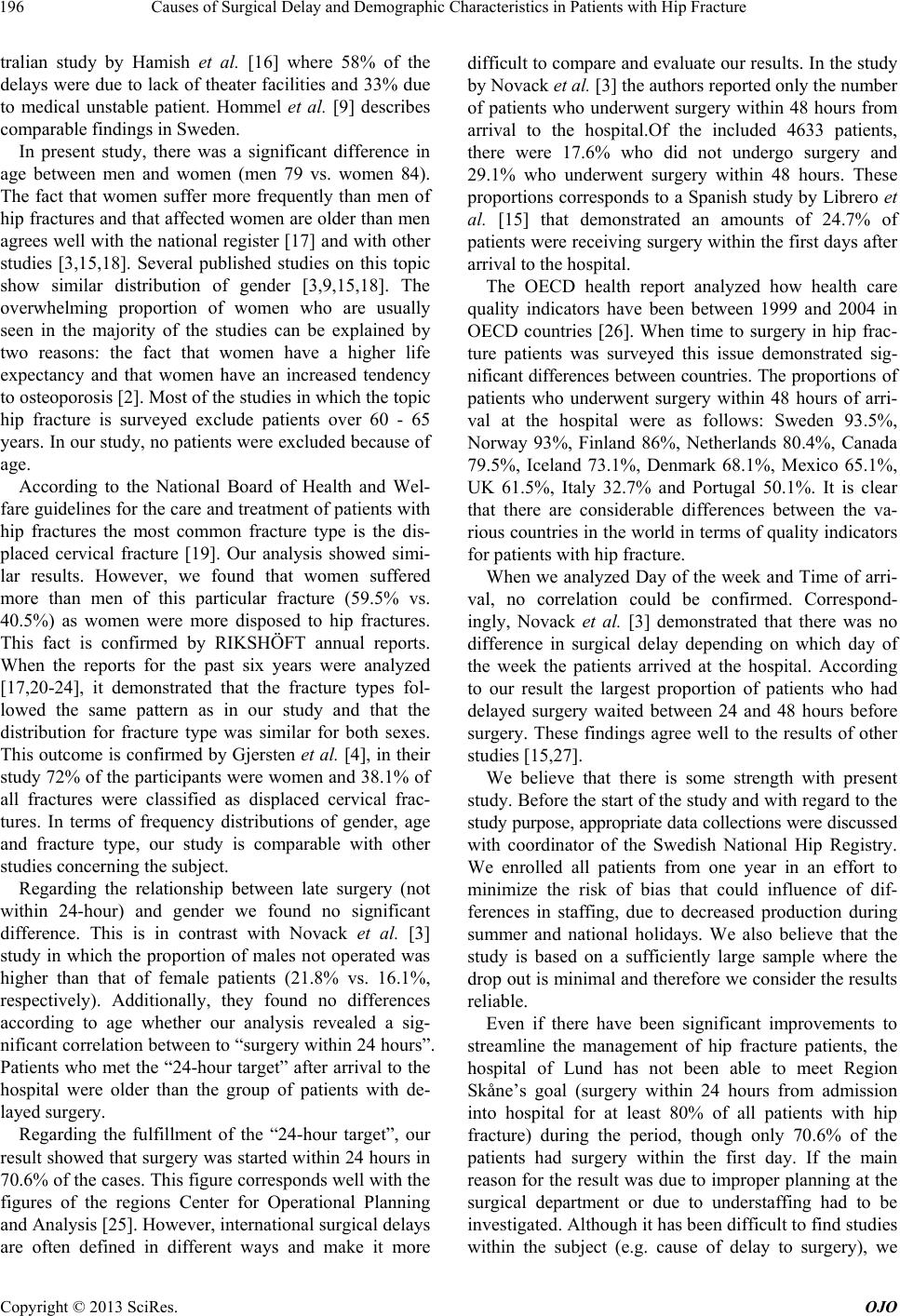 Causes of Surgical Delay and Demographic Characteristics in Patients with Hip Fracture Copyright © 2013 SciRes. OJO 196 tralian study by Hamish et al. [16] where 58% of the delays were due to lack of theater facilities and 33% due to medical unstable patient. Hommel et al. [9] describes comparable findings in Sweden. In present study, there was a significant difference in age between men and women (men 79 vs. women 84). The fact that women suffer more frequently than men of hip fractures and that affected women are older than men agrees well with the nation al register [17] and with other studies [3,15,18]. Several published studies on this topic show similar distribution of gender [3,9,15,18]. The overwhelming proportion of women who are usually seen in the majority of the studies can be explained by two reasons: the fact that women have a higher life expectancy and that women have an increased tendency to osteoporosis [2]. Most of the studies in which the topic hip fracture is surveyed exclude patients over 60 - 65 years. In our study, no patients were excluded because of age. According to the National Board of Health and Wel- fare guidelines for the care and treatment of patients with hip fractures the most common fracture type is the dis- placed cervical fracture [19]. Our analysis showed simi- lar results. However, we found that women suffered more than men of this particular fracture (59.5% vs. 40.5%) as women were more disposed to hip fractures. This fact is confirmed by RIKSHÖFT annual reports. When the reports for the past six years were analyzed [17,20-24], it demonstrated that the fracture types fol- lowed the same pattern as in our study and that the distribution for fracture type was similar for both sexes. This outcome is confirmed by Gjersten et al. [4], in th eir study 72% of the participants were wo men and 38.1% of all fractures were classified as displaced cervical frac- tures. In terms of frequency distributions of gender, age and fracture type, our study is comparable with other studies concerning the subject. Regarding the relationship between late surgery (not within 24-hour) and gender we found no significant difference. This is in contrast with Novack et al. [3] study in which the proportion of males not operated was higher than that of female patients (21.8% vs. 16.1%, respectively). Additionally, they found no differences according to age whether our analysis revealed a sig- nificant correlation between to “surgery within 24 hours”. Patients who met the “24-hour target” after arrival to the hospital were older than the group of patients with de- layed surgery. Regarding the fulfillment of the “24-hour target”, our result showed that surg ery was started within 24 hou rs in 70.6% of the cases. This figure corresponds well with the figures of the regions Center for Operational Planning and Analysis [2 5]. However, international surgical delays are often defined in different ways and make it more difficult to compare and evalua te our results. In the study by Novack et al. [3] the authors reported only the number of patients who underwent surgery within 48 hours from arrival to the hospital.Of the included 4633 patients, there were 17.6% who did not undergo surgery and 29.1% who underwent surgery within 48 hours. These proportions cor responds to a Spanish study by Librero et al. [15] that demonstrated an amounts of 24.7% of patients were receiving surgery within the first days after arrival to the hospital. The OECD health report analyzed how health care quality indicators have been between 1999 and 2004 in OECD countries [26]. When time to surgery in hip frac- ture patients was surveyed this issue demonstrated sig- nificant differences between countries. The proportions of patients who underwent surgery within 48 hours of arri- val at the hospital were as follows: Sweden 93.5%, Norway 93%, Finland 86%, Netherlands 80.4%, Canada 79.5%, Iceland 73.1%, Denmark 68.1%, Mexico 65.1%, UK 61.5%, Italy 32.7% and Portugal 50.1%. It is clear that there are considerable differences between the va- rious countries in the wo rld in terms of quality indicators for patie nts with hi p f rac ture. When we analyzed Day of the week and Time of arri- val, no correlation could be confirmed. Correspond- ingly, Novack et al. [3] demonstrated that there was no difference in surgical delay depending on which day of the week the patients arrived at the hospital. According to our result the largest proportion of patients who had delayed surgery waited between 24 and 48 hours before surgery. These findings agree well to the results of other studies [15,27]. We believe that there is some strength with present study. Before the start of the study and with regard to the study purpose, appropriate data collections were discussed with coordinator of the Swedish National Hip Registry. We enrolled all patients from one year in an effort to minimize the risk of bias that could influence of dif- ferences in staffing, due to decreased production during summer and national holidays. We also believe that the study is based on a sufficiently large sample where the drop out is minimal and therefore we consider the results reliable. Even if there have been significant improvements to streamline the management of hip fracture patients, the hospital of Lund has not been able to meet Region Skåne’s goal (surgery within 24 hours from admission into hospital for at least 80% of all patients with hip fracture) during the period, though only 70.6% of the patients had surgery within the first day. If the main reason for the result was due to improper planning at the surgical department or due to understaffing had to be investigated. Altho ugh it h as been difficult to find stud ies within the subject (e.g. cause of delay to surgery), we  Causes of Surgical Delay and Demographic Characteristics in Patients with Hip Fracture Copyright © 2013 SciRes. OJO 197 believe that our study could contribute to future actions and measurements, in order to further optimize the health care program for these patients and a prospective study might be useful in order to better identify the causes of the surgical delay. 5. Conclusion The causes of delay to surgery within 24 hours occurred in 29.4% of all patients with hip fracture. The main rea- sons for delays were lack of theatre facilities (54%), medical unstable patient (16%) and anticoagulant treat- ment (10%). The most common type of hip fracture was displaced cervical hip fracture (39%) with a majority of fractures in male patients. REFERENCES [1] A. Hommel, “Improved Safety and Quality of Care for Patients with a Hip Fracture,” Ph.D. Dissertation, Lunds Universitet, Institutionen för Hälsa, Vård Och Samhälle, 2007. [2] WHO, “Sweden: “Nutrition for Older Persons,” 2011. www.who.int/nutrition/topics/ageing/en/index2.html [3] V. Novack, A. Jotkowitz, O. Etzion and A. Porath, “Does Delay in Surgery after Hip Fracture Lead to Worse Out- comes? A Multicenter Survey,” International Journal for Quality in Health Care, Vol. 19, No. 3, 2007, pp. 170-176. doi:10.1093/intqhc/mzm003 [4] J.-E. Gjertsen, L.-B. Engesæter, O. Furnes, L.-I. Havelin, K. Steindal, T. Vinje and J.-M. Fevang, “The Norwegian Hip Fracture Register Experiences after the First 2 Years and 15,576 Reported Operations,” Acta Orthopaedia, Vol. 79, No. 5, 2008, pp. 583-583. doi:10.1080/17453670810016588 [5] National Board of Health and Welfare, “Sweden: Fall- skador i Vården,” 2011. http://www.socialstyrelsen.se/patientsakerhet/riskomrade n/fallskador [6] RIKSHÖFT, “Sweden: Höftfrakturer; 2009a,” 2009. http://www.rikshoft.se/se/index.php?option=com_content &view=article&id=50&Itemid=37 [7] J. Richmond, G.-B. Aharonoff, J.-D. Zuckerman and K.-J. Koval, “Mortality Risk after Hip Fracture,” Journal of Orthopaedic Trauma, Vol. 17, No. 1, 2003, pp. 53-56. doi:10.1097/00005131-200301000-00008 [8] P. Vestergaard, L. Rejnmark and L. Mosekilde, “Increased Mortality in Patients with a Hip Fracture-Effect of Pre- Morbid Conditions and Post-Fracture Complications,” Osteoporosi International, Vol. 18, No. 12, 2007, pp. 1583-1593. doi:10.1007/s00198-007-0403-3 [9] A. Hommel, K. Ulander, K. B. Björkelund, P.-O. Norman, H. Wingstrand and K.-G. Thorngren, “Influence of Opti- mised Treatment of People with Hipfracture on Time to Operation, Length of Hospital Stay, Reoperations and Mortality within 1 Year,” International Journal of the Care of the Injured, Vol. 39, No. 10, 2008, pp. 1164-1174. doi:10.1016/j.injury.2008.01.048 [10] S.-K. Khan, S. Kalra, M. M. Thiruvengada and M. J. Parker, “Timing to Surgery for Hip Fractures: A System- atic Rewiew of 52 Published Studies Involving 291,413 Patients,” International Journal of the Care of the Injured, Vol. 40, No. 7, 2009, pp. 692-697. doi:10.1016/j.injury.2009.01.010 [11] N. Simunovic, P. J. Devereaux and M. Bhandari, “Sur- gery for Hip Fractures: Does Surgical Delay Affect Out- comes?” Indian Journal Orthopaedia, Vol. 45, No. 1, 2011, pp. 27-32. doi:10.4103/0019-5413.73660 [12] K. B. Björkelund, “Acute Confusional State in Elderly Pa- tients with Hip Fracture. Identification of Risk factors and Intervention Using a Prehospital and Perioperative Man- agement Program,” Ph.D. Dissertation, Lunds Universitet, Institutionen för Hälsa, Vård Och Samhälle, 2008. [13] RIKSHÖFT, “Sweden: Om Rikshöft; 2009b,” 2011. http://www.rikshoft.se/se/index.php?option=com_content &view=article&id=46&Itemid=27 [14] A. Bottle and P. Aylin, “Mortality Associates with Delay in Operation after Hip Fracture: Observational Study,” British Medical Journal, Vol. 332, No. 7547, 2006, pp. 947-951. doi:10.1136/bmj.38790.468519.55 [15] J. Librero, S. Peiró, E. Leutscher, J. Merlo, E. Bernal- Delgado, M. Ridao, N. Martínez-Lizaga and G. Sanfélix- Gimeno, “Timing of Surgery for Hip Fracture and In-Hos- pital Mortality: A Retrospective Population-Based Cohort Study in the Spanish National Health System,” BMC Health Services Research, Vol. 12, No. 15, 2012. doi:10.1186/1472-6963-12-15 [16] C. R. Hamish, I. A. Harris, L. Mcevoy and T. Todovora, “Delay to Surgery and Mortality after Hip Fracture,” The Australian and New Zealand Journal of Surgery, Vol. 77, No. 10, 2007, pp. 889-891. doi:10.1111/j.1445-2197.2007.04267.x [17] RIKSHÖFT-SAHFE, “Annual Report 2009,” 2012. http://rikshoft.se/se/images/stories/arsrapporter/arsrapport 2009.pdf [18] K. B. Björkelund, A. Hommel, K.-G. Thorgren, L. Gus- tafson, S. Larsson and D. Lundberg, “Reducing Delirium in Elderly Patients with Hip Fracture: A Multi-Factorial Intervention Study,” Acta Anaesthesiologica Scandinavia, Vol. 54, No. 6, 2010, pp. 678-688. doi:10.1111/j.1399-6576.2010.02232.x [19] National Board of Health and Welfare, “Guidelines for Care and Treatment in Patients with Hip Fracture,” So- cialstyrelsen, Stockholm, 2003. [20] RIKSHÖFT-SAHFE, “Annual Report 2005,” 2011. http://rikshoft.se/se/images/stories/arsrapporter/Arsrappor t2005.pdf [21] RIKSHÖFT-SAHFE, “Annual Report 2006,” 2011. http://rikshoft.se/se/images/stories/arsrapporter/Arsrappor t2006.pdf [22] RIKSHÖFT-SAHFE, “Annual Report 2007,” 2011. http://rikshoft.se/se/images/stories/arsrapporter/Arsrappor t2007.pdf [23] RIKSHÖFT-SAHFE, “Annual Report 2008,” 2011. http://www.rikshoft.se/se/images/stories/arsrapporter/Arsr apport2008.pdf  Causes of Surgical Delay and Demographic Characteristics in Patients with Hip Fracture Copyright © 2013 SciRes. OJO 198 [24] RIKSHÖFT-SAHFE, “Annual Report 2010,” 2012. http://rikshoft.se/se/images/stories/arsrapporter/arsrapport 2010.pdf [25] Center for Operational Planning and Analysis, 2011. http://www.skane.se/Upload/Webbplatser/vardgaranti/l% C3%A4gesbilder/Uppf%C3%B6jlning%20T2%202011% 20h%C3%B6ftprocessm%C3%A5l%20internetversion% 20_3_.pdf [26] HCQI, “Health Care Quality Indicators Project. Initial Indicators Report,” 2012. http://www.oecd.org/dataoecd/1/34/36262514.pdf [27] M. P. Fantini, G. Fabbria, M. Lausb, E. Carrettaa, S. Mi- mmia, G. Franchino, L. Faveroc and P. Rucci, “Determi- nants of Surgical Delay for Hip Fracture,” The Surgeon, Vol. 9, No. 3, 2011, pp. 130-134. doi:10.1016/j.surge.2010.11.031 |