

Paper Menu >>
Journal Menu >>
 Open Journal of Modern Linguistics 2013. Vol.3, No.3, 252-258 Published Online September 2013 in SciRes (http://www.scirp.org/journal/ojml) http://dx.doi.org/10.4236/ojml.2013.33033 Copyright © 2013 SciRes. 252 Processing Facilitation Strategies in OV and VO Languages: A Corpus Study Luis Pastor, Itziar Laka Department of Linguistics and Basque Studies, University of the Basque Country, Bilbao, Spain Email: [email protected] Received June 25th, 2013; revised July 28th, 2013; accepted August 5th, 2013 Copyright © 2013 Luis Pastor, Itziar Laka. This is an open access article distributed under the Creative Com- mons Attribution License, which permits unrestricted use, distribution, and reproduction in any medium, pro- vided the original work is properly cited. The present corpus study aimed to examine whether Basque (OV) resorts more often than Spanish (VO) to certain grammatical operations, in order to minimize the number of arguments to be processed before the verb. Ueno & Polinsky (2009) argue that VO/OV languages use certain grammatical resources with different frequencies in order to facilitate real-time processing. They observe that both OV and VO lan- guages in their sample (Japanese, Turkish and Spanish) have a similar frequency of use of subject pro- drop; however, they find that OV languages (Japanese, Turkish) use more intransitive sentences than VO languages (English, Spanish), and conclude this is an OV-specific strategy to facilitate processing. We conducted a comparative corpus study of Spanish (VO) and Basque (OV). Results show (a) that the fre- quency of use of subject pro-drop is higher in Basque than in Spanish; and (b) Basque does not use more intransitive sentences than Spanish; both languages have a similar frequency of intransitive sentences. Based on these findings, we conclude that the frequency of use of grammatical resources to facilitate the processing does not depend on a single typological trait (VO/OV) but it is modulated by the concurrence of other grammatical features. Keywords: Basque; Spanish; Word Order; Pro-Drop; Language Processing; OV/VO Languages; Corpus Study Introduction A central question in contemporary linguistic theory is to what extent the properties of language result from conditions imposed by processing demands. Thus, for instance, The Mini- malist Program (Chomsky, 1995) assumes as a premise that most properties of language derive from conditions imposed by the Conceptual-Intentional (C-I) and Articulatory-Perceptual (A-P) interfaces. Within psycholinguistics, the idea that proc- essing requirements have a significant impact on the form of sentences was first explored in the Depth Hypothesis (Yngve, 1960) that provided an account for the different incidence of left-branching and right-branching structures in English based on processing constraints. A decade later, Bever (1970) argued that the form of language reflects general cognitive laws, in such a way that mechanisms of language processing are one of the factors determining grammatical phenomena. This issue has been investigated from different perspectives by many research- ers, mostly in psycholinguistics, and it continues to be a much- researched area among linguists and psycholinguists; MacDonald (2013), for instance, currently argues that production demands heavily constrain linguistic output and typological choices. The present paper seeks to contribute to our understanding of the interplay between grammar and the conditions imposed by the externalization of linguistic expressions, and it does so by exploring the hypothesis that facilitation of processing in real time guides the preferences with which languages with different basic word orders resort to certain grammatical phenomena. Of the six possible basic word orders (SVO, SOV, VSO, VOS, OSV, OVS) (Greenberg, 1969), the vast majority of human lan- guages are either VO (40.5%) or OV (35.4%) (Dryer, 2011). These basic word orders correspond strongly with other word order properties; in VO languages the genitive generally fol- lows the noun, while in OV languages it almost always pre- cedes it (Greenberg’s Universal 2). Several studies have sug- gested that basic word order has an impact on language proc- essing, i.e., that VO-OV languages tend to favor different syn- tactic constructions, because they are more efficient to process each language type (VO-OV). For instance, Hawkins (1994, 2004) argued that VO-OV grammars result from the optimiza- tion of processing requirements. Hawkins proposed a general principle, Minimize Domains (MiD), according to which the orderings with the smaller domain are preferred in processing. Thus, MiD predicts that VO languages will favor word orders where short constituents precede long ones, whereas OV lan- guages will prefer to place long constituents before short ones, creating a mirror effect. Yamashita & Chang (2001) carried out an experimental exploration of Hawkins’ hypothesis and found a preference in Japanese (OV) for placing long constituents be- fore short ones. More recently, Ros, Laka, Fukumura, & Santes- teban (2012) conducted a similar experimental exploration in Basque (OV) and also found a “long before short” preference. Both studies lend support to Hawkins’ hypothesis that VO-OV languages employ different constituent ordering strategies in order to facilitate processing.  L. PASTOR, I. LAKA Copyright © 2013 SciRes. 253 Ueno & Polinsky (2009) tackle the interaction between basic word order (OV/VO) and processing constraints from a differ- ent but not incompatible perspective, and argue that VO-OV languages resort to different syntactic phenomena as strategies to facilitate processing, and that these distinct patterns are re- flected in the frequency with which they employ these gram- matical resources. Ueno & Polinsky (2009) follow the assumption that the verb plays a pivotal role in sentence processing, because argument relations are resolved when the verb is reached (Head-driven model, Pritchett, 1992; Pickering & Barry, 1991; Pickering, 1993; Trueswell, Tanenhaus, & Kello, 1993; Garnsey, Pearlmutter, Myers, & Lotocky, 1997). According to this assumption, SOV sentences should present an extra processing cost because two arguments must be retained in working memory before proc- essing the verb: the subject (S) and object (O). Ueno & Polinsky (2009) hypothesize that OV languages will resort to some syn- tactic phenomena (such as pro-drop, intransitive and others) more frequently than VO languages in order to minimize the amount of arguments expressed before the verb. In particular, they argue that pro-drop (unexpressed arguments) and Intransi- tivity might serve as strategies to reduce the number of prever- bal arguments in OV languages. The former minimizes the num- ber of arguments phonologically expressed, whereas the latter minimizes the number of arguments required by the verb. To test this hypothesis, Ueno & Polinsky (2009) conducted two comparative corpus studies. A first study compared English (VO) and Japanese (OV) written sentences, and it revealed a similar frequency in the usage of pro-drop in transitive sentences in both languages, and a more frequent use of intransitive sen- tences in Japanese (OV) as compared to English (VO). The second study compared the narrative production of native speak- ers of English, Spanish (VO), Japanese and Turkish (OV), and it replicate the results obtained in the first study: pro-drop is used more often in transitive than in intransitive sentences in all languages (Spanish, Japanese and Turkish) and intransitive sen- tences occur more frequently in OV languages (Japanese and Turkish) than in VO languages (English and Spanish). Thus, whereas pro-drop is more frequently used in transitive senten- ces in both VO-OV languages with equivalent frequency, in- transitive sentences are significatively more frequent in OV lan- guages. Therefore, according to this study, resort to intransitive formats reflects an OV-specific strategy, directed at minimizing the number of preverbal arguments in a sentence. The Current Study The present investigation extends Ueno & Polinsky’s (2009) study, by comparing Spanish (VO) and Basque (OV). We con- ducted a comparative corpus study of Spanish (VO) and Basque (OV) aimed at determining whether Basque, presents a higher frequency of intransitives as do Turkish and Japanese in com- parison to VO languages like Spanish, while the frequency of pro-drop would be similar in Basque and Spanish. One main reason to pursue this study is to ascertain the gen- eral validity of the results obtained by Ueno & Polinsky for OV languages, and to explore Spanish in a larger corpus. Both Span- ish and Basque can place subjects and objects after the verb, a possibility not available in English, Turkish, Japanese and Ko- rean. Furthermore, in the present study, the corpora employed are significantly larger than those used by Ueno & Polinsky (2009). Characteristics of Basque Like Japanese and Turkish, Basque has basic SOV word or- der (cf. 1a). However, unlike Japanese and Turkish, which have strictly verb-final sentences, Basque may have postverbal ar- guments (cf. (1c, d, e, f)) (Laka, 1996; Hualde & Ortiz de Ur- bina, 2003; De Rijk, 2007; Erdozia et al., 2009). 1) a)gizon-a-k emakume-a-Ø ikusi du (SOV) man-Det-ERG woman-Det-ABS see AUX “The man has seen the woman” b)emakumea gizonak ikusi du (OSV) c)gizonak ikusi du emakumea (SVO) d)emakumea ikusi du gizonak (OVS) e)ikusi du gizonak emakumea (VSO) f)ikusi du emakumea gizonak (VOS) In addition, Basque is a pro-drop language, i.e., the argu- ments that agree with the verb do not have to be phonologically expressed. Both subjects and objects can be omitted (cf. (2b, c, d, e)), unlike in Spanish, where there only subjects can be unex- pressed. 2) a)Ni-k zu-ri liburua-Ø ekarri dizut I-ERG you-DAT book-ABS bring AUX “I bring you the book” b) p ro zuri liburua ekarri dizut [subject pro-drop] c)Nik pro liburua ekarri dizut [direct object pro-drop] d)Nik zuri pro ekarri dizut [indirect object pro-drop] e) p ro pro pro ekarri dizut [subject, indirect object and direct object pro-drop] These two grammatical properties of Basque make it a rele- vant grammar to investigate whether all OV resort to similar strategies to facilitate processing. In particular, we seek to as- certain whether Basque behaves like Japanese and Turkish using a high frequency of intransitive sentences in order to reduce ar- guments of the preverbal area, or whether this language will re- sort to postverbal arguments as a specific strategy, not available to Japanese and Turkish. We also seek to determine the status of pro-drop as a facilitating strategy, by comparing the ratios of pro-drop in Basque and Spanish. Method A total of 2800 sentences from press and books in both Spa- nish and Basque (1400 sentences/source × 2 sources) were ana- lyzed for sentence type. Each source was divided into different genres in both languages in order to have a heterogeneous cor- pus. Press source was divided in 7 genres (business, culture, so- ciety, politics, world, national and sports) (100 sentences/genre × 7 genres × 2 languages); whereas books in 4 genres (comedy, mystery, historical and non-fictional) (175 sentences/genre × 4 genres × 2 languages). Matrix clauses of the sentences were manually coded for sen- tence type, while adjoined and embedded clauses were disre- garded. They were classified as either “Intransitive” or “Tran- sitive”. The Intransitive category included intransitive verbs, non-verbal sentences (adjectival and nominal), and demotion structures (passives with or without the by-phrase, impersonals, middle voices…) (Table 1). The transitive category included 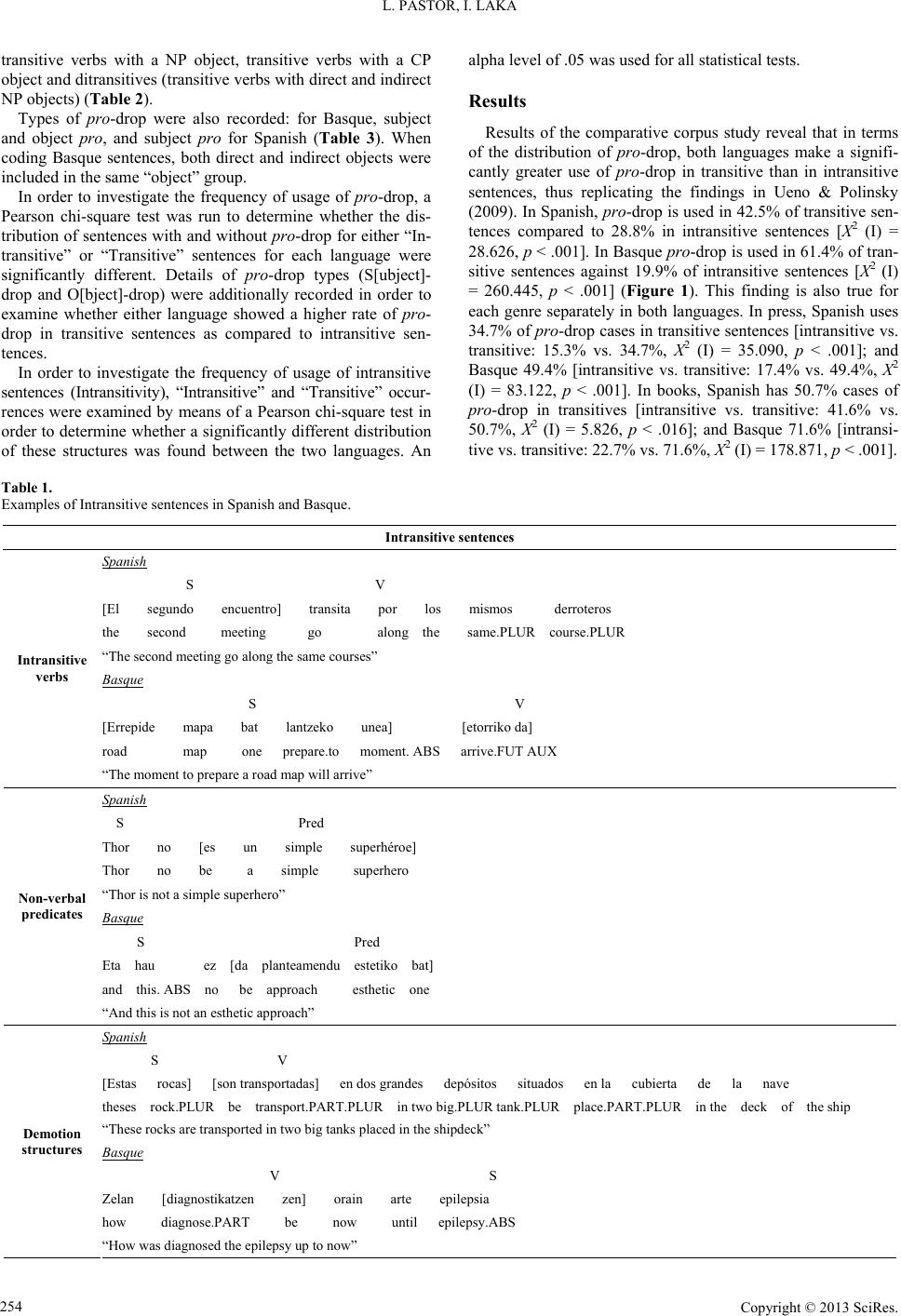 L. PASTOR, I. LAKA Copyright © 2013 SciRes. 254 transitive verbs with a NP object, transitive verbs with a CP object and ditransitives (transitive verbs with direct and indirect NP objects) (Table 2). Types of pro-drop were also recorded: for Basque, subject and object pro, and subject pro for Spanish (Table 3). When coding Basque sentences, both direct and indirect objects were included in the same “object” group. In order to investigate the frequency of usage of pro-drop, a Pearson chi-square test was run to determine whether the dis- tribution of sentences with and without pro-drop for either “In- transitive” or “Transitive” sentences for each language were significantly different. Details of pro-drop types (S[ubject]- drop and O[bject]-drop) were additionally recorded in order to examine whether either language showed a higher rate of pro- drop in transitive sentences as compared to intransitive sen- tences. In order to investigate the frequency of usage of intransitive sentences (Intransitivity), “Intransitive” and “Transitive” occur- rences were examined by means of a Pearson chi-square test in order to determine whether a significantly different distribution of these structures was found between the two languages. An alpha level of .05 was used for all statistical tests. Results Results of the comparative corpus study reveal that in terms of the distribution of pro-drop, both languages make a signifi- cantly greater use of pro-drop in transitive than in intransitive sentences, thus replicating the findings in Ueno & Polinsky (2009). In Spanish, pro-drop is used in 42.5% of transitive sen- tences compared to 28.8% in intransitive sentences [X2 (I) = 28.626, p < .001]. In Basque pro-drop is used in 61.4% of tran- sitive sentences against 19.9% of intransitive sentences [X2 (I) = 260.445, p < .001] (Figure 1). This finding is also true for each genre separately in both languages. In press, Spanish uses 34.7% of pro-drop cases in transitive sentences [intransitive vs. transitive: 15.3% vs. 34.7%, X2 (I) = 35.090, p < .001]; and Basque 49.4% [intransitive vs. transitive: 17.4% vs. 49.4%, X2 (I) = 83.122, p < .001]. In books, Spanish has 50.7% cases of pro-drop in transitives [intransitive vs. transitive: 41.6% vs. 50.7%, X2 (I) = 5.826, p < .016]; and Basque 71.6% [intransi- tive vs. transitive: 22.7% vs. 71.6%, X2 (I) = 178.871, p < .001]. Table 1. Examples of Intransitive sentences in Spanish and Basque. Intransitive sentences Spanish S V [El segundo encuentro] transita por los mismos derroteros the second meeting go along the same.PLUR course.PLUR “The second meeting go along the same courses” Basque S V [Errepide mapa bat lantzeko unea] [etorriko da] road map one prepare.to moment. ABS arrive.FUT AUX Intransitive verbs “The moment to prepare a road map will arrive” Spanish S Pred Thor no [es un simple superhéroe] Thor no be a simple superhero “Thor is not a simple superhero” Basque S Pred Eta hau ez [da planteamendu estetiko bat] and this. ABS no be approach esthetic one Non-verbal predicates “And this is not an esthetic approach” Spanish S V [Estas rocas] [son transportadas] en dos grandes depósitos situados en la cubierta de la nave theses rock.PLUR be transport.PART.PLUR in two big.PLUR tank.PLUR place.PART.PLUR in the deck of the ship “These rocks are transported in two big tanks placed in the shipdeck” Basque V S Zelan [diagnostikatzen zen] orain arte epilepsia how diagnose.PART be now until epilepsy.ABS Demotion structures “How was diagnosed the epilepsy up to now” 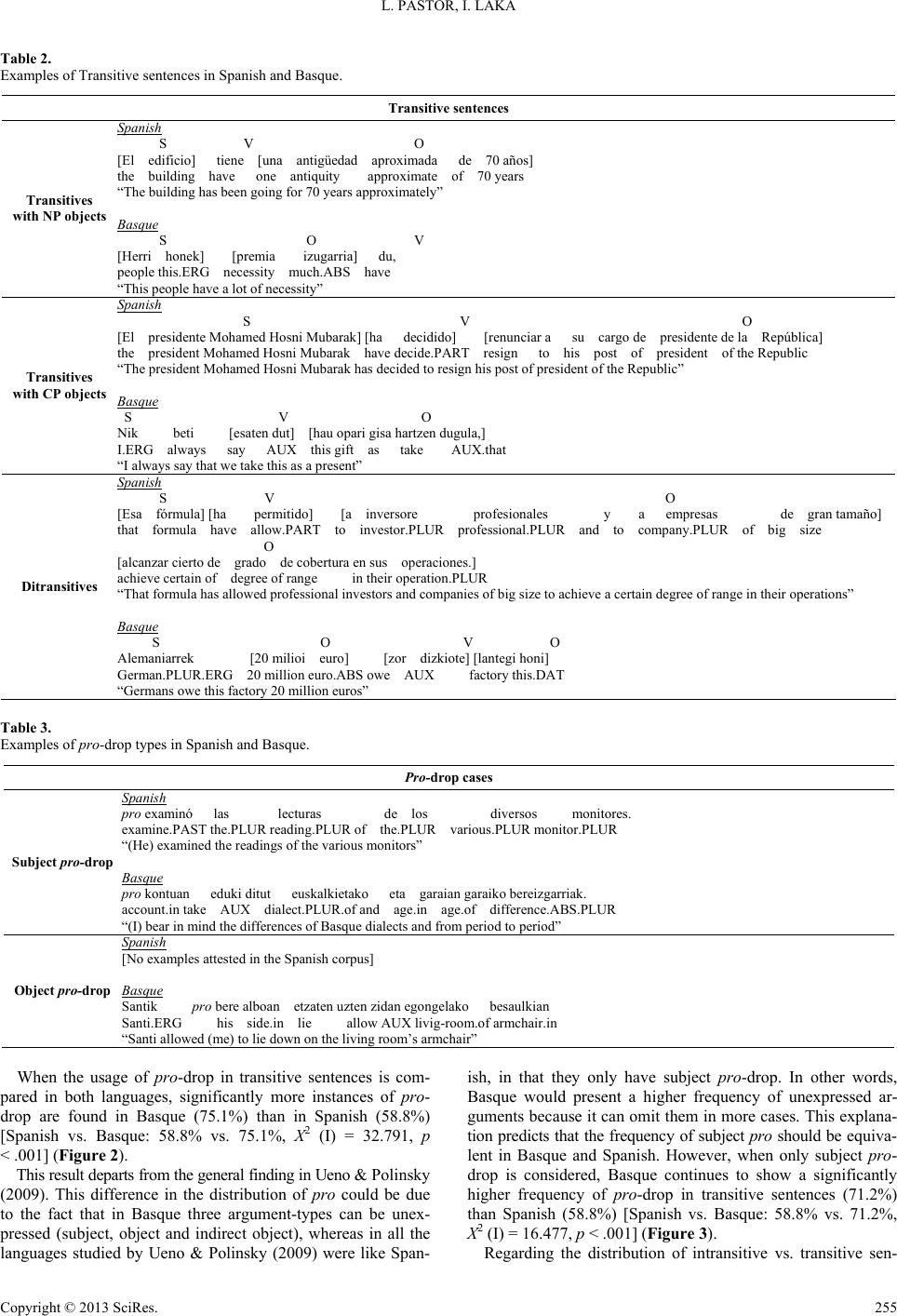 L. PASTOR, I. LAKA Copyright © 2013 SciRes. 255 Table 2. Examples of Transitive sentences in Spanish and Basque. Transitive sentences Transitives with NP objects Spanish S V O [El edificio] tiene [una antigüedad aproximada de 70 años] the building have one antiquity approximate of 70 years “The building has been going for 70 years approximately” Basque S O V [Herri honek] [premia izugarria] du, people this.ERG necessity much.ABS have “This people have a lot of necessity” Transitives with CP objects Spanish S V O [El presidente Mohamed Hosni Mubarak] [ha decidido] [renunciar a su cargo de presidente de la República] the president Mohamed Hosni Mubarak have decide.PART resign to his post of president of the Republic “The president Mohamed Hosni Mubarak has decided to resign his post of president of the Republic” Basque S V O Nik beti [esaten dut] [hau opari gisa hartzen dugula,] I.ERG always say AUX this gift as take AUX.that “I always say that we take this as a present” Ditransitives Spanish S V O [Esa fórmula] [ha permitido] [a inversore profesionales y a empresas de gran tamaño] that formula have allow.PART to investor.PLUR professional.PLUR and to company.PLUR of big size O [alcanzar cierto de grado de cobertura en sus operaciones.] achieve certain of degree of range in their operation.PLUR “That formula has allowed professional investors and companies of big size to achieve a certain degree of range in their operations” Basque S O V O Alemaniarrek [20 milioi euro] [zor dizkiote] [lantegi honi] German.PLUR.ERG 20 million euro.ABS owe AUX factory this.DAT “Germans owe this factory 20 million euros” Table 3. Examples of pro-drop types in Spanish and Basque. Pro-drop cases Subject pro-drop Spanish p ro examinó las lecturas de los diversos monitores. examine.PAST the.PLUR reading.PLUR of the.PLUR various.PLUR monitor.PLUR “(He) examined the readings of the various monitors” Basque p ro kontuan eduki ditut euskalkietako eta garaian garaiko bereizgarriak. account.in take AUX dialect.PLUR.of and age.in age.of difference.ABS.PLUR “(I) bear in mind the differences of Basque dialects and from period to period” Object pro-drop Spanish [No examples attested in the Spanish corpus] Basque Santik pro bere alboan etzaten uzten zidan egongelako besaulkian Santi.ERG his side.in lie allow AUX livig-room.of armchair.in “Santi allowed (me) to lie down on the living room’s armchair” When the usage of pro-drop in transitive sentences is com- pared in both languages, significantly more instances of pro- drop are found in Basque (75.1%) than in Spanish (58.8%) [Spanish vs. Basque: 58.8% vs. 75.1%, X2 (I) = 32.791, p < .001] (Figure 2). This result departs from the general finding in Ueno & Polinsky (2009). This difference in the distribution of pro could be due to the fact that in Basque three argument-types can be unex- pressed (subject, object and indirect object), whereas in all the languages studied by Ueno & Polinsky (2009) were like Span- ish, in that they only have subject pro-drop. In other words, Basque would present a higher frequency of unexpressed ar- guments because it can omit them in more cases. This explana- tion predicts that the frequency of subject pro should be equiva- lent in Basque and Spanish. However, when only subject pro- drop is considered, Basque continues to show a significantly higher frequency of pro-drop in transitive sentences (71.2%) than Spanish (58.8%) [Spanish vs. Basque: 58.8% vs. 71.2%, X2 (I) = 16.477, p < .001] (Figure 3). Regarding the distribution of intransitive vs. transitive sen- 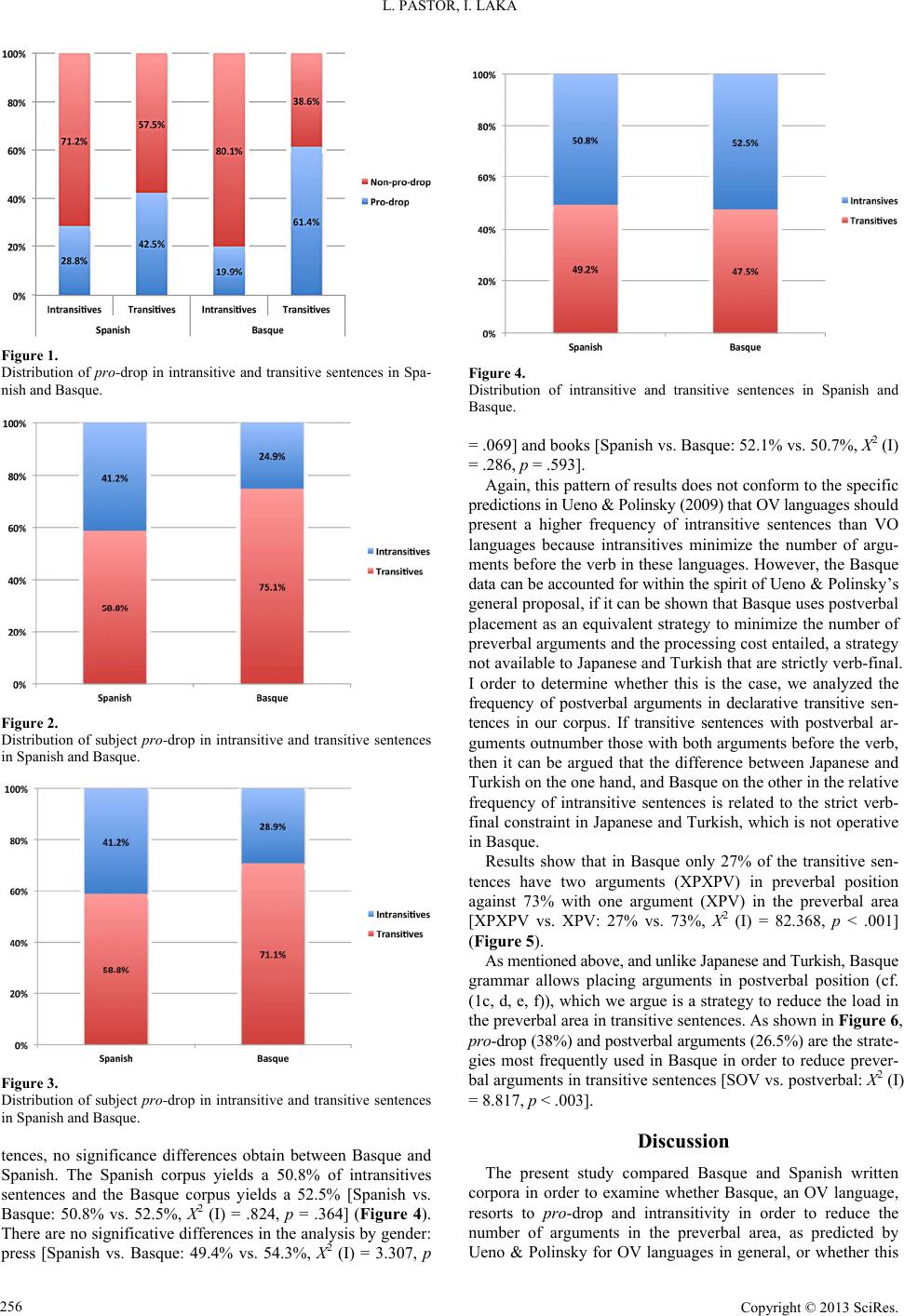 L. PASTOR, I. LAKA Copyright © 2013 SciRes. 256 Figure 1. Distribution of pro-drop in intransitive and transitive sentences in Spa- nish and Basque. Figure 2. Distribution of subject pro-drop in intransitive and transitive sentences in Spanish and Basque. Figure 3. Distribution of subject pro-drop in intransitive and transitive sentences in Spanish and Basque. tences, no significance differences obtain between Basque and Spanish. The Spanish corpus yields a 50.8% of intransitives sentences and the Basque corpus yields a 52.5% [Spanish vs. Basque: 50.8% vs. 52.5%, X2 (I) = .824, p = .364] (Figure 4). There are no significative differences in the analysis by gender: press [Spanish vs. Basque: 49.4% vs. 54.3%, X2 (I) = 3.307, p Figure 4. Distribution of intransitive and transitive sentences in Spanish and Basque. = .069] and books [Spanish vs. Basque: 52.1% vs. 50.7%, X2 (I) = .286, p = .593]. Again, this pattern of results does not conform to the specific predictions in Ueno & Polinsky (2009) that OV languages should present a higher frequency of intransitive sentences than VO languages because intransitives minimize the number of argu- ments before the verb in these languages. However, the Basque data can be accounted for within the spirit of Ueno & Polinsky’s general proposal, if it can be shown that Basque uses postverbal placement as an equivalent strategy to minimize the number of preverbal arguments and the processing cost entailed, a strategy not available to Japanese and Turkish that are strictly verb-final. I order to determine whether this is the case, we analyzed the frequency of postverbal arguments in declarative transitive sen- tences in our corpus. If transitive sentences with postverbal ar- guments outnumber those with both arguments before the verb, then it can be argued that the difference between Japanese and Turkish on the one hand, and Basque on the other in the relative frequency of intransitive sentences is related to the strict verb- final constraint in Japanese and Turkish, which is not operative in Basque. Results show that in Basque only 27% of the transitive sen- tences have two arguments (XPXPV) in preverbal position against 73% with one argument (XPV) in the preverbal area [XPXPV vs. XPV: 27% vs. 73%, X2 (I) = 82.368, p < .001] (Figure 5). As mentioned above, and unlike Japanese and Turkish, Basque grammar allows placing arguments in postverbal position (cf. (1c, d, e, f)), which we argue is a strategy to reduce the load in the preverbal area in transitive sentences. As shown in Figure 6, pro-drop (38%) and postverbal arguments (26.5%) are the strate- gies most frequently used in Basque in order to reduce prever- bal arguments in transitive sentences [SOV vs. postverbal: X2 (I) = 8.817, p < .003]. Discussion The present study compared Basque and Spanish written corpora in order to examine whether Basque, an OV language, resorts to pro-drop and intransitivity in order to reduce the number of arguments in the preverbal area, as predicted by Ueno & Polinsky for OV languages in general, or whether this 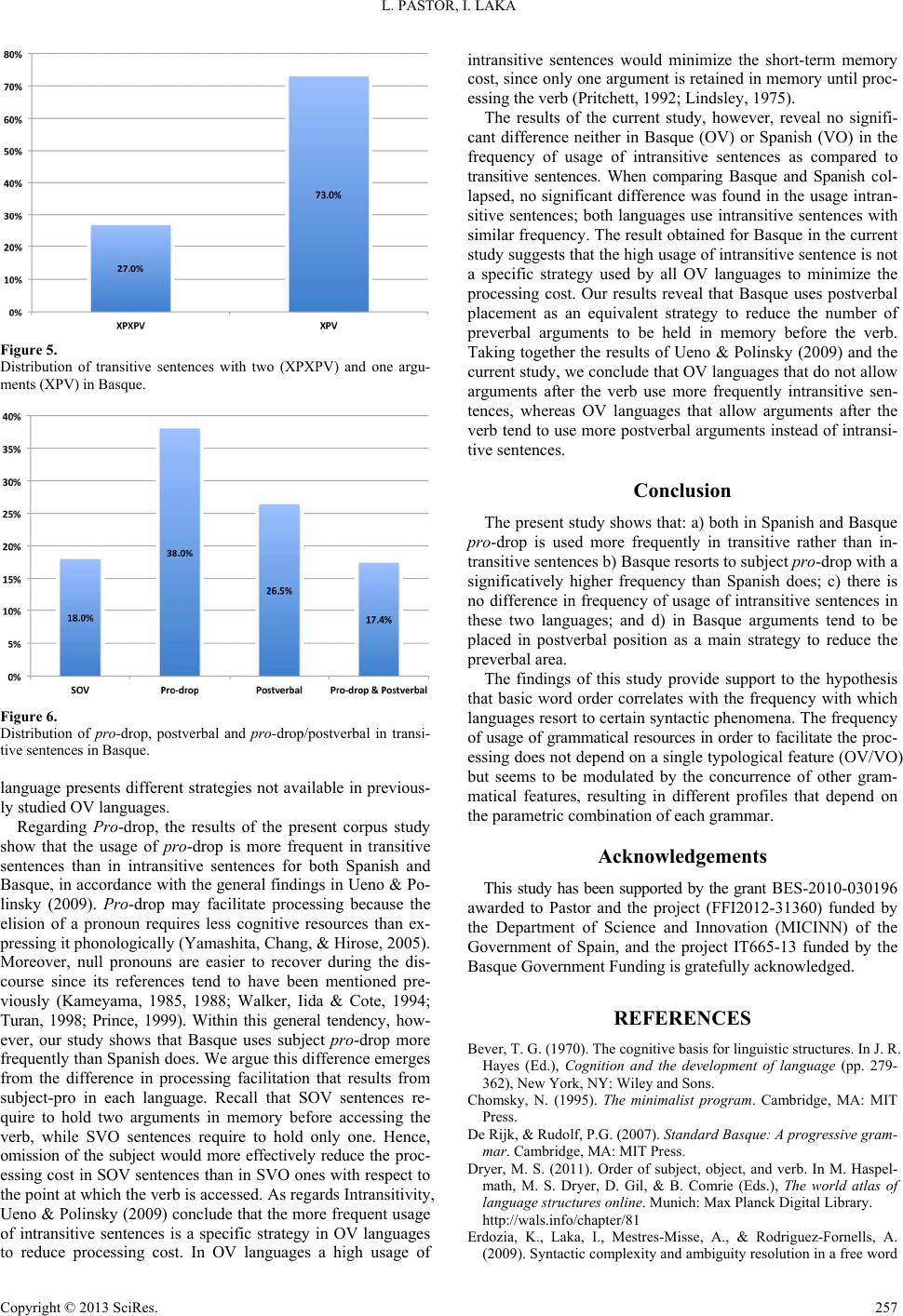 L. PASTOR, I. LAKA Copyright © 2013 SciRes. 257 Figure 5. Distribution of transitive sentences with two (XPXPV) and one argu- ments (XPV) in Basque. Figure 6. Distribution of pro-drop, postverbal and pro-drop/postverbal in transi- tive sentences in Basque. language presents different strategies not available in previous- ly studied OV languages. Regarding Pro-drop, the results of the present corpus study show that the usage of pro-drop is more frequent in transitive sentences than in intransitive sentences for both Spanish and Basque, in accordance with the general findings in Ueno & Po- linsky (2009). Pro-drop may facilitate processing because the elision of a pronoun requires less cognitive resources than ex- pressing it phonologically (Yamashita, Chang, & Hirose, 2005). Moreover, null pronouns are easier to recover during the dis- course since its references tend to have been mentioned pre- viously (Kameyama, 1985, 1988; Walker, Iida & Cote, 1994; Turan, 1998; Prince, 1999). Within this general tendency, how- ever, our study shows that Basque uses subject pro-drop more frequently than Spanish does. We argue this difference emerges from the difference in processing facilitation that results from subject-pro in each language. Recall that SOV sentences re- quire to hold two arguments in memory before accessing the verb, while SVO sentences require to hold only one. Hence, omission of the subject would more effectively reduce the proc- essing cost in SOV sentences than in SVO ones with respect to the point at which the verb is accessed. As regards Intransitivity, Ueno & Polinsky (2009) conclude that the more frequent usage of intransitive sentences is a specific strategy in OV languages to reduce processing cost. In OV languages a high usage of intransitive sentences would minimize the short-term memory cost, since only one argument is retained in memory until proc- essing the verb (Pritchett, 1992; Lindsley, 1975). The results of the current study, however, reveal no signifi- cant difference neither in Basque (OV) or Spanish (VO) in the frequency of usage of intransitive sentences as compared to transitive sentences. When comparing Basque and Spanish col- lapsed, no significant difference was found in the usage intran- sitive sentences; both languages use intransitive sentences with similar frequency. The result obtained for Basque in the current study suggests that the high usage of intransitive sentence is not a specific strategy used by all OV languages to minimize the processing cost. Our results reveal that Basque uses postverbal placement as an equivalent strategy to reduce the number of preverbal arguments to be held in memory before the verb. Taking together the results of Ueno & Polinsky (2009) and the current study, we conclude that OV languages that do not allow arguments after the verb use more frequently intransitive sen- tences, whereas OV languages that allow arguments after the verb tend to use more postverbal arguments instead of intransi- tive sentences. Conclusion The present study shows that: a) both in Spanish and Basque pro-drop is used more frequently in transitive rather than in- transitive sentences b) Basque resorts to subject pro-drop with a significatively higher frequency than Spanish does; c) there is no difference in frequency of usage of intransitive sentences in these two languages; and d) in Basque arguments tend to be placed in postverbal position as a main strategy to reduce the preverbal area. The findings of this study provide support to the hypothesis that basic word order correlates with the frequency with which languages resort to certain syntactic phenomena. The frequency of usage of grammatical resources in order to facilitate the proc- essing does not depend on a single typological feature (OV/VO) but seems to be modulated by the concurrence of other gram- matical features, resulting in different profiles that depend on the parametric combination of each grammar. Acknowledgements This study has been supported by the grant BES-2010-030196 awarded to Pastor and the project (FFI2012-31360) funded by the Department of Science and Innovation (MICINN) of the Government of Spain, and the project IT665-13 funded by the Basque Government Funding is gratefully acknowledged. REFERENCES Bever, T. G. (1970). The cognitive basis for linguistic structures. In J. R. Hayes (Ed.), Cognition and the development of language (pp. 279- 362), New York, NY: Wiley and Sons. Chomsky, N. (1995). The minimalist program. Cambridge, MA: MIT Press. De Rijk, & Rudolf, P.G. (2007). Standard Basque: A progressive gram- mar. Cambridge, MA: MIT Press. Dryer, M. S. (2011). Order of subject, object, and verb. In M. Haspel- math, M. S. Dryer, D. Gil, & B. Comrie (Eds.), The world atlas of language structures online. Munich: Max Planck Digital Library. http://wals.info/chapter/81 Erdozia, K., Laka, I., Mestres-Misse, A., & Rodriguez-Fornells, A. (2009). Syntactic complexity and ambiguity resolution in a free word 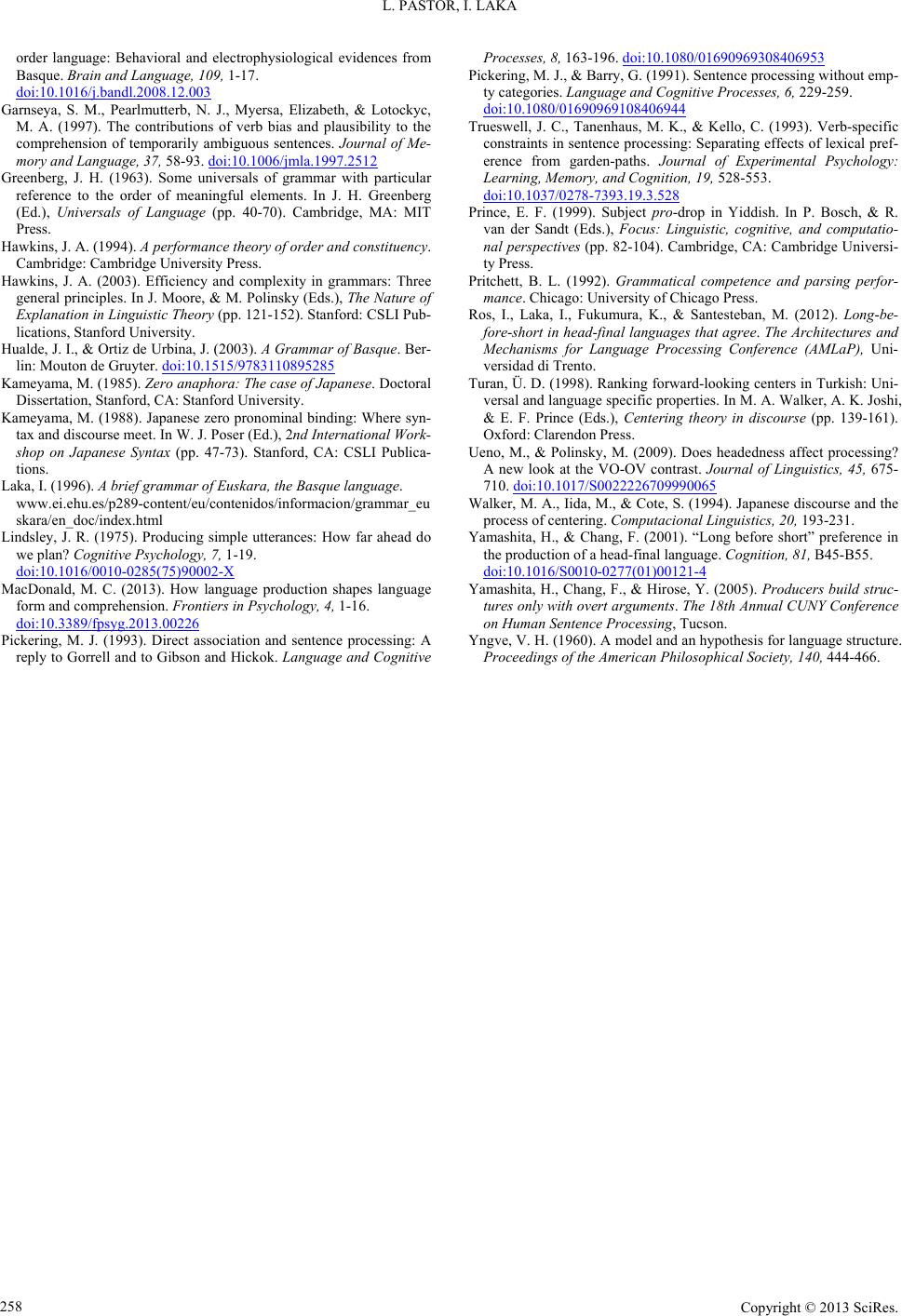 L. PASTOR, I. LAKA Copyright © 2013 SciRes. 258 order language: Behavioral and electrophysiological evidences from Basque. Brain and Language, 109, 1-17. doi:10.1016/j.bandl.2008.12.003 Garnseya, S. M., Pearlmutterb, N. J., Myersa, Elizabeth, & Lotockyc, M. A. (1997). The contributions of verb bias and plausibility to the comprehension of temporarily ambiguous sentences. Journal of Me- mory and Language, 37, 58-93. doi:10.1006/jmla.1997.2512 Greenberg, J. H. (1963). Some universals of grammar with particular reference to the order of meaningful elements. In J. H. Greenberg (Ed.), Universals of Language (pp. 40-70). Cambridge, MA: MIT Press. Hawkins, J. A. (1994). A performance theory of order and constituency. Cambridge: Cambridge University Press. Hawkins, J. A. (2003). Efficiency and complexity in grammars: Three general principles. In J. Moore, & M. Polinsky (Eds.), The Nature of Explanation in Linguistic Theory (pp. 121-152). Stanford: CSLI Pub- lications, Stanford University. Hualde, J. I., & Ortiz de Urbina, J. (2003). A Grammar of Basque. Ber- lin: Mouton de Gruyter. doi:10.1515/9783110895285 Kameyama, M. (1985). Zero anaphora: The case of Japanese. Doctoral Dissertation, Stanford, CA: Stanford University. Kameyama, M. (1988). Japanese zero pronominal binding: Where syn- tax and discourse meet. In W. J. Poser (Ed.), 2nd International Work- shop on Japanese Syntax (pp. 47-73). Stanford, CA: CSLI Publica- tions. Laka, I. (1996). A brief grammar of Euskara, the Basque language. www.ei.ehu.es/p289-content/eu/contenidos/informacion/grammar_eu skara/en_doc/index.html Lindsley, J. R. (1975). Producing simple utterances: How far ahead do we plan? Cognitive Psychology, 7, 1-19. doi:10.1016/0010-0285(75)90002-X MacDonald, M. C. (2013). How language production shapes language form and comprehension. Frontiers in Psychology, 4, 1-16. doi:10.3389/fpsyg.2013.00226 Pickering, M. J. (1993). Direct association and sentence processing: A reply to Gorrell and to Gibson and Hickok. Language and Cognitive Processes, 8, 163-196. doi:10.1080/01690969308406953 Pickering, M. J., & Barry, G. (1991). Sentence processing without emp- ty categories. Language and Cognitive Processes, 6, 229-259. doi:10.1080/01690969108406944 Trueswell, J. C., Tanenhaus, M. K., & Kello, C. (1993). Verb-specific constraints in sentence processing: Separating effects of lexical pref- erence from garden-paths. Journal of Experimental Psychology: Learning, Memory, and Cognition, 19, 528-553. doi:10.1037/0278-7393.19.3.528 Prince, E. F. (1999). Subject pro-drop in Yiddish. In P. Bosch, & R. van der Sandt (Eds.), Focus: Linguistic, cognitive, and computatio- nal perspectives (pp. 82-104). Cambridge, CA: Cambridge Universi- ty Press. Pritchett, B. L. (1992). Grammatical competence and parsing perfor- mance. Chicago: University of Chicago Press. Ros, I., Laka, I., Fukumura, K., & Santesteban, M. (2012). Long-be- fore-short in head-final languages that agree. The Architectures and Mechanisms for Language Processing Conference (AMLaP), Uni- versidad di Trento. Turan, Ü. D. (1998). Ranking forward-looking centers in Turkish: Uni- versal and language specific properties. In M. A. Walker, A. K. Joshi, & E. F. Prince (Eds.), Centering theory in discourse (pp. 139-161). Oxford: Clarendon Press. Ueno, M., & Polinsky, M. (2009). Does headedness affect processing? A new look at the VO-OV contrast. Journal of Linguistics, 45, 675- 710. doi:10.1017/S0022226709990065 Walker, M. A., Iida, M., & Cote, S. (1994). Japanese discourse and the process of centering. Computacional Linguistics, 20, 193-231. Yamashita, H., & Chang, F. (2001). “Long before short” preference in the production of a head-final language. Cognition, 81, B45-B55. doi:10.1016/S0010-0277(01)00121-4 Yamashita, H., Chang, F., & Hirose, Y. (2005). Producers build struc- tures only with overt arguments. The 18th Annual CUNY Conference on Human Sentence Processing, Tucson. Yngve, V. H. (1960). A model and an hypothesis for language structure. Proceedings of the American Philosophical Society, 140, 444-466. |