

Paper Menu >>
Journal Menu >>
 Vol.4, No.8, 376-381 (2013) Agricultural Sciences http://dx.doi.org/10.4236/as.2013.48054 Sprouts seasonal elongation of two olive cultivars in a high-density orchard G. Strippoli1, G. A. Vivaldi1, S. Camposeo1*, F. Contò2 1Department of Agricultural and Environmental Sciences, University of Bari Aldo Moro Via Amendola, Bari, Italy; *Corresponding Author: [email protected] 2Department of Economics, University of Foggia Largo Papa Giovanni, Foggia, Italy Received 21 May 2013; revised 22 June 2013; accepted 15 July 2013 Copyright © 2013 G. Strippoli et al. This is an open access article distributed under the Creative Commons Attribution License, which permits unrestricted use, distribution, and reproduction in any medium, provided the original work is properly cited. ABSTRACT The new high-density cropping systems (>1200 trees ha−1) represent a very interesting proposal for olive orchard profitability. It is crucial to know the morphology and the dynamics of sprout elongation of a cultivar in order to fully assess its suitability for a high-density olive orchard. For this reason we planned a research on two cultivars, Coratina and Arbequina, in a high-density orchard. The apical sprouts elon- gation of Arbequina early stopped at fruit set without a further step, while Coratina showed a little growth flux after pit hardening. Similar trends showed the lateral proleptic sprouts. Only the sylleptic sprouts of both cultivars had a second period of activity. In all cases, the sprouts elongation finished at the end of sum- mer, when oil accumulation started. Coratina showed higher apical shoot growth and inter- nodes mean length than Arbequina. On the con- trary, Coratina showed lower lateral proleptic shoot growth and nodes number than Arbequina, but the same internodes mean length. No sig- nificant differences were observed between cul- tivars for growth, nodes number and internodes mean length of sylleptic shoots. The differences observed between the two cultivars could be explained considering their different vigour. The introduction of this innovative cropping system is allowed to register a considerable reduction of production costs. The result is a considerable increase in the economic performance of the olive grove and a consequent reduction in the unit cost for kg of oil. These data are very useful for varietal choice and field management in high-density orchards and then for new olive breeding programs. Keywords: Arbequina; Coratina; Proleptic Axis; Sylleptic Axis; Growth Flux 1. INTRODUCTION Today the millennial olive tree cultivation all over the world can be defined in a change of epoch: it tends quickly to move from traditional low-density (<200 trees per hectare) to modern medium-density cropping sys- tems (300 - 400 trees per hectare) and overall to new high-density cropping systems (>1200 trees per hectare), which represent a very interesting proposal for olive or- chard profitability [1]. The high-density cropping sys- tems are characterized by strong reduction of production costs thanks to total mechanization, from planting to har- vesting [2]. Cost reduction allows you to make new com- petitive companies with production facilities archaic. The improvement of productivity is fundamental in contexts that are now confronted with major international chal- lenges, and the cost containment is essential for the sur- vival of the farm. This cost reduction must then neces- sarily be accompanied by sustainable production policies as now required from Europe and from the market [3]. The high-density cropping systems are based on early bearing (3rd year from planting), yield stabilization start- ing from 5th - 6th years from planting (8 - 10 t per hectare per year) with very negligible alternate bearing and con- tinuous harvesting [1,4]. Several physiological and agronomic aspects are al- ready started to be studied for high-density olive or- chards: light interception [5], soil management [6], irri- gation [7, 8], harvesting time [9]. Moreover, in the lit- erature some vegetative and productive parameters are considered in order to assess the varietal response since considerable differences are observed among different cultivars, mainly depending on both growth habit and vigour [1,2,4, 10]. In fact the benefit of these new sys- tems mainly depends on the availability of cultivars with Copyright © 2013 SciRes. OPEN ACCESS  G. Strippoli et al. / Agricultural Sciences 4 (2013) 376-381 377 compact habit and slow canopy growth, owned by Ar- bequina and Arbosana, two Spanish cultivars on which these systems were calibrated up to now [2]. It is crucial to know the morphology and the dynamics of sprout elongation of an olive cultivated genotype in order to fully assess its suitability for a high-density olive orchard. The first one to define and introduce the study of plant morphology was Goethe, the famous German writer [11]. It has long been accepted that the plants are modular organisms that develop through repetition of elementary botanical entity, continually subject to change during ontogeny [12]. The study of the plant architecture has been developed as a new scientific discipline about 40 years ago, coming from the earlier works on plant mor- phology [13]. At first, plant architecture investigations have focused on canopy analysis of the tropical species [14]; then these concepts were applied on temperate for- estry tree species [15,16] and only more recently on fruit tree species, such as apple [17], apricot [18], and peach [19]. Although the architecture of some plants consists in single vegetative axis, most of the tree species show a more complex architectture, composed of several axes (sprouts, shoots, branches) one derived from the other by means of a repetitive process known as branching [20]. In particular, according to the time of woody bud break- ing on the shoot, two types of axis can be distinguished: proleptic if they come from resting buds and sylleptic if they derive from steady buds [21]. Analysis of shoots vegetative growth and modelling growth dynamics of olive tree (Olea europaea L. var. sativa Hoffm. and Lk.) is very recent, but made in arid areas under low and very-low densities and rainfed cropping systems [22,23]. Considering that sprouts are the fundamental units for both yield load and vegetative growth of an olive tree [24], the aim of our research was to study the seasonal elongation of all types of sprouts (apical, lateral proleptic and sylleptic) on a olive shoot in order to highlight dif- ferent varietal behaviours under high-density irrigated conditions. 2. MATERIALS AND METHODS The study was carried out in the olive grove located at the experimental farm of the Department of Agricultural and Environmental Sciences at Valenzano (Bari, South- ern Italy—41˚01'N; 16˚45'E; 110 m a.s.l.), on a sandy clay soil (sand, 630 g·kg−1; silt, 160 g·kg−1; clay, 210 g·kg−1) classified as a Typic Haploxeralf (USDA) or Chromi-Cutanic Luvisol (FAO). The site is characterised by a typical Mediterranean climate, with a long-term average annual rainfall of 560 mm, two third concen- trated from autumn to winter, and a long-term average annual temperature of 15.6˚C. The olive grove has been planted in 2006 with self-rooted plants; the trees were trained according to the central leader system and spaced 4.0 m × 1.5 m (1667 trees ha−1) with a North-South rows orientation, according to the Spanish high-density crop- ping system. Props, drip irrigation and routine cultural practices (nutrition, pruning, disease control) were set up as already described [1,4]. The study was conducted on two cultivars: Arbequina, on which the high-density sys- tem was calibrated, and Coratina, the most important traditional Apulian olive cultivated variety [25]. The measurements were carried out in 2009, 2010 and 2011, respectively at 5th, 6th and 7th years after plantation. A randomized block experimental design was adopted: for each cultivar the measurements have been replicated on 3 blocks of 3 plants and the observations were carried out on all plants of each block. Before woody bud breaking, two healthy well light-exposed shoots per tree (E-W) were labelled (18 shoots per cultivar) in the middle part of the crown. The shoots were homogeneous, with 25 - 30 cm in length and 15 - 20 nodes as mean. After woody buds breaking, the length of the sprouts issued by the apical bud and by lateral buds, both proleptic and syllep- tic, and the nodes number were measured fortnightly on each labelled shoot. At the end of the vegetative season, the total length and the total nodes number of the new shoots on each labelled shoot were determined. In this work we did not separate sylleptic sprouts coming from the apical or the lateral sprouts. For each cultivar seasonal data were statistically treated by one-way analysis of variance (ANOVA) fol- lowed by post hoc testing (Tukey post hoc test) using the R 2.15.0 software (R Foundation for Statistical Comput- ing); standard error (SE) was also calculated. For detect statistical differences between the two cultivars at each measurement time t test was adopted. 3. RESULTS AND DISCUSSION 3.1. Apical Sprouts Elongation In all years, apical woody buds expanding began in the early spring (80 - 90 DOY), while lateral proleptic and sylleptic buds breaking started few weeks after (110 - 120 DOY), just before full blooming (130 - 140 DOY), without any difference between the cultivars (Figures 1-3). A general model of olive tree sprouts elongation provides for two periods of activity: the major one occurs during spring before blooming and the second one, less important, occurs during early autumn separated by a summer rest [26]. Our data differ from this general model and statistical differences among sprouts type and between cultivars were observed. Indeed the apical sprouts elongation of Arbequina early stopped at fruit set (150 - 160 DOY) without a further step, while Coratina showed a little growth flux after pit hardening (190 - 230 DOY) better following the general model (Figure 1). Copyright © 2013 SciRes. OPEN ACCESS 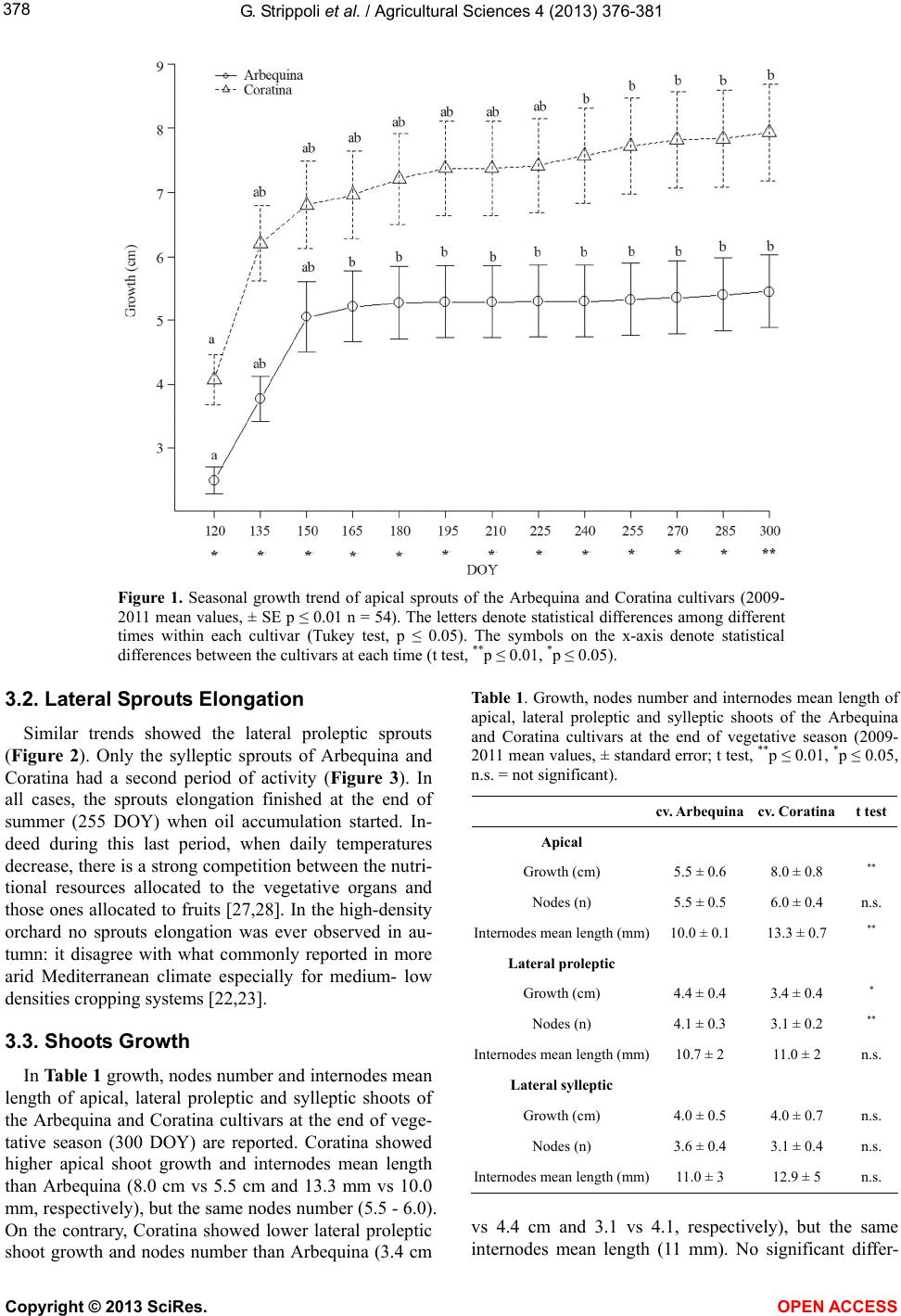 G. Strippoli et al. / Agricultural Sciences 4 (2013) 376-381 Copyright © 2013 SciRes. 378 Figure 1. Seasonal growth trend of apical sprouts of the Arbequina and Coratina cultivars (2009- 2011 mean values, ± SE p ≤ 0.01 n = 54). The letters denote statistical differences among different times within each cultivar (Tukey test, p ≤ 0.05). The symbols on the x-axis denote statistical differences between the cultivars at each time (t test, **p ≤ 0.01, *p ≤ 0.05). 3.2. Lateral Sprouts Elongation Table 1. Growth, nodes number and internodes mean length of apical, lateral proleptic and sylleptic shoots of the Arbequina and Coratina cultivars at the end of vegetative season (2009- 2011 mean values, ± standard error; t test, **p ≤ 0.01, *p ≤ 0.05, n.s. = not significant). Similar trends showed the lateral proleptic sprouts (Figure 2). Only the sylleptic sprouts of Arbequina and Coratina had a second period of activity (Figure 3). In all cases, the sprouts elongation finished at the end of summer (255 DOY) when oil accumulation started. In- deed during this last period, when daily temperatures decrease, there is a strong competition between the nutri- tional resources allocated to the vegetative organs and those ones allocated to fruits [27,28]. In the high-density orchard no sprouts elongation was ever observed in au- tumn: it disagree with what commonly reported in more arid Mediterranean climate especially for medium- low densities cropping systems [22,23]. cv. Arbequina cv. Coratinat test Apical Growth (cm) 5.5 ± 0.6 8.0 ± 0.8 ** Nodes (n) 5.5 ± 0.5 6.0 ± 0.4 n.s. Internodes mean length (mm)10.0 ± 0.1 13.3 ± 0.7 ** Lateral proleptic Growth (cm) 4.4 ± 0.4 3.4 ± 0.4 * Nodes (n) 4.1 ± 0.3 3.1 ± 0.2 ** Internodes mean length (mm)10.7 ± 2 11.0 ± 2 n.s. Lateral sylleptic Growth (cm) 4.0 ± 0.5 4.0 ± 0.7 n.s. Nodes (n) 3.6 ± 0.4 3.1 ± 0.4 n.s. Internodes mean length (mm)11.0 ± 3 12.9 ± 5 n.s. 3.3. Shoots Growth In Table 1 growth, nodes number and internodes mean length of apical, lateral proleptic and sylleptic shoots of the Arbequina and Coratina cultivars at the end of vege- tative season (300 DOY) are reported. Coratina showed higher apical shoot growth and internodes mean length than Arbequina (8.0 cm vs 5.5 cm and 13.3 mm vs 10.0 mm, respectively), but the same nodes number (5.5 - 6.0). On the contrary, Coratina showed lower lateral proleptic shoot growth and nodes number than Arbequina (3.4 cm vs 4.4 cm and 3.1 vs 4.1, respectively), but the same internodes mean length (11 mm). No significant differ- OPEN ACCESS 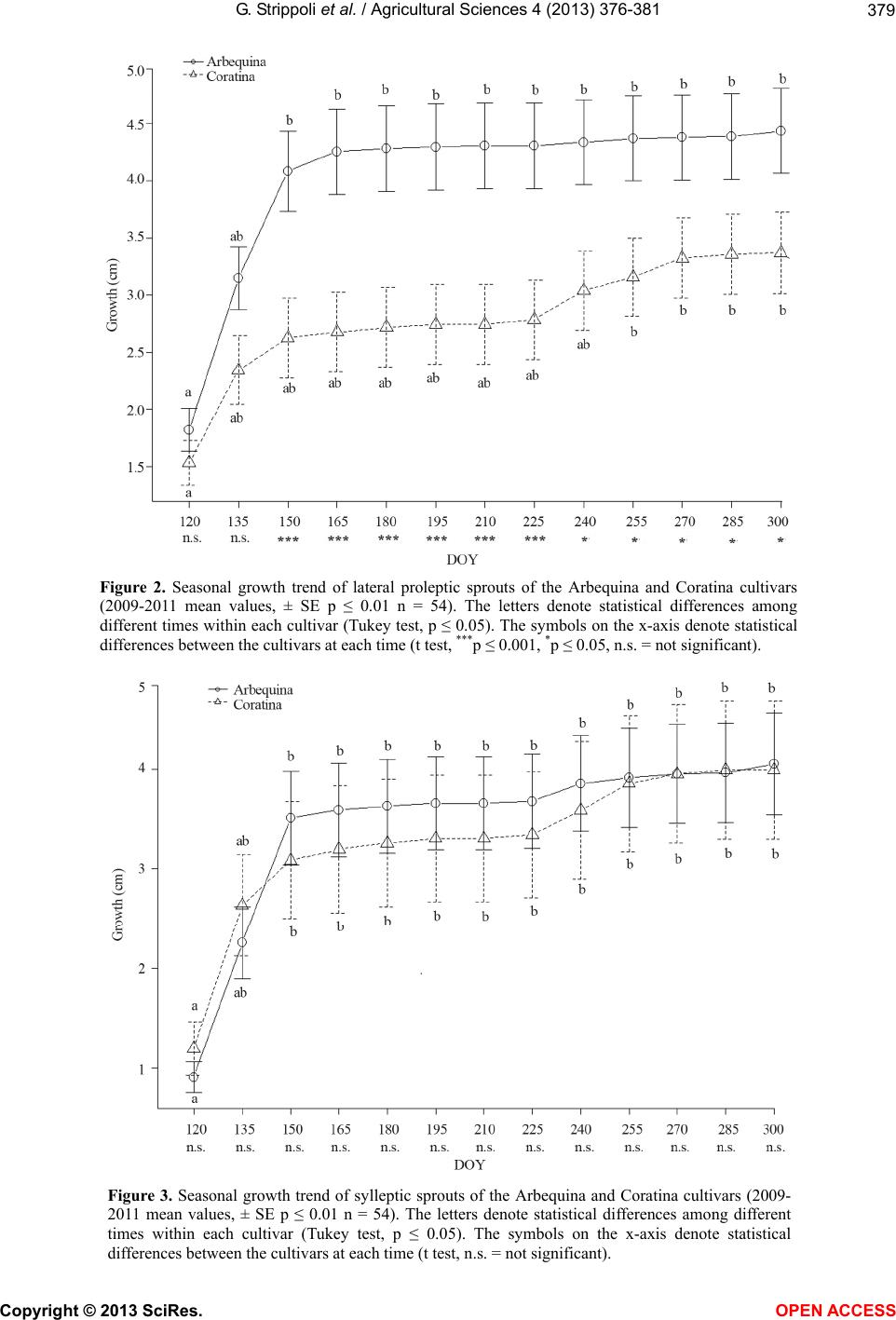 G. Strippoli et al. / Agricultural Sciences 4 (2013) 376-381 379 Figure 2. Seasonal growth trend of lateral proleptic sprouts of the Arbequina and Coratina cultivars (2009-2011 mean values, ± SE p ≤ 0.01 n = 54). The letters denote statistical differences among different times within each cultivar (Tukey test, p ≤ 0.05). The symbols on the x-axis denote statistical differences between the cultivars at each time (t test, ***p ≤ 0.001, *p ≤ 0.05, n.s. = not significant). Figure 3. Seasonal growth trend of sylleptic sprouts of the Arbequina and Coratina cultivars (2009- 2011 mean values, ± SE p ≤ 0.01 n = 54). The letters denote statistical differences among different times within each cultivar (Tukey test, p ≤ 0.05). The symbols on the x-axis denote statistical differences between the cultivars at each time (t test, n.s. = not significant). Copyright © 2013 SciRes. OPEN ACCESS 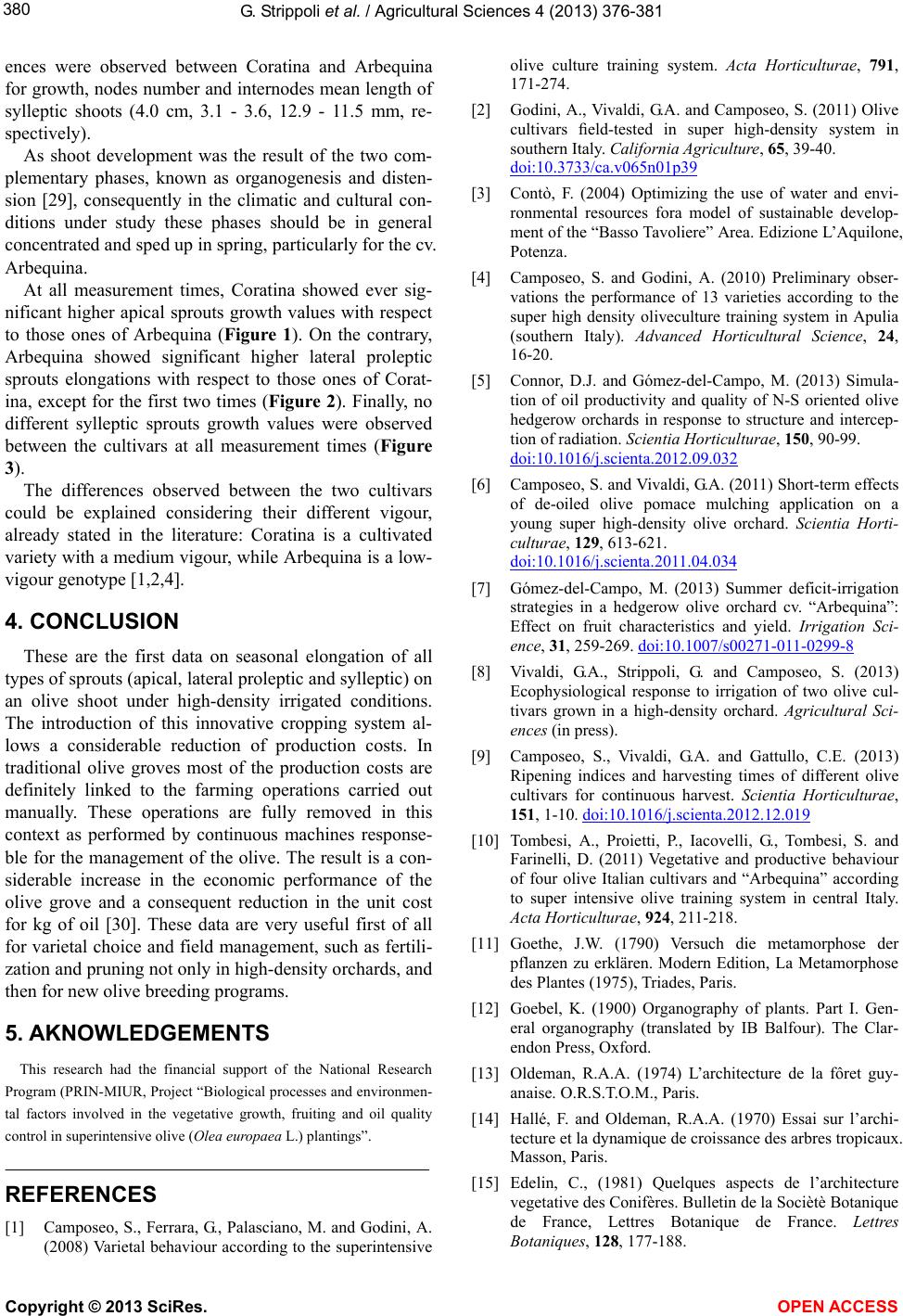 G. Strippoli et al. / Agricultural Sciences 4 (2013) 376-381 380 ences were observed between Coratina and Arbequina for growth, nodes number and internodes mean length of sylleptic shoots (4.0 cm, 3.1 - 3.6, 12.9 - 11.5 mm, re- spectively). As shoot development was the result of the two com- plementary phases, known as organogenesis and disten- sion [29], consequently in the climatic and cultural con- ditions under study these phases should be in general concentrated and sped up in spring, particularly for the cv. Arbequina. At all measurement times, Coratina showed ever sig- nificant higher apical sprouts growth values with respect to those ones of Arbequina (Figure 1). On the contrary, Arbequina showed significant higher lateral proleptic sprouts elongations with respect to those ones of Corat- ina, except for the first two times (Figure 2). Finally, no different sylleptic sprouts growth values were observed between the cultivars at all measurement times (Figure 3). The differences observed between the two cultivars could be explained considering their different vigour, already stated in the literature: Coratina is a cultivated variety with a medium vigour, while Arbequina is a low- vigour genotype [1,2,4]. 4. CONCLUSION These are the first data on seasonal elongation of all types of sprouts (apical, lateral proleptic and sylleptic) on an olive shoot under high-density irrigated conditions. The introduction of this innovative cropping system al- lows a considerable reduction of production costs. In traditional olive groves most of the production costs are definitely linked to the farming operations carried out manually. These operations are fully removed in this context as performed by continuous machines response- ble for the management of the olive. The result is a con- siderable increase in the economic performance of the olive grove and a consequent reduction in the unit cost for kg of oil [30]. These data are very useful first of all for varietal choice and field management, such as fertili- zation and pruning not only in high-density orchards, and then for new olive breeding programs. 5. AKNOWLEDGEMENTS This research had the financial support of the National Research Program (PRIN-MIUR, Project “Biological processes and environmen- tal factors involved in the vegetative growth, fruiting and oil quality control in superintensive olive (Olea europaea L.) plantings”. REFERENCES [1] Camposeo, S., Ferrara, G., Palasciano, M. and Godini, A. (2008) Varietal behaviour according to the superintensive olive culture training system. Acta Horticulturae, 791, 171-274. [2] Godini, A., Vivaldi, G.A. and Camposeo, S. (2011) Olive cultivars field-tested in super high-density system in southern Italy. California Agriculture, 65, 39-40. doi:10.3733/ca.v065n01p39 [3] Contò, F. (2004) Optimizing the use of water and envi- ronmental resources fora model of sustainable develop- ment of the “Basso Tavoliere” Area. Edizione L’Aquilone, Potenza. [4] Camposeo, S. and Godini, A. (2010) Preliminary obser- vations the performance of 13 varieties according to the super high density oliveculture training system in Apulia (southern Italy). Advanced Horticultural Science, 24, 16-20. [5] Connor, D.J. and Gómez-del-Campo, M. (2013) Simula- tion of oil productivity and quality of N-S oriented olive hedgerow orchards in response to structure and intercep- tion of radiation. Scientia Horticulturae, 150, 90-99. doi:10.1016/j.scienta.2012.09.032 [6] Camposeo, S. and Vivaldi, G.A. (2011) Short-term effects of de-oiled olive pomace mulching application on a young super high-density olive orchard. Scientia Horti- culturae, 129, 613-621. doi:10.1016/j.scienta.2011.04.034 [7] Gómez-del-Campo, M. (2013) Summer deficit-irrigation strategies in a hedgerow olive orchard cv. “Arbequina”: Effect on fruit characteristics and yield. Irrigation Sci- ence, 31, 259-269. doi:10.1007/s00271-011-0299-8 [8] Vivaldi, G.A., Strippoli, G. and Camposeo, S. (2013) Ecophysiological response to irrigation of two olive cul- tivars grown in a high-density orchard. Agricultural Sci- ences (in press). [9] Camposeo, S., Vivaldi, G.A. and Gattullo, C.E. (2013) Ripening indices and harvesting times of different olive cultivars for continuous harvest. Scientia Horticulturae, 151, 1-10. doi:10.1016/j.scienta.2012.12.019 [10] Tombesi, A., Proietti, P., Iacovelli, G., Tombesi, S. and Farinelli, D. (2011) Vegetative and productive behaviour of four olive Italian cultivars and “Arbequina” according to super intensive olive training system in central Italy. Acta Horticulturae, 924, 211-218. [11] Goethe, J.W. (1790) Versuch die metamorphose der pflanzen zu erklären. Modern Edition, La Metamorphose des Plantes (1975), Triades, Paris. [12] Goebel, K. (1900) Organography of plants. Part I. Gen- eral organography (translated by IB Balfour). The Clar- endon Press, Oxford. [13] Oldeman, R.A.A. (1974) L’architecture de la fôret guy- anaise. O.R.S.T.O.M., Paris. [14] Hallé, F. and Oldeman, R.A.A. (1970) Essai sur l’archi- tecture et la dynamique de croissance des arbres tropicaux. Masson, Paris. [15] Edelin, C., (1981) Quelques aspects de l’architecture vegetative des Conifères. Bulletin de la Sociètè Botanique de France, Lettres Botanique de France. Lettres Botaniques, 128, 177-188. Copyright © 2013 SciRes. OPEN ACCESS  G. Strippoli et al. / Agricultural Sciences 4 (2013) 376-381 381 [16] Nicolini, E. (1998) Architecture et gradients morpho- génétiques chez de jeunes hêtres (Fagus sylvatica L. Fagaceae) en milieu forestier. Canadian Journal of Bot- any, 76, 1232-1244. doi:10.1139/b98-053 [17] Lauri, P.E. and Térouanne, E. (1999) Effect of inflores- cence removal on the fruit set of the remaining inflores- cences and development of the laterals on one year old apple (Malus domestica Borkh) branches. Journal Horti- cultural Science Biotechnology, 74, 110-117. [18] Costes, E., Fournier D. and Salles J.C. (2000) Changes in primary and secondary growth as influenced by crop load in “Fantasme” apricot trees. Journal Horticultural Sci- ence Biotechnology, 75, 510-519. [19] Barman, M.E. and DeJong, T.M. (2003) Seasonal patterns of vegetative growth and competition with reproductive sink in peach. Journal Horticultural Science Biotechnol- ogy, 78, 303-309. [20] Hallé, F., Oldeman, R.A.A. and Tomlinson, P.B. (1978) Tropical trees and forests. Springer-Verlag, Berlin. doi:10.1007/978-3-642-81190-6 [21] Barthélémy, D., Caraglio, Y. and Costes, E. (1997) Archi- tecture, gradients morphogénétiques et age physiologique chez les végétaux. In: Bouchon, J., de Reffye, P. and Barthèlèmy, D., Eds., Modelisation et simulation de l’architecture des végétaux. Sciences Update. Editions INRA, Paris, 89-136. [22] Aïachi-Mezghani, M., Sahli, A., Labidi, F, Meddeb, K., Jebari, A. and Ben El Hadj, S. (2008) Analysis in primary and secondary growth and modeling growth dynamics of olive shoots (Olea europea L.). Journal Horticultural Science Biotechnology, 83, 411-418. doi:10.1051/fruits:2006048 [23] Masmoudi-Charfi, C. and Ben Mechlia, N. (2008) Changes in olive tree height growth during the first years of cultivation. Advances Horticultural Science, 22, 8-12. [24] Moutier, N., Garcia, G. and Lauri, P.E. (2004) Shoot ar- chitecture of the olive tree: Effect of cultivar on the number and distribution of vegetative and reproductive organs on branches. Acta Horticulturae, 636, 689-694. [25] Camposeo, S., Ferrara, G., Palasciano, M., Godini, A. (2012) About the biological behaviour of cv. Coratina. Acta Horticulturae, 949, 129-133. [26] Lavee, S. (1997) L’olivier, 61-110. In: COI, Encyclopédie mondiale de l’Olivier. Conseil Oléicole International, Madrid, Barcelona, 479. [27] Monselise, S. and Goldschmidt, E.E. (1982) Alternate bearing in fruit trees. Horticultural Review, 4, 128-173. [28] Castillo-Llanque, F.J. and Rapoport, H.F. (2011) Rela- tionship between reproductive behavior and new shoot development in 5-year-old branches of olive trees (Olea europaea L.). Trees, 25, 823-832. [29] Lüttge, U., Kluge, M. and Bauer, G. (1992) Botanique. Traité fondamental. 3rd Edition, Edition Technique et Documentation, Paris, 574. [30] Contò, F. (2006) Economics and organization of agro- food chains. The chain of high quality oil olive. Franco Angeli Editore, Milano. Copyright © 2013 SciRes. OPEN ACCESS |