

Paper Menu >>
Journal Menu >>
 Open Journal of Ophthalmology, 2013, 3, 90-92 http://dx.doi.org/10.4236/ojoph.2013.33021 Published Online August 2013 (http://www.scirp.org/journal/ojoph) Preoperative Management of Cataract Surgery Candidates: An Evaluation of Their Perception and Preferences Evgenia Kanonidou*, Vasileios Konidaris, Christina Kanonidou, Leonidas Papazisis Department of Ophthalmology, General Hospital of Veria, Veria, Greece. Email: *[email protected] Received January 4th, 2013; revised February 5th, 2013; accepted March 4th, 2013 Copyright © 2013 Evgenia Kanonidou et al. This is an open access article distributed under the Creative Commons Attribution Li- cense, which permits unrestricted use, distribution, and reproduction in any medium, provided the original work is properly cited. ABSTRACT Purpose: To assess the primary visual disabilit y in patients with cataract and to ev aluate their preference regarding the visual outcome after surgery. Materials and Methods: 120 patients (66 males, mean age 76.3 years, mean best cor- rected visual acuity 5.2/10 binocularly) participated. Perception regarding the primary visual disability related to cata- ract and preference of visual outcome after surgery were assessed by a questionnaire. All study procedures adhered to the principles outlined in the Declaration of Helsinki for research involving human subjects, and all participants gave written informed consent before their participation. Results: 74 patients (61.6%) had difficulty in distant vision, 5 (4.2%) in near vision, 17 (14.2%) mentioned blurred vision, 14 (11.7%) difficulty in driving especially at night, 7 (5.8%) complained about monocular diplopia and 3 (2.5%) about anisometropia. All mentioned that they preferred to obtain clear distant and near vision after cataract surgery. Conclusions: There was an interesting variety in visual disability related to cataract. The difficulty in distant vision was the primary visual deficit in the majority of the patients and the preference for clea r distant and near vision was the desired postoperative visual outcome. Keywords: Cataract; Visual Outcome; Visual Disability; Quality of Life 1. Introduction ability in patients with cataract, their perception regard- ing the postoperative visual outcome and their prefer- ences regarding the preoperative management. Cataract is one of the commonest causes of vision loss and the commonest cause of reversible loss of useful vision worldwide [1]. It is defined as the loss of trans- parency of the natural lens of the eye, usually due to the ageing process [1,2]. The only treatment is surgery, which has become the most frequent performed surgery in industrialized countries [2]. As the trend towards smaller incisions and shorter operating time continues, less sedation and anesthesia are required [3]. Topical anesthesia and intracameral anesthesia are the standard for cooperative patients [4-6]. Snellen chart visual acuity is the standard procedure to measure the preoperative visual acuity and thereby the indication of cataract surgery and the postoperative outcome. However, the disability of a patient with cataract goes beyond the loss of visual acuity, as decreased visual function is associated with poor qual- ity of life and general functioning living activities. The aim of this study was to evaluate the primary visual dis- 2. Methods 120 patients (66 males) with mean age 76.3 years old and mean best corrected visual acuity 5.2/10 binocularly par- ticipated in the study. All the patients were recruited through the cataract clinic of the Department of Oph- thalmology of General Hospital of Veria, Veria, Greece for a time period of one year. All had a history of visu- ally significant cataract for their daily activities for at least six months and suffered from no other ocular co- morbidity. All the participants were of a basic educa- tional level and occupied themselves with agriculture. Their perception regarding the primary visual disability related to cataract, their preference with respect to the visual outcome after cataract surgery as well as their at- titudes related to the preoperative management was as- sessed by means of a simple questionnaire. All study *Corresponding a uthor. Copyright © 2013 SciRes. OJOph 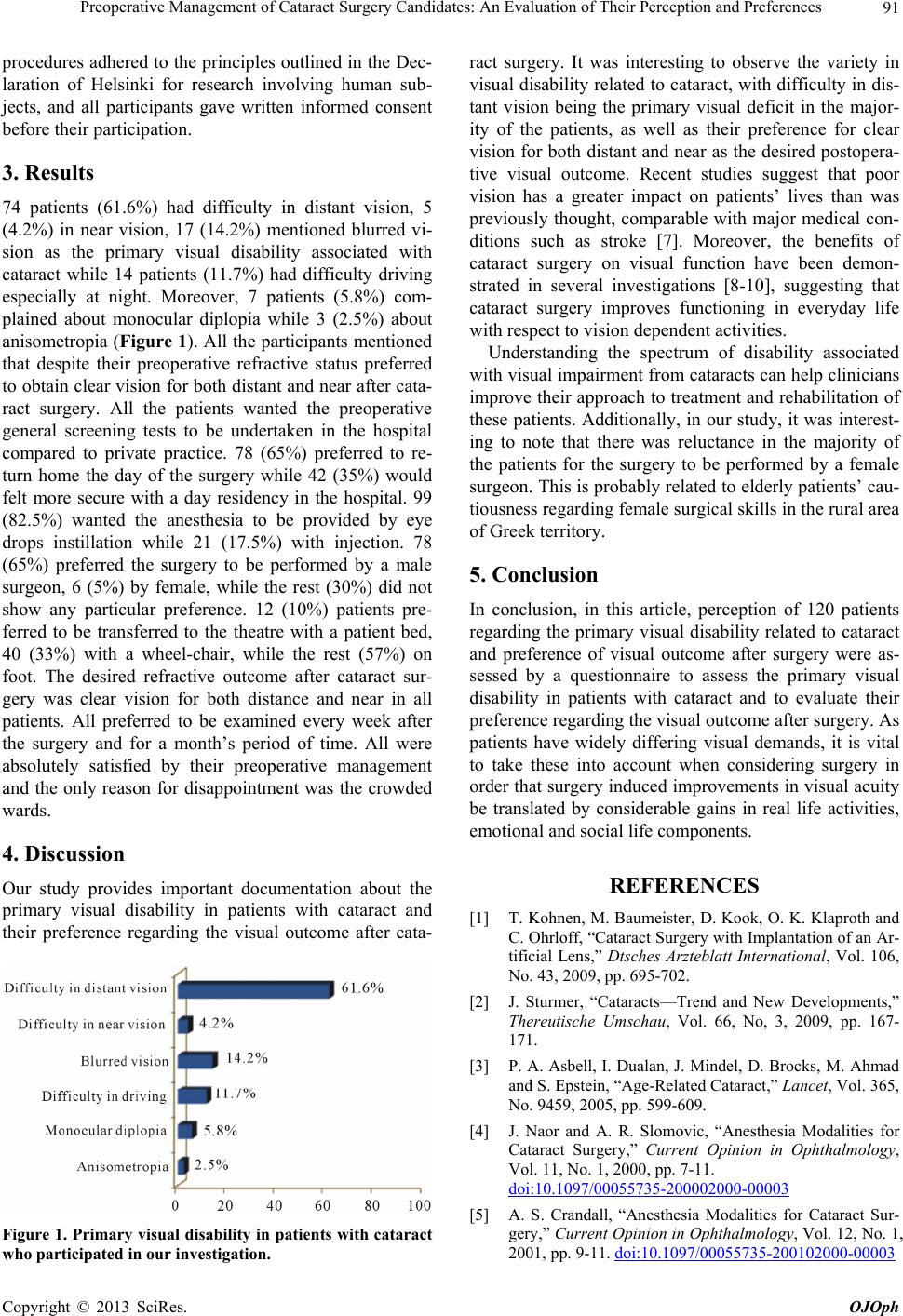 Preoperative Management of Cataract Surgery Candidates: An Evaluation of Their Perception and Preferences 91 procedures adhered to the princip les outlined in the Dec- laration of Helsinki for research involving human sub- jects, and all participants gave written informed consent before their participatio n. 3. Results 74 patients (61.6%) had difficulty in distant vision, 5 (4.2%) in near vision, 17 (14.2%) mentioned blurred vi- sion as the primary visual disability associated with cataract while 14 patients (11.7%) had difficulty driving especially at night. Moreover, 7 patients (5.8%) com- plained about monocular diplopia while 3 (2.5%) about anisometropia (Figure 1). All the participants mentioned that despite their preoperative refractive status preferred to obtain clear vision for both distant and near after cata- ract surgery. All the patients wanted the preoperative general screening tests to be undertaken in the hospital compared to private practice. 78 (65%) preferred to re- turn home the day of the surgery while 42 (35%) would felt more secure with a day residency in the hospital. 99 (82.5%) wanted the anesthesia to be provided by eye drops instillation while 21 (17.5%) with injection. 78 (65%) preferred the surgery to be performed by a male surgeon, 6 (5%) by female, while the rest (30%) did not show any particular preference. 12 (10%) patients pre- ferred to be transferred to the theatre with a patient bed, 40 (33%) with a wheel-chair, while the rest (57%) on foot. The desired refractive outcome after cataract sur- gery was clear vision for both distance and near in all patients. All preferred to be examined every week after the surgery and for a month’s period of time. All were absolutely satisfied by their preoperative management and the only reason for disappointment was the crowded wards. 4. Discussion Our study provides important documentation about the primary visual disability in patients with cataract and their preference regarding the visual outcome after cata- Figure 1. Primary visual disability in patients with cataract who participated in our investigation. ract surgery. It was interesting to observe the variety in visual disability related to cataract, with difficulty in dis- tant vision being the primary visual deficit in the major- ity of the patients, as well as their preference for clear vision for both distant and near as the desired postopera- tive visual outcome. Recent studies suggest that poor vision has a greater impact on patients’ lives than was previously thought, comparable with major medical con- ditions such as stroke [7]. Moreover, the benefits of cataract surgery on visual function have been demon- strated in several investigations [8-10], suggesting that cataract surgery improves functioning in everyday life with respect to vision dependent activities. Understanding the spectrum of disability associated with visual impairment from cataracts can help clinicians improve their approach to treat ment and rehabilitation o f these patients. Additionally, in our study, it was interest- ing to note that there was reluctance in the majority of the patients for the surgery to be performed by a female surgeon. This is pr obably related to elderly patients’ cau- tiousness regarding female surgical skills in the rural area of Greek territory. 5. Conclusion In conclusion, in this article, perception of 120 patients regarding the primary visual disability related to cataract and preference of visual outcome after surgery were as- sessed by a questionnaire to assess the primary visual disability in patients with cataract and to evaluate their preference regarding the visual outcome after surgery. As patients have widely differing visual demands, it is vital to take these into account when considering surgery in order that surgery induced improvements in visual acuity be translated by considerable gains in real life activities, emotional and social life co mponents. REFERENCES [1] T. Kohnen, M. Baumeister, D. Kook, O. K. Klaproth and C. Ohrloff, “Cataract Surgery with Implantation of an Ar- tificial Lens,” Dtsches Arzteblatt International, Vol. 106, No. 43, 2009, pp. 695-702. [2] J. Sturmer, “Cataracts—Trend and New Developments,” Thereutische Umschau, Vol. 66, No, 3, 2009, pp. 167- 171. [3] P. A. Asbell, I. Dualan, J. Mindel, D. Brocks, M. Ahmad and S. Epstein, “Age-Related Cataract,” Lancet, Vol. 365, No. 9459, 2005, pp. 599-609. [4] J. Naor and A. R. Slomovic, “Anesthesia Modalities for Cataract Surgery,” Current Opinion in Ophthalmology, Vol. 11, No. 1, 2000, pp. 7-11. doi:10.1097/00055735-200002000-00003 [5] A. S. Crandall, “Anesthesia Modalities for Cataract Sur- gery,” Current Opinion in Ophthalmology, Vol. 12, No. 1, 2001, pp. 9-11. doi:10.1097/00055735-200102000-00003 Copyright © 2013 SciRes. OJOph  Preoperative Management of Cataract Surgery Candidates: An Evaluation of Their Perception and Preferences Copyright © 2013 SciRes. OJOph 92 [6] M. J. Oakley, D. Ellis and D. Mullins, “Evolution of Cataract Surgery Anesthesia,” Journal of Cataract & Re- fractive Surgery, Vol. 28, No. 12, 2002, p. 2244. doi:10.1016/S0886-3350(02)01903-X [7] E. M. Chia, J. J. Wang, E. Rochtchina, W. Smith, R. R. Cumming and P. Mitchell, “Impact of Bilateral Visual Impairment on Health-Related Quality of Life: The Blue Mountains Eye Study,” Investigative Ophthalmology & Visua l Science , Vol. 45, No. 1, 2004, pp. 71-76. doi:10.1167/iovs.03-0661 [8] C. S. Gray, G. Karimova, A. J. Hildreth, L. Crabtree, D. Allen and J. E. O’Connell, “Recovery of Visual and Func- tional Disability Following Cataract Surgery in Older People: Sunderland Cataract Study,” Journal of Cataract & Refractive Surgery, Vol. 32, No. 1, 2006, pp. 60-66. doi:10.1016/j.jcrs.2005.07.040 [9] P. Desai, A. Reidy, D. C. Minassian, G. Vafidis and J. Bolger, “Gains from Cataract Surgery: Visual Function and Quality of Life,” British Journal of Ophthalmology, Vol. 80, No. 10, 1996, pp. 868-873. doi:10.1136/bjo.80.10.868 [10] M. Abrahamsson, B. Carlsson, M. Tornqvist, B. Sterner and J. Sjostrand, “Changes of Visual Function and Visual Ability in Daily Life Following Cataract Surgery,” Acta Ophthalmologica Scandinavica, Vol. 74, No. 1, 1996, pp. 69-73. doi:10.1111/j.1600-0420.1996.tb00686.x |