

Paper Menu >>
Journal Menu >>
 Vol.5, No.8, 1236-1240 (2013) Health http://dx.doi.org/10.4236/health.2013.58167 Aerobic exercise program on blood lipids in women between 40 and 55 years old Judith M. Rodríguez-Villalobos*, María de Jesús Muñoz-Daw, Rosa P. Hernández, Martha Ornelas Faculty of Physical Education and Sport Sciences, Chihuahua Autonomous University, Chihuahua, México; *Corresponding Author: [email protected] Received 24 May 2013; revised 25 June 2013; accepted 16 July 2013 Copyright © 2013 Judith M. Rodríguez-Villalobos et al. This is an open access article distributed under the Creative Commons At- tribution License, which permits unrestricted use, distribution, and reproduction in any medium, provided the original work is prop- erly cited. ABSTRACT Objective: Evaluate the effect of a physical ac- tivity program on the blood lipid profile in wo- men between 40 and 55 years old. Methods: 7 female participants from the city of Chihuahua, Chihuahua, Mexico, on a program of moderate- intensity physical activity lasting 4 months, eva- luated before and af ter the implementation of the program in the variables of total cholesterol, triglycerides, LDL and HDL, as well as the athe- rogenic index and cardiov ascular risk. Dat a were analyzed with Student t test for related samples with a significance level of 0.05. Results: Total cholesterol levels and LDL in samples collected after physical exercise program decreased sig- nificantly compared to those collected before the implementation of the exercise program, while statistically, HDL and triglycerides did not show significant changes. The atherogenic in- dex and cardiovascular risk showed positive trends, thus favoring that moderate intensity aerobic exercise decreased cardiovascular risk in women reaching the perimenopause period. Keywords: Lipids; Menopause; Exercise; Therapy 1. INTRODUCTION Cardiovascular diseases are the main causes of death in women. Epidemiological studies show that menopause is associated with the prevalence of cardiovascular diseases [1]. In Mexican women, the average age of menopause occurrence is 49 years, due to the loss of ovarian follicu- lar activity [2]. The hormonal deprivation produces changes in the lipid profile, increasing the quantity of total cholesterol (TC), low density lipoprotein (LCL-C) [1,2] and de- crease of high density lipoprotein (HDL-C) [3]. This mo- dification in blood lipids is a risk factor in the contrac- tion of atherosclerosis and other chronic degenerative diseases; this was observed more frequently in the post- menopausal period, causing deterioration in the quality of life and increase of morbidity and mortality [2,4-6]. The lipid problem has been increasing in our country, mainly in women who are older than 40 and to 69 years old, presenting higher values than men of the same age [7]. The most common treatments for women during this period are hormonal and/or drug therapy, however, the use of hormones as a monotherapy has not been evident in these conditions [4]. New studies involve a multidis- ciplinary approach in which the measures are directed to reduce the risk factors for cardiovascular diseases in- cluding obesity, abnormal blood lipids, hypertension, dia- betes, smoking, sedentary lifestyle, genetic background effects, stress and estrogen deficiency [1]. Physical activity is acquiring more and more impor- tance in being incorporated as part of an integral treat- ment. Benefits have been found in several studies, espe- cially in lipids and other cardiovascular risk factors in women in perimenopause stage [8-11]. Among the pub- lished involvements there are still variations in the man- ner of applying the physical activity. On one hand, the level of intensity of the exercise has been given consid- erable importance, finding different benefits in the body, aerobic activity being the most recommended for the reduction of lipids and strength exercises being recom- mended for the management of osteoporosis [12-16]. Some studies concluded in favor of low-intensity exer- cise [17], others focused on vigorous exercise [18]. On the other hand, research such as Kraus argues that it is not the intensity level but the amount of exercise that Copyright © 2013 SciRes. OPEN AC CESS  J. M. Rodríguez-Villalobos et al. / Health 5 (2013) 1236-1240 1237 gets really beneficial results [19]. The present study proposes the implementation of a program of moderate-intensity physical activity (indi- vidually controlled), for an extended period of time, to assess its effect on the lipid profile in women who are in perimenopause stage. The study’s objective is to gener- ate and verify effective strategies to supplement existing treatment processes in the area of Chihuahua, Mexico. 2. METHODS 2.1. Design Intervention study is with the same group as control. The individuals were evaluated in lipid profile at the be- ginning and the end of their physical activity program, which 4 lasted months. 2.2. Subjects 7 volunteer women who responded to a campaign by radio and press and who met the following inclusion cri- teria: age between 40 and 55 years old, without diabetes, with medical authorization to exercise and complete sat- isfactorily at least 80% of the sessions of the program. They attended an informative meeting and at the same meeting signed a letter of voluntary participation and answered the questionnaire Par-Q & You [20]. Partici- pants were instructed to maintain their normal activities in their daily lives. The research committee of the Fac- ulty of Physical Education and Sport Sciences at the Autonomous University of Chihuahua approved the re- search. 2.3. Variables Independent variables: exercise program The exercise program lasted a total of 66 sessions over 4 months, 4 times a week and 3 levels of intensity were used, gradually increasing at each level. They started the first 16 sessions at 40% of maximum heart rate, then increased to 50% the following 16 sessions, and the last sessions were programmed at 60%. The intensity at which they should perform physical activity was deter- mined based on their heart rate reserve calculated by the Karvonen method [21], for this calculation we used the age and resting heart rate of the subject taken with the heart rate monitor after 10 minutes of remaining without any physical effort, the equation was used as follows: 220 minus age, the heart rate at rest is then subtracted from the result, and thus obtaining the so-called heart rate reserve; this number is multiplied by the degree or intensity that is going to be worked (40%, 50% or 60%), and to the result of this multiplication, finally we add the resting heart rate, and thus we obtain a heart rate at which the person must maintain during a minimum of 20 minutes for each session, with variations of no more than 5 beats above and below it. Their beats per minute were controlled using telemetric Polar heart rate monitors. Dependent variable: The variables observed were: lipid profile (total cho- lesterol, triglycerides, low density lipoprotein, high den- sity lipoprotein), the atherogenic index [22] (calculated by dividing the total cholesterol by high density lipopro- tein) and the cardiovascular risk index [23] (composed of five components: age, total cholesterol, HDL-C, smoking and blood pressure). Variables were also measured to describe the general characteristics of the participants, which were: estradiol level, hemoglobin, weight and body mass index (BMI). 2.4. Procedure In the beginning, participants were asked to provide a medical authorization document to affirm that they could exercise and were also asked to independently undertake a blood test to determine the level of estradiol which was issued by a certified laboratory, for women who still had menstrual cycle, the sample was taken in the twenty-first day of the menstrual cycle. In the initial assessment overall variables were meas- ured: body weight and height. A blood sample from the antecubital vein was taken while fasting to determine the lipid and hemoglobin profile; with the results of all these assessments a file was made. We proceeded to the implementation of the program in which each session consisted of a warm up, between 10 and 15 min which included basic gymnastic exercises to warm up the joints and stretch the muscles, the core con- sisted of aerobic exercises for 30 to 40 min ranging from in motion gymnastic moves, to floor exercises, and rou- tines, with and without hand held weights, which did not exceed 1 kg; the relaxation in the closing session lasted between 5 and 10 min with relaxed breathing and stretch- ing exercises. Heart rate was monitored every 5 minutes making sure that in the core of each session people maintained their heart rate according to the programmed intensity. At the end of four months, the lipid profile measure- ments were performed again. 2.5. Instruments The instrument used for the measurement of body weight was a Torino brand scale and for the height it was a standing stadimeter fixed to the wall, using for both the technique of the International Society for the Advance- ment of kinanthropometry. With these values were cal- culated the BMI (weight /height2). For the assessment of the blood sample, syringes or vacuum extraction system were used in the measurement Copyright © 2013 SciRes. OPEN AC CESS 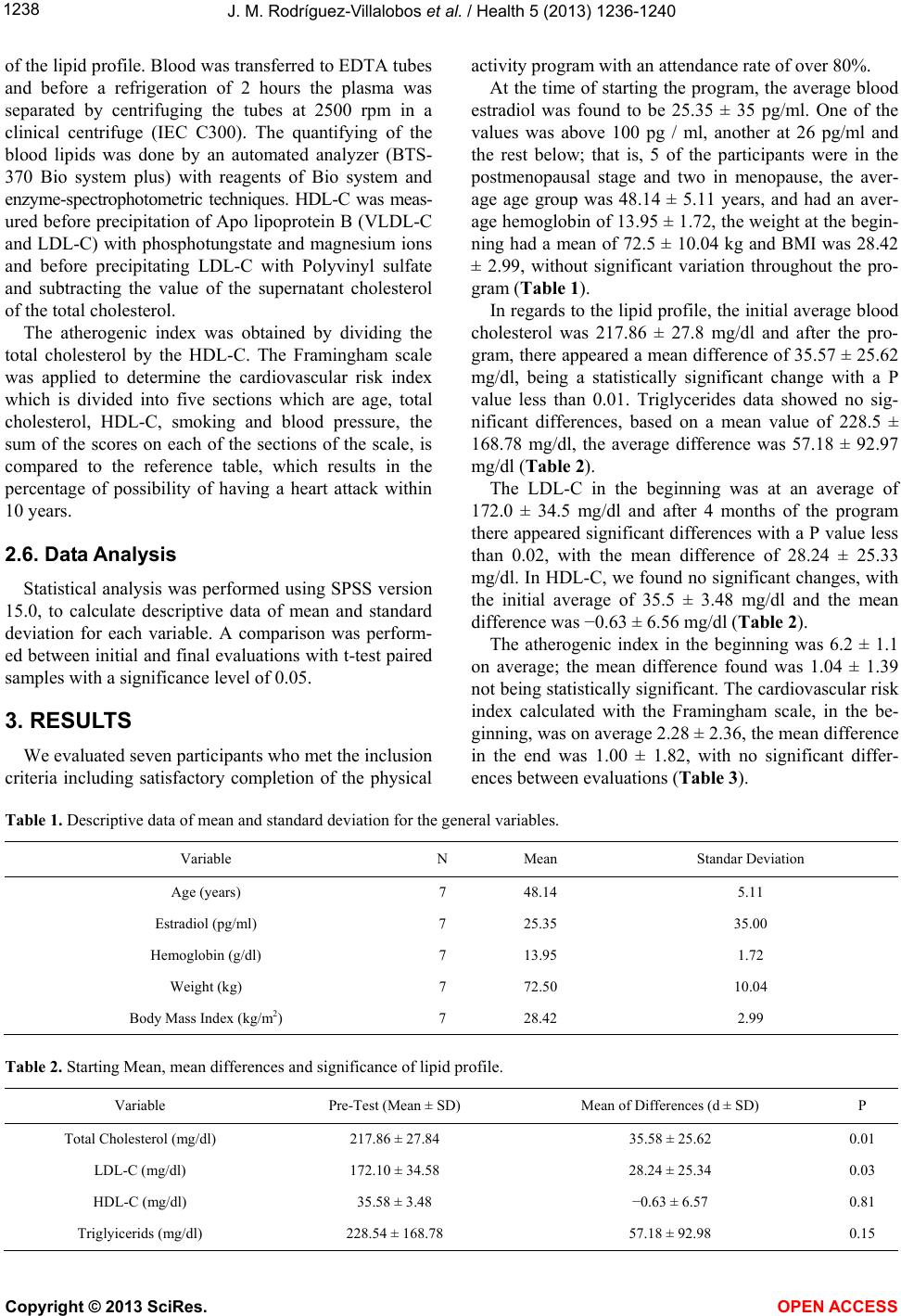 J. M. Rodríguez-Villalobos et al. / Health 5 (2013) 1236-1240 Copyright © 2013 SciRes. OPEN AC CESS 1238 of the lipid profile. Blood was transferred to EDTA tubes and before a refrigeration of 2 hours the plasma was separated by centrifuging the tubes at 2500 rpm in a clinical centrifuge (IEC C300). The quantifying of the blood lipids was done by an automated analyzer (BTS- 370 Bio system plus) with reagents of Bio system and enzyme-spectrophotometric techniques. HDL-C was meas- ured before precipitation of Apo lipoprotein B (VLDL-C and LDL-C) with phosphotungstate and magnesium ions and before precipitating LDL-C with Polyvinyl sulfate and subtracting the value of the supernatant cholesterol of the total cholesterol. The atherogenic index was obtained by dividing the total cholesterol by the HDL-C. The Framingham scale was applied to determine the cardiovascular risk index which is divided into five sections which are age, total cholesterol, HDL-C, smoking and blood pressure, the sum of the scores on each of the sections of the scale, is compared to the reference table, which results in the percentage of possibility of having a heart attack within 10 years. 2.6. Data Analysis Statistical analysis was performed using SPSS version 15.0, to calculate descriptive data of mean and standard deviation for each variable. A comparison was perform- ed between initial and final evaluations with t-test paired samples with a significance level of 0.05. 3. RESULTS We evaluated seven participants who met the inclusion criteria including satisfactory completion of the physical activity program with an attendance rate of over 80%. At the time of starting the program, the average blood estradiol was found to be 25.35 ± 35 pg/ml. One of the values was above 100 pg / ml, another at 26 pg/ml and the rest below; that is, 5 of the participants were in the postmenopausal stage and two in menopause, the aver- age age group was 48.14 ± 5.11 years, and had an aver- age hemoglobin of 13.95 ± 1.72, the weight at the begin- ning had a mean of 72.5 ± 10.04 kg and BMI was 28.42 ± 2.99, without significant variation throughout the pro- gram (Table 1). In regards to the lipid profile, the initial average blood cholesterol was 217.86 ± 27.8 mg/dl and after the pro- gram, there appeared a mean difference of 35.57 ± 25.62 mg/dl, being a statistically significant change with a P value less than 0.01. Triglycerides data showed no sig- nificant differences, based on a mean value of 228.5 ± 168.78 mg/dl, the average difference was 57.18 ± 92.97 mg/dl (Table 2). The LDL-C in the beginning was at an average of 172.0 ± 34.5 mg/dl and after 4 months of the program there appeared significant differences with a P value less than 0.02, with the mean difference of 28.24 ± 25.33 mg/dl. In HDL-C, we found no significant changes, with the initial average of 35.5 ± 3.48 mg/dl and the mean difference was −0.63 ± 6.56 mg/dl (Table 2). The atherogenic index in the beginning was 6.2 ± 1.1 on average; the mean difference found was 1.04 ± 1.39 not being statistically significant. The cardiovascular risk index calculated with the Framingham scale, in the be- ginning, was on average 2.28 ± 2.36, the mean difference in the end was 1.00 ± 1.82, with no significant differ- ences between evaluations (Table 3). Table 1. Descriptive data of mean and standard deviation for the general variables. Variable N Mean Standar Deviation Age (years) 7 48.14 5.11 Estradiol (pg/ml) 7 25.35 35.00 Hemoglobin (g/dl) 7 13.95 1.72 Weight (kg) 7 72.50 10.04 Body Mass Index (kg/m2) 7 28.42 2.99 Table 2. Starting Mean, mean differences and significance of lipid profile. Variable Pre-Test (Mean ± SD) Mean of Differences (d ± SD) P Total Cholesterol (mg/dl) 217.86 ± 27.84 35.58 ± 25.62 0.01 LDL-C (mg/dl) 172.10 ± 34.58 28.24 ± 25.34 0.03 HDL-C (mg/dl) 35.58 ± 3.48 −0.63 ± 6.57 0.81 Triglyicerids (mg/dl) 228.54 ± 168.78 57.18 ± 92.98 0.15 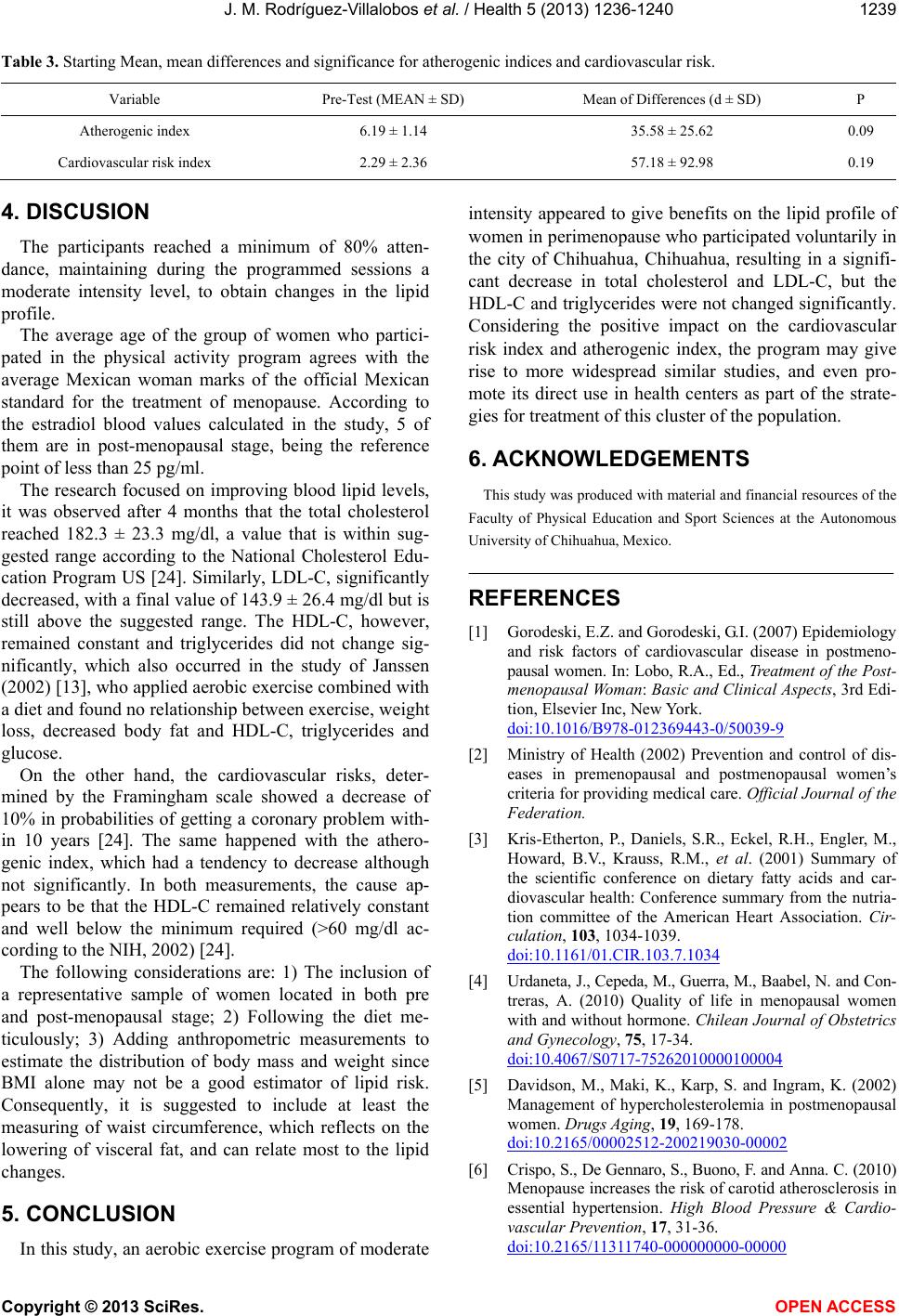 J. M. Rodríguez-Villalobos et al. / Health 5 (2013) 1236-1240 1239 Table 3. Starting Mean, mean differences and significance for atherogenic indices and cardiovascular risk. Variable Pre-Test (MEAN ± SD) Mean of Differences (d ± SD) P Atherogenic index 6.19 ± 1.14 35.58 ± 25.62 0.09 Cardiovascular risk index 2.29 ± 2.36 57.18 ± 92.98 0.19 4. DISCUSION The participants reached a minimum of 80% atten- dance, maintaining during the programmed sessions a moderate intensity level, to obtain changes in the lipid profile. The average age of the group of women who partici- pated in the physical activity program agrees with the average Mexican woman marks of the official Mexican standard for the treatment of menopause. According to the estradiol blood values calculated in the study, 5 of them are in post-menopausal stage, being the reference point of less than 25 pg/ml. The research focused on improving blood lipid levels, it was observed after 4 months that the total cholesterol reached 182.3 ± 23.3 mg/dl, a value that is within sug- gested range according to the National Cholesterol Edu- cation Program US [24]. Similarly, LDL-C, significantly decreased, with a final value of 143.9 ± 26.4 mg/dl but is still above the suggested range. The HDL-C, however, remained constant and triglycerides did not change sig- nificantly, which also occurred in the study of Janssen (2002) [13], who applied aerobic exercise combined with a diet and found no relationship between exercise, weight loss, decreased body fat and HDL-C, triglycerides and glucose. On the other hand, the cardiovascular risks, deter- mined by the Framingham scale showed a decrease of 10% in probabilities of getting a coronary problem with- in 10 years [24]. The same happened with the athero- genic index, which had a tendency to decrease although not significantly. In both measurements, the cause ap- pears to be that the HDL-C remained relatively constant and well below the minimum required (>60 mg/dl ac- cording to the NIH, 2002) [24]. The following considerations are: 1) The inclusion of a representative sample of women located in both pre and post-menopausal stage; 2) Following the diet me- ticulously; 3) Adding anthropometric measurements to estimate the distribution of body mass and weight since BMI alone may not be a good estimator of lipid risk. Consequently, it is suggested to include at least the measuring of waist circumference, which reflects on the lowering of visceral fat, and can relate most to the lipid changes. 5. CONCLUSION In this study, an aerobic exercise program of moderate intensity appeared to give benefits on the lipid profile of women in perimenopause who participated voluntarily in the city of Chihuahua, Chihuahua, resulting in a signifi- cant decrease in total cholesterol and LDL-C, but the HDL-C and triglycerides were not changed significantly. Considering the positive impact on the cardiovascular risk index and atherogenic index, the program may give rise to more widespread similar studies, and even pro- mote its direct use in health centers as part of the strate- gies for treatment of this cluster of the population. 6. ACKNOWLEDGEMENTS This study was produced with material and financial resources of the Faculty of Physical Education and Sport Sciences at the Autonomous University of Chihuahua, Mexico. REFERENCES [1] Gorodeski, E.Z. and Gorodeski, G.I. (2007) Epidemiology and risk factors of cardiovascular disease in postmeno- pausal women. In: Lobo, R.A., Ed., Treatment of the Post- menopausal Woman: Basic and Clinical Aspects, 3rd Edi- tion, Elsevier Inc, New York. doi:10.1016/B978-012369443-0/50039-9 [2] Ministry of Health (2002) Prevention and control of dis- eases in premenopausal and postmenopausal women’s criteria for providing medical care. Official Journal of the Federation. [3] Kris-Etherton, P., Daniels, S.R., Eckel, R.H., Engler, M., Howard, B.V., Krauss, R.M., et al. (2001) Summary of the scientific conference on dietary fatty acids and car- diovascular health: Conference summary from the nutria- tion committee of the American Heart Association. Cir- culation, 103, 1034-1039. doi:10.1161/01.CIR.103.7.1034 [4] Urdaneta, J., Cepeda, M., Guerra, M., Baabel, N. and Con- treras, A. (2010) Quality of life in menopausal women with and without hormone. Chilean Journal of Obstetrics and Gynecology, 75, 17-34. doi:10.4067/S0717-75262010000100004 [5] Davidson, M., Maki, K., Karp, S. and Ingram, K. (2002) Management of hypercholesterolemia in postmenopausal women. Drugs Aging, 19, 169-178. doi:10.2165/00002512-200219030-00002 [6] Crispo, S., De Gennaro, S., Buono, F. and Anna. C. (2010) Menopause increases the risk of carotid atherosclerosis in essential hypertension. High Blood Pressure & Cardio- vascular Prevention, 17, 31-36. doi:10.2165/11311740-000000000-00000 Copyright © 2013 SciRes. OPEN AC CESS  J. M. Rodríguez-Villalobos et al. / Health 5 (2013) 1236-1240 1240 [7] Gutiérrez, J.P., Rivera-Dommarco, J., Shamah-Levy, T., Villalpando-Hernández, S., Franco, A., Cuevas-Nasu, L., Romero-Martínez, M. and Hernádez-Ávila, M. (2012) National survey of health and nutrition 2012. National findings. National Public Health Institute (MX), Cuer- navaca. [8] Derby, C.A., Crawford, S.L., Pasternak, R.C., Sowers, M., Sternfeld, B. and Matthews, K.A. (2009) Lipid changes during the menopause transition in relation to age and weight the study of women’s health across the nation. American Journal of Epidemiology, 169, 1352-1361. doi:10.1093/aje/kwp043 [9] Saucedo, P., Abellán, J., Gómez, P., Leal, M., Ortega, E., Colado, J.C., et al. (2008) Effects of an exercise program of strength/resistance on cardiovascular risk factors in postmenopausal women with low cardiovascular risk. CL IDERICA study. Primary Attention, 40, 351-356. doi:10.1157/13124128 [10] Mckechnie, R., Rubenfire, M. and Mosca, L. (2001) As- sociation between self-reported physical activity and vas- cular reactivity in postmenopausal women. Atherosclero- sis, 159, 483-490. doi:10.1016/S0021-9150(01)00529-9 [11] Elavsky, S. (2009) Physical activity menopause, and qua- lity of life: The role of affect and self-worth across time. Menopause, 265-271. doi:10.1097/gme.0b013e31818c0284 [12] Bergström, I., Landgren, B., Brinck, J. and Freyschuss, B. (2008) Physical training preserves bone mineral density in postmenopausal women with forearm fractures and low bone mineral density. Osteoporosis International, 19, 177-183. doi:10.1007/s00198-007-0445-6 [13] Janssen, I., Fortier, A., Hudson, R. and Ross, R. (2002) Effects of an energy-restrictive diet with or without exer- cise on abdominal fat, intramuscular fat, and metabolic risk factors in obese women. Diabetes Care, 25. doi:10.2337/diacare.25.3.431 [14] Elliott, K., Sale, C. and Cable, N. (2002) Effects of resis- tance training and detraining on muscle strength and blood lipid profiles in postmenopausal women. British Journal of Sport Medicine, 36, 340-345. doi:10.1136/bjsm.36.5.340 [15] Brentano, M., Cadore, E., Da Silva, E., Ambrosini, A., Coertjens, M., Petkowicz, R., et al. (2008) Physiological adaptations to strength and circuit training in postmeno- pausal women with bone loss. Journal of Strength and Conditioning Research, 22, 1819-1825. doi:10.1519/JSC.0b013e31817ae3f1 [16] Waltman, N.L., Twiss, J.J., Ott, C.D., Gross, G.J., Lindsey, A.M., Moore, T.E., et al. (2010) The effect of weight training on bone mineral density and bone turnover in postmenopausal breast cancer survivors with bone loss: A 24-month randomized controlled trial. Osteoporosis In- ternational, 21, 1361-1369. doi:10.1007/s00198-009-1083-y [17] Joseph, L., Prigeon, R., Blumenthal, J., Ryan, A. and Gold- berg, A. (2011) Weight loss and low-intensity exercise for the treatment of metabolic syndrome in obese postmeno- pausal women. The Journals of Gerontology Series A: Biological Sciences and Medical Sciences, 66A, 1022- 1029. doi:10.1093/gerona/glr093 [18] Mason, C., Foster-Schubert, K., Imayama, I., Kong, A., Xiao, L., Bain, C., et al. (2011) Dietary weight loss and exercise effects on insulin resistance in postmenopausal women. American Journal of Preventive Medicine, 41, 366-375. doi:10.1016/j.amepre.2011.06.042 [19] Kraus, W., Houmard, J., Duscha, B., Knetzger, K., Harton, M., McCartney, J., et al. (2002) Effects of the amount and intensity of exercise on plasma lipoproteins. The New England Journal of Medicine, 347, 1483-1492. doi:10.1056/NEJMoa020194 [20] Thomas, S., Reading, J. and Shephard, R.J. (1992) Revi- sion of the Physical Activity Readiness Questionnaire (PAR- Q). Canadian Journal of Applied Sport Sciences, 17, 338- 345. [21] Franckowiak, S.C., Dobrosielski, D.A., Reilley, S.M., Walston, J.D. and Andersen, R. (2011) Maximal heart rate prediction in adults that are overweight or obese. The Journal of Strength & Conditioning Research, 25, 1407- 1412. doi:10.1519/JSC.0b013e3181d682d2 [22] Castelli, W. (1996) Lipids, risk factors and ischaemic heart disease. Atherosclerosis, 124, S1-S9. [23] Wilson, P., D’Agostino, R., Levy, D., Belanger, A., Sil- vertshatz, H. and Kannel, W. (1998) Prediction of coro nary heart disease using risk factor categories. Circula- tion, 97, 1837-1847. doi:10.1161/01.CIR.97.18.1837 [24] National Cholesterol Education Program (2002) Third report of the national cholesterol education program (NCEP) expert panel on detection, evaluation, and treat- ment of high blood cholesterol in adults
(adult treatment panel III). NIH Publication No. 02-5215, National Cho- lesterol Education Program, US Department of Health and Human Services. Copyright © 2013 SciRes. OPEN AC CESS |