

Paper Menu >>
Journal Menu >>
 Materials Sciences and Applications, 2013, 4, 478-482 http://dx.doi.org/10.4236/msa.2013.48058 Published Online August 2013 (http://www.scirp.org/journal/msa) Copyright © 2013 SciRes. MSA Microstructure and Dielectric Properties of PZS-PLZT Ceramics System Sakri Adel*, Boutarfaia Ahmed Laboratory of Applied Chemistry, University of Biskra, Biskra, Algeria. Email: *[email protected] Received June 5th, 2013; revised July 8th, 2013; accepted July 17th, 2013 Copyright © 2013 Sakri Adel, Boutarfaia Ahmed. This is an open access article distributed under the Creative Commons Attribution License, which permits unrestricted use, distribution, and reproduction in any medium, provided the original work is properly cited. ABSTRACT Piezoelectric ceramics are an important class of solid-state materials as they exhibit a wide range of applications. This article investigates the sintering temperature effect on microstructure and dielectric properties of a new ceramics mate- rial Pb (Zn, Sb) O3-PbLa (Zr, Ti) O3 (PZS-PLZT), which was prepared by a solid mixed-oxide solution method. Scan- ning electron micrograph (SEM) and X-ray diffraction (XRD) techniques was employed to examine the crystallization of the ceramics. The results of XRD show that the phase structure of the samples is tetragonal. The lattice parameters and the density increased with increase of the sintering temperature. The dielectric constant and the dielectric loss of the investigated samples decreased with increase in the frequency. Keywords: Ferroelectric; Microstructure; Piezoelectric Ceramics; Dielectric Properties 1. Introduction The piezoelectric property plays an important role for electric and electronic materials. The most widely used piezoelectric materials are based on the PbTiO3-PbZrO3 system (PZT) [1-3]. The application of the PZT compo- nent is wide, including nonvolatile memory elements, pyroelectric detectors, piezoelectric transducers, and pho- toelectric devices [4,5], but the electrical and thermal properties of PZT ceramics depend to a large extent on their surface microstructures [6]. Many researchers have considered modified PZT compositions with suitable substitution at the A and B sites [7-9] with some dopants to improve their electrical and mechanical property of piezoelectric materials in recent years, this dopants can be classified into two categories: donor dopants which induce Pb vacancies by changing with a higher valence ion for Pb2+ or (Ti, Zr)4+ like Sb5+, La3+. And the acceptor dopants induce O vacancies by changing with a lower valance ion for Pb2+ or (Ti, Zr)4+ example K+, Fe3+ [10, 11]. So the properties of a PZT samples are very sen- sitive to additives, composition and synthesis methods. Whatmore et al. [12] and Chaipanich et al. [13] have reported that the electric properties of PZT ceramics could be improved by the doping of Sb2O3. [14]. It was found that sintering behavior had obvious effects on the microstructure and piezoelectric properties. With the in- crease of sintering temperature, the microstructure of the ceramic samples changed accordingly and the porosity decreased [15]. There have been several reports on La substituted PZT. It has been reported that substitution of Pb2+ by La3+ ions created vacancies in the A site of perovskite ABO3 structured PZT ceramics. The 7% La doped PZT ceram- ics PLZT (7/60/40) composition is one of the most im- portant candidates for piezoelectric applications due to its extremely high piezoelectric and electromechanical cou- pling coefficients reported in literature [16-18]. In this work, a new ceramics material based PZT is prepared by a solid mixed-oxide solution method, and we investigate the structural, dielectrical properties of a doped PZT ceramic with La, Sb and Zn for different sin- tered temperature. 2. Experimental The composition of PZS-PLZT system was 0.3Pb(Zn1/3, Sb2/3)O3-0.7Pb0.98La0.02(Zr0.48,Ti0.52)O3 were synthesized from high purity oxide powders PbO (99.90%), ZrO2 (99.90%), TiO2 (99.80%), Sb2O3 (99.90%), ZnO (99.90%), and La2O3 (99.90%), the samples were pre- pared by the conventional ceramic procedure. Stoichio- metric amount of metal for the designated PZS-PLZT *Corresponding author. 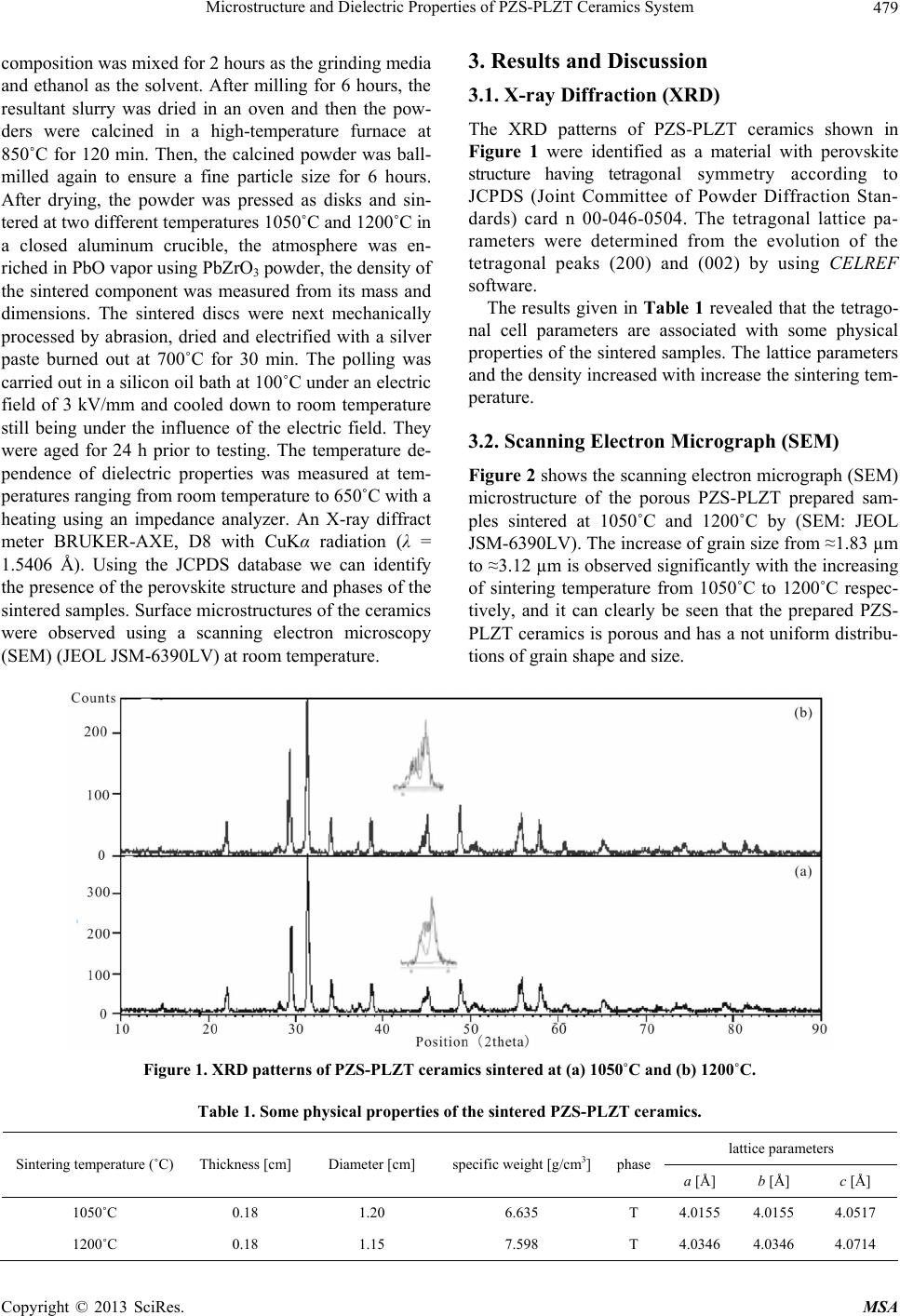 Microstructure and Dielectric Properties of PZS-PLZT Ceramics System Copyright © 2013 SciRes. MSA 479 composition was mixed for 2 hours as the grinding media and ethanol as the solvent. After milling for 6 hours, the resultant slurry was dried in an oven and then the pow- ders were calcined in a high-temperature furnace at 850˚C for 120 min. Then, the calcined powder was ball- milled again to ensure a fine particle size for 6 hours. After drying, the powder was pressed as disks and sin- tered at two different temperatures 1050˚C and 1200˚C in a closed aluminum crucible, the atmosphere was en- riched in PbO vapor using PbZrO3 powder, the density of the sintered component was measured from its mass and dimensions. The sintered discs were next mechanically processed by abrasion, dried and electrified with a silver paste burned out at 700˚C for 30 min. The polling was carried out in a silicon oil bath at 100˚C under an electric field of 3 kV/mm and cooled down to room temperature still being under the influence of the electric field. They were aged for 24 h prior to testing. The temperature de- pendence of dielectric properties was measured at tem- peratures ranging from room temperature to 650˚C with a heating using an impedance analyzer. An X-ray diffract meter BRUKER-AXE, D8 with CuKα radiation (λ = 1.5406 Å). Using the JCPDS database we can identify the presence of the perovskite structure and phases of the sintered samples. Surface microstructures of the ceramics were observed using a scanning electron microscopy (SEM) (JEOL JSM-6390LV) at room temperature. 3. Results and Discussion 3.1. X-ray Diffraction (XRD) The XRD patterns of PZS-PLZT ceramics shown in Figure 1 were identified as a material with perovskite structure having tetragonal symmetry according to JCPDS (Joint Committee of Powder Diffraction Stan- dards) card n 00-046-0504. The tetragonal lattice pa- rameters were determined from the evolution of the tetragonal peaks (200) and (002) by using CELREF software. The results given in Table 1 revealed that the tetrago- nal cell parameters are associated with some physical properties of the sintered samples. The lattice parameters and the density increased with increase the sintering tem- perature. 3.2. Scanning Electron Micrograph (SEM) Figure 2 shows the scanning electron micrograph (SEM) microstructure of the porous PZS-PLZT prepared sam- ples sintered at 1050˚C and 1200˚C by (SEM: JEOL JSM-6390LV). The increase of grain size from ≈1.83 µm to ≈3.12 µm is observed significantly with the increasing of sintering temperature from 1050˚C to 1200˚C respec- tively, and it can clearly be seen that the prepared PZS- PLZT ceramics is porous and has a not uniform distribu- tions of grain shape and size. Figure 1. XRD patterns of PZS-PLZT ceramics sintered at (a) 1050˚C and (b) 1200˚C. Table 1. Some physical properties of the sintered PZS-PLZT ceramics. lattice parameters Sintering temperature (˚C) Thickness [cm] Diameter [cm] specific weight [g/cm3] phase a [Å] b [Å] c [Å] 1050˚C 0.18 1.20 6.635 T 4.0155 4.0155 4.0517 1200˚C 0.18 1.15 7.598 T 4.0346 4.0346 4.0714 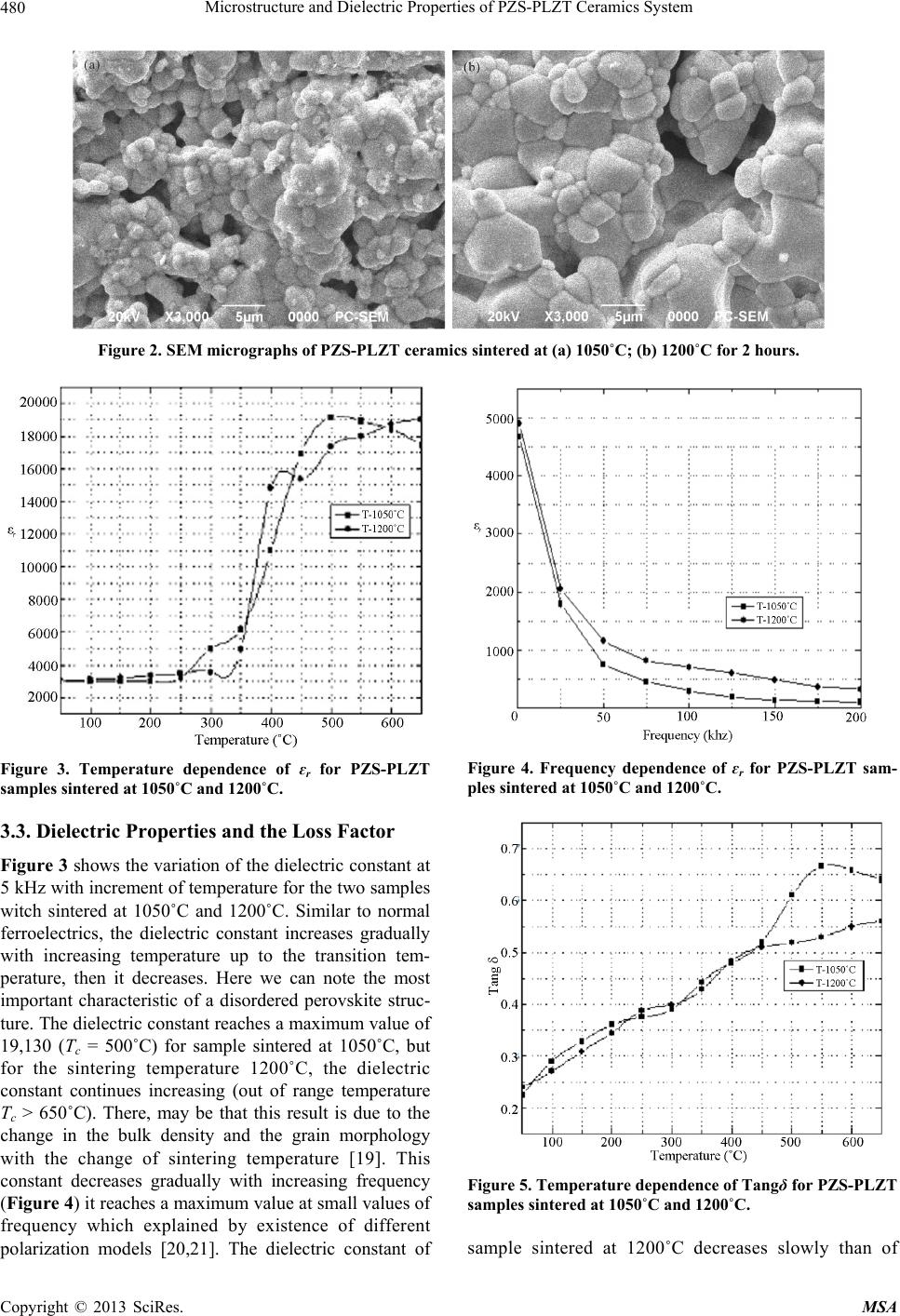 Microstructure and Dielectric Properties of PZS-PLZT Ceramics System Copyright © 2013 SciRes. MSA 480 Figure 2. SEM micrographs of PZS-PLZT ceramics sintered at (a) 1050˚C; (b) 1200˚C for 2 hours. Figure 3. Temperature dependence of ɛr for PZS-PLZT samples sintered at 1050˚C and 1200˚C. 3.3. Dielectric Properties and the Loss Factor Figure 3 shows the variation of the dielectric constant at 5 kHz with increment of temperature for the two samples witch sintered at 1050˚C and 1200˚C. Similar to normal ferroelectrics, the dielectric constant increases gradually with increasing temperature up to the transition tem- perature, then it decreases. Here we can note the most important characteristic of a disordered perovskite struc- ture. The dielectric constant reaches a maximum value of 19,130 (Tc = 500˚C) for sample sintered at 1050˚C, but for the sintering temperature 1200˚C, the dielectric constant continues increasing (out of range temperature Tc > 650˚C). There, may be that this result is due to the change in the bulk density and the grain morphology with the change of sintering temperature [19]. This constant decreases gradually with increasing frequency (Figure 4) it reaches a maximum value at small values of frequency which explained by existence of different polarization models [20,21]. The dielectric constant of Figure 4. Frequency dependence of ɛr for PZS-PLZT sam- ples sintered at 1050˚C and 1200˚C. Figure 5. Temperature dependence of Tangδ for PZS-PLZT samples sintered at 1050˚C and 1200˚C. sample sintered at 1200˚C decreases slowly than of 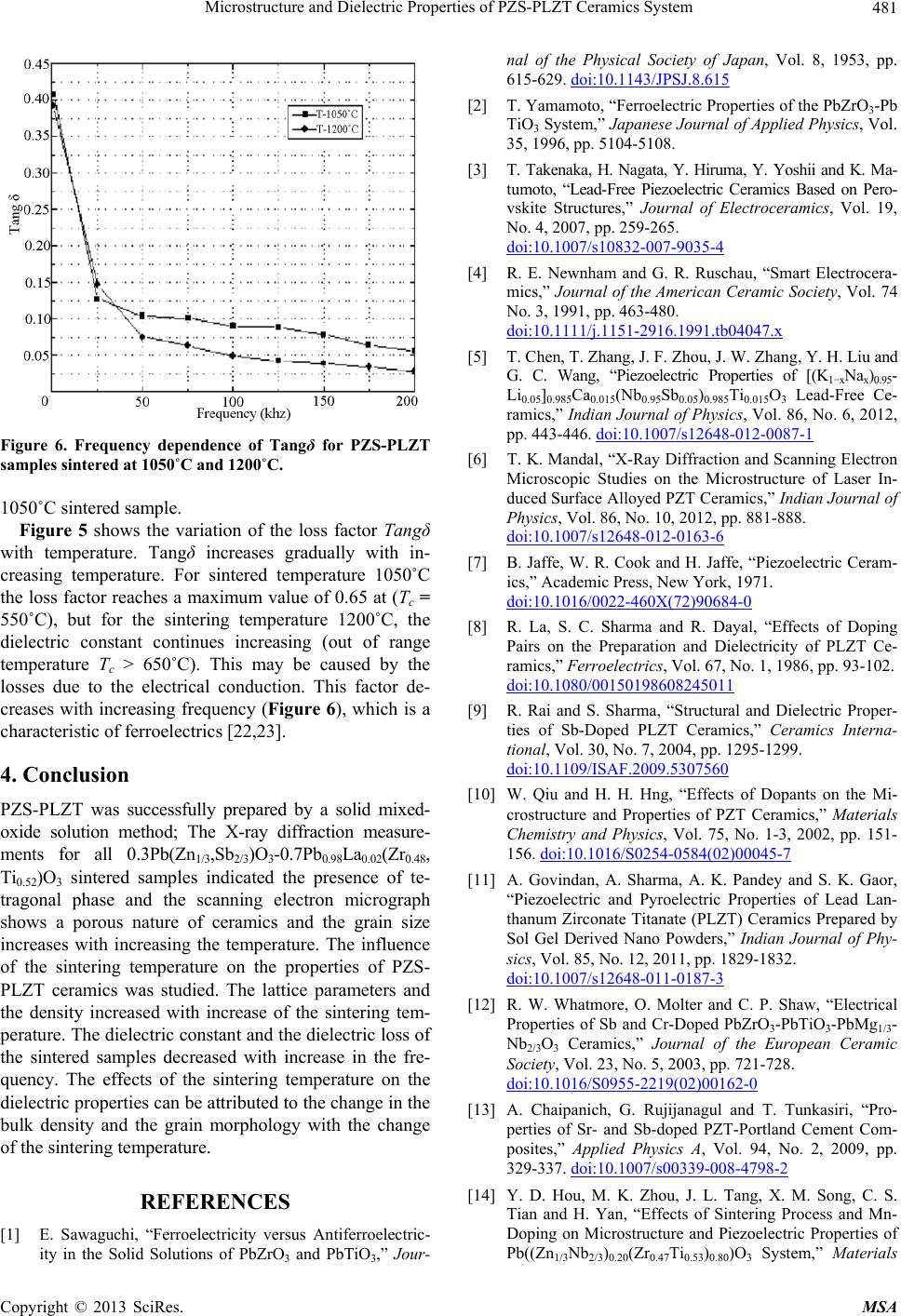 Microstructure and Dielectric Properties of PZS-PLZT Ceramics System Copyright © 2013 SciRes. MSA 481 Figure 6. Frequency dependence of Tangδ for PZS-PLZT samples sintered at 1050˚C and 1200˚C. 1050˚C sintered sample. Figure 5 shows the variation of the loss factor Tangδ with temperature. Tangδ increases gradually with in- creasing temperature. For sintered temperature 1050˚C the loss factor reaches a maximum value of 0.65 at (Tc = 550˚C), but for the sintering temperature 1200˚C, the dielectric constant continues increasing (out of range temperature Tc > 650˚C). This may be caused by the losses due to the electrical conduction. This factor de- creases with increasing frequency (Figure 6), which is a characteristic of ferroelectrics [22,23]. 4. Conclusion PZS-PLZT was successfully prepared by a solid mixed- oxide solution method; The X-ray diffraction measure- ments for all 0.3Pb(Zn1/3,Sb2/3)O3-0.7Pb0.98La0.02(Zr0.48, Ti0.52)O3 sintered samples indicated the presence of te- tragonal phase and the scanning electron micrograph shows a porous nature of ceramics and the grain size increases with increasing the temperature. The influence of the sintering temperature on the properties of PZS- PLZT ceramics was studied. The lattice parameters and the density increased with increase of the sintering tem- perature. The dielectric constant and the dielectric loss of the sintered samples decreased with increase in the fre- quency. The effects of the sintering temperature on the dielectric properties can be attributed to the change in the bulk density and the grain morphology with the change of the sintering temperature. REFERENCES [1] E. Sawaguchi, “Ferroelectricity versus Antiferroelectric- ity in the Solid Solutions of PbZrO3 and PbTiO3,” Jour- nal of the Physical Society of Japan, Vol. 8, 1953, pp. 615-629. doi:10.1143/JPSJ.8.615 [2] T. Yamamoto, “Ferroelectric Properties of the PbZrO3-Pb TiO3 System,” Japanese Journal of Applied Physics, Vol. 35, 1996, pp. 5104-5108. [3] T. Takenaka, H. Nagata, Y. Hiruma, Y. Yoshii and K. Ma- tumoto, “Lead-Free Piezoelectric Ceramics Based on Pero- vskite Structures,” Journal of Electroceramics, Vol. 19, No. 4, 2007, pp. 259-265. doi:10.1007/s10832-007-9035-4 [4] R. E. Newnham and G. R. Ruschau, “Smart Electrocera- mics,” Journal of the American Ceramic Society, Vol. 74 No. 3, 1991, pp. 463-480. doi:10.1111/j.1151-2916.1991.tb04047.x [5] T. Chen, T. Zhang, J. F. Zhou, J. W. Zhang, Y. H. Liu and G. C. Wang, “Piezoelectric Properties of [(K1−xNax)0.95- Li0.05]0.985Ca0.015(Nb0.95Sb0.05)0.985Ti0.015O3 Lead-Free Ce- ramics,” Indian Journal of Physics, Vol. 86, No. 6, 2012, pp. 443-446. doi:10.1007/s12648-012-0087-1 [6] T. K. Mandal, “X-Ray Diffraction and Scanning Electron Microscopic Studies on the Microstructure of Laser In- duced Surface Alloyed PZT Ceramics,” Indian Journal of Physics, Vol. 86, No. 10, 2012, pp. 881-888. doi:10.1007/s12648-012-0163-6 [7] B. Jaffe, W. R. Cook and H. Jaffe, “Piezoelectric Ceram- ics,” Academic Press, New York, 1971. doi:10.1016/0022-460X(72)90684-0 [8] R. La, S. C. Sharma and R. Dayal, “Effects of Doping Pairs on the Preparation and Dielectricity of PLZT Ce- ramics,” Ferroelectrics, Vol. 67, No. 1, 1986, pp. 93-102. doi:10.1080/00150198608245011 [9] R. Rai and S. Sharma, “Structural and Dielectric Proper- ties of Sb-Doped PLZT Ceramics,” Ceramics Interna- tional, Vol. 30, No. 7, 2004, pp. 1295-1299. doi:10.1109/ISAF.2009.5307560 [10] W. Qiu and H. H. Hng, “Effects of Dopants on the Mi- crostructure and Properties of PZT Ceramics,” Materials Chemistry and Physics, Vol. 75, No. 1-3, 2002, pp. 151- 156. doi:10.1016/S0254-0584(02)00045-7 [11] A. Govindan, A. Sharma, A. K. Pandey and S. K. Gaor, “Piezoelectric and Pyroelectric Properties of Lead Lan- thanum Zirconate Titanate (PLZT) Ceramics Prepared by Sol Gel Derived Nano Powders,” Indian Journal of Phy- sics, Vol. 85, No. 12, 2011, pp. 1829-1832. doi:10.1007/s12648-011-0187-3 [12] R. W. Whatmore, O. Molter and C. P. Shaw, “Electrical Properties of Sb and Cr-Doped PbZrO3-PbTiO3-PbMg1/3- Nb2/3O3 Ceramics,” Journal of the European Ceramic Society, Vol. 23, No. 5, 2003, pp. 721-728. doi:10.1016/S0955-2219(02)00162-0 [13] A. Chaipanich, G. Rujijanagul and T. Tunkasiri, “Pro- perties of Sr- and Sb-doped PZT-Portland Cement Com- posites,” Applied Physics A, Vol. 94, No. 2, 2009, pp. 329-337. doi:10.1007/s00339-008-4798-2 [14] Y. D. Hou, M. K. Zhou, J. L. Tang, X. M. Song, C. S. Tian and H. Yan, “Effects of Sintering Process and Mn- Doping on Microstructure and Piezoelectric Properties of Pb((Zn1/3Nb2/3)0.20(Zr0.47Ti0.53)0.80)O3 System,” Materials  Microstructure and Dielectric Properties of PZS-PLZT Ceramics System Copyright © 2013 SciRes. MSA 482 Chemistry and Physics, Vol. 99, No. 1, 2006, pp. 66-70. doi:10.1016/j.matchemphys.2005.09.076 [15] Z. He, J. Ma and R. Z. T. Li, “PZT-Based Materials with Bilayered Structure: Preparation and Ferroelectric Proper- ties,” Journal of the European Ceramic Society, Vol. 23, No. 11, 2003, pp. 1943-1947. doi:10.1016/S0955-2219(02)00423-5 [16] Y. Xu, “Ferroelectric Materials and Their Applications,” North-Holland, Amsterdam, 1991. [17] M.-S. Cao, D.-W. Wang, J. Yuan, H.-B. Lin, Q.-L. Zhao, W.-L. Song and D.-Q. Zhang, “Enhanced Piezoelectric and Mechanical Properties of ZnO Whiskers and Sb2O3 Co-Modified Lead Zirconate Titanate Composites,” Ma- terials Letters, Vol. 64, No. 16, 2010, pp. 1798-1801. doi:10.1016/j.matlet.2010.05.037 [18] A. Yang, C. Wang, R. Guo, Y. Huang and C. Nan, “Ef- Fects of Sintering Behavior on Microstructure and Piezo- electric Properties of Porous PZT Ceramics,” Ceramics International, Vol. 36, No. 2, 2010, pp. 549-554. doi:10.1016/j.ceramint.2009.09.022 [19] J. Zhao, Q. M. Zhang, et al., “Electromechanical Proper- ties of Relaxor Ferroelectric Lead Magnesium Niobate- Lead Titanate Ceramics,” Japanese Journal of Applied Physics, Vol. 34, No. 10, 1995, pp. 5658-5663. doi:10.1143/JJAP.34.5658 [20] G. H. Haertling and C. E. Land, “Hot-Pressed (Pb,La) (Zr,Ti)O3 Ferroelectric Ceramics for Electrooptic Appli- cations,” Journal of the American Ceramic Society, Vol. 54, No. 1, 1971, pp. 1-11. doi:10.1111/j.1151-2916.1970.tb12105.x-i1 [21] A. Fawzi, A. D. Sheikh and V. L. Mathe, “Effect of Mag- netostrictive Phase on Structural, Dielectric and Electrical Properties of NiFe2O4+Pb0.93La0.07(Zr0.6Ti0.4)O3 Compos- ites,” Solid State Sciences, Vol. 11, No. 11, 2009, pp. 1979-1984 doi:10.1016/j.solidstatesciences.2009.07.006 [22] Z. He, J. M. R. Zhang and T. Li, “Fabrication and Char- acterization of Bilayered Pb(Zr,Ti)O3-Based Ceramics,” Materials Letters, Vol. 56, No. 6, 2002, pp. 1084-1088. doi:10.1016/S0167-577X(02)00683-3 [23] Z. He, J. Ma and R. Zhang, “Investigation on the Micro- structure and Ferroelectric Properties of Porous PZT Ce- ramics,” Ceramics International, Vol. 30, No. 7, 2004, pp. 1353-1356. doi:10.1016/j.ceramint.2003.12.108 |