

Paper Menu >>
Journal Menu >>
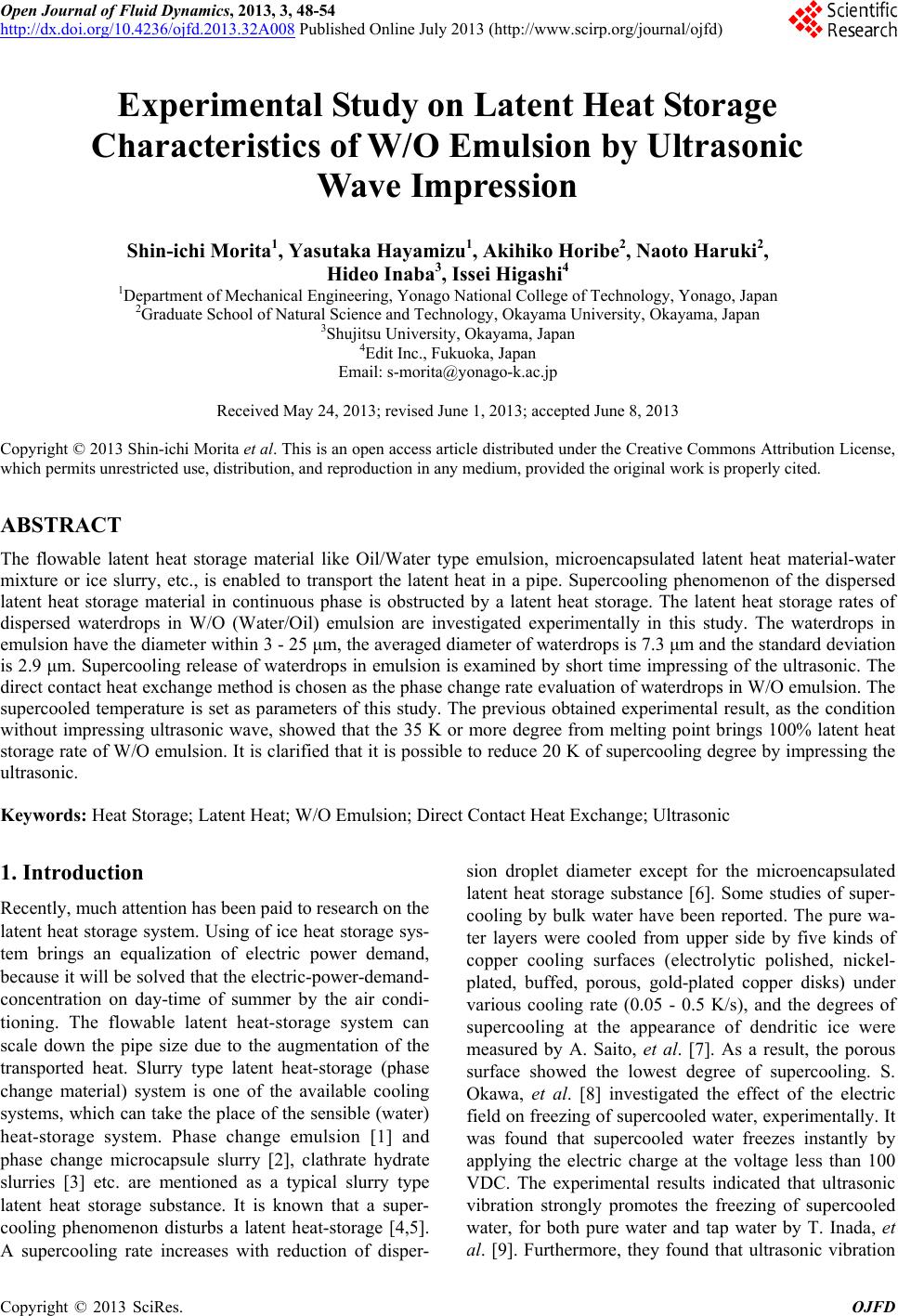 Open Journal of Fluid Dynamics, 2013, 3, 48-54 http://dx.doi.org/10.4236/ojfd.2013.32A008 Published Online July 2013 (http://www.scirp.org/journal/ojfd) Experimental Study on Latent Heat Storage Characteristics of W/O Emulsion by Ultrasonic Wave Impression Shin-ichi Morita1, Yasutaka Hayamizu1, Akihiko Horibe2, Naoto Haruki2, Hideo Inaba3, Issei Higashi4 1Department of Mechanical Engineering, Yonago National College of Technology, Yonago, Japan 2Graduate School of Natural Science and Technology, Okayama University, Okayama, Japan 3Shujitsu University, Okayama, Japan 4Edit Inc., Fukuoka, Japan Email: [email protected] Received May 24, 2013; revised June 1, 2013; accepted June 8, 2013 Copyright © 2013 Shin-ichi Morita et al. This is an open access article distributed under the Creative Commons Attribution License, which permits unrestricted use, distribution, and reproduction in any medium, provided the original work is properly cited. ABSTRACT The flowable latent heat storage material like Oil/Water type emulsion, microencapsulated latent heat material-water mixture or ice slurry, etc., is enabled to transport the latent heat in a pipe. Supercooling phenomenon of the dispersed latent heat storage material in continuous phase is obstructed by a latent heat storage. The latent heat storage rates of dispersed waterdrops in W/O (Water/Oil) emulsion are investigated experimentally in this study. The waterdrops in emulsion have the diameter within 3 - 25 μm, the averaged diameter of waterdrops is 7.3 μm and the standard deviation is 2.9 μm. Supercooling release of waterdrops in emulsion is examined by short time impressing of the ultrasonic. The direct contact heat exchange method is chosen as the phase change rate evaluation of waterdrops in W/O emulsion. The supercooled temperature is set as parameters of this study. The previous obtained experimental result, as the condition without impressing ultrasonic wave, showed that the 35 K or more degree from melting point brings 100% latent heat storage rate of W/O emulsion. It is clarified that it is possible to reduce 20 K of supercooling degree by impressing the ultrasonic. Keywords: Heat Storage; Latent Heat; W/O Emulsion; Direct Contact Heat Exchange; Ultrasonic 1. Introduction Recently, much attention has been paid to research on the latent heat storage system. Using of ice heat storage sys- tem brings an equalization of electric power demand, because it will be solved that the electric-power-demand- concentration on day-time of summer by the air condi- tioning. The flowable latent heat-storage system can scale down the pipe size due to the augmentation of the transported heat. Slurry type latent heat-storage (phase change material) system is one of the available cooling systems, which can take the place of the sensible (water) heat-storage system. Phase change emulsion [1] and phase change microcapsule slurry [2], clathrate hydrate slurries [3] etc. are mentioned as a typical slurry type latent heat storage substance. It is known that a super- cooling phenomenon disturbs a latent heat-storage [4,5]. A supercooling rate increases with reduction of disper- sion droplet diameter except for the microencapsulated latent heat storage substance [6]. Some studies of super- cooling by bulk water have been reported. The pure wa- ter layers were cooled from upper side by five kinds of copper cooling surfaces (electrolytic polished, nickel- plated, buffed, porous, gold-plated copper disks) under various cooling rate (0.05 - 0.5 K/s), and the degrees of supercooling at the appearance of dendritic ice were measured by A. Saito, et al. [7]. As a result, the porous surface showed the lowest degree of supercooling. S. Okawa, et al. [8] investigated the effect of the electric field on freezing of supercooled water, experimentally. It was found that supercooled water freezes instantly by applying the electric charge at the voltage less than 100 VDC. The experimental results indicated that ultrasonic vibration strongly promotes the freezing of supercooled water, for both pure water and tap water by T. Inada, et al. [9]. Furthermore, they found that ultrasonic vibration C opyright © 2013 SciRes. OJFD 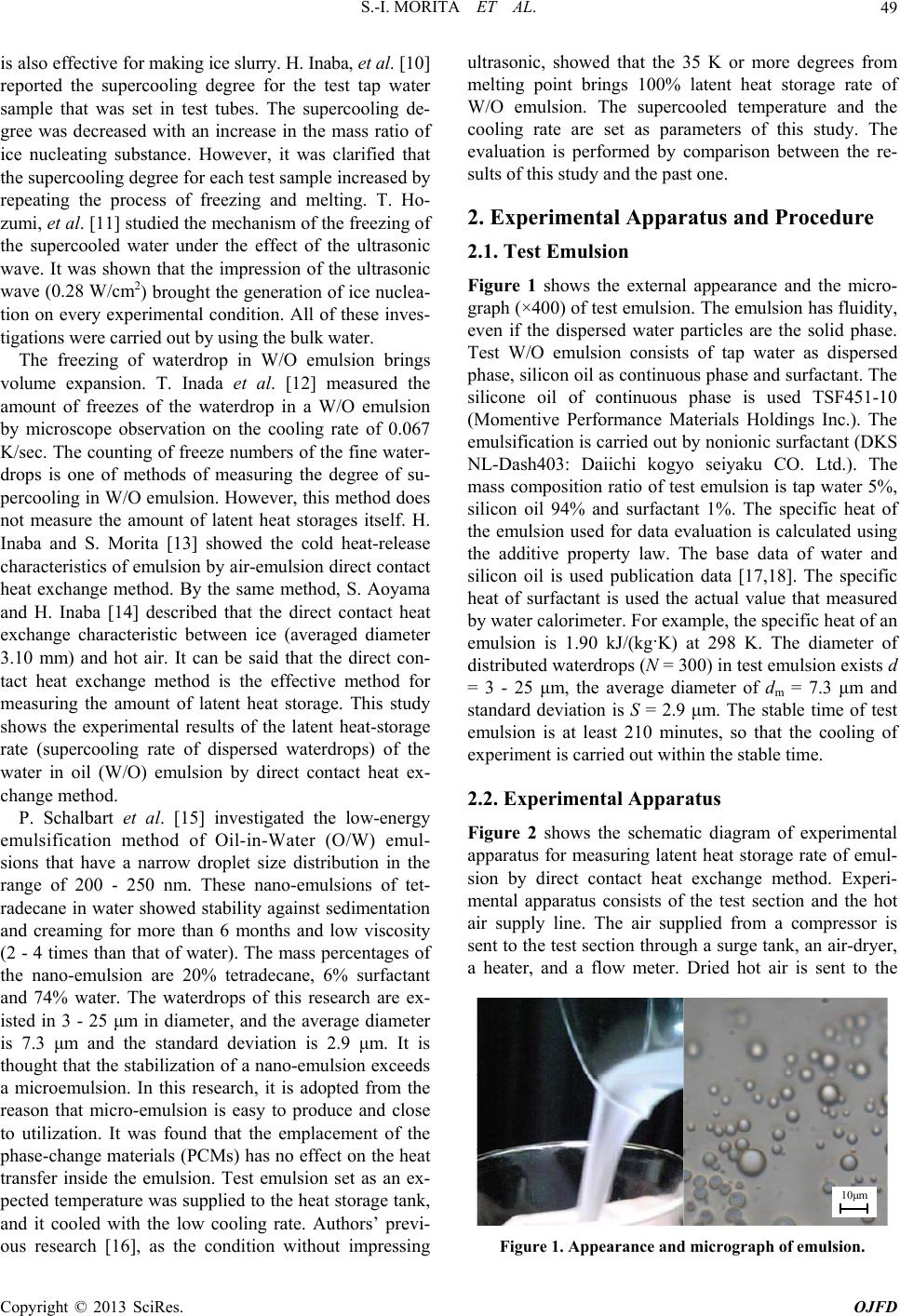 S.-I. MORITA ET AL. 49 is also effective for making ice slurry. H. Inaba, et al. [10] reported the supercooling degree for the test tap water sample that was set in test tubes. The supercooling de- gree was decreased with an increase in the mass ratio of ice nucleating substance. However, it was clarified that the supercooling degree for each test sample increased by repeating the process of freezing and melting. T. Ho- zumi, et al. [11] studied the mechanism of the freezing of the supercooled water under the effect of the ultrasonic wave. It was shown that the impression of the ultrasonic wave (0.28 W/cm2) brought the generation of ice nuclea- tion on every experimental condition. All of these inves- tigations were carried out by using the bulk water. The freezing of waterdrop in W/O emulsion brings volume expansion. T. Inada et al. [12] measured the amount of freezes of the waterdrop in a W/O emulsion by microscope observation on the cooling rate of 0.067 K/sec. The counting of freeze numbers of the fine water- drops is one of methods of measuring the degree of su- percooling in W/O emulsion. However, this method does not measure the amount of latent heat storages itself. H. Inaba and S. Morita [13] showed the cold heat-release characteristics of emulsion by air-emulsion direct contact heat exchange method. By the same method, S. Aoyama and H. Inaba [14] described that the direct contact heat exchange characteristic between ice (averaged diameter 3.10 mm) and hot air. It can be said that the direct con- tact heat exchange method is the effective method for measuring the amount of latent heat storage. This study shows the experimental results of the latent heat-storage rate (supercooling rate of dispersed waterdrops) of the water in oil (W/O) emulsion by direct contact heat ex- change method. P. Schalbart et al. [15] investigated the low-energy emulsification method of Oil-in-Water (O/W) emul- sions that have a narrow droplet size distribution in the range of 200 - 250 nm. These nano-emulsions of tet- radecane in water showed stability against sedimentation and creaming for more than 6 months and low viscosity (2 - 4 times than that of water). The mass percentages of the nano-emulsion are 20% tetradecane, 6% surfactant and 74% water. The waterdrops of this research are ex- isted in 3 - 25 μm in diameter, and the average diameter is 7.3 μm and the standard deviation is 2.9 μm. It is thought that the stabilization of a nano-emulsion exceeds a microemulsion. In this research, it is adopted from the reason that micro-emulsion is easy to produce and close to utilization. It was found that the emplacement of the phase-change materials (PCMs) has no effect on the heat transfer inside the emulsion. Test emulsion set as an ex- pected temperature was supplied to the heat storage tank, and it cooled with the low cooling rate. Authors’ previ- ous research [16], as the condition without impressing ultrasonic, showed that the 35 K or more degrees from melting point brings 100% latent heat storage rate of W/O emulsion. The supercooled temperature and the cooling rate are set as parameters of this study. The evaluation is performed by comparison between the re- sults of this study and the past one. 2. Experimental Apparatus and Procedure 2.1. Test Emulsion Figure 1 shows the external appearance and the micro- graph (×400) of test emulsion. The emulsion has fluidity, even if the dispersed water particles are the solid phase. Test W/O emulsion consists of tap water as dispersed phase, silicon oil as continuous phase and surfactant. The silicone oil of continuous phase is used TSF451-10 (Momentive Performance Materials Holdings Inc.). The emulsification is carried out by nonionic surfactant (DKS NL-Dash403: Daiichi kogyo seiyaku CO. Ltd.). The mass composition ratio of test emulsion is tap water 5%, silicon oil 94% and surfactant 1%. The specific heat of the emulsion used for data evaluation is calculated using the additive property law. The base data of water and silicon oil is used publication data [17,18]. The specific heat of surfactant is used the actual value that measured by water calorimeter. For example, the specific heat of an emulsion is 1.90 kJ/(kg·K) at 298 K. The diameter of distributed waterdrops (N = 300) in test emulsion exists d = 3 - 25 μm, the average diameter of dm = 7.3 μm and standard deviation is S = 2.9 μm. The stable time of test emulsion is at least 210 minutes, so that the cooling of experiment is carried out within the stable time. 2.2. Experimental Apparatus Figure 2 shows the schematic diagram of experimental apparatus for measuring latent heat storage rate of emul- sion by direct contact heat exchange method. Experi- mental apparatus consists of the test section and the hot air supply line. The air supplied from a compressor is sent to the test section through a surge tank, an air-dryer, a heater, and a flow meter. Dried hot air is sent to the 10μm Figure 1. Appearance and micrograph of emulsion. Copyright © 2013 SciRes. OJFD 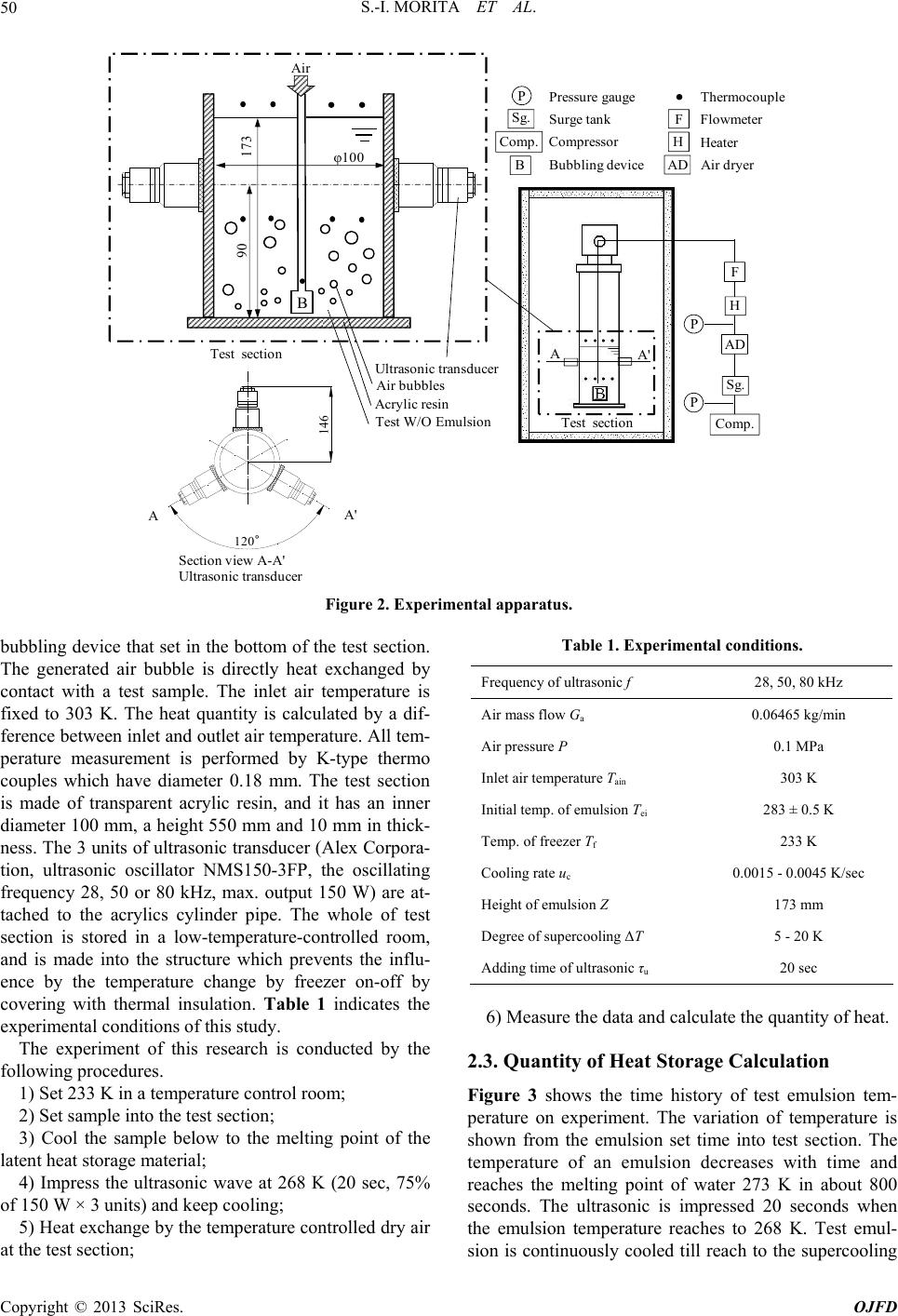 S.-I. MORITA ET AL. Copyright © 2013 SciRes. OJFD 50 φ100 173 120° 146 AA' Section view A-A' Ultrasonic transduce r Test sectionComp. Sg. AD H F AA' Pressure gauge Surge tank Compressor Bubbling deviceAir dryer Heater Flowmeter Thermo couple ● P B Comp. Sg. AD H F B Air bubbles Acrylic resin TestW/O Emulsion Test section Air Ultrasonic transducer 90 P P Figure 2. Experimental apparatus. Table 1. Experimental conditions. bubbling device that set in the bottom of the test section. The generated air bubble is directly heat exchanged by contact with a test sample. The inlet air temperature is fixed to 303 K. The heat quantity is calculated by a dif- ference between inlet and outlet air temperature. All tem- perature measurement is performed by K-type thermo couples which have diameter 0.18 mm. The test section is made of transparent acrylic resin, and it has an inner diameter 100 mm, a height 550 mm and 10 mm in thick- ness. The 3 units of ultrasonic transducer (Alex Corpora- tion, ultrasonic oscillator NMS150-3FP, the oscillating frequency 28, 50 or 80 kHz, max. output 150 W) are at- tached to the acrylics cylinder pipe. The whole of test section is stored in a low-temperature-controlled room, and is made into the structure which prevents the influ- ence by the temperature change by freezer on-off by covering with thermal insulation. Table 1 indicates the experimental conditions of this study. Frequency of ultrasonic f 28, 50, 80 kHz Air mass flow Ga 0.06465 kg/min Air pressure P 0.1 MPa Inlet air temperature Tain 303 K Initial temp. of emulsion Tei 283 ± 0.5 K Temp. of freezer Tf 233 K Cooling rate uc 0.0015 - 0.0045 K/sec Height of emulsion Z 173 mm Degree of supercooling ΔT 5 - 20 K Adding time of ultrasonic τu 20 sec 6) Measure the data and calculate the quantity of heat. The experiment of this research is conducted by the following procedures. 2.3. Quantity of Heat Storage Calculation 1) Set 233 K in a temperature control room; Figure 3 shows the time history of test emulsion tem- perature on experiment. The variation of temperature is shown from the emulsion set time into test section. The temperature of an emulsion decreases with time and reaches the melting point of water 273 K in about 800 seconds. The ultrasonic is impressed 20 seconds when the emulsion temperature reaches to 268 K. Test emul- sion is continuously cooled till reach to the supercooling 2) Set sample into the test section; 3) Cool the sample below to the melting point of the latent heat storage material; 4) Impress the ultrasonic wave at 268 K (20 sec, 75% of 150 W × 3 units) and keep cooling; 5) Heat exchange by the temperature controlled dry air at the test section; 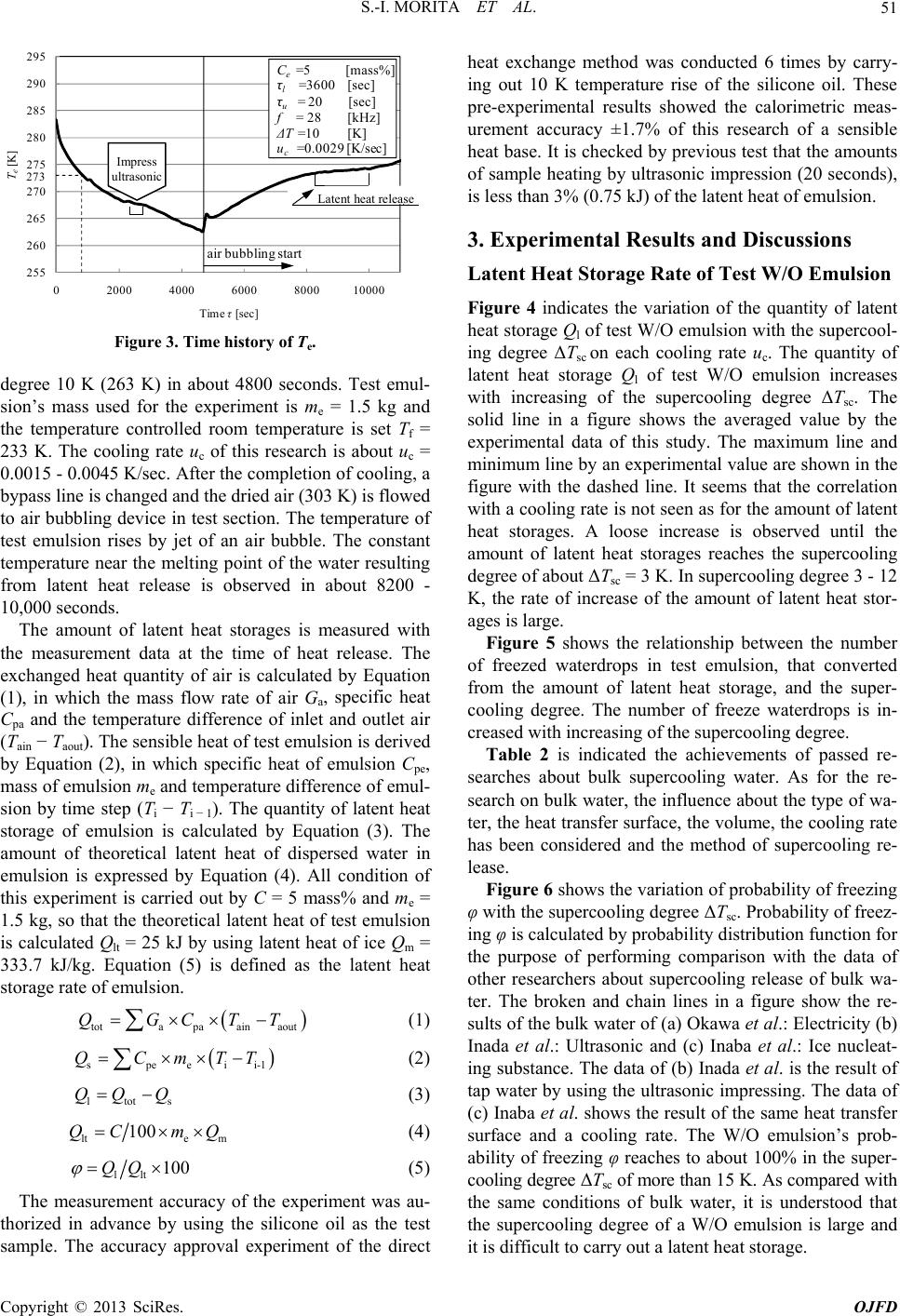 S.-I. MORITA ET AL. 51 255 260 265 270 275 280 285 290 295 02000 4000 6000 800010000 T e [K] Time τ[sec] 273 C e =5 [mass%] τ l =3600 [sec] τ u = 20 [sec] f = 28 [kHz] ΔT =10 [K] u c =0.0029 [K/sec] add ultrasonic air bubbling start latent heat stora g e Latent heat release Impress ultrasonic Figure 3. Time history of Te. degree 10 K (263 K) in about 4800 seconds. Test emul- sion’s mass used for the experiment is me = 1.5 kg and the temperature controlled room temperature is set Tf = 233 K. The cooling rate uc of this research is about uc = 0.0015 - 0.0045 K/sec. After the completion of cooling, a bypass line is changed and the dried air (303 K) is flowed to air bubbling device in test section. The temperature of test emulsion rises by jet of an air bubble. The constant temperature near the melting point of the water resulting from latent heat release is observed in about 8200 - 10,000 seconds. The amount of latent heat storages is measured with the measurement data at the time of heat release. The exchanged heat quantity of air is calculated by Equation (1), in which the mass flow rate of air Ga, specific heat Cpa and the temperature difference of inlet and outlet air (Tain − Taout). The sensible heat of test emulsion is derived by Equation (2), in which specific heat of emulsion Cpe, mass of emulsion me and temperature difference of emul- sion by time step (Ti − Ti − 1). The quantity of latent heat storage of emulsion is calculated by Equation (3). The amount of theoretical latent heat of dispersed water in emulsion is expressed by Equation (4). All condition of this experiment is carried out by C = 5 mass% and me = 1.5 kg, so that the theoretical latent heat of test emulsion is calculated Qlt = 25 kJ by using latent heat of ice Qm = 333.7 kJ/kg. Equation (5) is defined as the latent heat storage rate of emulsion. totapaain aout QGCTT (1) speeii- QCmTT 1 (2) ltots QQ Q (3) lte m 100QC mQ (4) llt 100QQ (5) The measurement accuracy of the experiment was au- thorized in advance by using the silicone oil as the test sample. The accuracy approval experiment of the direct heat exchange method was conducted 6 times by carry- ing out 10 K temperature rise of the silicone oil. These pre-experimental results showed the calorimetric meas- urement accuracy ±1.7% of this research of a sensible heat base. It is checked by previous test that the amounts of sample heating by ultrasonic impression (20 seconds), is less than 3% (0.75 kJ) of the latent heat of emulsion. 3. Experimental Results and Discussions Latent Heat Storage Rate of Test W/O Emulsion Figure 4 indicates the variation of the quantity of latent heat storage Ql of test W/O emulsion with the supercool- ing degree ΔTsc on each cooling rate uc. The quantity of latent heat storage Ql of test W/O emulsion increases with increasing of the supercooling degree ΔTsc. The solid line in a figure shows the averaged value by the experimental data of this study. The maximum line and minimum line by an experimental value are shown in the figure with the dashed line. It seems that the correlation with a cooling rate is not seen as for the amount of latent heat storages. A loose increase is observed until the amount of latent heat storages reaches the supercooling degree of about ΔTsc = 3 K. In supercooling degree 3 - 12 K, the rate of increase of the amount of latent heat stor- ages is large. Figure 5 shows the relationship between the number of freezed waterdrops in test emulsion, that converted from the amount of latent heat storage, and the super- cooling degree. The number of freeze waterdrops is in- creased with increasing of the supercooling degree. Table 2 is indicated the achievements of passed re- searches about bulk supercooling water. As for the re- search on bulk water, the influence about the type of wa- ter, the heat transfer surface, the volume, the cooling rate has been considered and the method of supercooling re- lease. Figure 6 shows the variation of probability of freezing φ with the supercooling degree ΔTsc. Probability of freez- ing φ is calculated by probability distribution function for the purpose of performing comparison with the data of other researchers about supercooling release of bulk wa- ter. The broken and chain lines in a figure show the re- sults of the bulk water of (a) Okawa et al.: Electricity (b) Inada et al.: Ultrasonic and (c) Inaba et al.: Ice nucleat- ing substance. The data of (b) Inada et al. is the result of tap water by using the ultrasonic impressing. The data of (c) Inaba et al. shows the result of the same heat transfer surface and a cooling rate. The W/O emulsion’s prob- ability of freezing φ reaches to about 100% in the super- cooling degree ΔTsc of more than 15 K. As compared with the same conditions of bulk water, it is understood that the supercooling degree of a W/O emulsion is large and it is difficult to carry out a latent heat storage. Copyright © 2013 SciRes. OJFD 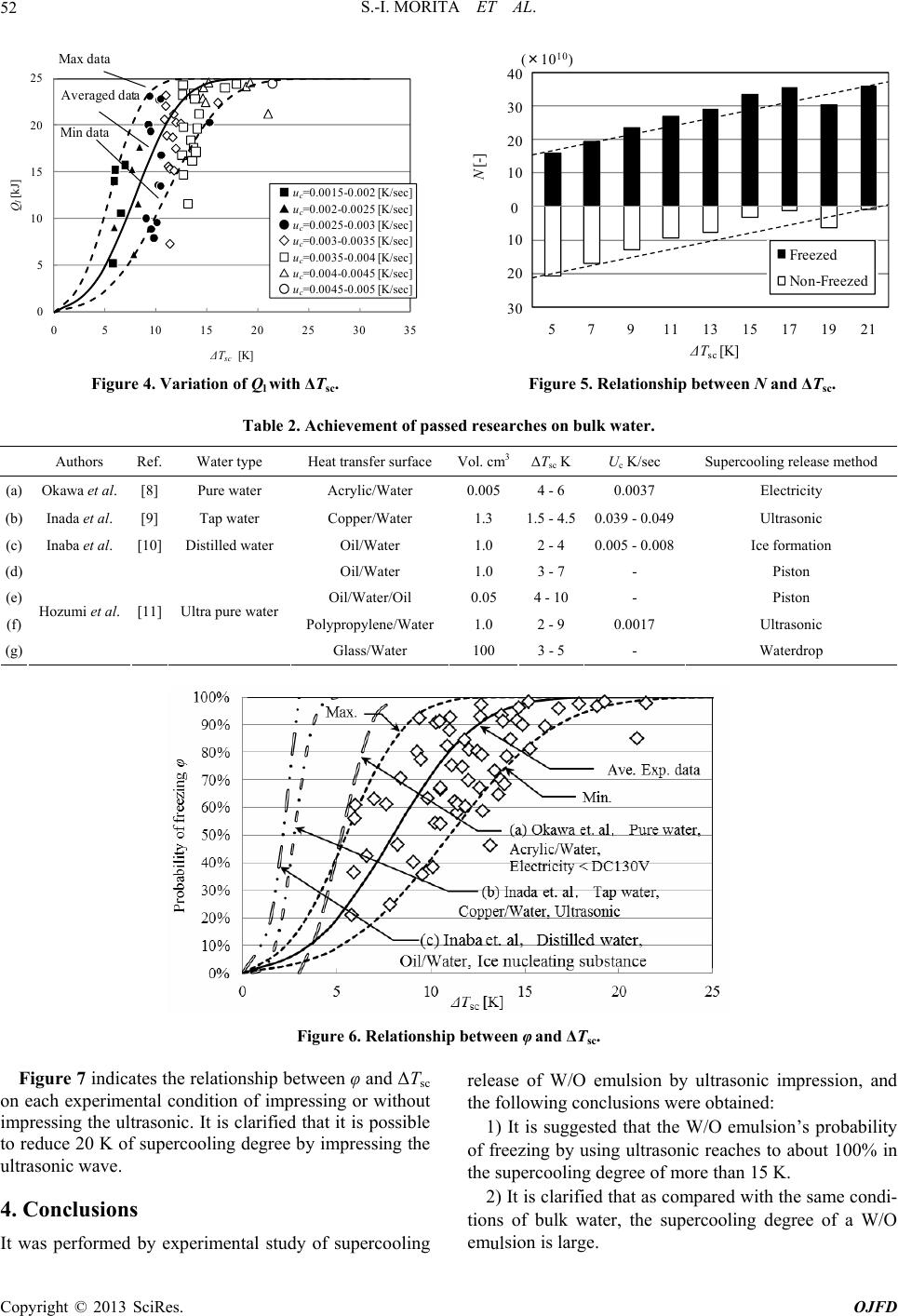 S.-I. MORITA ET AL. Copyright © 2013 SciRes. OJFD 52 579 111315171921 N[-] ΔT sc [K] 40 30 20 10 0 10 20 30 (×10 10 ) Freezed Non-Freezed 0 5 10 15 20 25 0510 15 20 25 30 35 Q l [kJ] ΔT s c [K] ■u c =0.0015-0.002 [K/sec] ▲u c =0.002-0.0025 [K/sec] ●u c =0.0025-0.003 [K/sec] ◇u c =0.003-0.0035 [K/sec] □u c =0.0035-0.004 [K/sec] △u c =0.004-0.0045 [K/sec] ○u c =0.0045-0.005 [K/sec] Max data Min data Averaged data Figure 4. Variation of Ql with ΔTsc. Figure 5. Relationship between N and ΔTsc. Table 2. Achievement of passed researches on bulk water. Authors Ref. Water type Heat transfer surface Vol. cm3ΔTsc KUc K/sec Supercooling release method (a) Okawa et al. [8] Pure water Acrylic/Water 0.005 4 - 6 0.0037 Electricity (b) Inada et al. [9] Tap water Copper/Water 1.3 1.5 - 4.50.039 - 0.049Ultrasonic (c) Inaba et al. [10] Distilled water Oil/Water 1.0 2 - 4 0.005 - 0.008Ice formation (d) Oil/Water 1.0 3 - 7 - Piston (e) Oil/Water/Oil 0.05 4 - 10 - Piston (f) Polypropylene/Water1.0 2 - 9 0.0017 Ultrasonic (g) Hozumi et al. [11] Ultra pure water Glass/Water 100 3 - 5 - Waterdrop Figure 6. Relationship between φ and ΔTsc. Figure 7 indicates the relationship between φ and ΔTsc on each experimental condition of impressing or without impressing the ultrasonic. It is clarified that it is possible to reduce 20 K of supercooling degree by impressing the ultrasonic wave. release of W/O emulsion by ultrasonic impression, and the following conclusions were obtained: 1) It is suggested that the W/O emulsion’s probability of freezing by using ultrasonic reaches to about 100% in the supercooling degree of more than 15 K. 2) It is clarified that as compared with the same condi- tions of bulk water, the supercooling degree of a W/O emsion is large. 4. Conclusions ul It was performed by experimental study of supercooling 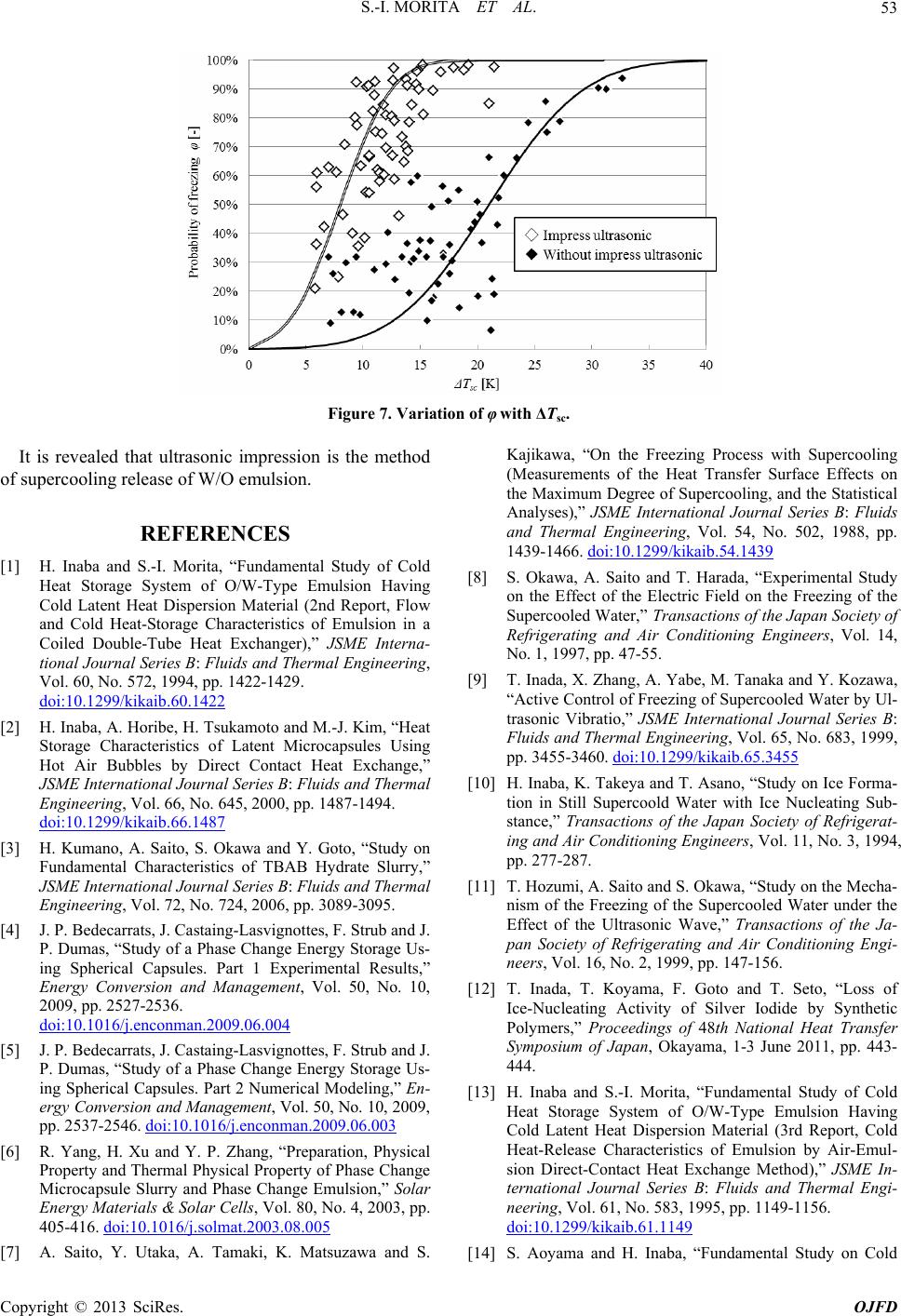 S.-I. MORITA ET AL. 53 Figure 7. Variation of φ with ΔTsc. It is revealed that ultrasonic impression is the method of supercooling release of W/O emulsion. REFERENCES [1] H. Inaba and S.-I. Morita, “Fundamental Study of Cold Heat Storage System of O/W-Type Emulsion Having Cold Latent Heat Dispersion Material (2nd Report, Flow and Cold Heat-Storage Characteristics of Emulsion in a Coiled Double-Tube Heat Exchanger),” JSME Interna- tional Journal Series B: Fluids and Thermal Engineering, Vol. 60, No. 572, 1994, pp. 1422-1429. doi:10.1299/kikaib.60.1422 [2] H. Inaba, A. Horibe, H. Tsukamoto and M.-J. Kim, “Heat Storage Characteristics of Latent Microcapsules Using Hot Air Bubbles by Direct Contact Heat Exchange,” JSME International Journal Series B: Fluids and Thermal Engineering, Vol. 66, No. 645, 2000, pp. 1487-1494. doi:10.1299/kikaib.66.1487 [3] H. Kumano, A. Saito, S. Okawa and Y. Goto, “Study on Fundamental Characteristics of TBAB Hydrate Slurry,” JSME International Journal Series B: Fluids and Thermal Engineering, Vol. 72, No. 724, 2006, pp. 3089-3095. [4] J. P. Bedecarrats, J. Castaing-Lasvignottes, F. Strub and J. P. Dumas, “Study of a Phase Change Energy Storage Us- ing Spherical Capsules. Part 1 Experimental Results,” Energy Conversion and Management, Vol. 50, No. 10, 2009, pp. 2527-2536. doi:10.1016/j.enconman.2009.06.004 [5] J. P. Bedecarrats, J. Castaing-Lasvignottes, F. Strub and J. P. Dumas, “Study of a Phase Change Energy Storage Us- ing Spherical Capsules. Part 2 Numerical Modeling,” En- ergy Conversion and Management, Vol. 50, No. 10, 2009, pp. 2537-2546. doi:10.1016/j.enconman.2009.06.003 [6] R. Yang, H. Xu and Y. P. Zhang, “Preparation, Physical Property and Thermal Physical Property of Phase Change Microcapsule Slurry and Phase Change Emulsion,” Solar Energy Materials & Solar Cells, Vol. 80, No. 4, 2003, pp. 405-416. doi:10.1016/j.solmat.2003.08.005 [7] A. Saito, Y. Utaka, A. Tamaki, K. Matsuzawa and S. Kajikawa, “On the Freezing Process with Supercooling (Measurements of the Heat Transfer Surface Effects on the Maximum Degree of Supercooling, and the Statistical Analyses),” JSME International Journal Series B: Fluids and Thermal Engineering, Vol. 54, No. 502, 1988, pp. 1439-1466. doi:10.1299/kikaib.54.1439 [8] S. Okawa, A. Saito and T. Harada, “Experimental Study on the Effect of the Electric Field on the Freezing of the Supercooled Water,” Transactions of the Japan Society of Refrigerating and Air Conditioning Engineers, Vol. 14, No. 1, 1997, pp. 47-55. [9] T. Inada, X. Zhang, A. Yabe, M. Tanaka and Y. Kozawa, “Active Control of Freezing of Supercooled Water by Ul- trasonic Vibratio,” JSME International Journal Series B: Fluids and Thermal Engineering, Vol. 65, No. 683, 1999, pp. 3455-3460. doi:10.1299/kikaib.65.3455 [10] H. Inaba, K. Takeya and T. Asano, “Study on Ice Forma- tion in Still Supercoold Water with Ice Nucleating Sub- stance,” Transactions of the Japan Society of Refrigerat- ing and Air Conditioning Engineers, Vol. 11, No. 3, 1994, pp. 277-287. [11] T. Hozumi, A. Saito and S. Okawa, “Study on the Mecha- nism of the Freezing of the Supercooled Water under the Effect of the Ultrasonic Wave,” Transactions of the Ja- pan Society of Refrigerating and Air Conditioning Engi- neers, Vol. 16, No. 2, 1999, pp. 147-156. [12] T. Inada, T. Koyama, F. Goto and T. Seto, “Loss of Ice-Nucleating Activity of Silver Iodide by Synthetic Polymers,” Proceedings of 48th National Heat Transfer Symposium of Japan, Okayama, 1-3 June 2011, pp. 443- 444. [13] H. Inaba and S.-I. Morita, “Fundamental Study of Cold Heat Storage System of O/W-Type Emulsion Having Cold Latent Heat Dispersion Material (3rd Report, Cold Heat-Release Characteristics of Emulsion by Air-Emul- sion Direct-Contact Heat Exchange Method),” JSME In- ternational Journal Series B: Fluids and Thermal Engi- neering, Vol. 61, No. 583, 1995, pp. 1149-1156. doi:10.1299/kikaib.61.1149 [14] S. Aoyama and H. Inaba, “Fundamental Study on Cold Copyright © 2013 SciRes. OJFD 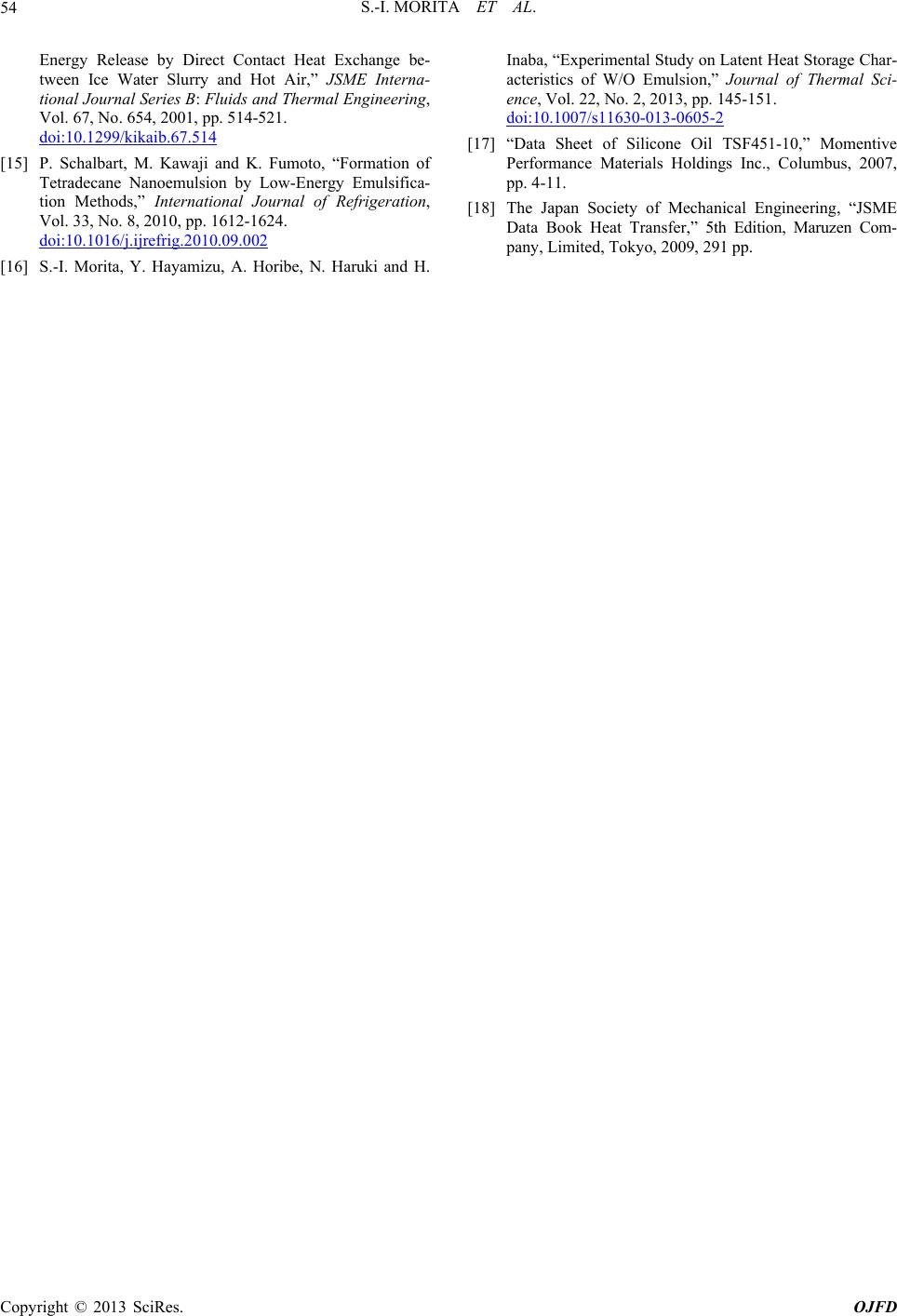 S.-I. MORITA ET AL. 54 Energy Release by Direct Contact Heat Exchange be- tween Ice Water Slurry and Hot Air,” JSME Interna- tional Journal Series B: Fluids and Thermal Engineering, Vol. 67, No. 654, 2001, pp. 514-521. doi:10.1299/kikaib.67.514 [15] P. Schalbart, M. Kawaji and K. Fumoto, “Formation of Tetradecane Nanoemulsion by Low-Energy Emulsifica- tion Methods,” International Journal of Refrigeration, Vol. 33, No. 8, 2010, pp. 1612-1624. doi:10.1016/j.ijrefrig.2010.09.002 [16] S.-I. Morita, Y. Hayamizu, A. Horibe, N. Haruki and H. Inaba, “Experimental Study on Latent Heat Storage Char- acteristics of W/O Emulsion,” Journal of Thermal Sci- ence, Vol. 22, No. 2, 2013, pp. 145-151. doi:10.1007/s11630-013-0605-2 [17] “Data Sheet of Silicone Oil TSF451-10,” Momentive Society of Mechanical Engineering, “JSME Performance Materials Holdings Inc., Columbus, 2007, pp. 4-11. [18] The Japan Data Book Heat Transfer,” 5th Edition, Maruzen Com- pany, Limited, Tokyo, 2009, 291 pp. Copyright © 2013 SciRes. OJFD |