

Paper Menu >>
Journal Menu >>
 Int. J. Communications, Network and System Sciences, 2013, 6, 377-380 http://dx.doi.org/10.4236/ijcns.2013.68040 Published Online August 2013 (http://www.scirp.org/journal/ijcns) Call Admission Control in HAP W-CDMA Cellular Systems Behnaz Behzadi Faculty of Engineering, Islamic Azad University, South Branch, Tehran, Iran Email: [email protected] Received June 15, 2013; revised July 15, 2013; accepted July 25, 2013 Copyright © 2013 Behnaz Behzadi. This is an open access article distributed under the Creative Commons Attribution License, which permits unrestricted use, distribution, and reproduction in any medium, provided the original work is properly cited. ABSTRACT Among various radio sources which control different dependencies/functions, in this article, we will talk about the Call Admission Control (CAC), and we are supposed to confine our concentration on W-CDMA which is based on high raised platforms, since during the recent years remarkable amount of attention has been focused on platforms located in stratosphere layer [1]. Firstly, we study the capacity of uplink from HAP (High Altitude Platform) W-CDMA and we’ll work on estimation and power control defects in a new conversation added to current conversations. We’ll enhance the Call Admission Control (CAC) based on the side effects of power control defects and users’ stimulus and then compare the CAC which has been measured by using of momentary energy on bit in the spectral density form (Eb/N0). Then we examine the mentioned charts for two different criteria which the decision will be made by these criteria in order to de- cide if exchanged calls are to be admitted or not. The first criterion is based on the minimum of (Eb/N0) of the first row cells meanwhile the second criterion is based on the average of (Eb/N0) of first row-cells. Keywords: High Raised Platforms; Call Admission Control; Quality of Services; Power Control Defects 1. Introduction The HAPS internal potentials will be appeared gradually, HAPS (High Altitude Platform Station) is the name of a technology which provides far distance communication between wide and narrow fiber. The aim of HAPS is to offer the services to the users using planes with pilot or none pilot running planes, or balloons. These platforms are available for several us- ages and will be used in estratosphery zone in the height range of 20 - 50 km [2]. It’s not a cutting-edge innovation to use platforms as a none-polluter and cheap and flexible. These platforms can be accordant with satellite and also earth-established equipments since they can be an organizer as a founda- tion. Also HAPS can be used in a special event such as Olympics to be covered when there’ll be lots of crowd. Daily enhancement of demands for telecommunication systems and having new systems with a wide range of fi- bers has turned the trend to the use of more high-tech systems to meet the demand. The third generation of mo- bile cellular telecommunication and the following gen- eration have been designed in a wide telecommunication and several sided accessibility with pass code, plus hav- ing more capacity in comparison with current systems, to be able to provide a sending with different rates. This paper investigates a HAP W-CDMA cellular sys- tem based on a high platform. One of the radio sources that controls the HAP W-CDMA system’s functions. In this article, we concentrate on call admission control which it means to admit or to reject a call will be admit- ed when it receives the service quality from the net and no good to be mentioned that this issue will affect on call service quality that is being used. At the same time, it’s possible that QoS rejects the current calls. Lots of issues are engaged in call admission but the power control is above the qualification and possibility. In real systems, the control defects power will lead to some alterations in receiving power by a central station which consequently lead to some alterations in ratio of receiving energy per bit to spectral density of power- noise of (Eb/N0). Call admission will be done based on measures of (Eb/N0). Two thresholds will be considered for new transferred calls and exchanged calls. The process will be as below in the second ward. We will analyze the call admission control. The third part contains an explanation of the offering plan and laying matters. In the forth part, the simulated results have been offered and the point of discussion. And lastly, the result C opyright © 2013 SciRes. IJCNS 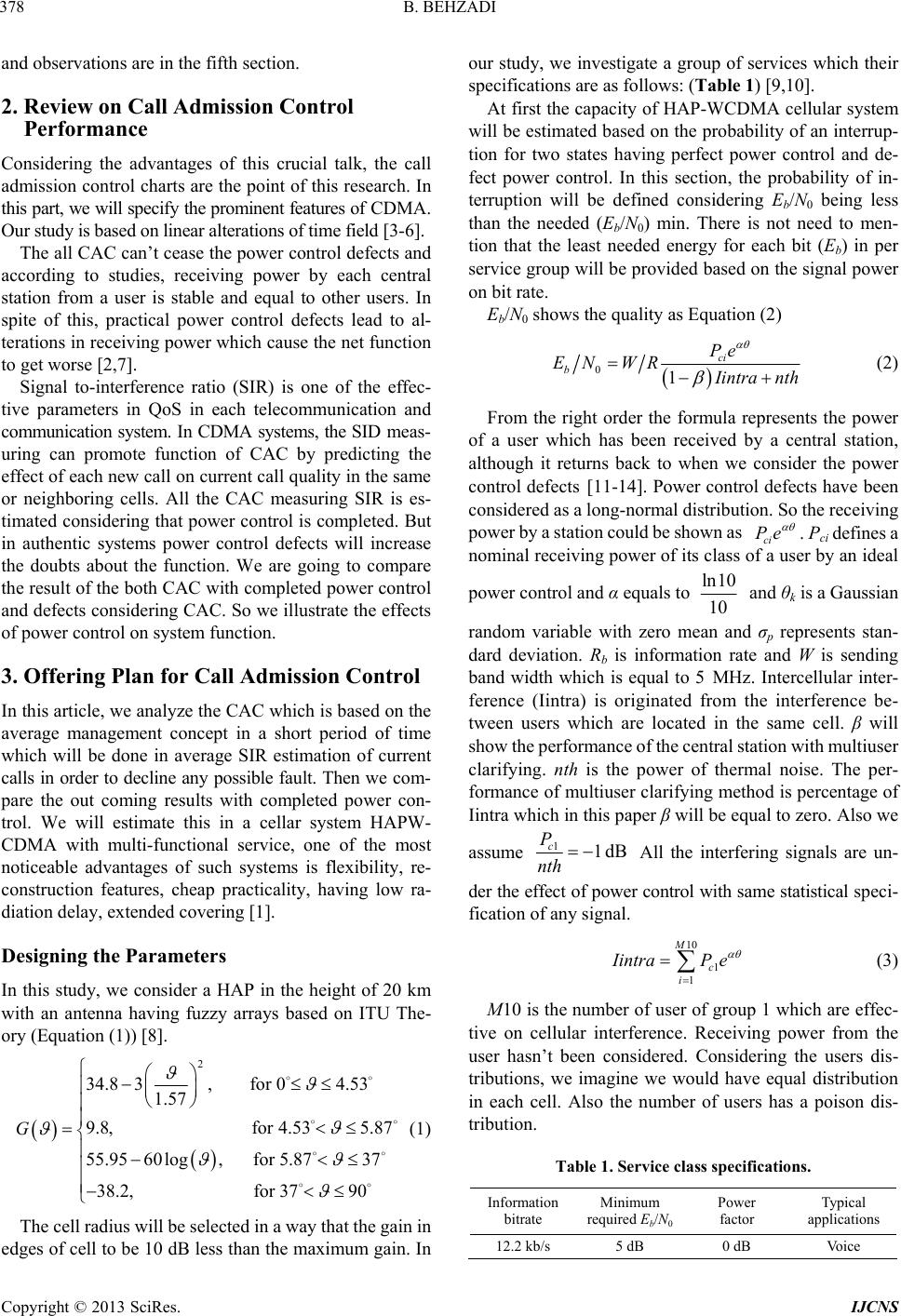 B. BEHZADI 378 and observations are in the fifth section. 2. Review on Call Admission Control Performance Considering the advantages of this crucial talk, the call admission control charts are the point of this research. In this part, we will specify the prominent features of CDMA. Our study is based on linear alterations of time field [3-6]. The all CAC can’t cease the power control defects and according to studies, receiving power by each central station from a user is stable and equal to other users. In spite of this, practical power control defects lead to al- terations in receiving power which cause the net function to get worse [2,7]. Signal to-interference ratio (SIR) is one of the effec- tive parameters in QoS in each telecommunication and communication system. In CDMA systems, the SID meas- uring can promote function of CAC by predicting the effect of each new call on current call quality in the same or neighboring cells. All the CAC measuring SIR is es- timated considering that power control is completed. But in authentic systems power control defects will increase the doubts about the function. We are going to compare the result of the both CAC with completed power control and defects considering CAC. So we illustrate the effects of power control on system function. 3. Offering Plan for Call Admission Control In this article, we analyze the CAC which is based on the average management concept in a short period of time which will be done in average SIR estimation of current calls in order to decline any possible fault. Then we com- pare the out coming results with completed power con- trol. We will estimate this in a cellar system HAPW- CDMA with multi-functional service, one of the most noticeable advantages of such systems is flexibility, re- construction features, cheap practicality, having low ra- diation delay, extended covering [1]. Designing the Parameters In this study, we consider a HAP in the height of 20 km with an antenna having fuzzy arrays based on ITU The- ory (Equation (1)) [8]. 2 34.83,for 04.53 1.57 9.8,for 4.535.87 55.9560log,for 5.8737 38.2,for 3790 G (1) The cell radius will be selected in a way that the gain in edges of cell to be 10 dB less than the maximum gain. In our study, we investigate a group of services which their specifications are as follows: (Table 1) [9,10]. At first the capacity of HAP-WCDMA cellular system will be estimated based on the probability of an interrup- tion for two states having perfect power control and de- fect power control. In this section, the probability of in- terruption will be defined considering Eb/N0 being less than the needed (Eb/N0) min. There is not need to men- tion that the least needed energy for each bit (Eb) in per service group will be provided based on the signal power on bit rate. Eb/N0 shows the quality as Equation (2) 01 ci b Pe EN WR I intra nth (2) From the right order the formula represents the power of a user which has been received by a central station, although it returns back to when we consider the power control defects [11-14]. Power control defects have been considered as a long-normal distribution. So the receiving power by a station could be shown as ci Pe . Pci defines a nominal receiving power of its class of a user by an ideal power control and α equals to ln10 10 and θk is a Gaussian random variable with zero mean and σp represents stan- dard deviation. Rb is information rate and W is sending band width which is equal to 5 MHz. Intercellular inter- ference (Iintra) is originated from the interference be- tween users which are located in the same cell. β will show the performance of the central station with multiuser clarifying. nth is the power of thermal noise. The per- formance of multiuser clarifying method is percentage of Iintra which in this paper β will be equal to zero. Also we assume 11dB c P nth All the interfering signals are un- der the effect of power control with same statistical speci- fication of any signal. 10 1 1 M c i I intraP e (3) M10 is the number of user of group 1 which are effec- tive on cellular interference. Receiving power from the user hasn’t been considered. Considering the users dis- tributions, we imagine we would have equal distribution in each cell. Also the number of users has a poison dis- tribution. Table 1. Service class specifications. Information bitrate Minimum required Eb/N0 Power factor Typical applications 12.2 kb/s 5 dB 0 dB Voice Copyright © 2013 SciRes. IJCNS 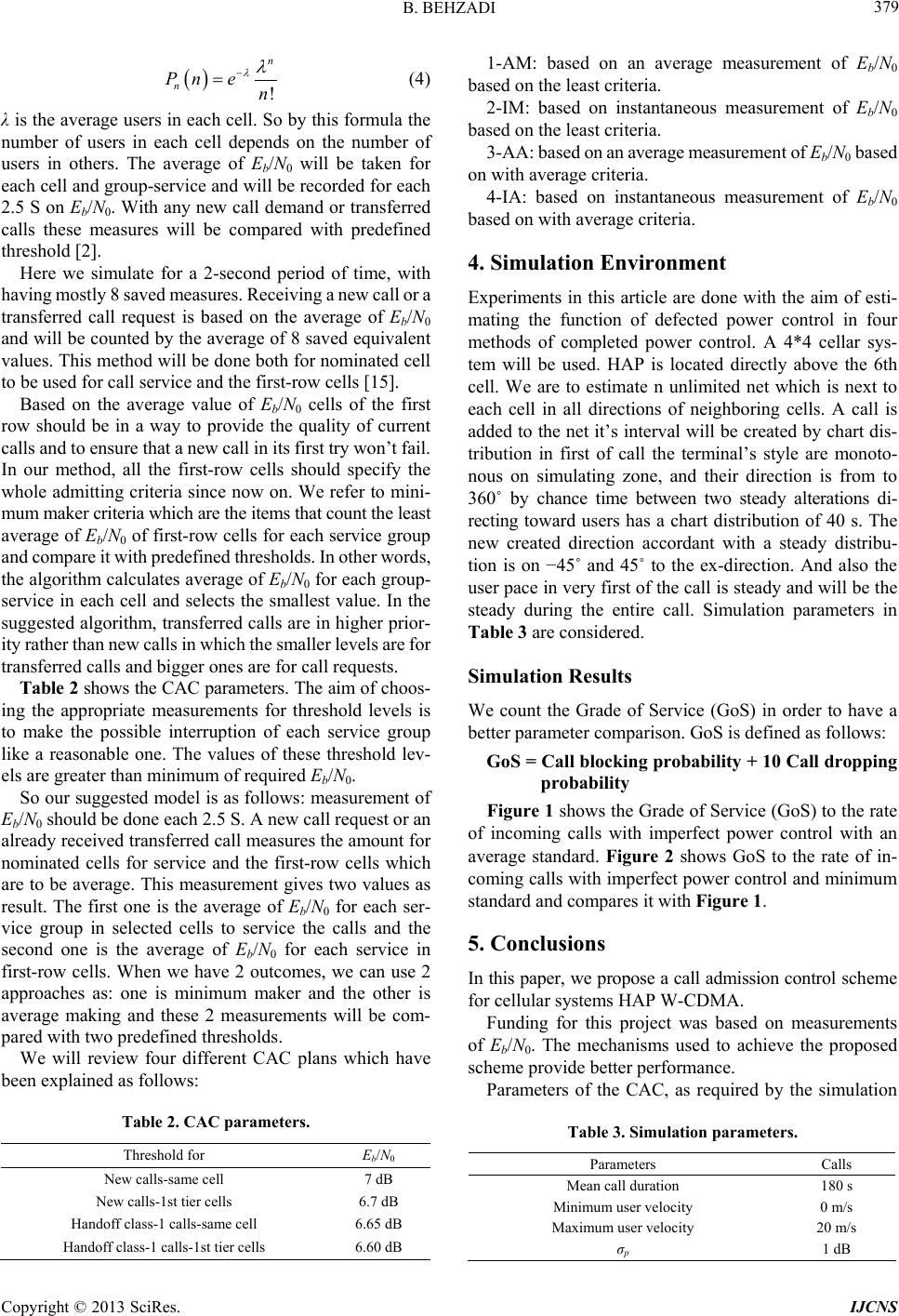 B. BEHZADI 379 ! n n Pne n (4) λ is the average users in each cell. So by this formula the number of users in each cell depends on the number of users in others. The average of Eb/N0 will be taken for each cell and group-service and will be recorded for each 2.5 S on Eb/N0. With any new call demand or transferred calls these measures will be compared with predefined threshold [2]. Here we simulate for a 2-second period of time, with having mostly 8 saved measures. Receiving a new call or a transferred call request is based on the average of Eb/N0 and will be counted by the average of 8 saved equivalent values. This method will be done both for nominated cell to be used for call service and the first-row cells [15]. Based on the average value of Eb/N0 cells of the first row should be in a way to provide the quality of current calls and to ensure that a new call in its first try won’t fail. In our method, all the first-row cells should specify the whole admitting criteria since now on. We refer to mini- mum maker criteria which are the items that count the least average of Eb/N0 of first-row cells for each service group and compare it with predefined thresholds. In other words, the algorithm calculates average of Eb/N0 for each group- service in each cell and selects the smallest value. In the suggested algorithm, transferred calls are in higher prior- ity rather than new calls in which the smaller levels are for transferred calls and bigger ones are for call requests. Table 2 shows the CAC parameters. The aim of choos- ing the appropriate measurements for threshold levels is to make the possible interruption of each service group like a reasonable one. The values of these threshold lev- els are greater than minimum of required Eb/N0. So our suggested model is as follows: measurement of Eb/N0 should be done each 2.5 S. A new call request or an already received transferred call measures the amount for nominated cells for service and the first-row cells which are to be average. This measurement gives two values as result. The first one is the average of Eb/N0 for each ser- vice group in selected cells to service the calls and the second one is the average of Eb/N0 for each service in first-row cells. When we have 2 outcomes, we can use 2 approaches as: one is minimum maker and the other is average making and these 2 measurements will be com- pared with two predefined thresholds. We will review four different CAC plans which have been explained as follows: Table 2. CAC parameters. Threshold for E b/N0 New calls-same cell 7 dB New calls-1st tier cells 6.7 dB Handoff class-1 calls-same cell 6.65 dB Handoff class-1 calls-1st tier cells 6.60 dB 1-AM: based on an average measurement of Eb/N0 based on the least criteria. 2-IM: based on instantaneous measurement of Eb/N0 based on the least criteria. 3-AA: based on an average measurement of Eb/N0 based on with average criteria. 4-IA: based on instantaneous measurement of Eb/N0 based on with average criteria. 4. Simulation Environment Experiments in this article are done with the aim of esti- mating the function of defected power control in four methods of completed power control. A 4*4 cellar sys- tem will be used. HAP is located directly above the 6th cell. We are to estimate n unlimited net which is next to each cell in all directions of neighboring cells. A call is added to the net it’s interval will be created by chart dis- tribution in first of call the terminal’s style are monoto- nous on simulating zone, and their direction is from to 360˚ by chance time between two steady alterations di- recting toward users has a chart distribution of 40 s. The new created direction accordant with a steady distribu- tion is on −45˚ and 45˚ to the ex-direction. And also the user pace in very first of the call is steady and will be the steady during the entire call. Simulation parameters in Table 3 are considered. Simulation Results We count the Grade of Service (GoS) in order to have a better parameter comparison. GoS is defined as follows: GoS = Call blocking probability + 10 Ca ll dropping probability Figure 1 shows the Grade of Service (GoS) to the rate of incoming calls with imperfect power control with an average standard. Figure 2 shows GoS to the rate of in- coming calls with imperfect power control and minimum standard and compares it with Figure 1. 5. Conclusions In this paper, we propose a call admission control scheme for cellular systems HAP W-CDMA. Funding for this project was based on measurements of Eb/N0. The mechanisms used to achieve the proposed scheme provide better performance. Parameters of the CAC, as required by the simulation Table 3. Simulation parameters. Parameters Calls Mean call duration 180 s Minimum user velocity 0 m/s Maximum user velocity 20 m/s σp 1 dB Copyright © 2013 SciRes. IJCNS 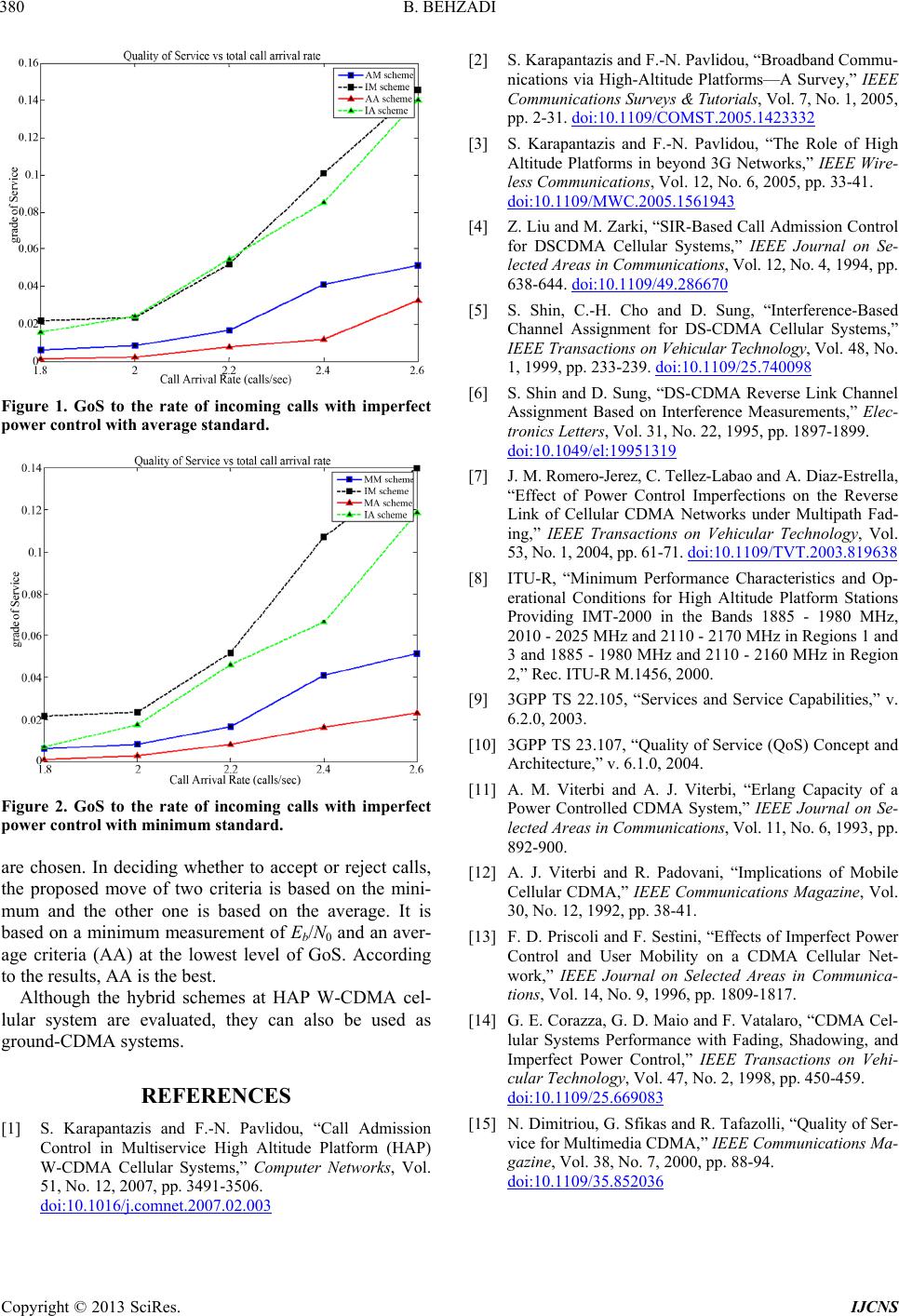 B. BEHZADI Copyright © 2013 SciRes. IJCNS 380 [2] S. Karapantazis and F.-N. Pavlidou, “Broadband Commu- nications via High-Altitude Platforms—A Survey,” IEEE Communications Surveys & Tutorials, Vol. 7, No. 1, 2005, pp. 2-31. doi:10.1109/COMST.2005.1423332 [3] S. Karapantazis and F.-N. Pavlidou, “The Role of High Altitude Platforms in beyond 3G Networks,” IEEE Wire- less Communications, Vol. 12, No. 6, 2005, pp. 33-41. doi:10.1109/MWC.2005.1561943 [4] Z. Liu and M. Zarki, “SIR-Based Call Admission Control for DSCDMA Cellular Systems,” IEEE Journal on Se- lected Areas in Communications, Vol. 12, No. 4, 1994, pp. 638-644. doi:10.1109/49.286670 [5] S. Shin, C.-H. Cho and D. Sung, “Interference-Based Channel Assignment for DS-CDMA Cellular Systems,” IEEE Transactions on Vehicular Technology, Vol. 48, No. 1, 1999, pp. 233-239. doi:10.1109/25.740098 [6] S. Shin and D. Sung, “DS-CDMA Reverse Link Channel Assignment Based on Interference Measurements,” Elec- tronics Letters, Vol. 31, No. 22, 1995, pp. 1897-1899. doi:10.1049/el:19951319 Figure 1. GoS to the rate of incoming calls with imperfect power control with average standard. [7] J. M. Romero-Jerez, C. Tellez-Labao and A. Diaz-Estrella, “Effect of Power Control Imperfections on the Reverse Link of Cellular CDMA Networks under Multipath Fad- ing,” IEEE Transactions on Vehicular Technology, Vol. 53, No. 1, 2004, pp. 61-71. doi:10.1109/TVT.2003.819638 [8] ITU-R, “Minimum Performance Characteristics and Op- erational Conditions for High Altitude Platform Stations Providing IMT-2000 in the Bands 1885 - 1980 MHz, 2010 - 2025 MHz and 2110 - 2170 MHz in Regions 1 and 3 and 1885 - 1980 MHz and 2110 - 2160 MHz in Region 2,” Rec. ITU-R M.1456, 2000. [9] 3GPP TS 22.105, “Services and Service Capabilities,” v. 6.2.0, 2003. [10] 3GPP TS 23.107, “Quality of Service (QoS) Concept and Architecture,” v. 6.1.0, 2004. [11] A. M. Viterbi and A. J. Viterbi, “Erlang Capacity of a Power Controlled CDMA System,” IEEE Journal on Se- lected Areas in Communications, Vol. 11, No. 6, 1993, pp. 892-900. Figure 2. GoS to the rate of incoming calls with imperfect power control with minimum standard. are chosen. In deciding whether to accept or reject calls, the proposed move of two criteria is based on the mini- mum and the other one is based on the average. It is based on a minimum measurement of Eb/N0 and an aver- age criteria (AA) at the lowest level of GoS. According to the results, AA is the best. [12] A. J. Viterbi and R. Padovani, “Implications of Mobile Cellular CDMA,” IEEE Communications Magazine, Vol. 30, No. 12, 1992, pp. 38-41. [13] F. D. Priscoli and F. Sestini, “Effects of Imperfect Power Control and User Mobility on a CDMA Cellular Net- work,” IEEE Journal on Selected Areas in Communica- tions, Vol. 14, No. 9, 1996, pp. 1809-1817. Although the hybrid schemes at HAP W-CDMA cel- lular system are evaluated, they can also be used as ground-CDMA systems. [14] G. E. Corazza, G. D. Maio and F. Vatalaro, “CDMA Cel- lular Systems Performance with Fading, Shadowing, and Imperfect Power Control,” IEEE Transactions on Vehi- cular Technology, Vol. 47, No. 2, 1998, pp. 450-459. doi:10.1109/25.669083 REFERENCES [15] N. Dimitriou, G. Sfikas and R. Tafazolli, “Quality of Ser- vice for Multimedia CDMA,” IEEE Communications Ma- gazine, Vol. 38, No. 7, 2000, pp. 88-94. doi:10.1109/35.852036 [1] S. Karapantazis and F.-N. Pavlidou, “Call Admission Control in Multiservice High Altitude Platform (HAP) W-CDMA Cellular Systems,” Computer Networks, Vol. 51, No. 12, 2007, pp. 3491-3506. doi:10.1016/j.comnet.2007.02.003 |