

Paper Menu >>
Journal Menu >>
 Engineering, 2013, 5, 10-14 doi:10.4236/eng.2013.55B003 Published Online May 2013 (http://www.scirp.org/journal/eng) Pseudobezoars: Technology Progress and New Prospects as a Medical Platform Orly Yadid-Pecht1, Martin P. Mintchev1,2 1Department of Electrical and Computer Engineering, University of Calgary, Calgary, Canada 2Department of Surgery, University of Alberta, Edmonton, Canada Email: [email protected], [email protected] Received 2013 ABSTRACT In recent years, pseudobezoars have been a subject of research, mainly serving as a basis for a new non-invasive alter- native to obesity treatment. A pill incorporating the technology has been proven to be successful as a weight loss ther- apy. It enables patients to sustain a diet longer, due to an increase in the level of satiety, resulting in a smaller amount of food intake. Utilization of the tech nology has recently found new prospects in another organ of the GI tract, the colon. Pseudobezoar technology can be utilized as an enhanced method for colon cancer screening and also as an alternative carrier for bacterial therapy. Keywords: Pseudobezoars; Obesity; Colon Cancer Screening; Diagnostic Device; Therapeutic Device 1. Introduction The pseudobezoar technology is relatively new and only recently has been granted a US patent [1]. However, early successes of utilizing the device as a dietary pill have already been reported [2-4]. The technology com- prises a pill coated and targeted for the stomach, where the shell dissolves and the superabsorbent polymer gran- ules within expanding due to the contact with and ab- sorption of gastric liquid. The granules are kept in the stomach without an option to exit, since they are con- tained in a gauze that disintegrates only after a few days. Taking the pill in a prescribed regimen, demonstrated a significant weight loss in a double blind study [3]. These results confirmed the efficacy of the technology as a die- tary pill targeted at the stomach. We have recently described an additional possibility for usage of the technology, targeting the colon as the organ of choice. The method comprises use of the pseu- dobezoar as a colon cancer screening device when taken as a colon-targeted pill. Section 2 will describe the current colon cancer screening options. Section 3 will describe the utilization of pseudobezoars as an alternative to current colon can- cer screening technologies. Section 4 will briefly outline the prospects of the utilizatio n of the device as a bacterial transplant and summarize this p ape r. 2. Current Colon Cancer Screening Options Colon cancer is the most common gastrointestinal (GI) malignancy and the second leading cause of cancer deaths in the United States [5]. Of the many pre-neoplastic and neoplastic condition s in humans, nowh ere is the ability to prevent disease as profound as it is in colon cancer [6]. Strategies for prevention have evolved over the past 15 years, now including the use of fecal occult blood test (FOBT), fecal immunology tests (FIT), fecal DNA tests, colonoscopy, video capsule endoscopy (VCE), and computed tomographic (CT) colonography, also known as Virtual Colonoscopy [7]. 2.1. Fecal Occult Blood Tests Although improved fecal occult blood tests have been utilized, the overall sensitivity of this approach is not impressive. In a 2005 study [8] Morikawa et al con- cluded that the sensitivity of 1-time immunochemical FOBT for detecting advanced neoplasia and invasive cancer was 27.1% and 65.8%, respectively. In addition, the sensitivity for invasive cancer detection according to Dukes’ stages showed 50.0% for Dukes’ stage A, 70.0% for Dukes’ stage B, and 78.3% for Dukes’ stages C or D [9]. The sensitivity for detecting advanced neoplasia in the proximal colon was significantly lower than that de- tected in the distal colon (1 6. 3% vs 3 0.7%, p < 0.00007). 2.2. Fecal Immunology Tests This testing method can be considered a refinement, ex- tension and an additive improvement over the traditional fecal occult blood testing. It has been reported that when Copyright © 2013 SciRes. ENG  O. YADID-PECHT, M. P. MINTCHEV 11 a routine fecal occult blood test (e.g. a sensitive guaiac test) is combined with an immunological test for human haemoglobin, the sensitivity improves to 97% (only 3% false negative results) in patients and no false positiv es in controls [10]. Another far more comprehensive study [11] found that the sensitivity of the combined test was the highest among all occult blood tests (in the range of 80%), and its specificity for detecting cancer was above 97%. The problem of all fecal occult blood tests, how- ever, is that they aim at discovering blood in the feces resulting from existing bleeding colorectal lesions, while adenomatous polyps in asymptomatic average-risk adults remain undetected. Therefore, by the time findings are obtained with the fecal tests, it is usually too late [12,13]. Nevertheless, the use of either annual or biennial fecal occult-blood testing significantly reduces the risk of co- lorectal cancer [14]. 2.3. Fecal DNA Tests Oncogene mutations that characterize colorectal neopla- sia are detectable in exfoliated ep ithelial cells in the stoo l. Whereas neoplastic bleeding is intermittent making the detection of occult fecal blood more or less random, epithelial shedding is continual, potentially making fecal DNA testing more sensitive. Early 21st century reports indicated that a fecal DNA test had a sensitivity of 91 percent for the detection of colorectal cancer and 82 per- cent for the identification of adenomas[15]. However, one other report indicated that fecal DNA testing did not improve dramatically the preventive early detection of colon cancer compared to occult fecal blood testing [16]. 2.4. Colonoscopy Traditional colonoscopy has been considered the gold standard for assessing colonic abnormalities, offering sensitivity and specificity in detecting polyps exceeding 90%. Moreover, it also offers the ability to remove polyps during the procedure. Although classical colonoscopy can be considered safe, reliable, real-time and quick, re- cent population-based studies have demonstrated that the rate of protection against colorectal cancer that it offers was only 30% to 50% [17]. In addition, colonoscopy is an invasive procedure, performed in a hospital setting, requires extensive and expensive logistic preparations, carries substantial risks of harming patien ts (2 -4/100 0), is heavily operator-dependent, and requires post-procedural recovery [18,19]. 2.5. Video Capsule Endoscopy Orally administered video capsule endoscope(VCE) is a simple, safe, non-invasive, and non-sedation requiring procedure. VCE is well accepted and tolerated by the patients and allows complete exploration of the small bowel. Usually, it takes 24 to 48 hours for a VCE to pass through the entire GI tract as a result of its passive movement from mouth to anus [20]. In view of the fact that the movement of these capsules is controlled by spontaneous gut peristalsis, the application of VCE is currently limited to small-lumen organs [21]. In larger- lumen organs, such as the stomach or the colon, the cap- sules tend to tumble, which leads to incorrect recognition of a given organ segment by the capsule imaging system, thus rendering the images unsuitable for diagnostic pur- poses and a miss rate in the colon exceeding 30% [22]. In addition, rapid colonic motility could result in in- complete imaging considering that most of the commer- cial CEs are designed to acquire images at a pre-fixed frame rate, usually 2 frames per second (FPS) [23]. Moreover, tumbling movement by peristalsis also limits the visual field and causes failure to catch significant lesions or grossly distorts the perceived dimensions of polyps [24]. The Pill Cam Colon capsule (Given Imaging, Yo- qneam, Israel) is the only VCE currently in use for colo- nic investigation. In the most recent study of 56 patients, colon capsule endoscopy (CCE) was followed by con- ventional colonoscopy (CSPY). Polyp detection rate (per patient) was 50% (n = 28) for CSPY and 62% (n = 35) for CCE. For relevant polyps (> 5 mm) there was a cor- respondence in the detection rates of both methods (p < 0.05). The mean sensitivity was 50% (p < 0.05), the mean specificity was 76% (p < 0.05), the positive predic- tive value (PPV) was 20% and the negative predictive value (NPV) was 93% [25]. These results indicate the general problem of VCE tumblin g during its tran sit in th e colon and the need for VCE stabilization [24]. A recent report on self-stabilizing capsule endoscopy systems seems to overcome this issue [26]. 2.6. Computed Tomographic Colonography (Virtual Colonoscopy) It has been suggested th at virtual colonoscopy perfor med with a computed tomography is an accurate screening method for the detection of colorectal neoplasia in as- ymptomatic average-risk adults and compares favorably with optical colonoscopy in terms of the detection of clinically relevant lesions. In a 2003 study [27] Pickhardt et al. suggested that the sensitivity of virtual colonoscopy for adenomatous polyps was 93.8 percent for polyps at least 10 mm in diameter, 93.9 percent for polyps at least 8 mm in diameter, and 88.7 percent for polyps at least 6 mm in diameter. The sensitivity of optical colonoscopy for adenomatous polyps was 87.5 percent, 91.5 percent, and 92.3 percent for the three sizes of polyps, respec- tively. The specificity of virtual colonoscopy for adeno- matous polyps was 96.0 percent for polyps at least 10 mm in diameter, 92.2 percen t for polyps at least 8 mm in Copyright © 2013 SciRes. ENG  O. YADID-PECHT, M. P. MINTCHEV 12 diameter, and 79.6 percent for polyps at least 6 mm in diameter. 3. Utilization of the Pseudobezoar as a Diagnostic Screening Device Recently proposed pseudobezoartechnology has been suggested for the treatment of obesity and for controlled drug delivery in the body (see e.g. [1]). Here we suggest to utilize these retaining devices as platforms for colon biopsy performed from the inside of the colon by a co- lon-targeted pseudobezoar which will be in contact with the colonic walls in a friction-like fashion severe enou gh to collect tissue samples, but moderate enough not t o cause excessive or abnormal bleeding or mucosal damage. This “artificial stool” will enable generalized biopsy from the entire organ (without actually having the information from which exact location in the organ the tissue samples have been collected). The advantage of having it screen the entire organ is to overcome the miss of adenomas in the right side of the colon as attested by Schoenfeld in [28], who calls for improvements in colonoscopy. A recent patent application close to what we propose has already been filed [29]. It discloses a colon-targeting ingestible device platform designed to recognize its entry to the colon and expand in the colon, ultimately aiming at improved imaging of the colon walls. On approaching the external anal sphin cter muscle, the ingestible p ill may contract or deform, for elimination. Colon recognition may be based on a structural image, based on the differ- ences in diameters between the small intestine and the colon, and particularly, based on the semilunar fold structure, which is unique to the colon. Additionally or alternatively, colon recognition may be based on a func- tional image, based on the generally inflammatory state of the vermiform appendix. Addition ally or alternatively, pH, flora, enzymes and/or chemical analyses may be used to recognize the colon. The imaging of the colon walls may be functional, by nuclear-radiatio n imaging of radionuclide-labeled antibodies, or by optical-fluores- cence-spectroscopy imaging of fluorescence-labeled an- tibodies. Additionally or alternatively, it may be struc- tural, for example, by visual, ultrasound or MRI means. Due to the proximity to the colon walls, the imaging is claimed to be advantageous to colonoscopy or virtual colonoscopy, as it is designed to distinguish malignant from benign tumors and detect tumors even at their in- cipient stage. Various sensors are envisioned to be em- bedded within the expandable colonic structure, includ- ing e.g. radioactive-emission detectors, fluorescence de- tectors, ultrasound detectors, MRI detectors, still and video cameras operating in the visible and/or infrared light ranges, temperature detectors, and impedance de- tectors. Recently offered patent pending technology [30], also offers a colon-targeting expandable structure, but it has 4 distinct features: 1)Its expansion is facilitated by a per- meable, mesh-like gauze structure which is in constant contact with the walls of the colon; 2) The expansion is provided by swellable granules of an appropriate bio- compatible polymer (e.g. polyacrylic acid) which swell individually but do not fuse into each other, thus not forming a uniform mass non-permeable to gases and liq- uids causing colonic obstruction; 3) The design of the entire device is such that the mesh-like gauze structure can exert relatively constant pressure on the colonic walls from the moment it reaches its final dimensions, until it exits the organ, thus enabling abrasive contact (for scraping maximally well the colonic walls while retaining the scraped material within the structure, with- out, however, damaging the colonic walls); 4) This tech- nology aims at collecting samples of tissue and bodily fluids, to be expelled from the body and analyzed later, rather than detecting colon pathologies in situ via detec- tors as disclosed in the cited US Patent Application 20050266074 [29]; The aim of the technology is creating a controllable, organ-targeting gastrointestinal pseudobezoar with the purpose to scrape the organ from inside in order to col- lect maximal diagnostic information for further process- ing. The implement can be self-administrable (in the case of humans) or administrable autonomously or unaided, meaning the implement is administrable in a non-inva- sive fashion, without the need of any external positioning or manipulating device functionally attached to it, such as an endoscope. When the container has the first dimension, the im- plement can be retained in a capsule capable of being easily swallowed or administered autonomously. Once the capsule has dissolved and the container is released in the colon, the colonic fluids will enter the fluid-perme- able, mesh-like, expandable container. When the fluid contacts the at least one swellable molecule cluster, the cluster will swell and the container will expand to the second dimension. When the container has expanded to the second dimension, it is sufficiently large so as to touch the colonic walls. The number of swellable mole- cule clusters in the container, their individual diameter, and their liquid-retaining and absorbing properties under various pressures, as well as the design of the container itself are made such that the swollen implement has an appropriate compliance to remain in constant touch with the colonic walls regardless of the lumen of the organ. For example, in a section of the colon where the lumen is large, the implement expands in a spherical shape to touch the walls of the organ. When the lumen of the co- lon is reduced, the implement elongates itself longitudi- nally in the organ, but it remains in contact with the colonic walls. Copyright © 2013 SciRes. ENG 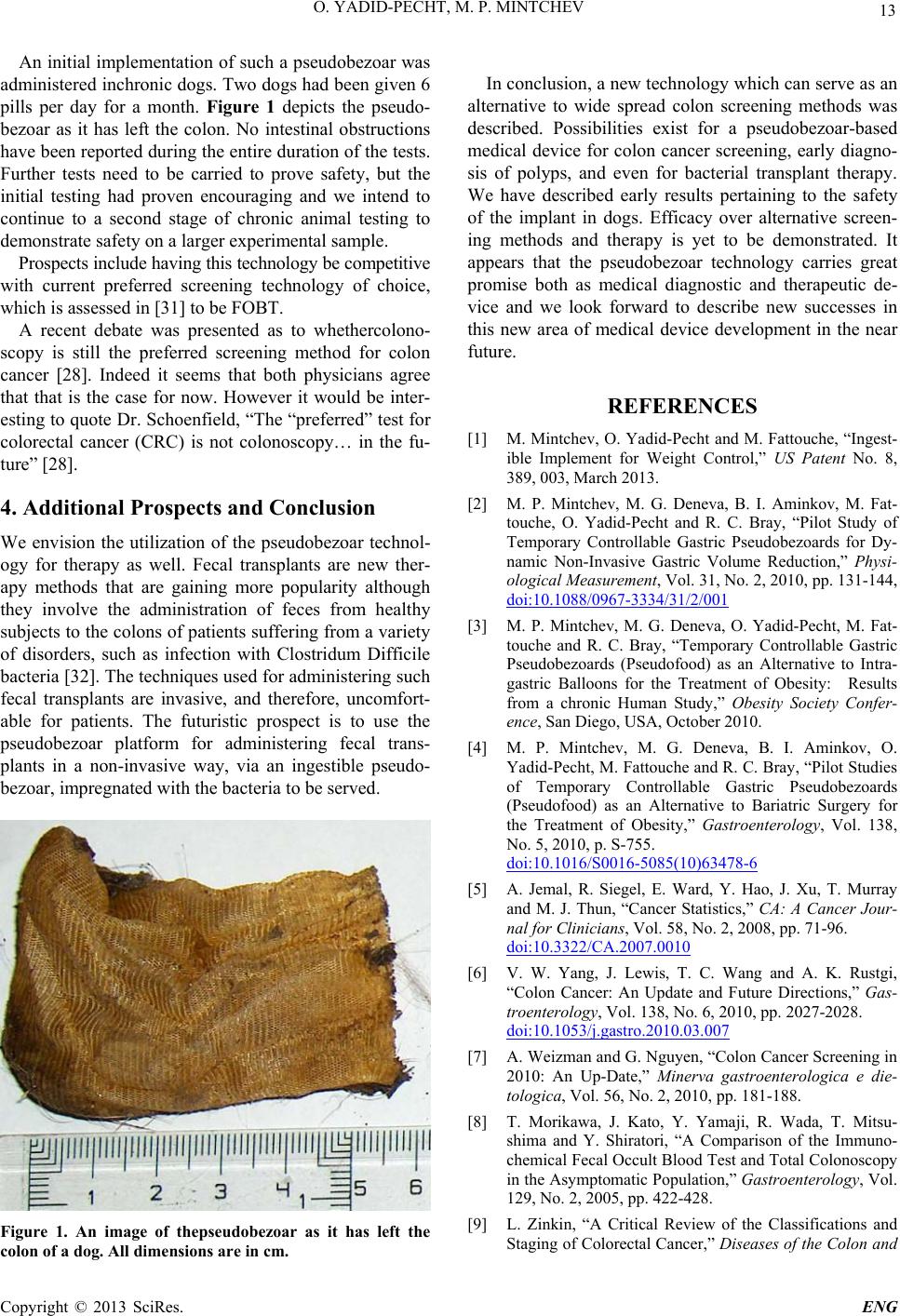 O. YADID-PECHT, M. P. MINTCHEV 13 An initial implementation of such a p seudobezoar was administered inchronic dogs. Two dogs had been given 6 pills per day for a month. Figure 1 depicts the pseudo- bezoar as it has left the colon. No intestinal obstructions have been reported during the entire duration of the tests. Further tests need to be carried to prove safety, but the initial testing had proven encouraging and we intend to continue to a second stage of chronic animal testing to demonstrate safety on a larger experimental sample. Prospects include having this technology be competitive with current preferred screening technology of choice, which is assessed in [31] to be FOBT. A recent debate was presented as to whethercolono- scopy is still the preferred screening method for colon cancer [28]. Indeed it seems that both physicians agree that that is the case for now. However it would be inter- esting to quote Dr. Schoenfield, “The “preferred” test for colorectal cancer (CRC) is not colonoscopy… in the fu- ture” [28]. 4. Additional Prospects and Conclusion We envision the utilization of the pseudobezoar technol- ogy for therapy as well. Fecal transplants are new ther- apy methods that are gaining more popularity although they involve the administration of feces from healthy subjects to the colons of patients suffering from a variety of disorders, such as infection with Clostridum Difficile bacteria [32]. The techniques used for administering such fecal transplants are invasive, and therefore, uncomfort- able for patients. The futuristic prospect is to use the pseudobezoar platform for administering fecal trans- plants in a non-invasive way, via an ingestible pseudo- bezoar, impregnated with the bacteria to be served. Figure 1. An image of thepseudobezoar as it has left the colon of a dog. All dimensions are in cm. In conclusion, a new technology which can serve as an alternative to wide spread colon screening methods was described. Possibilities exist for a pseudobezoar-based medical device for colon cancer screening, early diagno- sis of polyps, and even for bacterial transplant therapy. We have described early results pertaining to the safety of the implant in dogs. Efficacy over alternative screen- ing methods and therapy is yet to be demonstrated. It appears that the pseudobezoar technology carries great promise both as medical diagnostic and therapeutic de- vice and we look forward to describe new successes in this new area of medical device development in the near future. REFERENCES [1] M. Mintchev, O. Yadid-Pecht and M. Fattouche, “Ingest- ible Implement for Weight Control,” US Patent No. 8, 389, 003, March 2013. [2] M. P. Mintchev, M. G. Deneva, B. I. Aminkov, M. Fat- touche, O. Yadid-Pecht and R. C. Bray, “Pilot Study of Temporary Controllable Gastric Pseudobezoards for Dy- namic Non-Invasive Gastric Volume Reduction,” Physi- ological Measurement, Vol. 31, No. 2, 2010, pp. 131-144, doi:10.1088/0967-3334/31/2/001 [3] M. P. Mintchev, M. G. Deneva, O. Yadid-Pecht, M. Fat- touche and R. C. Bray, “Temporary Controllable Gastric Pseudobezoards (Pseudofood) as an Alternative to Intra- gastric Balloons for the Treatment of Obesity: Results from a chronic Human Study,” Obesity Society Confer- ence, San Diego, USA, October 2010. [4] M. P. Mintchev, M. G. Deneva, B. I. Aminkov, O. Yadid-Pecht, M. Fattouche and R. C. Bray, “Pilot Studies of Temporary Controllable Gastric Pseudobezoards (Pseudofood) as an Alternative to Bariatric Surgery for the Treatment of Obesity,” Gastroenterology, Vol. 138, No. 5, 2010, p. S-755. doi:10.1016/S0016-5085(10)63478-6 [5] A. Jemal, R. Siegel, E. Ward, Y. Hao, J. Xu, T. Murray and M. J. Thun, “Cancer Statistics,” CA: A Cancer Jour- nal for Clinicians, Vol. 58, No. 2, 2008, pp. 71-96. doi:10.3322/CA.2007.0010 [6] V. W. Yang, J. Lewis, T. C. Wang and A. K. Rustgi, “Colon Cancer: An Update and Future Directions,” Gas- troenterology, Vol. 138, No. 6, 2010, pp. 2027-2028. doi:10.1053/j.gastro.2010.03.007 [7] A. Weizman and G. Nguyen, “Colon Cancer Screening in 2010: An Up-Date,” Minerva gastroenterologica e die- tologica, Vol. 56, No. 2, 2010, pp. 181-188. [8] T. Morikawa, J. Kato, Y. Yamaji, R. Wada, T. Mitsu- shima and Y. Shiratori, “A Comparison of the Immuno- chemical Fecal Occult Blood Test and Total Colonoscopy in the Asymptomatic Population,” Gastroenterology, Vol. 129, No. 2, 2005, pp. 422-428. [9] L. Zinkin, “A Critical Review of the Classifications and Staging of Colorectal Cancer,” Diseases of the Colon and Copyright © 2013 SciRes. ENG  O. YADID-PECHT, M. P. MINTCHEV Copyright © 2013 SciRes. ENG 14 Rectum, Vol. 26, 1983, pp. 37-43. doi:10.1007/BF02554677 [10] M. J. Turunen, K. Liewendahl, P. Partanen and H. Adler- creutz, “Immuno logical Detec tion of Faecal Occult Blood in Colorectal Cancer,” British Journal of Cancer, Vol. 49, No. 2, 1984, pp. 141-148. doi:10.1038/bjc.1984.26 [11] J. E. Allison, I. S. Tekawa, L. J. Ransom and A. L. Ad- rain, “A Comparison of Fecal Occult-Blood Tests for Colorectal-Cancer Screening,” New England Journal of Medicine, Vol. 334, No. 3, 1996, pp. 155-160. doi:10.1056/NEJM199601183340304 [12] B. Levin, D. A. Lieberman, B. McFarland, et al., “Screen- ing and Surveillance for the Early Detection of Colorectal Cancer and Adenomatous Polyps, 2008: A Joint Guide- line From the American Cancer Society, the US Multi-Society Task Force on Colorectal Cancer, and the American College of Radiology,” Gastroenterology, Vol. 134, No. 5, 2008, pp. 1570-1595. doi:10.1053/j.gastro.2008.02.002 [13] B. M. Levin, “Promoting Early Detection Tests for Colo- rectal Carcinoma and Adenoma Polyps,” Cancer, Vol. 98, No. 8, 2002, pp. 1618-1628. doi:10.1002/cncr.10890 [14] J. S. Mandel, T. R. Church, J. H. Bond, et al., “The Effect of Fecal Occult-Blood Screening on the Incidence of Co- lorectal Cancer,” New England Journal of Medicine, Vol. 343, No. 22, 2000, pp. 1603-1607. doi:10.1056/NEJM200011303432203 [15] S. H. Woolf et al., “A Smarter Strategy? — Reflections on Fecal DNA Screening for Colorectal Cancer,” New England Journal of Medicine, Vol. 351, 2004, pp. 2755-2758. doi:10.1056/NEJMe048259 [16] K. Song, A. M. Fendric and U. Ladabaum,” Fecal DNA Testing Compared with Conventional Colorectal Cancer Screening Methods: A Decision Analysis,” Journal of Gastroenterology, Vol. 126, No. 5, 2004, pp. 1270-1279. doi:10.1053/j.gastro.2004.02.016 [17] A. D. Müller, A. Sonnenberg, “Protection by Endoscopy Against Death From Colorectal Cancer: A Case-Control Study Among Veterans,” Archives of Internal Medicine, Vol. 155, No. 16, 1995, pp. 1741-1748. doi:10.1001/archinte.1995.00430160065007 [18] D. S. Weinberg, “Colonoscopy: What Does It Take to Get It ‘Right’?” J. Ann. Intern Med, Vol. 154, No. 1, 2011, pp. 68-69. [19] G. Minoli, G. Meucci, A. Prada, et al., “Quality Assur- ance and Colonoscopy,” Endoscopy, Vol. 31, No. 7, 1999, pp. 522-527. doi:10.1055/s-1999-54 [20] W. El-Matary, “Wireless Capsule Endoscopy: Indications, Limitations and Future Challenges,” Journal of Pediatric Gastroenterology Nutrition, Vol. 46, No. 1, 2008, pp. 4-12. doi:10.1097/01.mpg.0000304447.69305.cc [21] ASGE Technology Commitee, “Capsule Endoscopy of the Colon,” J Gastrointest Endosc, Vol. 68, No. 4, 2008, pp. 621-623. [22] R. Eliakim, Z. Fireman, I. M. Gralnek et al., “Evaluation of the Pill Cam Colon Capsule in the Detection of Colo- nic Pathology: Results of the First Multicenter, Prospec- tive, Comparative Study,” Endoscopy, Vol. 38, No. 10, 2006, pp. 963-970. doi:10.1055/s-2006-944832 [23] D. Lieberman, “Progress and Challenges in Colorectal Cancer Screening and Surveillance,” Gastroenterology, Vol. 138, No. 6, 2010, pp. 2115-2126. doi:10.1053/j.gastro.2010.02.006 [24] K. N. C. Hin, O. Yadid-Pecht and M. Mintchev, “E-Stool: Self-Stabilizng Capsule for Colonic Imaging,” in Pro- ceedings of the 20th Int. Symposium on Neurogastroen- terology and Motility, July 3, 2005, pp. 86-90. [25] J. B. Pilz, S. Portmann, P. Shajan, CH. Beglinger and L. Degen, “Colon Capsule Endoscopy Compared to Con- ventional Colonoscopy under Routine Screening Condi- tions,” J BMC Gastroenterology, Vol. 10, No. 66, 2010. [26] D. Filip, O. Yadid-Pecht, C. N. Andrews and M. P. Mintchev, “Self-Stabilizing Colonic Capsule Endoscopy: Pilot Study of Acute Canine Models,” IEEE Transactions on Medical Imaging. Vol. 30, No. 12, 2011, pp. 2115-2125. [27] P. J. Pickhardt et al., “Computed Tomographic Virtual Colonoscopy to Screen for Colorectal Neoplasia in As- ymptomatic Adults,” New England Journal of Medicine, Vol. 349, 2003, pp. 2191-2200. doi:10.1056/NEJMoa031618 [28] P. Schoenfield, “The Preferred Test for CRC Prevention is not Colonoscopy In the future,” AGA Pespectives, Vol. 9, No. 1, March 2013. [29] Y. Zilbershtein et al. “Ingestible Device Platform for the Colon,” US Patent Application 20050266074. [30] M. P. Mintchev and O. Yadid-Pecht, “Pseudobe zoar-basedint raluminal gastro-intestinal cleansing and biopsy,” Pend- ing Canadian Patent application. [31] S. J. Heitman, R. J. HIlsden, F. Au, S. Dowden and B. J. Manns, “Colerectal Cancer Screening for Average Risk North Americans: An Economic Evaluation,” PLOS Medicine, Vol. 7, No. 11, 2010. [32] E. Gough, H. Shaikh and A. R. Manges, “Systematic Review of Intestinal Microbiota Transplantation (Fecal Bacteriotherapy) for Recurrent Clostridium Difficile In- fection,” Clinical infectious diseases, Vol. 53, No. 10, 2011, pp. 994-1002. doi:10.1093/cid/cir632 |