

Paper Menu >>
Journal Menu >>
 International Journal of Clinical Medicine, 2013, 4, 350-354 http://dx.doi.org/10.4236/ijcm.2013.48062 Published Online August 2013 (http://www.scirp.org/journal/ijcm) The Clinic Analysis of Diclofenac Suppository for Oocyte Retrieval Analgesia in IVF-ET Cycles Yubin Li, Qingyun Mai, Tao Li, Yiping Zhong, Canquan Zhou The Reproductive Center, The First Affiliated Hospital of Sun Yat-sen University, Guangzhou, China. Email: [email protected] Received June 3rd, 2013; revised June 23rd, 2013; accepted July 11th, 2013 Copyright © 2013 Yubin Li et al. This is an open access article distributed under the Creative Commons Attribution License, which permits unrestricted use, distribution, and reproduction in any medium, provided the original work is properly cited. ABSTRACT Obje ctive: To study the effect of diclofenac suppository in oocyte retrieval of IVF-ET. Study Design: 1176 patients with informed consents were enrolled into this prospective randomized controlled study. The setting was an IVF-ET program at the First Affiliated Hospital of Sun Yat-sen University, Guangzhou, China. According to the analgesic drug use, the patients were randomly divided into pethidine group (573 cases) and diclofenac suppository group (603 cases). The data of vital signs, common adverse reactions, severe adverse events and pain degree in oocyte retrieval were col- lected. The IVF-ET outcomes were also compared. Results: The post-operation pressure and pulse were lower in pethidine gr oup than in diclofen ac supp o sitory gro up (both P < 0.001).Th e rest vital signs were not statistically different (all P > 0.05). Common adverse reactions in diclofenac suppository group were relatively less (all P < 0.05). Pain de- gree between the two groups was not statistically different (P = 0.304). IVF-ET outcomes were also not statistically different (all P > 0.05). There were 3 cases serious abdominal bleeding with shock in the diclofenac suppository group. Conclusion: Using diclofenac suppository in oocyte retrieval analgesic had a good effect. And there was no adverse effect in the IVF-ET outcome. But we should pay close atten tion to the probability of serious abdominal bleeding. Keywords: Diclofenac Suppository; IVF-ET; Oocyte Retrieva l; Analgesia 1. Introduction With the vigorous development of assisted reproductive technology, in vitro fertilization-embryo transfer (IVF- ET) technique has gradually become the routine method in current infertility treatment. Oocyte retrieval in IVF- ET protocol is an invasive step, which is often mediated by trans vag inal u ltras onogr aphy. The su rgeries often lead to lower abdominal pain. And sometimes it is even un- bearable. In many IVF reproductive centers, pethidine is chosen for analgesia in the operation. Other drugs such as propofol, nitrous oxid e also achieved good r esults. But the unknown influences of narcotic drugs on the oocytes often limit the use of effective analgesic drugs. So the pain in some patients has not been effectively alleviated [1]. Diclofenac suppository had been efficiently used in gynecological and obstetric operations [2,3]. Recently in some IVF centers, it also was used in oocyte retrieval. In order to learn more about the clinical efficacy and safety of this drug in IVF treatment protocols, we carried out this clinical analysis. 2. Materials and Methods 2.1. Clinical Characteristics 1176 patients undergoing IVF treatment in our hospital from November 2011 to April 2012 were collected into the study, which included conventional IVF-ET and in- tracytoplasmic sperm injection (ICSI-ET). Before opera- tions all patients signed informed consents. The study ob- tained the approval from the ethics committee of The First Affiliated Hospital of Sun Yat-sen University. Ova- rian hyperstimulation protocols were conventional long protocols and short protocols. The patients, aged from 22 to 42 years old, didn’t have any contraindications of oo- cyte retrieval and using of pethidine, diazepam and di- clofenac in accordance with the medication instructions. They didn’t have vital organs dysfunction, and didn’t use aspirin and other anti-clotting drugs. Bilateral ovarian re- serves of all patients were good, and the total antral fo lli- cles were more than 5. In accordance with the analgesic drugs used before operations, the patients were randomly divided into two groups: the observation group using Copyright © 2013 SciRes. IJCM  The Clinic Analysis of Diclofenac Suppository for Oocyte Retrieval Analgesia in IVF-ET Cycles 351 diclofenac suppository (603 cases) (Tongyao, Wuhan, China), and the control group using pethidin (573 cases) (Renfu, Yichang, China). The patients’ age, body mass index (BMI), constituent ratios of ovarian hyper-stimu- lation protocols and insemination methods were all not statistically different compared between the two groups (all P > 0.05). 2.2. Oocyte Retrieval and the Analgesic Drugs Use All patients undergoing oocyte retrievals were after ova- rian hyperstimulation protocols. Before operations, the patients were routin ely asked common p hysical cond itio n, checked vital signs and identity information. Analgesic drugs were used 10 - 15 minutes before oocyte retrieval by our nurses randomly. The patients in control group were intramuscular injected 50 mg pethidine for analge- sia. And in observation group the patien ts inserted 50 mg diclofenac suppositories into rectum. The doctors had adequate oocyte retrieval experience. The operations were guided by transvaginal ultrasonography using 16 G oo- cyte-retrieval needles un der negative pressure (110 - 120 mmHg) on both ovaries. We must avoid the puncture needles injuring blood vessels and passing through uter- uses and bladders. During the operations, we recorded the pain response, vital signs and common adverse reac- tions. The common adverse reactions included dizziness, palpitations, nausea, vomiting and cold sweat, etc. The nurses recorded the patients’ blood pressure, pulses, oxy- gen saturation when finishing aspirating one side of ovary. And then the doctors continued to the other sides. When finishing oocyte retrieval, we should observe whe- ther there was apparent abdominal active hemorrhage by ultrasound carefully. Also we must pay attention to the bleeding of vaginal wall. Finally we recorded the post- operative blood pressure, pulse, blood oxygen saturation. Oocyte retrieval time of all cases was within 15 minutes. 2.3. Recording Severe Adverse Events Abdominal massive hemorrhage with shock (which needed surgery to stop bleeding), cardiovascular and cerebro- vascular accidents affecting the lives were recorded. 2.4. Evaluation Criteria of Pain Degree in Oocyte Retrieval In according to the patients’ pain response in oocyte re- trieval, it was divided into 4 grades. Grade 0: no pain, a little discomfort; Grade 1: mild pain, do not feel abdo- minal pain when distracted, only feel brief tingling when the needle through vaginal wall; Grade 2: moderate pain, feel abdominal pain throughout the procedure with mild autonomic nervous dysfunction even when distracted, but patients still can tolerate; Grade 3: severe pain through- out the procedure with significant autonomic nervous dysfunction. Patients cannot tolerate and demand strongly to stop or suspend the surgeries. The patients’ pain de- grees were judged and recorded by a specific person from our study staff by single-blind method. 2.5. Comparison of IVF-ET Outcomes The numbers of oocytes, fertilization rates, high-quality embryo rates, biochemical pregnancy rates were com- pared between the two groups. The biochemical preg- nancy was defined as confirming blood β-HCG positive 14 days after embryo transfer. 2.6. Statistical Analysis The Variance Analysis and χ2 test were performed for statistical analysis by using the SPSS 11.0. A P value less than 0.05 was considered statistically significant. 3. Results 3.1. Comparison of the Perioperation Vital Signs In Table 1, it shows that the blood pressure, pulse and oxygen saturation are not statistically different before the oocyte retrieval operation between the two groups (P > 0.05). During the operation, those differences were not significant yet (P > 0.05). But blood pressure and pulse in diclofenac suppository group reduced when compared with those in pethidin e group (P < 0.001) after operation, except for oxygen saturation. 3.2. Common Adverse Reactions during the Operations (Table 2) The incidences of nausea, vomiting and dizziness be- tween the two groups were significantly different. The incidences in the diclofenac suppository group were rela- tive lower (P < 0.001). No particular symptom rate be- tween the two groups were also significantly different ( P < 0.001). 3.3. Severe Adverse Events There were no death, emergency su rgery and other major adverse events in the pethidine group during the six months of clinical study. In the diclofenac suppository group, no death has occurred. But there were three cases of abdominal bleeding with shock in it, which were re- quired emergency laparotomies. The total blood loss was about 900 ml, 1000 ml and 2000 ml respectively. The shock reasons were all ovarian bleeding. The time inter- vals between oocyte-retrievals and the sudden abdominal pain with shock were 8 hours, 20 hours and 9 hours re- spectively. No acute serious shock happened just after Copyright © 2013 SciRes. IJCM 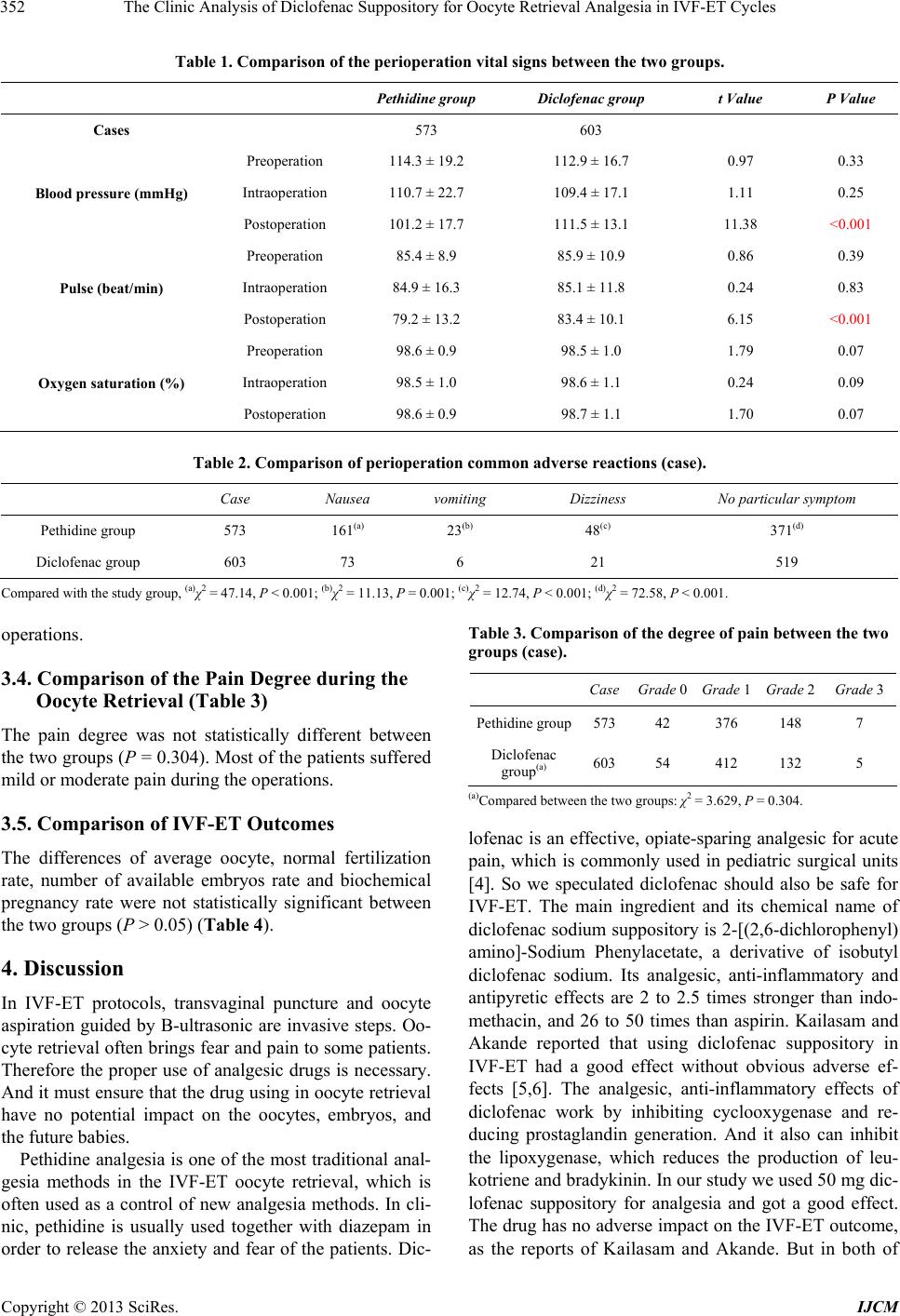 The Clinic Analysis of Diclofenac Suppository for Oocyte Retrieval Analgesia in IVF-ET Cycles Copyright © 2013 SciRes. IJCM 352 Table 1. Comparison of the perioperation vital signs between the two groups. Pethidine group Diclofenac group t Value P Value Cases 573 603 Preoperation 114.3 ± 19.2 112.9 ± 16.7 0.97 0.33 Blood pressure (mmHg) Intraoperation 110.7 ± 22.7 109.4 ± 17.1 1.11 0.25 Postoperation 101. 2 ± 17.7 111.5 ± 13.1 11.38 <0.001 Preoperation 85.4 ± 8.9 85.9 ± 10.9 0.86 0.39 Pulse (beat/min) Intraoperation 84.9 ± 16.3 85.1 ± 11.8 0.24 0.83 Postoperation 79.2 ± 13.2 83.4 ± 10.1 6.15 <0.001 Preoperation 98.6 ± 0.9 98.5 ± 1.0 1.79 0.07 Oxygen saturation (%) Intraoperation 98.5 ± 1.0 98.6 ± 1.1 0.24 0.09 Postoperation 98.6 ± 0.9 98.7 ± 1.1 1.70 0.07 Table 2. Comparison of perioperation common adverse reactions (case). Case Nausea vomiting Dizziness No particular symptom Pethidine group 573 161(a) 23(b) 48(c) 371(d) Diclofenac group 603 73 6 21 519 Compared with the study group, (a)χ2 = 47.14, P < 0.001; (b)χ2 = 11.13, P = 0. 001; (c)χ2 = 12.74, P < 0.001; (d)χ2 = 72.58, P < 0.001. operations. 3.4. Comparison of the Pain Degree during the Oocyte Retrieval (Table 3) The pain degree was not statistically different between the two groups ( P = 0.304). Most of the patients suffered mild or moderate pain during the operations. 3.5. Comparison of IVF-ET Outcomes The differences of average oocyte, normal fertilization rate, number of available embryos rate and biochemical pregnancy rate were not statistically significant between the two groups (P > 0.05) (Table 4). 4. Discussion In IVF-ET protocols, transvaginal puncture and oocyte aspiration guided by B-ultrasonic are invasive steps. Oo- cyte retrieval often brings fear and pain to some patients. Therefore the proper use of analgesic drugs is necessary. And it must ensure that the drug using in oocyte retrieval have no potential impact on the oocytes, embryos, and the future babies. Pethidine analg esia is one of the most traditional an al- gesia methods in the IVF-ET oocyte retrieval, which is often used as a control of new analgesia methods. In cli- nic, pethidine is usually used together with diazepam in order to release the anxiety and fear of the patients. Dic- Table 3. Comparison of the degree of pain between the two groups (case). CaseGrade 0 Grade 1 Grade 2Grade 3 Pethidine group573 42 376 148 7 Diclofenac group(a) 603 54 412 132 5 (a)Compared between the two groups: χ2 = 3.629, P = 0.304. lofenac is an effective, opiate-sparing analgesic for acute pain, which is commonly used in pediatric surgical units [4]. So we speculated diclofenac should also be safe for IVF-ET. The main ingredient and its chemical name of diclofenac sodium suppository is 2-[(2,6-dichlorophenyl) amino]-Sodium Phenylacetate, a derivative of isobutyl diclofenac sodium. Its analgesic, anti-inflammatory and antipyretic effects are 2 to 2.5 times stronger than indo- methacin, and 26 to 50 times than aspirin. Kailasam and Akande reported that using diclofenac suppository in IVF-ET had a good effect without obvious adverse ef- fects [5,6]. The analgesic, anti-inflammatory effects of diclofenac work by inhibiting cyclooxygenase and re- ducing prostaglandin generation. And it also can inhibit the lipoxygenase, which reduces the production of leu- kotriene and bradykinin. In our study we used 50 mg dic- lofenac suppository for analgesia and got a good effect. The drug has no adverse impact on the IVF-ET outcome, as the reports of Kailasam and Akande. But in both of 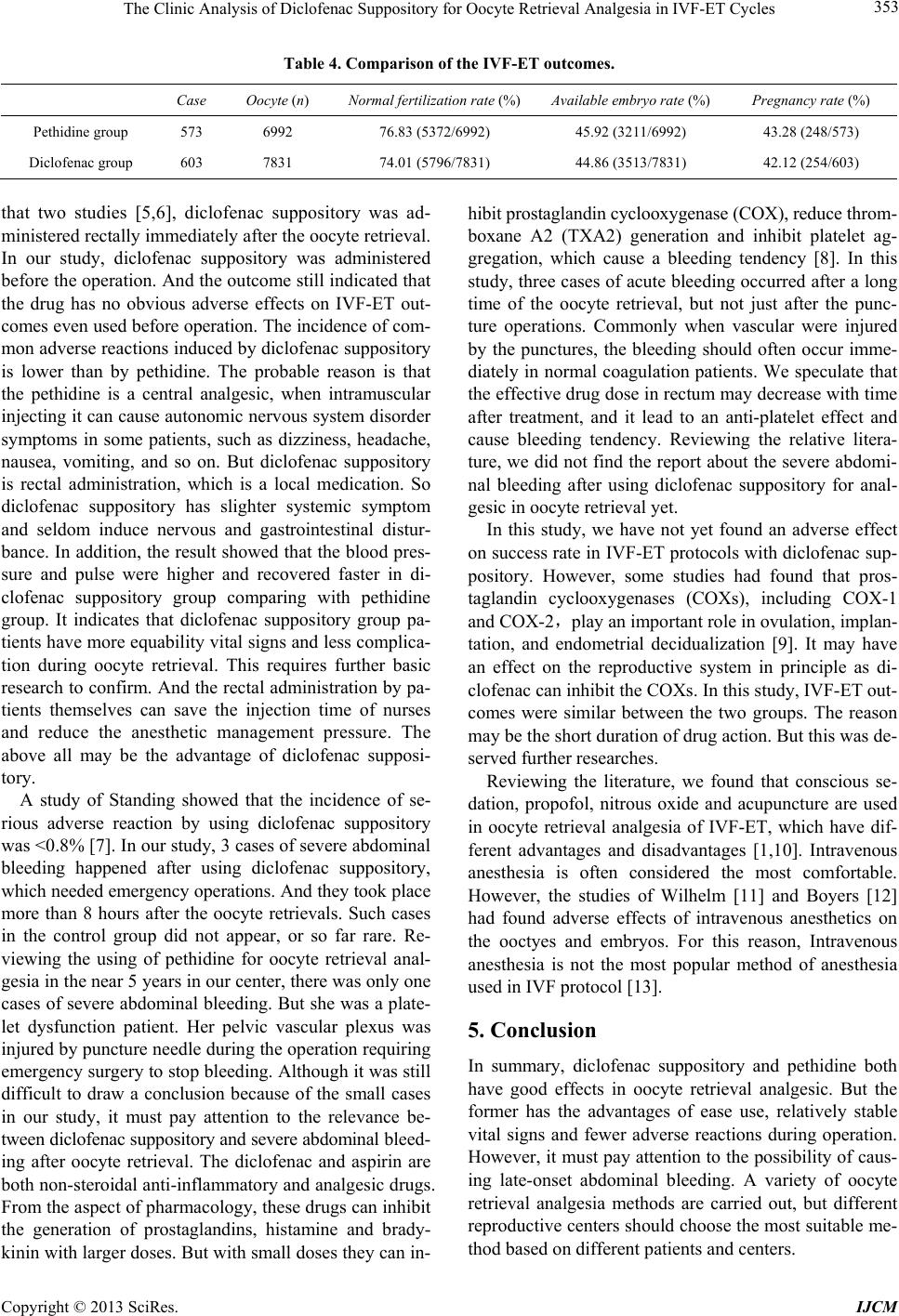 The Clinic Analysis of Diclofenac Suppository for Oocyte Retrieval Analgesia in IVF-ET Cycles 353 Table 4. Comparison of the IVF-ET outcomes. Case Oocyte (n) Normal fertilization rate (%) Available embryo rate (%) Pregnancy rate (%) Pethidine group 573 6992 76.83 (5372/69 92 ) 45.92 (3211/69 92 ) 43.28 (248/573) Diclofenac group 603 7831 74.01 (5796/78 31 ) 44.86 (3513/78 31 ) 42.12 (254/603) that two studies [5,6], diclofenac suppository was ad- ministered rectally immediately after the oocyte retrieval. In our study, diclofenac suppository was administered before the operatio n. And the outcome still i ndicated that the drug has no obvious adverse effects on IVF-ET out- comes even used before operation. The incidence of com- mon adverse reactions induced by diclofenac suppository is lower than by pethidine. The probable reason is that the pethidine is a central analgesic, when intramuscular injecting it can cause autonomic n ervous system disorder symptoms in some patients, such as dizziness, headache, nausea, vomiting, and so on. But diclofenac suppository is rectal administration, which is a local medication. So diclofenac suppository has slighter systemic symptom and seldom induce nervous and gastrointestinal distur- bance. In addition, the result showed that the blood pres- sure and pulse were higher and recovered faster in di- clofenac suppository group comparing with pethidine group. It indicates that diclofenac suppository group pa- tients have more equability vital sign s and less complica- tion during oocyte retrieval. This requires further basic research to confirm. And the rectal administration by pa- tients themselves can save the injection time of nurses and reduce the anesthetic management pressure. The above all may be the advantage of diclofenac supposi- tory. A study of Standing showed that the incidence of se- rious adverse reaction by using diclofenac suppository was <0.8 % [7]. In ou r study, 3 cases of sev ere abdominal bleeding happened after using diclofenac suppository, which needed emergency operations. And they took place more than 8 hours after the oocyte retrievals. Such cases in the control group did not appear, or so far rare. Re- viewing the using of pethidine for oocyte retrieval anal- gesia in the near 5 years in our center, there was only one cases of severe abdominal bleeding. But she was a plate- let dysfunction patient. Her pelvic vascular plexus was injured by punctu re needle du ring the oper ation requir ing emergency surgery to stop bleeding. Although it was still difficult to draw a conclusion because of the small cases in our study, it must pay attention to the relevance be- tween diclofenac suppository and severe abdominal bl e ed - ing after oocyte retrieval. The diclofenac and aspirin are both non-steroidal anti-inflammatory and analgesic drugs. From the aspect of pharmacology, these drugs can inhibit the generation of prostaglandins, histamine and brady- kinin with larger doses. But with small doses they can in- hibit prostaglandi n cy cl ooxy g e nase (C OX), r e duce throm- boxane A2 (TXA2) generation and inhibit platelet ag- gregation, which cause a bleeding tendency [8]. In this study, three cases of acute bleeding occurred after a long time of the oocyte retrieval, but not just after the punc- ture operations. Commonly when vascular were injured by the punctures, the bleeding should often occur imme- diately in normal coagulation patients. We speculate that the effective drug dose in rectum may decrease with time after treatment, and it lead to an anti-platelet effect and cause bleeding tendency. Reviewing the relative litera- ture, we d id not find the report about the severe abdomi- nal bleeding after using diclofenac suppository for anal- gesic in oocyte retrieval yet. In this study, we have not yet found an adverse effect on success rate in IVF-ET protocols with diclofenac sup- pository. However, some studies had found that pros- taglandin cyclooxygenases (COXs), including COX-1 and COX-2,play an important role in ovulation , implan- tation, and endometrial decidualization [9]. It may have an effect on the reproductive system in principle as di- clofenac can inhibit the COXs. In th is study, IVF-ET out- comes were similar between the two groups. The reason may be the short duration of drug action. But this was de- served further researches. Reviewing the literature, we found that conscious se- dation, propofol, nitrous oxide and acupuncture are used in oocyte retrieval analgesia of IVF-ET, which have dif- ferent advantages and disadvantages [1,10]. Intravenous anesthesia is often considered the most comfortable. However, the studies of Wilhelm [11] and Boyers [12] had found adverse effects of intravenous anesthetics on the ooctyes and embryos. For this reason, Intravenous anesthesia is not the most popular method of anesthesia used in IVF protocol [13]. 5. Conclusion In summary, diclofenac suppository and pethidine both have good effects in oocyte retrieval analgesic. But the former has the advantages of ease use, relatively stable vital signs and fewer adverse reactions during operation. However, it must pay attention to the possibility of caus- ing late-onset abdominal bleeding. A variety of oocyte retrieval analgesia methods are carried out, but different reproductive cen ters should choose the most suitable me- thod based on di fferent patien t s and cent ers. Copyright © 2013 SciRes. IJCM  The Clinic Analysis of Diclofenac Suppository for Oocyte Retrieval Analgesia in IVF-ET Cycles 354 6. Acknowledgements The work was supported by The National Natural Sci- ence Foundation of China (grant no. 81100470 and 81270750), The Young Teacher Training Project of Sun Yat-sen University, China (Grant No. 12ykpy24) and Na- tural Science Foundation of Guangdong Province, China (Grant No. S2012010009390). REFERENCES [1] N. F. Vlahos, I. Giannakikou, A. Vlachos and N. Vitora- tos, “Analgesia and Anesthesia for Assisted Reproductive Technologies,” International Journal of Gynecology & Obstetrics, Vol. 105, No. 3, 2009, pp. 201-205. doi:10.1016/j.ijgo.2009.01.017 [2] M. Vosoughin, S. Mohammadi and A. Dabbagh, “Intra- venous Ketamine Compared with Diclofenac Suppository in Suppressing Acute Postoperative Pain in Women Un- dergoing Gynecologic Laparoscopy,” Journal of Anesthe- sia, Vol. 26, No. 5, 2012, pp. 732-737. doi:10.1007/s00540-012-1399-1 [3] S. Mitra, P. Khandelwal and A. Sehgal, “Diclofenac-Tra- madol vs. Diclofenac-Acetaminophen Combinations for Pain Relief after Caesarean Section,” Acta Anaesthesi- ologica Scandinavica, Vol. 56, No. 6, 2012, pp. 706-711. doi:10.1111/j.1399-6576.2012.02663.x [4] J. F. Standing, D. Tibboel, R. Korpela and K. T. Olkkola, “Diclofenac Pharmacokinetic Meta-Analysis and Dose Recommendations for Surgical Pain in Children Aged 1 - 12 Years,” Pediatric Anesthesia, Vol. 21, No. 3, 2011, pp. 316-324. doi:10.1111/j.1460-9592.2010.03509.x [5] C. Kailasam, L. P. Hunt, I. Ryder, I. Bhakri and U. D. Gordon, “Safety and Effectiveness of Diclofenac Sodium in Assisted Reproduction Treatment: A Randomized Pro- spective Double-Blind Study,” Reproductive BioMedicine Online, Vol. 16, No. 5, 2008, pp. 724-729. doi:10.1016/S1472-6483(10)60488-9 [6] V. Akande, A. Garas and D. Cahill, “The Effect of Di- clofenac and Paracetamol on Pregnancy and Implantation Rates in Infertile Women Undergoing IVF Treatment,” Journal of Obstetrics and Gynaecology, Vol. 26, No. 8, 2006, pp. 785-787. doi:10.1080/01443610600984578 [7] J. F. Standing, K. Ooi, S. Keady, R. F. Howa rd, I. Savage and I. C. Wong, “Prospective Observational Study of Adverse Drug Reactions to Diclofenac in Children,” British Journal of Clinical Pharmacology, Vol. 68, No. 2, 2009, pp. 243-251. doi:10.1111/j.1365-2125.2009.03447.x [8] L. C. Hamilton, J. A. Mitchell, A. M. Tomlinson and T. D. Warner, “Synergy between Cyclo-Oxygenase-2 Induction and Arachidic Acid Supply in Vivo: Consequences for Nonsteroidal Antiinflammatory Drug Efficacy,” FASEB Journal, Vol. 13, No. 2, 1999, pp. 245-251. [9] H. Achache, A. Tsafrir, D. Prus, R. Reich and A. Revel, “Defective Endometrial Prostaglandin Synthesis Identi- fied in Patients with Repeated Implantation Failure Un- dergoing in Vitro Fertilization,” Fertility and Sterility, Vol. 94, No. 4, 2010, pp. 1271-1278. doi:10.1016/j.fertnstert.2009.07.1668 [10] A. Bokhari and B. J. Pollard, “Anaesthesia for Assisted Conception: A Survey of UK Practice,” European Jour- nal of Anaesthesiology, Vol. 16, No. 4, 1999, pp. 225- 230. [11] W. Wilhel m, M. E. Hammade h, P. F. White, T. Georg, R. Fleser and A. Biedler, “General Anesthesia versus Moni- tored Anesthesia Care with Remifentanil for Assisted Re- productive Technologies: Effect on Pregnancy Rate,” Journal of Clinical Anesthesia, Vol. 14, No. 1, 2002, pp. 1-5. doi:10.1016/S0952-8180(01)00331-2 [12] S. P. Boyers, G. Lavy , J. B. Russell and A. H. DeCherney, “A Paired Analysis of in Vitro Fertilization and Cleavage Rates of First- versus Last-Recovered Preovulatory Hu- man Oocytes Exposed to Varying Intervals of 100% CO2 Pneumoperitoneum and General Anesthesia,” Fertility and Sterility, Vol. 48, No. 6, 1987, pp. 969-974. [13] P. O. Fiebai, A. A. Ogunmokun and R. A. Ajayi, “Ex- perience with Conscious Sedation for Oocyte Retrieval in Nigeria,” African Journal of Reproductive Health, Vol. 12, No. 1, 2008, pp. 30-34. Copyright © 2013 SciRes. IJCM |