

Paper Menu >>
Journal Menu >>
 Journal of Cancer Therapy, 2013, 4, 1095-1099 http://dx.doi.org/10.4236/jct.2013.46126 Published Online August 2013 (http://www.scirp.org/journal/jct) 1095 Topotecan Use for Second-Line Treatment in Patients with Recurrent or Metastatic Cervical Cancer at Brazilian National Cancer Institute (INCA)* Leandro Nascimento de Oliveira#, Flávia Vieira Guerra Alves, Paulo Alexandre Ribeiro Mora, Claudio Calazan do Carmo, Angélica Nogueira-Rodrigues, Alvaro Henrique Ingles Garces†, Andréia Cristina de Melo Instituto Nacional do Câncer, Hospital do Câncer II, Rio de Janeiro-RJ, Brazil. Email: †[email protected] Received March 17th, 2013; revised April 20th, 2013; accepted April 30th, 2013 Copyright © 2013 Leandro Nascimento de Oliveira et al. This is an open access article distributed under the Creative Commons At- tribution License, which permits unrestricted use, distribution, and reproduction in any medium, provided the original work is prop- erly cited. ABSTRACT Objective: Cervical cancer represents the third most commonly diagnosed cancer and is an important cause of death for women suffering with malignancies. Patients who are refractory or progressed after first-line palliative treatment have a dismal prognosis and no secon d-line chemotherapy is con sidered standard so far. Several agents h ave been investigated in this setting and topotecan is one of the most characterized. The objectiv e of this study was to evaluate response rate (RR), progression-free survival (PFS), overall survival (OS) and toxicity of topotecan in second palliative line for cer- vical cancer. Methods: An analysis was performed of all patients with recurrent or metastatic cervical cancer treated with topotecan in second palliative line at Brazilian National Canc er Institute, between 2008 and 2010. Results: A to tal of 73 courses of topotecan were given in the current study (median: 3.5 cycles; range 1 - 6). Anemia was the most fre- quent adverse event (grade 2:35%; grade 3:30%). Of the 20 patients evaluable, there were 2 partial responders to the treatment. The overall response rate (ORR) was 10%; 3 patients (15%) had stable disease as maximum response. The median PFS for the entire group was 2.93 months (95% CI 2.41 - 3.45) and OS was 4.66 months (95% CI 1.21 - 8.11). Conclusion: The limited activity of topotecan schemas in second-line treatment of cervical cancer and the associated overall toxicity may not justify their use in this setting. Patients who progress after first-line treatment may be offered participation in clinical trials, other second-line agents or best supportive care measures. Keywords: Topotecan; Cervical Cancer; Palliative Treatment 1. Introduction Cervical cancer represents the third most commonly di- agnosed cancer [1] and is an important cause of death for women suffering with malignancies; one-third of patients initially treated for early and locally advanced cervical cancer will die due to local or systemic relapse [2]. The 5-year survival rates for patients with locally advanced or distant cervical cancer are 49% and 15% respectively [3] and in accordance to literature the mortality rate in those pa- tients has re mained u nch anged o ver the past 25 years [4]. Palliative systemic chemotherapy, usually including platinum-based regimens, is the best option for patients who have relapsed after primary surgery or cisplatin- based chemoradiation, not amenable for curative treat- ment, and for those staging IVB at the initial diagnosis; however, the results for the majority of them are disap- pointing. Patients who are refractory or progressed after first-line palliative treatment have a dismal prognosis with infrequent responses and no second-line chemo- therapy is considered standard so far. The treatment usu- ally focuses on symptoms palliation and g ains in survival when feasible. *Authors’ disclosures of potential conflicts of interest: The authors in- dicated no potential conflicts of interest. #in memor ian. †Corresponding a uthor. Several agents have been investigated in this setting and topotecan is one of the most characterized. In vitro experiments have shown significant antineoplasic activ- Copyright © 2013 SciRes. JCT  Topotecan Use for Second-Line Treatment in Patients with Recurrent or Metastatic Cervical Cancer at Brazilian National Cancer Institute (INCA) 1096 ity in squamous cell lines of cervical cancer with topo- tecan alone as well as an increase in cytotoxicity when used in combination with cisplatin [5]. To date, the use of topotecan as second-line or third- line therapy in patients with cervical cancer has been studied in five phase II trials. The first study [6] administered intravenously topo- tecan at a dose of 1.2 mg/m2 per day during 5 consecu- tive days, on a 28-day cycle and included 22 patients with squamous cell carcinoma (SCC) or adenocarcinoma who had received prior chemotherapy (1 or 2 regimens). Eighteen patients were evaluated for efficacy with partial response (PR) in 16.6 % and stable disease (SD) in 33.3% of the patients. All 3 PR cases were diagnosed as SCC. The second trial, GOG 127-F [7 ], was restricted to pa- tients with advanced, recurrent or metastatic squamous cell carcinomas; one prior chemotherapy, usually plati- num-based, was allowed for metastatic disease. Patients received topotecan at 1.5 mg/m2 per day for 5 days on 21-day cycle. Thirty-four out of 45 patients who were included had received prior chemotherapy. Forty patients were evaluable for response-complete response (CR) in 2.5%, PR in 10% and SD in 37.5%. The median progres- sion-free interval (PFI) was 2.1 months with a median overall survival (OS) of 6.6 months. The third study [8] employed topotecan at a regimen of 1.0 mg/m2 per day during 5 consecutive days, every 21 days. Twelve patients with SCC or adenocarcinoma were treated, 7 of them received topotecan as second-line chemot h er ap y treatment. The re w er e 2 P R ( 16.7%). The fourth phase II [2] trial have demonstrated that an alternative schedule of weekly topotecan at 3.0 mg/m2 (maximum 5.0 mg/dose) administered at days 1, 8 and 15 on 28-day cycles as second or third-line treatment in pa- tients with recurrent or metastatic cervical cancer is safe and well tolerated. Twenty-two patients entered this study and 18 were evaluable for response; no CR or PR were observed and 27.7% of patients exhibited SD as the best response. Median PFI was 3.5 months and median OS was 7.0 months. Finally, the fifth was the GOG 127-U trial [4] evaluat- ing weekly topotecan as a single agent in second-line therapy in persistent or recurrent cervical carcinoma. Topotecan was administered at a dose 3.0 mg/m2, re- peated every 7 days for 21 days followed by a seven-day recovery, cycles were defined as a 28-day period. Twenty- five patients were evaluable and none responded to the treatment, 40% had SD. The median progression-free survival (PFS) was 2 .4 months. The main toxicity related to topotecan treatment is myelosuppresion with high incidence of grade 3 and 4 hematologic events and weekly schemes have remarka- bly proven to ameliorate hematologic toxicity. Nonhe- matologic toxicity is manageable, generally mild, not dose- limiting and does not present a dominant pattern. Herein, the experience of topotecan use for second-line treatment in patients with recurrent or metastatic cervical cancer at Brazilian National Cancer Institute is reported. 2. Material and Methods 2.1. Patient Selection and Data Collection This study was approved by the Ethics in Human Re- search Committee of the Brazilian National Cancer In- stitute (INCA), Rio de Janeiro, Brazil and conducted in accordance with the Declaration of Helsinki and Good Clinical Practice guidelines. In order to evaluate RR, PFS, OS and toxicity, an analysis of all cervical cancer patients treated with topo- tecan in second palliative line at INCA, between 2008 and 2010, was performed. Patients were identified through internal database and must have received one previous chemotherapy line for the treatment of incurable disease. Clinical data including demographics, stage, histology, previous th erapies and the toxicity related with topotecan therapy were retrospectively collected by medical re- cords review. Response was determined by physical examination and predominantly by repeated imaging studies. Re- sponse was defined as follows: complete response (CR), partial response (PR), progressive disease (PD) and sta- ble disease (SD). The radiological evaluation was based on the Response Evaluation Criteria in Solid Tumors (RECIST) v ersion 1.0. Adverse events were supposed to be assessed every cycle using the National Cancer Institute Common Tox- icity Criteria (NCI CTCAE), version 3.0. Before the first cycle of topotecan, patients had a com- plete medical history and physical examination, docu- mentation of disease progression after or during the first palliative line and laboratory assessment. Prior to each cycle patients had a medical evaluation including adverse events, complete blood count and chemistry panel. Im- aging studies were performed in a frequency according to physicians’ dis c ret i on. 2.2. Treatment A variety of topotecan schedules were prescribed (0.75 mg/ m2 per day during 5 consecutive days to 2.0 mg/m2 per day during 3 consecutive days, every 21 days or weekly topotecan at 3.0 mg/m2 administered at days 1, 8 and 15 on 28-day cycles) in an outpatient setting with cycles repeated until disease progression, prohibitive toxicity or patient refusal for further therapy. Premedica- tion and discharge prescription were in accordance to the guidelines of the Institution. Regimen selection, dose Copyright © 2013 SciRes. JCT 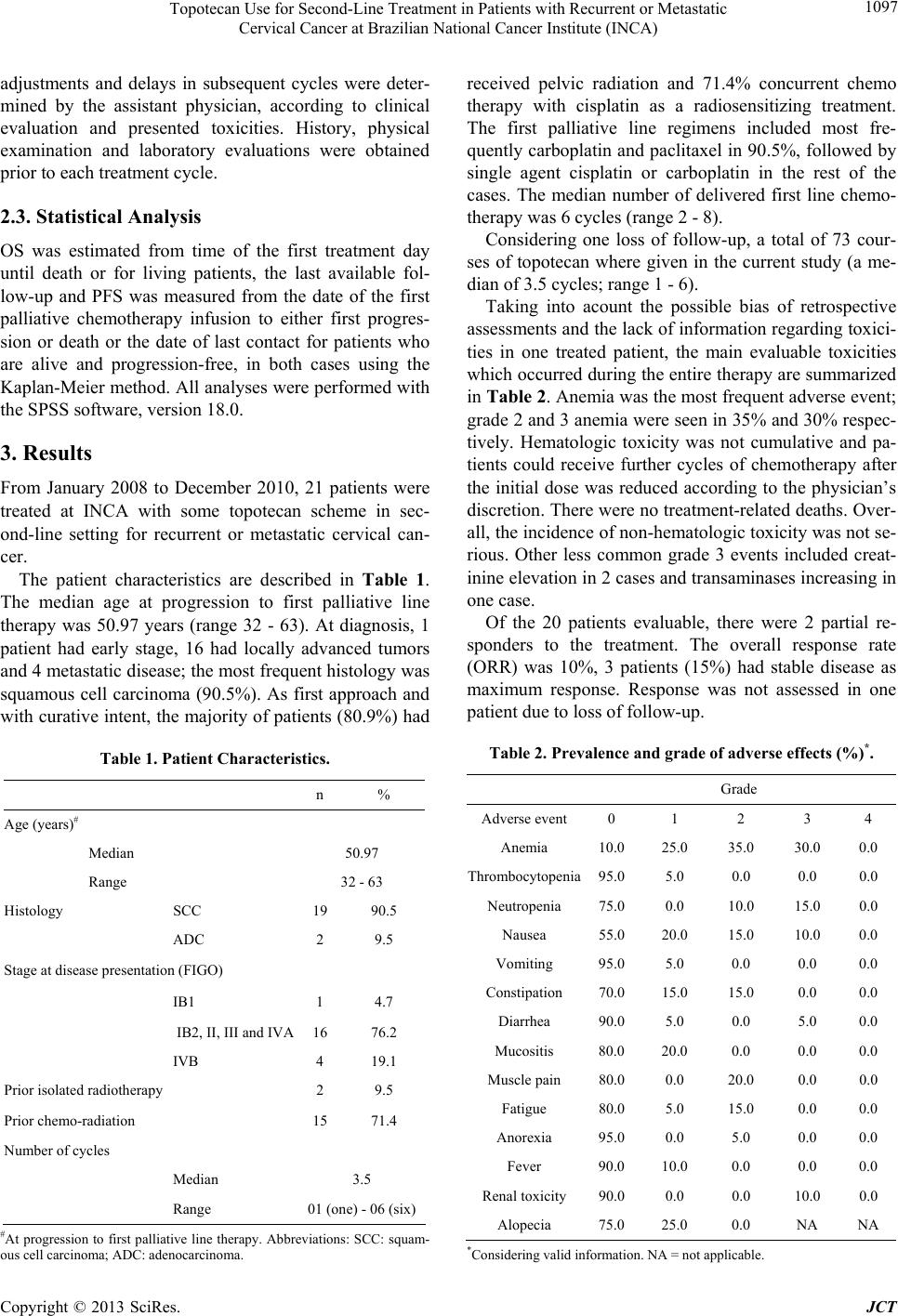 Topotecan Use for Second-Line Treatment in Patients with Recurrent or Metastatic Cervical Cancer at Brazilian National Cancer Institute (INCA) 1097 adjustments and delays in subsequent cycles were deter- mined by the assistant physician, according to clinical evaluation and presented toxicities. History, physical examination and laboratory evaluations were obtained prior to each treatment cycle. 2.3. Statistical Analysis OS was estimated from time of the first treatment day until death or for living patients, the last available fol- low-up and PFS was measured from the date of the first palliative chemotherapy infusion to either first progres- sion or death or the date of last contact for patients who are alive and progression-free, in both cases using the Kaplan-Meier method. All analyses were performed with the SPSS software, version 18.0. 3. Results From January 2008 to December 2010, 21 patients were treated at INCA with some topotecan scheme in sec- ond-line setting for recurrent or metastatic cervical can- cer. The patient characteristics are described in Table 1. The median age at progression to first palliative line therapy was 50.97 years (range 32 - 63). At diagnosis, 1 patient had early stage, 16 had locally advanced tumors and 4 metastatic disease; the most frequent histology was squamous cell carcinoma (90.5%). As first approach and with curative intent, the major ity of patients (80.9%) had Table 1. Patient Characteristics. n % Age (years)# Median 50.97 Range 32 - 63 Histology SCC 19 90.5 ADC 2 9.5 Stage at disease presentation (FIGO) IB1 1 4.7 IB2, II, III and IVA 16 76.2 IVB 4 19.1 Prior isolated radiotherapy 2 9.5 Prior chemo-radiation 15 71.4 Number of cycles Median 3.5 Range 01 (one) - 06 (six) #At progression to first palliative line therapy. Abbreviations: SCC: squam- ous cell carcinoma; ADC: adenocarcinoma. received pelvic radiation and 71.4% concurrent chemo therapy with cisplatin as a radiosensitizing treatment. The first palliative line regimens included most fre- quently carboplatin and paclitaxel in 90.5%, fo llowed by single agent cisplatin or carboplatin in the rest of the cases. The median number of delivered first line chemo- therapy was 6 cycles (range 2 - 8). Considering one loss of follow-up, a total of 73 cour- ses of topotecan where given in the current study (a me- dian of 3.5 cycles; range 1 - 6). Taking into acount the possible bias of retrospective assessments and the lack of information regarding toxici- ties in one treated patient, the main evaluable toxicities which occurred during the entire therapy are summarized in Table 2. Anemia was the most frequent adverse event; grade 2 and 3 anemia were seen in 35% and 30% resp ec- tively. Hematologic toxicity was not cumulative and pa- tients could receive further cycles of chemotherapy after the initial dose was reduced according to the physician’s discretion. There were no treatment-related death s. Over- all, the incidence of non-hematologic toxicity was not se- rious. Other less common grade 3 events included creat- inine elevation in 2 cases and transaminases increasing in one case. Of the 20 patients evaluable, there were 2 partial re- sponders to the treatment. The overall response rate (ORR) was 10%, 3 patients (15%) had stable disease as maximum response. Response was not assessed in one patient due to loss of follow-up . Table 2. Prevalence and grade of adverse effects (%)*. Grade Adverse event0 1 2 3 4 Anemia 10.0 25.0 35.0 30.0 0.0 Thrombocytopenia95.0 5.0 0.0 0.0 0.0 Neutropenia 75.0 0.0 10.0 15.0 0.0 Nausea 55.0 20.0 15.0 10.0 0.0 Vomiting 95.0 5.0 0.0 0.0 0.0 Constipation 70.0 15.0 15.0 0.0 0.0 Diarrhea 90.0 5.0 0.0 5.0 0.0 Mucositis 80.0 20.0 0.0 0.0 0.0 Muscle pain 80.0 0.0 20.0 0.0 0.0 Fatigue 80.0 5.0 15.0 0.0 0.0 Anorexia 95.0 0.0 5.0 0.0 0.0 Fever 90.0 10.0 0.0 0.0 0.0 Renal toxicity 90.0 0.0 0.0 10.0 0.0 Alopecia 75.0 25.0 0.0 NA NA *Considerin g valid information. NA = not applicable. Copyright © 2013 SciRes. JCT  Topotecan Use for Second-Line Treatment in Patients with Recurrent or Metastatic Cervical Cancer at Brazilian National Cancer Institute (INCA) 1098 The median PFS for the entire group was 2.93 months (95% CI 2.41 - 3.45) and OS was 4.66 months (95% CI 1.21 - 8.11). 4. Discussion The combination of paclitaxel and cisplatin (or carbo- platin alternatively) is a worldwide current first choice for systemic treatment in advanced and persistent/recur- rent cervical cancer not amenable to curative therapy with an overall response rate of 36% [9]. Patients who have progressed after platinum-based therapy may be treated with second-line schemas, included in clinical studies or receive best supportive care measures. A variety of second-line agents have been tested in this scenario [10-12] and the efficacy is rather modest. Topo- tecan is one of the cytotoxic options that had been inves- tigated for antineoplastic activity in a small number of trials. The heterogeneity of patients accrued in these studies render it impossible to compare results among them. It seems that topotecan, as a single agent or in combination, exihibits only modest activity in a popula- tion of previously treated patients with cervical cancer albeit at a cost of substantial hematologic toxicity [11]. There is clearly an unmet need for active new thera- pies in the management of advanced cervical cancer. The poor outcome for these patients warrants the develop- ment of novel therapeutic strategies that exploit abnormal tumor biology. Some targeted drugs modulating different signal trans- duction pathways are currently under clinical develop- ment inhibiting angiogenesis, targeting epidermal gro wth factor receptor (EGFR), cell cycle, matrix metallopro- teinases, cyclooxygenase-2, mammalian target of rapa- mycin (mTOR) or proteasome, evaluating efficacy and safety [11-13]. However, no phase III trials have been published and consequently no molecularly targeted agents have been approved for use in clinical practice. The limited activity of topotecan schemas in second- line treatment of cervical cancer and the associated over- all toxicity as shown in this retrospective study may not justify their use in this settin g. Patients who progress after first-line treatment may be offered participation in clini- cal trials, other second-line agents or best supportive care measures. REFERENCES [1] J. Ferlay, H. R. Shin, F. Bray , D. Forman, C. Mathers and D. M. Parkinm “GLOBOCAN 2008 v2.0, Cancer Inci- dence and Mortality Worldwide: IARC Cancer Base No. 10,” International Agency for Research on Cancer, Lyon, 2010. http://globocan.iarc.fr [2] J. Coronel, L. Cetina, M. Candelaria, A. González-Fierro, D. Arias, D. Cantu, et al., “Weekly Topotecan as Second- or Third-Line Treatment in Patients with Recurrent or Metastatic Cervical Cancer,” Medical Oncology, Vol. 26, No. 2, 2009, pp. 210-214. doi:10.1007/s12032-008-9108-5 [3] L. A. G. Ries, M. P. Eisner, C. L. Kosary, B. F. Hankey, B. A. Miller, L. Clegg, et al., “SEER Cancer Statistics Review, 1973-1998,” National Cancer Institute, Bethesda, 2012. http://seer.cancer.gov/Publications/CSR1973_1998/2001 [4] J. V. Fiorica, J. A. Blessing, L. V. Puneky , A. A. Se cord, J. S. Hoffman, S. D. Yamada, et al., “A Phase II Evalua- tion of Weekly Topotecan as a Single Agent Second Line Therapy in Persistent or Recurrent Carcinoma of the Cer- vix: A Gynecologic Oncology Group Study,” Gyneco- logic Oncology, Vol. 115, No. 2, 2009, pp. 285-289. doi:10.1016/j.ygyno.2009.07.024 [5] P. Boabang, C. M. Kurbacher, H. Kohlhagen, A. Waida and B. K. Amo-Takyi, “Anti-Neoplastic Activity of Topo- tecan versus Cisplatin, Etoposide and Paclitaxel in Four Squamous Cell Cancer Cell Lines of the Female Genital Tract Using an ATP-Tumor Chemosensitivity Assay ,” An- ticancer Drugs, Vol. 11, No. 10, 2000, pp. 843-848. [6] K. Noda, H. Sasaki, K. Yamamoto, T. Yamamoto, R. Nishimura, T. Sugiyama, et al., “Phase II Trial of Topo- tecan for Cervical Cancer of the Uterus,” Proceedings of the American Society of Clinical Oncologists, Vol. 15, 1996, p. 754. [7] M. A. Bookman, J. A. Blessing, P. Hanjani, T. J. Herzog and W. A. Andersen, “Topotecan in Squamous Cell Car- cinoma of the Cervix: A Phase II Study of the Gyneco- logic Oncology Group,” Gynecologic Oncology, Vol. 77, No. 3, 2000, pp. 446-449. doi:10.1006/gyno.2000.5807 [8] N. R. Abu-Rustum, S. Lee and L. S. Massad, “Topotecan for Recurrent Cervical Cancer after Platinum-Based Ther- apy,” International Journal of Gynecological Cancer, Vol. 10, No. 4, 2000, pp. 285-288. doi:10.1046/j.1525-1438.2000.010004285.x [9] D. H. Moore, J. A. Blessing, R. P. McQuellon, H. T. Thaler, D. Cella, J. Benda, et al., “Phase III Study of Cis- platin with or without Paclitaxel in Stage IVB, Recurrent, or Persistent Squamous Cell Carcinoma of the Cervix: A Gynecologic Oncology Group Study,” Journal of Clinical Oncology, Vol. 22, No. 15, 2004, pp. 3113-3119. [10] H. J. Long III., “Management of Metastatic Cervical Can- cer: Review of the Literature,” Journal of Clinical On- cology, Vol. 25, No. 20, 2007, pp. 2966-2974. [11] F. Zagouri, T. N. Sergentanis, D. Chrysikos, M. Filipits and R. Bartsch, “Molecularly Targeted Therapies in Cer- vical Cancer. A Systematic Review,” Gynecologic Onco- logy, Vol. 126, No. 2, 2012, pp. 291-303. doi:10.1016/j.ygyno.2012.04.007 [12] B. J. Monk, M. W. Sill, R. A. Burger, H. J. Gray, T. E. Buekers and L. D. Roman, “Phase II Trial of Bevacizu- mab in the Treatment of Persistent or Recurrent Squa- mous Cell Carcinoma of the Cervix: A Gynecologic On- cology Group Study,” Journal of Clinical Oncology, Vol. 27, No. 7, 2009, pp. 1069-1074. doi:10.1200/JCO.2008.18.9043 Copyright © 2013 SciRes. JCT  Topotecan Use for Second-Line Treatment in Patients with Recurrent or Metastatic Cervical Cancer at Brazilian National Cancer Institute (INCA) Copyright © 2013 SciRes. JCT 1099 [13] A. Nogueira-Rodrigues, C. C. Carmo, C. Viegas, F. Er- lich, C. Cami são, K. Fo ntão , et al., “Phase I Trial of Erlo- tinib Combined with Cisplatin and Radiotherapy for Pa- tients with Locally Advanced Cervical Squamous Cell Cancer,” Clinical Cancer Research, Vol. 14, No. 19, 2008, pp. 6324-6329. doi:10.1158/1078-0432.CCR-07-5112 |