

Paper Menu >>
Journal Menu >>
 Psychology 2013. Vol.4, No.8, 619-621 Published Online August 2013 in SciRes (http://www.scirp.org/journal/psych) http://dx.doi.org/10.4236/psych.2013.48088 Copyright © 2013 SciRes. 619 Social Inhibition of Vection* Takeharu Seno1,2,3 1Faculty of Design, Kyushu Unive rsity, Fukuoka, Japan 2Institute for Advanced Study, Kyushu University, F u kuoka, Japan 3Research Center for Appli ed Perceptual Science, Kyushu University, Fukuoka, Jap a n Email: [email protected] Received May 31st, 2013; revised Ju ne 29th, 2013; accepted July 15th, 2013 Copyright © 2013 Takeharu Seno. This is an open access article distributed under the Creative Commons Attri- bution License, which permits unrestricted use, distribution, and reproduction in any medium, provided the original work is properly cited. The purpose of this study was to examine whether the social interaction can affect vection strength. We compared the strength of self-motion perception (vection) with and without an audience (two people in addition to the participant) present during stimulus presentation. We presented the optical flow (dots’ ex- pansion) for 40 seconds and obtained vection duration and latency and we also obtained the subjective strength of vection via magnitude estimation. We found that vection was inhibited by the presence of an audience. We speculate that audience presence might distract the attention of participants from the vection, depriving them of the attentional resources inhibited vection. Keywords: Vection; Social Inhibition; Audience Introduction Self-motion perception as determined solely by visual cues is called “vection” (e.g. Fischer & Kornmüller, 1930). Stimulus attributes for the effective induction of vection have been ex- tensively studied (Seno et al., 2009). Relationships between vection and attention (Seno et al., 2011a), time perception (Seno et al., 20011b), memory (Seno et al., 2013), the effect of alcohol consumption (Seno & Nakamura, in press), cognitive bias (Palmisano & Chan, 2004) and quantity perception (Seno et al., 2011c) have also been reported, as well as relationships between vection and multiple modalities (e.g. Riecke et al., 2009), personality attributes of observers (Seno et al., 2011d), and aging and development (Haibach et al., 2009; Shirai et al, 2012). Furthermore vection enhanced a type of visual illusion (Fukuda & Seno, 2012) and the semantic meaning could affect vection strength (Seno & Fukuda, 2012). Multiple aspects of the human mind are involved in vection. One important issue that has not been addressed is the impact of social psychologi- cal factors on vection. We focused on social facilitation and inhibition of vection. An “audience effect” has been established in the field of so- cial psychology (Travis, 1925), in which the existence of an audience can facilitate or inhibit the performance of a partici- pant. Even when the presence of an audience is not logically related to the execution of a task, audience presence can modu- late the performance of a participant. In most cases, the domi- nant task outcome is facilitated by the presence of an audience, and the non-dominant task outcome is inhibited (review in Za- jonc, 1965). It has been also reported that arousal levels are increased by audience presence (Mason & Brady, 1964). Con- sidering previous studies, we predicted that vection could be modulated by audience presence. In our previous vection stud- ies, vection was reported in 70% of all stimulus presentation period (Seno et al., 2011a, 2011b, 2011c, 2011d), and was thus the dominant task outcome. We predicted that perception of vection would be facilitated and that the duration of vection would be elongated by audience presence. In this case, our study would be the first to report that the perception of vection can be altered by social context. Method Participants Eleven adult volunteers participated in the experiment. The volunteers were either graduate or undergraduate students (7 females and 4 males; aged 20 to 25 years) with no reported visual or vestibular abnormalities. They previously attended some vection experiments. Thus the task of reporting vection was easy and accustomed task for them. Apparatus Stimuli were generated and controlled by a computer (MB543J/A, Apple) and presented on a plasma display (3D Viera, 50-inch, Panasonic, with 1024 × 768 pixel resolution at a 60 Hz refresh rate). The experiment was conducted in a dark chamber. Stimuli We used an expanding optical flow pattern, which was cre- ated by positioning 16,000 dots at random inside a simulated cube and moving the observer’s viewpoint to simulate a for- ward self-motion of 16 m/s. The stimuli were identical to those used by Seno et al. (2010), and the duration of the stimulus was *The author was supported by Funds for the Development of Human Re- sources in Science and Technology (Japan Science and Technology Agency) This work is supported by Program to Disseminate Tenure Tracking System, MEXT, Japan. 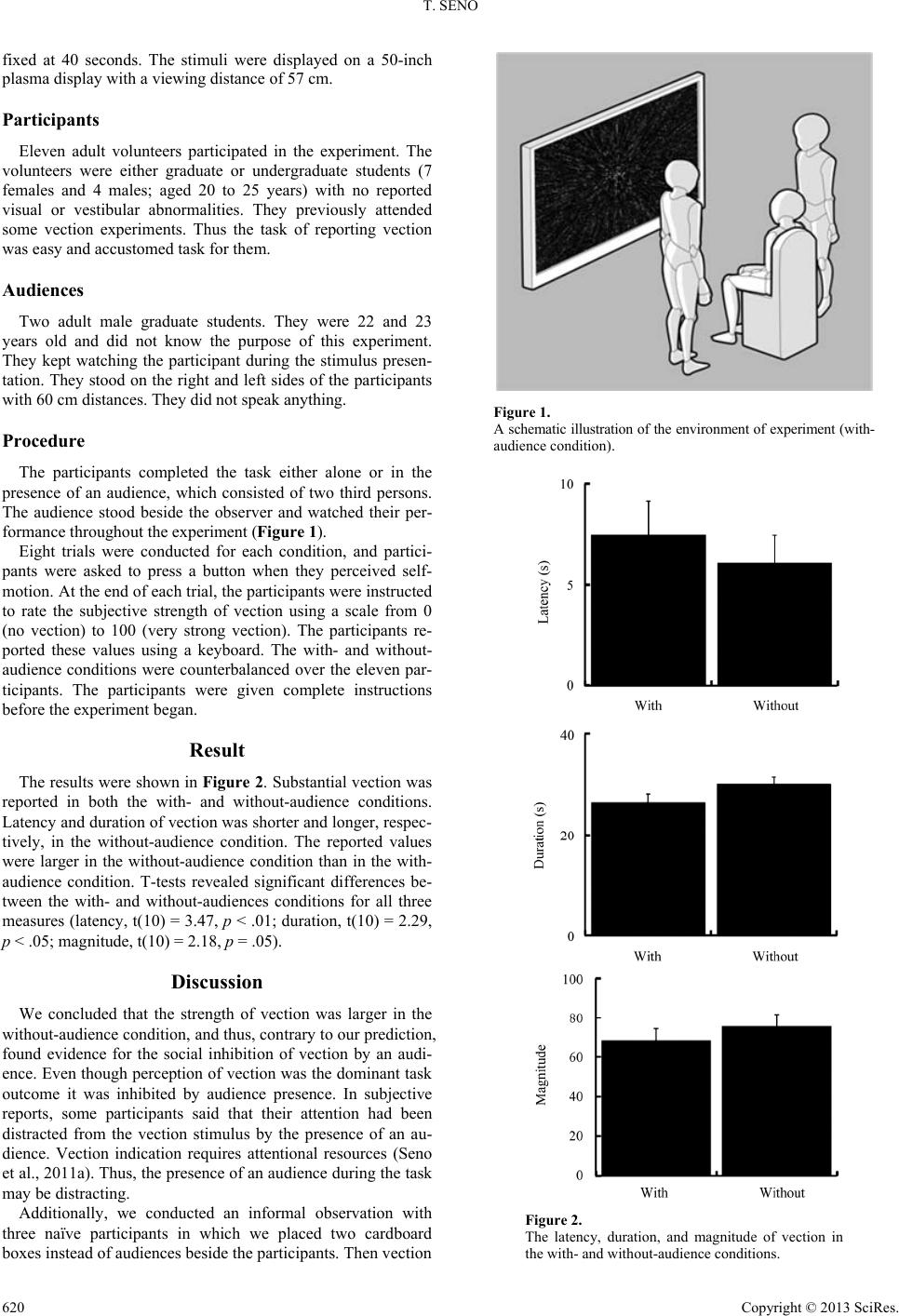 T. SENO fixed at 40 seconds. The stimuli were displayed on a 50-inch plasma display with a viewing distance of 57 cm. Participants Eleven adult volunteers participated in the experiment. The volunteers were either graduate or undergraduate students (7 females and 4 males; aged 20 to 25 years) with no reported visual or vestibular abnormalities. They previously attended some vection experiments. Thus the task of reporting vection was easy and accustomed task for them. Audiences Two adult male graduate students. They were 22 and 23 years old and did not know the purpose of this experiment. They kept watching the participant during the stimulus presen- tation. They stood on the right and left sides of the participants with 60 cm distances. They did not speak anything. Procedure The participants completed the task either alone or in the presence of an audience, which consisted of two third persons. The audience stood beside the observer and watched their per- formance througho ut the experiment (Figure 1). Eight trials were conducted for each condition, and partici- pants were asked to press a button when they perceived self- motion. At the end of each trial, the participants were instructed to rate the subjective strength of vection using a scale from 0 (no vection) to 100 (very strong vection). The participants re- ported these values using a keyboard. The with- and without- audience conditions were counterbalanced over the eleven par- ticipants. The participants were given complete instructions before the experiment began. Result The results were shown in Figure 2. Substantial vection was reported in both the with- and without-audience conditions. Latency and duration of vection was shorter and longer, respec- tively, in the without-audience condition. The reported values were larger in the without-audience condition than in the with- audience condition. T-tests revealed significant differences be- tween the with- and without-audiences conditions for all three measures (latency, t(10) = 3.47, p < .01; duration, t(10) = 2.29, p < .05; magnitude, t(10 ) = 2.18, p = .05). Discussion We concluded that the strength of vection was larger in the without-audience condition, and thus, contrary to our prediction, found evidence for the social inhibition of vection by an audi- ence. Even though perception of vection was the dominant task outcome it was inhibited by audience presence. In subjective reports, some participants said that their attention had been distracted from the vection stimulus by the presence of an au- dience. Vection indication requires attentional resources (Seno et al., 2011a). Thus, the presence of an audience during the task may be distract in g. Additionally, we conducted an informal observation with three naïve participants in which we placed two cardboard boxes instead of audiences beside the participants. Then vection Figure 1. A schematic illust ration of the enviro nment of experiment (with- audience condition). Figure 2. The latency, duration, and magnitude of vection in the with- and without-audience c o n ditions. Copyright © 2013 SciRes. 620  T. SENO Copyright © 2013 SciRes. 621 strength was not changed in that condition. Thus the effect of being things was not obtained. The audience of human was the critical factor for inhibition of vection. We also should consider the gender effect of the audience. In this study, we employed two male audiences. In the future study, all variations of male and female audiences should be examined. We examined only the case of two male audiences. This was the limitation of our study, we should note. In future, further examination of various types of audiences should be examined. We conclude that, social context (presence of an audience) can affect vection strength. This could be an important demon- stration of an instance in which social context can alter percep- tion, although further research is necessary to clarify this rela- tionship. REFERENCES Fukuda, H., & Seno, T. (2012). Healin’ Groovy: Movement affects the appearance of the Healing Grid Illusion. P erception, 41, 243-246. doi:10.1068/p7132 Haibach, P., Slobounov, S., & Newell, K. (2009). Egomotion and vec- tion in young and elderly adults. Gerontology, 55, 637-643. doi:10.1159/000235816 Latane, B., Williams, K., & Harkins, S. (1979). Many hands make light the worker: Causes and consequences of social loafing. Journal of Personality and Social Psychology, 37, 822-832. doi:10.1037/0022-3514.37.6.822 Mason, J. W., & Brady, J. V. (1964). The sensitivity of psycho endo- crine system to social and physical environ ment. In P. H. Leiderman, & D. Shapiro (Eds.), Psychob io lo g ic al ap pr oaches to social behavior. Stanford: Stanford University Press. Palmisano, S., & Chan, A. Y. C. (2004). Jitter and size effects on vec- tion are immune to experimental instructions and demands. Percep- tion, 33, 987-1000. doi:10.1068/p5242 Riecke, B. E., Valjamae, A., & Schulte-Pelkum, J. (2009). Moving sounds enhance the visually-induced self-motion illusion (circular vection) in virtual reality. ACM Transactions on Applied Perception (TAP), 6, Article 7. doi:10.1145/1498700.1498701 Seno T., & Nakamura S. (in Press) Alcohol consumption enhances vection. Perception. Seno, T., & Fukuda H. (2012) Stimulus meanings alter illusory self- motion (vection). Experimental examination of the train illusion. Seeing & Perceiving, 25, 631-645. doi:10.1163/18784763-00002394 Seno, T., Ito, H., & Sunaga, S. (2009). The object and background hypothesis for vection. Vi sion Research, 49, 2973-2982. doi:10.1016/j.visres.2009.09.017 Seno, T., Ito, H., & Sunaga, S. (2011b). Self-motion perception com- presses time experienced in return travel. Perception, 40, 497-499. doi:10.1068/p6885 Seno, T., Ito, H., & Sunaga, S. (2010). Vection after-effect from ex- panding/contracting stimuli. Seeing & Perceiving, 23, 273-294. doi:10.1163/187847510X532667 Seno, T., Ito, H., & Sunaga, S. (2011a). Attentional load inhibits vec- tion. Attention, Perception & Psychophysics, 73, 1467-1476. doi:10.3758/s13414-011-0129-3 Seno, T., Kawabe T., Ito H., & Sunaga, S. (2013) Vection modulates emotional valence of autobiographical episodic memories. Cognition, 126, 115-120. doi:10.1016/j.cognition.2012.08.009 Seno, T., Taya, S., Ito, H., & Sunaga, S. (2011c). Mental number line in depth revealed by vection. Perception, 40, 1241-1244. doi:10.1068/p6965 Seno, T., Yamada, Y., & Ihaya, K. (2011d) Narcissistic people cannot be moved easily by visual stimulation. Perception, 40, 1390-1392. doi:10.1068/p7062 Shirai, N., Seno, T., & Morohashi, S. (2012). More rapid and stronger vection can occur in elementary school children than in adults. Per- ception, 41, 1399-1402. doi:10.1068/p7251 Travis, L. E. (1925). The effect of a small audience upon eye-hand coordination. Jour na l o f Abnormal Social Psychology, 20, 142-146. doi:10.1037/h0071311 Zajonc, R. B. (1965). Social facilitation. Science, 149, 269-274. doi:10.1126/science.149.3681.269 |