

Paper Menu >>
Journal Menu >>
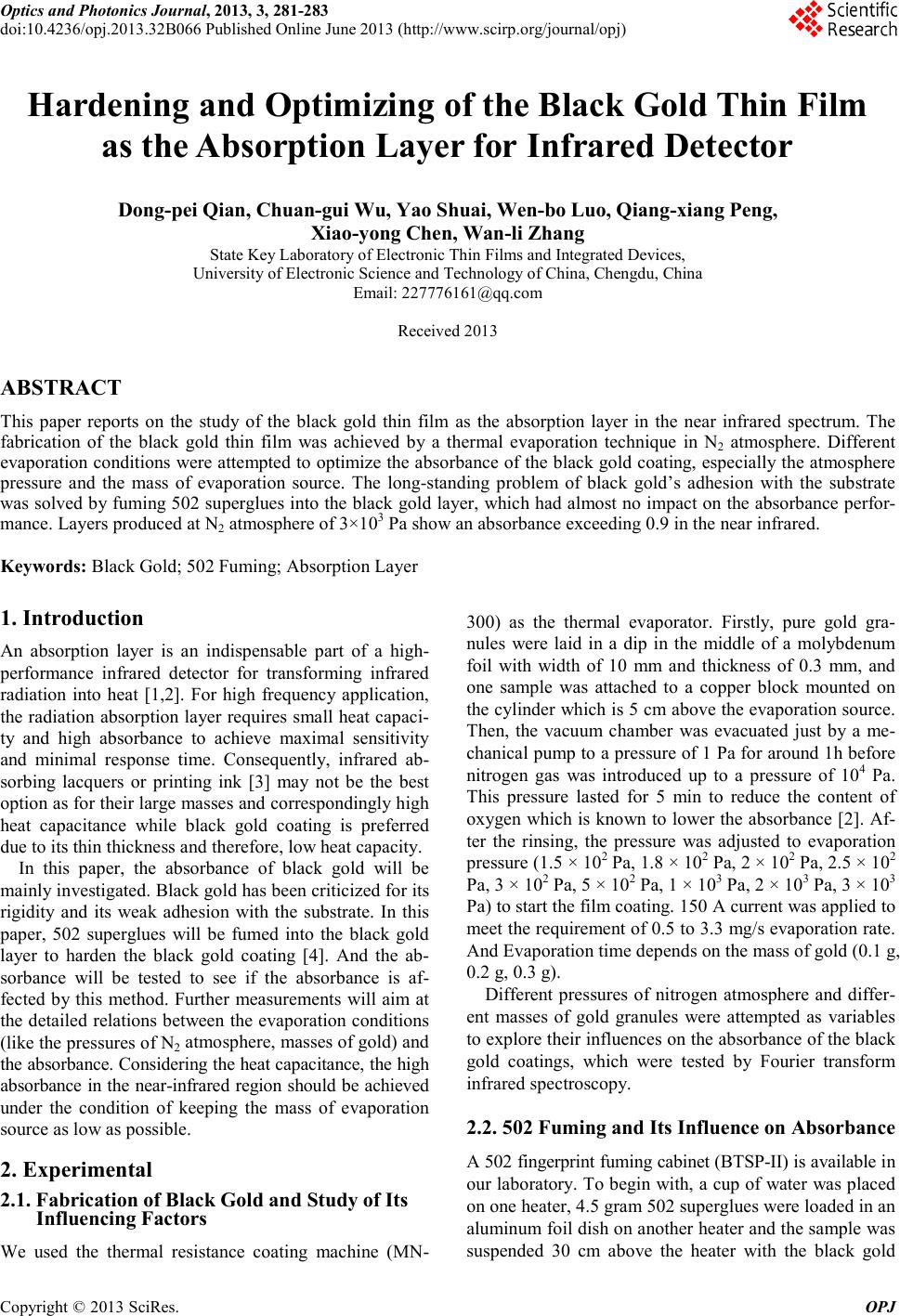 Optics and Photonics Journal, 2013, 3, 281-283 doi:10.4236/opj.2013.32B066 Published Online June 2013 (http://www.scirp.org/journal/opj) Copyright © 2013 S ciRes. OPJ Hardening and Optimizing of the Black Gold Thin Film as the Absorption Layer for I n f rared Detector Dong-pei Qi an, Chuan-gui Wu, Yao Shuai, Wen-bo Luo, Qiang-xiang Peng, Xiao-yong Chen, Wan-li Zhang State Key Laboratory of Electronic Thin Films and Integrated Devi ces , Universit y of Electronic Science and Technology of China, Chengdu, China Email: [email protected] Received 2013 ABSTRACT This paper reports on the study of the black gold thin film as the absorption layer in the near infrared spectrum. The fabrication of the black gold thin film was achieved by a thermal evaporation technique in N2 atmosphere. Different evaporation conditions were attempted to optimize the absorbance of the black gold coating, especially the atmosphere pressure and the mass of evaporation source. The long-standing problem of black gold’s adhesion with the substrate was solved by fuming 502 superglues into the black gold layer, which had almost no impact on the absorbance perfor- mance. Layers produced at N2 atmosphere of 3×10³ Pa show an absorbance exceeding 0.9 in the near infrared. Keywords: Black Gold; 502 Fuming; Absorption Layer 1. Introduction An absorption layer is an indispensable part of a high- performance infrared detector for transforming infrared radiation into heat [1,2]. For high frequency application, the radiation absorption layer requires small heat capaci- ty and high absorbance to achieve maximal sensitivity and minimal response time. Consequently, infrared ab- sorbing lacquers or printing ink [3] may not be the best option as for their large masses and correspondingly high heat capacitance while black gold coating is preferred due to its thin thickness and therefore, low heat capacity. In this paper, the absorbance of black gold will be mainly investigated. Black gold has been criticized for its rigidity and its weak adhesion with the substrate. In this paper, 502 superglues will be fumed into the black gold layer to harden the black gold coating [4]. And the ab- sorbance will be tested to see if the absorbance is af- fected by this method. Further measurements will aim at the detailed relations between the evaporation conditions (like the pressures of N2 atmosphere, masses of gold) and the absorbance. Considering th e heat capacitance, the high absorbance in the near-infrared region should be achieved under the condition of keeping the mass of evaporation source as low as po ssi ble. 2. Experimental 2.1. Fabrication of Black Gold and Study of Its Influencing Factors We used the thermal resistance coating machine (MN- 300) as the thermal evaporator. Firstly, pure gold gra- nules were laid in a dip in the middle of a molybdenum foil with width of 10 mm and thickness of 0.3 mm, and one sample was attached to a copper block mounted on the c ylinder whic h is 5 cm above the evaporation so urce . Then, the vacuum chamber was evacuated just by a me- chanical pump to a pressure of 1 Pa for around 1h before nitrogen gas was introduced up to a pressure of 104 Pa. This pressure lasted for 5 min to reduce the content of oxygen which is known to lower the absorbance [2]. Af- ter the rinsing, the pressure was adjusted to evaporation pressure (1.5 × 10² Pa, 1.8 × 10² Pa, 2 × 10² P a , 2 .5 × 102 Pa, 3 × 10² Pa, 5 × 10² Pa , 1 × 10³ Pa , 2 × 10³ Pa, 3 × 10³ Pa) to start the film coati ng. 150 A current was applied to meet the requirement of 0.5 to 3.3 mg/s evaporation rate. And Evaporation time depends on the mass of gold (0.1 g, 0.2 g, 0.3 g). Different pressures of nitrogen atmosphere and differ- ent masses of gold granules were attempted as variables to explore their influences on the absorbance of the black gold coatings, which were tested by Fourier transform infrared spectroscopy. 2.2. 502 Fuming and Its Influence on Absorbance A 502 fingerprint fuming cabinet (BTSP-II) is available in our laboratory. To begin with, a cup of water was placed on one heater, 4.5 gram 502 superglues were loaded in an aluminum foil dish on another heater and the sample was suspended 30 cm above the heater with the black gold 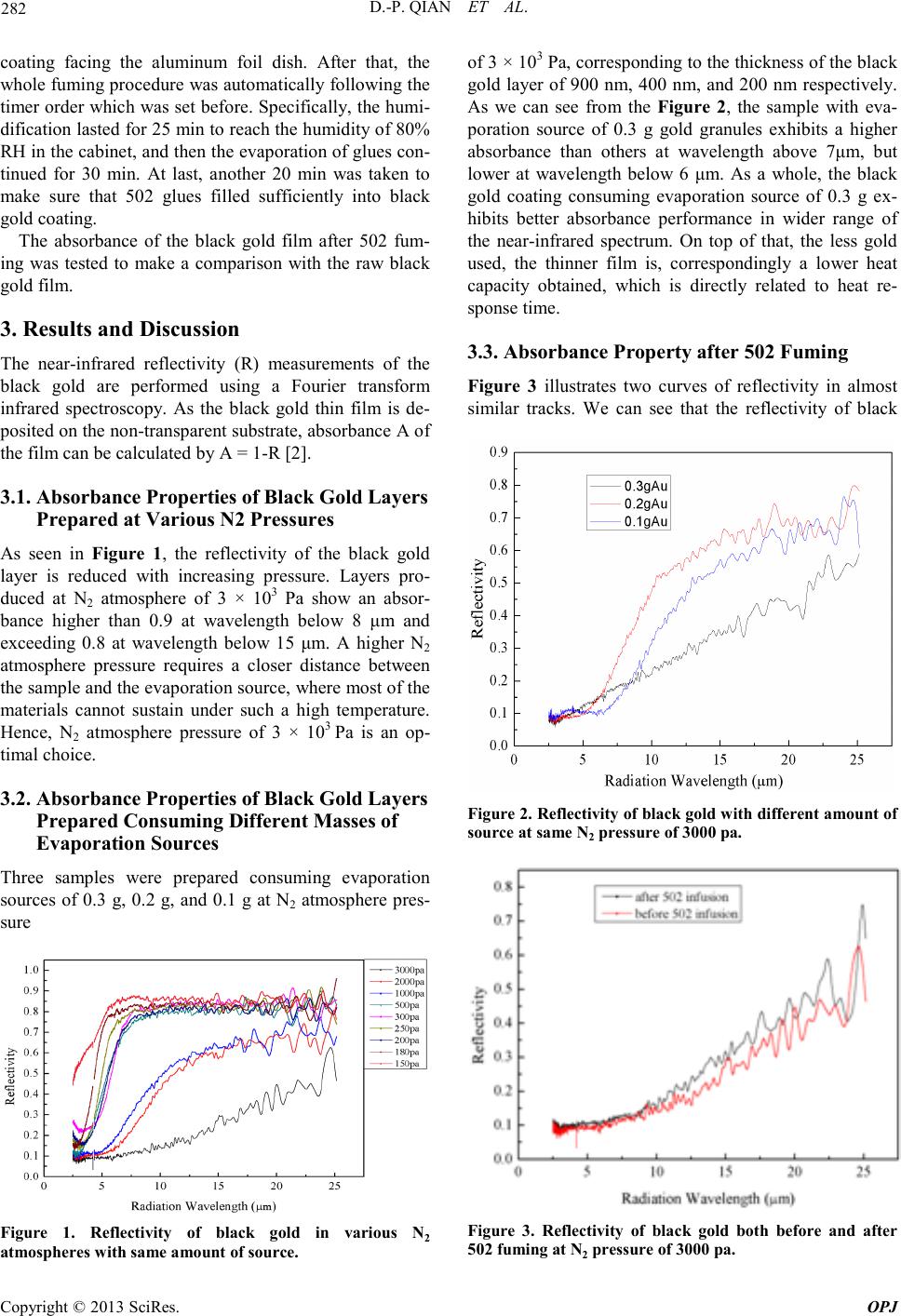 D.-P. QIAN ET AL. Copyright © 2013 S ciRes. OPJ 282 coating facing the aluminum foil dish. After that, the whole fuming procedure was automatically follo win g the timer order which was set before. Specifically, the humi- dification lasted for 25 min to reach the humidity of 80% RH in t he ca bine t, a nd the n t he evap ora tion o f glue s co n- tinued for 30 min. At last, another 20 min was taken to make sure that 502 glues filled sufficiently into black gold coating. The absorbance of the black gold film after 502 fum- ing was tested to make a comparison with the raw black gold film. 3. Results and Discussion The near-infrared reflectivity (R) measurements of the black gold are performed using a Fourier transform infrared spectroscopy. As the black gold thin film is de- posited on t he no n -transparent substrate, absorbance A of the film can be calculated by A = 1-R [2]. 3.1. Absorbance Properties of Black Gold Layers Prepared at Various N2 Pressures As seen in Figure 1, the reflectivity of the black gold layer is reduced with increasing pressure. Layers pro- duced at N2 atmosphere of 3 × 10³ Pa show an absor- bance higher than 0.9 at wavelength below 8 μm and exceeding 0.8 at wavelength below 15 μm. A higher N2 atmosphere pressure requires a closer distance between the sample and the evaporation source, where most of the materials cannot sustain under such a high temperature. Hence, N2 atmosphere pressure of 3 × 10³ Pa is an op- timal choice. 3.2. Absorbance Properties of Black Gold Layers Prepared Consuming Different Masses of Evaporation Sources Three samples were prepared consuming evaporation sources of 0.3 g, 0.2 g, and 0.1 g at N2 atmosphere pres- sure Figure 1. Reflectivity of black gold in various N2 atmosphe res with same amount of source. of 3 × 10³ Pa, cor resp ond ing to the thi ckne ss o f the black gold layer of 900 nm, 400 nm, and 200 nm respectively. As we can see from the Figu re 2, the sample with eva- poration source of 0.3 g gold granules exhibits a higher absorbance than others at wavelength above 7μm, but lower at wavelength belo w 6 μm. As a whole, the black gold coating consuming evaporation source of 0.3 g ex- hibits better absorbance performance in wider range of the near-infrared spectrum. On top of that, the less gold used, the thinner film is, correspondingly a lower heat capacity obtained, which is directly related to heat re- sponse t ime. 3.3. Absorbance Property after 502 Fum i ng Figure 3 illustrates two curves of reflectivity in almost similar tracks. We can see that the reflectivity of black Figure 2. Reflectivity of black gold with different amount of source at same N2 pressure of 300 0 pa. Figure 3. Reflectivity of black gold both before and after 502 fuming at N2 pressure of 3000 pa. 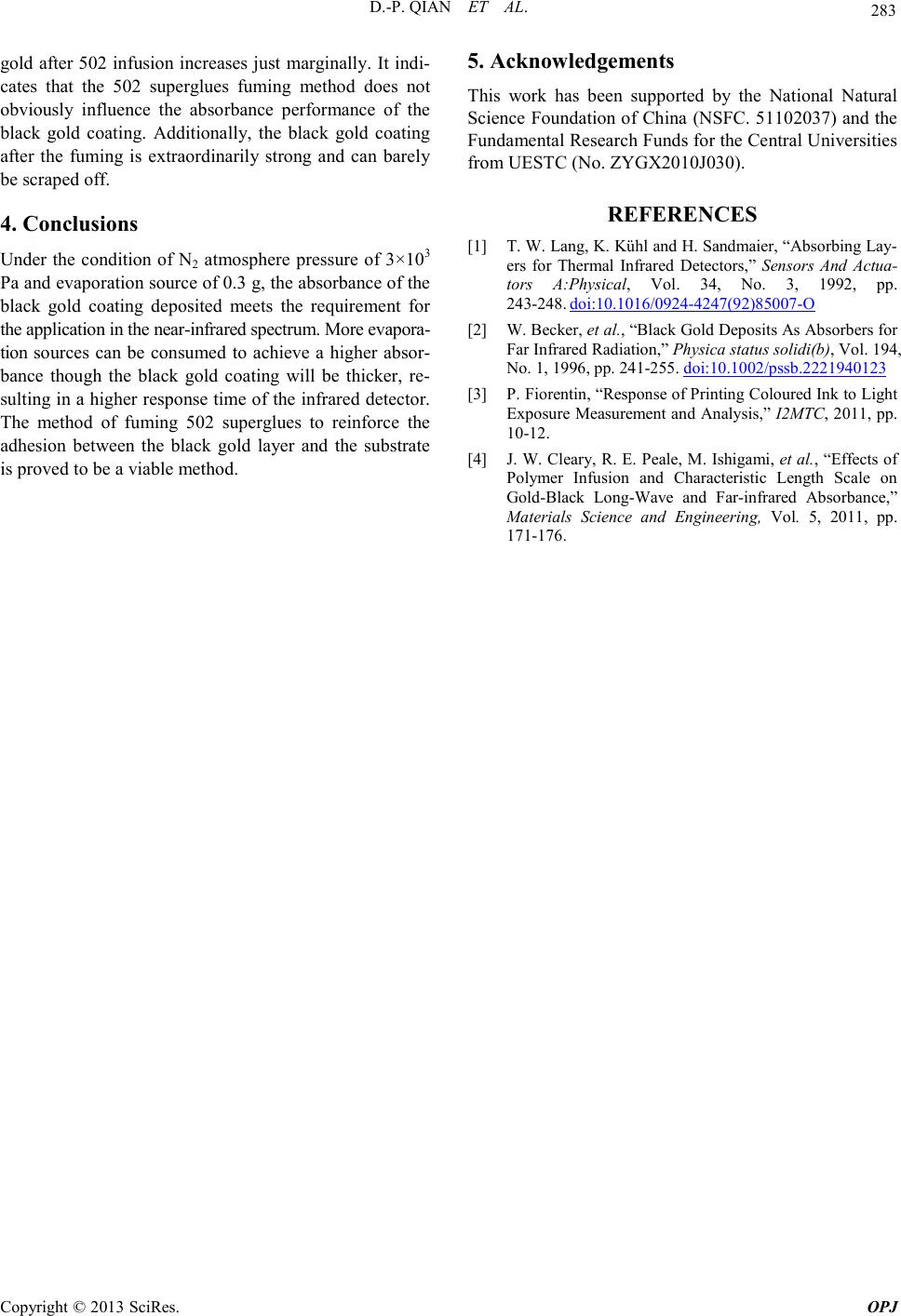 D.-P. QIAN ET AL. Copyright © 2013 S ciRes. OPJ 283 gold after 502 infusion increases just marginally. It i ndi- cates that the 502 superglues fuming method does not obviously influence the absorbance performance of the black gold coating. Additionally, the black gold coating after the fuming is extraordinarily strong and can barely be scraped off. 4. Conclusions Under the condition of N2 atmosphere pressure of 3×10³ Pa and evaporation source of 0.3 g, the absorbance o f t he black gold coating deposited meets the requirement for the appli catio n in the near-infrared spectrum. More evapora- tion sources can be consumed to achieve a higher absor- bance though the black gold coating will be thicker, re- sulti ng in a highe r response time of the infrared detector. The method of fuming 502 superglues to reinforce the adhesion between the black gold layer and the substrate is proved to be a viable method. 5. Acknowledgements This work has been supported by the National Natural Science Foundation of China (NSFC. 51102037) and the Fund ame ntal Rese ar c h F u nd s fo r t he Ce nt ra l Uni ve rsi ties from UESTC (No. ZYGX2010J030). REFERENCES [1] T. W. Lang, K. Kühl and H. S andmaier, “Absorbing Lay- ers for Thermal Infrared Detectors,” Sensors And Actua- tors A:Physical , Vol. 34, No. 3, 1992, pp. 243-248. doi:10.1016/0924-4247(92)85007-O [2] W. Becker, et al., “Black Gold Deposits As Absorbers for Far Infrared Radiation,” Physica stat us solidi(b), Vol. 194, No. 1, 1996, pp. 241-255. doi:10.1002/pssb.2221940123 [3] P. Fiorentin, “Response of Printing Coloured Ink to Light Exposure Measur ement and Analysis,” I2MTC, 2011, pp. 10-12. [4] J. W. Clear y, R. E. P eale, M. Ishigami, et al., “Effects of Polymer Infusion and Characteristic Length Scale on Gold-Black Long-Wave and Far-infrared Absorbance,” Materials Science and Engineering, Vol. 5, 2011, pp. 171-176. |