

Paper Menu >>
Journal Menu >>
 Optics and Photonics Journal, 2013, 3, 265-267 doi:10.4236/opj.2013.32B062 Published Online June 2013 (http://www.scirp.org/journal/opj) A Smart Graded-index Multimode Fiber Based Sensor Unit for Multi-parameter Sensing Applications Shuo Fang, Baoyong Li, Dawei Song, Jianzhong Zhang*, Weimin Sun, Libo Yuan Key Laboratory of In-Fiber Integrated Optics, Ministry of Education, Harbin 150001, China Email: *[email protected] Received 2013 ABSTRACT We demonstrate a smart optical fiber sensor unit to realize a multi-parameter sensing, including temperature, curvature and strain or displacement. The sensor unit is composed of a Bragg grating in graded-index multimode fiber and a Fizeau cavity. Keywords: Fiber Optic Sensor; Fiber Bragg Grating; Fiber Fizeau Cavity 1. Introduction Fiber optic sensors offer lots of advantages including elec- tromagnetic interference immunity, multiplexing capabil- ity of several sensors in series, and resistance to harsh environment such as high temperature and big pressure. Multi-parameter sensing is also an important trend for optical fiber sensor. Many techniques are based on mul- tiplexing different FBGs or combining different types of sensors, such as hybrid FBG/Fizeau interferometer, hybrid FBG/long-period gratings and so on [1-3]. On the other hand, multimode fiber (MMF) based sensors [4-7] have attracted much attention recently because of their high sensitivity and low price. A step-index MMF-based tem- perature and strain sensor, a refractive index sensor and a curvature sensor based on MMF, and a strain and tem- perature sensor based on a graded-index (GI) MMF are all demonstrated. Here we propose and demonstrate a GI MMF based sensor unit to realize a multi-parameter sensing, including temperature, curvature and strain or displacement. 2. Setup and Experiments The Sensor Unit is composed of several parts, shown in Figure 1. A short Bragg grating is written in a section (~3 cm) of GI MMF with cleaved end faces and spliced with a single mode fiber. Then this structure is inserted into a micro-silicon tube of ~500 μm internal diameter. Another cleaved fiber of ~300 μm in diameter is inserted into the micro-silicon tube from the other side and a Fizeau cavity is realized by the cleaved end-faces. Ultra- violet curing glue is used to fix the positions of fibers, finally creating the sensor unit. The sensor unit is con- nected with a circulator. The light source is a broadband source ASE, and an OSA and personal computer (PC) based system is used to acquire and demodulate the sig- nals from the sensor unit. Figure 1. A GI MMF based sensor unit and its demodulation sche me . *Corresponding author. Copyright © 2013 SciRes. OPJ 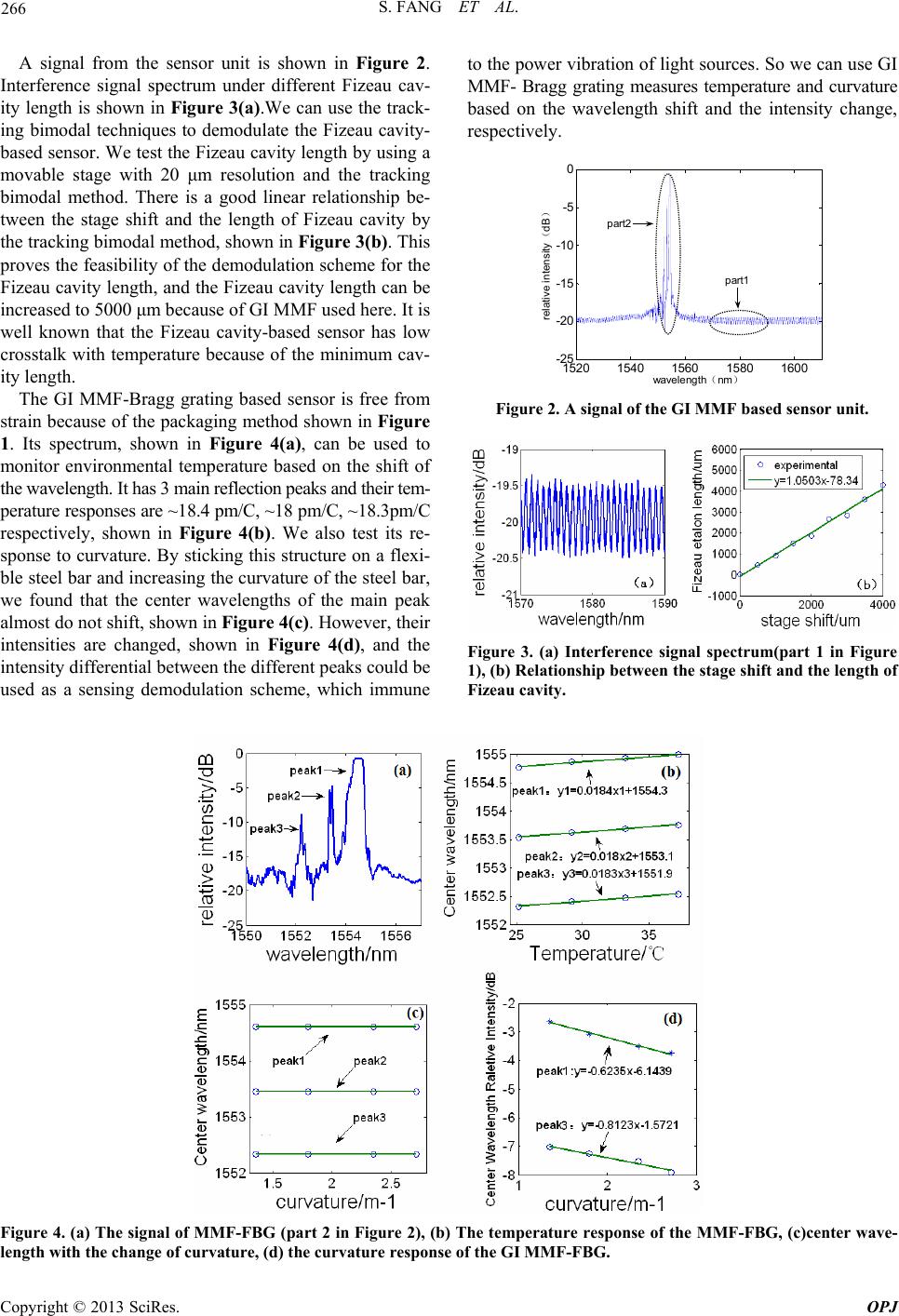 S. FANG ET AL. 266 A signal from the sensor unit is shown in Figure 2. Interference signal spectrum under different Fizeau cav- ity length is shown in Figure 3(a).We can use the track- ing bimodal techniques to demodulate the Fizeau cavity- based sensor. We test the Fizeau cavity length by using a movable stage with 20 μm resolution and the tracking bimodal method. There is a good linear relationship be- tween the stage shift and the length of Fizeau cavity by the tracking bimodal method, shown in Figure 3(b). This proves the feasibility of the demodulation scheme for the Fizeau cavity length, and the Fizeau cavity length can be increased to 5000 μm because of GI MMF used here. It is well known that the Fizeau cavity-based sensor has low crosstalk with temperature because of the minimum cav- ity length. The GI MMF-Bragg grating based sensor is free from strain because of the packaging method shown in Figure 1. Its spectrum, shown in Figure 4(a), can be used to monitor environmental temperature based on the shift of the wavelength. It has 3 main reflection peaks and their tem- perature responses are ~18.4 pm/C, ~18 pm/C, ~18.3pm/C respectively, shown in Figure 4(b). We also test its re- sponse to curvature. By sticking this structure on a flexi- ble steel bar and increasing the curvature of the steel bar, we found that the center wavelengths of the main peak almost do not shift, shown in Figure 4(c). However, their intensities are changed, shown in Figure 4(d), and the intensity differential between the different peaks could be used as a sensing demodulation scheme, which immune to the power vibration of light sources. So we can use GI MMF- Bragg grating measures temperature and curvature based on the wavelength shift and the intensity change, respectively. 1520 1540 15601580 1600 -25 -20 -15 -10 -5 0 wave l eng t h(nm) relative intensity(dB) part2 part1 Figure 2. A signal of the GI MMF based sensor unit. Figure 3. (a) Interference signal spectrum(part 1 in Figure 1), (b) Relationship between the stage shift and the length of Fizeau cavity. Figure 4. (a) The signal of MMF-FBG (part 2 in Figure 2), (b) The temperature response of the MMF-FBG, (c)center wave- length with the change of curvature, (d) the curvature response of the GI MMF-FBG. Copyright © 2013 SciRes. OPJ 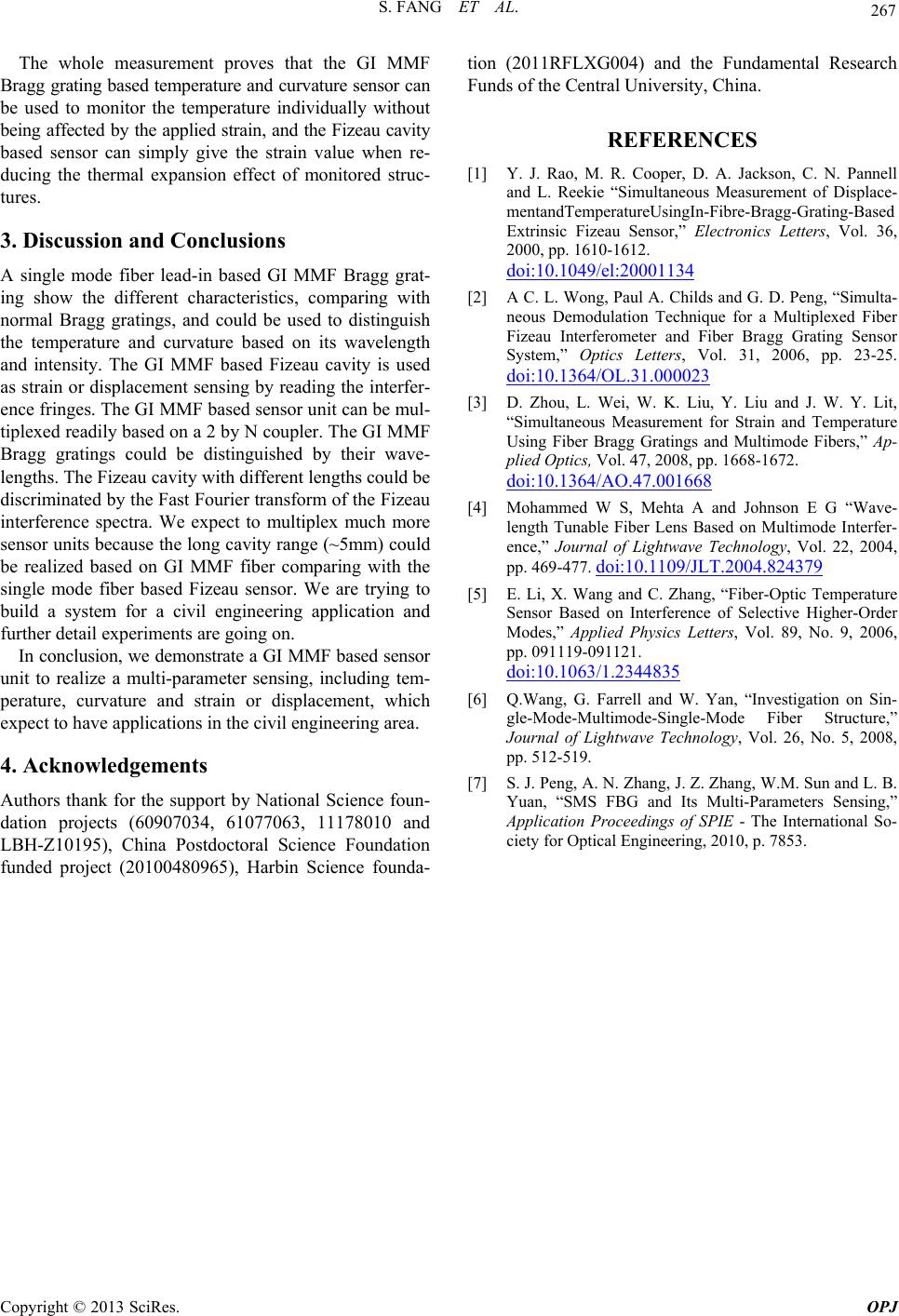 S. FANG ET AL. 267 The whole measurement proves that the GI MMF Bragg grating based temperature and curvature sensor can be used to monitor the temperature individually without being affected by the applied strain, and the Fizeau cavity based sensor can simply give the strain value when re- ducing the thermal expansion effect of monitored struc- tures. 3. Discussion and Conclusions A single mode fiber lead-in based GI MMF Bragg grat- ing show the different characteristics, comparing with normal Bragg gratings, and could be used to distinguish the temperature and curvature based on its wavelength and intensity. The GI MMF based Fizeau cavity is used as strain or displacement sensing by reading the interfer- ence fringes. The GI MMF based sensor unit can be mul- tiplexed readily based on a 2 by N coupler. The GI MMF Bragg gratings could be distinguished by their wave- lengths. The Fizeau cavity with different lengths could be discriminated by the Fast Fourier transform of the Fizeau interference spectra. We expect to multiplex much more sensor units because the long cavity range (~5mm) could be realized based on GI MMF fiber comparing with the single mode fiber based Fizeau sensor. We are trying to build a system for a civil engineering application and further detail experiments are going on. In conclusion, we demonstrate a GI MMF based sensor unit to realize a multi-parameter sensing, including tem- perature, curvature and strain or displacement, which expect to have applications in the civil engineering area. 4. Acknowledgements Authors thank for the support by National Science foun- dation projects (60907034, 61077063, 11178010 and LBH-Z10195), China Postdoctoral Science Foundation funded project (20100480965), Harbin Science founda- tion (2011RFLXG004) and the Fundamental Research Funds of the Central University, China. REFERENCES [1] Y. J. Rao, M. R. Cooper, D. A. Jackson, C. N. Pannell and L. Reekie “Simultaneous Measurement of Displace- mentandTemperatureUsingIn-Fibre-Bragg-Grating-Based Extrinsic Fizeau Sensor,” Electronics Letters, Vol. 36, 2000, pp. 1610-1612. doi:10.1049 /el:20001134 [2] A C. L. Wong, Paul A. Childs and G. D. Peng, “Simulta- neous Demodulation Technique for a Multiplexed Fiber Fizeau Interferometer and Fiber Bragg Grating Sensor System,” Optics Letters, Vol. 31, 2006, pp. 23-25. doi:10.1364 /OL.31.000023 [3] D. Zhou, L. Wei, W. K. Liu, Y. Liu and J. W. Y. Lit, “Simultaneous Measurement for Strain and Temperature Using Fiber Bragg Gratings and Multimode Fibers,” Ap- plied Optics, Vol. 47, 2008, pp. 1668-1672. doi:10.1364 /AO.47.001668 [4] Mohammed W S, Mehta A and Johnson E G “Wave- length Tunable Fiber Lens Based on Multimode Interfer- ence,” Journal of Lightwave Technology, Vol. 22, 2004, pp. 469-477. doi:10.1109/JLT.2004 .824379 [5] E. Li, X. Wang and C. Zhang, “Fiber-Optic Temperature Sensor Based on Interference of Selective Higher-Order Modes,” Applied Physics Letters, Vol. 89, No. 9, 2006, pp. 091119-091121. doi:10.1063 /1.2344835 [6] Q.Wang, G. Farrell and W. Yan, “Investigation on Sin- gle-Mode-Multimode-Single-Mode Fiber Structure,” Journal of Lightwave Technology, Vol. 26, No. 5, 2008, pp. 512-519. [7] S. J. Peng, A. N. Zhang, J. Z. Zhang, W.M. Sun and L. B. Yuan, “SMS FBG and Its Multi-Parameters Sensing,” Application Proceedings of SPIE - The International So- ciety for Optical Engineering, 2010, p. 7853. Copyright © 2013 SciRes. OPJ |