

Paper Menu >>
Journal Menu >>
 Journal of Cancer Therapy, 2013, 4, 49-55 http://dx.doi.org/10.4236/jct.2013.47A008 Published Online August 2013 (http://www.scirp.org/journal/jct) 49 Sentinel-Node-Driven Personalized Radiation Techniques Ranging from Partial Breast Irradiation to Regional Nodal Radiation after Breast-Conserving Surgery* Kazuhiko Sato1#, Yoshio Mizuno1, Hiromi Fuchikami1, Masahiro Kato2, Takahiro Shimo2, Jun Kubota2, Naoko Takeda1,3, Yuko Inoue3, Hiroshi Seto4, Tomohiko Okawa5 1Department of Breast Oncology, Tokyo-West Tokushukai Hospital, Tokyo, Japan; 2Department of Radiation Oncology, Tokyo- West Tokushukai Hospital, Tokyo, Japan; 3Inoue Ladies Clinic, Tokyo, Japan; 4Seto Hospital, Saitama, Japan; 5Health Evaluation Center, Utsunomiya Memorial Hospital, Tochigi, Japan. Email: #[email protected] Received June 11th, 2013; revised July 10th, 2013; accepted July 17th, 2013 Copyright © 2013 Kazuhiko Sato et al. This is an open access article distributed under the Creative Commons Attribution License, which permits unrestricted use, distribution, and reproduction in any medium, provided the original work is properly cited. ABSTRACT Background: Breast-conserving surgery (BCS) followed by whole breast irradiation (WBI) has become the standard of care for treating patients with early-stage breast cancer. Recently, various radiation techniques followed by BCS have been reported. We have been investigating “personalized radiotherapy after BCS” ranging from accelerated partial breast irradiation (APBI) to WBI with regional nodal irradiation (RNI) based on the axillary node status. In this study, we compared different cohorts that received personalized radiotherapy. Method: Of 317 consecutive patients who un- derwent BCS followed by radiotherapy since November 2007, 187 who received APBI and 122 who received WBI were analyzed. Results: The local-only recurrence rate was 1.1% in the APBI group and 3.3% in the WBI group, and the regional-only recurrence rate was 1.1% for APBI and 0.8% for WBI. Conclusions: The clinical efficacy of APBI for local control after BCS was comparable to that of WBI ± RNI. Although this study was based on a small number of patients with a short follow-up period, the feasibility of breast-conserving therapy using multicatheter brachytherapy to achieve acceptable clinical outcomes was demonstrated. Keywords: Breast Cancer; Personalized Radiotherapy; Sentinel Node; Partial Breast Irradiation; Regional Nodal Radition 1. Introduction Breast-conserving surgery (BCS) followed by whole breast irradiation (WBI) is reportedly as effective as mas- tectomy and has now become the standard of care for treating patients with early-stage breast cancer [1,2]. Al- though the Oxford meta-analysis demonstrated not only a significant reduction of local recurrence but also an over- all survival benefit with adjuvant breast radiation therapy after BCS [3,4], 15% - 30% of patients who undergo BCS refuse WBI [5-10]. The latter may be caused by po- tential factors, including severe and long-term adverse events, such as rib fracture, lung injury, and late cardio- vascular toxicity, and by long-term daily visits to radia- tion institutions for at least 5 - 6 weeks. However, no subset of patients who should forego radiation therapy after BCS has been identified [11-13] and local recur- rence after BCS with WBI is most likely to occur in the vicinity of the lumpectomy site [14-17]. Considering the above, the efficacy and feasibility of accelerated partial breast irradiation (APBI) as an alternative to WBI have been evaluated in many Phases II and III studies [18-22]. In general, these rapid advances in APBI radiation therapy have been introduced for patients for whom the absence of positive nodes has been confirmed by senti- nel-node (SN) biopsy (SNB), and the addition of regional nodal radiation (RNI) to WBI is recommended for pa- *This study was not funded by any public or private grant. All authors declare no conflict of interest. #Corresponding author. Copyright © 2013 SciRes. JCT 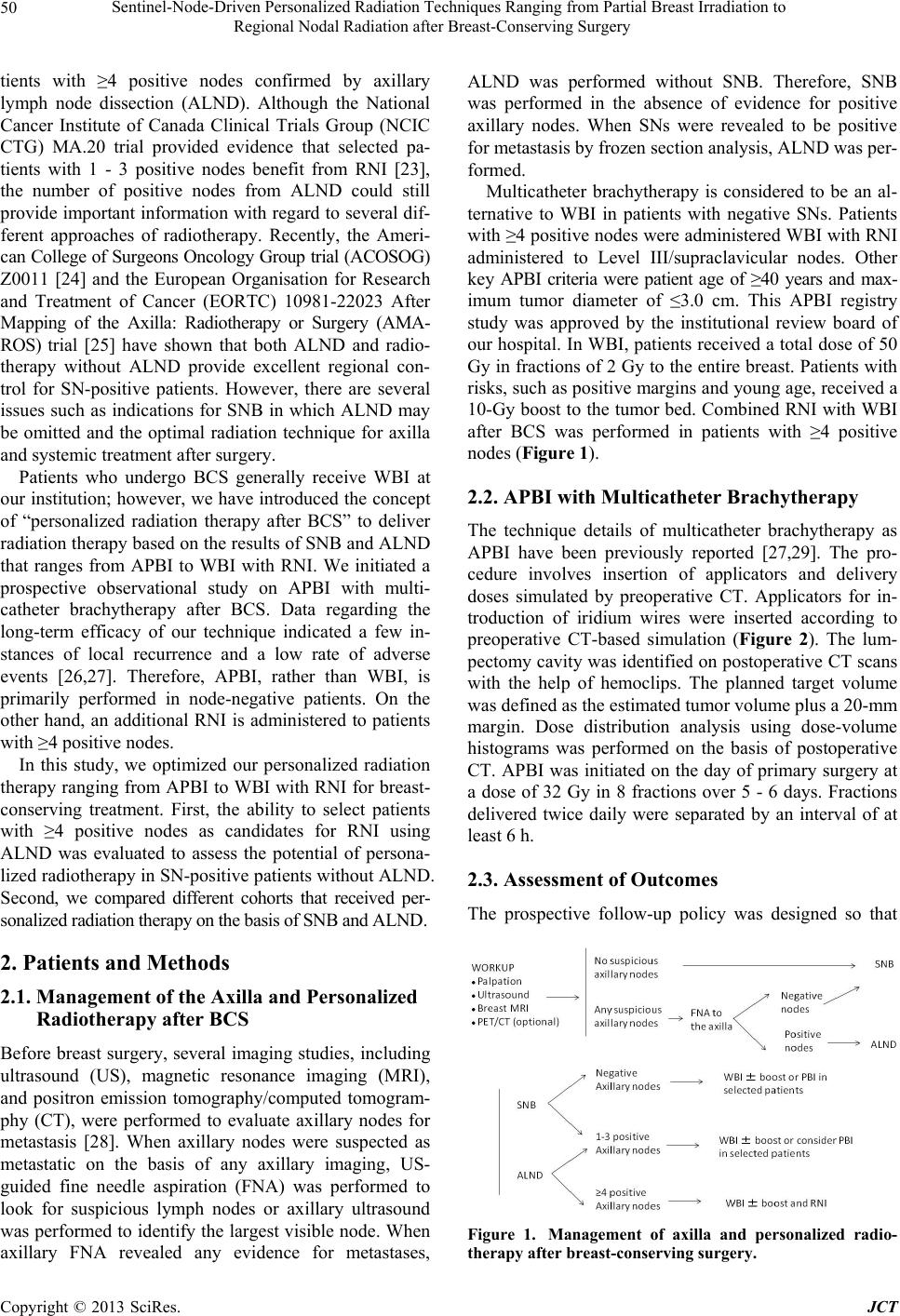 Sentinel-Node-Driven Personalized Radiation Techniques Ranging from Partial Breast Irradiation to Regional Nodal Radiation after Breast-Conserving Surgery 50 tients with ≥4 positive nodes confirmed by axillary lymph node dissection (ALND). Although the National Cancer Institute of Canada Clinical Trials Group (NCIC CTG) MA.20 trial provided evidence that selected pa- tients with 1 - 3 positive nodes benefit from RNI [23], the number of positive nodes from ALND could still provide important information with regard to several dif- ferent approaches of radiotherapy. Recently, the Ameri- can College of Surgeons Oncology Group trial (ACOSOG) Z0011 [24] and the European Organisation for Research and Treatment of Cancer (EORTC) 10981-22023 After Mapping of the Axilla: Radiotherapy or Surgery (AMA- ROS) trial [25] have shown that both ALND and radio- therapy without ALND provide excellent regional con- trol for SN-positive patients. However, there are several issues such as indications for SNB in which ALND may be omitted and the optimal radiation technique for axilla and systemic treatment after surgery. Patients who undergo BCS generally receive WBI at our institution; however, we have introduced the concept of “personalized radiation therapy after BCS” to deliver radiation therapy based on the results of SNB and ALND that ranges from APBI to WBI with RNI. We initiated a prospective observational study on APBI with multi- catheter brachytherapy after BCS. Data regarding the long-term efficacy of our technique indicated a few in- stances of local recurrence and a low rate of adverse events [26,27]. Therefore, APBI, rather than WBI, is primarily performed in node-negative patients. On the other hand, an additional RNI is administered to patients with ≥4 positive nodes. In this study, we optimized our personalized radiation therapy ranging from APBI to WBI with RNI for breast- conserving treatment. First, the ability to select patients with ≥4 positive nodes as candidates for RNI using ALND was evaluated to assess the potential of persona- lized radiotherapy in SN-positive patients without ALND. Second, we compared different cohorts that received per- sonalized radiation therapy on the basis of SNB and ALND. 2. Patients and Methods 2.1. Management of the Axilla and Personalized Radiotherapy after BCS Before breast surgery, several imaging studies, including ultrasound (US), magnetic resonance imaging (MRI), and positron emission tomography/computed tomogram- phy (CT), were performed to evaluate axillary nodes for metastasis [28]. When axillary nodes were suspected as metastatic on the basis of any axillary imaging, US- guided fine needle aspiration (FNA) was performed to look for suspicious lymph nodes or axillary ultrasound was performed to identify the largest visible node. When axillary FNA revealed any evidence for metastases, ALND was performed without SNB. Therefore, SNB was performed in the absence of evidence for positive axillary nodes. When SNs were revealed to be positive for metastasis by frozen section analysis, ALND was per- formed. Multicatheter brachytherapy is considered to be an al- ternative to WBI in patients with negative SNs. Patients with ≥4 positive nodes were administered WBI with RNI administered to Level III/supraclavicular nodes. Other key APBI criteria were patient age of ≥40 years and max- imum tumor diameter of ≤3.0 cm. This APBI registry study was approved by the institutional review board of our hospital. In WBI, patients received a total dose of 50 Gy in fractions of 2 Gy to the entire breast. Patients with risks, such as positive margins and young age, received a 10-Gy boost to the tumor bed. Combined RNI with WBI after BCS was performed in patients with ≥4 positive nodes (Figure 1). 2.2. APBI with Multicatheter Brachytherapy The technique details of multicatheter brachytherapy as APBI have been previously reported [27,29]. The pro- cedure involves insertion of applicators and delivery doses simulated by preoperative CT. Applicators for in- troduction of iridium wires were inserted according to preoperative CT-based simulation (Figure 2). The lum- pectomy cavity was identified on postoperative CT scans with the help of hemoclips. The planned target volume was defined as the estimated tumor volume plus a 20-mm margin. Dose distribution analysis using dose-volume histograms was performed on the basis of postoperative CT. APBI was initiated on the day of primary surgery at a dose of 32 Gy in 8 fractions over 5 - 6 days. Fractions delivered twice daily were separated by an interval of at least 6 h. 2.3. Assessment of Outcomes The prospective follow-up policy was designed so that Figure 1. Management of axilla and personalized radio- therapy after breast-conserving surgery. Copyright © 2013 SciRes. JCT 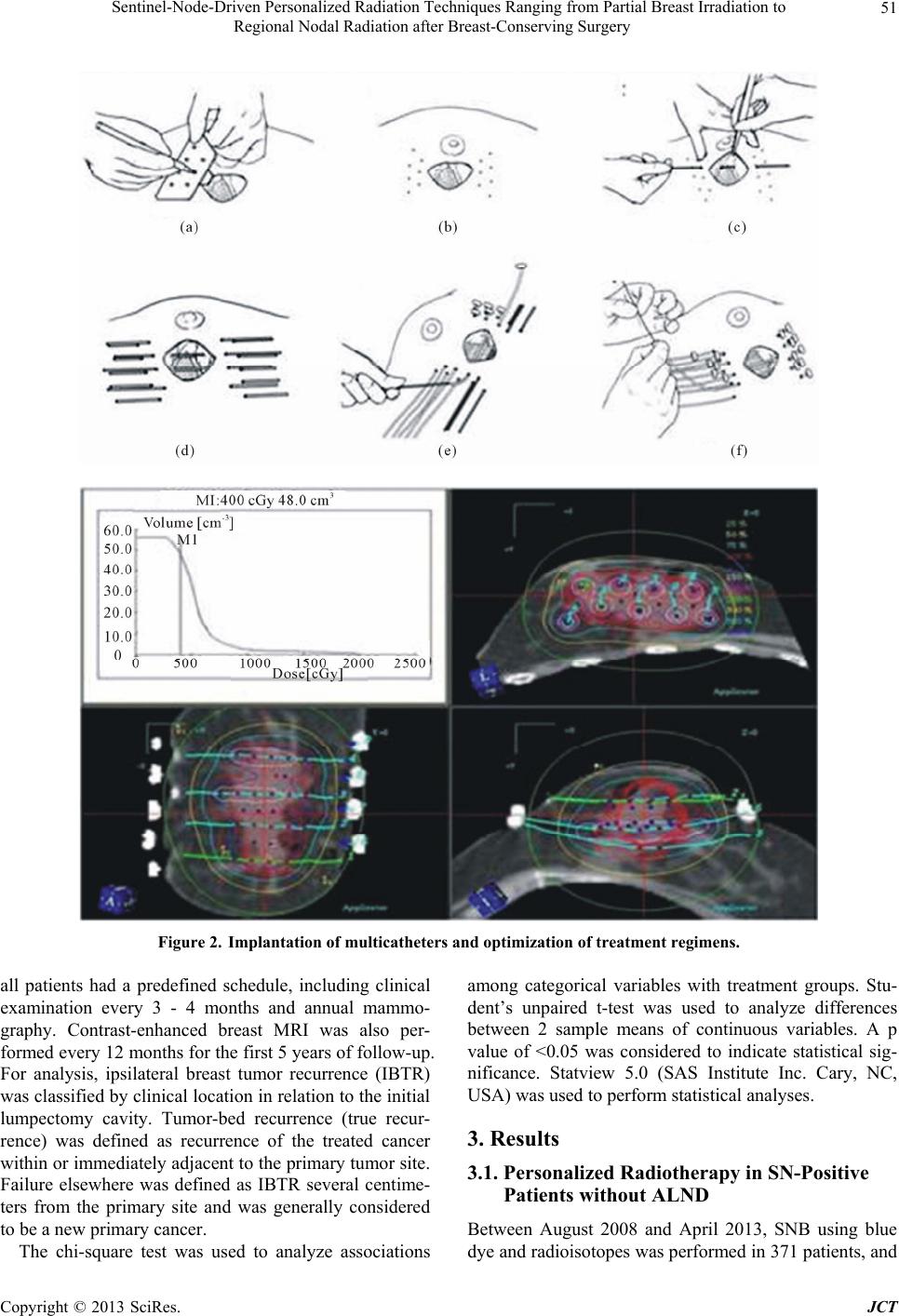 Sentinel-Node-Driven Personalized Radiation Techniques Ranging from Partial Breast Irradiation to Regional Nodal Radiation after Breast-Conserving Surgery Copyright © 2013 SciRes. JCT 51 Figure 2. Implantation of multicatheters and optimization of treatment regimens. all patients had a predefined schedule, including clinical examination every 3 - 4 months and annual mammo- graphy. Contrast-enhanced breast MRI was also per- formed every 12 months for the first 5 years of follow-up. For analysis, ipsilateral breast tumor recurrence (IBTR) was classified by clinical location in relation to the initial lumpectomy cavity. Tumor-bed recurrence (true recur- rence) was defined as recurrence of the treated cancer within or immediately adjacent to the primary tumor site. Failure elsewhere was defined as IBTR several centime- ters from the primary site and was generally considered to be a new primary cancer. The chi-square test was used to analyze associations among categorical variables with treatment groups. Stu- dent’s unpaired t-test was used to analyze differences between 2 sample means of continuous variables. A p value of <0.05 was considered to indicate statistical sig- nificance. Statview 5.0 (SAS Institute Inc. Cary, NC, USA) was used to perform statistical analyses. 3. Results 3.1. Personalized Radiotherapy in SN-Positive Patients without ALND Between August 2008 and April 2013, SNB using blue dye and radioisotopes was performed in 371 patients, and 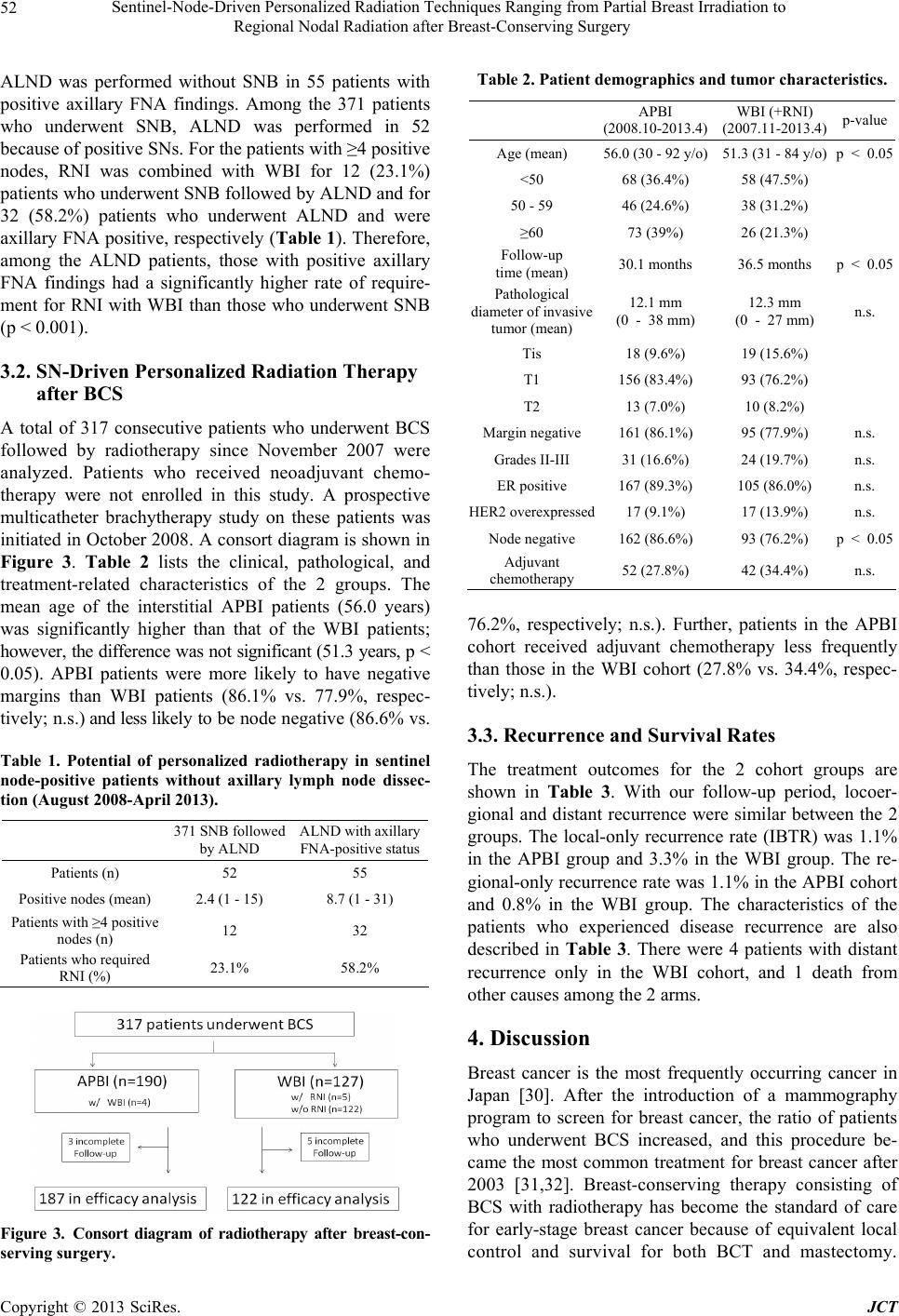 Sentinel-Node-Driven Personalized Radiation Techniques Ranging from Partial Breast Irradiation to Regional Nodal Radiation after Breast-Conserving Surgery 52 ALND was performed without SNB in 55 patients with positive axillary FNA findings. Among the 371 patients who underwent SNB, ALND was performed in 52 because of positive SNs. For the patients with ≥4 positive nodes, RNI was combined with WBI for 12 (23.1%) patients who underwent SNB followed by ALND and for 32 (58.2%) patients who underwent ALND and were axillary FNA positive, respectively (Table 1). Therefore, among the ALND patients, those with positive axillary FNA findings had a significantly higher rate of require- ment for RNI with WBI than those who underwent SNB (p < 0.001). 3.2. SN-Driven Personalized Radiation Therapy after BCS A total of 317 consecutive patients who underwent BCS followed by radiotherapy since November 2007 were analyzed. Patients who received neoadjuvant chemo- therapy were not enrolled in this study. A prospective multicatheter brachytherapy study on these patients was initiated in October 2008. A consort diagram is shown in Figure 3. Table 2 lists the clinical, pathological, and treatment-related characteristics of the 2 groups. The mean age of the interstitial APBI patients (56.0 years) was significantly higher than that of the WBI patients; however, the difference was not significant (51.3 years, p < 0.05). APBI patients were more likely to have negative margins than WBI patients (86.1% vs. 77.9%, respec- tively; n.s.) and less likely to be node negative (86.6% vs. Table 1. Potential of personalized radiotherapy in sentinel node-positive patients without axillary lymph node dissec- tion (August 2008-April 2013). 371 SNB followed by ALND ALND with axillary FNA-positive status Patients (n) 52 55 Positive nodes (mean) 2.4 (1 - 15) 8.7 (1 - 31) Patients with ≥4 positive nodes (n) 12 32 Patients who required RNI (%) 23.1% 58.2% Figure 3. Consort diagram of radiotherapy after breast-con- serving surgery. Table 2. Patient demographics and tumor characteristics. APBI (2008.10-2013.4) WBI (+RNI) (2007.11-2013.4) p-value Age (mean) 56.0 (30 - 92 y/o) 51.3 (31 - 84 y/o)p < 0.05 <50 68 (36.4%) 58 (47.5%) 50 - 59 46 (24.6%) 38 (31.2%) ≥60 73 (39%) 26 (21.3%) Follow-up time (mean) 30.1 months 36.5 months p < 0.05 Pathological diameter of invasive tumor (mean) 12.1 mm (0 - 38 mm) 12.3 mm (0 - 27 mm) n.s. Tis 18 (9.6%) 19 (15.6%) T1 156 (83.4%) 93 (76.2%) T2 13 (7.0%) 10 (8.2%) Margin negative161 (86.1%) 95 (77.9%) n.s. Grades II-III 31 (16.6%) 24 (19.7%) n.s. ER positive 167 (89.3%) 105 (86.0%) n.s. HER2 overexpressed17 (9.1%) 17 (13.9%) n.s. Node negative 162 (86.6%) 93 (76.2%) p < 0.05 Adjuvant chemotherapy 52 (27.8%) 42 (34.4%) n.s. 76.2%, respectively; n.s.). Further, patients in the APBI cohort received adjuvant chemotherapy less frequently than those in the WBI cohort (27.8% vs. 34.4%, respec- tively; n.s.). 3.3. Recurrence and Survival Rates The treatment outcomes for the 2 cohort groups are shown in Table 3. With our follow-up period, locoer- gional and distant recurrence were similar between the 2 groups. The local-only recurrence rate (IBTR) was 1.1% in the APBI group and 3.3% in the WBI group. The re- gional-only recurrence rate was 1.1% in the APBI cohort and 0.8% in the WBI group. The characteristics of the patients who experienced disease recurrence are also described in Table 3. There were 4 patients with distant recurrence only in the WBI cohort, and 1 death from other causes among the 2 arms. 4. Discussion Breast cancer is the most frequently occurring cancer in Japan [30]. After the introduction of a mammography program to screen for breast cancer, the ratio of patients who underwent BCS increased, and this procedure be- came the most common treatment for breast cancer after 2003 [31,32]. Breast-conserving therapy consisting of BCS with radiotherapy has become the standard of care for early-stage breast cancer because of equivalent local control and survival for both BCT and mastectomy. Copyright © 2013 SciRes. JCT  Sentinel-Node-Driven Personalized Radiation Techniques Ranging from Partial Breast Irradiation to Regional Nodal Radiation after Breast-Conserving Surgery 53 Table 3. Locoregional control and distant recurrence. APBI (n = 187) WBI (+RNI) (n = 122) Locoregional Recurrence Local only (IBTR) 2 (1.1%) 4 (3.3%) Tumor bed recurrence 1 3 Failure elsewhere 1 1 Regional only 2 (1.1%) 1 (0.8%) Local + regional 4 (2.1%) 5 (4.1%) Distant Recurrence First or concurrent 0 4 (3.3%) After locoregional 0 0 Moreover, according to a recent report, BCT was associ- ated with improvement in overall survival and disease- specific survival regardless of age or hormone receptor status [33]. Although EBCTCG data demonstrated that omission of radiotherapy was one of the most relevant factors associated with local recurrence and the rela- tionship between effects on local control and breast can- cer mortality showed that 1 death from breast cancer could be avoided for every 4 local recurrences prevented [3,4], 20% of patients who underwent BCS in Japan did not receive WBI [34] because they had complete patho- logically negative margins, occasional severe adverse events because of WBI, and long-term daily visits to ra- diation institutes. Therefore, we previously initiated a prospective ob- servational study of APBI with multicatheter brachy- therapy as an alternative to WBI after BCS. Data regard- ing the long-term efficacy of our technique in Japanese breast cancer patients indicated a few instances of local recurrence and a low rate of adverse events [25,26]. In this study, we optimized our personalized radiation therapy ranging from APBI to WBI with RNI for breast- conserving treatment. The results demonstrated that clinical efficacy of APBI for local control after BCS was comparable to that of WBI ± RNI at approximately 2.5 years of follow-up. The limitations of this study were that it was not randomized, was based on only a small number of participants, and covered only a short follow- up period. However, to the best of our knowledge, this is one of the largest observational studies from Asia to demonstrate the feasibility of BCT using multicatheter brachytherapy and with acceptable clinical outcomes. In terms of “personalized radiotherapy after BCS”, many other factors other than axillary node status need to be considered because the risk of recurrence has been reported to be associated with not only the number of positive nodes but also various other factors (e.g., tumor subtype was recently claimed to be a factor relevant to local recurrence). The recent publication of the results of the American College of Surgeons Oncology Group trial Z0011 demonstrated equivalent survival and local con- trol in patients with 1 - 2 positive SNs who were ran- domly assigned to SNB alone or SNB followed by ALND [23]. The EORTC AMAROS trial has also shown that both ALND and axillary radiotherapy without ALND provided excellent regional control for SN positive pa- tients [24]. The number of positive nodes was still im- portant for the personalization of radiotherapy through several different approaches, from APBI to WBI with RNI. However, the number of positive nodes present cannot be determined if ALND is omitted. When multi-image analyses and axillary FNA for sus- picious lymph nodes have been introduced to select can- didates for SNB, about 80% of SN-positive patients did not require RNI. On the other hand, if axillary FNA re- vealed metastatic lymph nodes, approximately 60% need- ed RNI because they had ≥4 positive nodes. Therefore, to extend “personalized radiotherapy after BCS”, we may adopt the following strategy: APBI (or WBI in selected patients) for SN-negative patients, WBI and ALND (or APBI and ALND in selected patients) for SN-positive patients, and WBI and ALND with or without RNI for axillary FNA-positive patients. Additional research infor- mation from several institutions is required, and random- ized clinical trials to confirm the validity of the above strategy are warranted. 5. Acknowledgements The authors would like to thank Enago (www.enago.jp) for the English language review. This study was pre- sented in part at the 2013 the Japanese Breast Cancer Society Annual Meeting. REFERENCES [1] B. Fisher, S. Anderson, J. Bryant, et al., “Twenty-Year Follow-Up of a Randomized Trial Comparing Total Ma- stectomy, Lumpectomy, and Lumpectomy plus Irradia- tion for the Treatment of Invasive Breast Cancer,” The New England Journal of Medicine, Vol. 347, No. 16, 2002, pp. 1233-1241. doi:10.1056/NEJMoa022152 [2] U. Veronesi, N. Cascinelli, L. Mariani, et al., “Twenty- Year Follow-Up of a Randomized Study Comparing Breast-Conserving Surgerywith Radical Mastectomy for Early Breast Cancer,” The New England Journal of Medicine, Vol. 347, No. 16, 2002, pp. 1227-1232. doi:10.1056/NEJMoa020989 [3] M. Clarke, R. Collins, S. Darby, et al., “Effects of Radio- therapy and of Differences in the Extent of Surgery for Early Breast Cancer on Local Recurrence and 15-Year Survival: An Overview of the Randomised Trials,” Lan- cet, Vol. 366, No. 9503, 2005, pp. 2087-2106. [4] Early Breast Cancer Trialists’ Collaborative Group Copyright © 2013 SciRes. JCT  Sentinel-Node-Driven Personalized Radiation Techniques Ranging from Partial Breast Irradiation to Regional Nodal Radiation after Breast-Conserving Surgery 54 (EBCTCG), S. Darby, P. McGale, C. Correa, et al., “Ef- fect of Radiotherapy after Breast-Conserving Surgery on 10-Year Recurrence and 15-Year Breast Cancer Death: Meta-Analysis of Individual Patient Data for 10,801 Women in 17 Randomised Trials,” Lancet, Vol. 378, No. 9804, 2011, pp. 1707-1716. doi:10.1016/S0140-6736(11)61629-2 [5] D. C. Farrow, W. C. Hunt and J. M. Samet, “Geographic Variation in the Treatment of Localized Breast Cancer,” The New England Journal of Medicine, Vol. 326, No. 17, 1992, pp. 1097-1101. doi:10.1056/NEJM199204233261701 [6] D. A. Lazovich, E. White, D. B. Thomas, et al., “Under- utilization of Breast-Conserving Surgery and Radiation Therapy among Women with Stage I or II Breast Can- cer,” The Journal of the American Medical Association, Vol. 266, No. 24, 1991, pp. 3433-3438. doi:10.1001/jama.1991.03470240055032 [7] B. A. Mann, J. M. Samet, W. C. Hunt, et al., “Changing Treatment of Breast Cancer in New Mexico from 1969 through 1985,” The Journal of the American Medical As- sociation, Vol. 259, No. 23, 1988, pp. 3413-3417. doi:10.1001/jama.1988.03720230023024 [8] R. Ballard-Barbash, A. L. Potosky, L. C. Harlan, et al., “Factors Associated with Surgical and Radiation Therapy for Early Stage Breast Cancer in Older Women,” Journal of the National Cancer Institute, Vol. 88, No. 23, 1996, pp. 716-726. doi:10.1093/jnci/88.11.716 [9] W. F. Athas, M. Adams-Cameron, W. C. Hunt, et al., “Tra- vel Distance to Radiation Therapy and Receipt of Radio- therapy Following Breast-Conserving Surgery,” Journal of the National Cancer Institute, Vol. 92, No. 3, 2000, pp. 269-271. doi:10.1093/jnci/92.3.269 [10] A. T. Schroen, D. R. Brenin, M. D. Kelly, et al., “Impact of Patient Distance to Radiation Therapy on Mastectomy Use in Early-Stage Breast Cancer Patients,” Journal of Clinical Oncology, Vol. 23, No. 28, 2005, pp. 7074-7080. doi:10.1200/JCO.2005.06.032 [11] B. Fisher, J. Bryant, J. J. Dignam, et al., “Tamoxifen, Radiation Therapy, or Both for Prevention of Ipsilateral Breast Tumor Recurrence after Lumpectomy in Women with Invasive Breast Cancers of One Centimeter or Less,” Journal of Clinical Oncology, Vol. 20, No. 20, 2002, pp. 4141-4149. doi:10.1200/JCO.2002.11.101 [12] A. W. Fyles, D. R. McCready, L. A. Manchul, et al., “Ta- moxifen with or without Breast Irradiation in Women 50 Years of Age or Older with Early Breast Cancer,” The New England Journal of Medicine, Vol. 351, No. 10, 2004, pp. 963-970. doi:10.1056/NEJMoa040595 [13] K. S. Hughes, L. A. Schnaper, D. Berry, et al., “Lumpec- tomy plus Tamoxifen with or without Irradiation in Women 70 Years of Age or Older with Early Breast Cancer,” The New England Journal of Medicine, Vol. 351, No. 10, 2004, pp. 971-977. [14] B. Fisher and S. Anderson, “Conservative Surgery for the Management of Invasive and Noninvasive Carcinoma of the Breast: NSABP Trials, National Surgical Adjuvant Breast and Bowel Project,” World Journal of Surgery, Vol. 18, No. 1, 1994, pp. 63-69. doi:10.1007/BF00348193 [15] K. Holli, R. Saaristo, J. Isola, et al., “Lumpectomy with or without Postoperative Radiotherapy for Breast Cancer with Favourable Prognostic Features: Results of a Ran- domized Study,” British Journal of Cancer, Vol. 84, No. 2, 2001, pp. 164-169. doi:10.1054/bjoc.2000.1571 [16] G. Liljegren, L. Holmberg, H.-O. Adami, et al., “Sector Resection with or without Postoperative Radiotherapy for Stage I Breast Cancer: Five-Year Results of a Random- ized Trial,” Journal of the National Cancer Institute, Vol. 86, No. 9, 1994, pp. 717-722. doi:10.1093/jnci/86.9.717 [17] R. M. Clark, P. B. McCulloch, M. N. Levine, et al., “Randomized Clinical Trial to Assess the Effectiveness of Breast Irradiation Following Lumpectomy and Axillary Dissection for Node-Negative Breast Cancer,” Journal of the National Cancer Institute, Vol. 84, No. 9, 1992, pp. 683-689. doi:10.1093/jnci/84.9.683 [18] C. Polgár, Z. Sulyok, J. Fodor, et al., “Sole Brachyther- apy of the Tumor Bed after Conservative Surgery for T1 Breast Cancer: Five-Year Results of a Phase I-II Study and Initial Fndings of a Randomized Phase III Trial,” Journal of Surgical Oncology, Vol. 80, No. 3, 2002, pp. 121-128. [19] C. Polgár, T. Major, J. Fodor, et al., “High-Dose-Rate Brachytherapy Alone versus Whole Breast Radiotherapy with or without Tumor Bed Boost after Breast-Conserv- ing Surgery: Seven-Year Results of a Comparative Study,” International Journal of Radiation Oncology * Biology Physics, Vol. 60, No. 4, 2004, pp. 1173-1181. [20] U. Veronesi, R. Orecchia, A. Luini, et al., “Intraoperative Radiotherapy during Breast Conserving Surgery: A Study on 1822 Cases Treated with Electrons,” Breast Cancer Research and Treatment, Vol. 124, No. 1, 2010, pp. 141- 151. [21] J. S. Vaidya, D. J. Joseph, J. S. Tobias, et al., “Targeted Intraoperative Radiotherapy versus Whole Breast Radio- therapy for Breast Cancer (TARGIT-A Trial): An Inter- national, Prospective, Randomised, Non-Inferiority Phase 3 Trial,” Lancet, Vol. 376, No. 9735, 2010, pp. 91-102. [22] C. Polgár, J. Fodor, T. Major, et al., “Breast-Conserving Treatment with Partial or Whole-Breast Irradiation for Low-Risk Invasive Breast Carcinoma-5-Year Results of a Randomized Trial,” International Journal of Radiation Oncology Biology Physics, Vol. 69, No. 3, 2007, pp. 694- 702. [23] T. J. Whelan, I. Olivotto, I. Ackerman, et al., “NCIC- CTG MA.20: An Intergroup Trial of Regional Nodal Ir- radiation in Early Breast Cancer,” Journal of Clinical Oncology, Vol. 29, No. 18, 2011. http://meetinglibrary.asco.org/content/79126-102 [24] A. E. Giuliano, K. K. Hunt, K. V. Ballman, et al., “Axil- lary Dissection vs No Axillary Dissection in Women with Invasive Breast Cancer and Sentinel Node Metastasis. A Randomized Clinical Trial,” The Journal of the American Medical Association, Vol. 305, No. 6, 2011, pp. 569-575. doi:10.1001/jama.2011.90 [25] E. J. Rutgers, M. Donker, M. E. Straver, et al., “Radio- therapy or Surgery of the Axilla after a Positive Sentinel Copyright © 2013 SciRes. JCT  Sentinel-Node-Driven Personalized Radiation Techniques Ranging from Partial Breast Irradiation to Regional Nodal Radiation after Breast-Conserving Surgery Copyright © 2013 SciRes. JCT 55 Node in Breast Cancer Patients: Final Analysis of the EORTC AMAROS Trial (10981/22023),” Journal of Cli- nical Oncology, Vol. 31, No. 15, 2013. http://meetinglibrary.asco.org/content/109779-132 [26] K. Sato, Y. Mizuno, M. Kato, et al., “Intraoperative Open- Cavity Implant for Accelerated Partial Breast Irradiation using High-Dose Rate Multicatheter Brachytherapy in Japanese Breast Cancer Patients: A Single-Institution Re- gistry Study,” Journal of Cancer Therapy, Vol. 3, No. 5A, 2012, pp. 822-830. [27] K. Sato, Y. Mizuno, H. Fuchikami, et al., “Individualized Case-Control Study of Accelerated Partial Breast Irradia- tion by Multicatheter Intertstitial Brachytherapy in Japa- nese Patients with Breast Cancer,” Cancer and Clinical Oncology, Vol. 2, No. 1, 2013, pp. 127-135. doi:10.5539/cco.v2n1p127 [28] K. Sato, K. Tamaki, H. Tsuda, et al., “Utility of Axillary Ultrasound Examination to Select Breast Cancer Patients Suited for Optimal Sentinel Node Biopsy,” The American Journal of Surgery, Vol. 187, No. 6, 2004, pp. 679-683. doi:10.1016/j.amjsurg.2003.10.012 [29] K. Sato, H. Takayanagi, Y. Mizuno, et al., “Open-Cavity Implant for Accelerated Partial Breast Irradiation (APBI) Using HDR Multicatheter Brachytherapy,” Rinsho Geka, Vol. 66, No. 13, 2011, pp. 1669-1672. http://www.bitway.ne.jp/ejournal/club/1407103881-e.html [30] K. Saika and T. Sobue, “Epidemiology of Breast Cancer in Japan and the US,” Japan Medical Association Journal, Vol. 52, No. 1, 2009, pp. 39-44. http://www.med.or.jp/english/journal/pdf/2009_01/039_0 44.pdf [31] H. Sonoo and S. Noguchi, “Results of Questionnaire Sur- vey on Breast Cancer Surgery in Japan 2004-2006,” Breast Cancer, Vol. 15, No. 1, 2008, pp. 3-4. doi:10.1007/s12282-007-0017-9 [32] Y. Park, T. Kitahara, R. Takagi, et al., “Current Status of Therapy for Breast Cancer Worldwide and in Japan,” World Journal of Clinical Oncology, Vol. 2, No. 2, 2011, pp. 125-134. doi:10.5306/wjco.v2.i2.125 [33] E. S. Hwang, D. Y. Lichtensztajn, S. L. Gomez, et al., “Survival after Lumpectomy and Mastectomy for Early Stage Invasive Breast Cancer: The Effect of Age and Hor- mone Receptor Status,” Cancer, Vol. 119, No. 7, 2013, pp. 1402-1411. doi:10.1002/cncr.27795 [34] M. Mitsumori, M. Hiraoka, H. Inaji, et al., “Impact of Radiation Therapy on Breast-Conserving Therapy for Breast Cancer in Japanese Women: A Retrospective Ana- lyses of Multi-Institutional Experience. Kansai Breast Cancer Radiation Therapy Study Group,” Oncology Re- ports, Vol. 21, No. 6, 2009, pp. 1461-1466. |