

Paper Menu >>
Journal Menu >>
 Open Journal of Genetics, 2013, 3, 1-8 OJGen http://dx.doi.org/10.4236/ojgen.2013.32A2001 Published Online July 2013 (http://www.scirp.org/journal/ojgen/) RNAi technology targeting PbGP43 and PbP27 in Paracoccidioides brasiliensis Isaura Torres Gómez1,2, Orville Hernandez Ruiz1,3, Jose F. Muñoz1,2, Ana María Garcia1, Angela Restrepo1, Juan G. McEwen1,4 1Unidad de Biología Celular y Molecular, Corporación para Investigaciones Biológicas (CIB), Medellín, Colombia 2Instituto de Biología, Universidad de Antioquia, Medellín, Colombia 3Grupo de Investigación en Biociencias, Facultad de Ciencias de la Salud, Institucion Universitaria Colegio Mayor de Antioquia, Medellín, Colombia 4Facultad de Medicina, Universidad de Antioquia, Medellín, Colombia Email: [email protected] Received 7 May 2013; revised 7 June 2013; accepted 30 June 2013 Copyright © 2013 Isaura Torres Gómez et al. This is an open access article distributed under the Creative Commons Attribution Li- cense, which permits unrestricted use, distribution, and reproduction in any medium, provided the original work is properly cited. ABSTRACT Efficient technologies for gene silencing would be im- portant to carry out functional analysis with P. bra- siliensis genes, as well as for a better understanding of the biology and pathogenesis of this pathogenic fun- gus. Due to the fact that homologous recombination is unusual in P. brasiliensis, the development of knock- out isolates is currently non-feasible. The goal of this work was to assess RNA interference (RNAi) techno- logy as an alternative tool for gene silencing previous- ly employed successfully in H. capsulatum. For this purpose, we built different inverted repeat transgenic hairpin constructs to down-regulate the PbGP43 and PbP27 genes known to codify for two fungal immuno- genic proteins that elicit a strong immune response during experimental paracoccidioidomycosis. Using the RNAi strategy, a reduction in the mRNA levels of the PbGP43 and PbP27 genes was observed during the first 20 days after selection; however, in the trans- formed yeast cells, the gene silencing status proved non-stable through the assay. We demonstrated that electrotransformation was suitable to transform P. brasiliensis yeast cells and integrate the hairpin con- structions; nonetheless, gene silencing was not stable along the experimental time. A detailed analysis of the underlying molecular RNAi machinery may provide further insights into the intracellular mechanism that governs this reverse genetic tool. Keywords: Paracoccidioides brasiliensis; Interference RNA; Gene Silencing; PbGP43; PbP27; Gene Expression 1. INTRODUCTION RNA interference (RNAi), a natural mechanism con- served all along evolution, has been implicated in gene silencing in eukaryotic systems [1]. In addition, RNAi participates in the regulation of genetic expression medi- ated by certain classes of small endogenous RNAs such as micro RNA (miRNA), which acts by using double stranded RNA (dsRNA) homologous to the target se- quence [2]. Due to the fact that generation of knockout isolates is time consuming and requires sequential positive and ne- gative selection steps, in order to enrich the desired re- combination event, RNAi technology has rapidly become one of the key methods in functional genomics studies, and is used to block gene expression and create potential phenotypes capable of yielding clues concerning the fun- ction of these genes [2]. This technology has been suc- cessfully used to obtain gene disruption in dimorphic fungi, e.g. Histoplasma capsulatum [3] and Blastomyces dermatitidis [4]. Paracoccidioides brasiliensis, a thermally dimorphic fungus, is the etiological agent of paracoccidioidomyco- sis (PCM), an important systemic, endemic mycosis in Central and South America [5]. In this fungus, gene dis- ruption methods are even more laborious and currently seem unfeasible. This could be due to the presence of do- minant illegitimate recombinant events (by non-homolo- gous end-joining) overriding homologous recombination [6]. In P. brasiliensis, RNAi could be employed as an alternative method to transcriptional gene silencing me- diated by sequence-specific mRNA depletion. The aim of this work was to determine if RNAi strategy was a profi- cient tool to down regulate both PbGP43 (a 43 kDa gly- OPEN ACCESS 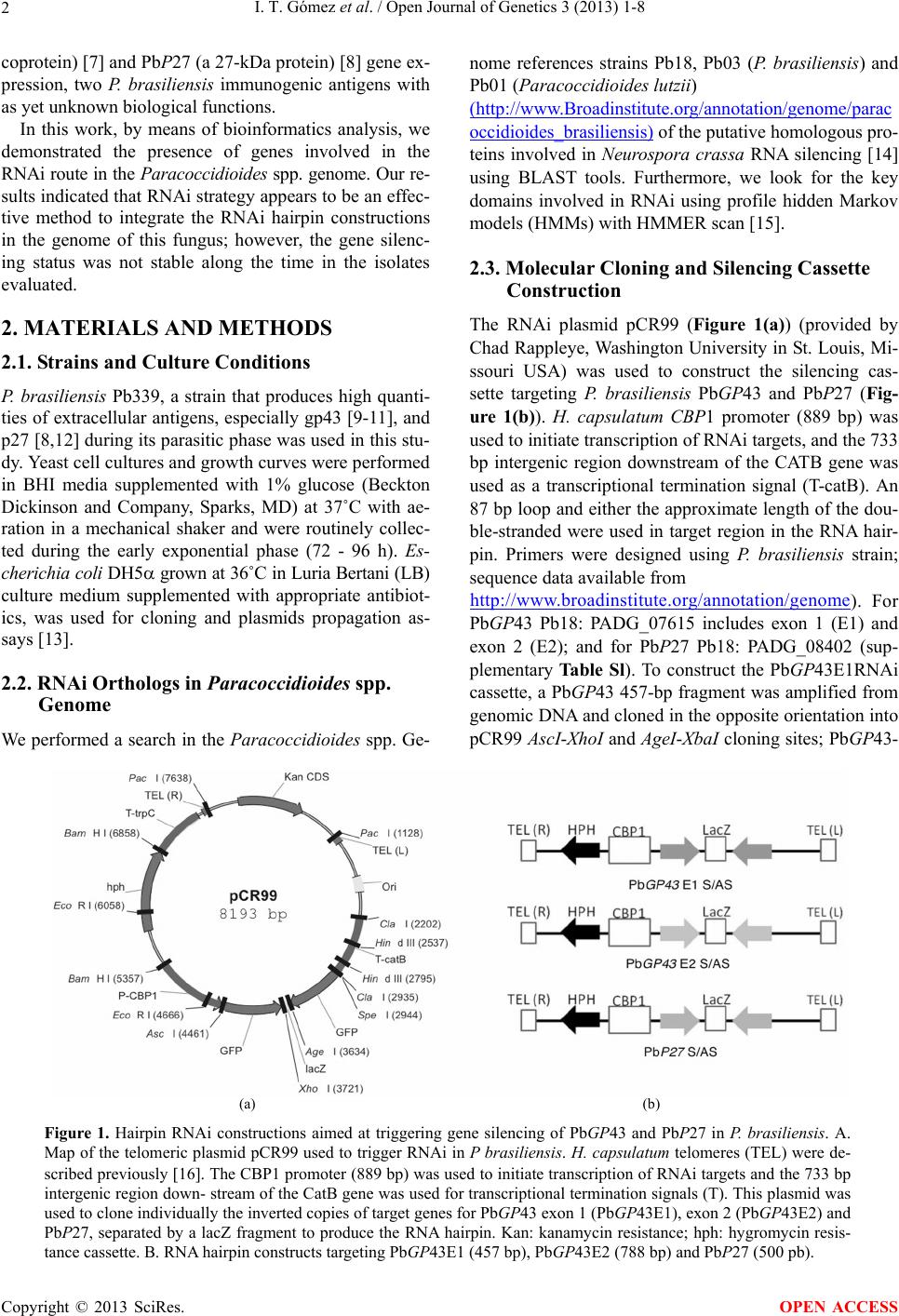 I. T. Gómez et al. / Open Journal of Genetics 3 (2013) 1-8 2 coprotein) [7] and PbP27 (a 27-kDa protein) [8] gene ex- pression, two P. brasiliensis immunogenic antigens with as yet unknown biological functions. In this work, by means of bioinformatics analysis, we demonstrated the presence of genes involved in the RNAi route in the Paracoccidioides spp. genome. Our re- sults indicated that RNAi strategy appears to be an effec- tive method to integrate the RNAi hairpin constructions in the genome of this fungus; however, the gene silenc- ing status was not stable along the time in the isolates evaluated. 2. MATERIALS AND METHODS 2.1. Strains and Culture Conditions P. brasiliensis Pb339, a strain that produces high quanti- ties of extracellular antigens, especially gp43 [9-11], and p27 [8,12] during its parasitic phase was used in this stu- dy. Yeast cell cultures and growth curves were performed in BHI media supplemented with 1% glucose (Beckton Dickinson and Company, Sparks, MD) at 37˚C with ae- ration in a mechanical shaker and were routinely collec- ted during the early exponential phase (72 - 96 h). Es- cherichia coli DH5 grown at 36˚C in Luria Bertani (LB) culture medium supplemented with appropriate antibiot- ics, was used for cloning and plasmids propagation as- says [13]. 2.2. RNAi Orthologs in Paracoccidioides spp. Genome We performed a search in the Paracoccidioides spp. Ge- nome references strains Pb18, Pb03 (P. brasiliensis) and Pb01 (Paracoccidioides lutzii) (http://www.Broadinstitute.org/annotation/genome/parac occidioides_brasilien sis) of the putative homologous pro- teins involved in Neurospora crassa RNA silencing [14] using BLAST tools. Furthermore, we look for the key domains involved in RNAi using profile hidden Markov models (HMMs) with HMMER scan [15]. 2.3. Molecular Cloning and Silencing Cassette Construction The RNAi plasmid pCR99 (Figure 1(a)) (provided by Chad Rappleye, Washington University in St. Louis, Mi- ssouri USA) was used to construct the silencing cas- sette targeting P. brasiliensis PbGP43 and PbP27 (Fig- ure 1(b)). H. capsulatum CBP1 promoter (889 bp) was used to initiate transcription of RNAi targets, and the 733 bp intergenic region downstream of the CATB gene was used as a transcriptional termination signal (T-catB). An 87 bp loop and either the approximate length of the dou- ble-stranded were used in target region in the RNA hair- pin. Primers were designed using P. brasiliensis strain; sequence data available from http://www.broadinstitute.org/annotation/genome). For PbGP43 Pb18: PADG_07615 includes exon 1 (E1) and exon 2 (E2); and for PbP27 Pb18: PADG_08402 (sup- plementary Table Sl). To construct the PbGP43E1RNAi cassette, a PbGP43 457-bp fragment was amplified from genomic DNA and cloned in the opposite orientation into pCR99 AscI-XhoI and AgeI-XbaI cloning sites; PbGP43- (a) (b) Figure 1. Hairpin RNAi constructions aimed at triggering gene silencing of PbGP43 and PbP27 in P. brasiliensis. A. Map of the telomeric plasmid pCR99 used to trigger RNAi in P brasiliensis. H. capsulatum telomeres (TEL) were de- scribed previously 16. The CBP1 promoter (889 bp) was used to initiate transcription of RNAi targets and the 733 bp intergenic region down- stream of the CatB gene was used for transcriptional termination signals (T). This plasmid was used to clone individually the inverted copies of target genes for PbGP43 exon 1 (PbGP43E1), exon 2 (PbGP43E2) and PbP27, separated by a lacZ fragment to produce the RNA hairpin. Kan: kanamycin resistance; hph: hygromycin resis- tance cassette. B. RNA hairpin constructs targeting PbGP43E1 (457 bp), PbGP43E2 (788 bp) and PbP27 (500 pb). Copyright © 2013 SciRes. OPEN ACCESS  I. T. Gómez et al. / Open Journal of Genetics 3 (2013) 1-8 3 E2RNAi and PbP27RNAi cassettes were designed, am- plified and constructed using the same strategy employed to PbGP43E1RNAi cassette (Figure 1(b)). The primers are described in supplementary Table S1, the sizes of the target sequences were 788-pb and 500-pb respectively. All PCR products were amplified using the Platinum high-fidelity TaqDNA polymerase (Invitrogen, Carlsbad, CA, USA). 2.4. P. brasiliensis Transformations and Screening The Pb339 strain was electrotransformed with PmeI-lin- earized plasmid according to the protocol previously de- scribed [16]. Briefly, P. brasiliensis yeast cells were grown in BHI batch cultures to their exponenttial growth phase with shaking at 36˚C, washed once with 10% man- nitol, sterilized by filtration as electroporation solution. Yeast cells were electrotransformed with 2 g of PmeI-di- gested pCR99 constructions (PbGP43E1RNAi, PbGP43E2 RNAi and PbP27 RNAi) and an empty vector (PbEV) as a control, in a Gene Pulser Electroporator (Bio-Rad, Her- cules, CA), using the following conditions: capacitance of 25 μF, resistance of 600 Ω and set voltage of 0.75 kV [16,17]. Following transformation, cells were spread onto selective BHI media supplemented with 100 μg/ml of hy- gromycin B (Sigma, Aldrich, MO, USA). Selection plates were monitored for colony forming ability at 37˚C for 15 to 20 days. The phenotypic stability of P. brasiliensis transformants yeast cells was determined by analyzing the stability of hygromycin B resistance [18]. Sixty indi- vidual colonies were selected and subcultured in selec- tive medium, (solid BHI containing 150 μgml hygromy- cin B) each 5 days at 37˚C for three consecutive times and then subcultured in liquid BHI containing 150 μgml hygromycin B three times, RNA extraction was then done and used in the RT-qPCR assay. 2.5. Molecular Detection of the Hygromycin Resistance Gene (HPH) Genomic DNAs from PbWt, PbEV, PbGP43E1RNAi, PbGP43E2 RNAi and PbP27 RNAi transformants yeast cells were isolated using the glass beads protocol de- scribed by Van Burik (1998) [19]. In order to confirm the presence of the hygromycin B resistance cassette, PCR analysis was carried out to detect an hph 1000-bp ampli- fication product using primers hphF (5’-AACTCACC- GCGACGTCTGTCGA-3’) and hphR (5’-CTACACA- GCCATCGGTCCAGA-3 ’). PCR amplification included 30 cycles of 1 min at 94˚C, for denaturation, 1 min at 68˚C for annealing, and 1.5 min at 72˚C for extension. The reaction products were analyzed in 1% agarose gel and visualized with ethidium bromide under UV light. 2.6. RNA Extraction, cDNA Synthesis and Real-Time RT-qPCR Analysis P. brasiliensis yeast cells were grown in liquid BHI sup- plemented with glucose 1% and hygromycin B 150 g/ml at 37˚C and harvested after 5 days of growth. RNA was obtained using the TRIzol® reagent according to the manufacturer’s instructions (Invitrogen, Carlsbad, CA, USA). Total RNA was treated with DNaseI (Invi- trogen, Carlsbad, CA, USA) and tested for chromosomal DNA contamination using conventional PCR for the β- tubulin gene [20]. cDNA was synthesized using 1 µg of total RNA and Superscript III reverse transcriptase accor- ding to the manufacturer’s instructions (Invitrogen, Carl- sbad, CA, USA). Real-time PCR (RT-qPCR) was per- formed using Maxima® SYBR Green/Fluorescein qPCR Master Mix, according to the manufacturer’s instructions (Fermentas Maryland, USA). The CFX96 Real-Time PCR Detection System (Bio-Rad, Headquarters Hercules, Ca- lifornia, USA) was used to evaluate PbGP43 or PbP27 gene expression; -tubulin was selected as house keeping gene [20]. Melting curve analysis was done after the am- plification phase to eliminate the possibility of nonspe- cific amplification or primer dimer formation. Folding changes in mRNA expression were calculated using the 2∆∆CT formula, where ∆∆CT is the difference between target and -tubulin genes [21]. Each experiment was car- ried out in triplicate and the expression level was meas- ured three times. 3. RESULTS In P. brasiliensis Electrotransformed Yeast Cells, PbGP43 and PbP27 Gene Silencing Achieved by Using the RNAi System, Was Effective but Not Stable during Time of the Experiments Three different RNAi constructions were designed from exon 1 and exon 2 from PbGP43 (PbGP43E1 RNAi, PbGP43E2 RNAi) and one from PbP27 (PbP27 RNAi), and transformed individually in PbWt yeast cells. Four- teen transformants with reduced gene expression levels were obtained by electrotransformation with the con- structions PbGP43E1-RNAi (n: 6), PbGP 43E2-RNAi (n: 5) and PbP27-RNAi (n: 3) and selected after phenotypic and mitotic stability tests (Table 1). The presence of the RNAi cassette in the knock down strains and the yeast cells transformed with PbEV was demonstrated by hph gene amplification. This gene was no observed in PbWt yeast cells (Figure 2). In all yeast transformants cells, mitotic stability re- mained stable in vitro cultures with continuous subcul- tures in selective medium containing hygromycin B; in parallel, all transformants were cultured several times in non-selective medium; after this, all of them remained Copyright © 2013 SciRes. OPEN ACCESS  I. T. Gómez et al. / Open Journal of Genetics 3 (2013) 1-8 4 Table 1. Genetic transformation of P. brasiliensis by electroporation using hairpin RNAi constructions. Construct (2 μg) Colony number after phenotypic stability test Number of stable transformants after mitotic stability test Mitotic stability (%) PbGP43E1 RNAi 20 6 30 PbGP43E2 RNAi 31 5 16 PbP27 RNAi 33 3 9 Number of transformants obtained using 2 g of PmeI-linearized plasmid DNA; Mitotic stability of putative transformants was analyzed after 5 subcultures on non-selective medium followed by plating on hygromycin B (150 g/ml). PbGP43E1 PbGP43E2 PbP27 PbEV PbWt MW 1000 bp PbGP43E1 PbGP43E2 PbP27 PbEV PbWt MW 1000 bp Figure 2. Molecular analysis of the integration of the hph resistance cassette into P. brasiliensis putative transfor- mants.Wild type host strain, PbWt harboring the empty vector (PbEV). Three putative transformants from the RNAi hairpin constructions selected randomly were sub- jected to PCR using the phosphotransferase gene (hph) specific primers, hph-F and hph-R, in order to amplify a 1000 bp internal fragment of the hph gene MW: DNA mo- lecular size marker. their capacity to grow in the hygromycin B-containing medium (Table 1). After 20 days of growth in culture media, a decrease in gene expression level ranging from 64% to 84% was observed in PbGP43E1 RNAi isolates (Figure 3(a)), and from 42% to 71% in the PbGP43E2 RNAi isolates (Fig- ure 3(b)). In an equal manner, in the yeast cells trans- formants that had been obtained using the PbP27RNAi construction, a decrease in PbP27 gene expression level ranging from 39% to 79%, was observed in comparison with the expression levels in PbWt and PbEV (Figure 3(c)). However, after 45 and 60 days of growth in the selective culture media, an increase in PbGP43 gene ex- pression level in both PbGP43E1 RNAi and in PbGP43E2 RNAi transformants was observed. Similarly, an increase of PbP27 gene expression was observed in PbP27RNAi yeast cells, indicating that in P. brasiliensis electrotransformed yeast cells silencing had not been sta- ble during the course of time. BLAST searches using published data and available genomes corresponding to P. brasiliensis Pb18, Pb03 and, Pb01, as well as P. lutzii [22] (www.braodins titute.org) were done. We identified all genes that participated in the RNA silencing related with predicted function such RNA- directed RNA polymerases (qde-1, sad-1, rrp-3), Argo- naute-like (qde-2, Sms-2), Dicer-like (dcl-2, Sms-2) and RecQ helicase-like (qde-3, RecQ-2) (Table 2). Further- more, we found that the key protein domain of the RNAi system in the proteins detected in the BLAST search, indicating that the RNAi system could be used to down regulate specific genes in P. brasiliensis (Supplementary Figure S1). 4. DISCUSSION Efficient technologies to achieve gene silencing could help to undertake functional analysis of P. brasiliensis genes and increase the understanding of the biology and virulence attributes of this fungus, overcoming many of the difficulties associated with traditional gene disruption. RNAi does not depend on the homologous recombina- tion machinery, making this strategy an attractive alter- native to gene silencing [17]. In this study, we found that in Paracoccidioides spp, there were homologous proteins involved in the RNA silencing process suggesting the presence of the compo- nents required for RNAi gene silencing thus supporting the hypothesis that in this fungus such event should oc- cur under natural conditions. Our results show that the electroporation is an efficient tool to introduce the linearized construction of RNAi in P. brasiliensis yeast cells genome, as confirmed by the pre- sence of the hph gene into the transformed cells. How- ever, the reduced mitotic stability observed in the trans- formant isolates would indicate that the fungus tends to loose the hph fragment during continuous fungal growth under non-selective pressure. As previously reported, the efficiency of silencing depends upon several factors in- cluding the length and structure of the hairpin construc- tions. Rappleye et al., (2004) [17] have shown, that a greater silencing effect was observed with a shorter loop and a longer target gene sequence; these conditions were used in our experiments but our results were different. Currently, a gene silencing strategy based on anti- sense-RNA (asRNA) has been efficiently employed in P. brasiliensis to induce the knockdown of PbCDC42, PbHAD32, PbAOX, and PbHSP90 [23-26]. Additionally, based in our previous results using the antisense RNA strategy targeting PbGP43 and PbP27 (unpublished), and Copyright © 2013 SciRes. OPEN ACCESS 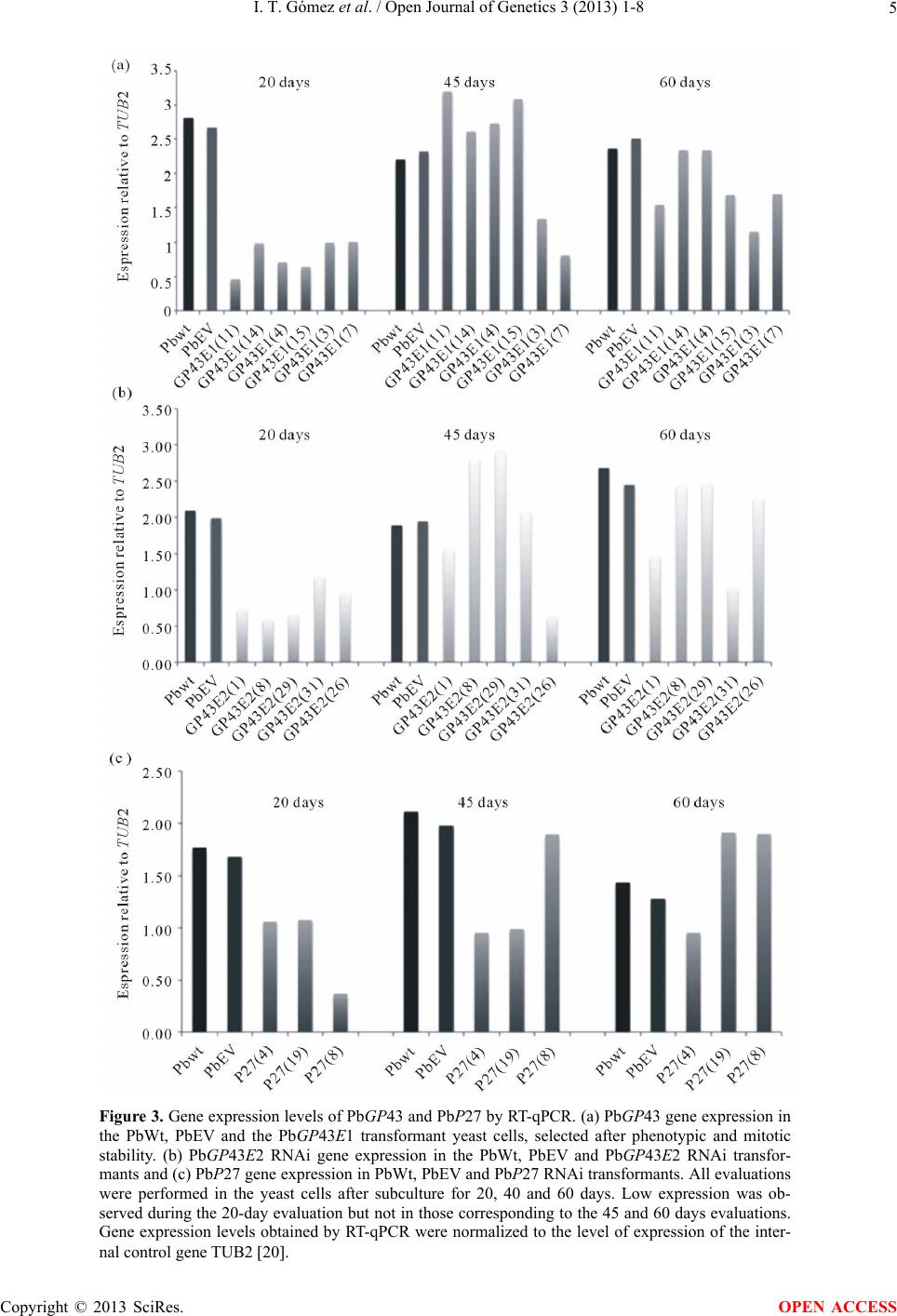 I. T. Gómez et al. / Open Journal of Genetics 3 (2013) 1-8 5 Figure 3. Gene expression levels of PbGP43 and PbP27 by RT-qPCR. (a) PbGP43 gene expression in the PbWt, PbEV and the PbGP43E1 transformant yeast cells, selected after phenotypic and mitotic stability. (b) PbGP43E2 RNAi gene expression in the PbWt, PbEV and PbGP43E2 RNAi transfor- mants and (c) PbP27 gene expression in PbWt, PbEV and PbP27 RNAi transformants. All evaluations were performed in the yeast cells after subculture for 20, 40 and 60 days. Low expression was ob- served during the 20-day evaluation but not in those corresponding to the 45 and 60 days evaluations. Gene expression levels obtained by RT-qPCR were normalized to the level of expression of the inter- nal control gene TUB2 20. Copyright © 2013 SciRes. OPEN ACCESS 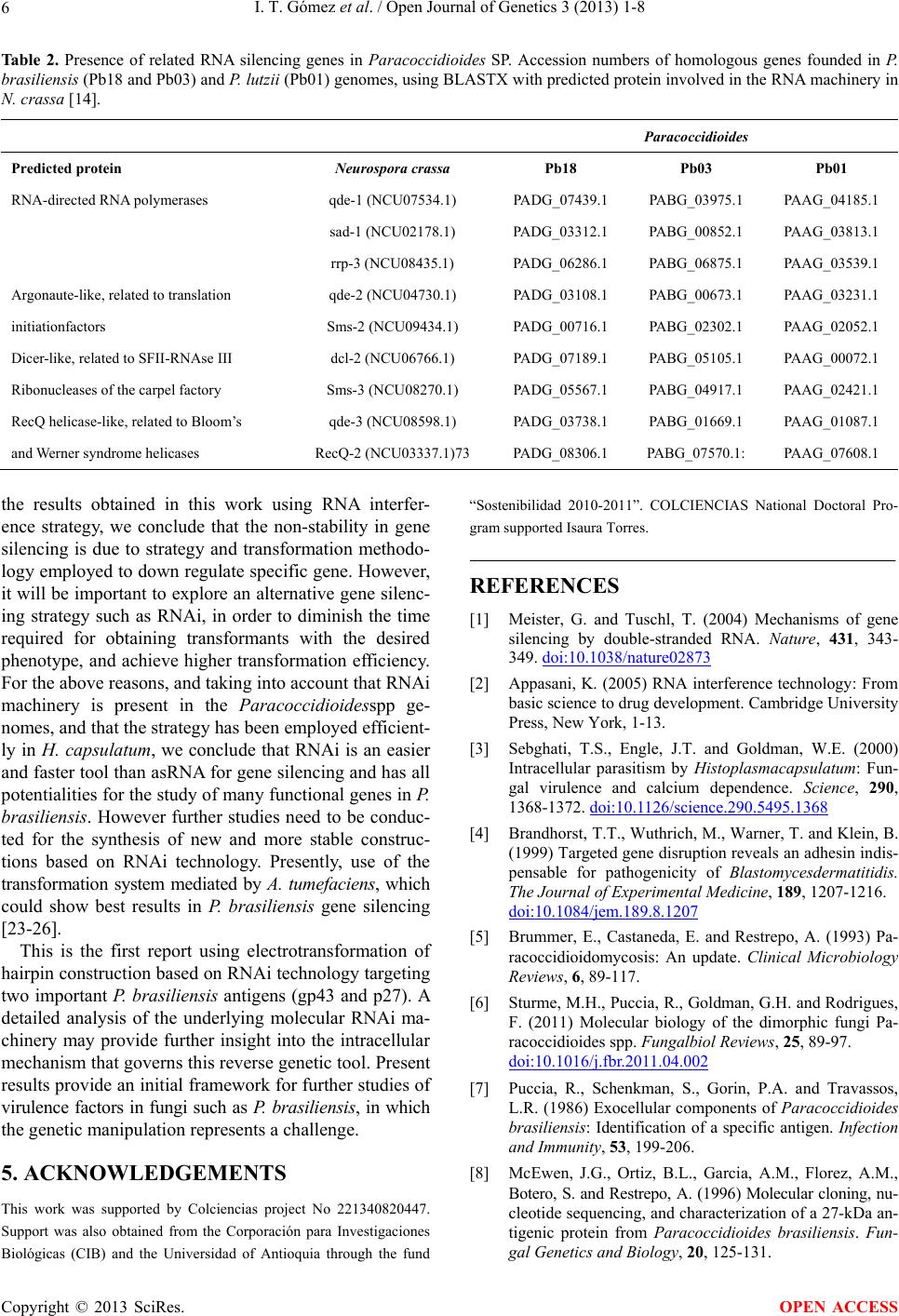 I. T. Gómez et al. / Open Journal of Genetics 3 (2013) 1-8 6 Table 2. Presence of related RNA silencing genes in Paracoccidioides SP. Accession numbers of homologous genes founded in P. brasiliensis (Pb18 and Pb03) and P. lutzii (Pb01) genomes, using BLASTX with predicted protein involved in the RNA machinery in N. crassa [14]. Paracoccidioides Predicted protein Neuros po ra c rassa Pb18 Pb03 Pb01 RNA-directed RNA polymerases qde-1 (NCU07534.1) PADG_07439.1 PABG_03975.1 PAAG_04185.1 sad-1 (NCU02178.1) PADG_03312.1 PABG_00852.1 PAAG_03813.1 rrp-3 (NCU08435.1) PADG_06286.1 PABG_06875.1 PAAG_03539.1 Argonaute-like, related to translation qde-2 (NCU04730.1) PADG_03108.1 PABG_00673.1 PAAG_03231.1 initiationfactors Sms-2 (NCU09434.1) PADG_00716.1 PABG_02302.1 PAAG_02052.1 Dicer-like, related to SFII-RNAse III dcl-2 (NCU06766.1) PADG_07189.1 PABG_05105.1 PAAG_00072.1 Ribonucleases of the carpel factory Sms-3 (NCU08270.1) PADG_05567.1 PABG_04917.1 PAAG_02421.1 RecQ helicase-like, related to Bloom’s qde-3 (NCU08598.1) PADG_03738.1 PABG_01669.1 PAAG_01087.1 and Werner syndrome helicases RecQ-2 (NCU03337.1)73 PADG_08306.1 PABG_07570.1: PAAG_07608.1 the results obtained in this work using RNA interfer- ence strategy, we conclude that the non-stability in gene silencing is due to strategy and transformation methodo- logy employed to down regulate specific gene. However, it will be important to explore an alternative gene silenc- ing strategy such as RNAi, in order to diminish the time required for obtaining transformants with the desired phenotype, and achieve higher transformation efficiency. For the above reasons, and taking into account that RNAi machinery is present in the Paracoccidioidesspp ge- nomes, and that the strategy has been employed efficient- ly in H. capsulatum, we conclude that RNAi is an easier and faster tool than asRNA for gene silencing and has all potentialities for the study of many functional genes in P. brasiliensis. However further studies need to be conduc- ted for the synthesis of new and more stable construc- tions based on RNAi technology. Presently, use of the transformation system mediated by A. tumefaciens, which could show best results in P. brasiliensis gene silencing [23-26]. This is the first report using electrotransformation of hairpin construction based on RNAi technology targeting two important P. brasiliensis antigens (gp43 and p27). A detailed analysis of the underlying molecular RNAi ma- chinery may provide further insight into the intracellular mechanism that governs this reverse genetic tool. Present results provide an initial framework for further studies of virulence factors in fungi such as P. brasiliensis, in which the genetic manipulation represents a challenge. 5. ACKNOWLEDGEMENTS This work was supported by Colciencias project No 221340820447. Support was also obtained from the Corporación para Investigaciones Biológicas (CIB) and the Universidad of Antioquia through the fund “Sostenibilidad 2010-2011”. COLCIENCIAS National Doctoral Pro- gram supported Isaura Torres. REFERENCES [1] Meister, G. and Tuschl, T. (2004) Mechanisms of gene silencing by double-stranded RNA. Nature, 431, 343- 349. doi:10.1038/nature02873 [2] Appasani, K. (2005) RNA interference technology: From basic science to drug development. Cambridge University Press, New York, 1-13. [3] Sebghati, T.S., Engle, J.T. and Goldman, W.E. (2000) Intracellular parasitism by Histoplasmacapsulatum: Fun- gal virulence and calcium dependence. Science, 290, 1368-1372. doi:10.1126/science.290.5495.1368 [4] Brandhorst, T.T., Wuthrich, M., Warner, T. and Klein, B. (1999) Targeted gene disruption reveals an adhesin indis- pensable for pathogenicity of Blastomycesdermatitidis. The Journal of Experimental Medicine, 189, 1207-1216. doi:10.1084/jem.189.8.1207 [5] Brummer, E., Castaneda, E. and Restrepo, A. (1993) Pa- racoccidioidomycosis: An update. Clinical Microbiology Reviews, 6, 89-117. [6] Sturme, M.H., Puccia, R., Goldman, G.H. and Rodrigues, F. (2011) Molecular biology of the dimorphic fungi Pa- racoccidioides spp. Fungalbiol Reviews, 25, 89-97. doi:10.1016/j.fbr.2011.04.002 [7] Puccia, R., Schenkman, S., Gorin, P.A. and Travassos, L.R. (1986) Exocellular components of Paracoccidioides brasiliensis: Identification of a specific antigen. Infection and Immunity, 53, 199-206. [8] McEwen, J.G., Ortiz, B.L., Garcia, A.M., Florez, A.M., Botero, S. and Restrepo, A. (1996) Molecular cloning, nu- cleotide sequencing, and characterization of a 27-kDa an- tigenic protein from Paracoccidioides brasiliensis. Fun- gal Genetics and Biology, 20, 125-131. Copyright © 2013 SciRes. OPEN ACCESS 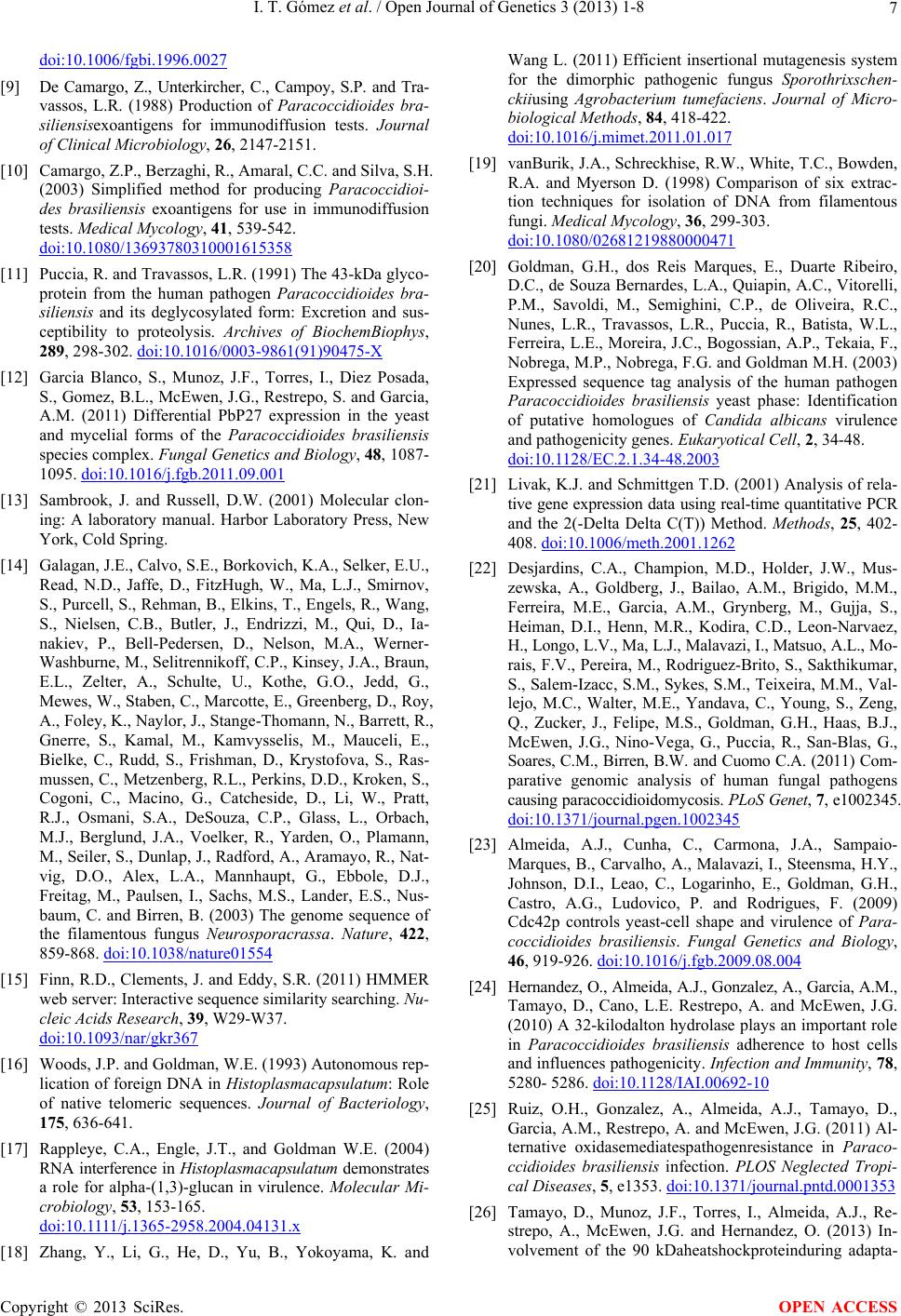 I. T. Gómez et al. / Open Journal of Genetics 3 (2013) 1-8 7 doi:10.1006/fgbi.1996.0027 [9] De Camargo, Z., Unterkircher, C., Campoy, S.P. and Tra- vassos, L.R. (1988) Production of Paracoccidioides bra- siliensisexoantigens for immunodiffusion tests. Journal of Clinical Microbiology, 26, 2147-2151. [10] Camargo, Z.P., Berzaghi, R., Amaral, C.C. and Silva, S.H. (2003) Simplified method for producing Paracoccidioi- des brasiliensis exoantigens for use in immunodiffusion tests. Medical Mycology, 41, 539-542. doi:10.1080/13693780310001615358 [11] Puccia, R. and Travassos, L.R. (1991) The 43-kDa glyco- protein from the human pathogen Paracoccidioides bra- siliensis and its deglycosylated form: Excretion and sus- ceptibility to proteolysis. Archives of BiochemBiophys, 289, 298-302. doi:10.1016/0003-9861(91)90475-X [12] Garcia Blanco, S., Munoz, J.F., Torres, I., Diez Posada, S., Gomez, B.L., McEwen, J.G., Restrepo, S. and Garcia, A.M. (2011) Differential PbP27 expression in the yeast and mycelial forms of the Paracoccidioides brasiliensis species complex. Fungal Genetics and Biology, 48, 1087- 1095. doi:10.1016/j.fgb.2011.09.001 [13] Sambrook, J. and Russell, D.W. (2001) Molecular clon- ing: A laboratory manual. Harbor Laboratory Press, New York, Cold Spring. [14] Galagan, J.E., Calvo, S.E., Borkovich, K.A., Selker, E.U., Read, N.D., Jaffe, D., FitzHugh, W., Ma, L.J., Smirnov, S., Purcell, S., Rehman, B., Elkins, T., Engels, R., Wang, S., Nielsen, C.B., Butler, J., Endrizzi, M., Qui, D., Ia- nakiev, P., Bell-Pedersen, D., Nelson, M.A., Werner- Washburne, M., Selitrennikoff, C.P., Kinsey, J.A., Braun, E.L., Zelter, A., Schulte, U., Kothe, G.O., Jedd, G., Mewes, W., Staben, C., Marcotte, E., Greenberg, D., Roy, A., Foley, K., Naylor, J., Stange-Thomann, N., Barrett, R., Gnerre, S., Kamal, M., Kamvysselis, M., Mauceli, E., Bielke, C., Rudd, S., Frishman, D., Krystofova, S., Ras- mussen, C., Metzenberg, R.L., Perkins, D.D., Kroken, S., Cogoni, C., Macino, G., Catcheside, D., Li, W., Pratt, R.J., Osmani, S.A., DeSouza, C.P., Glass, L., Orbach, M.J., Berglund, J.A., Voelker, R., Yarden, O., Plamann, M., Seiler, S., Dunlap, J., Radford, A., Aramayo, R., Nat- vig, D.O., Alex, L.A., Mannhaupt, G., Ebbole, D.J., Freitag, M., Paulsen, I., Sachs, M.S., Lander, E.S., Nus- baum, C. and Birren, B. (2003) The genome sequence of the filamentous fungus Neurosporacrassa. Nature, 422, 859-868. doi:10.1038/nature01554 [15] Finn, R.D., Clements, J. and Eddy, S.R. (2011) HMMER web server: Interactive sequence similarity searching. Nu- cleic Acids Research, 39, W29-W37. doi:10.1093/nar/gkr367 [16] Woods, J.P. and Goldman, W.E. (1993) Autonomous rep- lication of foreign DNA in Histoplasmacapsulatum: Role of native telomeric sequences. Journal of Bacteriology, 175, 636-641. [17] Rappleye, C.A., Engle, J.T., and Goldman W.E. (2004) RNA interference in Histoplasmacapsulatum demonstrates a role for alpha-(1,3)-glucan in virulence. Molecular Mi- crobiology, 53, 153-165. doi:10.1111/j.1365-2958.2004.04131.x [18] Zhang, Y., Li, G., He, D., Yu, B., Yokoyama, K. and Wang L. (2011) Efficient insertional mutagenesis system for the dimorphic pathogenic fungus Sporothrixschen- ckiiusing Agrobacterium tumefaciens. Journal of Micro- biological Methods, 84, 418-422. doi:10.1016/j.mimet.2011.01.017 [19] vanBurik, J.A., Schreckhise, R.W., White, T.C., Bowden, R.A. and Myerson D. (1998) Comparison of six extrac- tion techniques for isolation of DNA from filamentous fungi. Medical Mycology, 36, 299-303. doi:10.1080/02681219880000471 [20] Goldman, G.H., dos Reis Marques, E., Duarte Ribeiro, D.C., de Souza Bernardes, L.A., Quiapin, A.C., Vitorelli, P.M., Savoldi, M., Semighini, C.P., de Oliveira, R.C., Nunes, L.R., Travassos, L.R., Puccia, R., Batista, W.L., Ferreira, L.E., Moreira, J.C., Bogossian, A.P., Tekaia, F., Nobrega, M.P., Nobrega, F.G. and Goldman M.H. (2003) Expressed sequence tag analysis of the human pathogen Paracoccidioides brasiliensis yeast phase: Identification of putative homologues of Candida albicans virulence and pathogenicity genes. Eukaryotical Cell, 2, 34-48. doi:10.1128/EC.2.1.34-48.2003 [21] Livak, K.J. and Schmittgen T.D. (2001) Analysis of rela- tive gene expression data using real-time quantitative PCR and the 2(-Delta Delta C(T)) Method. Methods, 25, 402- 408. doi:10.1006/meth.2001.1262 [22] Desjardins, C.A., Champion, M.D., Holder, J.W., Mus- zewska, A., Goldberg, J., Bailao, A.M., Brigido, M.M., Ferreira, M.E., Garcia, A.M., Grynberg, M., Gujja, S., Heiman, D.I., Henn, M.R., Kodira, C.D., Leon-Narvaez, H., Longo, L.V., Ma, L.J., Malavazi, I., Matsuo, A.L., Mo- rais, F.V., Pereira, M., Rodriguez-Brito, S., Sakthikumar, S., Salem-Izacc, S.M., Sykes, S.M., Teixeira, M.M., Val- lejo, M.C., Walter, M.E., Yandava, C., Young, S., Zeng, Q., Zucker, J., Felipe, M.S., Goldman, G.H., Haas, B.J., McEwen, J.G., Nino-Vega, G., Puccia, R., San-Blas, G., Soares, C.M., Birren, B.W. and Cuomo C.A. (2011) Com- parative genomic analysis of human fungal pathogens causing paracoccidioidomycosis. PLoS Genet, 7, e1002345. doi:10.1371/journal.pgen.1002345 [23] Almeida, A.J., Cunha, C., Carmona, J.A., Sampaio- Marques, B., Carvalho, A., Malavazi, I., Steensma, H.Y., Johnson, D.I., Leao, C., Logarinho, E., Goldman, G.H., Castro, A.G., Ludovico, P. and Rodrigues, F. (2009) Cdc42p controls yeast-cell shape and virulence of Para- coccidioides brasiliensis. Fungal Genetics and Biology, 46, 919-926. doi:10.1016/j.fgb.2009.08.004 [24] Hernandez, O., Almeida, A.J., Gonzalez, A., Garcia, A.M., Tamayo, D., Cano, L.E. Restrepo, A. and McEwen, J.G. (2010) A 32-kilodalton hydrolase plays an important role in Paracoccidioides brasiliensis adherence to host cells and influences pathogenicity. Infection and Immunity, 78, 5280- 5286. doi:10.1128/IAI.00692-10 [25] Ruiz, O.H., Gonzalez, A., Almeida, A.J., Tamayo, D., Garcia, A.M., Restrepo, A. and McEwen, J.G. (2011) Al- ternative oxidasemediatespathogenresistance in Paraco- ccidioides brasiliensis infection. PLOS Neglected Tropi- cal Diseases, 5, e1353. doi:10.1371/journal.pntd.0001353 [26] Tamayo, D., Munoz, J.F., Torres, I., Almeida, A.J., Re- strepo, A., McEwen, J.G. and Hernandez, O. (2013) In- volvement of the 90 kDaheatshockproteinduring adapta- Copyright © 2013 SciRes. OPEN ACCESS 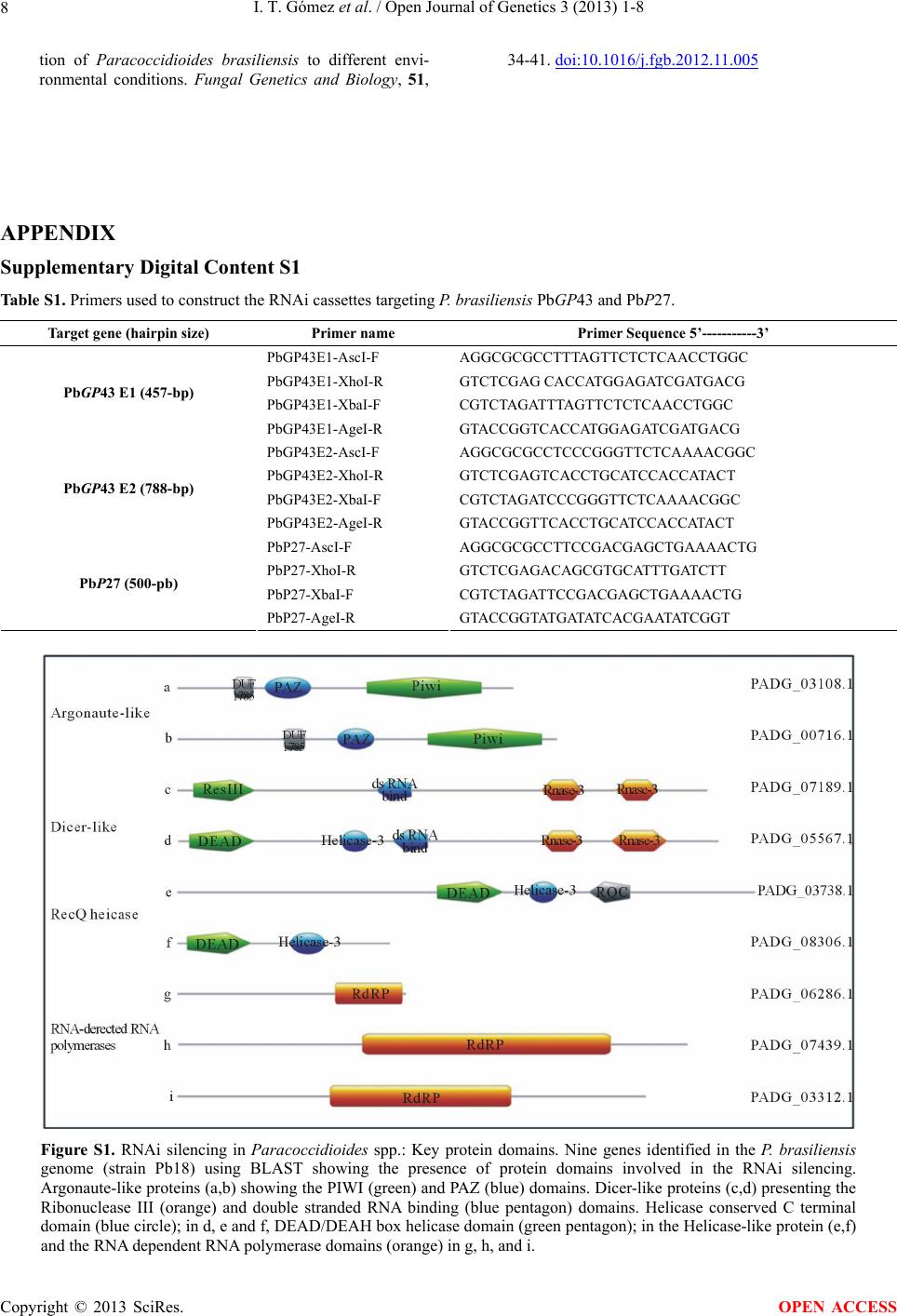 I. T. Gómez et al. / Open Journal of Genetics 3 (2013) 1-8 Copyright © 2013 SciRes. 8 tion of Paracoccidioides brasiliensis to different envi- ronmental conditions. Fungal Genetics and Biology, 51, 34-41. doi:10.1016/j.fgb.2012.11.005 APPENDIX Supplementary Digital Content S1 Table S1. Primers used to construct the RNAi cassettes targeting P. brasiliensis PbGP43 and PbP27. Target gene (hairpin size) Primer name Primer Sequence 5’-----------3’ PbGP43E1-AscI-F AGGCGCGCCTTTAGTTCTCTCAACCTGGC PbGP43E1-XhoI-R GTCTCGAG CACCATGGAGATCGATGACG PbGP43E1-XbaI-F CGTCTAGATTTAGTTCTCTCAACCTGGC PbGP43 E1 (457-bp) PbGP43E1-AgeI-R GTACCGGTCACCATGGAGATCGATGACG PbGP43E2-AscI-F AGGCGCGCCTCCCGGGTTCTCAAAACGGC PbGP43E2-XhoI-R GTCTCGAGTCACCTGCATCCACCATACT PbGP43E2-XbaI-F CGTCTAGATCCCGGGTTCTCAAAACGGC PbGP43 E2 (788-bp) PbGP43E2-AgeI-R GTACCGGTTCACCTGCATCCACCATACT PbP27-AscI-F AGGCGCGCCTTCCGACGAGCTGAAAACTG PbP27-XhoI-R GTCTCGAGACAGCGTGCATTTGATCTT PbP27-XbaI-F CGTCTAGATTCCGACGAGCTGAAAACTG PbP27 (500-pb) PbP27-AgeI-R GTACCGGTATGATATCACGAATATCGGT Figure S1. RNAi silencing in Paracoccidioides spp.: Key protein domains. Nine genes identified in the P. brasiliensis genome (strain Pb18) using BLAST showing the presence of protein domains involved in the RNAi silencing. Argonaute-like proteins (a,b) showing the PIWI (green) and PAZ (blue) domains. Dicer-like proteins (c,d) presenting the Ribonuclease III (orange) and double stranded RNA binding (blue pentagon) domains. Helicase conserved C terminal domain (blue circle); in d, e and f, DEAD/DEAH box helicase domain (green pentagon); in the Helicase-like protein (e,f) and the RNA dependent RNA polymerase domains (orange) in g, h, and i. OPEN ACCESS |