

Paper Menu >>
Journal Menu >>
 Optics and Photonics Journal, 2013, 3, 183-186 doi:10.4236/opj.2013.32B044 Published Online June 2013 (http://www.scirp.org/journal/opj) Copyright © 2013 SciRes. OPJ Experimental Investigation of Improving the Performance of the Chaotic Optical Communication with Chaos-Masking through Wavelength Mismatch* Wei Chang, Xiaolei Chen, Qingchun Zhao, Hongxi Yin, Nan Zhao Lab of Optical Communications and Photonic Technology, School of Information and Communication Engineering, Dalian University of Technology, Dalian, China Email: [email protected] Received 2013 ABSTRACT In this paper, the wavelength mismatch between the message and the chaotic carrier in the chaotic optical communica- tion with c hao s-ma ski ng ha s b een e xpe ri mental ly i nve stiga te d. T he result s sho w t hat the d ec ryptio n p erfo rma nce o f t he receiver can be improved when the message wavelength is greater than that of the chaotic carrier. When the wavelength offset i s set to 0.12 nm, high-speed secure optical communication with a message of 2.5 Gbits/s is achieved. Keywords: Chaos Masking; Chaotic Synchronization; Chaotic Communication; Wavelength Mismatch 1. Introduction As a hardware-based encryption technique at the physical layer, the chaotic optical communication has attracted extensive interests from the community of secure and optical communications during the past decade [1,2]. At the receiver, the message can be filtered out by the re- ceiver laser, and the chaotic carrier that synchronizes with the carrier generated by the transmitter can be ob- tained. Then, the message can be decrypted by subtract- ing the output of the receiver laser from the encrypted signal [3 ,4] . With the in-depth exploring the secure chao- tic optical communication, the issues for secure chaotic optical communication mainly focus on bandwidth en- hancement [5], generation of novel chaotic carriers [6], chaotic photonic integrated circuits (PICs) [7], and bidi- rectional communications [8]. It is important to solve these issues for which can improve the performance of the system and promote the practical applications. How- ever, the encryption schemes as well as the relationship between the message and the chaotic carrier is the most important factor, which constraints the performance of the secure chaotic optical communication system direct- ly. At present, three encryption schemes have been pro- posed for the secure chaotic optical communications, name ly, chaos modulation (CM), chaos masking (CMS), and chaos shift-keying (CSK) [9]. For simple physical processes and convenient achievement, CMS is the most common encryption scheme. Argyris et al. experimen- tally investigated the performance of the three encryption schemes with a message of 1.5 Gbits/s [10]. However, it is still a problem being worthy further investigating how to improve the performance of different encryption schemes and to promote the data-rate of message. In this p aper , the misma tch o f the wavel engt h between the message and the chaotic carrier in the secure chaos- masking optical communication has been experimentally investigated. The relationship between the mismatch of the wavelength and the performance of the system has been quantitatively analyzed. When the wavelength off- set is set to 0.12 nm, high-speed secure communication with a message of 2.5 Gbits/s has been achieved experi- mentally. 2. Experimental Setup Figure 1 shows the experimental setup of the secure optical communication system with chaos-masking. The chaotic carrier is generated by optical feedback. The cir- culator, optical coupler (OC), and the variable optical attenuator (VOA) constitute the fiber-loop. The chaotic carrier is then split into two paths by a 50:50 OC after amplified by an Erbium-doped fiber amplifier (EDFA). The upper path is used for encrypting the secure message by CMS, and the lower path is transmitted as a secure *This work is supported in part by the National Natural Science Foun- dation of China (NSFC) under Grants 61071123, 61172059, and 6120122 4, the Funds for Ph. D. Studen t Academic New Investi gator of Ministry of Education of China, and the Natural Science Foundation of Changzhou City under CJ20 120015. 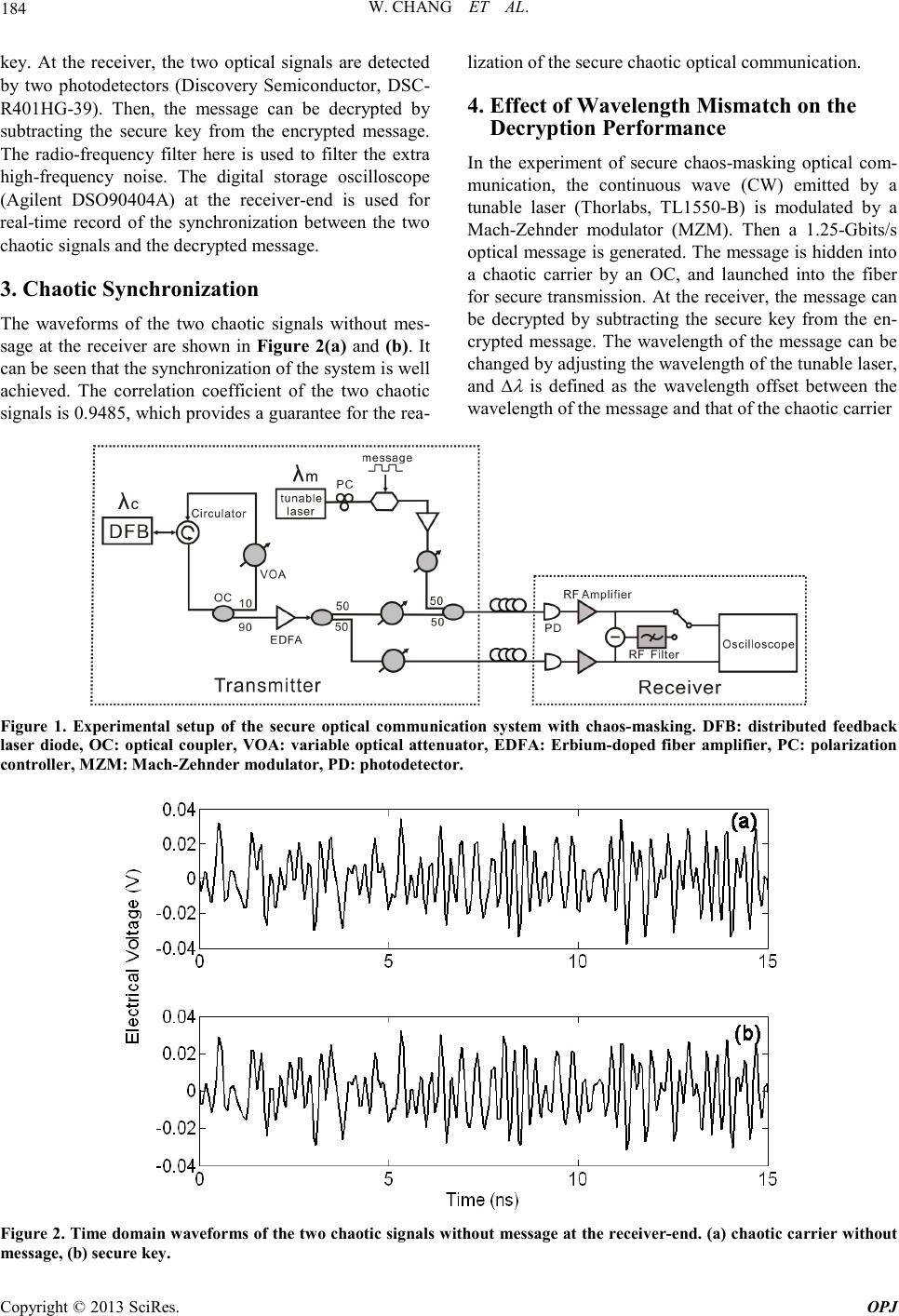 W. CHANG ET AL. Copyright © 2013 SciRes. OPJ 184 key. At the receiver, the two optical signals are detected by two photodetectors (Discovery Semiconductor, DSC- R401HG-39). Then, the message can be decrypted by subtracting the secure key from the encrypted message. The radio-frequency filter here is used to filter the extra high-frequency noise. The digital storage oscilloscope (Agilent DSO90404A) at the receiver-end is used for real-time record of the synchronization between the two chaotic signals and the decrypted message. 3. Chaotic Synchronization The waveforms of the two chaotic signals without mes- sage at the receiver are shown in Figure 2(a) and (b). It can be seen that the synchronization of the system is well achieved. The correlation coefficient of the two chaotic signals is 0.9485, which provides a guarantee for the rea- lization of the secure chaotic optical communication. 4. Effect of Wavelength Mismatch on the Decrypti on Perf ormanc e In the experiment of secure chaos-masking optical com- munication, the continuous wave (CW) emitted by a tunable laser (Thorlabs, TL1550-B) is modulated by a Mach-Zehnder modulator (MZM). Then a 1.25-Gbits/s optical message is ge nera ted. T he messa ge is hidde n into a chaotic carrier by an OC, and launched into the fiber for secure transmission. At the receiver, the message can be decrypted by subtracting the secure key from the en- crypted message. The wavelength of the message can be changed by adjusting the wavelength of the tunable laser, and ∆ λ is defined as the wavelength offset between the wavelength of the message and that of the chaotic carrier Figure 1. Experimental setup of the secure optical communication system with chaos-masking. DFB: distributed feedback laser diode, OC: optical coupler, VOA: variable optical attenuator, EDFA: Erbium-doped fiber amplifier, PC: polarization controller, MZM: Mac h-Zehnder modulator, PD: photodetecto r. Figure 2 . Time domain wavefo rms of the t wo chaot ic signals w ithout message at t he receiver-end. (a) c haotic carrier w ithout message, ( b) s ecure key. 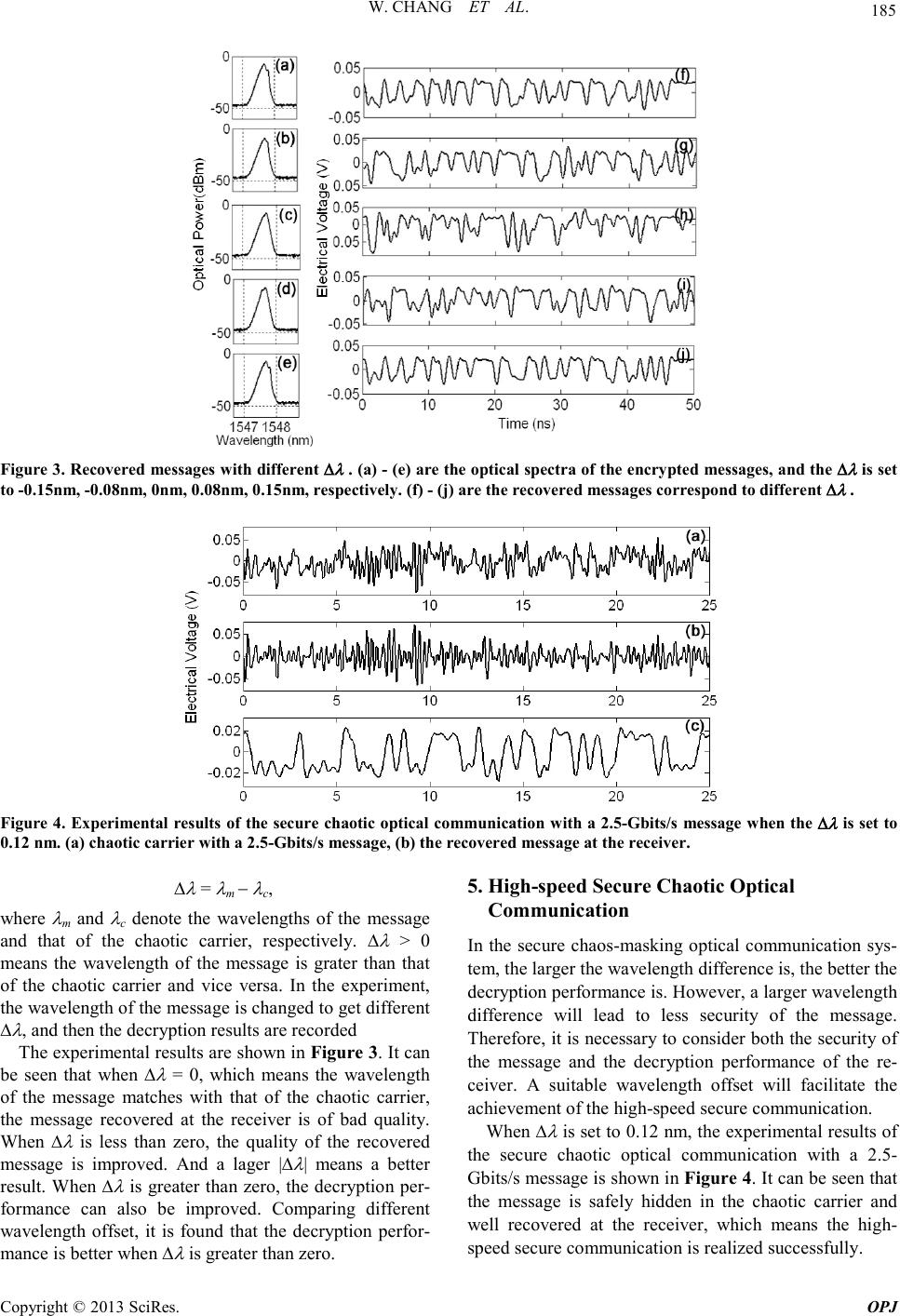 W. CHANG ET AL. Copyright © 2013 SciRes. OPJ 185 Figure 3 . Recovered messag es wi th different ∆ λ . (a) - (e) are the o ptical spectr a of the encry pted messages, and the ∆ λ is set to -0.15nm, -0.08nm, 0nm, 0.08nm, 0.15nm, respectively. (f) - (j) are the recovere d messages corres pond to different ∆ λ . Figure 4. Experimental results of the secure chaotic optical communication with a 2.5-Gbits/s message when the ∆ λ is set to 0.12 nm. (a) chaotic carri er with a 2.5-Gbits/ s message, ( b) t he recovered messag e at t he receiver. ∆ λ = λ m − λ c, where λ m and λ c denote the wavelengths of the message and that of the chaotic carrier, respectively. ∆ λ > 0 means the wavelength of the message is grater than that of the chaotic carrier and vice versa. In the experiment, the wa ve lengt h o f the messa g e is c ha n ge d t o ge t d i ffe rent ∆ λ , and then the decryption results are recorded The experimental results are shown in Figure 3. It can be seen that when ∆ λ = 0, which means the wavelength of the message matches with that of the chaotic carrier, the message recovered at the receiver is of bad quality. When ∆ λ is less than zero, the quality of the recovered message is improved. And a lager |∆ λ | means a better result. W hen ∆ λ is greater than zero, the decryption per- formance can also be improved. Comparing different wavelength offset, it is found that the decryption perfor- mance is better when ∆ λ is greater than zero. 5. High-speed Secure Chaotic Optical Comm unication In the secure chaos-masking optical communication sys- tem, the larger the wavelength difference is, the better the decryption performance is. However, a larger wavelength difference will lead to less security of the message. Therefore, it is necessary to consider both the security of the message and the decryption performance of the re- ceiver. A suitable wavelength offset will facilitate the achievement of the high-speed secure communication. When ∆ λ is set to 0.12 nm, the experimental results of the secure chaotic optical communication with a 2.5- Gbit s/s me ssa ge i s sho wn i n Figure 4. I t can be seen that the message is safely hidden in the chaotic carrier and well recovered at the receiver, which means the high- speed secure communication is realized successfully. 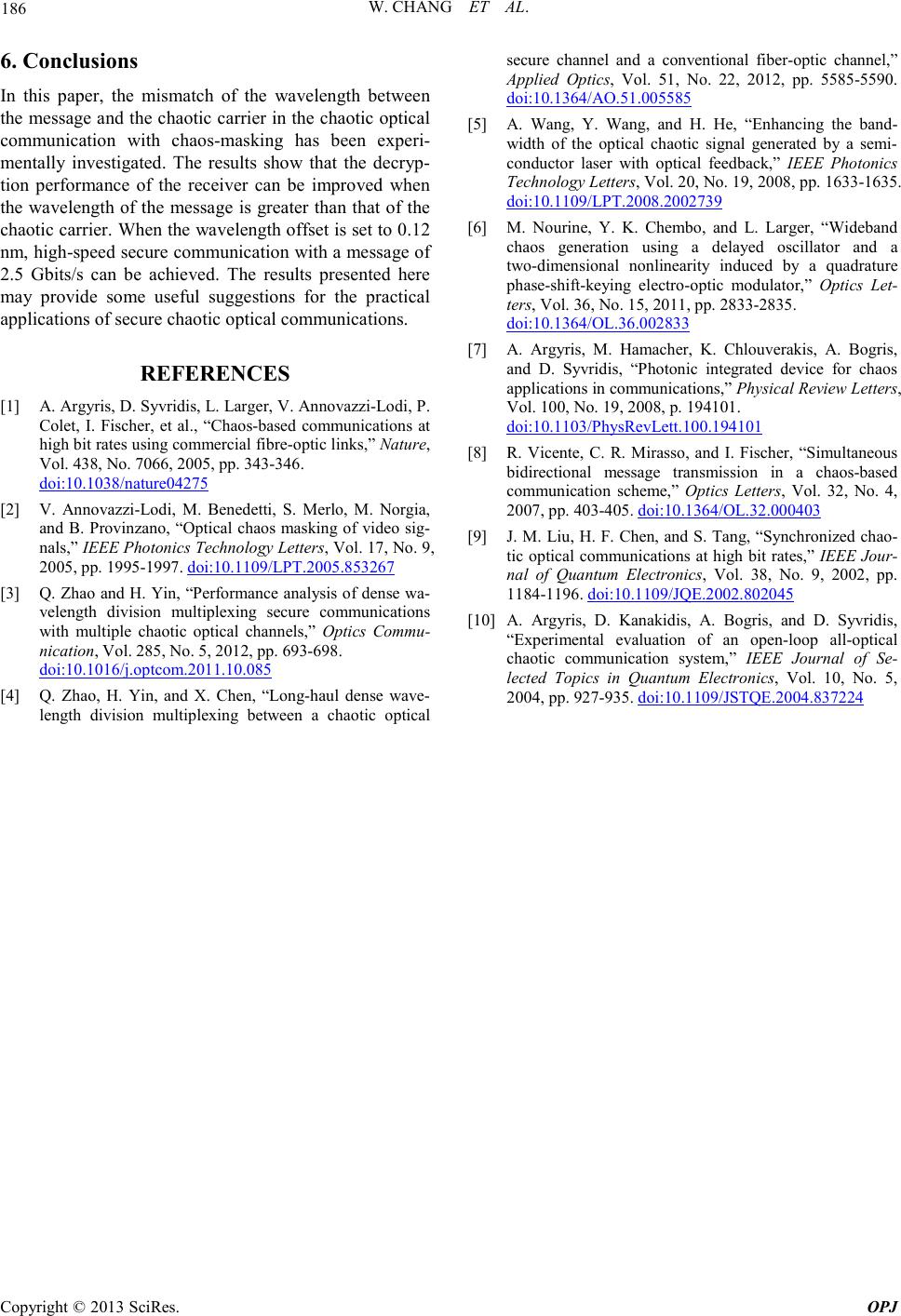 W. CHANG ET AL. Copyright © 2013 SciRes. OPJ 186 6. Conclusions In this paper, the mismatch of the wavelength between the message and the chaotic carrier in the chaotic optical communication with chaos-masking has been experi- mentally investigated. The results show that the decryp- tion performance of the receiver can be improved when the wa velength of the message is greater than that of the chaotic carrier. When the wavelength offset is set to 0.12 nm, high-speed secure communication with a message of 2.5 Gbits/s can be achieved. The results presented here may provide some useful suggestions for the practical applications of secure chaotic op tic a l c ommunications. REFERENCES [1] A. Argyris, D. Syvridis, L. Larger, V. Annovazzi-Lodi, P. Colet, I. Fischer, et al., “Chaos-based communications at high bit rates using commercial fib re-o ptic links,” Nature, Vol. 438, No. 7066, 2005, pp. 343-346. doi:10.1038/nature04275 [2] V. Annovazzi-Lodi, M. Benedetti, S. Merlo, M. Norgia, and B. Provinzano, “Optical chaos masking of video sig- nals,” I EEE Photon ics Techno logy Letter s, Vol. 17, No. 9, 2005, pp . 1995-1997. doi:10.1109/LPT.2005.853267 [3] Q. Zhao and H. Yin, “Performance analysis o f dense wa- velength division multiplexing secure communications with multiple chaotic optical channels,” Optics Commu- nication, Vol. 285, No. 5, 2012, pp. 693-698. doi:10.1016/j.optcom.2011.10.085 [4] Q. Zhao, H. Yin, and X. Chen, “Long-haul dense wave- length division multiplexing between a chaotic optical secure channel and a conventional fiber-optic channel,” Applied Optics, Vol. 51, No. 22, 2012, pp. 5585-5590. doi:10.1364/AO.51.005585 [5] A. Wang, Y. Wang, and H. He, “Enhancing the band- width of the optical chaotic signal generated by a semi- conductor laser with optical feedback,” IEEE Photonics Technology Letters, Vol. 20, No. 19, 2008, pp. 1633-1635. doi:10.1109/LPT.2008.2002739 [6] M. Nourine, Y. K. Chembo, and L. Larger, “Wideband chaos generation using a delayed oscillator and a two-dimensional nonlinearity induced by a quadrature phase-shift-keying electro-optic modulator,” Optics Let- ters, Vol. 36, No. 15, 201 1, pp . 2833 -2835. doi:10.1364/OL.36.002833 [7] A. Argyris, M. Hamacher, K. Chlouverakis, A. Bogris, and D. Syvridis, “Photonic integrated device for chaos applications in communications,” Ph ysica l Review L ett ers, Vol. 100, No. 19, 2008, p. 194101. doi:10.1103/PhysRevLett.100.194101 [8] R. Vicente, C. R. Mirasso, and I. Fischer, “Simultaneous bidirectional message transmission in a chaos-based communication scheme,” Optics Letters, Vol. 32, No. 4, 2007, pp . 403-405. doi:10.1364/OL.32.000403 [9] J. M. Liu, H. F. Chen, and S. Tang, “Synchronized chao- tic optical communications at high bit rates,” IEEE Jour- nal of Quantum Electronics, Vol. 38, No. 9, 2002, pp. 1184-1196. doi:10.1109/JQE.2002.802045 [10] A. Argyris, D. Kanakidis, A. Bogris, and D. Syvridis, “Experimental evaluation of an open-loop all-optical chaotic communication system,” IEEE Journal of Se- lected Topics in Quantum Electronics, Vol. 10, No. 5, 2004, pp . 927-935. doi:10.1109/JSTQE.2004.837224 |