

Paper Menu >>
Journal Menu >>
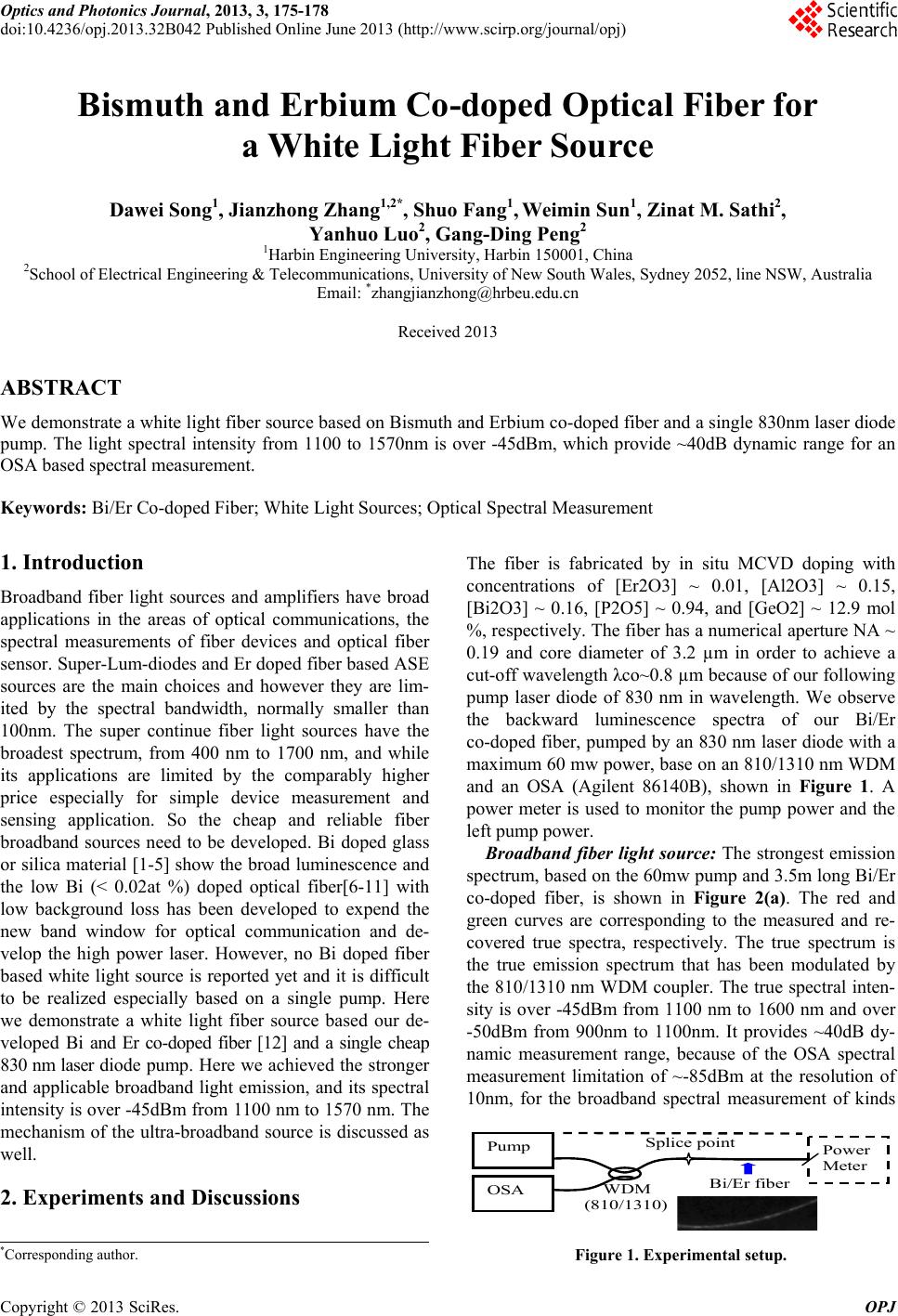 Optics and Photonics Journal, 2013, 3, 175-178 doi:10.4236/opj.2013.32B042 Published Online June 2013 (http://www.scirp.org/journal/opj) Bismuth and Erbium Co-doped Optical Fiber for a White Light Fiber Source Dawei Song1, Jianzhong Zhang1,2*, Shuo Fang1, Weimin Sun1, Zinat M. Sathi2, Yanhuo Luo2, Gang-Ding Peng2 1Harbin Engineering University, Harbin 150001, China 2School of Electrical Engineering & Telecommunications, University of New South Wales, Sydney 2052, line NSW, Australia Email: *[email protected] Received 2013 ABSTRACT We demonstrate a white light fiber source based on Bismuth and Erbium co-doped fiber and a single 830nm laser diode pump. The light spectral intensity from 1100 to 1570nm is over -45dBm, which provide ~40dB dynamic range for an OSA based spectral measurement. Keywords: Bi/Er Co-doped Fiber; White Light Sources; Optical Spectral Measurement 1. Introduction Broadband fiber light sources and amplifiers have broad applications in the areas of optical communications, the spectral measurements of fiber devices and optical fiber sensor. Super-Lum-diodes and Er doped fiber based ASE sources are the main choices and however they are lim- ited by the spectral bandwidth, normally smaller than 100nm. The super continue fiber light sources have the broadest spectrum, from 400 nm to 1700 nm, and while its applications are limited by the comparably higher price especially for simple device measurement and sensing application. So the cheap and reliable fiber broadband sources need to be developed. Bi doped glass or silica material [1-5] show the broad luminescence and the low Bi (< 0.02at %) doped optical fiber[6-11] with low background loss has been developed to expend the new band window for optical communication and de- velop the high power laser. However, no Bi doped fiber based white light source is reported yet and it is difficult to be realized especially based on a single pump. Here we demonstrate a white light fiber source based our de- veloped Bi and Er co-doped fiber [12] and a single cheap 830 nm laser diode pump. Here we achieved the stronger and applicable broadband light emission, and its spectral intensity is over -45dBm from 1100 nm to 1570 nm. The mechanism of the ultra-broadband source is discussed as well. 2. Experiments and Discussions The fiber is fabricated by in situ MCVD doping with concentrations of [Er2O3] ~ 0.01, [Al2O3] ~ 0.15, [Bi2O3] ~ 0.16, [P2O5] ~ 0.94, and [GeO2] ~ 12.9 mol %, respectively. The fiber has a numerical aperture NA ~ 0.19 and core diameter of 3.2 µm in order to achieve a cut-off wavelength λco~0.8 µm because of our following pump laser diode of 830 nm in wavelength. We observe the backward luminescence spectra of our Bi/Er co-doped fiber, pumped by an 830 nm laser diode with a maximum 60 mw power, base on an 810/1310 nm WDM and an OSA (Agilent 86140B), shown in Figure 1. A power meter is used to monitor the pump power and the left pump power. Broadband fiber light source: The strongest emission spectrum, based on the 60mw pump and 3.5m long Bi/Er co-doped fiber, is shown in Figure 2(a). The red and green curves are corresponding to the measured and re- covered true spectra, respectively. The true spectrum is the true emission spectrum that has been modulated by the 810/1310 nm WDM coupler. The true spectral inten- sity is over -45dBm from 1100 nm to 1600 nm and over -50dBm from 900nm to 1100nm. It provides ~40dB dy- namic measurement range, because of the OSA spectral measurement limitation of ~-85dBm at the resolution of 10nm, for the broadband spectral measurement of kinds Pump OSA WDM (810/1310) Splice point Bi/Er fiber Power Meter *Corresponding author. Figure 1. Experimental setup. Copyright © 2013 SciRes. OPJ 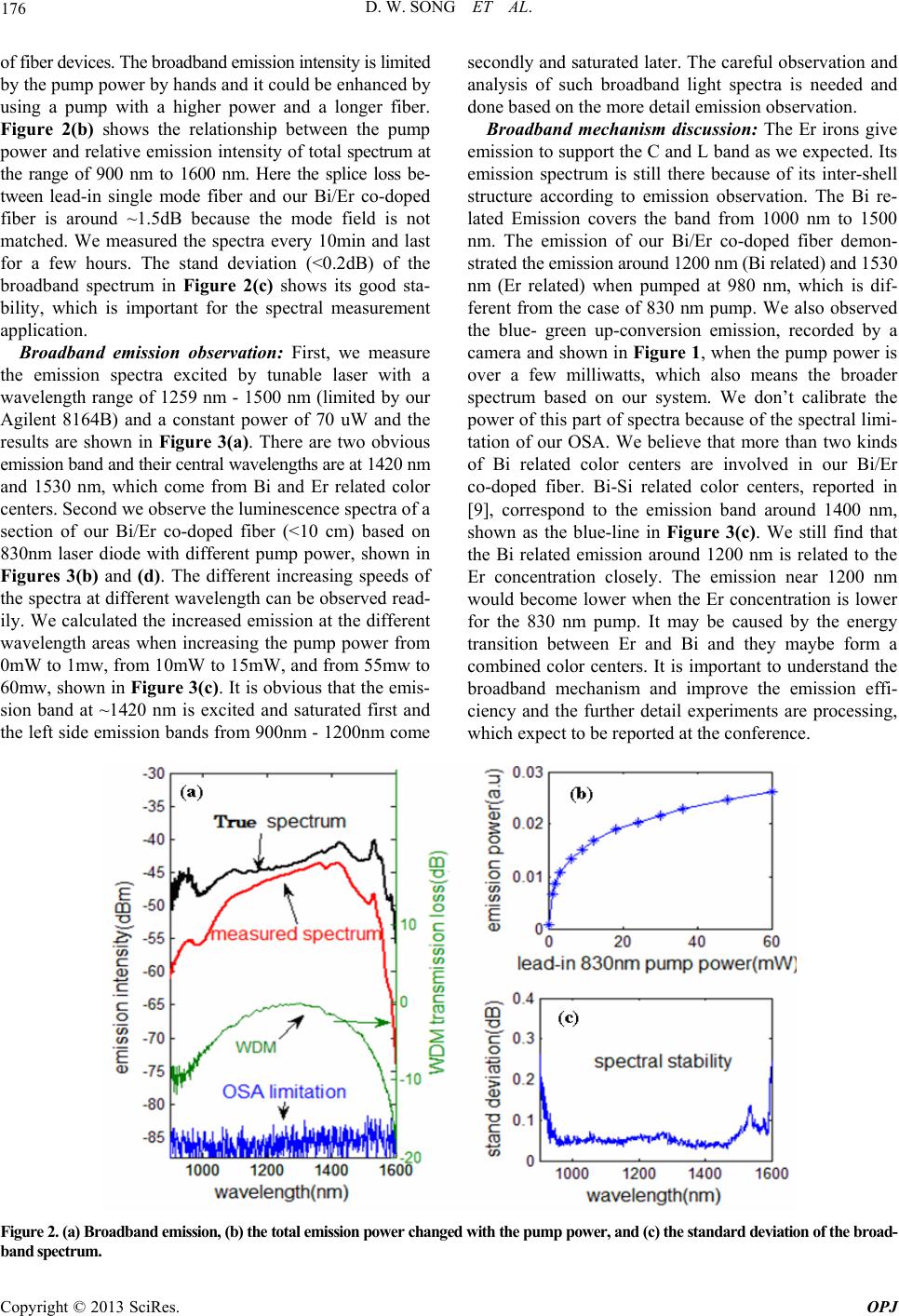 D. W. SONG ET AL. 176 of fiber devices. The broadband emission intensity is limited by the pump power by hands and it could be enhanced by using a pump with a higher power and a longer fiber. Figure 2(b) shows the relationship between the pump power and relative emission intensity of total spectrum at the range of 900 nm to 1600 nm. Here the splice loss be- tween lead-in single mode fiber and our Bi/Er co-doped fiber is around ~1.5dB because the mode field is not matched. We measured the spectra every 10min and last for a few hours. The stand deviation (<0.2dB) of the broadband spectrum in Figure 2(c) shows its good sta- bility, which is important for the spectral measurement application. Broadband emission observation: First, we measure the emission spectra excited by tunable laser with a wavelength range of 1259 nm - 1500 nm (limited by our Agilent 8164B) and a constant power of 70 uW and the results are shown in Figure 3(a). There are two obvious emission band and their central wavelengths are at 1420 nm and 1530 nm, which come from Bi and Er related color centers. Second we observe the luminescence spectra of a section of our Bi/Er co-doped fiber (<10 cm) based on 830nm laser diode with different pump power, shown in Figures 3(b) and (d). The different increasing speeds of the spectra at different wavelength can be observed read- ily. We calculated the increased emission at the different wavelength areas when increasing the pump power from 0mW to 1mw, from 10mW to 15mW, and from 55mw to 60mw, shown in Figure 3(c). It is obvious that the emis- sion band at ~1420 nm is excited and saturated first and the left side emission bands from 900nm - 1200nm come secondly and saturated later. The careful observation and analysis of such broadband light spectra is needed and done based on the more detail emission observation. Broadband mechanism discussion: The Er irons give emission to support the C and L band as we expected. Its emission spectrum is still there because of its inter-shell structure according to emission observation. The Bi re- lated Emission covers the band from 1000 nm to 1500 nm. The emission of our Bi/Er co-doped fiber demon- strated the emission around 1200 nm (Bi related) and 1530 nm (Er related) when pumped at 980 nm, which is dif- ferent from the case of 830 nm pump. We also observed the blue- green up-conversion emission, recorded by a camera and shown in Figure 1, when the pump power is over a few milliwatts, which also means the broader spectrum based on our system. We don’t calibrate the power of this part of spectra because of the spectral limi- tation of our OSA. We believe that more than two kinds of Bi related color centers are involved in our Bi/Er co-doped fiber. Bi-Si related color centers, reported in [9], correspond to the emission band around 1400 nm, shown as the blue-line in Figure 3(c). We still find that the Bi related emission around 1200 nm is related to the Er concentration closely. The emission near 1200 nm would become lower when the Er concentration is lower for the 830 nm pump. It may be caused by the energy transition between Er and Bi and they maybe form a combined color centers. It is important to understand the broadband mechanism and improve the emission effi- ciency and the further detail experiments are processing, which expect to be reported at the conference. Figure 2. (a) Broadband emission, (b) the total emiss ion p ower changed with the pump power, and (c) the standard deviation of the broad- band spectrum. Copyright © 2013 SciRes. OPJ 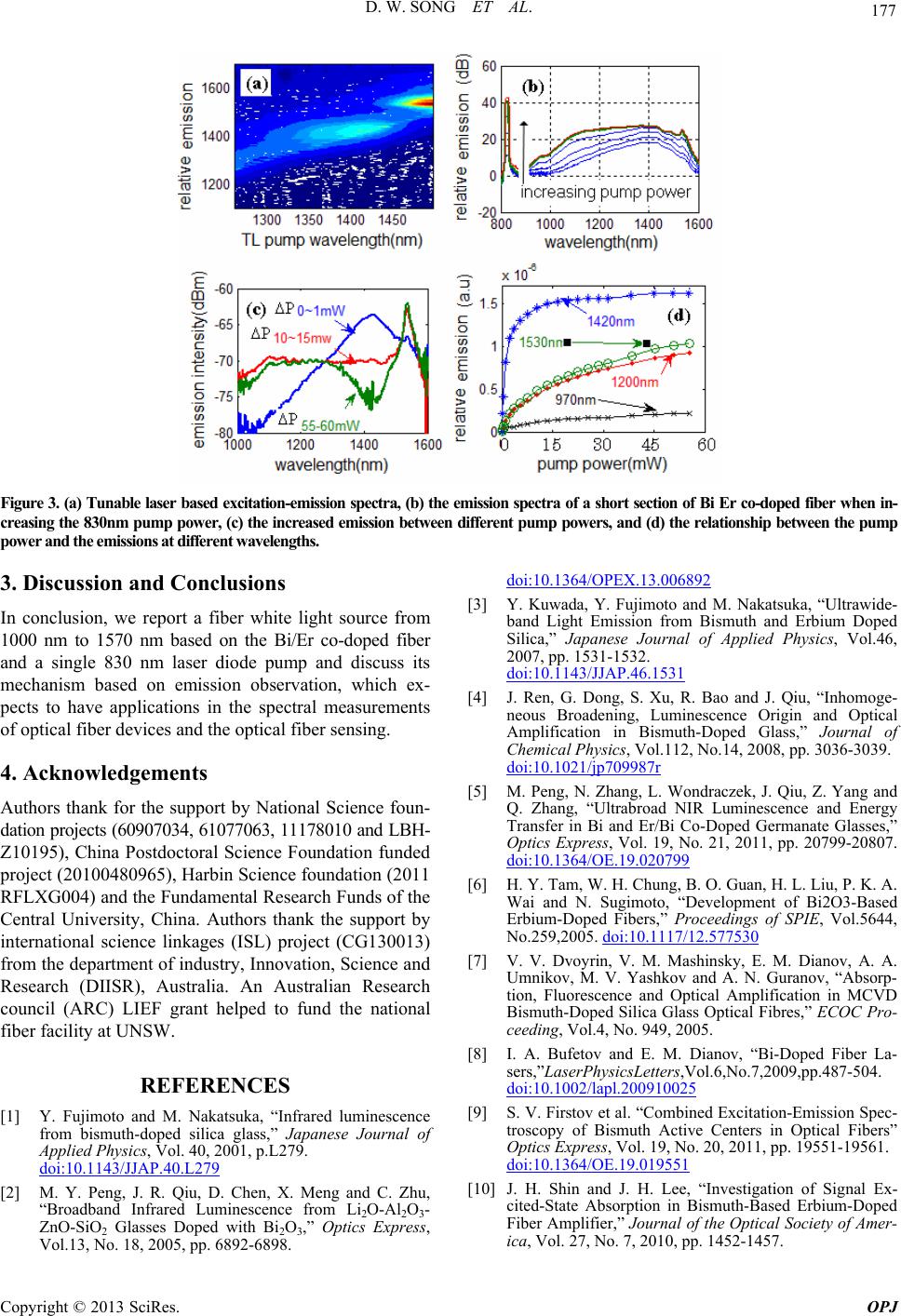 D. W. SONG ET AL. 177 Figure 3. (a) Tunable laser based excitation-emission spectra, (b) the emission spectra of a short section of Bi Er co-doped fiber when in- creasing the 830nm pump power, (c) the increased emission between different pump powers, and (d) the relationship between the pump power and the emissions at different wavelengths. 3. Discussion and Conclusions In conclusion, we report a fiber white light source from 1000 nm to 1570 nm based on the Bi/Er co-doped fiber and a single 830 nm laser diode pump and discuss its mechanism based on emission observation, which ex- pects to have applications in the spectral measurements of optical fiber devices and the optical fiber sensing. 4. Acknowledgements Authors thank for the support by National Science foun- dation projects (60907034, 61077063, 11178010 and LBH- Z10195), China Postdoctoral Science Foundation funded project (20100480965), Harbin Science foundation (2011 RFLXG004) and the Fundamental Research Funds of the Central University, China. Authors thank the support by international science linkages (ISL) project (CG130013) from the department of industry, Innovation, Science and Research (DIISR), Australia. An Australian Research council (ARC) LIEF grant helped to fund the national fiber facility at UNSW. REFERENCES [1] Y. Fujimoto and M. Nakatsuka, “Infrared luminescence from bismuth-doped silica glass,” Japanese Journal of Applied Physics, Vol. 40, 2001, p.L279. doi:10.1143/JJAP.40.L279 [2] M. Y. Peng, J. R. Qiu, D. Chen, X. Meng and C. Zhu, “Broadband Infrared Luminescence from Li2O-Al2O3- ZnO-SiO2 Glasses Doped with Bi2O3,” Optics Express, Vol.13, No. 18, 2005, pp. 6892-6898. doi:10.1364/OPEX.13.006892 [3] Y. Kuwada, Y. Fujimoto and M. Nakatsuka, “Ultrawide- band Light Emission from Bismuth and Erbium Doped Silica,” Japanese Journal of Applied Physics, Vol.46, 2007, pp. 1531-1532. doi:10.1143/JJAP.46.1531 [4] J. Ren, G. Dong, S. Xu, R. Bao and J. Qiu, “Inhomoge- neous Broadening, Luminescence Origin and Optical Amplification in Bismuth-Doped Glass,” Journal of Chemical Physics, Vol.112, No.14, 2008, pp. 3036-3039. doi:10.1021/jp709987r [5] M. Peng, N. Zhang, L. Wondraczek, J. Qiu, Z. Yang and Q. Zhang, “Ultrabroad NIR Luminescence and Energy Transfer in Bi and Er/Bi Co-Doped Germanate Glasses,” Optics Express, Vol. 19, No. 21, 2011, pp. 20799-20807. doi:10.1364/OE.19.020799 [6] H. Y. Tam, W. H. Chung, B. O. Guan, H. L. Liu, P. K. A. Wai and N. Sugimoto, “Development of Bi2O3-Based Erbium-Doped Fibers,” Proceedings of SPIE, Vol.5644, No.259,2005. doi:10.1117/12.577530 [7] V. V. Dvoyrin, V. M. Mashinsky, E. M. Dianov, A. A. Umnikov, M. V. Yashkov and A. N. Guranov, “Absorp- tion, Fluorescence and Optical Amplification in MCVD Bismuth-Doped Silica Glass Optical Fibres,” ECOC Pro- ceeding, Vol.4, No. 949, 2005. [8] I. A. Bufetov and E. M. Dianov, “Bi-Doped Fiber La- sers,”LaserPhysicsLe tters,Vol.6,No.7,2009,pp.487-504. doi:10.1002/lapl.200910025 [9] S. V. Firstov et al. “Combined Excitation-Emission Spec- troscopy of Bismuth Active Centers in Optical Fibers” Optics Express, Vol. 19, No. 20, 2011, pp. 19551-19561. doi:10.1364/OE.19.019551 [10] J. H. Shin and J. H. Lee, “Investigation of Signal Ex- cited-State Absorption in Bismuth-Based Erbium-Doped Fiber Amplifier,” Journal of the Optical Society of Amer- ica, Vol. 27, No. 7, 2010, pp. 1452-1457. Copyright © 2013 SciRes. OPJ  D. W. SONG ET AL. 178 doi:10.1364/JOSAB.27.001452 [11] Y. Q. Qiu, X. Y. Dong and C. L. Zhao, “Spectral Charac- teristics of the Erbium-Bismuth Co-Doped Silica Fibers and its Application in Single Frequency Fiber Laser,” Laser Physics, Vol. 20, No. 6, 2010, pp. 1418-1424. doi:10.1134/S1054660X10110186 [12] Y. H. Luo, J. X. Wen, J. Z. Zhang, J. Canning and G. D. Peng, “Bismuth and Erbium Codoped Optical Fiber with Ultra Broadband Luminescence Across O-, E-, S-, C-, and L-bands” Optics Letters, Vol. 37, No. 16, 2012, pp. 3447-3449. doi:10.1364/OL.37.003447 Copyright © 2013 SciRes. OPJ |