

Paper Menu >>
Journal Menu >>
 Optics and Photonics Journal, 2013, 3, 171-174 doi:10.4236/opj.2013.32B041 Published Online June 2013 (http://www.scirp.org/journal/opj) A Novel Method with Martingale Theory for Phase Noise Analysis in Coherent Optical Communication Chengle Sui1, Qiangmin Wang2, Shilin Xiao1, Pingqing Li1 1State Key Lab of Advanced Optical Communication System and Networks, Shanghai Jiao Tong University, Shanghai, China 2School of Information Security Engineering Shanghai Jiao Tong University, Shanghai, China Email: [email protected], [email protected] Received 2013 ABSTRACT Phase noise has a great influence on the performance of coherent optical communication. In this paper, martingale the- ory is introduced to analyze the phase noise effect for the first time as far as we know. Through Fubini’s Theory and martingale representation th eory, we proved that 0 1exp()( ) t s jWlsds T , which denotes the phase noise effect, is a pre- dictable martingale. Then Ito’s formula for solution to stochastic differential equation is utilized for the analysis of phase noise effect. Using our method, a nonrecursive formula for the moments of phase noise is derived and signal- noise-ratio (SNR) degradation in coherent optical OFDM due to phase noise is calculated with our method. Keywords: Martingale; Brownian Motion; Ito Itegral; Derivation of Moments; Phase Noise 1. Introduction Phase noise greatly limits the performance of coherent optical communication [1], especially on the condition that recent advances in modulation formats and multi- symbol detection are more and more widely introduced in optical communication system nowadays[2-3]. There- fore, the impact of phase noise has been investigated in a lot of great works. Generally, evaluating the impact of phase noises is difficult, because it’s too hard to fully assess the stochastic property of laser phase noise (LPN) Wiener process and nonlinear effect induced phase noise accurately. There are mainly two methods to evaluate phase noise effect: alternative moment method [4] and perturbation method [5]. Both of these two methods try to find a cer- tain kind of expansion to approach the random process. Thus, the two methods will either be ineffective in some cases [6] or not accurate enough [7]. In this paper, we introduce martingale theory to ana- lyze phase noise. Random process 0 1exp()( ) t s jWlsds T is proved to be a predictable martingale, which is meas- urable with respect to proper nature filtration. Thus, the process can be substituted to Ito’s formula for solution to stochastic differential equation. Then we take advantage of Ito’s formula to derive a non-recursive formula for the moments of phase noise. And the SNR degradation caused by LPN is approximated th rough Ito isometry. These two works are examples of the application of martingale the- ory for the analysis of phase noise in coherent optical communication. 2. Model and Theory Phase noise, frequency offset and nonlinear noise are the significant impairments of coherent optical communica- tion. The signal before detection can be described as Reexp (2 tktNeff EAjtW n L (1) where k is the phase of modulation, represents the frequency offset and t W is a Wiener-Levy process which is related to LPN. The stochastic characteristics of Wie- ner-Levy process in a laser are known: 12 212 12 2 tt WW tt tt (2) Here () H z denotes full 3dB line width of laser. NL and eff n corresponds to nonlinear noise and addi- tive Gaussian noise respectively. According to [8], for the frequency offset C , random process 2t tW t tW is a Brownian motion with drift and denotes a geometric Brownian motion. As it is stated in [4-5], if we simply look into the impact of frequency offset and LPN, phase noise effect can be denoted as exp 2 0 1exp 2 T s s Wds T . Our idea starts from the equation stated in [7] Copyright © 2013 SciRes. OPJ  C. L. SUI ET AL. 172 0 11 exp()( )exp( ) T s jWlsdsjWlsds TT 0 T s (3) 00 1 exp()( )exp( ) n T ss jWlsdsjnWls ds TT 1 T (4) In coherent optical communication systems, the sym- bol period is very small because of high-speed transmis- sion. Thus, (3-4) can be quite accurate according to integral property. If the time window is a rectangle over the whole symbol period, which is most frequently used in reality, we could simply to investig ate the integral of a ()ls Brownian motion 0 1t ts YW T ds. Let 0 1 exp 2t t SjtWd T s s . Now we will prove that the real rand process 0 1t s Wds T is a predict- able martingale, and so that t, the geometric random process, can be adapted to Ito Formula. S Stochastic Fubini’s Theorem: The stochastic process s W is a martingale with respect to a filtration 0 tt and probability measure P. Then the underlying filtration probability sp ace can be repre sented as 0, . t 0 ,, t tt If is a bounded random variable, and is predictable for filtration (, ,):trw RRR , then for 0T [0, ][0, ] 00 (,,) ()(,,) () tt T RR Ts s rw lrdrdWsrw lrdWdr (5) Utilizing (10), yielding 000 00 11 1 11 1() tts ts s tt t s s s YW dsdW ds TT dsdWts dW TT (6) Now the equation above can be utilized to prove 0 1t s Wds T is a predictable martingale. Martingale Representation Theorem: Let Ws be a Brownian motion on a standard filtered probability space 0 ,, , ttP if Mt is a square integrable random variable measurable with respect to 0 tt , then there exists a predictable process ϑt which is adapted to 0 tt such that 00 t ts M M ds (7) Therefore, the stochastic process 0 1t s Wds T (i.e. 0 1t s Wds T according to (16)) can be represented by Ito integral, which is called as predictable representation property[13]. It means the geometric random process St can also be a solution of Ito’s formula. Ito’s Formula: let partial derivative of function exits and is continuous, then (, )'(, )(, ) 1 ''(,) 2 ttt t dft WftWdWftWdt ftWdt t (8) By substituting f with , yielding t S 2 2 (2 ) 2 ttt tt dSjS dWjS dt TT t (9) 3. Applications In the section, the analysis above will be used to intro- duce some meaningful utilization in optical coherent communication, including moments of phase noise, SNR degrade due to LPN. These discussions here will reveal the way to apply martingale theory for analyzing phase noise effect. 3.1. Non-recursive Formula for the Moments of Phase Noise Reference [9] proved a recursive formula for the mo- ments of phase noise. Method of moments is very im- portant in performance evaluation of digital communica- tion systems [6]. Here a different approach is revealed to get a non-recursive formula for the moments of phase noise. By substituting (4) into (6), a new stochastic dif- ferential equation can be denoted as 22 2 2(1) 2 nn ttt nt t dSjSdWjnnnSdt TT n t (10) Integrating and then taking expectation on both side of the equation, yielding 22 02 0 1 2(1) 2 t nn n t s E SESjnnnsESd T s (11 Since the expectation of Wiener process is zero so ) , by lving the integral equation (11), we can get 22 02 2 2 1 exp2( 1) 2 (1) exp 2 nn t ESSjnnnt t T nn t jn t T (12) (Note: 000 1 exp 21 t s t SjtWds T ) The result is much simpler than that of [9], and it’s easy for calculation. Figure 1 shows the first three mo Copyright © 2013 SciRes. OPJ 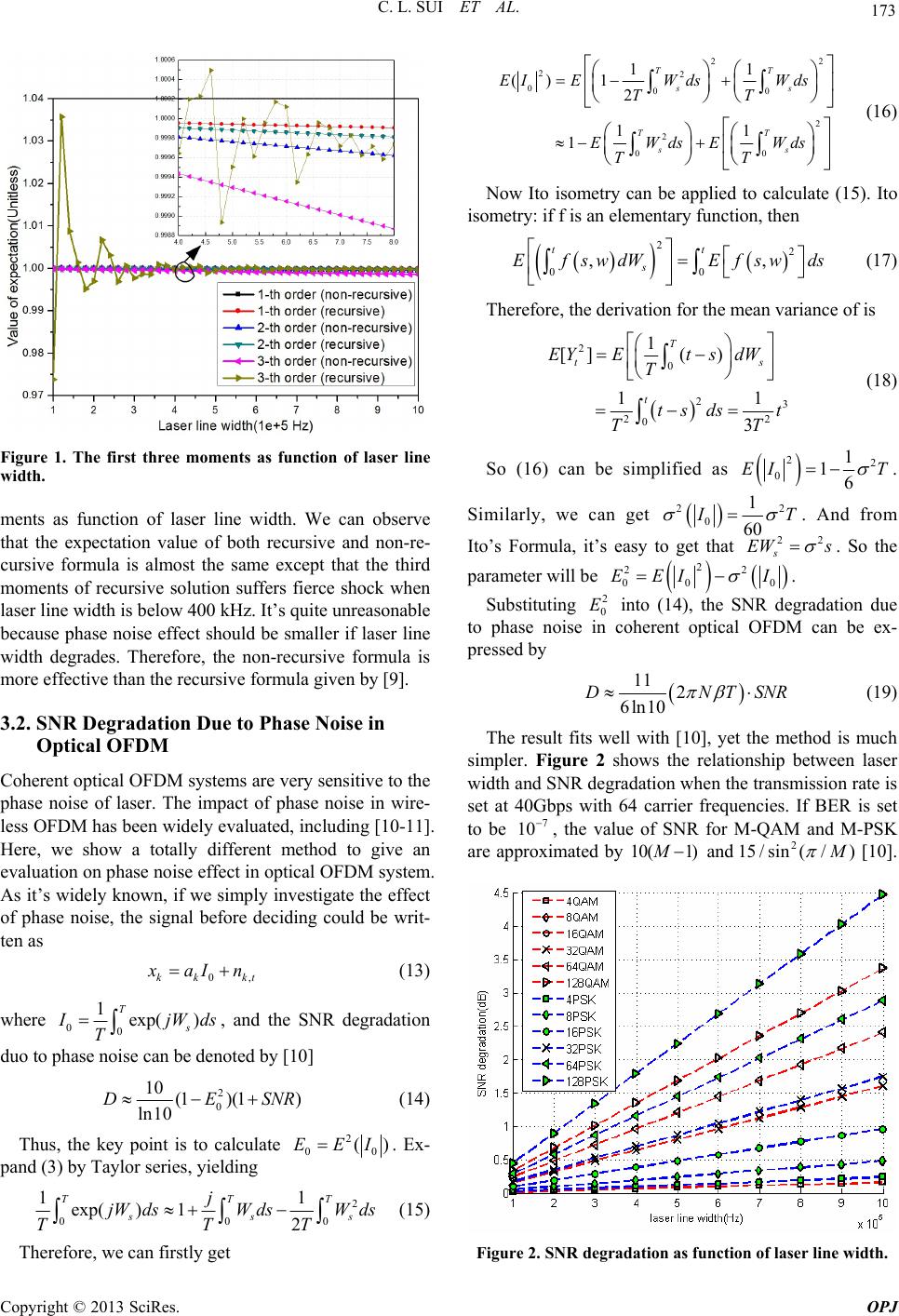 C. L. SUI ET AL. 173 Figure 1. The first three moments as function of laser lin ents as function of laser line width. We can observe 3.2. SNR Degradation Due to Phase Noise in Cohe systems are very sensitive to the t e width. m that the expectation value of both recursive and non-re- cursive formula is almost the same except that the third moments of recursive solution suffers fierce shock when laser line width is below 400 kHz. It’s quite unreasonable because phase noise effect should be smaller if laser line width degrades. Therefore, the non-recursive formula is more effective than the recursive formula given by [9]. Optical OFDM rent optical OFDM phase noise of laser. The impact of phase noise in wire- less OFDM has been widely evaluated, including [10-11]. Here, we show a totally different method to give an evaluation on phase noise effect in optical OFDM system. As it’s widely known, if we simply investigate the effect of phase noise, the signal before deciding could be writ- ten as 0,kk k x aI n (13) where 00 1exp( ) T s I jW ds T , and the SNR degradation se noise can be denduo to phaoted by [10] 2 0 10 (1 )(1) ln10 DESNR (14) Thus, the key point is to calculate 2 00 ()EEI. Ex- pand (3) by Taylor series, yielding 2 000 1 exp( )12 T sss jWdsW dsWds TTT (15) Therefore, we can firstly get 1 TT j 22 22 1 T 000 2 2 00 1 () 1 2 11 1 T ss TT ss EI EWdsWds TT EWdsEW ds TT (16) Now Ito isometry can be applied to calculate (15). Ito isometry: if f is an elementary function, then 00 ,, s EfswdWEf swds 22 tt (17) Therefore, the derivation for the mean variance of is 2 0 23 22 0 1T [] ( ) 11 3 ts t EYEts dW T tsds t TT (18) So (16) can be simplified as 22 01 16 EIT . Similarly, we can get 22 01 60 I T . And from get that Ito’s Formula, it’s easy to2 s 2 s EW . So the parameter will be I. 2 22 00 EEI 0 into (14), the SNR deadation due to Substituting 2 0 Egr phase noise in coherent optical OFDM can be ex- pressed by 11 2 6ln10 DNT SNR (19) The result fits well with [10], yet the method is much simpler. Figure 2 shows the relationship between laser width and SNR degradation when the tran smission rate is set at 40Gbps with 64 carrier frequencies. If BER is set to be 7 10 , the value of SNR for M-QAM and M-PSK are appmated by 10( 1)M roxi and 2 15/ sin(/) M [10]. Figure 2. SNR degradation as function of laser line width. Copyright © 2013 SciRes. OPJ 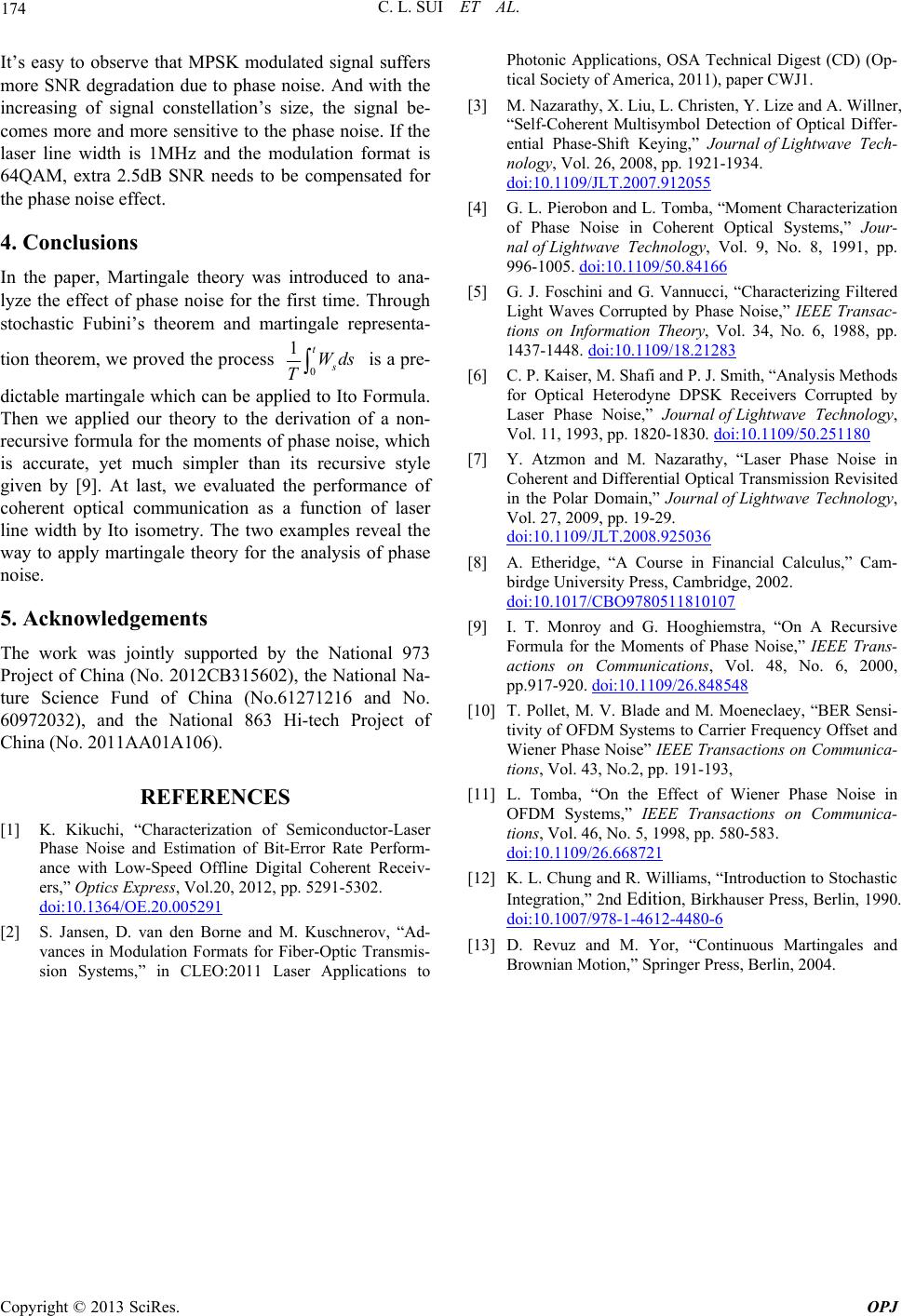 C. L. SUI ET AL. Copyright © 2013 SciRes. OPJ 174 It 4. Conclusions ngale theory was introduced to ana- ’s easy to observe that MPSK modulated signal suffers more SNR degradation due to phase noise. And with the increasing of signal constellation’s size, the signal be- comes more and more sensitive to the phase noise. If the laser line width is 1MHz and the modulation format is 64QAM, extra 2.5dB SNR needs to be compensated for the phase noise effect. In the paper, Marti lyze the effect of phase noise for the first time. Through stochastic Fubini’s theorem and martingale representa- tion theorem, we proved the process 0 1tWds is a pre- s T dictable martingale which can be applied to Ito Form 5. Acknowledgements orted by the Nationa REFERENCES [1] K. Kikuchi, miconductor- ula. Then we applied our theory to the derivation of a non- recursive formula for the moments of phase noise, which is accurate, yet much simpler than its recursive style given by [9]. At last, we evaluated the performance of coherent optical communication as a function of laser line width by Ito isometry. The two examples reveal the way to apply martingale theory for the analysis of phase noise. The work was jointly suppl 973 Project of China (No. 2012CB315602), the National Na- ture Science Fund of China (No.61271216 and No. 60972032), and the National 863 Hi-tech Project of China (No. 2011AA01A106). “Characterization of SeLaser Phase Noise and Estimation of Bit-Error Rate Perform- ance with Low-Speed Offline Digital Coherent Receiv- ers,” Optics Express, Vol.20, 2012, pp. 5291-5302. doi:10.1364/OE.20.005291 [2] S. Jansen, D. van den Borne and M. Kuschnerov, “Ad- A. Willner, vances in Modulation Formats for Fiber-Optic Transmis- sion Systems,” in CLEO:2011 Laser Applications to Photonic Applications, OSA Technical Digest (CD) (Op- tical Society of America, 2011), paper CWJ1. [3] M. Nazarathy, X. Liu, L. Christen, Y. Lize and “Self-Coherent Multisymbol Detection of Optical Differ- ential Phase-Shift Keying,” Journal of Lightwave Tech- nology, Vol. 26, 2008, pp. 1921-1934. doi:10.1109/JLT.2007.912055 [4] G. L. Pierobon and L. Tomba, “Moment Characterization of Phase Noise in Coherent Optical Systems,” Jour- nal of Lightwave Technology, Vol. 9, No. 8, 1991, pp. 996-1005. doi:10.1109/50.84166 [5] G. J. Foschini and G. Vannucci, “Characterizing Filtered Light Waves Corrupted by Phase Noise,” IEEE Transac- tions on Information Theory, Vol. 34, No. 6, 1988, pp. 1437-1448. doi:10.1109/18.21283 [6] C. P. Kaiser, M. Shafi and P. J. Smith, “Analysis Methods for Optical Heterodyne DPSK Receivers Corrupted by Laser Phase Noise,” Journal of Lightwave Technology, Vol. 11, 1993, pp. 1820-1830. doi:10.1109/50.251180 [7] Y. Atzmon and M. Nazarathy, “Laser Phase Noise in 036 Coherent and Differential Optical Transmission Revisited in the Polar Domain,” Journal of Lightwave Technology, Vol. 27, 2009, pp. 19-29. doi:10.1109/JLT.2008.925 inancial Calculus,” Cam-[8] A. Etheridge, “A Course in F birdge University Press, Cambridge, 2002. doi:10.1017/CBO9780511810107 [9] I. T. Monroy and G. Hooghiemstra, “On A Recursive Formula for the Moments of Phase Noise,” IEEE Trans- actions on Communications, Vol. 48, No. 6, 2000, pp.917-920. doi:10.1109/26.848548 [10] T. Pollet, M. V. Blade and M. Moeneclaey, “BER Sensi- iener Phase Noise in tivity of OFDM Systems to Carrier Frequency Offset and Wiener Phase Noise” IEEE Transactions on Communica- tions, Vol. 43, No.2, pp. 191-193, [11] L. Tomba, “On the Effect of W OFDM Systems,” IEEE Transactions on Communica- tions, Vol. 46, No. 5, 1998, pp. 580-583. doi:10.1109/26.668721 [12] K. L. Chung and R. Williams, “Introduction to Stochastic Integration,” 2nd Edition, Birkhauser Press, Berlin, 1990. doi:10.1007/978-1-4612-4480-6 [13] D. Revuz and M. Yor, “Continuous Martingales and Brownian Motion,” Springer Press, Berlin, 2004. |