

Paper Menu >>
Journal Menu >>
 Vol.1, No.1, 1-7 (2013) Advances in Entomology http://dx.doi.org/10.4236/ae.2013.11001 Lack of evidence for sufficiently isolated populations of Glossina morsitans submorsitans on the Adamawa Plateau of Cameroon following geometric morphometric analysis Mbunkah Daniel Achukwi1*, Jessica Gillingwater2, Alexandre Michel Njan Nloga3, Gustave Simo4 1Institute of Agricultural Research for Development (IRAD), Wakwa Regional Center, Veterinary Research Laboratory, Ngaoundere, Cameroun; *Corresponding Author: [email protected] 2London School of Hygiene and Tropical Medicine, London, UK 3School of Medicine and Veterinary Sciences, University of Ngaoundere, Ngaoundere, Cameroun 4Department of Biochemistry, Faculty of Science, University of Dschang, Dschang, Cameroon Received 24 April 2013; revised 21 June 2013; accepted 8 July 2013 Copyright © 2013 Mbunkah Daniel Achukwi et al. This is an open access article distributed under the Creative Commons Attribution License, which permits unrestricted use, distribution, and reproduction in any medium, provided the original work is properly cited. ABSTRACT Trypanosomosis remains the number one killer of livestock in spite of efforts made to eradicate t set se flies in the Adamawa plate au of Cameroon. Acetone-baited Laveissière type biconical traps were pitched at 100 meter intervals in strategic geo-referenced positions in various ecological niches of the landscape for 5 consecutive days in selected villages in Mayo Rey, Mbere, Vina and Faro et Deo divisions. All 493 tsetse flies captured in sites other than Mboula were G. morsitans submositans. Measurement of dif- ferent morphometric characters on the wings of each individual fly was undertaken using the Du Jardin package. The data was processed and analysed by “Permutaciones, Analisis Discrimi- nante (PAD)” and “Bootstraps, Analisis en Com- ponentes principales”. The three major sam- pling sites on the plateau yielded similar results as demonstrated by the neighbour joining tree of Mahalanobis distances but tests using PAD showed th e differen ces bet ween group mea ns to be significant (P < 0.05) even when the same number of flies was used. Mixing of tsetse populations from the northern lowlands and those on the plate au and K outine plain c ould not be ruled out . These prel i mina ry f indin gs sug ge st that the flies are not from isolated populations and should be considered as populations fre- quently exchanging migrants. However, mo- lecular genetics techniques are necessary in ad- dition to morphometric analysis to reach more definitive conclusions. Keywords: Glossina morsitans submositans; Fly Wing; Geometric Morphometry; Adamawa Plateau Cameroon 1. INTRODUCTION Tsetse flies (Diptera: Glossinidae) are vectors of try- panosomes that cause sleeping sickness in humans and nagana in livestock across sub-Saharan Africa. Try- panosomosis has a major negative impact on agriculture, especially on livestock economics, in areas such as the Adamawa Plateau region of Cameroon where livestock breeding is the mainstay of the economy. In the south- west of neighbouring Nigeria sedentary and semi seden- tary cattle herds had trypanosomosis prevalence rates of 9.8% and 42.8% respectively and more mechanical vec- tors were caught than Glossina spps: the G. papalis and G. tachinoides caught did not carry any trypanosome infections [1]. In Zambia, 75.1% of G. m. morsitans blood meals were from cattle, even when other domestic animals (mainly goats, pigs and dogs) were present [2]. Thus tsetse control strategies rely on a detailed under- standing of the epidemiology and ecology of tsetse flies and the genetic variation within and among the fly popu- lations. In sub-Saharan Africa, conventional disease control methods applied have inadequately addressed the prob- lem of trypanosomosis and large scale control operations Copyright © 2013 SciRes. Openly accessible at http://www.scirp.org/journal/ae/  M. D. Achukwi et al. / Advances in Entomology 1 (2013) 1-7 2 have virtually stopped. Large scale tsetse eradication campaigns instituted earlier in some countries including Cameroon required huge budgetary allocations that most affected countries could not afford on a sustainable basis. Even innovative options like the use of live bait pyre- throid-impregnated cattle against tsetse flies have had problems with efficiency, time input an d the high cost of pyrethroid in rural areas. After about thirty years of gov- ernment efforts to control tsetse on the Cameroon Ada- mawa Plateau, trypanosomosis still stands out from various surveys [3-5], as the number one killer of cattle. Large scale tsetse clearing activities were stopped in this region in the mid-nineties [6,7]. These tsetse control ef- forts have had mixed success records; ultimately, they have been unable to prevent re-infestation of tsetse cleared areas [8]. Consequently, there is a need for new sustainable technical approaches that are adapted to ex- isting local farming systems, more efficient and inexpen- sive. A pan African approach called “Pan African Tsetse and Trypanosomosis Eradication Campaign” (PATTEC) has been initiated under the support of African heads of states. The objective of this initiative is to eliminate tsetse flies and trypanosomosis in Africa. A critical ex- amination of alternative options to currently employed control strategies which include the use of screens, tsetse traps and area-wide techniques to exterminate pockets of tsetse infestations is urgently needed [9]. The success of these control strategies requires the identification of ge- netically isolated tsetse populations where elimination can be undertaken. The identification of genetically iso- lated tsetse populations is the critical point that will di- rect the choice between elimination and suppression of tsetse flies in a specific area. Over the past 30 years, several techniques have been used to assess genetic variation of tsetse flies to identify genetically isolated populations. These techniques in- clude allozymes [10-13], microsatellites [14-16], and mitochondrial DNA techniques [12,15,17-19]. These genetic markers have provided useful information on phenotypic and genetic polymorphisms in Glossina spe- cies. They have indicated a degree of genetic differentia- tion between geographically separated tsetse populations. This was surprising given the mobility of the flies com- bined with expectations derived from population genetics theory [20-22]. The analysis of mitochondrial DNA re- vealed relatively high levels of haplotype divergence between randomly chosen individuals among four spe- cies analysed, including G. morsitans [20]. However, arthropod mitochondrial genomes are small in size (14 - 25 kilobases) and maternally inherited [23], hence, data interpretation differs from that of variation in nuclear genes. The number of tsetse loci in the nuclear genome using the techniques sampled for variation to date is relatively limited for microsatellite markers. For example, in Glossina morsitans morsitans a total of 45 allozymes and five microsatellites were analysed by Krafsur [20]. Mor- phometric analyses have become interesting tools for the study of population genetics [24,25]. The first characters to be affected by micro-evolutionary changes are con- tinuous characters. Morphometrics measure these con- tinuous changes and represent a low-cost tool adapted to the study of phenotypic evolution. This tool has shown considerable epidemiological significance for medically important insects such as the vectors of leishmaniasis and Chagas disease in Latin America. Geometric mor- phometrics allow comparisons of many samples with homologous landmarks, e.g., the vein-patterns on wings. Morphometric analyses are generally simple to perform and easily realizable in most developing countries where trypanosomosis has a major impact on animals and/or humans. This tool can be used to determine how close or distant tsetse fly populations thought to be isolated truly are by normalising other factors such as size and rotation of the wings from the different populations. This tech- nique allows a more sensitive appraisal of the relation- ship between groups than genetic techniques involving microsatellites [26,27]. Therefore, the technique can be used to reveal the structure of vector populations. If a vector population is found to be sufficiently geographi- cally isolated to prevent casual mixing with other popu- lations, then it may be of interest for future vector control efforts. The present study specifically sought to compare Glossina morsitans submorsitans populations of different sites of the Adamawa region using morphometry of wings. 2. MATERIALS AND METHODS 2.1. Description of the Geographic Location The elevations where sampling was undertaken ranged from 487 m above sea level in the Koutine plain to over 1497 m on the plateau (Table 1). The Adamawa region has wooded savannah vegetation, a seven months rainy season with moderate temperatures (22˚C - 28˚C) and the average annual rainfall ranges from 1500 mm to 1900 mm. More details about these aspects of the study sites have been described [28]. 2.2. Entomological Approach This study was con duc ted in fo ur d iv isions (Mayo Rey, Mbere, Vina, and Faro et Deo) of the Adamawa Plateau of Cameroon (Figure 1). The sites comprised: one vil- lage (Gamba/Benoue National Park) of the Mayo Rey Division, one village (Mboula) of the Mbere Division, two villages (Mangoli, Mbe) of the Vina Division and Copyright © 2013 SciRes. Openly accessible at http://www.scirp.org/journal/ae/ 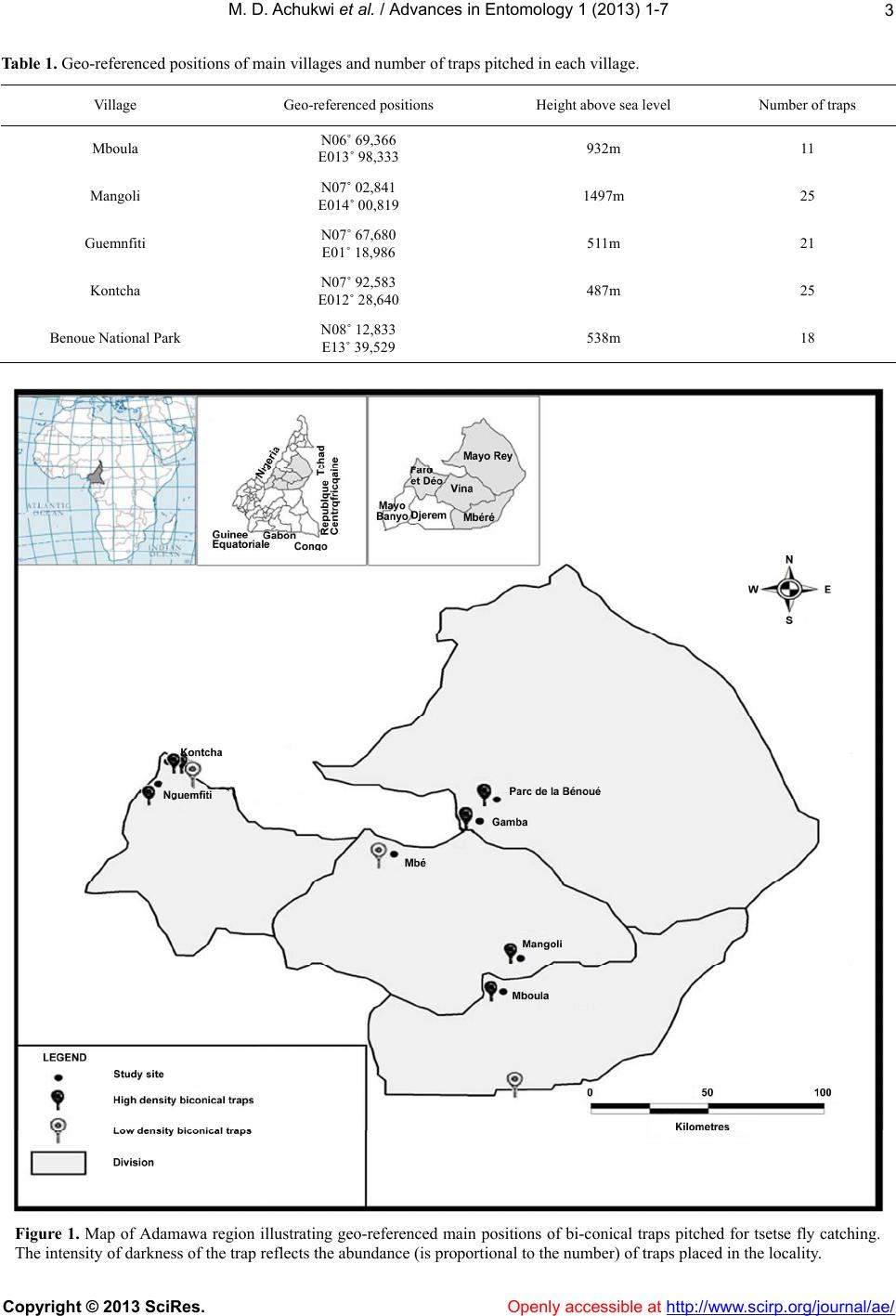 M. D. Achukwi et al. / Advances in Entomology 1 (2013) 1-7 Copyright © 2013 SciRes. http://www.scirp.org/journal/ae/ 3 Table 1. Geo-referenced positions of main villages and number of traps pitched in each village. Village Geo-referenced positions Height above sea level Number of traps Mboula N06˚ 69,366 E013˚ 98,333 932m 11 Mangoli N07˚ 02,841 E014˚ 00,819 1497m 25 Guemnfiti N07˚ 67,680 E01˚ 18,986 511m 21 Kontcha N07˚ 92,583 E012˚ 28,640 487m 25 Benoue National Park N08˚ 12,833 E13˚ 39,529 538m 18 Figure 1. Map of Adamawa region illustrating geo-referenced main positions of bi-conical traps pitched for tsetse fly catching. The intensity of darkness of the trap reflects the abundance (is proportional to the number) of traps placed in the locality. Openly accessible at 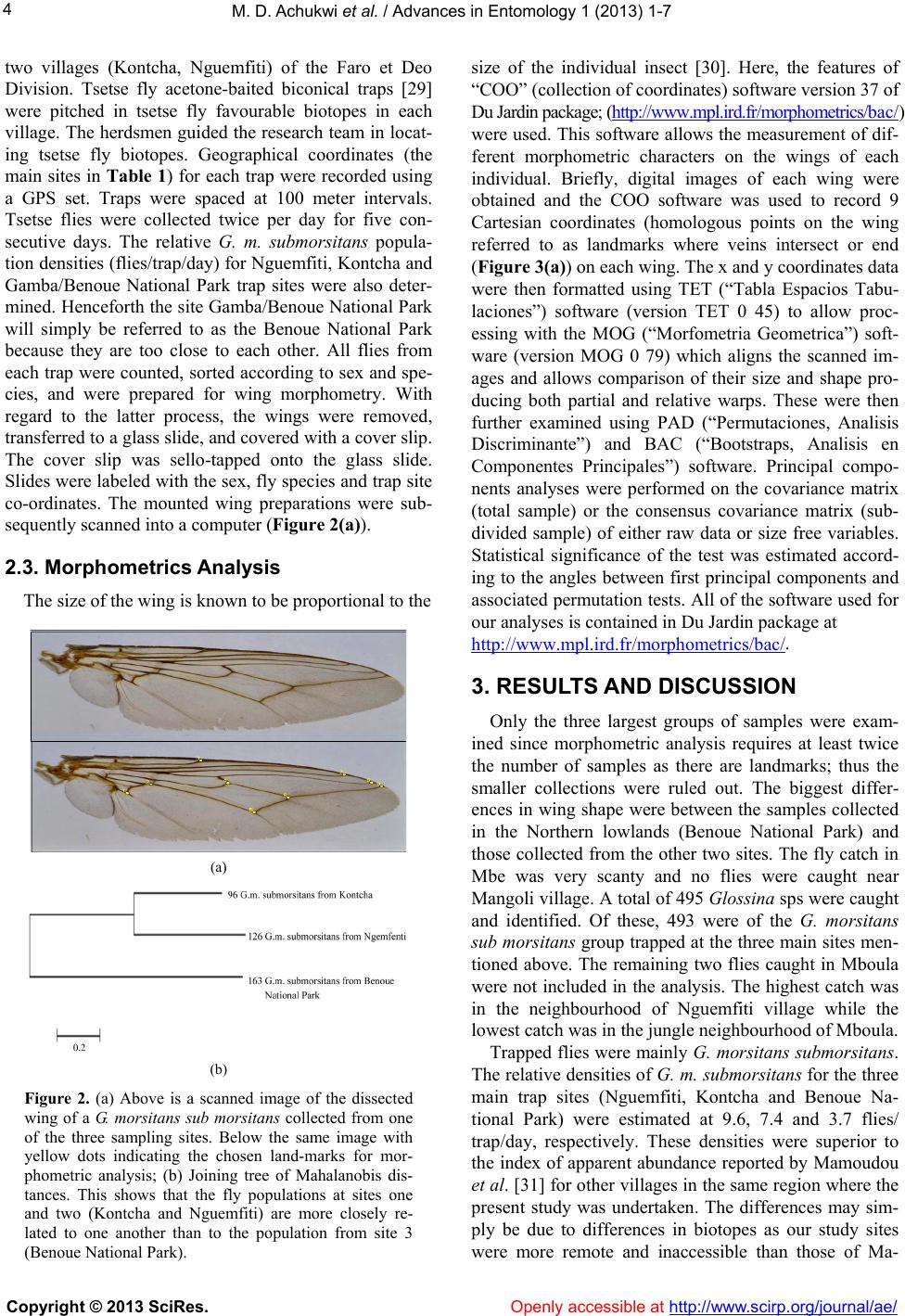 M. D. Achukwi et al. / Advances in Entomology 1 (2013) 1-7 4 two villages (Kontcha, Nguemfiti) of the Faro et Deo Division. Tsetse fly acetone-baited biconical traps [29] were pitched in tsetse fly favourable biotopes in each village. The herdsmen guid ed the research team in locat- ing tsetse fly biotopes. Geographical coordinates (the main sites in Table 1) for each trap were recorded using a GPS set. Traps were spaced at 100 meter intervals. Tsetse flies were collected twice per day for five con- secutive days. The relative G. m. submorsitans popula- tion densities (flies/trap/day) for Nguemfiti, Kontcha and Gamba/Benoue National Park trap sites were also deter- mined. Henceforth the site Gamba/Benoue National Park will simply be referred to as the Benoue National Park because they are too close to each other. All flies from each trap were counted, sorted according to sex and spe- cies, and were prepared for wing morphometry. With regard to the latter process, the wings were removed, transferred to a glass slide, and covered with a cover slip. The cover slip was sello-tapped onto the glass slide. Slides were labeled with the sex, fly species and trap site co-ordinates. The mounted wing preparations were sub- sequently scanned into a co mputer (Figure 2(a)). 2.3. Morphometrics Analysis The size of the wing is known to be proportio nal to the (a) (b) Figure 2. (a) Above is a scanned image of the dissected wing of a G. morsitans sub morsitans collected from one of the three sampling sites. Below the same image with yellow dots indicating the chosen land-marks for mor- phometric analysis; (b) Joining tree of Mahalanobis dis- tances. This shows that the fly populations at sites one and two (Kontcha and Nguemfiti) are more closely re- lated to one another than to the population from site 3 (Benoue National Park). size of the individual insect [30]. Here, the features of “COO” (collection of coordinates) software version 37 of Du Jardin package; (http://www.mpl.ird.fr/morphometrics/bac/) were used. This software allows the measurement of dif- ferent morphometric characters on the wings of each individual. Briefly, digital images of each wing were obtained and the COO software was used to record 9 Cartesian coordinates (homologous points on the wing referred to as landmarks where veins intersect or end (Figure 3(a)) on each wing. T he x and y co ordinates data were then formatted using TET (“Tabla Espacios Tabu- laciones”) software (version TET 0 45) to allow proc- essing with the MOG (“Morfometria Geometrica”) soft- ware (version MOG 0 79) which aligns the scanned im- ages and allows comparison of their size and shape pro- ducing both partial and relative warps. These were then further examined using PAD (“Permutaciones, Analisis Discriminante”) and BAC (“Bootstraps, Analisis en Componentes Principales”) software. Principal compo- nents analyses were performed on the covariance matrix (total sample) or the consensus covariance matrix (sub- divided sample) of either raw data or size free variables. Statistical significance of the test was estimated accord- ing to the angles between first principal components and associated permutation tests. All of the software used for our analyses is contained in Du Jardin package at http://www.mpl.ird.fr/morphometrics/bac/. 3. RESULTS AND DISCUSSION Only the three largest groups of samples were exam- ined since morphometric analysis requires at least twice the number of samples as there are landmarks; thus the smaller collections were ruled out. The biggest differ- ences in wing shape were between the samples collected in the Northern lowlands (Benoue National Park) and those collected from the other two sites. The fly catch in Mbe was very scanty and no flies were caught near Mangoli village. A total of 495 Glossina sps were caught and identified. Of these, 493 were of the G. morsitans sub morsitans group trapped at the three main sites men- tioned above. The remaining two flies caught in Mboula were not included in the analysis. The highest catch was in the neighbourhood of Nguemfiti village while the lowest catch was in the jungle ne ighbourhood of Mboula. Trapped flies were mainly G. morsitans submorsitans. The relative densities o f G. m. submorsitans for the three main trap sites (Nguemfiti, Kontcha and Benoue Na- tional Park) were estimated at 9.6, 7.4 and 3.7 flies/ trap/day, respectively. These densities were superior to the index of apparent abundance reported by Mamoudou et al. [31] for other villages in the same region where the present study was undertaken. The differences may sim- ply be due to differences in biotopes as our study sites were more remote and inaccessible than those of Ma- Copyright © 2013 SciRes. Openly accessible at http://www.scirp.org/journal/ae/  M. D. Achukwi et al. / Advances in Entomology 1 (2013) 1-7 5 (a) (b) Figure 3. (a) Results of a principle component analysis run in BAC. The three sampled populations show overlap be- tween the data. The numbers in the key refer to the sample sizes which were 96 for Kontcha (yello), 126 for Nguemfenti (green), and 163 for Gamba (red) at the Benoue National Park. This diagram also clearly shows the more dissimilar northern (Gamba) population overlapping least with the other two; (b) Principle component analysis run in BAC. This time the sample sizes are equal to ensure that it is not the difference in sample size causing the observed differ- ences between the populations. The first 96 samples in each of three groups Kontcha (K), Nguemfeti (N) and Gamba (G) were arbitrarily selected for this analysis. moudou et al. [31]. During a longitudinal study in the Adamawa region it was found that the incidence of try- panosomosis was high in the valley (3.7% - 20%) and the buffer zone (1.8% - 13.4%), and was significantly lower (0% - 2.1%) on the plateau where tsetse clearing had previously been undertaken [31]. They also caught main- ly Glossina morsitans submorsitans and a few G. tach in- oides in the valley and the buffer zone, but none on the plateau and concluded that the distribution of tsetse, in a large part of the valley, undergoes substantial seasonal changes depending on either the presence or absence of cattle. Other studies undertaken to the north of Kontcha (also one of the sites in the present study) in villages around Poli near the Faro National Park [3] showed a parasite detectable trypanosomosis prevalence rate of 14.3% in cattle. A consequence of the negative impact of the trypanosomosis in the Adamawa and northern re- gions of Cameroon is that huge quantities of trypano- cides are sold to farmers by vet pharmacies in these re- gions [32]. Results of the joining tree of Mahalanobis distances (Figure 2(b)) suggest a subdivision of G. m. submorsis- tans on the Adamawa Plateau according to the sampling sites. Looking at the permutation analysis, it appears that the two major sampling sites on the plateau yielded much more similar results as demonstrated by the neighbour joining tree of Mahalanobis distances (Figure 2(b)). These results were confirmed by a permutation test using PAD. The PAD showed significant (P < 0.05) differ- ences (Figure 3(a)) between tsetse populations from different capture sites. To ensure that the observed dif- ferences between the tsetse populations were not due to differences in sample sizes alone, the same analysis was performed using equal sample sizes for all three groups (Figure 3(b)); the same result was obtained. Conse- quently, morphometric analysis can be used to different- tiate Glossina m. submorsistans from the Adamawa Pla- teau of Cameroon and this technique can reveal differ- ences between vectors of medical and veterinary impor- tance. The geometric morphometrics technique allows a more sensitive appraisal of the relationships between groups than genetic techniques involving microsatellites [26,33]. Geometric morphometrics techniques are useful in evaluating the micro-evolutionary changes occurring during phenotypic evolution in tsetse flies, especially in developing countries where laboratories to perform ge- netic analyses are lacking. These techniques are valuable to the Pan African Tsetse and Trypanosomiasis Eradica- tion Campaign which envisages eradicatio n of tsetse flies from the African continent. Most countries infested by tsetse flies are poor and have few laboratories capable of genetic analyses. Several tsetse fly species are found in some tsetse infested areas. In such areas, the geometric morphometrics technique will be of great value because differences between tsetse species can be easily evalu- ated. In environments with different tsetse species, spe- cific markers for each species must be developed if ge- Copyright © 2013 SciRes. Openly accessible at http://www.scirp.org/journal/ae/ 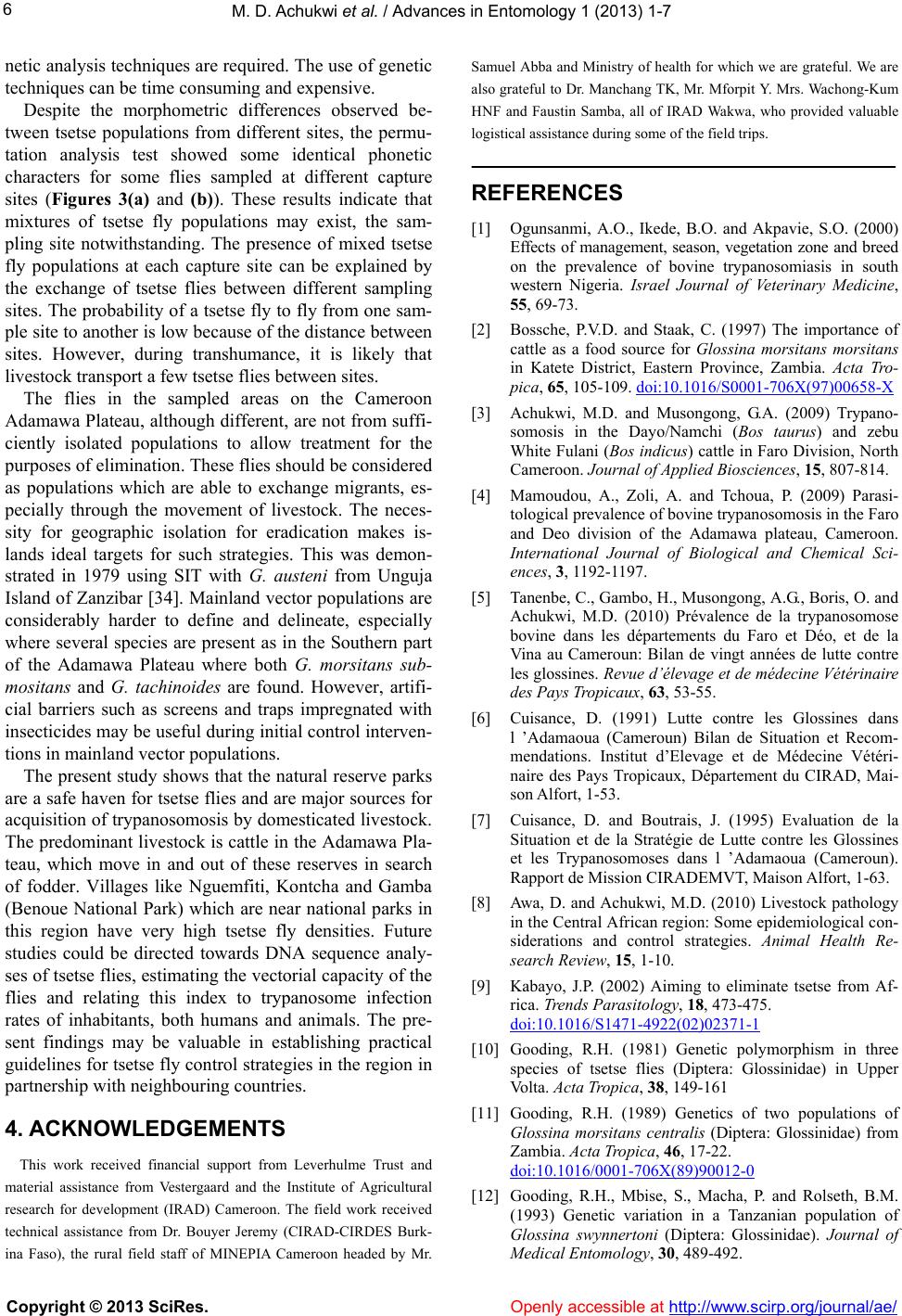 M. D. Achukwi et al. / Advances in Entomology 1 (2013) 1-7 6 netic analysis techniques are required. The use of genetic techniques can be time consuming and expensive. Despite the morphometric differences observed be- tween tsetse populations from different sites, the permu- tation analysis test showed some identical phonetic characters for some flies sampled at different capture sites (Figures 3(a) and (b)). These results indicate that mixtures of tsetse fly populations may exist, the sam- pling site notwithstanding. The presence of mixed tsetse fly populations at each capture site can be explained by the exchange of tsetse flies between different sampling sites. The probability of a tsetse fly to fly fro m one sam- ple site to another is low because of the distance between sites. However, during transhumance, it is likely that livestock transport a few tsetse flies between sites. The flies in the sampled areas on the Cameroon Adamawa Plateau, although different, are not from suffi- ciently isolated populations to allow treatment for the purposes of elimination. These flies should be considered as populations which are able to exchange migrants, es- pecially through the movement of livestock. The neces- sity for geographic isolation for eradication makes is- lands ideal targets for such strategies. This was demon- strated in 1979 using SIT with G. austeni from Unguja Island of Zan zibar [34]. Mainland vector populatio ns are considerably harder to define and delineate, especially where several species are present as in the Southern part of the Adamawa Plateau where both G. morsitans sub- mositans and G. tachinoides are found. However, artifi- cial barriers such as screens and traps impregnated with insecticides may be usefu l during initial contro l interven- tions in mainland vector populations. The present study shows that the natural reserve parks are a safe haven for tsetse flies and are major sources for acquisition of trypano somosis by domesticated livesto ck. The predominant livestock is cattle in the Adamawa Pla- teau, which move in and out of these reserves in search of fodder. Villages like Nguemfiti, Kontcha and Gamba (Benoue National Park) which are near national parks in this region have very high tsetse fly densities. Future studies could be directed towards DNA sequence analy- ses of tsetse flies, estimating the vectorial capacity of the flies and relating this index to trypanosome infection rates of inhabitants, both humans and animals. The pre- sent findings may be valuable in establishing practical guidelines for tsetse fly control strategies in the region in partnership with neighbouring countries. 4. ACKNOWLEDGEMENTS This work received financial support from Leverhulme Trust and material assistance from Vestergaard and the Institute of Agricultural research for development (IRAD) Cameroon. The field work received technical assistance from Dr. Bouyer Jeremy (CIRAD-CIRDES Burk- ina Faso), the rural field staff of MINEPIA Cameroon headed by Mr. Samuel Abba and Ministry of health for which we are grateful. We are also grateful to Dr. Manchang TK, Mr. Mforpit Y. Mrs. Wachong-Kum HNF and Faustin Samba, all of IRAD Wakwa, who provided valuable logistical assistance during some of the fi eld trips. REFERENCES [1] Ogunsanmi, A.O., Ikede, B.O. and Akpavie, S.O. (2000) Effects of management, season, vegetation zone and breed on the prevalence of bovine trypanosomiasis in south western Nigeria. Israel Journal of Veterinary Medicine, 55, 69-73. [2] Bossche, P.V.D. and Staak, C. (1997) The importance of cattle as a food source for Glossina morsitans morsitans in Katete District, Eastern Province, Zambia. Acta Tro- pica, 65, 105-109. doi:10.1016/S0001-706X(97)00658-X [3] Achukwi, M.D. and Musongong, G.A. (2009) Trypano- somosis in the Dayo/Namchi (Bos taurus) and zebu White Fulani (Bos indicus) cattle in Faro Division, North Cameroon. Journal of Applied Biosciences, 15, 807-814. [4] Mamoudou, A., Zoli, A. and Tchoua, P. (2009) Parasi- tological prevalence of bovine trypanosomosis in the Faro and Deo division of the Adamawa plateau, Cameroon. International Journal of Biological and Chemical Sci- ences, 3, 1192-1197. [5] Tanenbe, C., Gambo, H., Musongong, A.G., Boris, O. and Achukwi, M.D. (2010) Prévalence de la trypanosomose bovine dans les départements du Faro et Déo, et de la Vina au Cameroun: Bilan de vingt années de lutte contre les glossines. Revue d’élevage et de médecine Vétérinaire des Pays Tropicaux, 63, 53-55. [6] Cuisance, D. (1991) Lutte contre les Glossines dans l ’Adamaoua (Cameroun) Bilan de Situation et Recom- mendations. Institut d’Elevage et de Médecine Vétéri- naire des Pays Tropicaux, Département du CIRAD, Mai- son Alfort, 1-53. [7] Cuisance, D. and Boutrais, J. (1995) Evaluation de la Situation et de la Stratégie de Lutte contre les Glossines et les Trypanosomoses dans l ’Adamaoua (Cameroun). Rapport de Mission CIRADEMVT, Maison Alfort, 1-63. [8] Awa, D. and Achukwi, M.D. (2010) Livestock pathology in the Central African region: Some epidemiological con- siderations and control strategies. Animal Health Re- search Review, 15, 1-10. [9] Kabayo, J.P. (2002) Aiming to eliminate tsetse from Af- rica. Trends Parasitology, 18, 473-475. doi:10.1016/S1471-4922(02)02371-1 [10] Gooding, R.H. (1981) Genetic polymorphism in three species of tsetse flies (Diptera: Glossinidae) in Upper Volta. Acta Tr opic a, 38, 149-161 [11] Gooding, R.H. (1989) Genetics of two populations of Glossina morsitans centralis (Diptera: Glossinidae) from Zambia. Acta Tropica, 46, 17-22. doi:10.1016/0001-706X(89)90012-0 [12] Gooding, R.H., Mbise, S., Macha, P. and Rolseth, B.M. (1993) Genetic variation in a Tanzanian population of Glossina swynnertoni (Diptera: Glossinidae). Journal of Medical Entomology, 30, 489-492. Copyright © 2013 SciRes. Openly accessible at http://www.scirp.org/journal/ae/  M. D. Achukwi et al. / Advances in Entomology 1 (2013) 1-7 Copyright © 2013 SciRes. http://www.scirp.org/journal/ae/Openly accessible at 7 [13] Krafsur, E.S. (2002) Population structure of the tsetse fly Glossina pallidipes estimated by allozyme, microsatellite and mitochondrial gene diversities. Insect Molecular Bi- ology, 11, 37-45. doi:10.1046/j.0962-1075.2001.00307.x [14] Solano, P., Duvallet, G., Dumas, V., Cuisance, D. and Cuny, G. (1997) Microsatellite markers for genetic population studies in Glossina palpalis (Diptera: Glossinidae). Acta Tropica, 65, 175-180. doi:10.1016/S0001-706X(97)00663-3 [15] Ouma, J.O., Cummings, M.A., Jones, K.C. and Krafsur, E.S. (2003) Characterization of microsatellite markers in the tsetse fly, Glossina pallidipes (Diptera: Glossinidae). Molecular Ecology Notes, 3, 450-453. doi:10.1046/j.1471-8286.2003.00480.x [16] Krafsur, E.S. and Endsley, M.A. (2006) Shared microsa- tellite loci in Glossina morsitans sensulato (Diptera: Glos- sinidae). Journal of Medical Entomology, 43, 640-642. doi:10.1603/0022-2585(2006)43[640:SMLIGM]2.0.CO;2 [17] Krafsur, E.S. and Griffiths, N. (1997) Genetic variation at structural loci in the Glossina morsitans species group. Biochemical Genetic, 35, 1-11. doi:10.1023/A:1022252311715 [18] Krafsur, E.S. and Wohlford, D.L. (1999) Breeding struc- ture of Glossina pallidipes populations evaluated by mi- tochondrial variation. Journal of Heredity, 90, 635-642. doi:10.1093/jhered/90.6.635 [19] Marquez, J.G., Vreysen, M.J., Robinson, A.S., Bado, S., and Krafsur, E.S. (2004) Mitochondrial diversity analysis of Glossina palpalis gambiensis from Mali and Senegal. Medical and Veterinary Entomology, 18, 288-295. d oi: 10.1111/j.0 269- 283X.2004.00508.x [20] Krafsur, E.S. (2003) Tsetse fly population genetics: An indirect approach to dispersal. Trendsin Parasitology, 19, 162-166. doi:10.1016/S1471-4922(03)00034-5 [21] Krafsur, E.S. (2009) Tsetse flies: Genetics, evolution, and role as vectors. Infections, Genetic and Evolution, 9, 124- 141. doi:10.1016/j.meegid.2008.09.010 [22] Gooding, R.H. and Krafsur, E.S. (2005) Tsetse genetics: Contributions to biology, systematics, and control of tset- se flies. Annual Review of Entomology, 50, 101-123. doi:10.1146/annurev.ento.50.071803.130443 [23] Jeyaprakash, A. and Hoy, M.A. (2009) First divergence time of spiders, scorpions, mites and ticks (sub-phylum Chelicerata) inferred from mitochondrial phylogeny. Ex- primental App lied Aca rology. 47, 1-18. doi:10.1007/s10493-008-9203-5 [24] Solano, P., De La Rocque, S., Cuisance, D., Geoffroy, B. , De Meeus, T., Cuny, G. and Duvallet, G. (1999) Intras- pecific variability in natural populations of Glossina pal- palis gambiensis from West Africa, revealed by genetic and morphometric analyses. Medical and Veterinary En- tomology, 13, 401-407. doi:10.1046/j.1365-2915.1999.00189.x [25] Vignon, M. and Sasal, P. (2010) The use of geometric morphometrics in understanding shape variability of scle- rotized haptoral structures of monogeneans (Platyhel- minthes) with insights into biogeographic variability. Pa- rasitology International, 59, 183-191. doi:10.1016/j.parint.2010.01.006 [26] Bouyer, J., Ravel, S., Dujardin, J.P., De Meeüs, T., Vial, L., Thévenon, S., Guerrini, L., Sidibé, I. and Solano, P. (2007) Population structuring of Glossina palpalis gam- biensis (Diptera: Glossinidae) according to landscape fragmentation in the Mouhoun river, Burkina Faso. Jour- nal of Medical Entomology, 44, 788-795. doi:10.1603/0022-2585(2007)44[788:PSOGPG]2.0.CO;2 [27] Camara, M., Caroria n, H.O, Ravel, S, Dujardin, J.P., Her- vouet, J.P., De Meeus, T., Kagbadouno, M.S., Bouyer, J. and Solano, P. (2006) Genetic and morphometric eviden- ce for population isolation of Glossina palpalis gambien- sis (Diptera: Glossinidae) on the Loos Islands, Guinea. Journal of MedicalEntomology, 43, 853-860. doi:10.1603/0022-2585(2006)43[853:GAMEFP]2.0.CO;2 [28] Letouzey, R. (1969) Etude phytogéographique du came- roun. Le Chevalier, Paris, 1-513. [29] Gouteux, J.P. and Lancien, J. (1986) The pyramidal trap for collecting and controlling tsetse flies (Diptera: Glos- sinidae). Comparative trials and description of new col- lecting technics. Tropical Medicine and Parasitology, 37, 61-66. [30] Patterson, J.S. and Schofield, C.J. (2005) Preliminary study of wing morphometry in relation to tsetse popula- tion genetics. South African Journal of Science, 101, 132- 134. [31] Mamoudou, A., Zoli, A., Hamadama, H., Bourdanne, Abah, S., Geerts, S., Clausen, P.H., Zessin, K.H., Kyule, M. and Van Den Bossche, P. (2008) Seasonal distribution and abundance of tsetse flies (Glossina spp) in the Faro and Deo Division of the Adamaoua Plateau in Cameroon. Medical and Veterinary Entomology, 22, 32-36. d oi: 10.1111/j.1 365- 2915.2008.00711.x [32] Awa, D.N., Achukwi, M.D., Manchang, T.K., Enam, J., Tenghe, A.M.M., Niba, E., Mfopit, M.Y. and Nain, C.W. (2009) The veterinary input sector and animal health management in traditional livestock systems of north Cameroon. 3èmes Journées de Recherches en Sciences sociales. INRA, SFER, CIRAD, Montpellier. [33] Mamoudou, A., Zoli, A., Mbahin, N., Tanenbe, C., Bour- danne, Clausen, P.H., Marcotty, T., Van den Bossche P. and Geerts, S. (2006) Prevalence and incidence of bovine trypanosomosis on the Adamaoua plateau in Cameroon 10 years after the tsetse eradication campaign. Veterinary Parasitology, 142, 16-22. doi:10.1016/j.vetpar.2006.06.033 [34] Vrey sen, M.J.B., Saleh, K.M., Ali, M.Y., Abdullah, M.A., Zhu, Z.R., Juma, K.G., Dyck, V.A., Masangi, A.R., Mko- nyi, P.M. and Feldmann, H.U. (2000) Glossina austeni (Diptera: Glossinidae) eradicated on the Island of Unguja, Zanzibar, using the sterile insect technique. Journal of Economic Entomology, 93, 123-135. doi:10.1603/0022-0493-93.1.123 |