

Paper Menu >>
Journal Menu >>
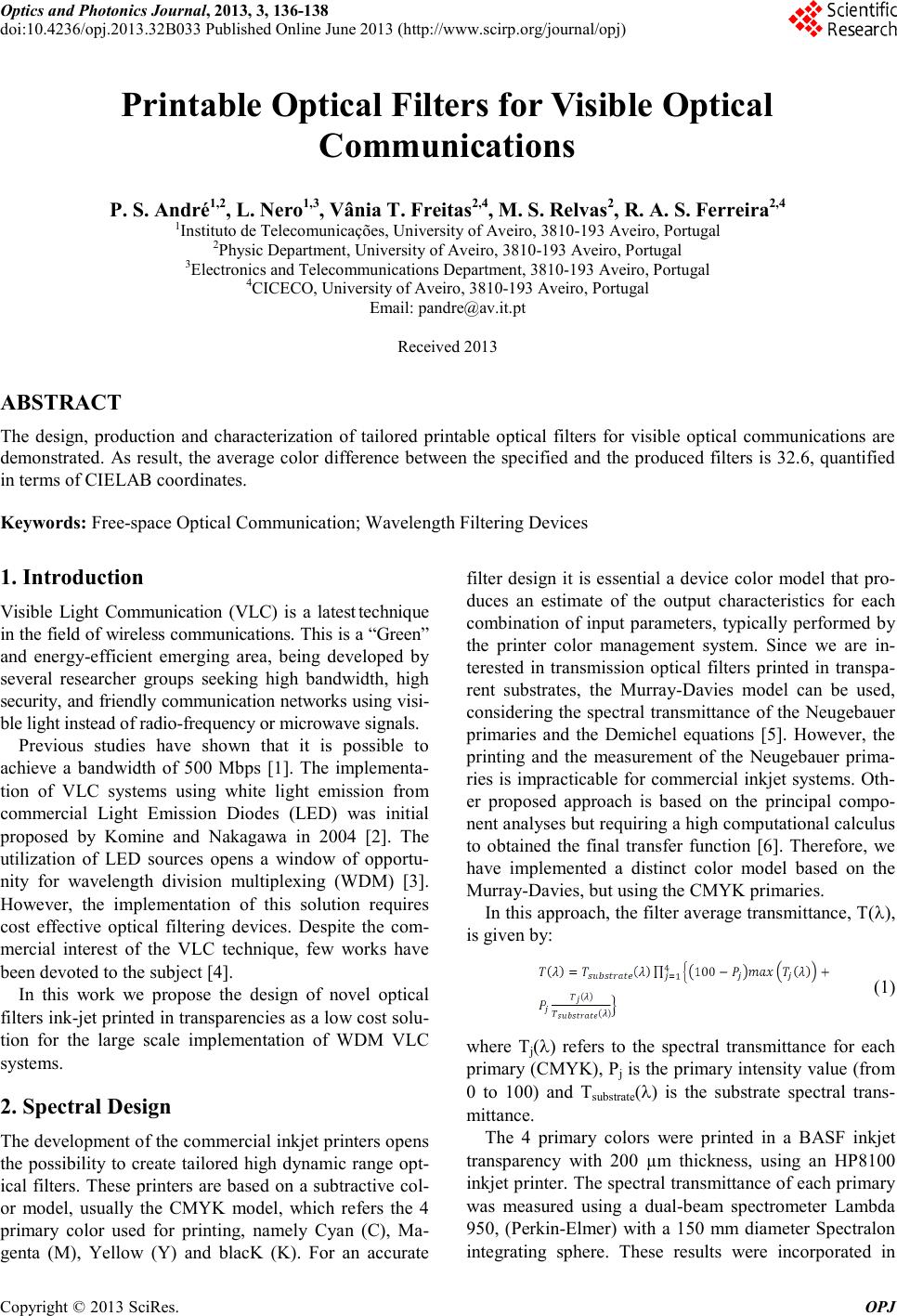 Optics and Photonics Journal, 2013, 3, 136-138 doi:10.4236/opj.2013.32B033 Published Online June 2013 (http://www.scirp.org/journal/opj) Copyright © 2013 SciRes. OPJ Printable Optical Filters for Visible Optical Communications P. S. André1,2, L. Nero1,3, Vânia T. Freitas2,4, M. S. Relvas2, R. A. S. Ferreira2,4 1Instituto de Telecomunicações, University of Aveiro, 3810-193 A v e i ro, Port ugal 2Physic Depar tment, U niversity of Aveiro, 3810-193 Aveiro, Portugal 3Electronics and Telecommunications Department, 3810-193 Avei ro, Por tugal 4CICECO, University of Aveiro, 3810-193 Aveiro, Portugal Email: [email protected] Received 2013 ABSTRACT The design, production and characterization of tailored printable optical filters for visible optical communications are demonstrated. As result, the average color difference between the specified and the produced filters is 32.6, quantified in terms of CIELAB coordinates. Keywords: Free-space Optical Communication; Wavelen gth Filterin g Devices 1. Introduction Visible Light Communication (VLC) is a latest technique in the field of wirele ss commu nications. T his is a “Gree n” and energy-efficient emerging area, being developed by several researcher groups seeking high bandwidth, high sec urity, a nd frie ndly co mmun icatio n networ ks usi ng visi- ble light instead of radio-frequ enc y or microwave signals. Previous studies have shown that it is possible to achieve a bandwidth of 500 Mbps [1]. The implementa- tion of VLC systems using white light emission from commercial Light Emission Diodes (LED) was initial proposed by Komine and Nakagawa in 2004 [2]. The utilization of LED sources opens a window of opportu- nity for wavelength division multiplexing (WDM) [3]. However, the implementation of this solution requires cost effective optical filtering devices. Despite the com- mercial interest of the VLC technique, few works have been devoted to the subject [4]. In this work we propose the design of novel optical filters i nk-jet printed in transparencies as a low cost solu- tion for the large scale implementation of WDM VLC systems. 2. Spectral Design The development of the commercial inkjet printers opens the possibility to create tailored high dynamic range opt- ical filters. These printers are based on a subtractive col- or model, usually the CMYK model, which refers the 4 primary color used for printing, namely Cyan (C), Ma- genta (M), Yellow (Y) and blacK (K). For an accurate filter design it is essential a device color model that pro- duces an estimate of the output characteristics for each combination of input parameters, typically performed by the printer color management system. Since we are in- terested in transmission optical filters printed in transpa- rent substrates, the Murray-Davies model can be used, considering the spectral transmittance of the Neugebauer primaries and the Demichel equations [5]. However, the printing and the measurement of the Neugebauer prima- ries is impracticable for commercial inkjet systems. Oth- er proposed approach is based on the principal compo- nent a na l yse s b ut r e qui ri n g a hig h c o mp uta ti onal c a lculus to obtained the final transfer function [6]. Therefore, we have implemented a distinct color model based on the Murray-Davies, but using the CM YK pri maries. In this approach, the filter average transmittance, T(λ), is given by: (1) where Tj(λ) refers to the spectral transmittance for each primary (CMYK), Pj is the p rimary intensit y value (fro m 0 to 100) and Tsubstrate(λ) is the substrate spectral trans- mittance. The 4 primary colors were printed in a BASF inkjet transparency with 200 µm thickness, using an HP8100 inkjet printer. The spectral transmittance of each primary was measured using a dual-beam spectrometer Lambda 950, (Perkin-Elmer) with a 150 mm diameter Spectralon integrating sphere. These results were incorporated in 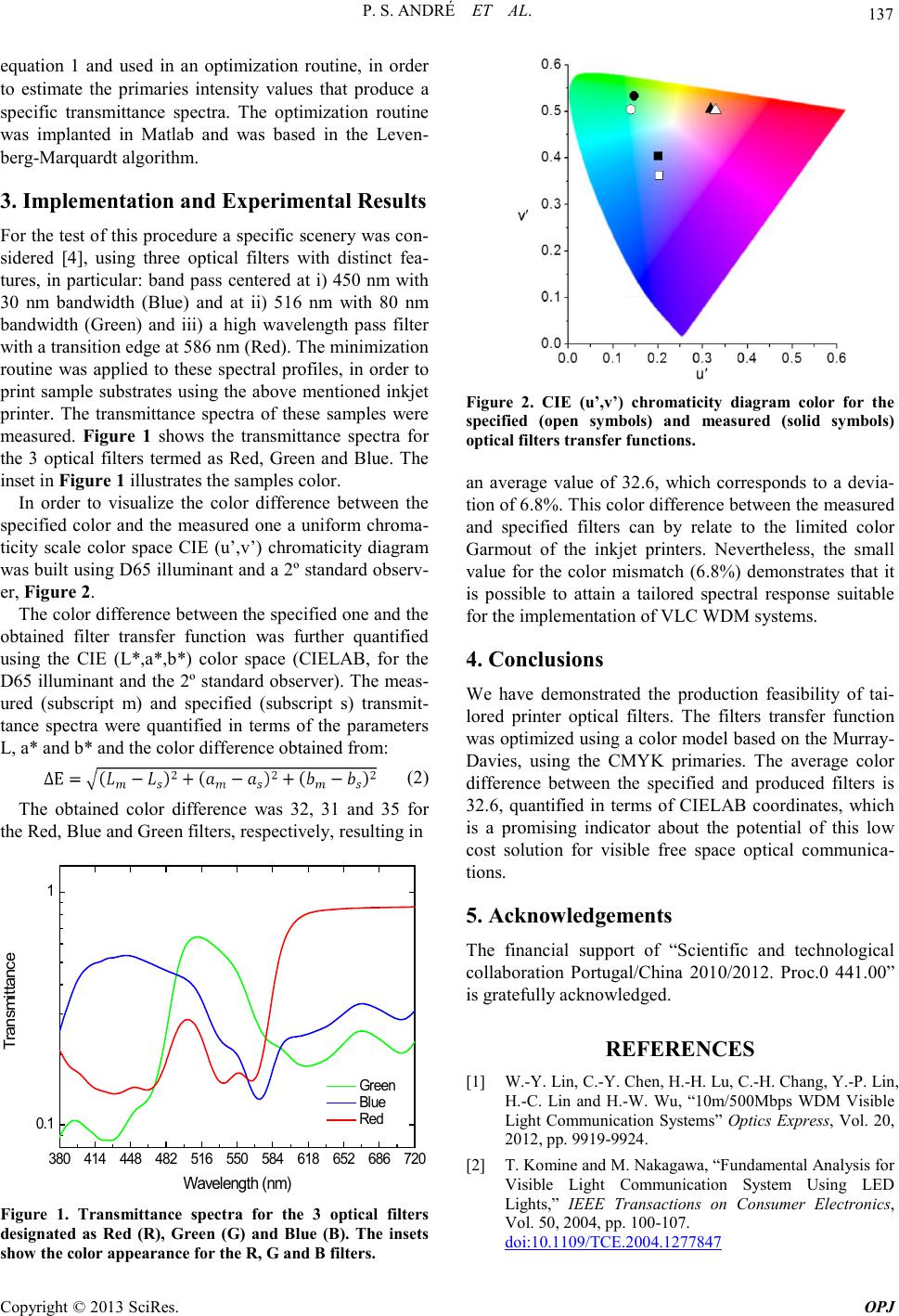 P. S. ANDRÉ ET AL. Copyright © 2013 SciRes. OPJ 137 equation 1 and used in an optimization routine, in order to estimate the primaries intensity values that produce a specific transmittance spectra. The optimization routine was implanted in Matlab and was based in the Leven- berg-Marquardt algorithm. 3. Implementation and Experimental Results For the test of this procedure a specific scenery was con- sidered [4], using three optical filters with distinct fea- tures, in particular: band pass centered at i) 450 nm with 30 nm bandwidth (Blue) and at ii) 516 nm with 80 nm bandwidth (Green) and iii) a high wavelength pass filter with a transition edge at 586 nm (Red). The minimization routine was applied to these spectral profiles, in order to print sample substrates usi ng the above mentioned inkjet printer. The transmittance spectra of these samples were measured. Figure 1 shows the transmittance spectra for the 3 optical filters termed as Red, Green and Blue. The inset in Figure 1 illustrates the samples color. In order to visualize the color difference between the specified color and the measured one a uniform chroma- ticity scale color space CIE (u’,v’) chromaticity diagram was built using D65 illuminant and a 2º standard observ- er, Figure 2. The color difference between the specified one and the obtained filter transfer function was further quantified using the CIE (L*,a*,b*) color space (CIELAB, for the D65 illuminant and the 2º standard observer). The meas- ured (subscript m) and specified (subscript s) transmit- tance spectra were quantified in terms of the parameters L, a* and b* and the color difference obtained from: (2) The obtained color difference was 32, 31 and 35 for the Red, Blue and Green filters, respectively, resulting in 380 414 448 482 516 550 584618 652 686 720 0.1 1 G reen Blue Red Transmittance Wavelength (nm) Figure 1. Transmittance spectra for the 3 optical filters designated as Red (R), Green (G) and Blue (B). The insets show the color appearance for the R, G and B fi lters. Figure 2. CIE (u’,v’) chromaticity diagram color for the specified (open symbols) and measured (solid symbols) optical fi lters transfer functions. an average value of 32.6, which corresponds to a devia- tion of 6.8%. This color difference between the measured and specified filters can by relate to the limited color Garmout of the inkjet printers. Nevertheless, the small value for the color mismatch (6.8%) demonstrates that it is possible to attain a tailored spectral response suitable for the impleme ntation of V L C WDM syste ms. 4. Conclusions We have demonstrated the production feasibility of tai- lored printer optical filters. The filters transfer function was optimized using a color model based on the Murray- Davies, using the CMYK primaries. The average color difference between the specified and produced filters is 32.6, quantified in terms of CIELAB coordinates, which is a promising indicator about the potential of this low cost solution for visible free space optical communica- tions. 5. Acknowledgements The financial support of “Scientific and technological collaboration Portugal/China 2010/2012. Proc.0 441.00” is gratefull y ac knowledged. REFERENCES [1] W.-Y. Li n , C .-Y. Chen, H.-H. Lu , C .-H. Chang, Y.-P. Lin, H.-C. Lin and H.-W. Wu, “10m/500Mbps WDM Visible Light Communication Systems” Optics Express, Vol. 20, 2012, pp . 9919-9924. [2] T. Ko mine an d M. Nakagawa, “F u nd amental Analysis for Visible Light Communication System Using LED Lights,” IEEE Transactions on Consumer Electronics, Vol. 50, 2004, pp. 100-107. doi:10.1109/TCE.2004.1277847  P. S. ANDRÉ ET AL. Copyright © 2013 SciRes. OPJ 138 [3] K.Y. Cui , G. Chen, Q.F. He and Z.Y. X u, “ Ind oo r Optical Wireless Communication by Ultraviolet and Visible Light,”Proceedings of SPIE 7091, 2009, p. 709106. [4] M. S. Uddin, J. S. Cha, J. Y. Kim and Y. M. Jang, “Mi ti- gation Technique for Receiver Performance Variation of Multi-Color Channels in Visible Light Communication”, Vol. 11, 2011, pp. 61 31-6144. doi:10.3390/s110606131 [5] I. A mid r or and R. D. Hersch, “Neugebauer an d Demichel: Dependence and Independence in N-Screen Superposi- tions for Colour Printing,” Color Research & Application Vol. 25, 2000, pp. 267-277. doi:10.1002/1520-6378(200008)25:4<267::AID-COL7>3 .0.CO;2-M [6] J. McElvaina, J. M illera and E. Jin, “Spectral Printer Modeling for Transparency Media: Toward High Dy- namic Range Scene Reproduction”, Proceedings of SPIE, Vol. 7241, 20 09, pp. 72 41 0U -1. doi:10.1117/12.806123 |