

Paper Menu >>
Journal Menu >>
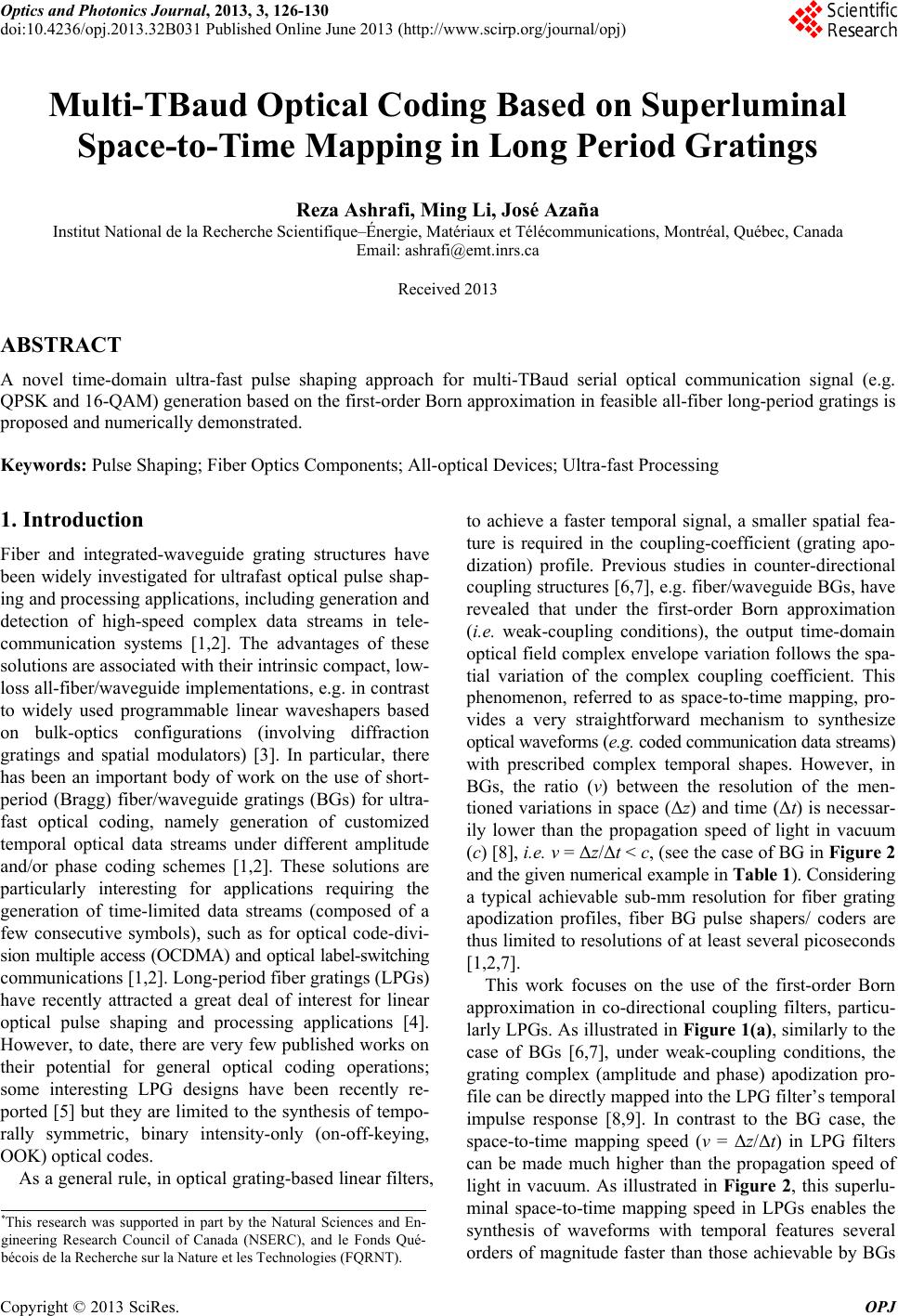 Optics and Photonics Journal, 2013, 3, 126-130 doi:10.4236/opj.2013.32B031 Published Online June 2013 (http://www.scirp.org/journal/opj) Multi-TBaud Optical Coding Based on Superluminal Space-to-Time Mapping in Long Period Gratings Reza Ashrafi, Ming Li, José Azaña Institut National de la Recherche Scientifique–Énergie, Matériaux et Télécommunications, Montréal, Québec, Canada Email: [email protected] Received 2013 ABSTRACT A novel time-domain ultra-fast pulse shaping approach for multi-TBaud serial optical communication signal (e.g. QPSK and 16-QAM) generation based on the first-order Born approximation in feasible all-fiber long-period gratings is proposed and numerically demonstrated. Keywords: Pulse Shaping; Fiber Optics Components; All-optical Devices; Ultra-fast Processing 1. Introduction Fiber and integrated-waveguide grating structures have been widely investigated for ultrafast optical pulse shap- ing and processing applications, including generation and detection of high-speed complex data streams in tele- communication systems [1,2]. The advantages of these solutions are associated with their intrinsic compact, low- loss all-fiber/waveguide implementations, e.g. in contrast to widely used programmable linear waveshapers based on bulk-optics configurations (involving diffraction gratings and spatial modulators) [3]. In particular, there has been an important body of work on the use of short- period (Bragg) fiber/waveguide gratings (BGs) for ultra- fast optical coding, namely generation of customized temporal optical data streams under different amplitude and/or phase coding schemes [1,2]. These solutions are particularly interesting for applications requiring the generation of time-limited data streams (composed of a few consecutive symbols), such as for optical code-divi- sion multiple access (OCDMA) and optical label-switching communications [1,2]. Long-period fiber gratings (LPGs) have recently attracted a great deal of interest for linear optical pulse shaping and processing applications [4]. However, to date, there are very few published works on their potential for general optical coding operations; some interesting LPG designs have been recently re- ported [5] but they are limited to the synthesis of tempo- rally symmetric, binary intensity-only (on-off-keying, OOK) optical codes. As a general rule, in optical grating-based linear filters, to achieve a faster temporal signal, a smaller spatial fea- ture is required in the coupling-coefficient (grating apo- dization) profile. Previous studies in counter-directional coupling structures [6,7], e.g. fiber/waveguide BGs, have revealed that under the first-order Born approximation (i.e. weak-coupling conditions), the output time-domain optical field complex envelope variation follows the spa- tial variation of the complex coupling coefficient. This phenomenon, referred to as space-to-time mapping, pro- vides a very straightforward mechanism to synthesize optical waveforms (e.g. coded communication data streams) with prescribed complex temporal shapes. However, in BGs, the ratio (v) between the resolution of the men- tioned variations in space (Δz) and time (Δt) is necessar- ily lower than the propagation speed of light in vacuum (c) [8], i.e. v = Δz/Δt < c, (see the case of BG in Figure 2 and the given numerical example in Table 1). Considering a typical achievable sub-mm resolution for fiber grating apodization profiles, fiber BG pulse shapers/ coders are thus limited to resolutions of at least several picoseconds [1,2,7]. This work focuses on the use of the first-order Born approximation in co-directional coupling filters, particu- larly LPGs. As illustrated in Figure 1(a), similarly to the case of BGs [6,7], under weak-coupling conditions, the grating complex (amplitude and phase) apodization pro- file can be directly mapped into the LPG filter’s temporal impulse response [8,9]. In contrast to the BG case, the space-to-time mapping speed (v = Δz/Δt) in LPG filters can be made much higher than the propagation speed of light in vacuum. As illustrated in Figure 2, this superlu- minal space-to-time mapping speed in LPGs enables the synthesis of waveforms with temporal features several orders of magnitude faster than those achievable by BGs *This research was supported in part by the Natural Sciences and En- gineering Research Council of Canada (NSERC), and le Fonds Qué- bécois de la Recherche sur la Nature et les Technologies (FQRNT). Copyright © 2013 SciRes. OPJ 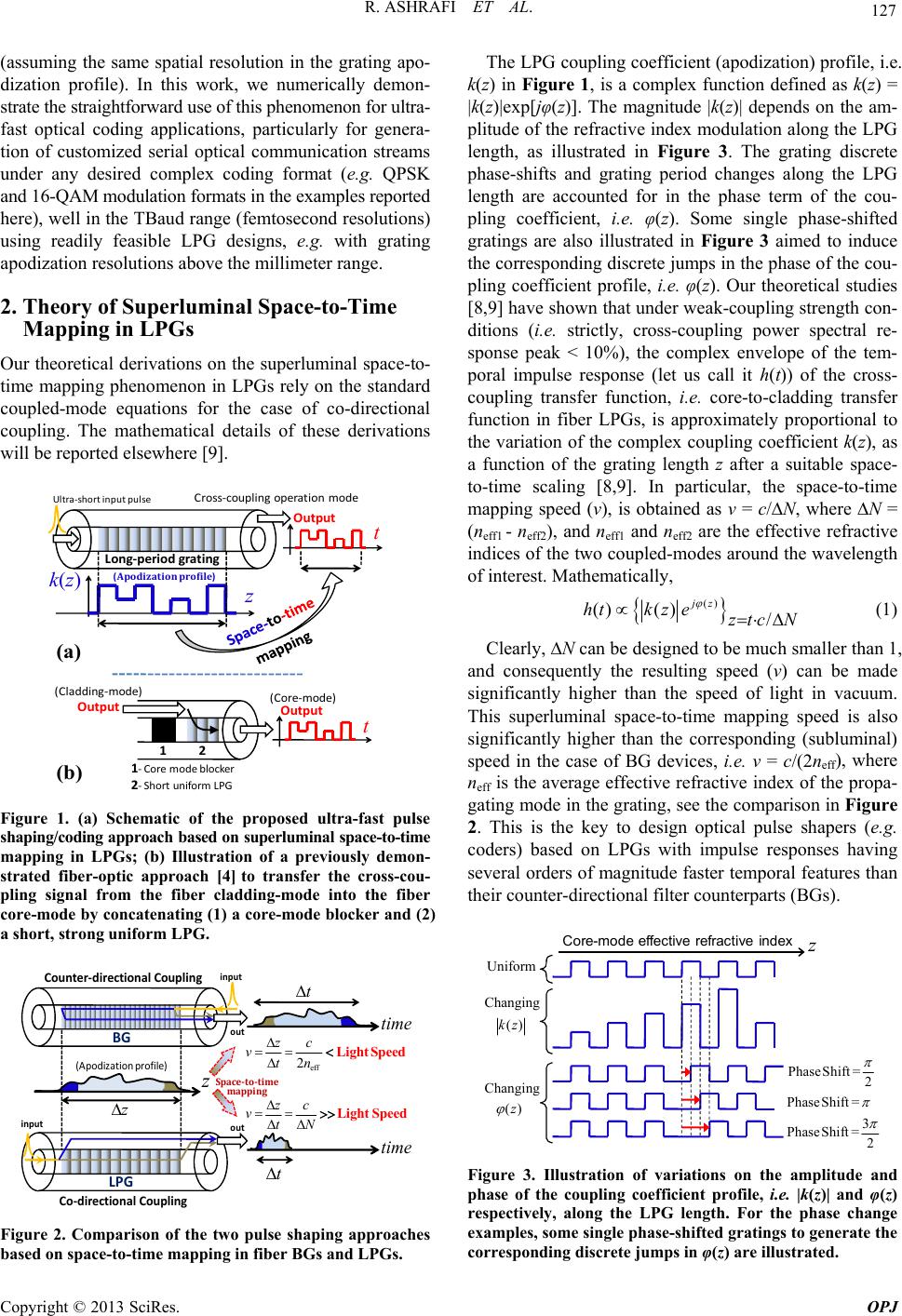 R. ASHRAFI ET AL. 127 (assuming the same spatial resolution in the grating apo- dization profile). In this work, we numerically demon- strate the straightforward use of this phenomenon for ultra- fast optical coding applications, particularly for genera- tion of customized serial optical communication streams under any desired complex coding format (e.g. QPSK and 16-QAM modulation formats in the examples reported here), well in the TBaud range (femtosecond resolutions) using readily feasible LPG designs, e.g. with grating apodization resolutions above the millimeter range. 2. Theory of Superluminal Space-to-Time Mapping in LPGs Our theoretical derivations on the superluminal space-to- time mapping phenomenon in LPGs rely on the standard coupled-mode equations for the case of co-directional coupling. The mathematical details of these derivations will be reported elsewhere [9]. Output Cross‐couplingoperat ionmode (Apodizationprofi le) Long‐periodgrating k(z)z t (Cladding‐mode) Output Output 12 1 ‐Coremodeblocker 2 ‐ShortuniformLP G (b) (a) (Core‐mode) Ultra‐sho r t inputpulse t Figure 1. (a) Schematic of the proposed ultra-fast pulse shaping/coding approach based on superluminal space-to-time mapping in LPGs; (b) Illustration of a previously demon- strated fiber-optic approach [4] to transfer the cross-cou- pling signal from the fiber cladding-mode into the fiber core-mode by concatenating (1) a core -mode blocker and (2) a short, strong uniform LPG. z Space‐to‐time LPG z time input BG t t eff v 2 zc tn Li g htS p eed zc tN Liv g ht Speed out out mappi ng time Counter‐directionalCoupling Co‐directionalCoupling (Apodizationprofile) input Figure 2. Comparison of the two pulse shaping approaches based on space-to-time mapping in fiber BGs and LPGs. The LPG coupling coefficient (apodization) profile, i.e. k(z) in Figure 1, is a complex function defined as k(z) = |k(z)|exp[jφ(z)]. The magnitude |k(z)| depends on the am- plitude of the refractive index modulation along the LPG length, as illustrated in Figure 3. The grating discrete phase-shifts and grating period changes along the LPG length are accounted for in the phase term of the cou- pling coefficient, i.e. φ(z). Some single phase-shifted gratings are also illustrated in Figure 3 aimed to induce the corresponding discrete jumps in the phase of the cou- pling coefficient profile, i.e. φ(z). Our theoretical studies [8,9] have shown that under weak-coupling strength con- ditions (i.e. strictly, cross-coupling power spectral re- sponse peak < 10%), the complex envelope of the tem- poral impulse response (let us call it h(t)) of the cross- coupling transfer function, i.e. core-to-cladding transfer function in fiber LPGs, is approximately proportional to the variation of the complex coupling coefficient k(z), as a function of the grating length z after a suitable space- to-time scaling [8,9]. In particular, the space-to-time mapping speed (v), is obtained as v = c/∆N, where ∆N = (neff1 - neff2), and neff1 and neff2 are the effective refractive indices of the two coupled-modes around the wavelength of interest. Mathematically, () ()( )/ jz htk zeztc N (1) Clearly, ∆N can be designed to be much smaller than 1, and consequently the resulting speed (v) can be made significantly higher than the speed of light in vacuum. This superluminal space-to-time mapping speed is also significantly higher than the corresponding (subluminal) speed in the case of BG devices, i.e. v = c/(2neff), where neff is the average effective refractive index of the propa- gating mode in the grating, see the comparison in Figure 2. This is the key to design optical pulse shapers (e.g. coders) based on LPGs with impulse responses having several orders of magnitude faster temporal features than their counter-directional filter counterparts (BGs). PhaseShift =2 3 PhaseShift =2 PhaseShift = Co re-mo de effecti ve refract ive index z Uniform Changing ()kz Changing ()z Figure 3. Illustration of variations on the amplitude and phase of the coupling coefficient profile, i.e. |k(z)| and φ(z) respectively, along the LPG length. For the phase change examples, some single phase-shifted gratings to generate the corresponding discrete jumps in φ(z) are illustrated. Copyright © 2013 SciRes. OPJ 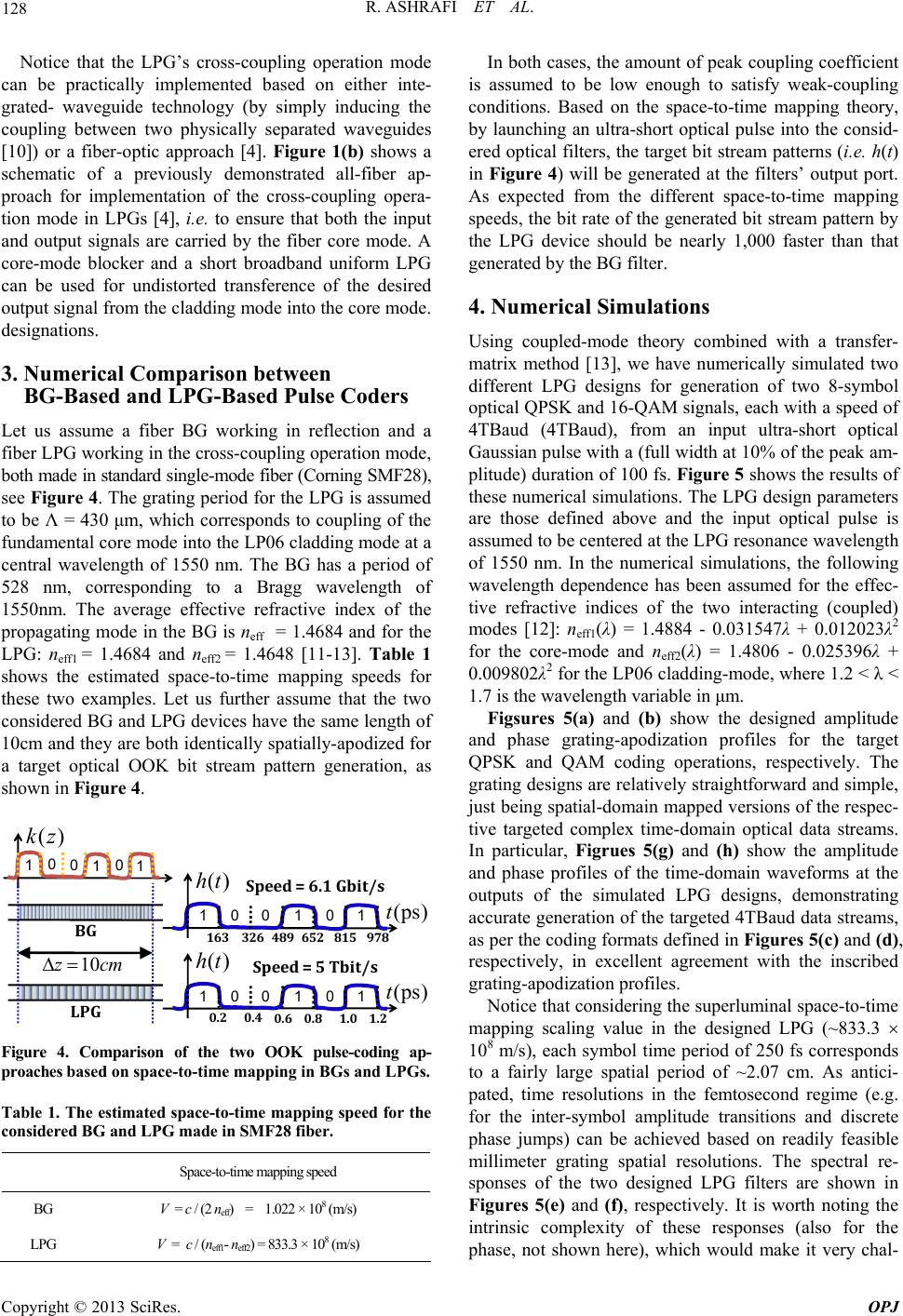 R. ASHRAFI ET AL. 128 Notice that the LPG’s cross-coupling operation mode can be practically implemented based on either inte- grated- waveguide technology (by simply inducing the coupling between two physically separated waveguides [10]) or a fiber-optic approach [4]. Figure 1(b) shows a schematic of a previously demonstrated all-fiber ap- proach for implementation of the cross-coupling opera- tion mode in LPGs [4], i.e. to ensure that both the input and output signals are carried by the fiber core mode. A core-mode blocker and a short broadband uniform LPG can be used for undistorted transference of the desired output signal from the cladding mode into the core mode. designations. 3. Numerical Comparison between BG-Based and LPG-Based Pulse Coders Let us assume a fiber BG working in reflection and a fiber LPG working in the cross-coupling operation mode, both made in standard single-mode fiber (Corning SMF28), see Figure 4. The grating period for the LPG is assumed to be Λ = 430 μm, which corresponds to coupling of the fundamental core mode into the LP06 cladding mode at a central wavelength of 1550 nm. The BG has a period of 528 nm, corresponding to a Bragg wavelength of 1550nm. The average effective refractive index of the propagating mode in the BG is neff = 1.4684 and for the LPG: neff1 = 1.4684 and neff2 = 1.4648 [11-13]. Table 1 shows the estimated space-to-time mapping speeds for these two examples. Let us further assume that the two considered BG and LPG devices have the same length of 10cm and they are both identically spatially-apodized for a target optical OOK bit stream pattern generation, as shown in Figure 4. ()kz 10zcm 1000 11 ()ht 100 011 BG LPG (ps)t 0.20.4 0.6 Sp eed=5Tbit/s ()ht 100 011 (ps)t 163326 489 652 815 978 Speed=6.1Gbi t / s 0.81.0 1.2 Figure 4. Comparison of the two OOK pulse-coding ap- proaches based on space-to-time mapping in BGs and LPGs. Table 1. The estimated space-to-time mapping speed for the considered BG and LPG made in S MF28 fib er. Space-to-time mapping speed BG V = c / (2 neff) = 1.022 × 10⁸ (m/s) LPG V = c / (neff1- neff2) = 833.3 × 10⁸ (m/s) In both cases, the amount of peak coupling coefficient is assumed to be low enough to satisfy weak-coupling conditions. Based on the space-to-time mapping theory, by launching an ultra-short optical pulse into the consid- ered optical filters, the target bit stream patterns (i.e. h(t) in Figure 4) will be generated at the filters’ output port. As expected from the different space-to-time mapping speeds, the bit rate of the generated bit stream pattern by the LPG device should be nearly 1,000 faster than that generated by the BG filter. 4. Numerical Simulations Using coupled-mode theory combined with a transfer- matrix method [13], we have numerically simulated two different LPG designs for generation of two 8-symbol optical QPSK and 16-QAM signals, each with a speed of 4TBaud (4TBaud), from an input ultra-short optical Gaussian pulse with a (full width at 10% of the peak am- plitude) duration of 100 fs. Figure 5 shows the results of these numerical simulations. The LPG design parameters are those defined above and the input optical pulse is assumed to be centered at the LPG resonance wavelength of 1550 nm. In the numerical simulations, the following wavelength dependence has been assumed for the effec- tive refractive indices of the two interacting (coupled) modes [12]: neff1(λ) = 1.4884 - 0.031547λ + 0.012023λ2 for the core-mode and neff2(λ) = 1.4806 - 0.025396λ + 0.009802λ2 for the LP06 cladding-mode, where 1.2 < λ < 1.7 is the wavelength variable in μm. Figsures 5(a) and (b) show the designed amplitude and phase grating-apodization profiles for the target QPSK and QAM coding operations, respectively. The grating designs are relatively straightforward and simple, just being spatial-domain mapped versions of the respec- tive targeted complex time-domain optical data streams. In particular, Figrues 5(g) and (h) show the amplitude and phase profiles of the time-domain waveforms at the outputs of the simulated LPG designs, demonstrating accurate generation of the targeted 4TBaud data streams, as per the coding formats defined in Figures 5(c) and (d), respectively, in excellent agreement with the inscribed grating-apodization profiles. Notice that considering the superluminal space-to-time mapping scaling value in the designed LPG (~833.3 108 m/s), each symbol time period of 250 fs corresponds to a fairly large spatial period of ~2.07 cm. As antici- pated, time resolutions in the femtosecond regime (e.g. for the inter-symbol amplitude transitions and discrete phase jumps) can be achieved based on readily feasible millimeter grating spatial resolutions. The spectral re- sponses of the two designed LPG filters are shown in Figures 5(e) and (f), respectively. It is worth noting the intrinsic complexity of these responses (also for the phase, not shown here), which would make it very chal- Copyright © 2013 SciRes. OPJ 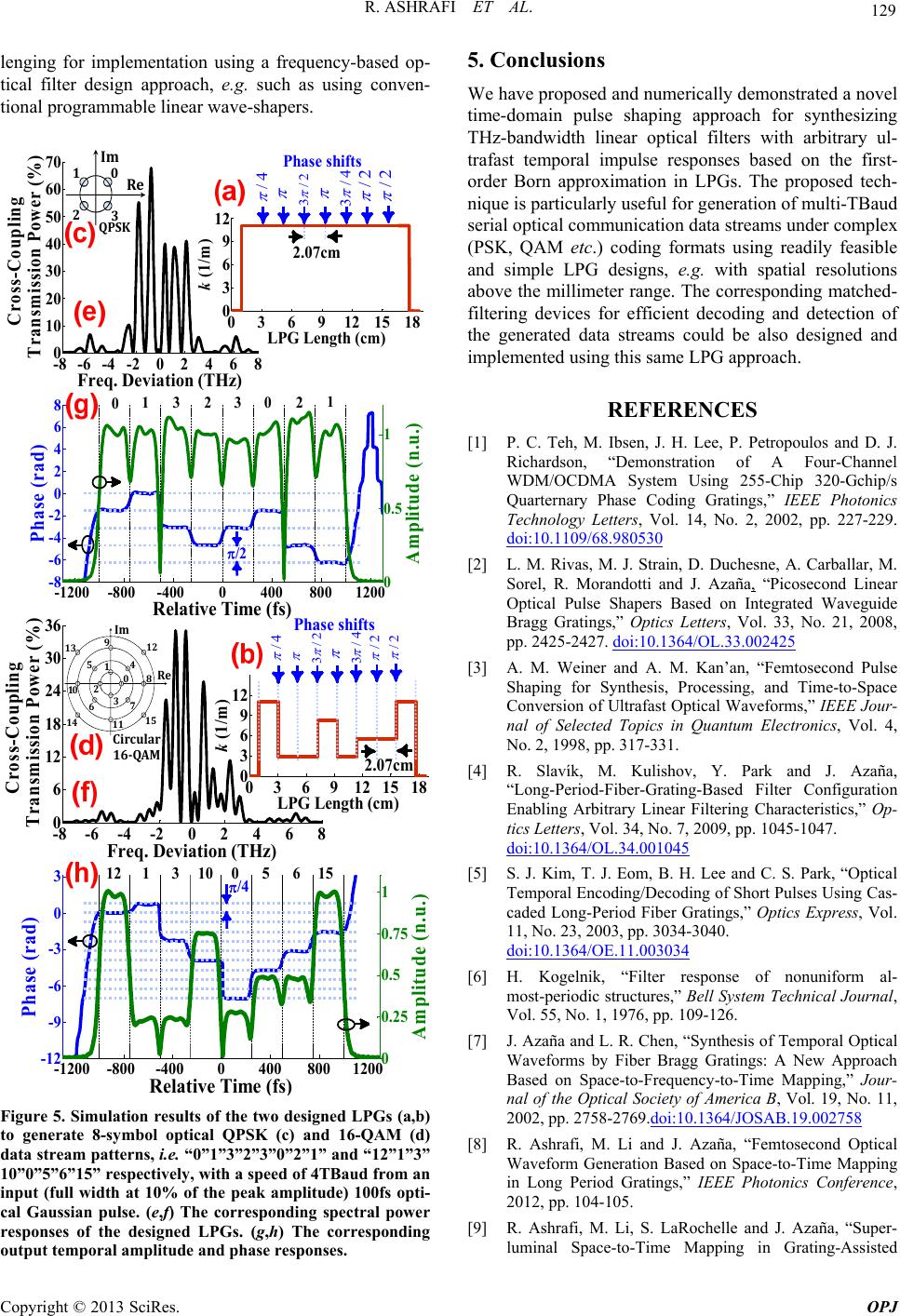 R. ASHRAFI ET AL. 129 lenging for implementation using a frequency-based op- tical filter design approach, e.g. such as using conven- tional programmable linear wave-shapers. -12 -9 -6 -3 0 3 Phase (rad) -1200 -800-400 0400 800 12000 0.25 0.5 0.75 1 Relative Time ( fs ) Am p litude ( n.u. ) 12 1310056 15 /4 -8 -6 -4 -202468 0 6 12 18 24 30 36 Freq. Deviation (THz) C ross- Cou pling Transmission Power (% ) 0 3 6 912 15 18 0 3 6 9 12 LPG Length (cm) k (1/m ) Phase shifts 2.07cm -8 -6 -4 -2 0 2 4 6 8 Phase (rad) -1200 -800-400 0400800 12000 0.5 1 Relative Time (fs) mplitude ()An.u. /2 33 00 22 1 1 -8 -6 -4 -20 2 46 8 0 10 20 30 40 50 60 70 Freq. Devi ati on (TH z) Cross - Cou plin g Transmission Power (% ) 0369 12 15 18 0 3 6 9 12 LPG Length (cm) k (1/m) Phase shifts 2.07cm 3/2 QPSK /4 3/4 /2 /2 Circular 16‐QAM /4 3/4 /2 /2 3/2 Im Re 2 08 1 3 4 5 67 9 11 12 13 14 15 0 1 Im Re 01 23 Figure 5. Simulation results of the two designed LPGs (a,b) to generate 8-symbol optical QPSK (c) and 16-QAM (d) data stream patterns, i.e. “0”1”3”2”3”0”2”1” and “12”1”3” 10”0”5”6”15” respectively, with a speed of 4TBaud from an input (full width at 10% of the peak amplitude) 100fs opti- cal Gaussian pulse. (e,f) The corresponding spectral power responses of the designed LPGs. (g,h) The corresponding output temporal amplitude and phase responses. 5. Conclusions We have proposed and numerically demonstrated a novel time-domain pulse shaping approach for synthesizing THz-bandwidth linear optical filters with arbitrary ul- trafast temporal impulse responses based on the first- order Born approximation in LPGs. The proposed tech- nique is particularly useful for generation of multi-TBaud serial optical communication data streams under complex (PSK, QAM etc.) coding formats using readily feasible and simple LPG designs, e.g. with spatial resolutions above the millimeter range. The corresponding matched- filtering devices for efficient decoding and detection of the generated data streams could be also designed and implemented using this same LPG approach. REFERENCES [1] P. C. Teh, M. Ibsen, J. H. Lee, P. Petropoulos and D. J. Richardson, “Demonstration of A Four-Channel WDM/OCDMA System Using 255-Chip 320-Gchip/s Quarternary Phase Coding Gratings,” IEEE Photonics Technology Letters, Vol. 14, No. 2, 2002, pp. 227-229. doi:10.1109/68.980530 [2] L. M. Rivas, M. J. Strain, D. Duchesne, A. Carballar, M. Sorel, R. Morandotti and J. Azaña, “Picosecond Linear Optical Pulse Shapers Based on Integrated Waveguide Bragg Gratings,” Optics Letters, Vol. 33, No. 21, 2008, pp. 2425-2427. doi:10.1364/OL.33.002425 [3] A. M. Weiner and A. M. Kan’an, “Femtosecond Pulse Shaping for Synthesis, Processing, and Time-to-Space Conversion of Ultrafast Optical Waveforms,” IEEE Jour- nal of Selected Topics in Quantum Electronics, Vol. 4, No. 2, 1998, pp. 317-331. [4] R. Slavík, M. Kulishov, Y. Park and J. Azaña, “Long-Period-Fiber-Grating-Based Filter Configuration Enabling Arbitrary Linear Filtering Characteristics,” Op- tics Letters, Vol. 34, No. 7, 2009, pp. 1045-1047. doi:10.1364/OL.34.001045 [5] S. J. Kim, T. J. Eom, B. H. Lee and C. S. Park, “Optical Temporal Encoding/Decoding of Short Pulses Using Cas- caded Long-Period Fiber Gratings,” Optics Express, Vol. 11, No. 23, 2003, pp. 3034-3040. doi:10.1364/OE.11.003034 [6] H. Kogelnik, “Filter response of nonuniform al- most-periodic structures,” Bell System Technical Journal, Vol. 55, No. 1, 1976, pp. 109-126. [7] J. Azaña and L. R. Chen, “Synthesis of Temporal Optical Waveforms by Fiber Bragg Gratings: A New Approach Based on Space-to-Frequency-to-Time Mapping,” Jour- nal of the Optical Society of America B, Vol. 19, No. 11, 2002, pp. 2758-2769.doi:10.1364/JOSAB.19.002758 [8] R. Ashrafi, M. Li and J. Azaña, “Femtosecond Optical Waveform Generation Based on Space-to-Time Mapping in Long Period Gratings,” IEEE Photonics Conference, 2012, pp. 104-105. [9] R. Ashrafi, M. Li, S. LaRochelle and J. Azaña, “Super- luminal Space-to-Time Mapping in Grating-Assisted Copyright © 2013 SciRes. OPJ  R. ASHRAFI ET AL. Copyright © 2013 SciRes. OPJ 130 Co-Directional Couplers,” Optics Letters, Vol. 21, No. 5, 2013, pp. 6249-6256. doi:10.1364/OE.21.006249 [10] J. Jiang, C. L. Callender, J. P. Noad and J. Ding, “Hybrid Silica/Polymer Long Period Gratings for Wavelength Fil- tering and Power Distribution,” Applied Optics, Vol. 48, No. 26, 2009, pp. 4866-4873. doi:10.1364/AO.48.004866 [11] R. Kritzinger, D. Schmieder and A. Booysen, “Azimuth- ally Symmetric Long-Period Fibre Grating Fabrication with A TEM01-Mode CO2 Laser,” Measurement Science and Technology, Vol. 20, No. 3, 2009, p. 034004. doi:10.1088/0957-0233/20/3/034004 [12] M. Smietana, W. J. Bock., P. Mikulic and J. Chen, “In- creasing Sensitivity of Arc-induced Long-Period Grat- ings—Pushing the Fabrication Technique Toward Its Limits,” Measurememt Science and Technology, Vol. 22, No.1,p.015201,2011.doi:10.1088/0957-0233/22/1/015201 [13] T. Erdogan, “Fiber Grating Spectra,” Journal of Light- wave Technology, Vol. 15, No. 8, 1997, pp. 1277-1294. doi:10.1109/50.618322 |