

Paper Menu >>
Journal Menu >>
 Psychology 2013. Vol.4, No.7, 585-591 Published Online July 2013 in SciRes (http://www.scirp.org/journal/psych) http://dx.doi.org/10.4236/psych.2013.47084 Copyright © 2013 SciRes. 585 Students’ Metacognitive Strategies in the Mathematics Classroom Using Open Approach Ariya Suriyon1, Maitree Inprasitha2, Kiat Sangaroon3 1Doctor of Philosophy Prog ram in Mathematics Education, Khon Kaen University, Khon Kaen, Thailand 2Center for Research in Mathematics Education, Khon Kaen University, Khon Kaen, Thailand 3Department of Mathematics, Faculty of Scie n ce, K hon Ka en Un iversity, Khon Kaen, Thailand Email: [email protected] Received March 24th, 2013; revised April 25th, 2013; accepted May 22nd, 2013 Copyright © 2013 Ariya Suriyon et al. This is an open access article distributed under the Creative Commons Attribution License, which permits unrestricted use, distribution, and reproduction in any medium, provided the original work is properly cited. This paper describes a study investigating students’ metacognitive behavior and abilities in the math- ematic class using the open approach. Four 1st grade students, ages six to seven years, served as a target group from the primary school having participated since 2006 in the Teacher Professional Development Project with innovation of lesson study and open approach. The research was based on Begle’s conceptual framework (1969), focusing on observing the nature of occurrences in order to describe emerging facts in the class. In addition, the data were examined by triangulation among three sources: video recording, field notes, and students’ written works. Data analysis rested upon 4 open approach-based teaching steps (In- prasitha, 2010). The study results showed that the open approach-based mathematic class helped students exhibit metacognitive behavior and abilities relevant to the four teaching steps: 1) posing open-ended problem, 2) students’ self learning, 3) whole class discussion and comparison, and 4) summarization through connecting students’ mathematical ideas emerging in the classroom. Keywords: Problem Solving; Metacognitive Strategies; Lesson Study; Open Approach Introduction As for significance of problem solving, National Council of Teachers of Mathematics (NCTM) (1989) mentioned in the curriculum standard on the item 1, “mathematics as problem solving”. Also, the NCTM Curriculum and Evaluation Stan- dards obviously demonstrated that mathematics might truly be the best teaching through problem solving situations (Kroll & Miller, 1993), and in problem solving, it is necessary to empha- size mathematics at school levels (NCTM, 1980) in relevance with the study of Inprasitha (1997), concluding in his research that problem solving was fundamental teaching reform. The problem solving approach supports education reform as a bot- tom-up process. “Bottom” means “class”, and “up” means “so- ciety” as a whole”. In addition, NCTM (2000) referred to the importance of problem solving as integration of all mathemati- cal learning by determining a main issue of teaching and learn- ing programs from the elementary level to grade 12 that stu- dents should be able to investigate and reflect on mathematical problem solving, which serves as a basic provision regarding metacognitive traits. The provision should begin to be used with students at the lowest school grade in mathematical prob- lem solving. In the research on mathematical problem solving, based on the fundamental concept of Flavell (1976: p. 232), the metacognitive aspect is significant for many researchers. Ac- cording to Flavell’s definition of metacognition, it can be con- cluded that “In any kind of cognitive transaction with the hu- man or non-human environment, a variety of information proc- essing activities may go on. Metacognition refers, among other things, to the active monitoring and consequent regulation and orchestration of these processes in relation to the cognitive objects or data on which they bear, usually in service of some concrete goal or objective.” There is increasing interest concerning the study on roles of metacognition in mathematical problem solving. However, little is known about the nature of elementary students’ use of meta- cognitive strategies, and how these strategies are applied when students solve problems. Goos and Galbraith (1996) conducted a study on the nature of using metacognitive strategies by two secondary students and studied how the students applied those strategies when they took part in problem solving. In Inpra- sitha’s study (2003) of Thai students’ metacognition, he found that when they read mathematical problems, they knew what were given in the questions, but they could solve problems only to a certain extent. As for metacognitive strategies, students conducted observation and investigation in advance of problem solving by developing plans, monitoring, and evaluating their own learning or thinking; this approach improved students’ efficiency in open-ended problem solving. These strategies were still used among students at low levels, although there were still some pairs of students who did not employ metacog- nitive strategies during open-ended problem solving. From review of literature regarding metacognitive strategies, the study of Pressley, Veenman et al. (2004) shows that to develop metacognition among student groups, teachers need to have tools to apply metacognition within classes, beneficial to those activities. In general, metacognitive learning and teaching is not only essential to each teacher but also in systematic school  A. SURIYON ET AL. management. Context of the Study The objective of this study was to investigate students’ metacognitive behavior and abilities in the open approach based mathematic class of the school which has participated in the Teacher Professional Development Project with the innovation of lesson study and open approach. Therefore, in order to un- derstand the context as a source of data collection, in this re- search, the researcher had a role as a participating observer. Also, details of observations leading to research issues are ex- plained hereinafter. This study was conducted at Koo Kham Pittayasan School located in Khon Kaen Province in the Northeast of Thailand. It is a school with extensive educational opportunities and teaching management from kindergarten level to secondary level in grade 9. The innovation of lesson study and open approach has been introduced through the Teacher Professional Development Project with collaboration and su- pervision and monitored by the Center for Research in Mathe- matics Education, Khon Kaen University since April, 2006. The use of the applicable innovation as an important method was emphasized to develop mathematical thinking in the inte- gration of the lesson study process and open approach. For the lesson study process, it was adapted from the Japanese practice by integrating open approach and focusing on participation in all steps in the cycle of lesson study. A student as a teaching practitioner, the observing teacher, the researcher as a school coordinator, and external experts participated in design and teaching planning, collaborative class observation and discus- sion and mutual result reflection (Inprasitha & Loipha, 2007) every week. The principal aim was to create and develop open- ended situations based on students’ ideas. Figure 1 shows the process of lesson study every week, at Koo Kham Pittayasan School, in which the student as a teach- ing practitioner at school, the observing teacher, and the re- searcher as a school coordinator collaborated in the design and teaching planning on Tuesday and participated in observation based on the teaching schedule assigned from the school direc- tor. They discussed results on Thursday. This process has con- tinued since 2006 at the school. In the mathematical class, there was a plan in arranging learning and teaching activities high- lighting the open approach-based problem solving with the aim that students could participate in activities and show potential in mathematical thinking with all of their ability. From the re- searchers’ participation in each step of lesson study and the continuous observation of elementary student at grade 1 since the academic year of 2007, it found that while solving problems, for most of their behavior, the students focused on writing along with thinking: writing diagram, writing expressions sen- tences, and writing description on a self-thinking process with letters. Students tried to write description of self-thinking by writing and spelling to communicate with other people (Suri- yon et al., 2011). Rose (1989 cited in Pugalee, 2004) described the process as “Thinking aloud on paper.” Writing is not only describing what they think but also providing evidence of thinking that helps students to be aware of their thoughts and shows how they solve problems. Writing is thinking evidence that problem solvers can use to investigate their self-thinking process. Also, NCTM (2000: p. 61) suggested, “in writing, mathematics can help students gather their thoughts since writ- ing requires students to reflect on their work results and clari- Figure 1. Lesson study cycle (Inprasitha, 2004). fies their thoughts about concepts.” Pugalee (2001) suggested that students should develop an association between writing, metacognition, and mathematical problem solving. Therefore, the research considered students’ written works as important evidence in this st udy. Method The methodology was based on qualitative research in which the research aimed at investigating and finding emerging facts related to students’ use of metacognitive strategies while solv- ing problems in the mathematics class using the open approach. Considering students’ behavior and abilities to solve problems was based on information on classroom observation and par- ticipation in the academic years of 2008 and 2009 as criteria for inclusion of target groups. The target group was a group of 1st grade students (1 male and 3 females) in the academic year of 2010 from Koo Kham Pittayasan School with the age range from 6 to 7 years. The students have been studying at grade 1 for 7 months. The researcher, the teacher, and the observing teacher worked together in the consideration by determining attributes of the target group concerning the following behavior and abilities. Abilities to speak, read, and write explanations of their own thinking ways and their groups’ ideas. Behavior of monitoring their own thinking process and their groups’ ideas. Abilities to think differently. Helping and working together with other people. Talking and explaining reasons to illustrate their own thinking ways and ideas from their groups. Participating in the classroom continuously using the open approach from the beginning of the first semester in the academic year of 2010. The teacher was a mathematics intern student from Faculty of Education, Khon Kaen University. She practiced teaching in the academic year of 2010, focusing on the open approach and use of the open-ended problem situation developed from stu- dents’ ideas. In addition, she took part in lesson planning with teaching staffs, the school coordinator, the researcher, and other intern students (as observers). According to the lesson study cycle, the open approach was used during instructional practice with emphasis on the problem solving process. The research team has participated progressively in all steps of the lesson study process from 2008 to the present. For this research, qualitative methodology was applied with Copyright © 2013 SciRes. 586  A. SURIYON ET AL. an emphasis on the three-year observational study based on Begle’s conceptual framework (1969) with ways of observation and consideration on studying the nature of occurrences which starts with extensive, careful, and empirical observations of mathematics teaching and learning. In 2008 and 2009, any trends noted in these observations would lead to the formula- tion of hypotheses. In 2010, these hypotheses could then be checked agains t further observ ations and refined and sharpened. There was data collection in the learning unit on “addition (2)”, the first activity “Children playing in sandboxes and on slides” and the second activity “Buying eggs to make omelets”, which were developed from the lesson study process. All important qualitative data came from class observations, video recording while students were solving problems, field notes, and students’ written works which were analyzed. This process was based on triangulation from three data sources: video recording while students were solving problems, field notes, and analyzing stu- dents’ written works. Results From the data analysis, it showed students’ metacognitive strategies by analyzing students’ problem solving behavior in the class, corresponding to the teaching steps in the open ap- proach. The data from the first activity “Children playing in sandboxes and on slides” was used to reflect on images of the previous class in order to analyze the data in the next activity “Buying eggs to make omelets.” From the second activity, data were interpreted and determined as an explanation related to the students’ problem solving behavior in the classroom in order to show existing consistency in each teaching step through the open approach. In this research, students’ behavior and abilities showing use of metacognitive strategies in each open ap- proach-based teaching step were considered under the follow- ing definition of metacognitive strategies. Metacognitive strate- gies could be defined as thinking ability causing behavior that a problem solver can control, monitor, and reflect his own think- ing process, based on an idea or a way which he values from existent resources—accumulative recording of previous learn- ing experiences and which he then uses as a problem solving tool which will function as a determinant of thinking ways and keep continuous problem solving for advance in problem solv- ing. Furthermore, metacognitive strategies are used for exam- ining his own thinking and ensuring that he has already achieved his goal. According to the study, the researcher has obtained the following results. Activity 1: Children playing in sandboxes and on slides Problem situation: There are 9 children playing in the sandbox and 4 children playing on the slide. How many chil- dren are there (see Figure 2)? Instructions: 1) Students find out how many children there Figure 2. Picture for the activity 1 (Gakkoh Tosho, 1999). are and explain their ways of thinking, 2) Students present their works. This activity occurred during the first period in the unit on “addition (2)”. At the beginning of the activity, the teacher reviewed students’ previously learned ways of thinking in preparation for students’ readiness in problem solving for the next activity “Children playing sandboxes and on slides”. After that, when students learned problem solving on their own (learning how to learn), the target student group used ways of counting at the beginning of problem solving and then ways of problem solving: Student remembered previously learned ideas and strategies: how to make ten, decomposing, writing block diagram and arrow diagrams to describe thinking process in- cluding explanation of their thinking processes in their own words. The previous ideas and ways were used as tools to solve problems they were encountering. Students were able to moni- tor and to reflect on the thinking process with their own words as shown in Figure 3. Students tried to create problem solving strategies that showed different ways of thinking besides only finding an answer: students used how to make ten as a way to solve the problem. Then students decided to apply that idea as a problem-solving tool, making the problem solving process car- ries on progressively and students succeed in problem solving in the following situation. Activity 2: Buying eggs to make omelets Problem situation: Ms. Pha had three eggs in the egg tray. She wanted to make some omelets, but the number of eggs was not enough. Then she went out to buy an egg tray containing 9 eggs from Pop, egg seller. From this activity, students need to find out the total number of eggs Ms. Pha has (see Figure 4). Instructions: 1) Students show the thinking way “3 + 9” and other ways of thinking, 2) Then students show their thinking. To look for students’ metacognitive strategies which ap- peared in the four teaching steps through the open approach in the activity 2 “Buying eggs to make omelets”, the research team examined activity management by video recording and considered the interpretation by checking data from field notes and students’ written works. The research team examined con-sistency with the definition of metacognitive strategies. Fol Figure 3. Evidence from students’ written works in the activity 1. Figure Egg trays Figure 4. Materials for the activity 2. Copyright © 2013 SciRes. 587  A. SURIYON ET AL. lowing are the details of the four steps through the open ap- proach: 1) Posing open-ended problems This step was the beginning of problem solving: posing open-ended problem related to a problem situation presented by the teacher as shown in Figure 5. Students’ behavior and use of metacognition, which connected with the first step related to attempting to understand the problem situation; students thought those problems were their problems (students’ prob- lematic), showing their desire in proving or finding solutions by themselves. This conclusion was drawn from the observed en- thusiasm to solve problems by themselves or saying something to show acceptance , for example, “I can do”, or “I want to do”, and expressing their happiness when the teacher asked students to participate in problem solving as a group. In this step, the teacher posed the problem situation to students by using pic- tures and telling stories in order to lead to the mentioned in- structions. The teacher began her class by greeting students, and after that, she put the pictures on the magnet board and chose two volunteer students to act as supporting characters in the stories by using the pictures. The teacher allowed students to observe and consider the pictures. In this step, it demonstrated that students tried to understand the problem by showing enthusiasm, concentrated on the pic- tures, and described what they had observed. Students’ attempts to find answer and make predictions were the beginning, which led to proof of finding facts of conclusions by students for the next steps. 2) Students’ self learning The students’ self learning began after the teacher presented the open-ended problem. Behavior and students’ metacognitive strategies were regarding students’ learning how to learn by participating in problem solving in subgroups. One student was the recorder of ideas on papers to present, and three students participated in showing ideas by expressing their ideas. While the student recorded ideas, the members examined ways of thinking by taking an egg from the tray of 3 eggs to put on the tray of 9 eggs so that 9 could became 10. In the first tray, 2 eggs were left, as shown in Figure 6. Figure 5. The teacher posed the problem situation to students by using pictures and telling stori es . Figure 6. Examining ideas by exper iment from egg trays. After finishing writing their first ideas, members in each group helped each other check by reviewing the ideas, showed their opinions towards and improved what they had done. Dur- ing the problem solving step, the students changed roles within their groups. The strategies and ideas of problem solving which students used as a thinking tool were considered as previously learned: how to make ten, decomposing by writing blocks, arrows to show thinking process, and descriptions of thinking process using their own words. Students tried to show different and various ways of thinking by writing to show the thinking process as the Table 1. In addition, they studied the problem together and asked questions in their groups while solving problems. For students in each group who did not work on re- cording, they worked on checking works instead from written works of the groups, questioning and reasoning to make a mu- tual conclusion. 3) Whole class discussion and comparison Whole class discussion was the relevant step to behavior and abilities of students showing metacognitive strategies. In this step, it included examining problem solving strategies together from the teacher and classmates, accepting suggestions from the teacher and friends, including correcting mistakes immedi- ately. To begin with, students who were volunteers of each group presented works in front of the class, introduced them- selves, and presented the ideas from their groups. For presenta- tion from each group, students participated in asking a question, explaining, and comparing and contrasting their friends’ strate- gies, with their own. There was consideration of works from many student groups in terms of formats of writing messages and expressions. Presenting students listened to suggestions from their friends and corrected mistakes for some ideas. The teacher and students in the class worked together to solve prob- lem for mutual understanding as illustrated in the Figure 7. 4) Summarization through connecting students’ mathe- matical ideas em er gi ng in the classroo m The final step was conclusion of connecting students’ ideas. Behavior and students’ matacognitive strategies were regarding evaluating validity and correctness of ideas and ways that stu- dents performed corresponding to the initial problem situation. For assessment of ideas and strategies, the students valued ef- fective idea and ways, for example, applying the idea of how to make ten, which was considered as a simple way to solve prob- lems and take less time. For considering choice and making a decision, students used the data from making choices in prob- lem solving through various ways and ideas and from experi- ences in solving problems by themselves in the step of self- learning. Moreover, it included Comparison of efficiency of ideas and ways in the step of Figure 7. Whole classroom discussion and co mparison. Copyright © 2013 SciRes. 588 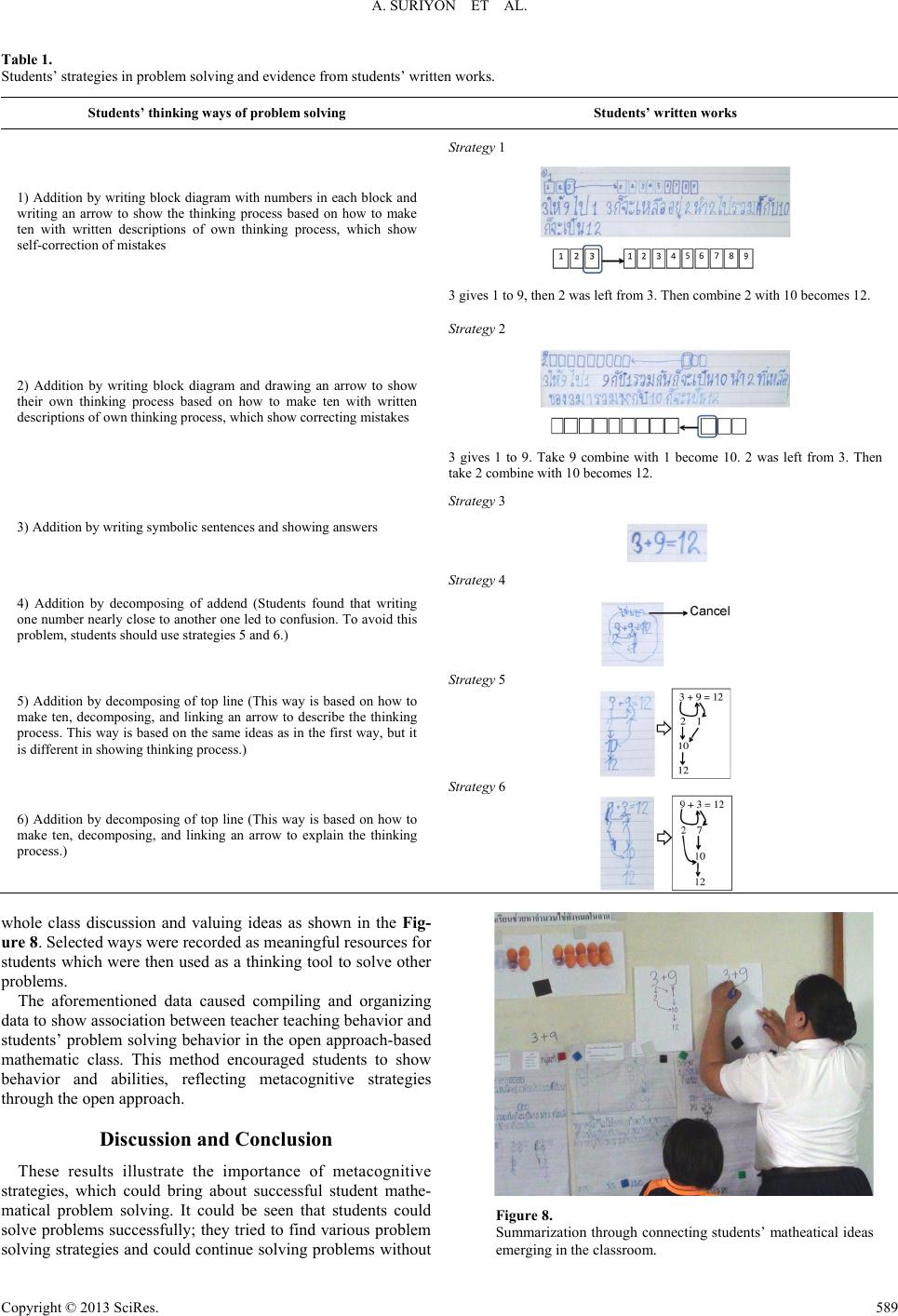 A. SURIYON ET AL. Copyright © 2013 SciRes. 589 Table 1. Students’ strategies in problem solving and evidence from students’ written works. Students’ thinking ways of problem solv ing Students’ written works 1) Additio n by writing blo ck diagram with n umbers in each bl ock and writing an arrow to show the thinking process based on how to make ten with written descriptions of own thinking process, which show self-correc tion of mista kes Strategy 1 3 gives 1 to 9, then 2 was left from 3. Then combine 2 with 10 beco mes 12. 2) Addition by writing block diagram and drawing an arrow to show their own thinking process based on how to make ten with written descriptions of own th inking process, which show correcting mistakes Strategy 2 3 gives 1 to 9. Take 9 combine with 1 become 10. 2 was left from 3. Then take 2 combine with 10 be comes 12. 3) Addition by writing symbolic sentences and showing answers Strategy 3 4) Addition by decomposing of addend (Students found that writing one number nearly close to another one led to confusion. To avoid this problem, students should use strategies 5 and 6.) Strategy 4 5) Addition by decomposing of top line (This way is based on how to make ten, decomposing, and linking an arrow to describe the thinking process. This way is based on the same ideas as in the first way, but it is different in showing thinking process.) Strategy 5 6) Addition by decomposing of top line (This way is based on how to make ten, decomposing, and linking an arrow to explain the thinking process.) Strategy 6 whole class discussion and valuing ideas as shown in the Fig- ure 8. Selected ways were recorded as meaningful resources for students which were then used as a thinking tool to solve other problems. The aforementioned data caused compiling and organizing data to show association between teacher teaching behavior and students’ problem solving behavior in the open approach-based mathematic class. This method encouraged students to show behavior and abilities, reflecting metacognitive strategies through the open approach. Discussion and Conclusion These results illustrate the importance of metacognitive strategies, which could bring about successful student mathe- matical problem solving. It could be seen that students could solve problems successfully; they tried to find various problem solving strategies and could continue solving problems without Figure 8. Summarization through connecting students’ matheatical ideas emerging in the classroom. 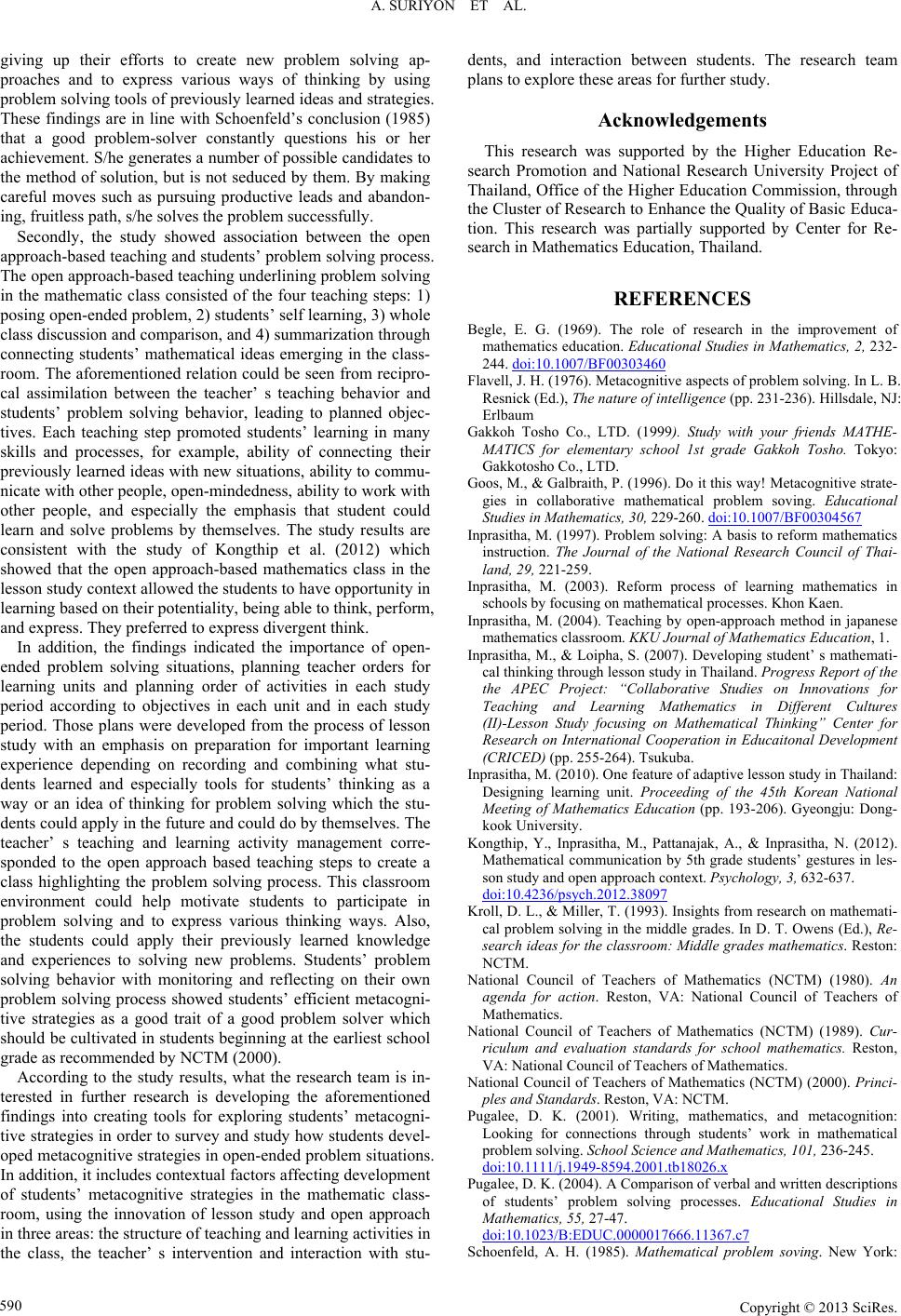 A. SURIYON ET AL. giving up their efforts to create new problem solving ap- proaches and to express various ways of thinking by using problem solving tools of previously learned ideas and strategies. These findings are in line with Schoenfeld’s conclusion (1985) that a good problem-solver constantly questions his or her achievement. S/he generates a number of possible candidates to the method of solution, but is not seduced by them. By making careful moves such as pursuing productive leads and abandon- ing, fruitless path, s/he solves the problem successfully. Secondly, the study showed association between the open approach-based teaching and students’ problem solving process. The open approach-based teaching underlining problem solving in the mathematic class consisted of the four teaching steps: 1) posing open-ended problem, 2) students’ self learning, 3) whole class discussion and comparison, and 4) summarization through connecting students’ mathematical ideas emerging in the class- room. The aforementioned relation could be seen from recipro- cal assimilation between the teacher’ s teaching behavior and students’ problem solving behavior, leading to planned objec- tives. Each teaching step promoted students’ learning in many skills and processes, for example, ability of connecting their previously learned ideas with new situations, ability to commu- nicate with other people, open-mindedness, ability to work with other people, and especially the emphasis that student could learn and solve problems by themselves. The study results are consistent with the study of Kongthip et al. (2012) which showed that the open approach-based mathematics class in the lesson study context a l l owed the student s to have opportunity in learning base d on t h eir potentiality , being able to think, perform, and express. They preferred to e xpress divergent think. In addition, the findings indicated the importance of open- ended problem solving situations, planning teacher orders for learning units and planning order of activities in each study period according to objectives in each unit and in each study period. Those plans were developed from the process of lesson study with an emphasis on preparation for important learning experience depending on recording and combining what stu- dents learned and especially tools for students’ thinking as a way or an idea of thinking for problem solving which the stu- dents could apply in the future and could do by themselves. The teacher’ s teaching and learning activity management corre- sponded to the open approach based teaching steps to create a class highlighting the problem solving process. This classroom environment could help motivate students to participate in problem solving and to express various thinking ways. Also, the students could apply their previously learned knowledge and experiences to solving new problems. Students’ problem solving behavior with monitoring and reflecting on their own problem solving process showed students’ efficient metacogni- tive strategies as a good trait of a good problem solver which should be cultivated in students beginning at the earliest school grade as recommended by NCTM (2000). According to the study results, what the research team is in- terested in further research is developing the aforementioned findings into creating tools for exploring students’ metacogni- tive strategies in order to survey and study how students devel- oped metacognitive strategies in open-ended problem situations. In addition, it includes contextual factors affecting development of students’ metacognitive strategies in the mathematic class- room, using the innovation of lesson study and open approach in three areas: the structure of teaching and learning activities in the class, the teacher’ s intervention and interaction with stu- dents, and interaction between students. The research team plans to explore these areas for further study. Acknowledgements This research was supported by the Higher Education Re- search Promotion and National Research University Project of Thailand, Office of the Higher Education Commission, through the Cluster of Research to Enhance the Quality of Basic Educa- tion. This research was partially supported by Center for Re- search in Mathematics Education, Thailand. REFERENCES Begle, E. G. (1969). The role of research in the improvement of mathematics education. Educational Studies in Mathematics, 2, 232- 244. doi:10.1007/BF00303460 Flavell, J. H. (1976). Metacognitive aspects of problem solving. In L. B. Resnick (Ed.), The nature of intelligence (pp. 231-236). Hillsdale, NJ: Erlbaum Gakkoh Tosho Co., LTD. (1999). Study with your friends MATHE- MATICS for elementary school 1st grade Gakkoh Tosho. Tokyo: Gakkotosho Co., LTD. Goos, M., & Galbraith, P. (1996). Do it this way! Metacognitive strate- gies in collaborative mathematical problem soving. Educational Studies in Mathematics, 3 0 , 229-260. doi:10.1007/BF00304567 Inprasitha, M. (1997). Problem solving: A basis to reform mathematics instruction. The Journal of the National Research Council of Thai- land, 29, 221-259. Inprasitha, M. (2003). Reform process of learning mathematics in schools by focusing on mathematical proces se s. Khon Kaen. Inprasitha, M. (2004). Teaching by open-approach method in japanese mathematics classroom. KKU Journal of Mathematics Education, 1. Inprasitha, M., & Loipha, S. (2007). Developing student’ s mathemati- cal thinking through lesson study in Thailand. Progress Report of the the APEC Project: “Collaborative Studies on Innovations for Teaching and Learning Mathematics in Different Cultures (II)-Lesson Study focusing on Mathematical Thinking” Center for Research on International Cooperation in Educaitonal Development (CRI CE D) (pp. 255-264). Tsukuba. Inprasitha, M. (2010). One feature of adaptive lesson study in Thailand: Designing learning unit. Proceeding of the 45th Korean National Meeting of Mathematics Education (pp. 193-206). Gyeongju: Dong- kook University. Kongthip, Y., Inprasitha, M., Pattanajak, A., & Inprasitha, N. (2012). Mathematical communication by 5th grade students’ gestures in les- son study and open approach context . Psychology, 3, 632-637. doi:10.4236/psych.2012.38097 Kroll, D. L., & Miller, T. (1993). Insights from research on mathemati- cal problem solving in the middle grades. In D. T. Owens (Ed.), Re- search ideas for the classroom: Middle grades mathematics. Reston: NCTM. National Council of Teachers of Mathematics (NCTM) (1980). An agenda for action. Reston, VA: National Council of Teachers of Mathematics. National Council of Teachers of Mathematics (NCTM) (1989). Cur- riculum and evaluation standards for school mathematics. Reston, VA: National Council of Teachers of Mathematics. National Council of Teachers of Mathematics (NCTM) (2000). Princi- ples and Standards. Reston, VA: NCTM. Pugalee, D. K. (2001). Writing, mathematics, and metacognition: Looking for connections through students’ work in mathematical problem solving. School Science and Mathematics , 101, 236-245. doi:10.1111/j.1949-8594.2001.tb18026.x Pugalee, D. K. (2004). A Comparison of verbal and written descriptions of students’ problem solving processes. Educational Studies in Mathematics, 55, 27-47. doi:10.1023/B:EDUC.0000017666.11367.c7 Schoenfeld, A. H. (1985). Mathematical problem soving. New York: Copyright © 2013 SciRes. 590  A. SURIYON ET AL. Copyright © 2013 SciRes. 591 Academic Press. Suriyon, A., Sangaroon, K., & Inprasitha, M. (2011). Exploring stu- dents’ metacognitive strategies during problem solving in a mathe- matics classroom using the open approach. Proceeding of the 35th PME Conference, 1, 397. Veenman, M. V. J., Wilhelm, P., & Beishuizen, J. J. (2004). The rela- tion between intellectual and metacognitive skills from a develop- mental perspective. Learning and Instruction, 14, 89-109. doi:10.1016/j.learninstruc.2003.10.004 |