

Paper Menu >>
Journal Menu >>
 Optics and Photonics Journal, 2013, 3, 94-98 doi:10.4236/opj.2013.32B024 Published Online June 2013 (http://www.scirp.org/journal/opj) A Neuro-inspired Adaptive Motion Detector Xiaopin Zhong1, Lin Ma2 1College of Mechatronics and Control Engineering, Shenzhen University, Shenzhen, China 2Shaanxi international trust co.,ltd. Xian’an, China Email: [email protected], [email protected] Received 2013 ABSTRACT In this paper, a novel motion detector is proposed to perceive the weak changes in a image sequence. This is inspired by the mechanism of fixational eye movement and dynamics of vertebrate’s cortex. We realized respectively an artificial model of visual attention selection, called dual-probe adaptive model (DPAM), and an active tremor operation (ATO) approach. It is foun d that between them there exists a resonance phenomenon. The phenomenon is enhanced when the ATO and the DPAM are in-phase and is suppressed when they are anti-phase. Based on this, we construct a novel mo- tion detector combined by the ATO and the DPAM to resonate with the motion direction. This allows capturing moving edges even in the image sequences with lighting change and noisy background. Simulation and Experimental results demonstrate the effectiveness. Keywords: Neuro-inspired; Motion Detector; Dual-pro be Adaptive Model; Active Tremor Operatio n 1. Introduction Motion detection is an important basic process in many video analysis tasks [1], such as object detection, behav- ior recognition and video en coding. There exist a number of typical approaches for motion detection. However, they consider in an image sequence all of the areas in- stead of the areas with motion. The most used two well-known methods are the tem- poral difference [2] and the background modeling [3]. They can work well only when the background is ap- proximately stationary and the foreground is relatively moving, i.e. they are sensitive to noise and variations in illumination. Marr-Ullman model [4] is an early motion detector which realized a highly sensitiv e 1D directional-selective detection by using the temporal derivative of zero-crossing fragment of measurement. This detector passively re- sponds to any significantly-moving object. The optic flow [5] is also a successful visual motion detection technique. There have recently emerged some specific computing techniques for highly accurate optic flows, but then they are still computationally inefficient. In fact, human and primate’s visual system can not only localize accurately moving objects, perceive their moving direction and velocity. This offers the cognitive ability to make use of the limited computing resource. Bouzerdoum and Pinter [6,7] proposed a directional se- lective multiplicative in hibitory motion de tector (MIMD) under steady lighting condition. Based on MIMD, Wang and Zheng [8] further developed a multiplicative inhibi- tory velocity detector (MIVD) by replacing the low-pass filter with a band-pass filter to determine the detectors temporal feature. This replacement allows obtaining the selectivi t y of motio n v ec t or for a mot i o n d etector. Inspiring by the Sterlings model of the retinal nerve circuits [9], a dynamic differential equation groups has been set up by Ma et al. [10], which could be used to capture the weak changing signals ex actly in noisy back- ground with few parallel computing steps. In the authors’ previous research [11], a group of dy- namic differential equations has been set up to capture exactly the weak changing signals in noisy backgrounds. It is so-called the Dual-Probe Adaptive Model (DPAM). Inspired by the mechanism of fixational eye move- ments of human vision [13,14], we simulated an active tremor operation (ATO). It is found that there is a reso- nance phenomenon between the ATO and the DPAM. This allows perceiving the motion direction. Based on this finding, we propose th en an adaptiv e motion de tector. This detector can perceive edges with specific moving directions and adapt to changes of background and lighting. The paper is structured as follows. In Section II, the detailed adaptive motion detector is introduced and dis- cussed. In Section III simulation and experimental results are shown and analyzed and we conclude in Section IV. 2. Adaptive Motion Detector 2.1. Dual-Probe Adaptive Model (DPAM) In fact, the so-call DPAM is a family of dynamic spatial Copyright © 2013 SciRes. OPJ 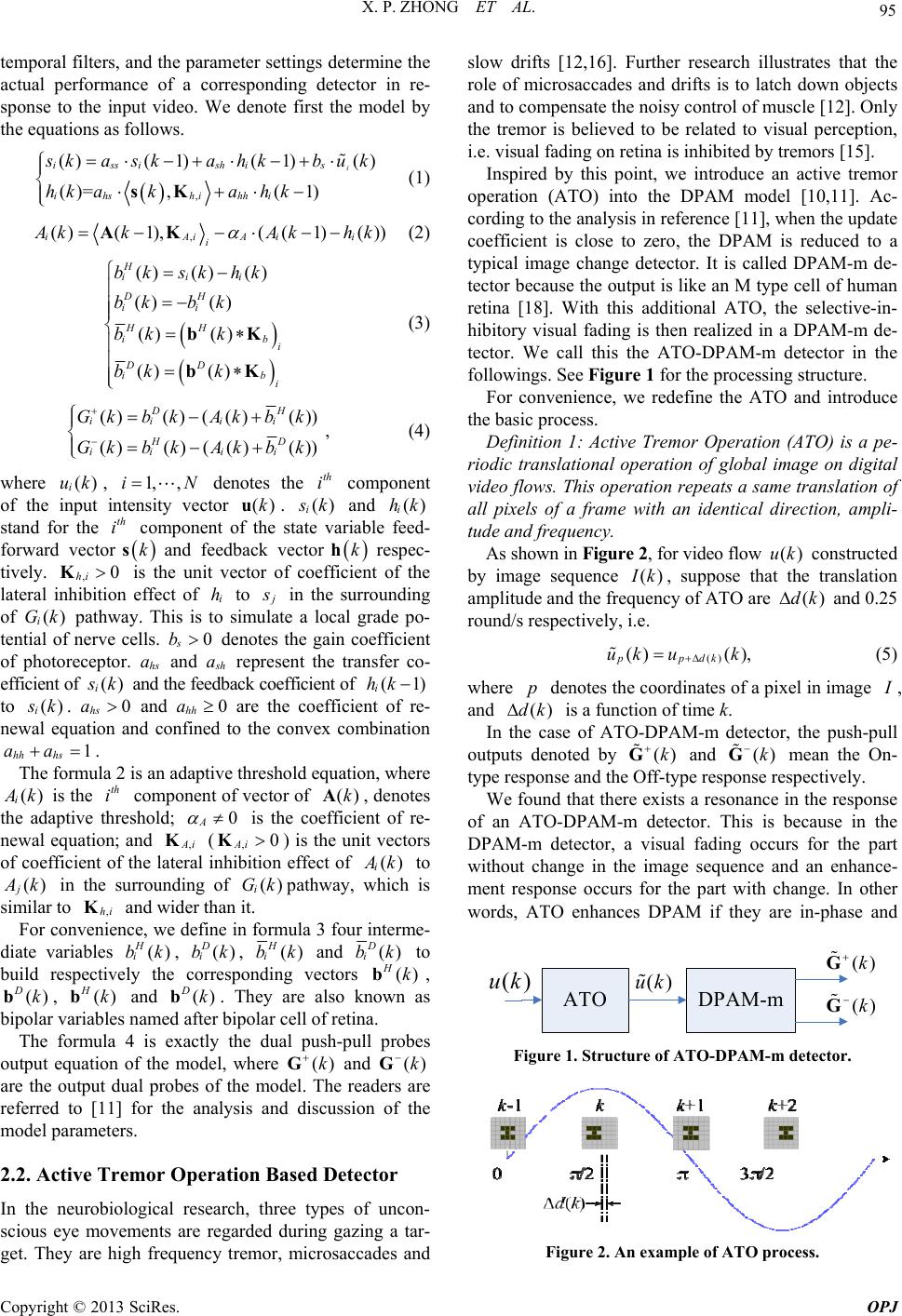 X. P. ZHONG ET AL. 95 temporal filters, and the parameter settings d etermine the actual performance of a corresponding detector in re- sponse to the input video. We denote first the model by the equations as follows. , ()( 1)(1)() ()=,( 1) i issishi s ihs hihhi s kaskahk buk hk akahk sK (1) , ()( 1),(( 1)()) iAiAi ii A kk Akhk AK (2) ()() () () () () () () () H iii DH ii HH ib i DD ib i bkskhk bk bk bk k bk k bK bK (3) ()()( ()()) ()() (()()) DH ii ii H ii ii GkbkAkbk GkbkAkb k D N (4) where , denotes the component of the input intensity vector . () i uk 1, ,ith i ()()k ui s k h and stand for the component of the state variable feed- forward vector and feedback vector respec- tively. is the unit vector of coefficient of the lateral inhibition effect of to () i hk th i ks 0 k ,hi K i h j s in the surrounding of pathway. This is to simulate a local grade po- tential of nerve cells. denotes the gain coefficient of photoreceptor. and () i Gk 0 s b hs a s h a represent the transfer co- efficient of () i s k and th e feedback co effici ent of (1)hk i to ( i) s khs a 1 hs . and are the coefficient of re- newal equation and confined to the convex combination . 0hh a0 hh aa The formula 2 is an adaptive threshold equation, where () i A k is the component of vector of , denotes the adaptive threshold; th i()kA 0 A ,Ai ,Ai K is the coefficient of re- newal equation; and () is the unit vectors of coefficient of the lateral inhibition effect of K0() i A k to () j A k in the surrounding of pathway, which is similar to and wider than it. () i Gk ,hi K For convenience, we define in formula 3 four interme- diate variables , , () H i bk () D i bk () H i bk and () D i bk to build respectively the corresponding vectors , , and b. They are also known as bipolar varia bles named after bi p ola r cell of ret i na. () Hkb () Dkb( Hkb) () Dk The formula 4 is exactly the dual push-pull probes output equation of the model, where and are the output dual probes of the model. The readers are referred to [11] for the analysis and discussion of the model parameters. ()k G()k G 2.2. Active Tremor Operation Based Detector In the neurobiological research, three types of uncon- scious eye movements are regarded during gazing a tar- get. They are high frequency tremor, microsaccades and slow drifts [12,16]. Further research illustrates that the role of microsaccades and drifts is to latch down objects and to compensate the noisy control of muscle [12]. Only the tremor is believed to be related to visual perception, i.e. visual fading on retina is inhibited by tremors [15]. Inspired by this point, we introduce an active tremor operation (ATO) into the DPAM model [10,11]. Ac- cording to the analysis in reference [11 ], when the update coefficient is close to zero, the DPAM is reduced to a typical image change detector. It is called DPAM-m de- tector because the outpu t is like an M type cell of human retina [18]. With this additional ATO, the selective-in- hibitory visual fading is then realized in a DPAM-m de- tector. We call this the ATO-DPAM-m detector in the followings. See Figure 1 for the processing structure. For convenience, we redefine the ATO and introduce the basic process. Definition 1: Active Tremor Operation (ATO) is a pe- riodic translational operation of global image on digital video flows. This operation repeats a same translation of all pixels of a frame with an identical direction, ampli- tude and frequency. As shown in Figure 2, for video flow constructed by image sequence ()uk () I k, suppose that the translation amplitud e and t h e fr equency o f A TO are and 0.25 round/s respectively, i.e. (dk) () () (), ppdk uk uk (5) where denotes the coordinates of a pixel in image p I , and (dk) is a function of time k. In the case of ATO-DPAM-m detector, the push-pull outputs denoted by and mean the On- type response and the Off-type response respectively. ()k G()k G We found that there exists a resonan ce in the response of an ATO-DPAM-m detector. This is because in the DPAM-m detector, a visual fading occurs for the part without change in the image sequence and an enhance- ment response occurs for the part with change. In other words, ATO enhances DPAM if they are in-phase and ATO DPAM-m ()k G ()k G ()uk ()uk Figure 1. Structure of ATO-DPAM-m detector. Figure 2. An example of ATO process. Copyright © 2013 SciRes. OPJ 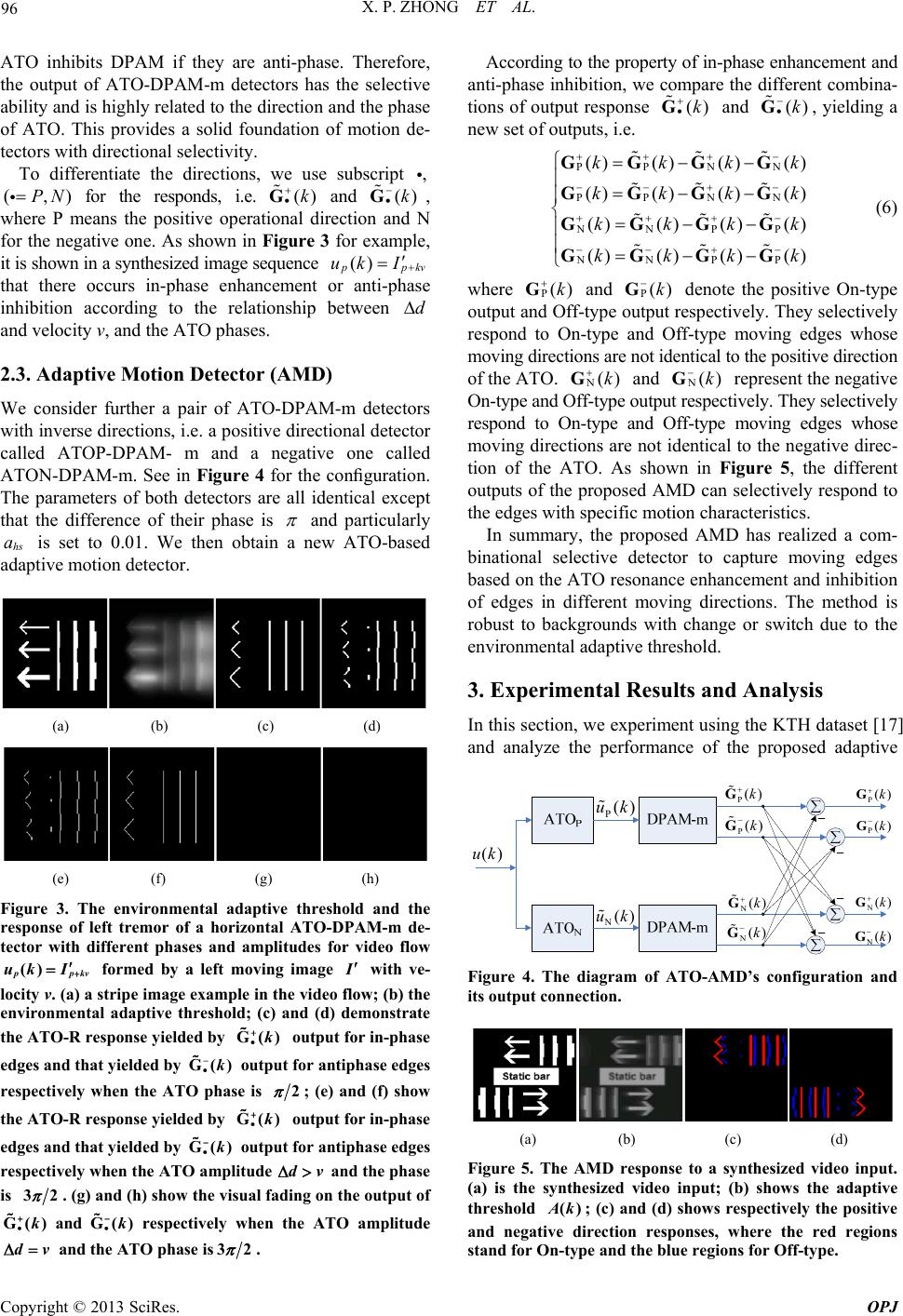 X. P. ZHONG ET AL. 96 ATO inhibits DPAM if they are anti-phase. Therefore, the output of ATO-DPAM-m detectors has the selective ability and is highly related to the directio n and the phase of ATO. This provides a solid foundation of motion de- tectors with directional selectivity. To differentiate the directions, we use subscript for the responds, i.e. and , where P means the positive operational direction and N for the negative one. As shown in Figure 3 for example, it is shown in a synthesized image sequence , ()(,PN)()k Gk G () p pkv uk I that there occurs in-phase enhancement or anti-phase inhibition according to the relationship between d and velocity v, and the ATO phases. 2.3. Adaptive Motion Detector (AMD) We consider further a pair of ATO-DPAM-m detectors with inverse directions, i.e. a positive d irectiona l detector called ATOP-DPAM- m and a negative one called ATON-DPAM-m. See in Figure 4 for the configuration. The parameters of both detectors are all identical except that the difference of their phase is and particularly is set to 0.01. We then obtain a new ATO-based adaptive motion detector. hs a (a) (b) (c) (d) (e) (f) (g) (h) Figure 3. The environmental adaptive threshold and the response of left tremor of a horizontal ATO-DPAM-m de- tector with different phases and amplitudes for video flow p pkv uk I() formed by a left moving image I According to the property of in-phase enhancement and anti-phase inhibition, we compare the different combina- tions of output response and , yielding a new set of outputs, i.e. ()k G()k G PPNN PPNN NNPP NNPP () () () () () () () () ()() () () ()() () () kkkk kkkk k kkk k kkk GGGG GGGG GGGG GGGG (6) where and denote the positive On-type output and Off-type output respectively. They selectively respond to On-type and Off-type moving edges whose moving directions are not i dent i cal to the posi ti ve di recti on of the ATO. and represent the negative On-type and Off-type output respectively. They selectively respond to On-type and Off-type moving edges whose moving directions are not identical to the negative direc- tion of the ATO. As shown in Figure 5, the different outputs of the proposed AMD can selectively respond to the edges with specific motion characteristics. P()k G G P()k G )G N(k N()k In summary, the proposed AMD has realized a com- binational selective detector to capture moving edges based on the ATO resonan ce enhancement and inhibition of edges in different moving directions. The method is robust to backgrounds with change or switch due to the environmental adaptive thresho ld. 3. Experimental Results and Analysis In this section, we experiment using the KTH dataset [17] and analyze the performance of the proposed adaptive P()k G N()k G P ()k G N ()k G P ()k G N ()k G P ()k G N ()k G ()uk P ()uk N ()uk with ve- locity v. (a) a stripe image example in the video flow; (b) the environmental adaptive threshold; (c) and (d) demonstrate the ATO-R response yielded by output for in-phase edges and that yiel ded by output for antiphase edges respectively when the ATO phase is kG() )kG( 2 ; (e) and (f) show the ATO-R response yielded by output for in-phase edges and that yiel ded by output for antiphase edges respectively when the ATO amplitude and the phase is k) d G( kG() v 32 . (g) and (h) show the visual fading on the output of and respectively when the ATO amplitude and the ATO phase is kG() dv kG() 32 . Figure 4. The diagram of ATO-AMD’s configuration and its output connection. (a) (b) (c) (d) Figure 5. The AMD response to a synthesized video input. (a) is the synthesized video input; (b) shows the adaptive threshold ; (c) and (d) shows respectively the positive and negative direction responses, where the red regions stand for On-type and the blue regions for Off-type. Ak() Copyright © 2013 SciRes. OPJ 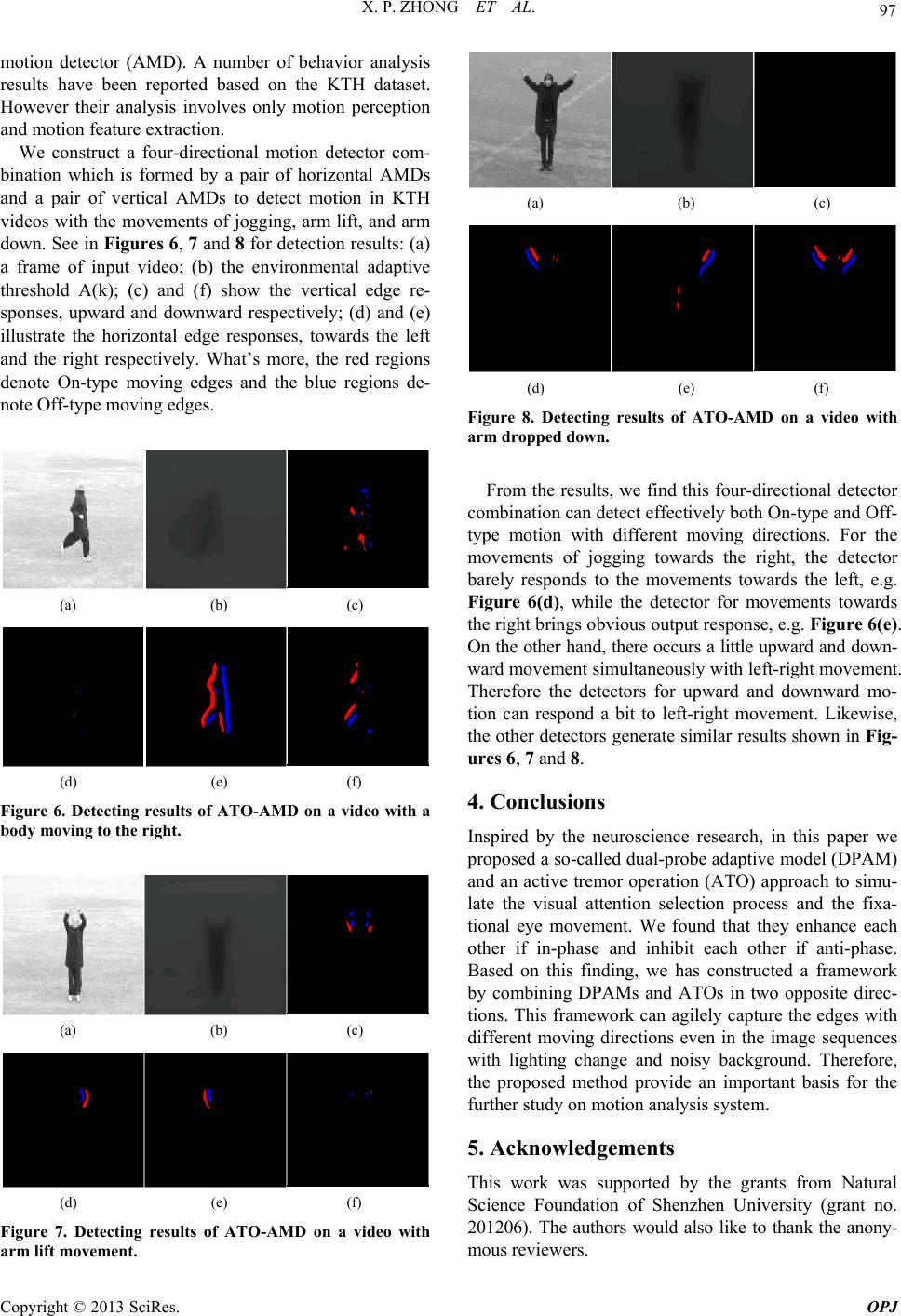 X. P. ZHONG ET AL. 97 motion detector (AMD). A number of behavior analysis results have been reported based on the KTH dataset. However their analysis involves only motion perception and motion feature ex traction. We construct a four-directional motion detector com- bination which is formed by a pair of horizontal AMDs and a pair of vertical AMDs to detect motion in KTH videos with the movements of jogging, arm lift, and arm down. See in Figures 6, 7 and 8 for detection results: (a) a frame of input video; (b) the environmental adaptive threshold A(k); (c) and (f) show the vertical edge re- sponses, upward and downward respectively; (d) and (e) illustrate the horizontal edge responses, towards the left and the right respectively. What’s more, the red regions denote On-type moving edges and the blue regions de- note Off-t ype movi ng e d ges. (a) (b) (c) (d) (e) (f) Figure 6. Detecting results of ATO-AMD on a video with a body moving to the right. (a) (b) (c) (d) (e) (f) Figure 7. Detecting results of ATO-AMD on a video with arm lift movement. (a) (b) (c) (d) (e) (f) Figure 8. Detecting results of ATO-AMD on a video with arm dropped dow n. From the results, we find this four-directional detector combination can detect effectively both On-type and Of f- type motion with different moving directions. For the movements of jogging towards the right, the detector barely responds to the movements towards the left, e.g. Figure 6(d), while the detector for movements towards the right br ings obv ious output respon se, e.g . Figure 6(e). On the other hand, there occurs a little upward and down- ward movement simultaneously with left-right movement. Therefore the detectors for upward and downward mo- tion can respond a bit to left-right movement. Likewise, the other detectors generate similar results shown in Fig- ures 6, 7 and 8. 4. Conclusions Inspired by the neuroscience research, in this paper we proposed a so-called dual-probe adaptive model (DPAM) and an active tremor operation (ATO) approach to simu- late the visual attention selection process and the fixa- tional eye movement. We found that they enhance each other if in-phase and inhibit each other if anti-phase. Based on this finding, we has constructed a framework by combining DPAMs and ATOs in two opposite direc- tions. This framework can agilely capture the edges with different moving directions even in the image sequences with lighting change and noisy background. Therefore, the proposed method provide an important basis for the further study on motion analysis system. 5. Acknowledgements This work was supported by the grants from Natural Science Foundation of Shenzhen University (grant no. 201206). The authors would also like to thank the anony- mous reviewers. Copyright © 2013 SciRes. OPJ  X. P. ZHONG ET AL. Copyright © 2013 SciRes. OPJ 98 REFERENCES [1] C. W. G. Clifford and M. R. Ibbotson, “Fundamental mechanisms of visual motion detection: models, cells and functions,” Progress in Neurobiology, Vol. 68, No. 6, 2002, pp. 409-437. doi:10.1016/S0301-0082(02)00154-5 [2] A. J. Lipton, H. Fujiyoshi and R. S. Patil, “Moving Target Classification and Tracking from Real-time Video,” in IEEE Workshop on Applications of Computer Vision, 1998, pp. 8-14. [3] Y. Ren, C.-S. Chua and Y.-K. Ho, “Motion detection with nonstationary background,” Machine Vision and Applica- tions, Vol. 13, No. 5, 2003, pp. 332-343. doi:10.1007/s00138-002-0091-0 [4] D. Marr and S. Ullman, “Directional Selectivity and Its Use in Early Visual Processing,” Proceedings of the Royal Society of London. Series B, Vol. 211, 1981, pp. 151-180. doi:10.1098/rspb.1981.0001 [5] B. K. P. Horn and B. G. Schunck, “Determining Optical Flow,” Artificial Intelligence, Vol. 17, 1981, pp. 185-203. doi:10.1016/0004-3702(81)90024-2 [6] A. Bouzerdoum and R. B. Pinter, “A Shunting Inhibitory Motion Detector that Can Account for the Functional Characteristics of Fly Motion-Sensitive Interneurons,” in 1990 IJCNN International Joint Conference on Neural Networks, Vol.1, 1990, pp. 149-153. doi:10.1109/IJCNN.1990 .137560 [7] A. Bouzerdoum, “The Elementary Movement Detection Mechanism in Insect Vision,” Philosophical Transactions: Biological Sciences, Vol. 339, No. 1290, 1993, pp. 375-384.doi:10.1098/r stb.1993.0037 [8] A. Wang, N. Zheng, L. Yuan et al., “Multiplicative In- hibitory Velocity Detector (MIVD) and Multi-Velocity Motion Detection Neural Network Model,” Proceedings of International Conference on Multi-Sensor Fusion and Integration for Intelligent Systems, 1996, pp. 476-483. [9] P. Sterling, “Microcircuitry of the Cat Retina,” Annual Review of Neuroscience, Vol. 6, No. 1, 1983, pp. 149C185. [10] L. Ma, N.-N. Zheng and Z.-J. Yuan, “A Dynamic Model for Early Vision Processing,” in IEEE International Con- ference on Computer and Electrical Engineering, Phuket Island, Thailand, 2008, pp. 96-100. [11] L. Ma, N.-N. Zheng, Z.-J. Yuan et al., “A Novel Dual Probes Adaptive Model for Image Change Detection,” IEEE Signal Proceeding Letters, Vol. 17, No. 10, 2010, pp. 863-866. doi:10.1109/LSP.2010.2063023 [12] S. Martinez-Conde, S. L. Macknik, and D. H. Hubel, “The Role of Fixational Eye Movements in Visual Per- ception,” Nature Reviews Neuroscience, Vol. 5, No. 3, 2004, pp. 229-240. doi:10.1038/nrn1348 [13] I. Murakami, “Fixational Eye Movements and Motion Perception,” in Twenty-eighth European Conference on Visual Perception, A Coruna, Spain, 2005, pp. 35-35. [14] S. Moshel, A. Z. Zivotofsky, L. Jin-Rong et al., “Persis- tence and Phase Synchronisation Properties of Fixational Eye Movements,” European Physical Journal-Special Topics, Vol. 161, Jul, 2008, pp. 207-223. doi:10.1140/epjst/e2008-00762-3 [15] M. Greschner, M. Bongard, P. Rujan et al., “Retinal Gan- glion Cell Synchronization by Fixational Eye Movements Improves Feature Estimation,” Nature Neuro sci enc e, Vol. 5, No. 4, 2002, pp. 341-347. doi:10.1038/nn821 [16] Engbert, Ralf. “Computational Modeling of Collicular Integration of Perceptual Responses and Attention in Mi- crosaccades,” The Journal of Neuroscience, Vol. 32, No. 23, 2012, pp. 8035-8039. doi:10.1523/JNEUROSCI.08 08-12.2012 [17] Z. Gao, M. Chen, et al. “Comparing Evaluation Protocols on the KTH Dataset,” Human Behavior Understanding (2010): 88-100. [18] W. Hui, Q. Zuo and X. Guan, “Main Retina Information Processing Pathways Modeling,” International Journal of Cognitive Informatics and Natural Intelligence, Vol. 5, No. 3, 2011, pp. 30-46. doi:10.4018/IJCINI.20110701 02 |