

Paper Menu >>
Journal Menu >>
 Optics and Photonics Journal, 2013, 3, 83-85 doi:10.4236/opj.2013.32B021 Published Online June 2013 (http://www.scirp.org/journal/opj) Ghost Imaging Lidar via Sparsity Constraints in Real Atmosphere Mingliang Chen, Enrong Li, Wenlin Gong, Zunwang Bo, Xuyang Xu, Chengqiang Zhao, Xia Shen, Wendong Xu, Shensheng Han Key Laboratory for Quantum Optics, Center for Cold Atom Physics of CAS, Shanghai Institute of Optics and Fine Mechanics, Chinese Academy of Sciences Shanghai, China Email: [email protected], [email protected] Received 2013 ABSTRACT We present a series of results acquired at a 2-kilometer distance us ing our lidar system under sev eral weather cond itions, clear, cloudy, light rain, moderately foggy, and night. The experimental results show that ghost imaging lidar via spar-sity constraints can realize imaging in all these weather conditions. Keywords: Ghost Imaging; Lidar; Atmosphere; Reconstruction Algorithm 1. Introduction In recent years, thanks to the development of laser tech- nology and laser detection techniques, several lidar tech- niques have been developed, such as spot scanning im- aging lidar [1], 3D imaging lidar [2-4] and synthetic ap- erture imaging lidar [5-7]. Ghost imaging lidar via spar- sity constraints (GISC lidar) is a newly developed imag- ing lidar technique based on the ghost imaging principle [8]. It gets target global information with a highly sensi- tive bucket detector, and the image is reconstructed with some algorithms. At present, most researches about ghost imaging in atmosphere are theoretical [9, 10] or laboratory experiments [11, 12]. We shall present the GISC lidar experimental results under several weather conditions. 2. Experiments Our experimental setup is shown in Figure 1. Pseudo- thermal light is produced by a 532 nm laser pulse passing through a rotatin g ground glass. The light is split into two paths by a beam split ter, of which the light field intensity of reference and test beam accounts respectively for 95% and 5% of the total energy of the incident light. In our GISC lidar system, the source plane optical field is im- aged respectively to the reference plane and the target plane throu gh the lenses and Lt [8, 13]. The target reflects the test beam light back to the receiving system. The aperture of the receiving telescope is 0.42 m with 5.0 m focal length. The photons collected by the receiving system pass through an interference filter with 1nm half bandwidth, then received by a photomultiplier tube (PMT). Reference beam light passes through lens and im- ages on a CCD detector. The intensity distribution of light field Lr Lr I mn is reshaped into a row vector 1 I N [14, 15], in which . After M obser- vations, we obtain measurement matrix Nmn A MN of M row vectors (1 ) I N , and from the M signals recorded by the PMT. In our experiments, 1YM 3000M , 200mn . The outdoor detection dis- tance is 2k m. The s cen e and targ et ar e shown in Figure 2. The target with a size of 54 cm * 58 cm is a two-dimen- sional resolution panel, with two groups of slits (three- slit, and double-slit), whose center-to-center distances between slits is 8 cm, 12 cm, respectively. Ghost imaging reconstruction algorithm plays an es- sential role in GISC lidar system. Although the linear reconstruction algorithm was first developed [16], nonlinear algorithms are usually used in a GISC lidar system since they better exploits the information from the collected data [8, 14, 15]. We developed a nonlinear Figure 1. Experimental setup of GIL system. Copyright © 2013 SciRes. OPJ 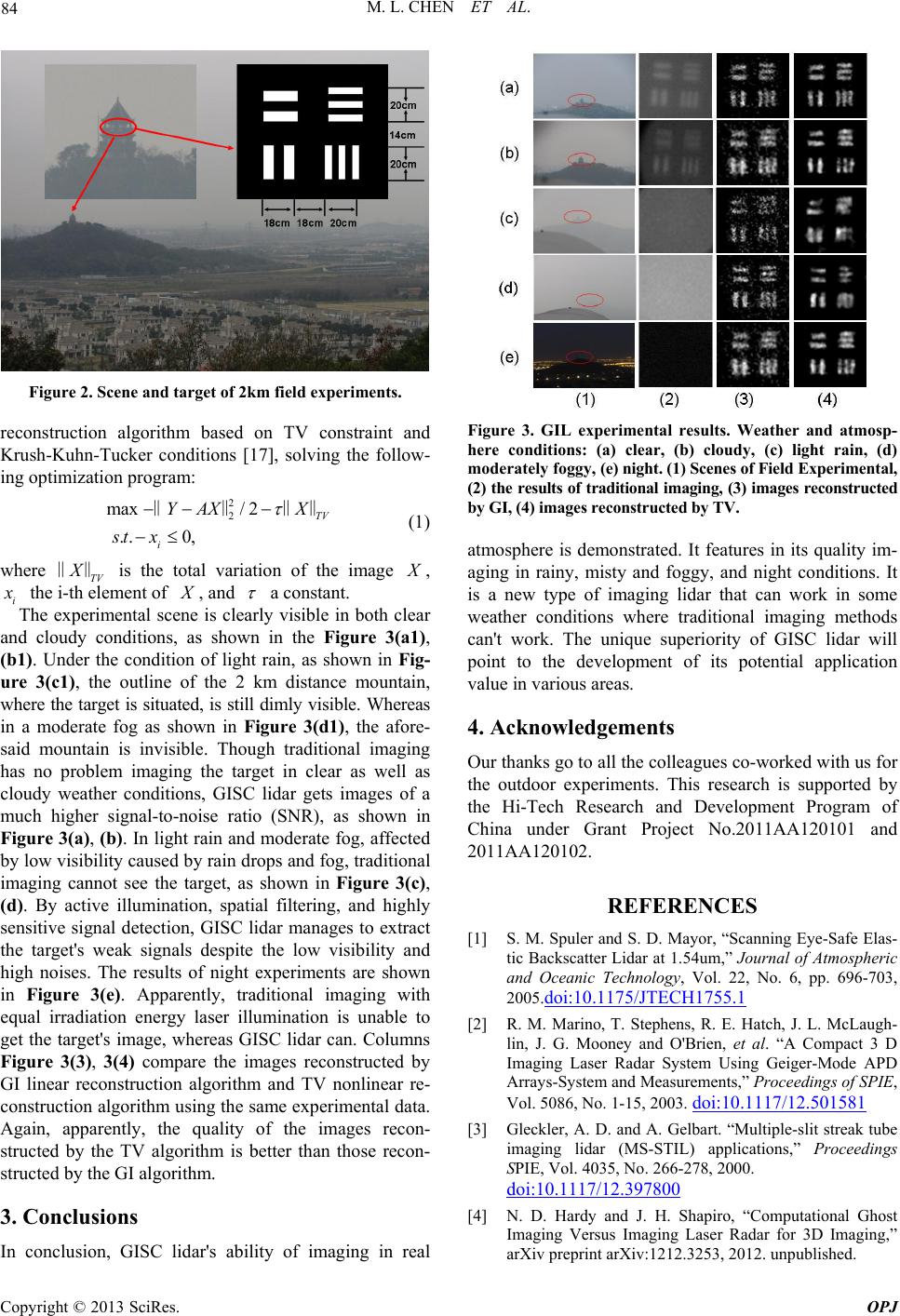 M. L. CHEN ET AL. 84 Figure 2. Scene and target of 2km field experiments. reconstruction algorithm based on TV constraint and Krush-Kuhn-Tucker conditions [17], solving the follow- ing optimi zat i on pro gram: 2 2 max/ 2 .. 0, TV i YAX X st x ‖‖‖‖ (1) where TV is the total variation of the imag X‖‖ e X , i x the i-th element of X , and a constant. The experimental scene is clearly visible in both clear and cloudy conditions, as shown in the Figure 3(a1), (b1). Under the condition of light rain, as shown in Fig- ure 3(c1), the outline of the 2 km distance mountain, where the target is situated, is still dimly visible. Whereas in a moderate fog as shown in Figure 3(d1), the afore- said mountain is invisible. Though traditional imaging has no problem imaging the target in clear as well as cloudy weather conditions, GISC lidar gets images of a much higher signal-to-noise ratio (SNR), as shown in Figure 3(a), (b). In light rain and moderate fog, affected by low visibility caused b y rain drop s and fog , trad itional imaging cannot see the target, as shown in Figure 3(c), (d). By active illumination, spatial filtering, and highly sensitive signal detection, GISC lidar manages to extract the target's weak signals despite the low visibility and high noises. The results of night experiments are shown in Figure 3(e). Apparently, traditional imaging with equal irradiation energy laser illumination is unable to get the target's image, whereas GISC lidar can. Columns Figure 3(3), 3(4) compare the images reconstructed by GI linear reconstruction algorithm and TV nonlinear re- construction algorithm using the same experimental data. Again, apparently, the quality of the images recon- structed by the TV algorithm is better than those recon- structed by the GI algorithm. 3. Conclusions In conclusion, GISC lidar's ability of imaging in real Figure 3. GIL experimental results. Weather and atmosp- here conditions: (a) clear, (b) cloudy, (c) light rain, (d) moderately foggy, (e) night. (1) Scenes of Field Experimental, (2) the results of traditional imaging, (3) images reconstructed by GI, (4) images reconstructed by TV. atmosphere is demonstrated. It features in its quality im- aging in rainy, misty and foggy, and night conditions. It is a new type of imaging lidar that can work in some weather conditions where traditional imaging methods can't work. The unique superiority of GISC lidar will point to the development of its potential application value in various areas. 4. Acknowledgements Our thanks go to all the colleagues co-worked with us for the outdoor experiments. This research is supported by the Hi-Tech Research and Development Program of China under Grant Project No.2011AA120101 and 2011AA120102. REFERENCES [1] S. M. Spuler and S. D. Mayor, “Scanning Eye-Safe Elas- tic Backscatter Lidar at 1.54um,” Journal of Atmospheric and Oceanic Technology, Vol. 22, No. 6, pp. 696-703, 2005.doi:10.1175/JTECH1755.1 [2] R. M. Marino, T. Stephens, R. E. Hatch, J. L. McLaugh- lin, J. G. Mooney and O'Brien, et al. “A Compact 3 D Imaging Laser Radar System Using Geiger-Mode APD Arrays-System and Measurements,” Proceedings of SPIE, Vol. 5086, No. 1-15, 2003. doi:10.1117/12.501581 [3] Gleckler, A. D. and A. Gelbart. “Multiple-slit streak tube imaging lidar (MS-STIL) applications,” Proceedings SPIE, Vol. 4035, No. 266-278, 2000. doi:10.1117/12.397800 [4] N. D. Hardy and J. H. Shapiro, “Computational Ghost Imaging Versus Imaging Laser Radar for 3D Imaging,” arXiv preprint arXiv:1212.3253, 2012. unpublished. Copyright © 2013 SciRes. OPJ 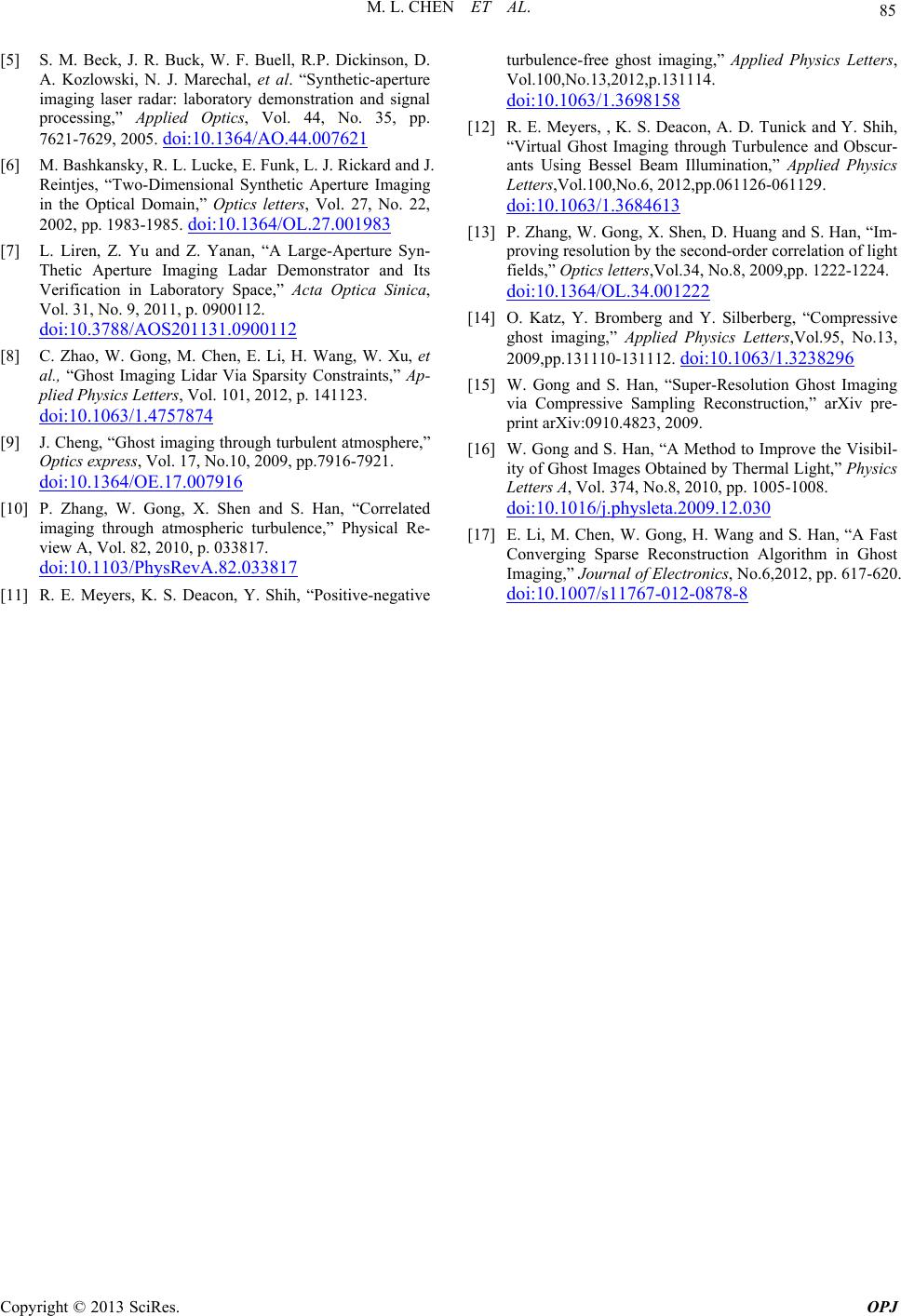 M. L. CHEN ET AL. Copyright © 2013 SciRes. OPJ 85 [5] S. M. Beck, J. R. Buck, W. F. Buell, R.P. Dickinson, D. A. Kozlowski, N. J. Marechal, et al. “Synthetic-aperture imaging laser radar: laboratory demonstration and signal processing,” Applied Optics, Vol. 44, No. 35, pp. 7621-7629, 2005. doi:10.1364/AO.44.007621 [6] M. Bashkansky, R. L. Lucke, E. Funk, L. J. Rickard and J. Reintjes, “Two-Dimensional Synthetic Aperture Imaging in the Optical Domain,” Optics letters, Vol. 27, No. 22, 2002, pp. 1983-1985. doi:10.1364/OL.27.001983 [7] L. Liren, Z. Yu and Z. Yanan, “A Large-Aperture Syn- Thetic Aperture Imaging Ladar Demonstrator and Its Verification in Laboratory Space,” Acta Optica Sinica, Vol. 31, No. 9, 2011, p. 0900112. doi:10.3788/AOS201131 .0900112 [8] C. Zhao, W. Gong, M. Chen, E. Li, H. Wang, W. Xu, et al., “Ghost Imaging Lidar Via Sparsity Constraints,” Ap- plied Physics Letters, Vol. 101, 2012, p. 141123. doi:10.1063/1.4757874 [9] J. Cheng, “Ghost imaging through turbulent atmosphere,” Optics express, Vol. 17, No.10, 2009, pp.7916-7921. doi:10.1364/OE.17.007916 [10] P. Zhang, W. Gong, X. Shen and S. Han, “Correlated imaging through atmospheric turbulence,” Physical Re- view A, Vol. 82, 2010, p. 033817. doi:10.1103/PhysRevA.82.033817 [11] R. E. Meyers, K. S. Deacon, Y. Shih, “Positive-negative turbulence-free ghost imaging,” Applied Physics Letters, Vol.100,No.13,2012,p.131114. doi:10.1063/1.3698158 [12] R. E. Meyers, , K. S. Deacon, A. D. Tunic k and Y. Shih, “Virtual Ghost Imaging through Turbulence and Obscur- ants Using Bessel Beam Illumination,” Applied Physics Letters,Vol.100,No.6, 2012,pp.061126-061129. doi:10.1063/1.3684613 [13] P. Zhang, W. Gong, X. Shen, D. Huang and S. Han, “Im- proving resolution by the second-order correlation of light fields,” Optics letters,Vol.34, No.8, 2009,pp. 1222-1224. doi:10.1364/OL.34.001222 [14] O. Katz, Y. Bromberg and Y. Silberberg, “Compressive ghost imaging,” Applied Physics Letters,Vol.95, No.13, 2009,pp.131110-131112. doi:10.1063/1.3238296 [15] W. Gong and S. Han, “Super-Resolution Ghost Imaging via Compressive Sampling Reconstruction,” arXiv pre- print arXiv:0910.4823, 2009. [16] W. Gong and S. Han, “A Method to Improve the Visibil- ity of Ghost Images Obtained by Thermal Light,” Physics Letters A, Vol. 374, No.8, 2010, pp. 1005-1008. doi:10.1016/j.physleta.2009.12.030 [17] E. Li, M. Chen, W. Gong, H. Wang and S. Han, “A Fast Converging Sparse Reconstruction Algorithm in Ghost Imaging,” Journal of Electronics, No.6,2012, pp. 617-620. doi:10.1007/s11767-012-0878-8 |