

Paper Menu >>
Journal Menu >>
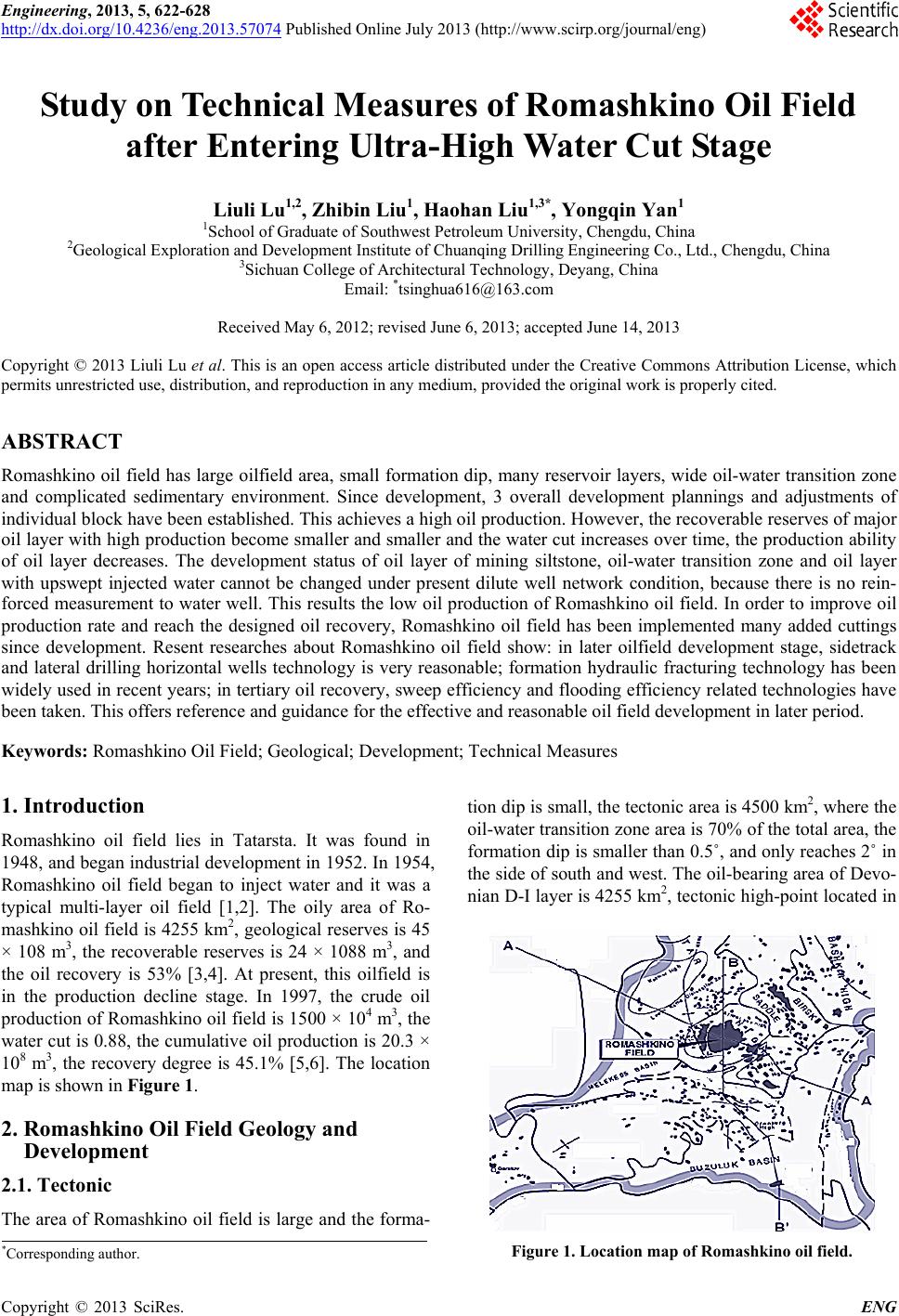 Engineering, 2013, 5, 622-628 http://dx.doi.org/10.4236/eng.2013.57074 Published Online July 2013 (http://www.scirp.org/journal/eng) Study on Technical Measures of Romashkino Oil Field after En t er ing Ultra-High Water Cut Sta ge Liuli Lu1,2, Zhibin Liu1, Haohan Liu1,3*, Yongqin Yan1 1School of Graduate of Southwest Petroleum University, Chengdu, China 2Geological Exploration and Development Institute of Chuanqing Drilling Engineering Co., Ltd., Chengdu, China 3Sichuan College of Architectural Technology, Deyang, China Email: *[email protected] Received May 6, 2012; revised June 6, 2013; accepted June 14, 2013 Copyright © 2013 Liuli Lu et al. This is an open access article distributed under the Creative Commons Attribution License, which permits unrestricted use, distribution, and reproduction in any medium, provided the original work is properly cited. ABSTRACT Romashkino oil field has large oilfield area, small formation dip, many reservoir layers, wide oil-water transition zone and complicated sedimentary environment. Since development, 3 overall development plannings and adjustments of individual block have been established. This achieves a high oil production. However, the recoverable reserves of major oil layer with high production become smaller and smaller and the water cut increases over time, the production ability of oil layer decreases. The development status of oil layer of mining siltstone, oil-water transition zone and oil layer with upswept injected water cannot be changed under present dilute well network condition, because there is no rein- forced measurement to water well. This results the low oil production of Romashkino oil field. In order to improve oil production rate and reach the designed oil recovery, Romashkino oil field has been implemented many added cuttings since development. Resent researches about Romashkino oil field show: in later oilfield development stage, sidetrack and lateral drilling horizontal wells technology is very reasonable; formation hydraulic fracturing technology has been widely used in recent years; in tertiary oil recovery, sweep efficiency and flooding efficiency related technologies have been taken. This offers reference and guidance for the effective and reasonable oil field development in later period. Keywords: Romashkino Oil Field; Geological; Development; Technical Measures 1. Introduction Romashkino oil field lies in Tatarsta. It was found in 1948, and began industrial development in 1952. In 1954, Romashkino oil field began to inject water and it was a typical multi-layer oil field [1,2]. The oily area of Ro- mashkino oil field is 4255 km2, geological reserves is 45 × 108 m3, the recoverable reserves is 24 × 1088 m3, and the oil recovery is 53% [3,4]. At present, this oilfield is in the production decline stage. In 1997, the crude oil production of Romashkino oil field is 1500 × 104 m3, the water cut is 0.88, the cumulative oil production is 20.3 × 10⁸ m3, the recovery degree is 45.1% [5,6]. The location map is shown in Figure 1. 2. Romashkino Oil Field Geology and Development 2.1. Tectonic The area of Romashkino oil field is large and the forma- tion dip is small, the tectonic area is 4500 km2, where the oil-water transition zone area is 70% of the total area, the formation dip is smaller than 0.5˚, and only reaches 2˚ in the side of south and west. The oil-bearing area of Devo- nian D-I layer is 4255 km2, tectonic high-point located in Figure 1. Location map of Romashkino oil field. *Corresponding author. C opyright © 2013 SciRes. ENG 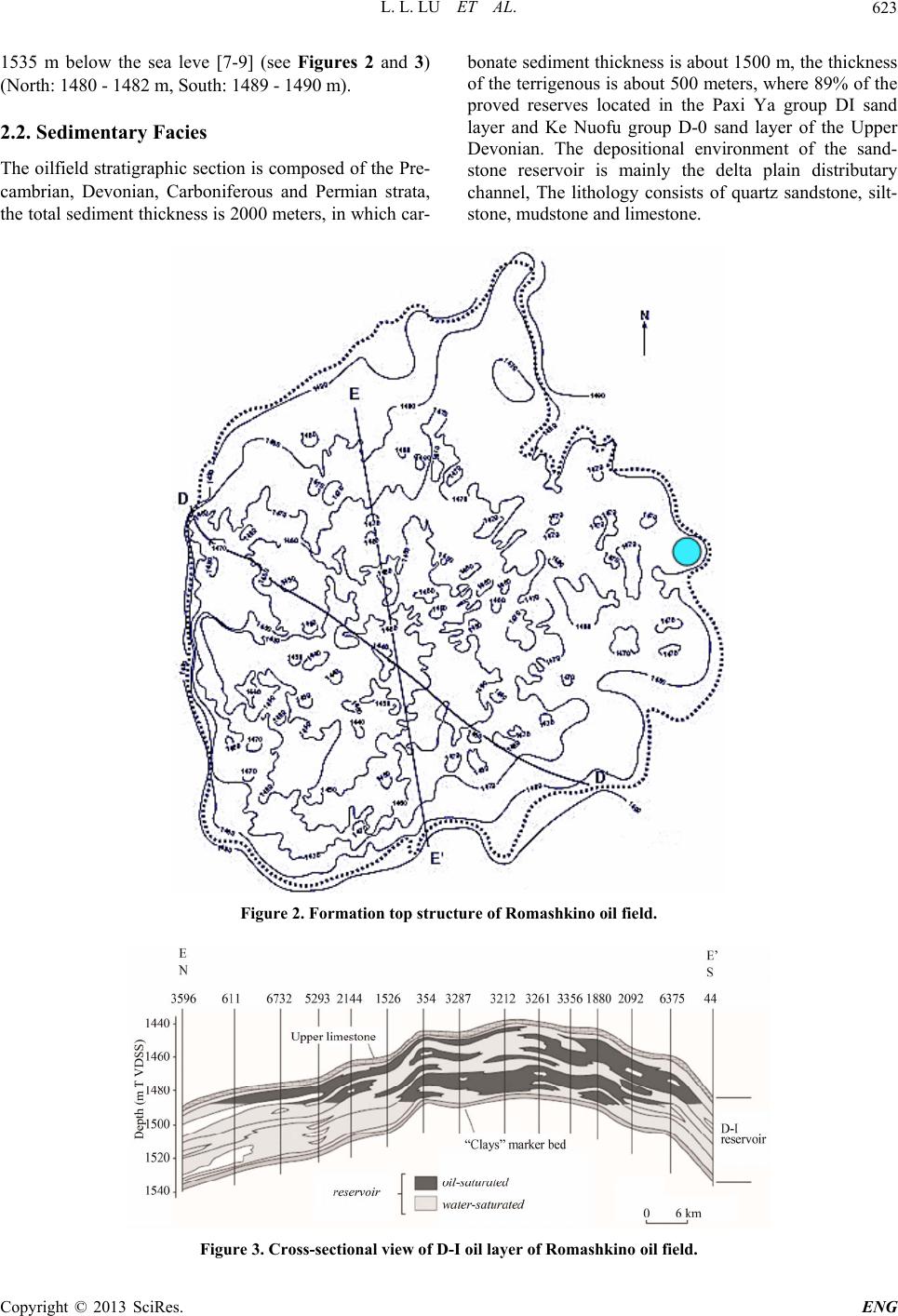 L. L. LU ET AL. 623 1535 m below the sea leve [7-9] (see Figures 2 and 3) (North: 1480 - 1482 m, South: 1489 - 1490 m). 2.2. Sedimentary Facies The oilfield stratigraphic section is composed of the Pre- cambrian, Devonian, Carboniferous and Permian strata, the total sediment thickness is 2000 meters, in which car- bonate sediment thickness is about 1500 m, the thickness of the terrigenous is about 500 meters, where 89% of the proved reserves located in the Paxi Ya group DI sand layer and Ke Nuofu group D-0 sand layer of the Upper Devonian. The depositional environment of the sand- stone reservoir is mainly the delta plain distributary channel, The lithology consists of quartz sandstone, silt- stone, mudstone and limestone. Figure 2. Formation top structure of Romashkino oil fiel d. Figure 3. Cross-sectional view of D-I oil layer of Romashkino oil field. Copyright © 2013 SciRes. ENG 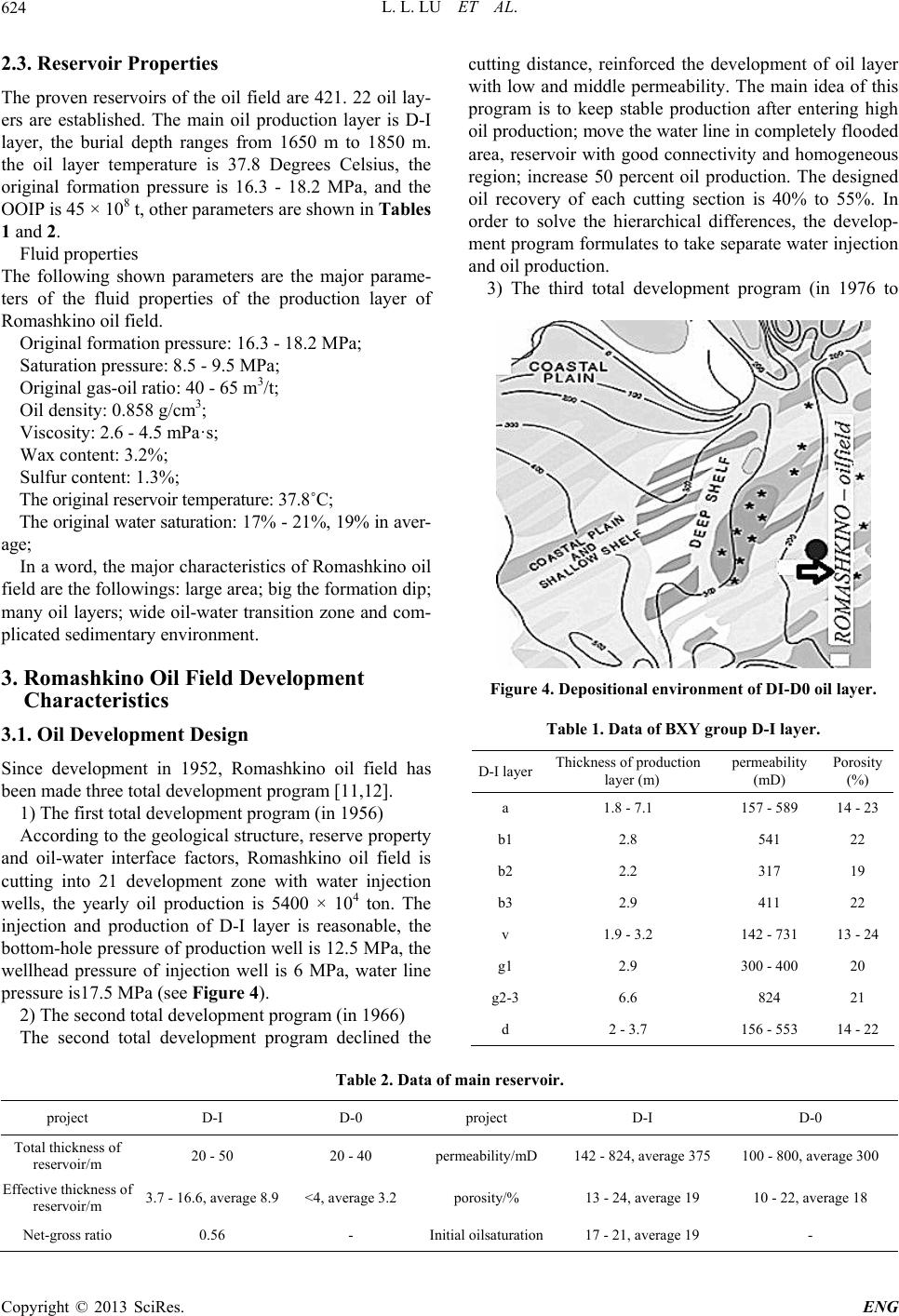 L. L. LU ET AL. 624 2.3. Reservoir Properties il field are 421. 22 oil lay- e major parame- mperature: 37.8˚C; 9% in aver- ag 3.1t Design ashkino oil field has erty an he cutting distance, reinforced the development of oil layer The proven reservoirs of the o ers are established. The main oil production layer is D-I layer, the burial depth ranges from 1650 m to 1850 m. the oil layer temperature is 37.8 Degrees Celsius, the original formation pressure is 16.3 - 18.2 MPa, and the OOIP is 45 × 108 t, other parameters are shown in Tables 1 and 2. Fluid propertis The following shown parameters are the ters of the fluid properties of the production layer of Romashkino oil field. Original formation pressure: 16.3 - 18.2 MPa; Saturation pressure: 8.5 - 9.5 MPa; 3 Original gas-oil ratio: 40 - 65 m/t; 3 Oil density: 0.858 g/cm; Viscosity: 2.6 - 4.5 mPa·s; Wax content: 3.2%; Sulfur content: 1.3%; The original reservoir te The original water saturation: 17% - 21%, 1 e; In a word, the major characteristics of Romashkino oil field are the followings: large area; big the formation dip; many oil layers; wide oil-water transition zone and com- plicated sedimentary environment. 3. Romashkino Oil Field Development Characteristics . Oil Developmen Since development in 1952, Rom been made three total development program [11,12]. 1) The first total development program (in 1956) pAccording to the geological structure, reserve pro d oil-water interface factors, Romashkino oil field is cutting into 21 development zone with water injection wells, the yearly oil production is 5400 × 104 ton. The injection and production of D-I layer is reasonable, the bottom-hole pressure of production well is 12.5 MPa, the wellhead pressure of injection well is 6 MPa, water line pressure is17.5 MPa (see Figure 4). 2) The second total development program (in 1966) The second total development program declined t with low and middle permeability. The main idea of this program is to keep stable production after entering high oil production; move the water line in completely flooded area, reservoir with good connectivity and homogeneous region; increase 50 percent oil production. The designed oil recovery of each cutting section is 40% to 55%. In order to solve the hierarchical differences, the develop- ment program formulates to take separate water injection and oil production. 3) The third total development program (in 1976 to Figure 4. Depositional environment of DI-D0 oil layer. D-I layerPorosity Table 1. Data of BXY group D-I layer. Thickness of production permeability layer (m) (mD) (%) a 1.8 - 7.1 1 1 57 - 5894 - 23 b1 2.8 541 22 b2 2.2 317 19 b3 2.9 411 22 v 1.2 141 14 2153 12 9 - 3.2 - 733 - 2 g1 2.9 300 - 400 20 g2-3 6.6 824 21 d - 3.7 6 - 554 - 2 f main reservoir. project D-I D-I D-0 Table 2. Data o D-0 project Total thickness of 20 - 50 20 - 40 permmD 142 - 824, average 375 100 - 800, average 300 reservoir/m eability/ Effective thickness o f 3.7 - 16.9 <4, aver2 Net-gross ratio Initon reservoir/m 6, average 8.age 3.porosity/% 13 - 24, average 19 10 - 22, average 18 0.56 - ial oilsaturati17 - 21, average 19 - Copyright © 2013 SciRes. ENG 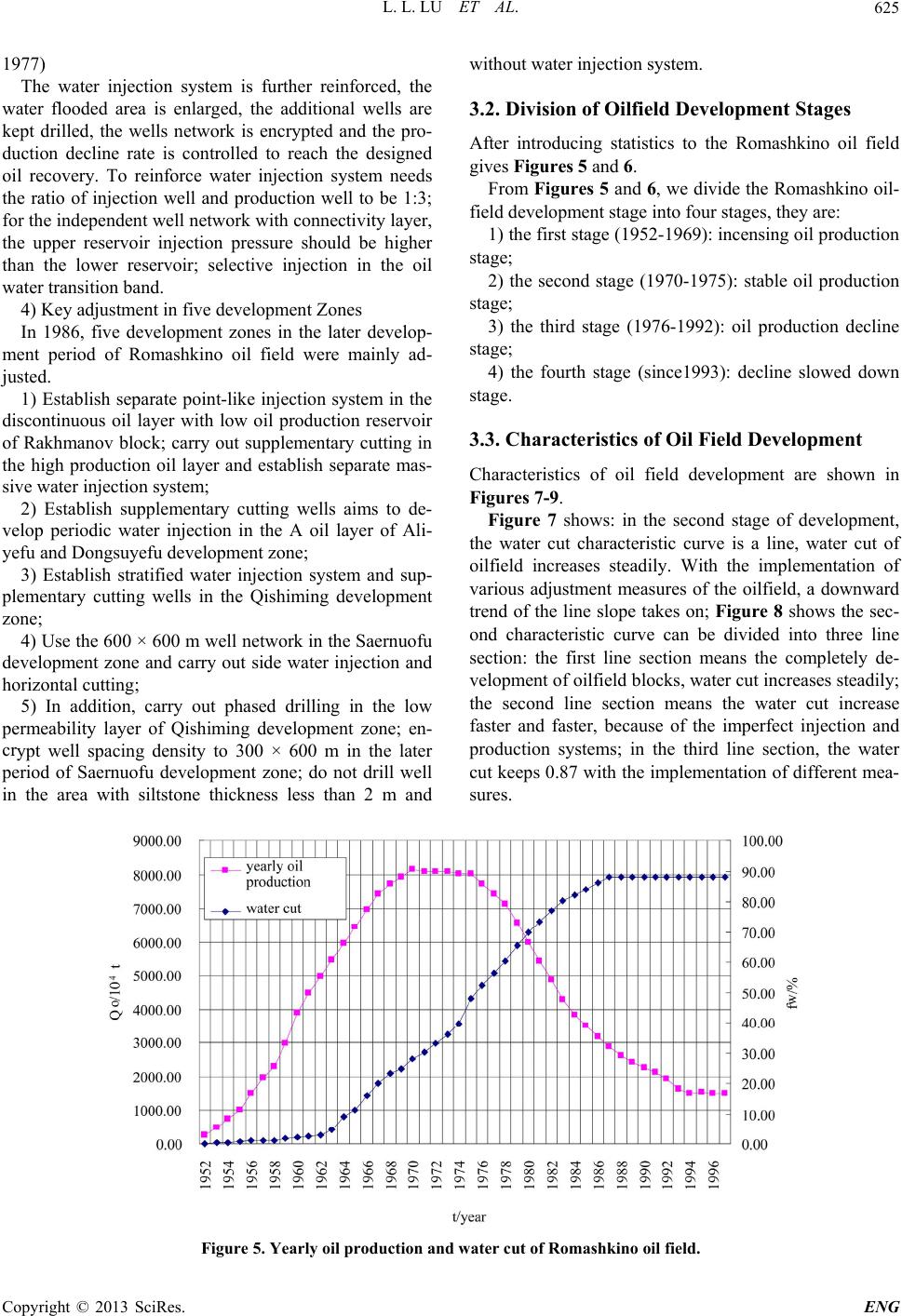 L. L. LU ET AL. 625 9 The water injection system is further reinforced, the ed area is enlarged, the additional wells are ke ent zones in the later develop- minly ad- ju nuous oil layer with low oil production reservoir of n in the A oil layer of Ali- ye development zo pment zone and carry out side water injection and ho of Qishiming development zone; en- cr ter i opment Stages ield into four stages, they are: aracteristics of Oil Field Development in characteristic curve is a line, water cut of oi 177) water flood pt drilled, the wells network is encrypted and the pro- duction decline rate is controlled to reach the designed oil recovery. To reinforce water injection system needs the ratio of injection well and production well to be 1:3; for the independent well network with connectivity layer, the upper reservoir injection pressure should be higher than the lower reservoir; selective injection in the oil water transition band. 4) Key adjustment in five development Zones In 1986, five developm ent period of Romashkino oil field were ma sted. 1) Establish separate point-like injection system in the disconti Rakhmanov block; carry out supplementary cutting in the high production oil layer and establish separate mas- sive water injection system; 2) Establish supplementary cutting wells aims to de- velop periodic water injectio fu and Dongsuyefu development zone; 3) Establish stratified water injection system and sup- plementary cutting wells in the Qishiming ne; 4) Use the 600 × 600 m well network in the Saernuofu develo rizontal cutting; 5) In addition, carry out phased drilling in the low permeability layer ypt well spacing density to 300 × 600 m in the later period of Saernuofu development zone; do not drill well in the area with siltstone thickness less than 2 m and without wanjection system. 3.2. Division of Oilfield Devel After introducing statistics to the Romashkino oil f gives Figures 5 and 6. From Figures 5 and 6, we divide the Romashkino oil- field development stage 1) the first stage (1952-1969): incensing oil production stage; 2) the second stage (1970-1975): stable oil production stage; 3) the third stage (1976-1992): oil production decline stage; 4) the fourth stage (since1993): decline slowed down stage. 3.3. Ch Characteristics of oil field development are shown Figures 7-9. Figure 7 shows: in the second stage of development, the water cut lfield increases steadily. With the implementation of various adjustment measures of the oilfield, a downward trend of the line slope takes on; Figure 8 shows the sec- ond characteristic curve can be divided into three line section: the first line section means the completely de- velopment of oilfield blocks, water cut increases steadily; the second line section means the water cut increase faster and faster, because of the imperfect injection and production systems; in the third line section, the water cut keeps 0.87 with the implementation of different mea- sures. Figure 5. Yearly oil production and water cut of Romashkino oil field. Copyright © 2013 SciRes. ENG 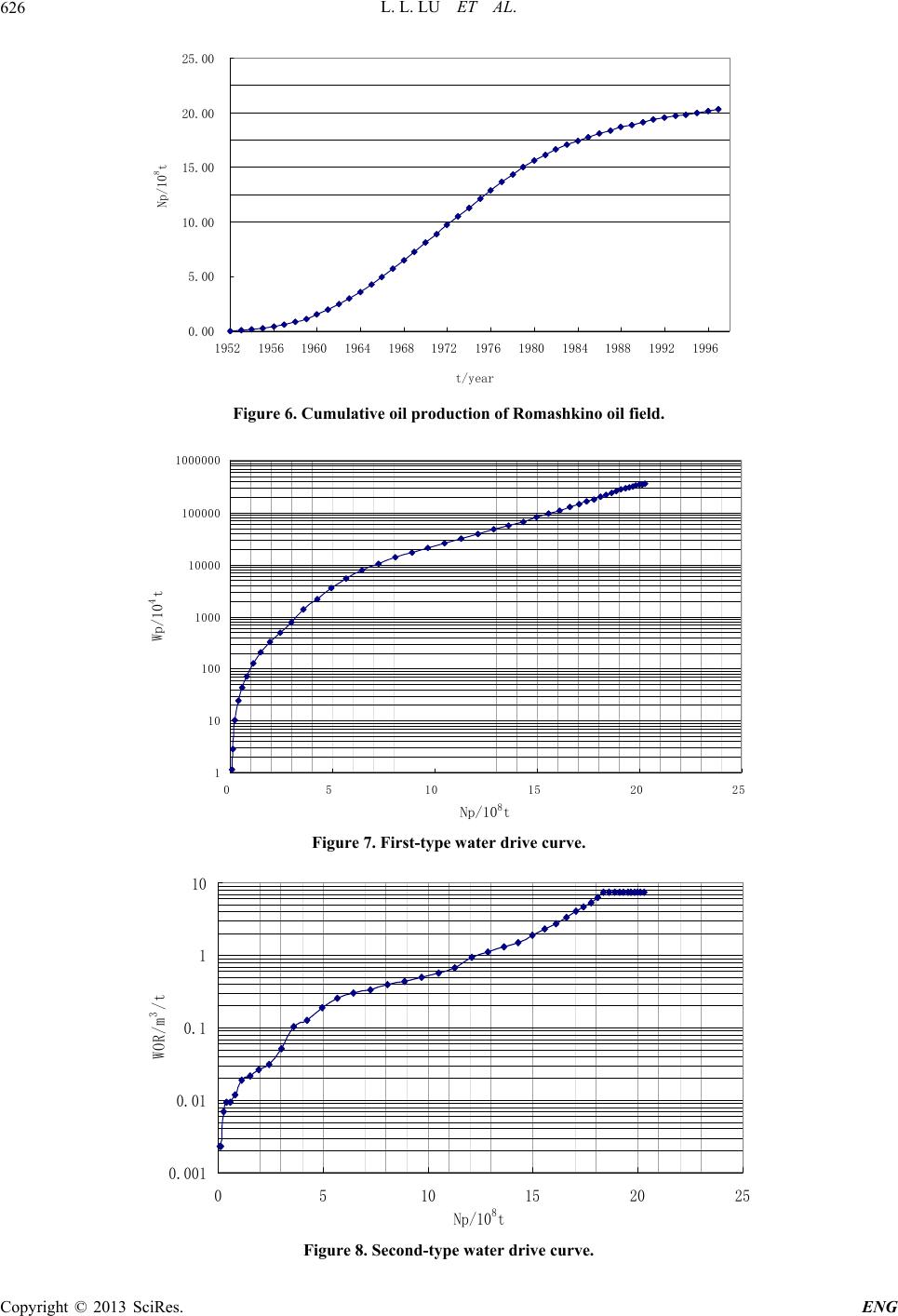 L. L. LU ET AL. 626 0.00 5.00 10.00 15.00 20.00 25.00 1952 19561960 1964 19681972 1976 1980 19841988 1992 1996 t/year Np/10 8 t Figure 6. Cumulative oil production of Romashkino oil field. 1 10 100 1000 10000 100000 1000000 051015 20 25 Np/10 8 t Wp/10 4 t Figure 7. First-type water drive curve. 0.001 0.01 0.1 1 10 0510 152025 Np/10 8 t WOR/m 3 /t Figure 8. Second-type water drive curve. Copyright © 2013 SciRes. ENG 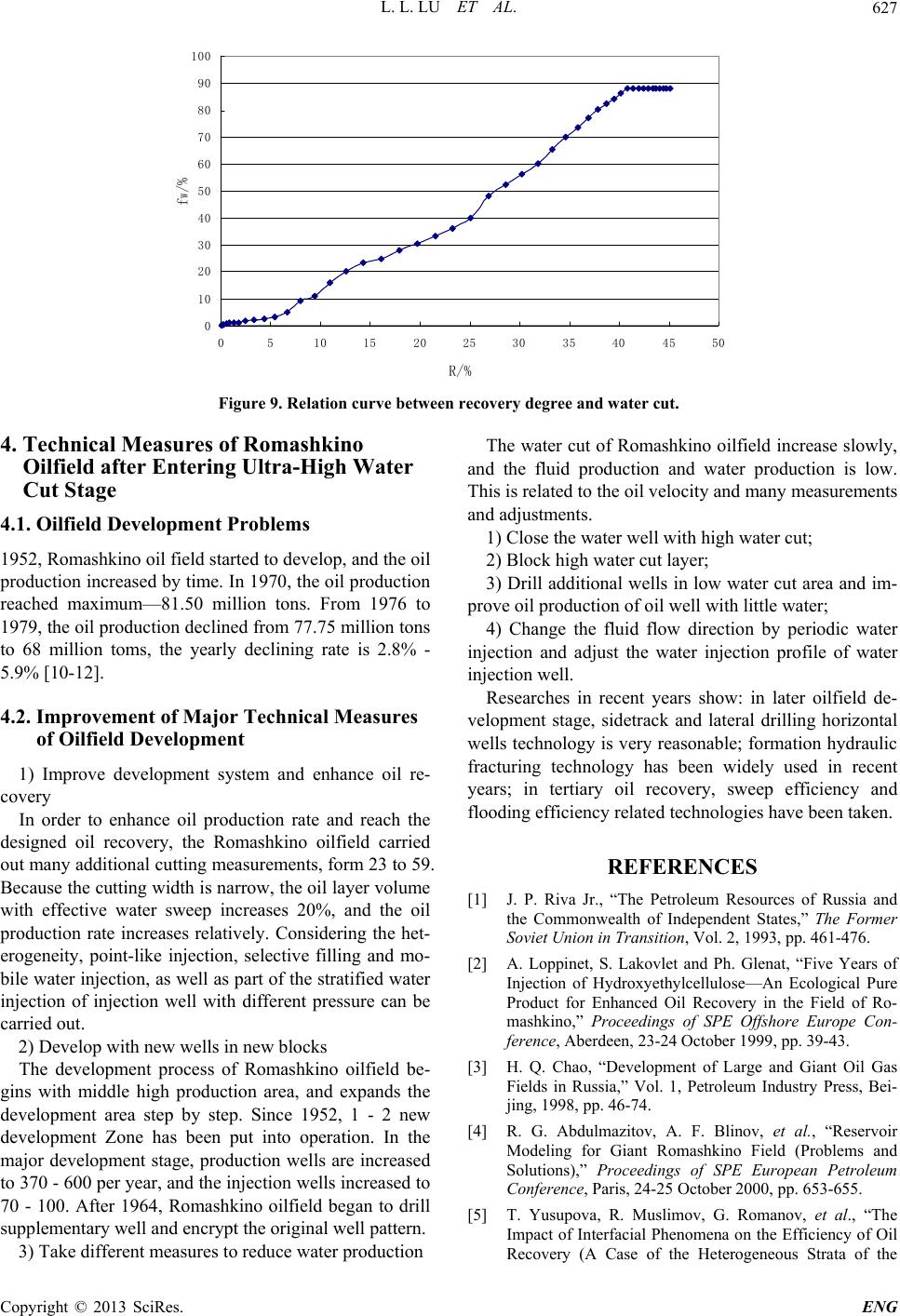 L. L. LU ET AL. Copyright © 2013 SciRes. ENG 627 0 10 20 30 40 50 60 70 80 90 100 0510 1520 25 3035 4045 50 R/% f W /% Figure 9. Relation curve between recovery degree and water cut. 4. Technical Measures of Romas h kino Oilfield after Entering Ultra- Cut Stage 4.1. Oilfield Development Problems 1952, Romashkino oil field started to develop, and the oil production increased by time. In 1970, the oil production reached maximum—81.50 million tons. From 1976 to 1979, the oil production declined from 77.75 million tons to 68 million toms, the yearly declining rate is 2.8% - 5.9% [10-12]. 4.2. Improvement of Major Technical Measures of Oilfield Development 1) Improve development system and enhance oil re- covery In order to enhance oil p esigned oil recovery, the R to 59. wi idering the het- g and mo- ea step by step. Since 1952, 1 - 2 new to 37 wells increased to 70 entary well and encrypt the original well pattern. The water cut of Romashkino oilfield increase slowly, duction and water production is low. This is related to the oil velocity and many measurements and adjustments. 1) Close the water well with high water cut; 2) Block high water cut layer; 3) Drill additional wells in low water cut area and im- prove oil production of oil well with little water; 4) Change the fluid flow direction by periodic water injection and adjust the water injection profile of water injection well. Researches in recent years show: in later oilfield de- velopment stage, sidetrack and lateral drilling horizontal wells technology is very reasonable; formation hydraulic fracturing technology has been widely used in recent years; in tertiary oil recovery, seep efficiency and flooding efficiency related technologies have been taken. iant Oil Gas Recovery (A Case of the Heterogeneous Strata of the High Water and the fluid pro w roduction rate and reach the omashkino oilfield carried d out many additional cutting measurements, form 23 Because the cutting width is narrow, the oil layer volume th effective water sweep increases 20%, and the oil production rate increases relatively. Cons erogeneity, point-like injection, selective fillin bile water injection, as well as part of the stratified water injection of injection well with different pressure can be carried out. 2) Develop with new wells in new blocks The development process of Romashkino oilfield be- gins with middle high production area, and expands the development ar development Zone has been put into operation. In the major development stage, production wells are increased 0 - 600 per year, and the injection - 100. After 1964, Romashkino oilfield began to drill supplem 3) Take different measures to reduce water production REFERENCES [1] J. P. Riva Jr., “The Petroleum Resources of Russia and the Commonwealth of Independent States,” The Former Soviet Union in Transition, Vol. 2, 1993, pp. 461-476. [2] A. Loppinet, S. Lakovlet and Ph. Glenat, “Five Years of Injection of Hydroxyethylcellulose—An Ecological Pure Product for Enhanced Oil Recovery in the Field of Ro- mashkino,” Proceedings of SPE Offshore Europe Con- ference, Aberdeen, 23-24 October 1999, pp. 39-43. [3] H. Q. Chao, “Development of Large and G Fields in Russia,” Vol. 1, Petroleum Industry Press, Bei- jing, 1998, pp. 46-74. [4] R. G. Abdulmazitov, A. F. Blinov, et al., “Reservoir Modeling for Giant Romashkino Field (Problems and Solutions),” Proceedings of SPE European Petroleum Conference, Paris, 24-25 October 2000, pp. 653-655. [5] T. Yusupova, R. Muslimov, G. Romanov, et al., “The Impact of Interfacial Phenomena on the Efficiency of Oil 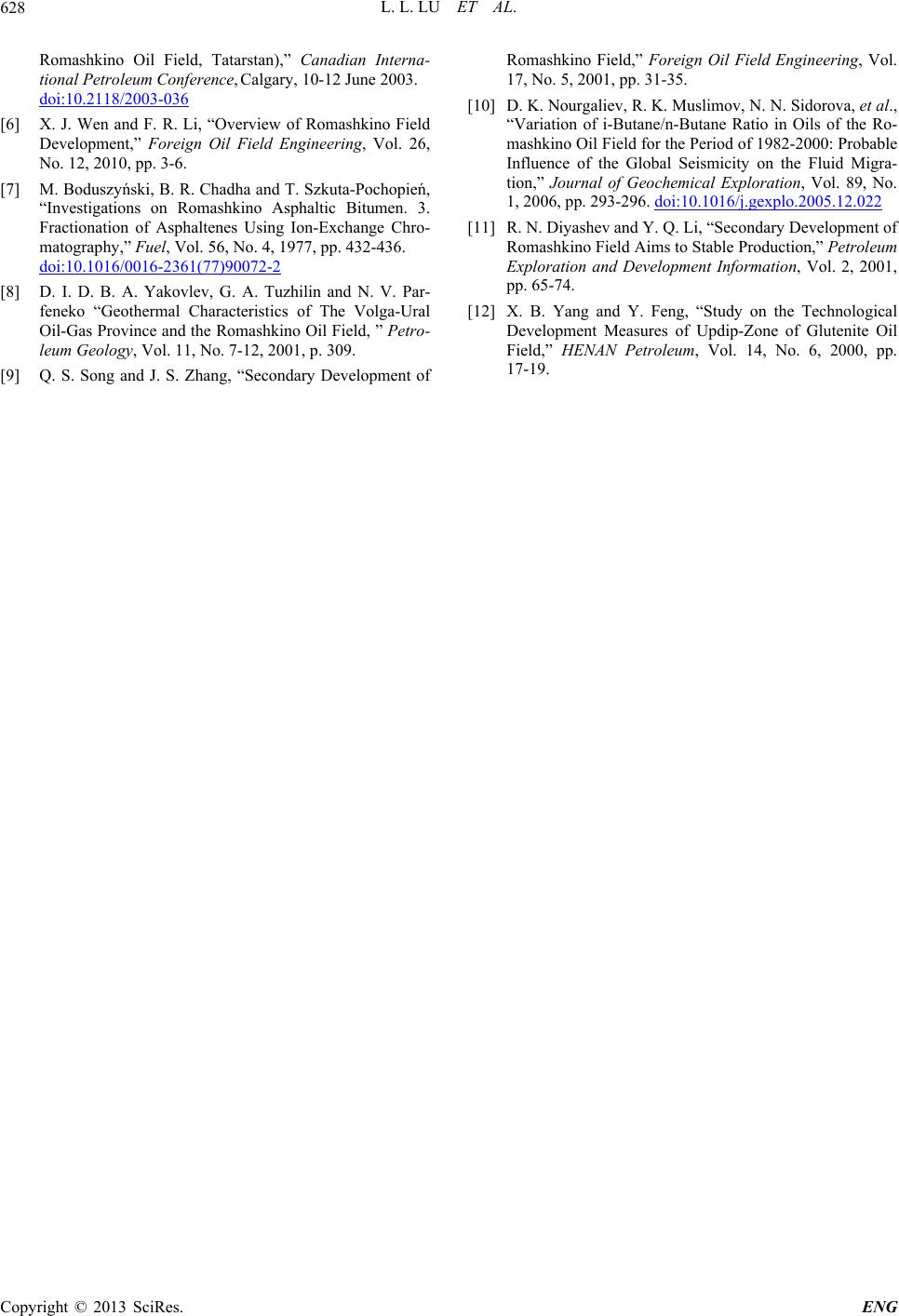 L. L. LU ET AL. 628 Romashkino Oil Field, Tatarstan),” Canadian Interna- tional Petroleum Conference, Calgary, 10-12 June 2003. doi:10.2118/2003-036 [6] X. J. Wen and F. R. Li, “Overview of Romashkino Field Development,” Foreign Oil Field Engineering, Vol. 26, No. 12, 2010, pp. 3-6. [7] M. Boduszyński, B. R. Chadha and T. Szkuta- “Investigations on Romashkino Asphaltic B Pochopień itumen. 3 sing Ion-Exchange Chro- , . Fractionation of Asphaltenes U matography,” Fuel, Vol. 56, No. 4, 1977, pp. 432-436. doi:10.1016/0016-2361(77)90072-2 [8] . i:10.1016/j.gexplo.2005.12.022 D. I. D. B. A. Yakovlev, G. A. Tuzhilin and N. V. Par- feneko “Geothermal Characteristics of The Volga-Ural Oil-Gas Province and the Romashkino Oil Field, ” Petro- leum Geology, Vol. 11, No. 7-12, 2001, p. 309. [9] Q. S. Song and J. S. Zhang, “Secondary Development of Romashkino Field,” Foreign Oil Field Engineering, Vol. 17, No. 5, 2001, pp. 31-35. [10] D. K. Nourgaliev, R. K. Muslimov, N. N. Sidorova, et al., “Variation of i-Butane/n-Butane Ratio in Oils of the Ro- mashkino Oil Field for the Period of 1982-2000: Probable Influence of the Global Seismicity on the Fluid Migra- tion,” Journal of Geochemical Exploration, Vol. 89, No 1, 2006, pp. 293-296. do opment Information, Vol. 2, 2001, . [11] R. N. Diyashev and Y. Q. Li, “Secondary Development of Romashkino Field Aims to Stable Production,” Petroleum Exploration and Devel pp. 65-74. [12] X. B. Yang and Y. Feng, “Study on the Technological Development Measures of Updip-Zone of Glutenite Oil Field,” HENAN Petroleum, Vol. 14, No. 6, 2000, pp 17-19. Copyright © 2013 SciRes. ENG |