

Paper Menu >>
Journal Menu >>
 Journal of Modern Physics, 2013, 4, 52-58 http://dx.doi.org/10.4236/jmp.2013.47A2008 Published Online July 2013 (http://www.scirp.org/journal/jmp) Proposal for Generalized Exergy and Entropy Properties Based on Stable Equilibrium of Composite System-Reservoir Pierfrancesco Palazzo Technip, Rome, Italy Email: [email protected] Received April 20, 2013; revised May 25, 2013; accepted June 27, 2013 Copyright © 2013 Pierfrancesco Palazzo. This is an open access article distributed under the Creative Commons Attribution License, which permits unrestricted use, distribution, and reproduction in any medium, provided the original work is properly cited. ABSTRACT The present theoretical study represents a proposal aimed at investigating about the possibility of generalizing the ca- nonical entropy-exergy relationship and the reservoir concept. The method adopted assumes the equality of pressure and chemical potential as necessary conditions of mutual stable equilibrium between a system and a reservoir in addi- tion to the equality of temperature that constitutes the basis for defining entropy as deriving from energy and exergy concepts. An attempt is made to define mechanical and chemical entropy as an additional and additive component of generalized entropy formulated from generalized exergy property. The implications in exergy method and the possible engineering applications of this appro ach are outlined as future developments among the domains involved. Keywords: Adiabatic Availability; Available Energy; Generalized Exergy; Generalized Entropy; Reservoir; Stable Equilibrium; Exergy Method 1. Introduction 2. Theoretical Model and Method The formulation of the Seco nd Law is based on the exis- tence and uniqueness of the state of stable equilibrium of a system interacting with a reservoir “among all the states of a system that have a given value of the energy and are compatible with a given set of values of the amounts of constituents and of the parameters” [1]. This general statement requires compliance with the necessary conditions of equ ality of (absolute) temperature, pressure and chemical potential between system and reservoir. The Second Law implies the definition of entropy prop- erty in relation to temperature. The entrop y of system The following assumptions are posited: 1) the analysis is focused on “simple systems” according to the terminal- ogy and definitions adopted by Gyftopoulos and Beretta [1]; 2) the external reference system behaves as a reser- voir as defined in the literature [1]; 3) the system may be large or small, even at molecular level, and may experi- ence states of equilibrium and nonequilibrium [1]; 4) physical and chemical exergy are accounted for; 5) ki- netic energy and the potential energy of the system as a whole are neglected. These assumptions are posited in order to constitute the requirements complying with the fundamental framework to which the addressed literature refers. A can also be derived as the difference of energy and exergy associated with the generalized available energy E EX R with respect to a reservoir at constant temperature R R The method adopted assumes the equality of pressure and chemical potential of the composite system-reservoir T [1]. The Second Law, expressed as in- dicated above, has to account for pressure and chemical potential in add ition to temperature, hence the purpose of this present study is to conceive a generalized formula- tion of exergy, and consequently of entropy, based on equality of pressure and chemical p oten tial, in additio n to temperature, between a system A and a reservoir at constant temperature A R as additional necessary conditions for mutual stable equilibrium, other than equality of temperature. The for- mulation of the entropy property is derived from exergy, related to a reservoir at constant temperature, constant pressure and constant chemical potential. This set of ge- neralized potentials equality constitutes a necessary and sufficient condition for the stable equilibrium of a com- posite system-reservoir consistent with the Second Law R R T, constant pressure R P and constant chemical potential R . C opyright © 2013 SciRes. JMP 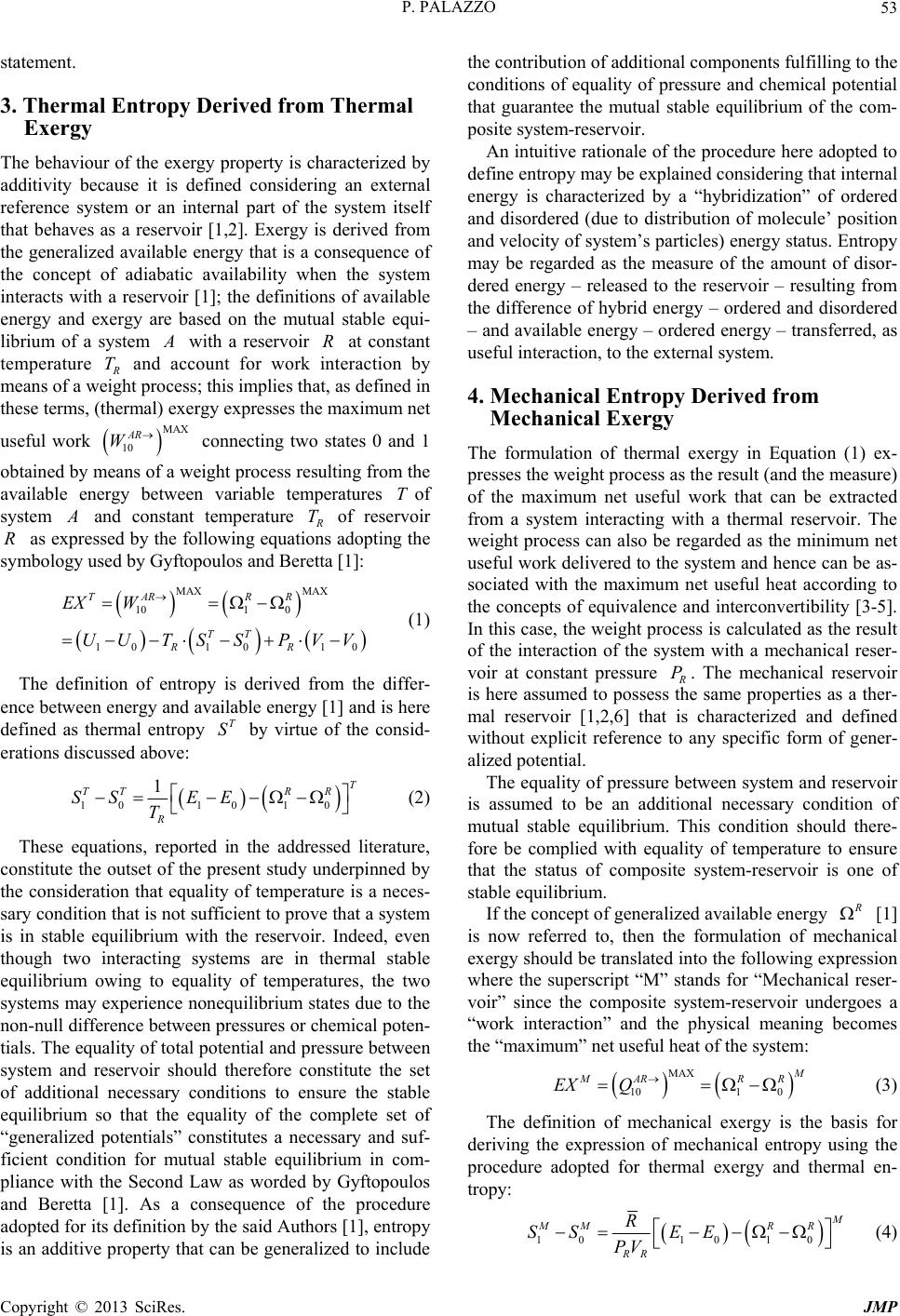 P. PALAZZO 53 statement. 3. Thermal Entropy Derived from Thermal Exergy The behaviour of the exergy property is characterized by additivity because it is defined considering an external reference system or an internal part of the system itself that behaves as a reservoir [1,2]. Exergy is derived from the generalized available energy that is a consequence of the concept of adiabatic availability when the system interacts with a reservoir [1]; the definitions of available energy and exergy are based on the mutual stable equi- librium of a system A with a reservoir at constant temperature R R T MAX 10 AR W and account for work interaction by means of a weight process; this implies that, as defined in these terms, (thermal) exergy expresses the maximum net useful work connecting two states 0 and 1 obtained by means of a weight process resulting from the available energy between variable temperatures Tof system A and constant temperature R T R of reservoir as expressed by the following equations adopting the symbology used by Gyftopoulos and Beretta [1]: MAX 0 10 R RR PVV T S MAX 10 1 101 0 TAR R TT EX W UUT SS (1) The definition of entropy is derived from the differ- ence between energy and available energy [1] and is here defined as thermal entropy by virtue of the consid- erations discussed above: 10 10 1 TT R SS EE T 1 0 T R R (2) These equations, reported in the addressed literature, constitute the outset of the present study underpinned by the consideration that equality of temperature is a neces- sary condition that is not sufficient to prove that a system is in stable equilibrium with the reservoir. Indeed, even though two interacting systems are in thermal stable equilibrium owing to equality of temperatures, the two systems may experience nonequ ilibrium states due to the non-null difference between pressures or chemical poten- tials. The equality of total potential and pressure between system and reservoir should therefore constitute the set of additional necessary conditions to ensure the stable equilibrium so that the equality of the complete set of “generalized potentials” constitutes a necessary and suf- ficient condition for mutual stable equilibrium in com- pliance with the Second Law as worded by Gyftopoulos and Beretta [1]. As a consequence of the procedure adopted for its definition by the said Authors [1], entropy is an additive property that can be generalized to include the contribution of additional components fulfilling to the conditions of equality of pressure and chemical potential that guarantee the mutual stable equilibrium of the com- posite system-reservoir. An intuitive rationale of the pro cedure here adopted to define entropy may be explained considering that internal energy is characterized by a “hybridization” of ordered and disordered (due to distribution of molecule’ position and velocity of system’s particles) energy status. Entropy may be regarded as the measure of the amount of disor- dered energy – released to the reservoir – resulting from the difference of hybrid energy – ordered and disordered – and available energy – ordered energy – transferred, as useful interaction, to th e external system. 4. Mechanical Entropy Derived from Mechanical Exergy The formulation of thermal exergy in Equation (1) ex- presses the weight process as the result (and the measure) of the maximum net useful work that can be extracted from a system interacting with a thermal reservoir. The weight process can also be regarded as the minimum net useful work delivered to the system and hence can be as- sociated with the maximum net useful heat according to the concepts of equivalence and interconvertibility [3-5]. In this case, the weight process is calculated as the result of the interaction of the system with a mechanical reser- voir at constant pressure R P. The mechanical reservoir is here assumed to possess the same properties as a ther- mal reservoir [1,2,6] that is characterized and defined without explicit reference to any specific form of gener- alized potential. The equality of pressu re between system and reservo ir is assumed to be an additional necessary condition of mutual stable equilibrium. This condition should there- fore be complied with equality of temperature to ensure that the status of composite system-reservoir is one of stable equilibrium. R If the concept of generalized available energy [1] is now referred to, then the formulation of mechanical exergy should be translated into the following expression where the superscript “M” stands for “Mechanical reser- voir” since the composite system-reservoir undergoes a “work interaction” and the physical meaning becomes the “maximum” net useful heat of the system: MAX 101 0 M MAR RR EXQ (3) The definition of mechanical exergy is the basis for deriving the expression of mechanical entropy using the procedure adopted for thermal exergy and thermal en- tropy: 1010 10 M MM RR RR R SS EE PV (4) Copyright © 2013 SciRes. JMP 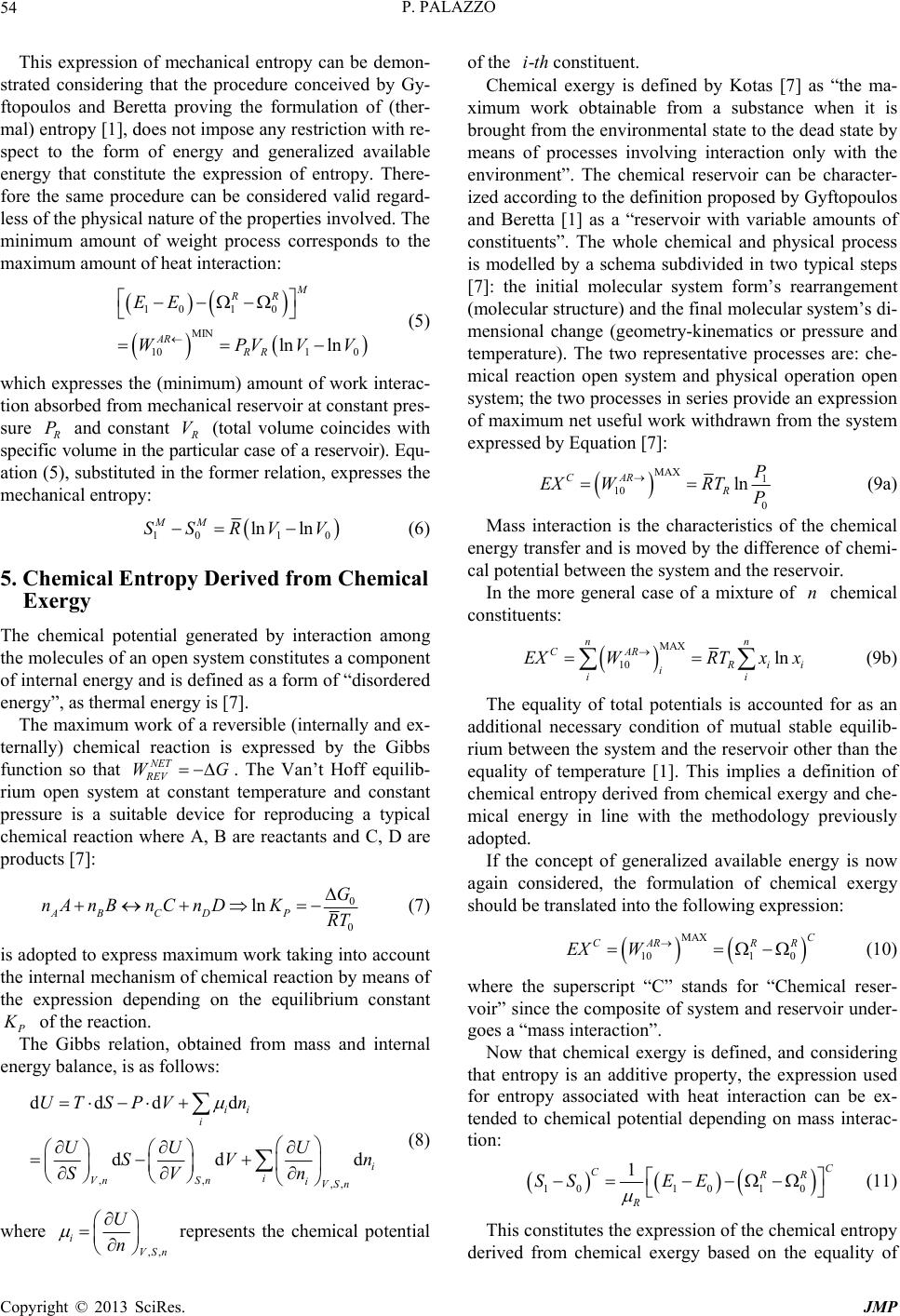 P. PALAZZO 54 This expression of mechanical entropy can be demon- strated considering that the procedure conceived by Gy- ftopoulos and Beretta proving the formulation of (ther- mal) entropy [1], does not impose any restriction with re- spect to the form of energy and generalized available energy that constitute the expression of entropy. There- fore the same procedure can be considered valid regard- less of the physical nature of the properties involved. Th e minimum amount of weight process corresponds to the maxim um amount of heat interact i on: 10 1 MIN 10 AR RR EE WP 0 1 0 ln ln M RR VVV (5) which expresses the (minimum) amount of work interac- tion absorbed from mechanical reservoir at constant pres- sure R P and constant R V (total volume coincides with specific volume in the particular case of a reservoir). Equ- ation (5), substituted in the former relation, expresses the mechanical entropy: 1 0 ln lnRVV NET WG 10 MM SS (6) 5. Chemical Entropy Derived from Chemical Exergy The chemical potential generated by interaction among the molecules of an open system constitutes a component of internal energy and is defined as a form of “disordered energy”, as thermal energy is [7]. The maximum work of a reversible (internally and ex- ternally) chemical reaction is expressed by the Gibbs function so that REV . The Van’t Hoff equilib- rium open system at constant temperature and constant pressure is a suitable device for reproducing a typical chemical reaction where A, B are reactants and C, D are products [7] : 0 0 PG KRT ln AB CD nA nBnCnD (7) is adopted to express maximum work tak ing into account the internal mechanism of chemical reaction by means of the expression depending on the equilibrium constant P K of the reaction. The Gibbs relation, obtained from mass and internal energy balance, is as follows: ,, dddd dd ii i i Vn Sn UTSPVn UU SV SV ,, d i iVSn U n n (8) where ,, iVSn U n -ith represents the chemical potential of the constituent. Chemical exergy is defined by Kotas [7] as “the ma- ximum work obtainable from a substance when it is brought from the environmental state to the dead state by means of processes involving interaction only with the environment”. The chemical reservoir can be character- ized according to the definition proposed by Gyftopoulos and Beretta [1] as a “reservoir with variable amounts of constituents”. The whole chemical and physical process is modelled by a schema subdivided in two typical steps [7]: the initial molecular system form’s rearrangement (molecular structure) and the final molecular system’s di- mensional change (geometry-kinematics or pressure and temperature). The two representative processes are: che- mical reaction open system and physical operation open system; the two processes in series provide an expression of maximum net useful work withdrawn from the system expressed by Equa t i o n [ 7]: MAX 1 10 0 ln CAR RP EXWRT P n (9a) Mass interaction is the characteristics of the chemical energy transfer and is moved by the difference of chemi- cal potential between the system and the reservoir. In the more general case of a mixture of chemical constituents: MAX 10 ln nn CAR R ii i ii EXWRTx x MAX 101 0 C CAR RR EXW (9b) The equality of total potentials is accounted for as an additional necessary condition of mutual stable equilib- rium between the system and the reservoir other than the equality of temperature [1]. This implies a definition of chemical entropy derived from chemical exergy and che- mical energy in line with the methodology previously adopted. If the concept of generalized available energy is now again considered, the formulation of chemical exergy should be translated into the following expression: (10) where the superscript “C” stands for “Chemical reser- voir” since the composite of system and reservoir under- goes a “mass interaction”. Now that chemical exergy is defined, and considering that entropy is an additive property, the expression used for entropy associated with heat interaction can be ex- tended to chemical potential depending on mass interac- tion: 101010 1C CRR R SS EE (11) This constitutes the expression of the chemical entrop y derived from chemical exergy based on the equality of Copyright © 2013 SciRes. JMP 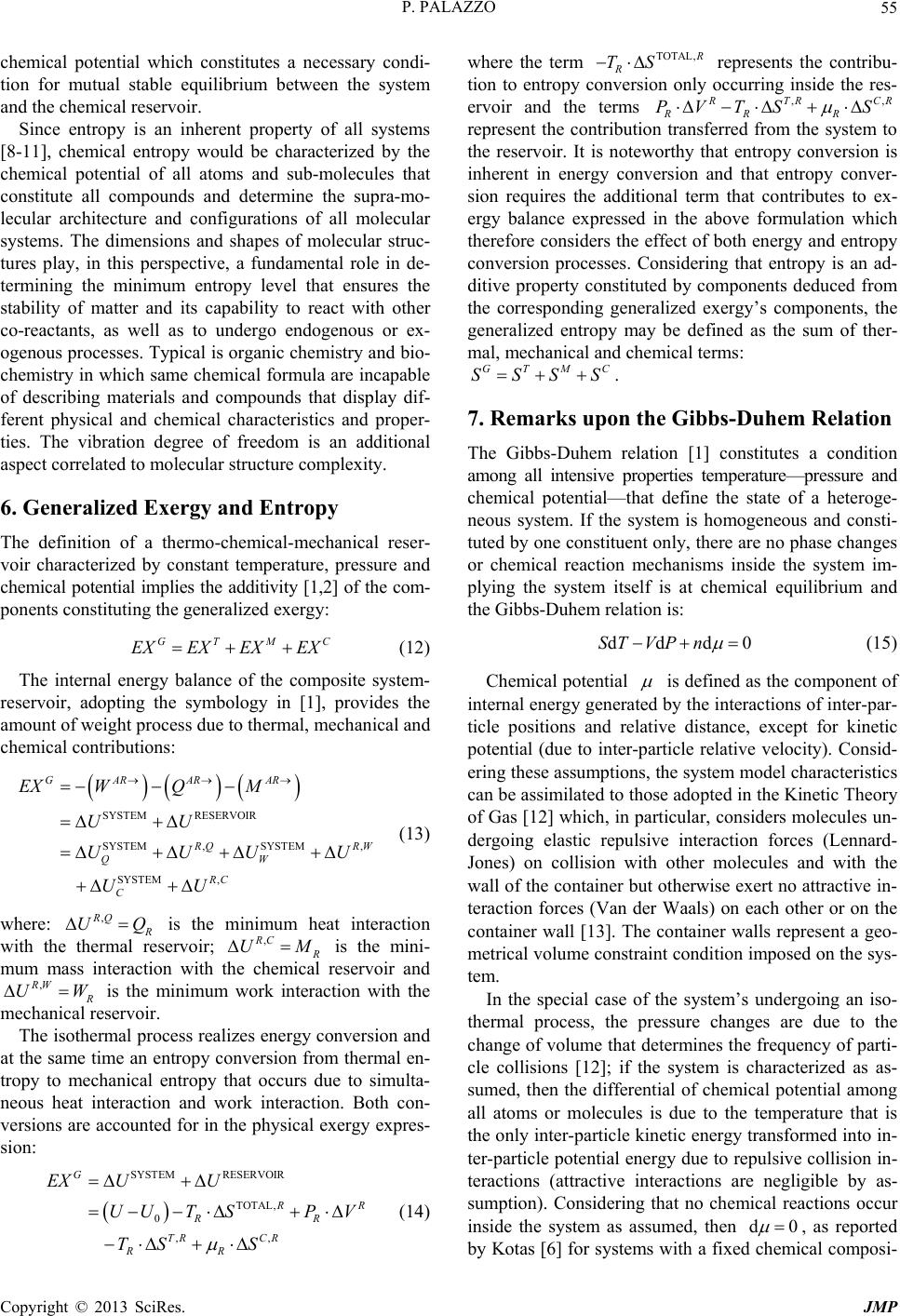 P. PALAZZO 55 chemical potential which constitutes a necessary condi- tion for mutual stable equilibrium between the system and the chemical reservoir. Since entropy is an inherent property of all systems [8-11], chemical entropy would be characterized by the chemical potential of all atoms and sub-molecules that constitute all compounds and determine the supra-mo- lecular architecture and configurations of all molecular systems. The dimensions and shapes of molecular struc- tures play, in this perspective, a fundamental role in de- termining the minimum entropy level that ensures the stability of matter and its capability to react with other co-reactants, as well as to undergo endogenous or ex- ogenous processes. Typical is organic chemistry and bio- chemistry in which same chemical formula are incapable of describing materials and compounds that display dif- ferent physical and chemical characteristics and proper- ties. The vibration degree of freedom is an additional aspect correlated to molecular structure complexity. 6. Generalized Exergy and Entropy The definition of a thermo-chemical-mechanical reser- voir characterized by constant temperature, pressure and chemical potential implies the additivity [1,2] of the com- ponents constitu ting the generalized exergy: GT EX EX MC EX EX (12) The internal energy balance of the composite system- reservoir, adopting the symbology in [1], provides the amount of weight process due to therm a l , mechanical and chemical contributions: TEM , AR SYSTEM RESERVOIR SYSTEM , SYS SYSTEM , GARAR R Q QW RC C EX WQM UU UU UU RW UU ,RQ (13) where: R UQ ,RC is the minimum heat interaction with the thermal reservoir; R UM is the mini- mum mass interaction with the chemical reservoir and ,RW R UW IR , is the minimum work interaction with the mechanical reservoir. The isothermal process r ealizes energy conversion and at the same time an entropy conversion from thermal en- tropy to mechanical entropy that occurs due to simulta- neous heat interaction and work interaction. Both con- versions are accounted for in the physical exergy expres- sion: SYSTEM RESERVO TOTAL 0 ,, G R R R R P V TOTAL, R TR C RR EX UU UUTS TS S (14) where the term R R represents the contribu- tion to entropy conversion only occurring inside the res- ervoir and the terms TS ,, R TR CR PVTSS GTMC SSSS ddd0STVPn RR R represent the contribution transferred from the system to the reservoir. It is noteworthy that entropy conversion is inherent in energy conversion and that entropy conver- sion requires the additional term that contributes to ex- ergy balance expressed in the above formulation which therefore considers the effect of both energy and entropy conversion processes. Considering that entropy is an ad- ditive property constituted by components deduced from the corresponding generalized exergy’s components, the generalized entropy may be defined as the sum of ther- mal, mechanical and chemical terms: . 7. Remarks upon the Gibbs-Duhem Relation The Gibbs-Duhem relation [1] constitutes a condition among all intensive properties temperature—pressure and chemical potential—that define the state of a heteroge- neous system. If the system is homogeneous and consti- tuted by one con stituent only, th ere are no phase changes or chemical reaction mechanisms inside the system im- plying the system itself is at chemical equilibrium and the Gibbs-Duhem relation is: (15) Chemical potential is defined as the component of internal energy ge nerated by the interactions of in ter-par- ticle positions and relative distance, except for kinetic potential (due to inter-particle relative velocity). Consid- ering these assumptions, the system model characteristics can be assimilated to those ado pted in the Kinetic Theory of Gas [12] which, in p articular, considers molecules un- dergoing elastic repulsive interaction forces (Lennard- Jones) on collision with other molecules and with the wall of the container but otherwise exert no attractive in- teraction forces (Van der Waals) on each other or on the container wall [13]. The container walls represent a geo- metrical volume constraint con dition imposed on the sys- tem. In the special case of the system’s undergoing an iso- thermal process, the pressure changes are due to the change of volume that determines the frequency of parti- cle collisions [12]; if the system is characterized as as- sumed, then the differential of chemical potential among all atoms or molecules is due to the temperature that is the only inter-particle kin etic energy transformed into in- ter-particle potential energ y due to repulsive collisio n in- teractions (attractive interactions are negligible by as- sumption). Considering that no chemical reactions occur inside the system as assumed, then d0 , as reported by Kotas [6] for systems with a fixed chemical composi- Copyright © 2013 SciRes. JMP 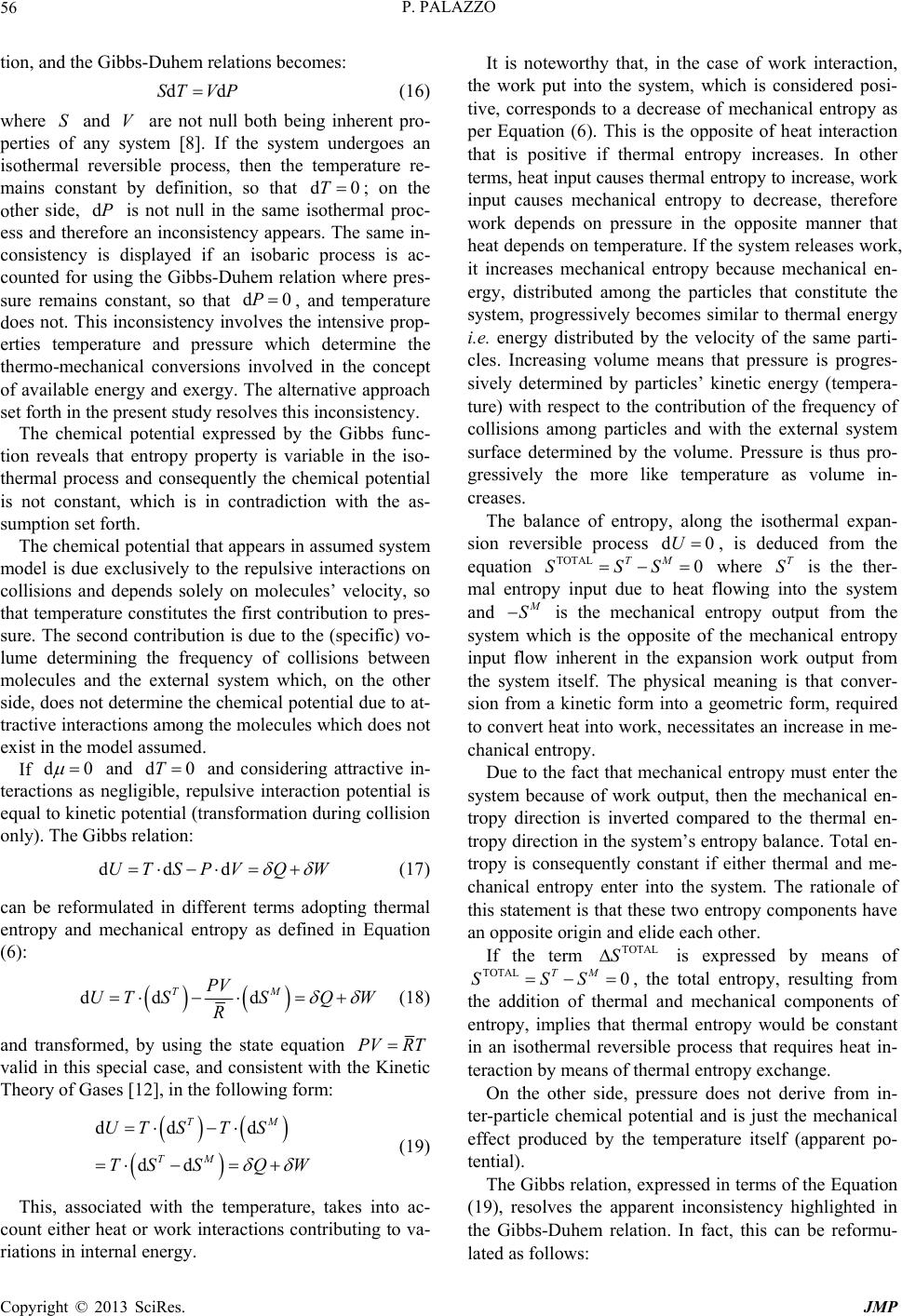 P. PALAZZO 56 tion, and the Gibbs-Duhem relations becomes: ddST VP S d0T dP d0 0 (16) where and V are not null both being inherent pro- perties of any system [8]. If the system undergoes an isothermal reversible process, then the temperature re- mains constant by definition, so that ; on the other side, is not null in the same isothermal proc- ess and therefore an inconsistency appears. The same in- consistency is displayed if an isobaric process is ac- counted for using the Gibbs-Duhem relation where pres- sure remains constant, so that , and temperature does not. This inconsistency involves the intensive prop- erties temperature and pressure which determine the thermo-mechanical conversions involved in the concept of available energy and exergy. The alternative ap proach set forth in the present study resolves this inco nsistency. P The chemical potential expressed by the Gibbs func- tion reveals that entropy property is variable in the iso- thermal process and consequently the chemical potential is not constant, which is in contradiction with the as- sumption set forth. The chemical potential that appears in assumed system model is due exclusively to the repulsive interactions on collisions and depends solely on molecules’ velocity, so that temperature constitutes the first contribution to pres- sure. The second contribution is due to the (specific) vo- lume determining the frequency of collisions between molecules and the external system which, on the other side, does not determine the chemical potential due to at- tractive interactions among the molecules which does not exist in the model assumed. If d and and considering attractive in- teractions as negligible, repulsive interaction potential is equal to kinetic poten tial (transformation during collision only). The Gibbs rel at i on: d0T dVQ WddUTSP (17) can be reformulated in different terms adopting thermal entropy and mechanical entropy as defined in Equation (6): dQ Wdd TM PV UT SS R (18) and transformed, by using the state equation PV RT d TM T S QW valid in this special case, and consistent with the Kinetic Theory of Gases [12], in the following form: dd dd TM UTS TSS 0U TOTAL 0 TM SSS (19) This, associated with the temperature, takes into ac- count either heat or work interactions contributing to va- riations in internal energy. It is noteworthy that, in the case of work interaction, the work put into the system, which is considered posi- tive, corresponds to a decrease of mechanical entropy as per Equation (6). This is the opposite of heat interaction that is positive if thermal entropy increases. In other terms, heat inpu t causes thermal entropy to increas e, work input causes mechanical entropy to decrease, therefore work depends on pressure in the opposite manner that heat depends on temperature. If the system releases work, it increases mechanical entropy because mechanical en- ergy, distributed among the particles that constitute the system, progressively becomes similar to thermal energy i.e. energy distributed by the velocity of the same parti- cles. Increasing volume means that pressure is progres- sively determined by particles’ kinetic energy (tempera- ture) with respect to the contribution of the frequency of collisions among particles and with the external system surface determined by the volume. Pressure is thus pro- gressively the more like temperature as volume in- creases. The balance of entropy, along the isothermal expan- sion reversible process d, is deduced from the equation T S where is the ther- mal entropy input due to heat flowing into the system and M S TOTAL S TOTAL 0 TM SSS is the mechanical entropy output from the system which is the opposite of the mechanical entropy input flow inherent in the expansion work output from the system itself. The physical meaning is that conver- sion from a kinetic form into a geometric form, required to convert heat into work, necessitates an increase in me- chanical entropy. Due to the fact that mechanical entropy must enter the system because of work output, then the mechanical en- tropy direction is inverted compared to the thermal en- tropy direction in the system’s entropy balance. Total en- tropy is consequently constant if either thermal and me- chanical entropy enter into the system. The rationale of this statement is that these two entrop y components have an opposite origin and elide each other. If the term is expressed by means of , the total entropy, resulting from the addition of thermal and mechanical components of entropy, implies that thermal entropy would be constant in an isothermal reversible process that requires heat in- teraction by means of thermal entropy exchange. On the other side, pressure does not derive from in- ter-particle chemical potential and is just the mechanical effect produced by the temperature itself (apparent po- tential). The Gibbs relation, expressed in terms of the Equation (19), resolves the apparent inconsistency highlighted in the Gibbs-Duhem relation. In fact, this can be reformu- lated as follows: Copyright © 2013 SciRes. JMP 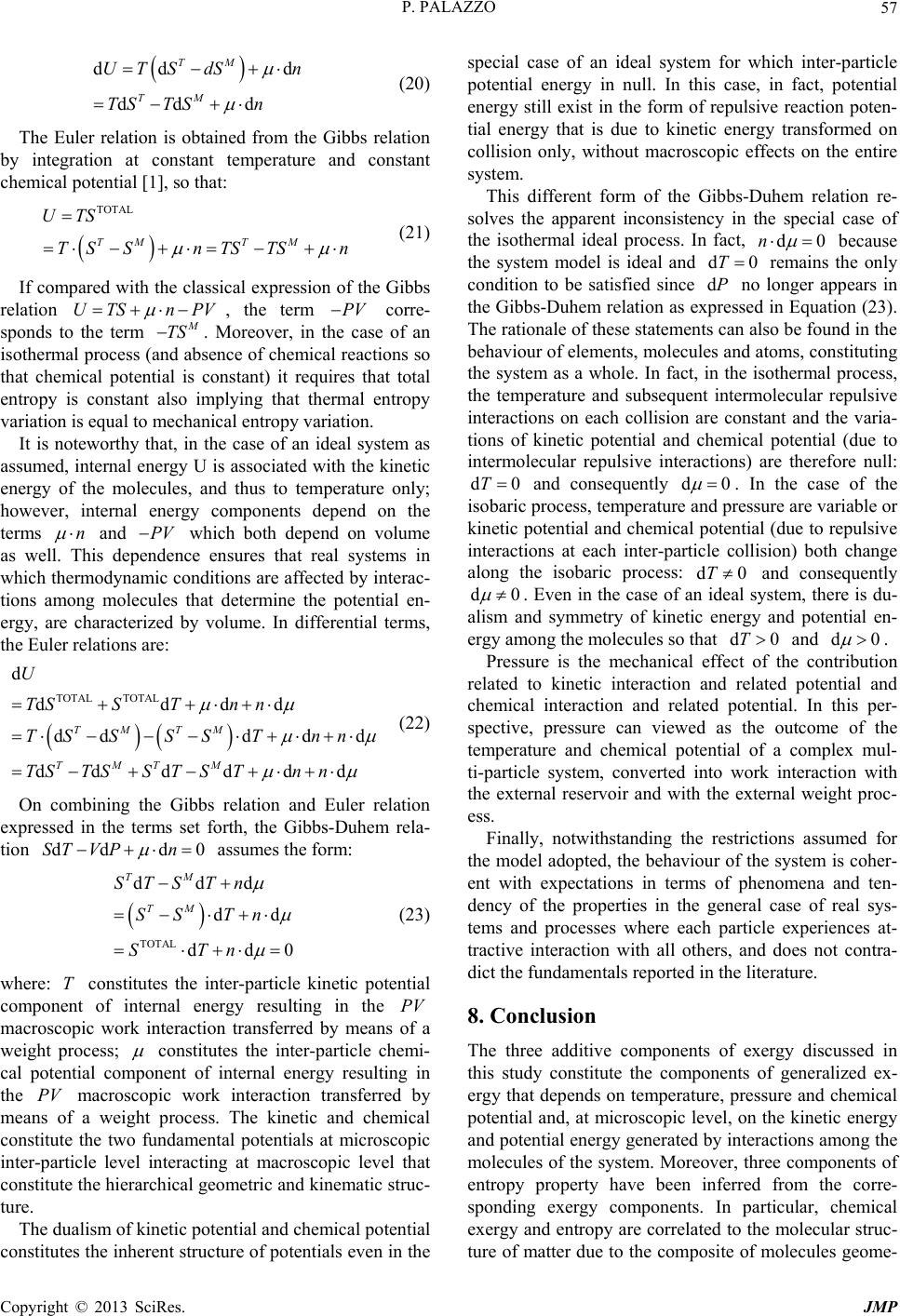 P. PALAZZO 57 d d TM dS n n T M TS n dd dd TM UTS TS TS (20) The Euler relation is obtained from the Gibbs relation by integration at constant temperature and constant chemical potential [1], so that: TOTAL TM UTS TSSn TS S nP (21) If compared with the classical expression of the Gibbs relation UT V PV, the term corre- sponds to the term M TS n . Moreover, in the case of an isothermal process (and absence of chemical reactions so that chemical potential is constant) it requires that total entropy is constant also implying that thermal entropy variation is equal to mechanical entropy variation. It is noteworthy that, in the case of an ideal system as assumed, internal energy U is associated with the kinetic energy of the molecules, and thus to temperature only; however, internal energy components depend on the terms and which both depend on volume as well. This dependence ensures that real systems in which thermodynamic cond itions are affected by interac- tions among molecules that determine the potential en- ergy, are characterized by volume. In differential terms, the Euler relations are: PV dd d d dd nn n n TOTAL TOTAL d dd dd d dddd TM TM TMTM U TSSTn n TS SSST TSTSST ST d0VP n (22) On combining the Gibbs relation and Euler relation expressed in the terms set forth, the Gibbs-Duhem rela- tion ddST d dd dd0 Tn Tn STn assumes the form: TOTAL dd TM TM STS SS TPV (23) where: constitutes the inter-particle kinetic potential component of internal energy resulting in the macroscopic work interaction transferred by means of a weight process; constitutes the inter-particle chemi- cal potential component of internal energy resulting in the macroscopic work interaction transferred by means of a weight process. The kinetic and chemical constitute the two fundamental potentials at microscopic inter-particle level interacting at macroscopic level that constitute the hierarch ical geometric and kinematic struc- ture. PV The dualism of kinetic potential and chemical potential constitutes the inh erent structure of potentials even in the special case of an ideal system for which inter-particle potential energy in null. In this case, in fact, potential energy still exist in the form of repulsive reaction poten- tial energy that is due to kinetic energy transformed on collision only, without macroscopic effects on the entire system. This different form of the Gibbs-Duhem relation re- solves the apparent inconsistency in the special case of the isothermal ideal process. In fact, d0n d0T dP d0T because the system model is ideal and remains the only condition to be satisfied since no longer appears in the Gibbs-Duhem relatio n as expressed in Equ ation (23). The rationale of these statements can also be found in the behaviour of elements, molecules and atoms, constituting the system as a whole. In fact, in the isothermal process, the temperature and subsequent intermolecular repulsive interactions on each collision are constant and the varia- tions of kinetic potential and chemical potential (due to intermolecular repulsive interactions) are therefore null: and consequently d0 0T d0 . In the case of the isobaric process, temperature and pressure are variable or kinetic potential and chemical po tential (due to repulsive interactions at each inter-particle collision) both change along the isobaric process: d and consequently . Even in the case of an ideal system, there is du- alism and symmetry of kinetic energy and potential en- ergy among the molecules so that and d0d0T . Pressure is the mechanical effect of the contribution related to kinetic interaction and related potential and chemical interaction and related potential. In this per- spective, pressure can viewed as the outcome of the temperature and chemical potential of a complex mul- ti-particle system, converted into work interaction with the external reservoir and with the external weight proc- ess. Finally, notwithstanding the restrictions assumed for the model adopted, the behaviour of the system is coher- ent with expectations in terms of phenomena and ten- dency of the properties in the general case of real sys- tems and processes where each particle experiences at- tractive interaction with all others, and does not contra- dict the fundamentals reported in the literature. 8. Conclusion The three additive components of exergy discussed in this study constitute the components of generalized ex- ergy that depends on temperature, pressure and chemical potential and, at microscopic level, on the kinetic energy and potential energy generated by interactions among the molecules of the system. Moreover, three components of entropy property have been inferred from the corre- sponding exergy components. In particular, chemical exergy and entropy are correlated to the molecular struc- ture of matter due to the composite of molecules geome- Copyright © 2013 SciRes. JMP 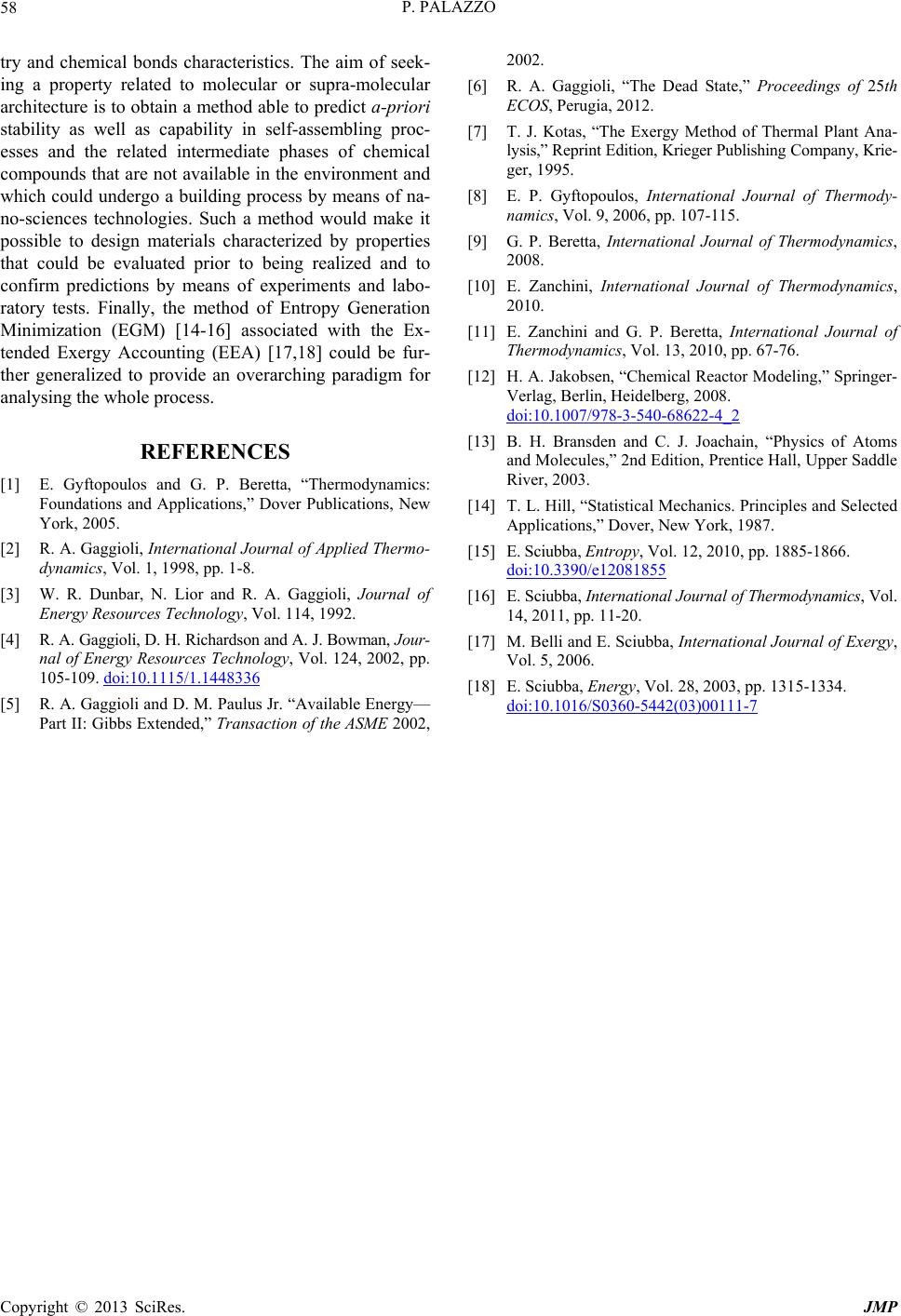 P. PALAZZO Copyright © 2013 SciRes. JMP 58 try and chemical bonds characteristics. The aim of seek- ing a property related to molecular or supra-molecular architecture is to obtain a method able to pred ict a-priori stability as well as capability in self-assembling proc- esses and the related intermediate phases of chemical compounds that are not available in the environment and which could undergo a building process by means of na- no-sciences technologies. Such a method would make it possible to design materials characterized by properties that could be evaluated prior to being realized and to confirm predictions by means of experiments and labo- ratory tests. Finally, the method of Entropy Generation Minimization (EGM) [14-16] associated with the Ex- tended Exergy Accounting (EEA) [17,18] could be fur- ther generalized to provide an overarching paradigm for analysing the whole process. REFERENCES [1] E. Gyftopoulos and G. P. Beretta, “Thermodynamics: Foundations and Applications,” Dover Publications, New York, 2005. [2] R. A. Gaggioli, International Journal of Applied Thermo- dynamics, Vol. 1, 1998, pp. 1-8. [3] W. R. Dunbar, N. Lior and R. A. Gaggioli, Journal of Energy Resources Technology, Vol. 114, 1992. [4] R. A. Gaggioli, D. H. Richar dso n and A. J. B owman, Jour- nal of Energy Resources Technology, Vol. 124, 2002, pp. 105-109. doi:10.1115/1.1448336 [5] R. A. Gaggioli and D. M. Paulus Jr. “Available Energy— Part II: Gibbs Extended,” Transaction of the ASME 2002, 2002. [6] R. A. Gaggioli, “The Dead State,” Proceedings of 25th ECOS, Perugia, 2012. [7] T. J. Kotas, “The Exergy Method of Thermal Plant Ana- lysis,” Reprint Edition, Krieger Publishing Co mpany, Krie- ger, 1995. [8] E. P. Gyftopoulos, International Journal of Thermody- namics, Vol. 9, 2006, pp. 107-115. [9] G. P. Beretta, International Journal of Thermodynamics, 2008. [10] E. Zanchini, International Journal of Thermodynamics, 2010. [11] E. Zanchini and G. P. Beretta, International Journal of Thermodynamics, Vol. 13, 2010, pp. 67-76. [12] H. A. Jakobsen, “Chemical Reactor Modeling,” Springer- Verlag, Berlin, Heidelberg, 2008. doi:10.1007/978-3-540-68622-4_2 [13] B. H. Bransden and C. J. Joachain, “Physics of Atoms and Molecules,” 2nd Edition, Prentice Hall, Upper Saddle River, 2003. [14] T. L. Hill, “Statistical Mechanics. Principles and Selected Applications,” Dover, New York, 1987. [15] E. Sciubba, Entropy, Vol. 12, 2010, pp. 1885-1866. doi:10.3390/e12081855 [16] E. Sciubba, International Journal of Thermodynamics, Vol. 14, 2011, pp. 11-20. [17] M. Belli and E. Sciubba, International Journal of Exergy, Vol. 5, 2006. [18] E. Sciubba, Energy, Vol. 28, 2003, pp. 1315-1334. doi:10.1016/S0360-5442(03)00111-7 |