

Paper Menu >>
Journal Menu >>
 Optics and Photonics Journal, 2013, 3, 25-28 doi:10.4236/opj.2013.32B006 Published Online June 2013 (http://www.scirp.org/journal/opj) Study on the Third-order Nonlinear Optical Properties of bis(tetraethylammonium) bis(1,3-dithiole-2-thione-4,5-dithiolato)cadium Hongliang Yang1, Fujun Zhang1, Xinqiang Wang2, Guanghui Zhang2 1Department of Optics, Shandong University, Jinan,250100,China 2State Key Laboratory of Crystal, Shandong University, Jinan,250100,China Email: [email protected], [email protected] Received 2013 ABSTRACT A dmit2- salt: bis(tetraethylammoniu m)bis(1,3 -dith io le-2-thion e-4,5 -dith io lato)cadiu m (CADMIT) was synthesized. The Optical Kerr Effect (OKE) signal of its acetonitrile solution was measured by femtosecond optical Kerr gate technique. Using CS2 OKE signal as reference signal measured under identical conditions, the third-order optical nonlinear suscep- tibility, (3), of the sample solution was obtained to be about 2.98 10-14 esu at the concentration of 1.57 10-3 M. The second-order hyperpolarizability of its molecular was estimated to be as large as 1.23 10-32 esu. Its response time was about 195 fs, which is believed to be the contribution from the delocalized electrons. Keywords: Optical Nonlinearity; Kerr Gate Technology; Response Time 1. Introduction Recently, nonlinear optical materials have attracted much interest because of their potential in fabricating ultrafast optical switching and processing devices [1-3]. For this purpose, many materials, including semiconductors, poly- mers, nanomaterials and inorganic materials, have been studied. Among them, -conjugated organic material has been paid great attention for its high nonlinear optical (NLO) properties and ultrafast response [4]. Especially, the organometallic and coordination material has been attracting great concern, because it has the advantages of architectural flexibility, ease of fabrication and tailoring, and high NLO properties of organics. Simultaneously, it possesses good transmissivity, temporal and thermal sta- bility of inorganic matter. Such material also has strongly enhanced second-order hyperpolarizability by introduc- ing a metal atom. Currently, the synthesis and characterization of 1,3- dithiole-2-thione-4,5-dithiolate (dmit) complexes and related selenlum- and oxygen-substituted isologs have been studied. As a special -electron delocalization con- jugated system, dmit and related ligand complexes have been used in the assembly of highly electrically conduct- ing radical anion salts and charge-transfer complexes. They are generally used as important building blocks for organic, organometallic and coordination complex elec- trical conductors and superconductors. The -electron delocalization in conjugated systems can also contribute to the ultrafast response capability and large third-order nonlinearity. Recently, some of these complexes pos- sessing good second-order[5,6] and third-order[7-11] NLO properties have been reported. In this paper, a dmit2- salt: bis(tetraethylammonium)bis(1,3-dithiole-2- thione-4,5-dithiolato)cadium was synthesized. The Opti- cal Kerr Effect (OKE) signal of its acetonitrile solution was measured by femtosecond optical Kerr gate tech- nique. 2. Material Preparation and Experiment Method The preparation method of CADMIT crystal was a modi- fication according to literature method [12]. The sample solution was prepared using acetonitrile as the solvent whose concentration is 1.57 10-3 M. The femtosecond optical Kerr gate technique was ap- plied in this experiment whose measurement setup is illustrated in Figure 1. The light source, centered at 800 nm, is a Ti:sapphire femtosecond laser system (Mira 900F, Coherent, USA), which is pumped by a multiline Ar+ laser system (Innova 400, Coherent, USA) at 11 W. The repetition rate is 76 MHz and its pulse width is 120 fs. The femtosecond laser beam whose average power was about 0.64 W is split into a probe beam and a pump beam by a beam splitter. The intensity ratio for the probe beam and the pump beam is 1:10. The polarization of the probe beam is carefully adjusted at 45o to the linear polar- Copyright © 2013 SciRes. OPJ 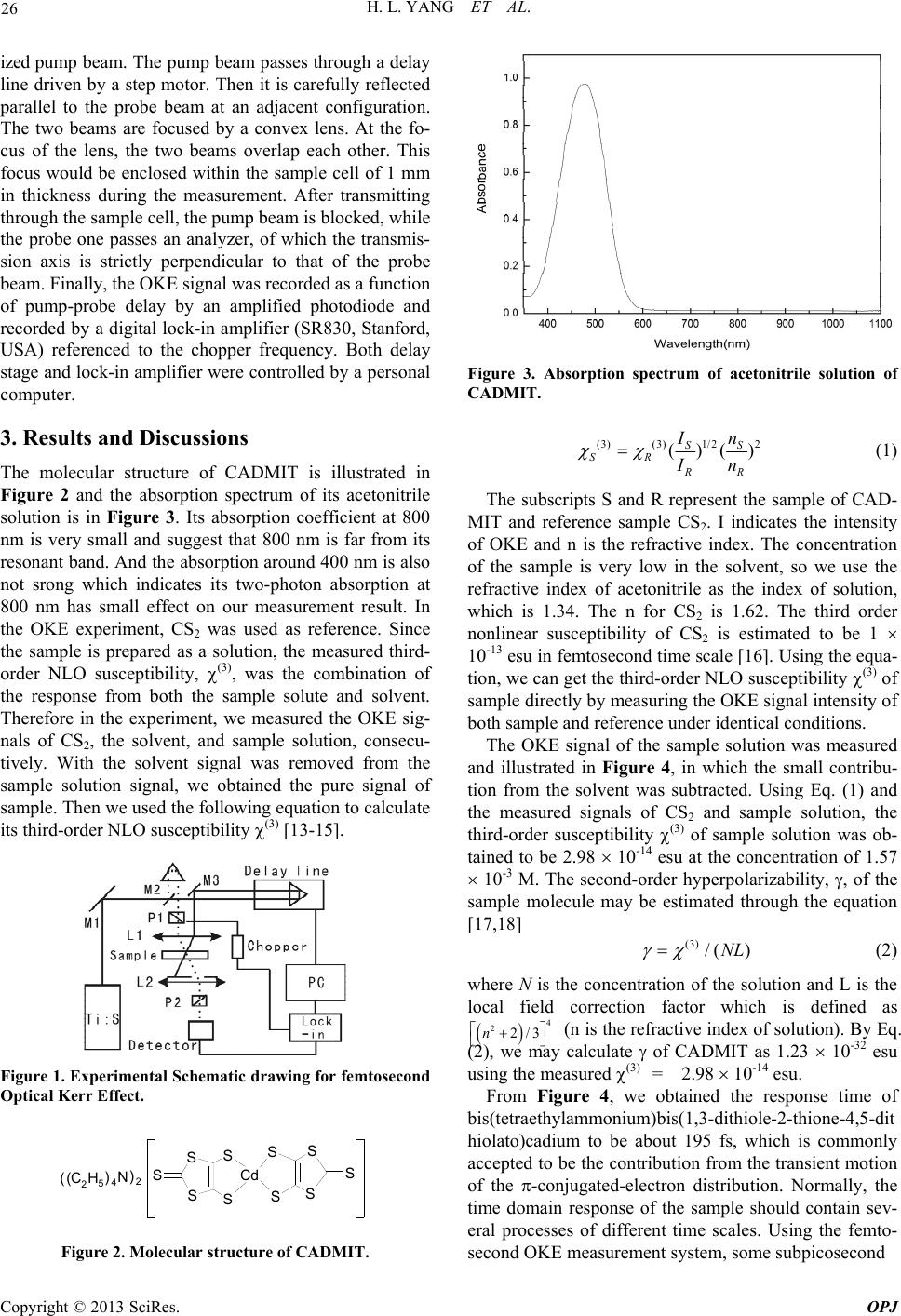 H. L. YANG ET AL. 26 ized pump beam. The pump beam passes through a delay line driven by a step motor. Then it is carefully reflected parallel to the probe beam at an adjacent configuration. The two beams are focused by a convex lens. At the fo- cus of the lens, the two beams overlap each other. This focus would be enclosed within the sample cell of 1 mm in thickness during the measurement. After transmitting through the sample cell, the pump beam is blocked, while the probe one passes an analyzer, of which the transmis- sion axis is strictly perpendicular to that of the probe beam. Finally, the OKE signal was recorded as a function of pump-probe delay by an amplified photodiode and recorded by a digital lock-in amplifier (SR830, Stanford, USA) referenced to the chopper frequency. Both delay stage and lock-in amplifier were controlled by a personal computer. 3. Results and Discussions The molecular structure of CADMIT is illustrated in Figure 2 and the absorption spectrum of its acetonitrile solution is in Figure 3. Its absorption coefficient at 800 nm is very small and suggest that 800 nm is far from its resonant band. And the absorption around 400 nm is also not srong which indicates its two-photon absorption at 800 nm has small effect on our measurement result. In the OKE experiment, CS2 was used as reference. Since the sample is prepared as a solution, the measured third- order NLO susceptibility, (3), was the combination of the response from both the sample solute and solvent. Therefore in the experiment, we measured the OKE sig- nals of CS2, the solvent, and sample solution, consecu- tively. With the solvent signal was removed from the sample solution signal, we obtained the pure signal of sample. Then we used the following equ ation to calculate its third-order NLO susceptibility (3) [13-15]. Figure 1. Experimental Schematic drawing for femtosecond Optical Kerr Effect. S S S S SCd S S S S S N)2 ((H5 C2)4 Figure 2. Molecular structure of CADMIT. Figure 3. Absorption spectrum of acetonitrile solution of CADMIT. (3)(3) 1/22 ()() SS SR RR I n I n (1) The subscripts S and R represent the sample of CAD- MIT and reference sample CS2. I indicates the intensity of OKE and n is the refractive index. The concentration of the sample is very low in the solvent, so we use the refractive index of acetonitrile as the index of solution, which is 1.34. The n for CS2 is 1.62. The third order nonlinear susceptibility of CS2 is estimated to be 1 10-13 esu in femtosecond time scale [16]. Using the equa- tion, we can get the third-order NLO suscep tibility (3) of sample directly by measuring the OKE signal intensity of both sample and reference under identical conditions. The OKE signal of the sample solution was measured and illustrated in Figure 4, in which the small contribu- tion from the solvent was subtracted. Using Eq. (1) and the measured signals of CS2 and sample solution, the third-order susceptibility (3) of sample solution was ob- tained to be 2.98 10-14 esu at the concentration of 1.57 10-3 M. The second-order hyperpolarizability, , of the sample molecule may be estimated through the equation [17,18] (3) /( )NL (2) where N is the concentration of the solution and L is the local field correction factor which is defined as 4 22/3n (n is the refractive index of solution). By Eq. (2), we may calculate of CADMIT as 1.23 10-32 esu using the measured (3) = 2.98 10-14 esu. From Figure 4, we obtained the response time of bis(tetraethylammonium)bis(1,3-dithiole-2-thione-4,5-dit hiolato)cadium to be about 195 fs, which is commonly accepted to be the contribution from the transient motion of the -conjugated-electron distribution. Normally, the time domain response of the sample should contain sev- eral processes of different time scales. Using the femto- second OKE measurement system, some subpicosecond Copyright © 2013 SciRes. OPJ 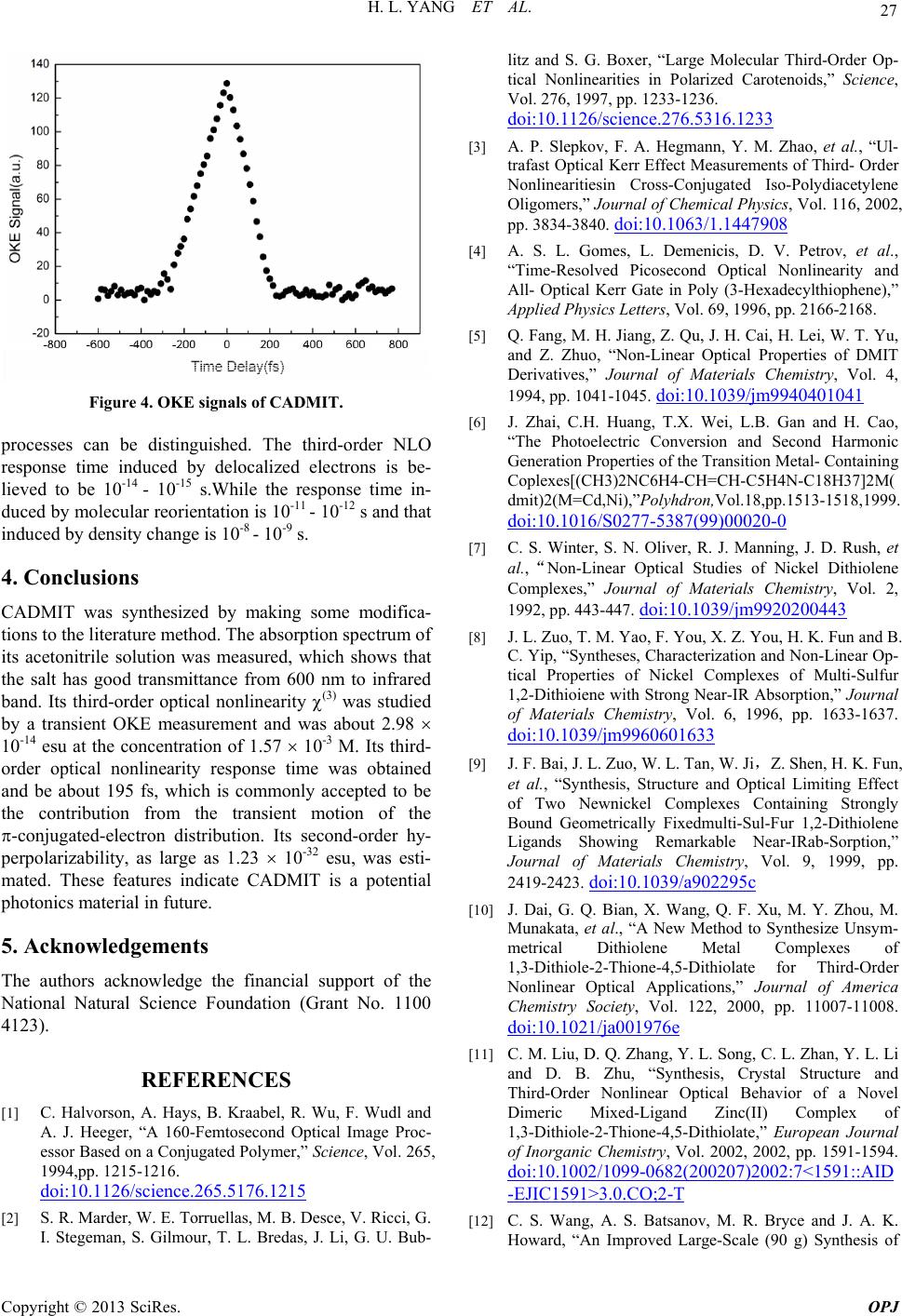 H. L. YANG ET AL. 27 Figure 4. OKE signals of CADMIT. processes can be distinguished. The third-order NLO response time induced by delocalized electrons is be- lieved to be 10-14 - 10-15 s.While the response time in- duced by molecular reorientation is 10-11 - 10-12 s and that induced by density change is 10-8 - 10-9 s. 4. Conclusions CADMIT was synthesized by making some modifica- tions to the literature method. The absorption sp ectrum of its acetonitrile solution was measured, which shows that the salt has good transmittance from 600 nm to infrared band. Its third-order optical nonlinearity (3) was studied by a transient OKE measurement and was about 2.98 10-14 esu at the concentration of 1.57 10-3 M. Its third- order optical nonlinearity response time was obtained and be about 195 fs, which is commonly accepted to be the contribution from the transient motion of the -conjugated-electron distribution. Its second-order hy- perpolarizability, as large as 1.23 10-32 esu, was esti- mated. These features indicate CADMIT is a potential photonics material in future. 5. Acknowledgements The authors acknowledge the financial support of the National Natural Science Foundation (Grant No. 1100 4123). REFERENCES [1] C. Halvorson, A. Hays, B. Kraabel, R. Wu, F. Wudl and A. J. Heeger, “A 160-Femtosecond Optical Image Proc- essor Based on a Conjugated Polymer,” Science, Vol. 265, 1994,pp. 1215-1216. doi:10.1126/science.265.5176.1215 [2] S. R. Marder, W. E. Torruellas, M. B. Desce, V. Ricci, G. I. Stegeman, S. Gilmour, T. L. Bredas, J. Li, G. U. Bub- litz and S. G. Boxer, “Large Molecular Third-Order Op- tical Nonlinearities in Polarized Carotenoids,” Science, Vol. 276, 1997, pp. 1233-1236. doi:10.1126/science.276.5316.1233 [3] A. P. Slepkov, F. A. Hegmann, Y. M. Zhao, et al., “Ul- trafast Optical Kerr Effect Measurements of Third- Order Nonlinearitiesin Cross-Conjugated Iso-Polydiacetylene Oligomers,” Journal of Chemical Physics, Vol. 116, 2002, pp. 3834-3840. doi:10.1063/1.1447908 [4] A. S. L. Gomes, L. Demenicis, D. V. Petrov, et al., “Time-Resolved Picosecond Optical Nonlinearity and All- Optical Kerr Gate in Poly (3-Hexadecylthiophene),” Applied Physics Letters, Vol. 69, 1996, pp. 2166-2168. [5] Q. Fang, M. H. Jiang, Z. Qu, J. H. Cai, H. Lei, W. T. Yu, and Z. Zhuo, “Non-Linear Optical Properties of DMIT Derivatives,” Journal of Materials Chemistry, Vol. 4, 1994, pp. 1041-1045. doi:10.1039/jm9940401041 [6] J. Zhai, C.H. Huang, T.X. Wei, L.B. Gan and H. Cao, “The Photoelectric Conversion and Second Harmonic Generation Properties of the Transition Metal- Containing Coplexes[(CH3)2NC6H4-CH=CH-C5H4N-C18H37]2M( dmit)2(M=Cd,Ni),”Polyhdron,Vol.18,pp.1513-1518,1999. doi:10.1016/S0277-5387(99)00020-0 [7] C. S. Winter, S. N. Oliver, R. J. Manning, J. D. Rush, et al.,“Non-Linear Optical Studies of Nickel Dithiolene Complexes,” Journal of Materials Chemistry, Vol. 2, 1992, pp. 443-447. doi:10.1039 /jm9920200443 [8] J. L. Zuo, T. M. Yao, F. You, X. Z. You, H. K. Fun and B. C. Yip, “Syntheses, Characterization and Non-Linear Op- tical Properties of Nickel Complexes of Multi-Sulfur 1,2-Dithioiene with Strong Near-IR Absorption,” Journal of Materials Chemistry, Vol. 6, 1996, pp. 1633-1637. doi:10.1039/jm9960601633 [9] J. F. Bai, J. L. Zuo, W. L. Tan, W. Ji,Z. Shen, H. K. Fun, et al., “Synthesis, Structure and Optical Limiting Effect of Two Newnickel Complexes Containing Strongly Bound Geometrically Fixedmulti-Sul-Fur 1,2-Dithiolene Ligands Showing Remarkable Near-IRab-Sorption,” Journal of Materials Chemistry, Vol. 9, 1999, pp. 2419-2423. doi:10.1039/a902295c [10] J. Dai, G. Q. Bian, X. Wang, Q. F. Xu, M. Y. Zhou, M. Munakata, et al., “A New Method to Synthesize Unsym- metrical Dithiolene Metal Complexes of 1,3-Dithiole-2-Thione-4,5-Dithiolate for Third-Order Nonlinear Optical Applications,” Journal of America Chemistry Society, Vol. 122, 2000, pp. 11007-11008. doi:10.1021/ja001976e [11] C. M. Liu, D. Q. Zhang, Y. L. Song, C. L. Zhan, Y. L. Li and D. B. Zhu, “Synthesis, Crystal Structure and Third-Order Nonlinear Optical Behavior of a Novel Dimeric Mixed-Ligand Zinc(II) Complex of 1,3-Dithiole-2-Thione-4,5-Dithiolate,” European Journal of Inorganic Chemistry, Vol. 2002, 2002, pp. 1591-1594. doi:10.1002/1099-0682(200207)2002:7<1591 ::AID -EJIC1591>3.0.CO;2-T [12] C. S. Wang, A. S. Batsanov, M. R. Bryce and J. A. K. Howard, “An Improved Large-Scale (90 g) Synthesis of Copyright © 2013 SciRes. OPJ  H. L. YANG ET AL. Copyright © 2013 SciRes. OPJ 28 Bis(tetraethylammnium)Bis(1,3-Dithiole-2-Thione-4,5-Di thiol)zincate:Synthesis and X-ray Crystal Structures of Bicyclic and Tricyclic 1,4-Dithiocines Derived from 1,3-Dithiole-2-thione-4,5-dithiolate(DMIT),”Synthesis,Vo l.1998, pp. 1615-1618. doi:10.1055/s-1998-2197 [13] B. K. Mandal, B. Bihari, A. K. Sinha, M. Kamath and L. Chen, “Third-Order Nonlinear Optical Response in A Multilayered Phthalocyanine Composite,” Applied Phys- ics Letters, Vol. 66, 1995, pp. 932-934. doi:10.1063/1.113601 [14] S. F. Wang, W. T. Huang, T. Q. Zhang, H. Yang, et al., “Third-Order Nonlinear Optical Properties of Didode- cyldimethylammonium–Au(dmit)2,”Applied Physics Let- ters, Vol. 75,1999, pp. 1845-1847,. [15] D. J. Mcgraw, A. E. Siegman, G. M. Wallraff, and R. D. Millar, “Resolution of the Nuclear and Electronic Con- tributions to the Optical Nonlinearity in Polysilanes,” Ap- plied Physics Letters, Vol. 54, 1989, pp. 1713-1715. doi:10.1063/1.101290 [16] K. Minoshima, M. Taiji a nd T. Kobayashi, “Femtosecond Time-Resolved Interferometry for the Determinatio of Complex Nonlinear Susceptibility,” Optics Letters, Vol. 16, 1991, pp. 1683-1685. doi:10.1364/OL.16.001683 [17] Q. H. Gong, Y. X. Sun, Z. J. Xia, et al., “Nonresonant Third-Order Optical Nonlinearity of All-Carbon MoleculesC60,”Journal of Applied Phyics, Vol. 71, 1992, pp. 3025-3026. doi:10.1063/1.351391 [18] M. T. Zhao, B. P. Singh and P. N. Prasad, “A Systematic Study of Polarizability and Microscopic Third‐Order Optical Nonlinearity in Thiophene Oligomers,” Journal of Chemical Physics, Vol. 89, 1988, pp. 5535-5541. doi:10.1063/1.455560 |