

Paper Menu >>
Journal Menu >>
 Theoretical Economics Letters, 2013, 3, 226-228 http://dx.doi.org/10.4236/tel.2013.34038 Published Online August 2013 (http://www.scirp.org/journal/tel) Inseparability of Transaction Medium and Store of Value in the Role of Money Masayuki Otaki Institute of Social Science, University of Tokyo, Tokyo, Japan Email: [email protected] Received April 27, 2013; revised May 27, 2013; accepted June 27, 2013 Copyright © 2013 Masayuki Otaki. This is an open access article distributed under the Creative Commons Attribution License, which permits unrestricted use, distribution, and reproduction in any medium, provided the original work is properly cited. ABSTRACT We analyze whether or not money can be circulated as a purely transaction medium in the search theory. We obtain the following result: unless the role of a store of value added to the function of money, money does not circulate and the economy degenerates into a barter economy. Keywords: Search Theory of Money; Degeneration of Monetary Economy into Barter Economy; Inseparability of Transaction Medium and Store of Value 1. Introduction The paper explores the function of money in the search model. There exist two main functions of money: trans- action demand for clearing and demand for store of value. Kiyotaki and Wright [1], which is the seminal work on the search money model, insist that money can be circu- lated solely by the motive of transaction even though it does not operate as a store of value. However, if money is perishable while differentiated goods are durable, some advantage exists on the side of goods. Namely, the visiting opportunities of exchange in a barter economy are more frequent those in a monetary economy. This leads us to the following hypothesis: unless money possesses both of the above properties, it is unable to circulate. Based on Kiyotaki and Wright [1], we ascertain the validity of this hypothesis. This paper is organized as follows. In Section 2, we construct a simple model based on Kiyotaki and Wright [1], and exhibit that money never circulates only as a transaction medium. Section 3 proves that money does not circulate until being attached by the function as a store of value. Section 4 contains brief concluding re- marks. 2. Model and Its Properties 2.1. Structure of the Model Our model entirely depends on Kiyotaki and Wright [1]. The individuals are classified into three: producers, com- modity traders, and money traders. A producer possesses nothing and is searching for the opportunity of produc- tion. A commodity trader has already finish ed pr oduction and is searching for a counterpart of exchange. The counterpart is admissible regardless of whether he/she is a commodity trader or a money trader. To become a money trader, it is necessary to first become a commod- ity trader. A money trader seeks a commodity trader for consumption. Money is assumed to be accepted with probability one by any trader, whereas there never exists such a guarantee in barter trade. 2.2. Assumptions We now state the assumptions of the model. i) A unit good produced by each producer is differen- tiated in the interval 0,1z. The good is more preferable when approaches 0. Namely, the utility derived from the consumption of a unit good , z z z uz, is a decreasing function of . This implies that indi- viduals are uniformly distributed around a circle of di- ameter 2 and that prefer goods produced at nearer dis- tance. z ii) Money is perishable. Namely, a money trader can stay in its position only within and returns to a producer thereafter. This means that money serves only as a transaction medium and not as a store of value. 0 iii) The opportunity of production follows the Poisson process with mean . Further, the opportunity of ex- change also follows the Poisson process with mean . C opyright © 2013 SciRes. TEL 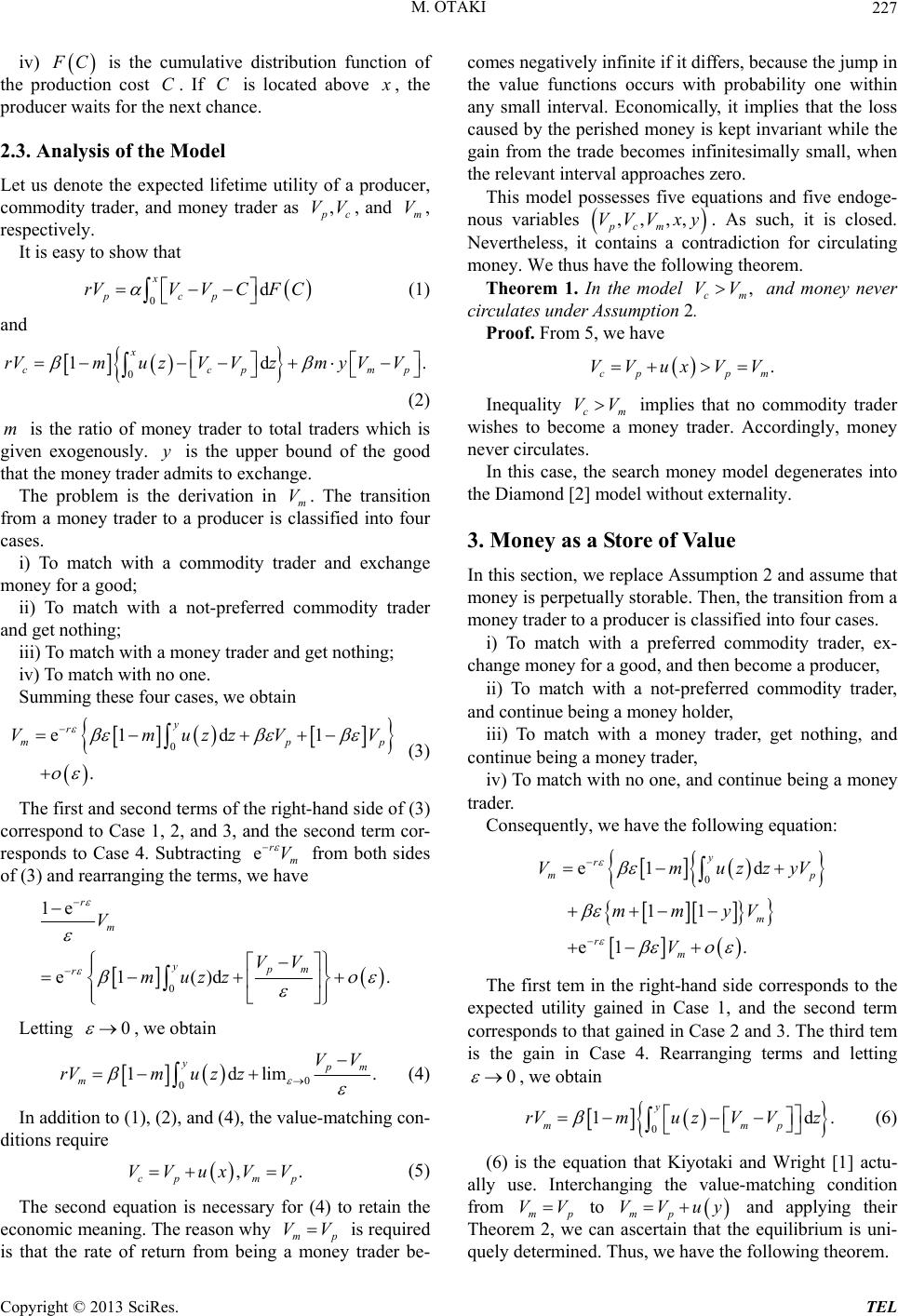 M. OTAKI 227 iv) F C is the cumulative distribution function of the production cost . If is located above C C x , the producer waits for the next chance. 2.3. Analysis of the Model Let us denote the expected lifetime utility of a producer, commodity trader, and money trader as , p c VV , and , respectively. m V It is easy to show that 0d x pcp CrVVVF C (1) and 0 1d mcc x p rVmu zzm yVVV V . p p p V (2) m is the ratio of money trader to total traders which is given exogenously. is the upper bound of the good that the money trader admits to exchange . y The problem is the derivation in m V. The transition from a money trader to a producer is classified into four cases. i) To match with a commodity trader and exchange money for a good; ii) To match with a not-preferred commodity trader and get nothing ; iii) To match with a money trader and get nothing; iv) To match with no one. Summing these four cases, we obtain 0 e1d 1 . y r m VmuzzV (3) The first and second terms of the right-hand side of (3) correspond to Case 1, 2, and 3, and the second term cor- responds to Case 4. Subtracting from both sides of (3) and rearranging the terms, we have erm V 0 1e e1 ()d r m ypm r V VV muzz . Letting 0 , we obtain 0 0 1dlim y. p m m VV rVmu zz (4) In addition to (1), (2), and (4), the value-matching con- ditions require , cp mp VVuxV V . (5) The second equation is necessary for (4) to retain the economic meaning. The reason why mp is required is that the rate of return from being a money trader be- comes negatively infinite if it differs, because the jump in the value functions occurs with probability one within any small interval. Economically, it implies that the loss caused by the perished money is kept invariant while the gain from the trade becomes infinitesimally small, when the relevant interval approaches zero. VV This model possesses five equations and five endoge- nous variables ,,,, pcm VVVxy. As such, it is closed. Nevertheless, it contains a contradiction for circulating money. We thus have the following theorem. Theorem 1. In the model and money never circulat es u nde r Assumpti o n 2. , cm VV Proof. From 5, we have . cp pm VVuxVV Inequality cm implies that no commodity trader wishes to become a money trader. Accordingly, money never circulates. VV In this case, the search money model degenerates into the Diamond [2] model without externality. 3. Money as a Store of Value In this section, we replace Assumption 2 and assume that money is perpetually storable. Then, the transition from a money trader to a producer is classified into four cases. i) To match with a preferred commodity trader, ex- change money for a good, and then become a producer, ii) To match with a not-preferred commodity trader, and continue being a money holder, iii) To match with a money trader, get nothing, and continue being a money trader, iv) To match with no one, and continue being a money trader. Consequently, we have the following equatio n: 0 e1 d 11 e1 . y r mp m rm Vmuzz mmyV V yV The first tem in the right-hand side corresponds to the expected utility gained in Case 1, and the second term corresponds to that gained in Case 2 and 3. The third tem is the gain in Case 4. Rearranging terms and letting 0 , we obtain 0 1d y mm rVmu zVVz . p (6) (6) is the equation that Kiyotaki and Wright [1] actu- ally use. Interchanging the value-matching condition from mp VV to and applying their Theorem 2, we can ascertain that the equilibrium is uni- quely determined. Thus, we ha ve the following theorem. mp VVuy Copyright © 2013 SciRes. TEL 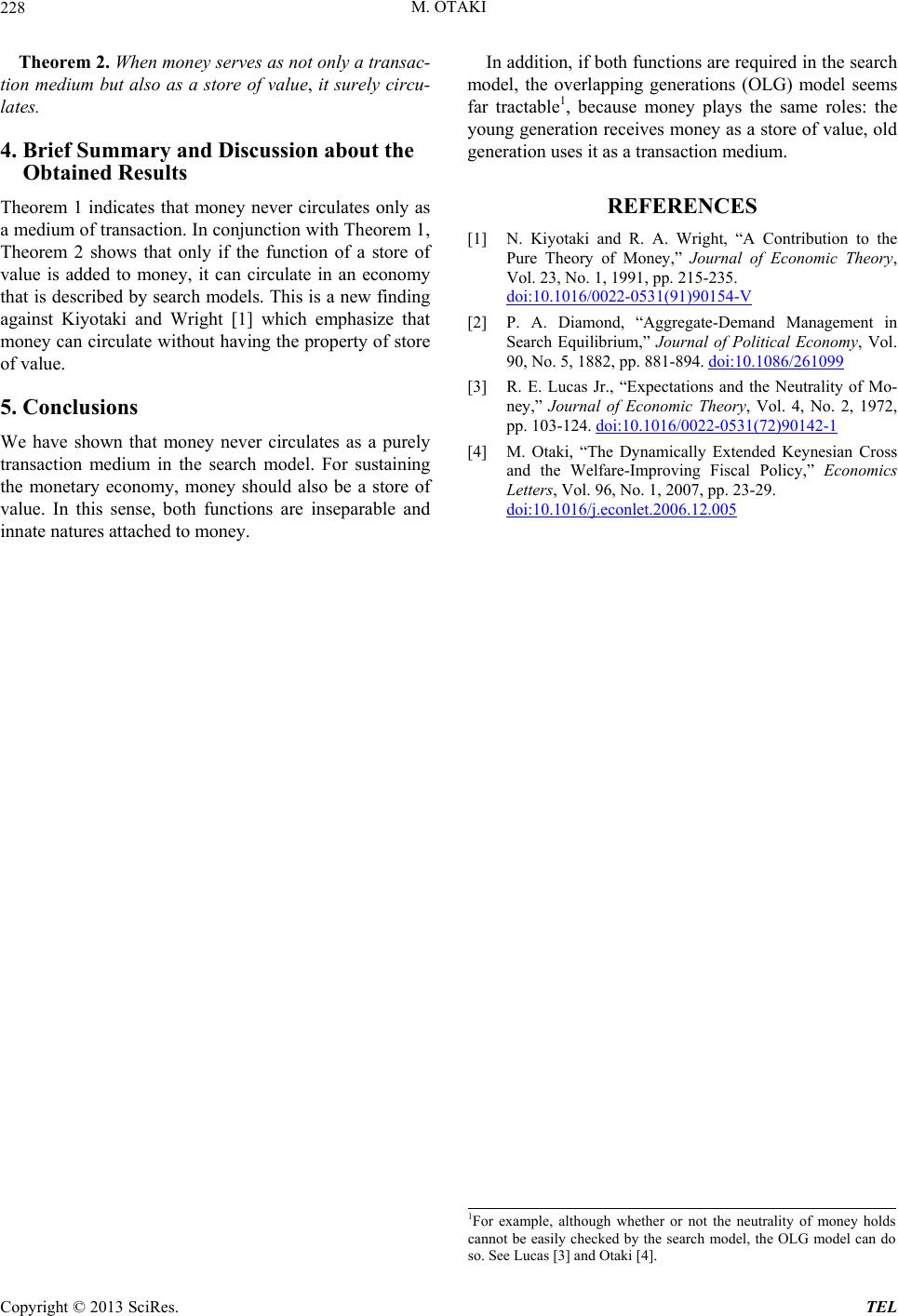 M. OTAKI Copyright © 2013 SciRes. TEL 228 Theorem 2. When money serves as not only a transac- tion medium but also as a store of value, it surely circu- lates. In addition, if both functions are required in the search model, the overlapping generations (OLG) model seems far tractable1, because money plays the same roles: the young generation receives money as a store of value, old generation uses it as a transaction medium. 4. Brief Summary and Discussion a bout the Obtained Results REFERENCES Theorem 1 indicates that money never circulates only as a medium of transaction. In conjunction with Theorem 1, Theorem 2 shows that only if the function of a store of value is added to money, it can circulate in an economy that is described by search models. This is a new finding against Kiyotaki and Wright [1] which emphasize that money can circulate without having the property of store of value. [1] N. Kiyotaki and R. A. Wright, “A Contribution to the Pure Theory of Money,” Journal of Economic Theory, Vol. 23, No. 1, 1991, pp. 215-235. doi:10.1016/0022-0531(91)90154-V [2] P. A. Diamond, “Aggregate-Demand Management in Search Equilibrium,” Journal of Political Economy, Vol. 90, No. 5, 1882, pp. 881-894. doi:10.1086/261099 [3] R. E. Lucas Jr., “Expectations and the Neutrality of Mo- ney,” Journal of Economic Theory, Vol. 4, No. 2, 1972, pp. 103-124. doi:10.1016/0022-0531(72)90142-1 5. Conclusions We have shown that money never circulates as a purely transaction medium in the search model. For sustaining the monetary economy, money should also be a store of value. In this sense, both functions are inseparable and innate natures attached to money. [4] M. Otaki, “The Dynamically Extended Keynesian Cross and the Welfare-Improving Fiscal Policy,” Economics Letters, Vol. 96, No. 1, 2007, pp. 23-29. doi:10.1016/j.econlet.2006.12.005 1For example,although whether or not the neutrality of money holds cannot be easily checked by the search model, the OLG model can do so. See Lucas [3] and Otaki [4]. |