

Paper Menu >>
Journal Menu >>
 Journal of Cancer Therapy, 2013, 4, 18-20 http://dx.doi.org/10.4236/jct.2013.47A004 Published Online August 2013 (http://www.scirp.org/journal/jct) Management of the Case of a Young Female Patient with Multiple Malignancies and Germline R24P CDKN2A Gene Mutation Gabriella Uhercsák1, Ágnes Dobi1, Roland Gyulai2, Judit Oláh2, László Kaizer3, Katalin Ormándi4,5, Adrienne Cserháti1, György Lázár6, Gyula Farkas6, Zsuzsanna Kahán1* 1Department of Oncotherapy, University of Szeged, Szeged, Hungary; 2Department of Dermatology and Immunology, University of Szeged, Szeged, Hungary; 3Department of Pathology, University of Szeged, Szeged, Hungary; 4Department of Radiology, University of Szeged, Szeged, Hungary; 5Euromedic Diagnostics Hungary Ltd., Szeged, Hungary; 6Department of Surgery, University of Szeged, Szeged, Hungary. Email: *[email protected] Received April 30th, 2013; revised June 1st, 2013; accepted June 9th, 2013 Copyright © 2013 Gabriella Uhercsák et al. This is an open access article distributed under the Creative Commons Attribution License, which permits unrestricted use, distribution, and reproduction in any medium, provided the original work is properly cited. ABSTRACT The case of a young female patient with metachronous primary melanomas, advanced breast and pancreatic cancers is reported. The 5 different tumors diagnosed within six years, were managed with curative intent. Genetic analysis re- vealed the mutation of the R24P CDKN2A gene in a heterozygote form in bo th the patient and her father. Careful terti- ary prevention during the follow-up of the patient is needed. Keywords: Breast Cancer; Melanoma; Pancreatic Cancer; R 24P CDKN2A Gene Muta t i on 1. Introduction The prevalence of multiple primary malignancies varies between 0.73% - 11.7% [1,2]. The synchronous occur- rence of primary malignancies is uncommon, but meta- chronous primary tumors are diagnosed more frequently due to the longer survival of the population and the suc- cessful therapy of malignancies [3]. Depending on the time between the diagnosis of the individual malignancy, multiple primary malignancies can be divided into two categories. Synchronous cancers occur within 6 months, whereas metachronous multiple malignancies occur later than 6 months after the diagnosis of the first malignancy [4]. In cases with multiple malignant diseases manifested at a young age, the possibility of genetic predisposing factors responsible for the elevated cancer risk is consid- ered. The history of different cancers among the family members may further support the suspicion of the pres- ence of inherited gene mutation. The detection of five different primary tumors within six years is quite rare. Here we report the case h istory of a young female p atient with successfully treated malignant melanomas, breast and pancreatic cancers. 2. Case Report In December 2006, a 1.5 cm malignant melanoma was removed from the left waist region of a 31-year-o ld Cau- casian female patient. From the left inguinal region one, from the left axillary fossa four sentinel lymph nodes were excised, that proved metastasis-free at histological examination. Because of the stage pT2b, Clark II-III pN0 (sn), a one-year adjuvant low-dose interferon-alpha ther- apy was given. At a routine follow-up examination, in Febru ary 2008, a 2 cm mass in the left axillary region was found, and removed. Histological analysis showed a lymph node infiltrated with anaplastic breast carcinoma, ER, PR and HER2 negative. Imaging examinations were carried out. Breast MRI showed multiple small foci with contrast medium enhancement in the left breast parenchyma, and a 13 mm lymph node in the ipsilateral axillary fossa. Abdominal-pelvic CT showed the widening of the head of the pancreas. On PET/CT, a 1 cm FDG accumulation at the upper quadrants of the left breast and a 7 mm FDG-avid lymph node in the left axillary fossa were ap- parent. At the border of the body and tail of pancreas, another 1.5 cm FDG-avid lesion was visible (Figure 1). First, left mastectomy and axillary lymph node dissec- *Corresponding a uthor. Copyright © 2013 SciRes. JCT 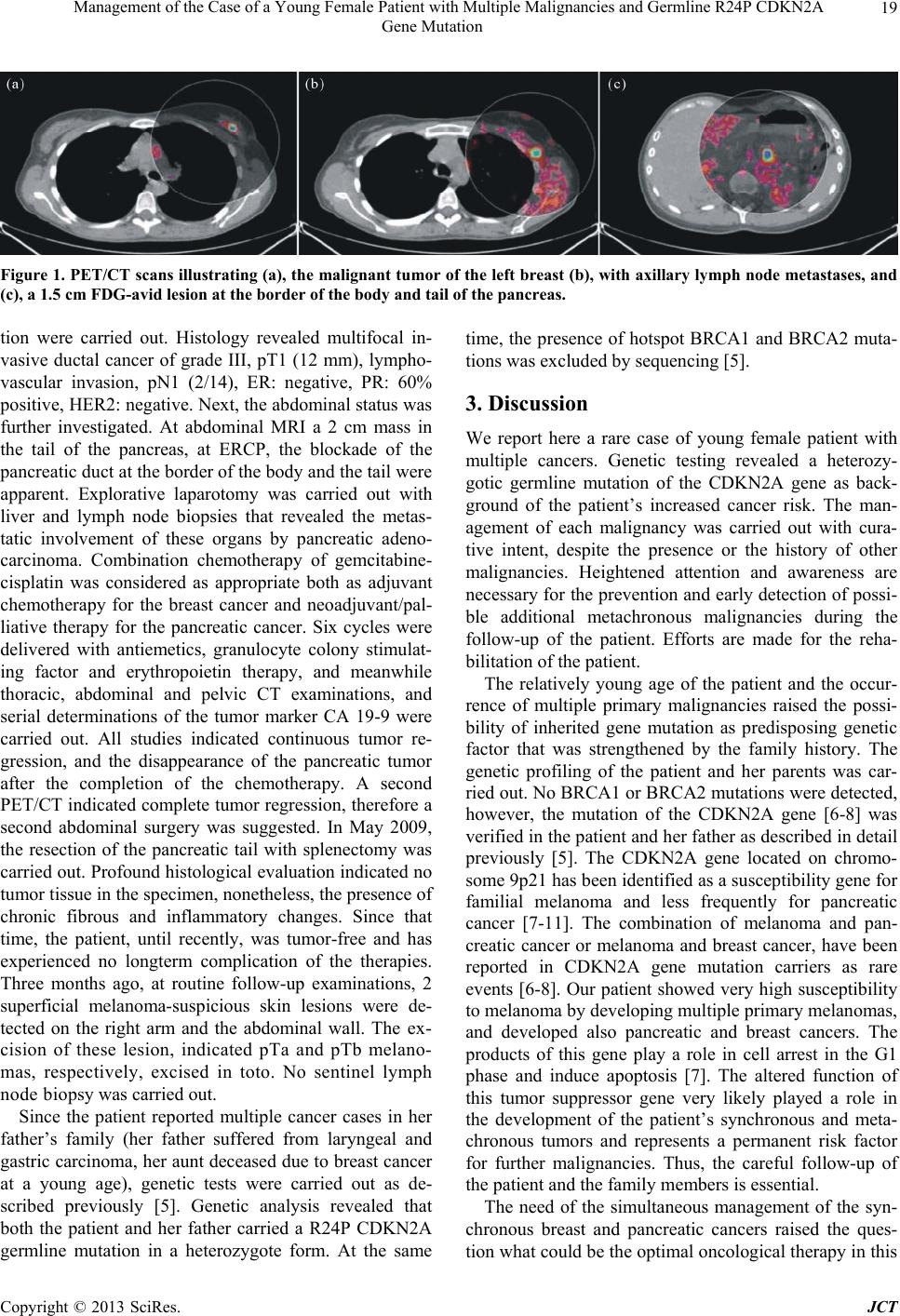 Management of the Case of a Young Female Patient with Multiple Malignancies and Germline R24P CDKN2A Gene Mutation 19 Figure 1. PET/CT scans illustrating (a), the malignant tumor of the left breast (b), with axillary lymph node metastases, and (c), a 1.5 cm FDG-avid lesion at the border of the body and tail of the pancreas. tion were carried out. Histology revealed multifocal in- vasive ductal cancer of grade III, pT1 (12 mm), lympho- vascular invasion, pN1 (2/14), ER: negative, PR: 60% positive, HER2: negativ e. Next, the abdominal statu s was further investigated. At abdominal MRI a 2 cm mass in the tail of the pancreas, at ERCP, the blockade of the pancreatic duct at the border of the body and the tail were apparent. Explorative laparotomy was carried out with liver and lymph node biopsies that revealed the metas- tatic involvement of these organs by pancreatic adeno- carcinoma. Combination chemotherapy of gemcitabine- cisplatin was considered as appropriate both as adjuvant chemotherapy for the breast cancer and neoadjuvant/pal- liative therapy for the pancreatic cancer. Six cycles were delivered with antiemetics, granulocyte colony stimulat- ing factor and erythropoietin therapy, and meanwhile thoracic, abdominal and pelvic CT examinations, and serial determinations of the tumor marker CA 19-9 were carried out. All studies indicated continuous tumor re- gression, and the disappearance of the pancreatic tumor after the completion of the chemotherapy. A second PET/CT indicated complete tumor regression, therefore a second abdominal surgery was suggested. In May 2009, the resection of the pancreatic tail with splenectomy was carried out. Profound histological evaluation indicated no tumor tissue in the specimen, nonetheless, the presence of chronic fibrous and inflammatory changes. Since that time, the patient, until recently, was tumor-free and has experienced no longterm complication of the therapies. Three months ago, at routine follow-up examinations, 2 superficial melanoma-suspicious skin lesions were de- tected on the right arm and the abdominal wall. The ex- cision of these lesion, indicated pTa and pTb melano- mas, respectively, excised in toto. No sentinel lymph node biopsy was carried out. Since the patient reported multiple cancer cases in her father’s family (her father suffered from laryngeal and gastric carcinoma, her aunt deceased due to breast cancer at a young age), genetic tests were carried out as de- scribed previously [5]. Genetic analysis revealed that both the patient and her father carried a R24P CDKN2A germline mutation in a heterozygote form. At the same time, the presence of hotspot BRCA1 and BRCA2 muta- tions was e xc luded b y sequenci ng [5]. 3. Discussion We report here a rare case of young female patient with multiple cancers. Genetic testing revealed a heterozy- gotic germline mutation of the CDKN2A gene as back- ground of the patient’s increased cancer risk. The man- agement of each malignancy was carried out with cura- tive intent, despite the presence or the history of other malignancies. Heightened attention and awareness are necessary for the pr evention and early detectio n of possi- ble additional metachronous malignancies during the follow-up of the patient. Efforts are made for the reha- bilitation of the patient. The relatively young age of the patient and the occur- rence of multiple primary malignancies raised the possi- bility of inherited gene mutation as predisposing genetic factor that was strengthened by the family history. The genetic profiling of the patient and her parents was car- ried out. No BRCA1 or BRCA2 mutation s were detected, however, the mutation of the CDKN2A gene [6-8] was verified in the patient and her father as described in detail previously [5]. The CDKN2A gene located on chromo- some 9p21 has b een id entified as a susceptib ility gen e for familial melanoma and less frequently for pancreatic cancer [7-11]. The combination of melanoma and pan- creatic cancer or melanoma and breast cancer, have been reported in CDKN2A gene mutation carriers as rare events [6-8]. Our patient showed very high susceptibility to melanoma by developing multiple primary melanomas, and developed also pancreatic and breast cancers. The products of this gene play a role in cell arrest in the G1 phase and induce apoptosis [7]. The altered function of this tumor suppressor gene very likely played a role in the development of the patient’s synchronous and meta- chronous tumors and represents a permanent risk factor for further malignancies. Thus, the careful follow-up of the patient and the family members is essential. The need of the simultaneous management of the syn- chronous breast and pancreatic cancers raised the ques- tion what could be the opti mal on cological therapy in this Copyright © 2013 SciRes. JCT  Management of the Case of a Young Female Patient with Multiple Malignancies and Germline R24P CDKN2A Gene Mutation 20 case with locally advanced pancreatic cancer and liver metastases of limited extent, and high risk breast cancer. A polychemotherapy regimen found active both in pan- creatic cancer [12] and breast cancer [13,14] was selected as neoadjuvant chemotherapy for the pancreatic cancer and as adjuvant chemotherapy for the breast tumor. We speculate that the role of the inherited gene mutation can not be excluded in the unexpectedly good response of the advanced pancreatic and breast cancers to chemotherapy. Although the metastatic spread to the pancreas or the breast are rare events [15,16], this possibility must have been taken into consideration during the management of the case. The diagnosis of each primary malignancy was carefully obtained using various imaging and pathologi- cal methods as described in detail previously [5]. Each malignancy was managed according to its actual stage and pathological features. REFERENCES [1] C. G. Demandante, D. A. Troyer and T. P. Miles, “Multi- ple Primary Malignant Neoplasms: Case Report and a Comprehensive Review of the Literature,” American Jour- nal of Clinical Oncology, Vol. 26, No. 1, 2003, pp. 79-83. doi:10.1097/00000421-200302000-00015 [2] A. Irimie, P. Achimas-Cadariu, C. Burz and E. Puscas, “Mul- tiple Primary Malignacies—Epidemiological Analysis at a Single Tertiary Institution,” Journal of Gastrointestinal and Liver Diseases, Vol. 19, No. 1, 2010, pp. 69-73. [3] R. Agrawal, “Synchronous Dual Malignancy: Success- fully Treated Cases,” Journal of Cancer Research and Therapy, Vol. 3, No. 3, 2007, pp. 153-156. doi:10.4103/0973-1482.37408 [4] G. Moertel, “Multiple Primary Malignant Neoplasms: His- torical Perspectives,” Cancer, Vol. 40, 1977, pp. 1786- 1792. doi:10.1002/1097-0142(197710)40:4+<1786::AID-CNCR 2820400803>3.0.CO;2-2 [5] K. Balogh, E. Nemes, G. Uhercsák, Zs. Kahán, Gy. Lázár, Gy. Farkas, H. Polyánka, E. Kiss, R. Gyulai, E. Varga, E. Kereszt-Határvölgyi, L. Kaizer, L. Haracska, L. Tiszla- vicz, L. Kemény, J. Oláh and M. Széll, “Melanoma-Pre- Disposing CDKN2A Mutations in Association with Breast Cancer: A Case-Study and a Meta-Analysis,” In: M. Murph, Ed., Melanoma in the Clinic—Diagnosis, Man- agement and Complications of Malignancy, InTech, Rijeka, 2011, pp. 211-224. [6] C. Monnerat, A. Chompret, C. Kanneng iesser, M. F. Avril, N. Janin, A. Spatz, J. M. Guinebretiere, C. Marian, M. Bar- rois, F. Boitier, G. M. Lenoir and B. Bressac-de Pail- lerets, “BRCA1, BRCA2, TP53, and CDKN2A Germline Mutations in Patients with Breast Cancer and Cutaneous Melanoma,” Familial Cancer, Vol. 6, No. 4, 2007, pp. 453-461. doi:10.1007/s10689-007-9143-y [7] M. Goldstein, “Familial Melanoma, Pancreatic Cancer and Germline CDKN2A Mutations,” Human Mutation, Vol. 23, No. 6, 2004, pp. 630-642. doi:10.1002/humu.9247 [8] M. Goldstein, M. C. Fraser, J. P. Struewing, C. J. Hussus- sian, K. Ranade, D. P. Zametkin, L. S. Fontaine, S. M. Organic, N. C. Dracopoli and W. H. Clark, “Increased Risk of Pancreatic Cancer in Melanoma-Prone Kindreds with p16INK4 Mutations,” The New England Journal of Medicine, Vol. 333, No. 15, 1995, pp. 970-974. doi:10.1056/NEJM199510123331504 [9] P. Ghiorzo, G. Fornarini, S. Sc ialle ro, et al., “CDKN2A Is the Main Susceptibility Gene in Italian Pancreatic Cancer Families,” Journal of Medical Genetics, Vol. 49, No. 3, 2012, pp. 164-170. doi:10.1136/jmedgenet-2011-100281 [10] S. Solomon, S. Das, R. Brand and D. C. Whitcomb, “In- herited Pancreatic Cancer Syndromes,” The Cancer Jour- nal, Vol. 18, No. 6, 2012, pp. 485-491. doi:10.1097/PPO.0b013e318278c4a6 [11] J. E. Axilbund and E. A. Wiley, “Genetic Testing by Can- cer Site: Pancreas,” The Cancer Journal,, Vol. 18, No. 4, 2012, pp. 350-354. doi:10.1097/PPO.0b013e3182624694 [12] V. Heinemann, D. Quietzsch, F. Gieseler, M. Gonner- mann, H. Schönekäs, A. Rost, H. Neuhaus, C. Haag, M. Clemens, B. Heinrich, U. Vehling-Kaiser, M. Fuchs, D. Fleckenstein, W. Gesierich, D. Uthgenannt, H. Einsele, A. Holstege, A. Hinke, A. Schalhorn and R. Wilkowski, “Randomized Phase III Trial of Gemcitabine plus Cis- platin Compared with Gemcitabine Alone in Advanced Pancreatic Cancer,” Journal of Clinical Oncology, Vol. 24, No. 24, 2006, pp. 3946-3952. doi:10.1200/JCO.2005.05.1490 [13] H. J. Stemmler, D. diGioia, W. Freier, H. W. Tessen, G. Gitsch, W. Jonat, W. Brugger, E. Kettner, W. Abenhardt, H. Tesch, H. J. Hurtz, S. Rösel, O. Brudler and V. Heine- mann, “Randomised Phase II Trial of Gemcitabine plus Vinorelbine vs Gemcitabine plus Cisplatin vs Gemcit- abine plus Capecitabine in Patients with Pretreated Me- tastatic Breast Cancer,” British Journal of Cancer, Vol. 104, No. 7, 2011, pp. 1071-1078. doi:10.1038/bjc.2011.86 [14] L. G. Brito, J. M. de Andrade, T. Lins-Almeida, F. E. Zola, M. N. Pinheiro, H. R. Marana, D. G. Tiezzi and F. M. Peria, “Safety and Efficacy of Gemcitabine plus Cis- platin Combination in Pretreated Metastatic Breast Can- cer Patients,” Medical Oncology, Vol. 29, No. 1, 2012, pp. 33-38. doi:10.1007/s12032-010-9793-8 [15] W. M. Rumancik, A. J. Megibow and M. A. Bosniak, “Metastatic Disease to the Pancreas: Evaluation by Com- puted Tomography,” Journal of Computer Assisted To- mography, Vol. 8, No. 5, 1984, pp. 829-834. doi:10.1097/00004728-198410000-00003 [16] S. Charfi, S. K. Makni, A. Khanfir, K. Abbes, N. Gouiaa, I. Fakhfakh, M. Guermazi, J. Daoud, M. Frikha and T. Sellami-Boudawara, “Breast Metastasis: Anatomoclinical Study of Six Cases,” Journal de Gynécologie Obstétrique et Biologie de la Reproduction (Paris), Vol. 37, No. 4, 2008, pp. 346-352. doi:10.1016/j.jgyn.2008.02.002 Copyright © 2013 SciRes. JCT |