

Paper Menu >>
Journal Menu >>
 Theoretical Economics Letters, 2013, 3, 216-219 http://dx.doi.org/10.4236/tel.2013.34036 Published Online August 2013 (http://www.scirp.org/journal/tel) Monetary Growth Theory under Perfect and Monopolistic Competitions Masayuki Otaki1, Masaoki Tamura2 1Institute of Social Science, University of Tokyo, Tokyo, Japan 2Institute of Innovation Research, Hitotsubashi University, Tokyo, Japan Email: [email protected], [email protected] Received May 13, 2013; revised June 13, 2013; accepted July 13, 2013 Copyright © 2013 Masayuki Otaki, Masaoki Tamura. This is an open access article distributed under the Creative Commons Attribu- tion License, which permits unrestricted use, distribution, and reproduction in any medium, provided the original work is properly cited. ABSTRACT This article analyzes the difference of properties of economic growth theory between perfect and monopolistic competi- tion. Whether or not capital investment is constrained by effective demand is the crucial factor which characterizes economic growth theories in different degree of competition. Whenever each firm faces a downward sloping demand curve the location of which is determined by the strength of effective demand (i.e., the real GDP), its capital accumula- tion is inevitably constrained by effective demand. Thus, as far as business environment is kept unchanged, so is capital investment. However, when the good market is perfectly competitive, firms never perceive such demand constraint, thereby capital investment advancing autonomously independent of the phase of business cycle. An important macro- economic implication of such a difference of the attitude toward capital investment is as follows. When an economy is in perfect competition, capital investment becomes an independent driving force of economic growth as Keynes con- siders, although it is subject to other independent expenditure (e.g., the government expenditure) and falls into a sub- sidiary component of effective demand otherwise. Keywords: Sustainability of Fiscal Expenditure; Monetary Economic Growth Theory; Investment Theory under General Equilibrium 1. Introduction It is almost unknown how the market structure of goods markets affects economic growth in a monetary economy. Although Dixit and Pindyck [1] and Smets [2] built models of investment function under uncertainty and pointed out that the function depends on the level of ef- fective demand, it is not their concern with how such investment relating to economic growth as a whole each other. Otaki [3] developed a general equilibrium growth model under monopolistic competition, and also found that there exists no endogenous economic force for sus- tainable growth in a monetary economy. In his seminal work, Uzawa [4] analyzed properties of the investment function under perfect competition in the context of general equilibrium model. Although his the- ory entirely excludes the existence of money, he found that the optimal investment ratio to capital is free from the level of effective demand. The optimal ratio is de- pendent on the profit rate which is endogenously deter- mined only by relative prices. Such a prominent property of the investment function implies that, differing from the monopolistic competition case analyzed by Otaki [3], capital investment enables an economy to sustain its growth. This is because the accumulated past capital in- vestments (i.e., existing capital stock itself) empowers current investment without referring to the condition of effective demand1, and the resources are rewarded by whole earned quasi rents within the firm. The main theoretical issue addressed in this article is to check the validity of Uzawa’s [4] assertion that capital investment calls forth future investment expansion under 1It is quite ambiguous why more capitals enhance more investment in Uzawa [4]. He attributes such a property to the existence of manageria l resources. However, it seems difficult to exhibit the substance o f managerial resources. Otaki [5], instead, introduces the concept o f dexterity of labor forces, which provides physical capital with positive externalities such as process innovations. A firm is regarded as an in- genious device for the internalization of such externalities, and thus, since there is no limit to sale under perfect competition, a firm attains sustainable growth together with the accumulation of dexterity. C opyright © 2013 SciRes. TEL 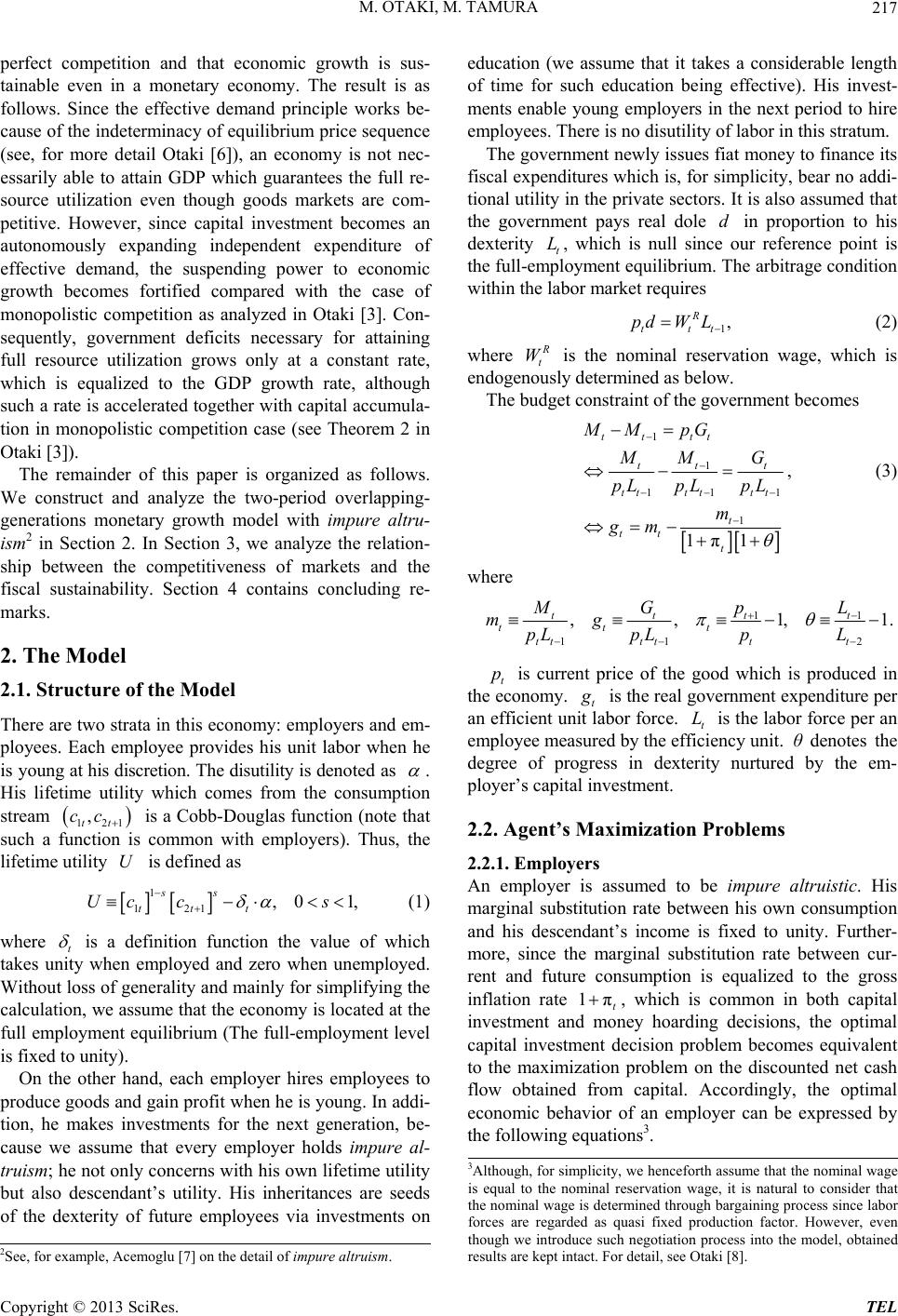 M. OTAKI, M. TAMURA 217 perfect competition and that economic growth is sus- tainable even in a monetary economy. The result is as follows. Since the effective demand principle works be- cause of the indeterminacy of equilibrium price sequence (see, for more detail Otaki [6]), an economy is not nec- essarily able to attain GDP which guarantees the full re- source utilization even though goods markets are com- petitive. However, since capital investment becomes an autonomously expanding independent expenditure of effective demand, the suspending power to economic growth becomes fortified compared with the case of monopolistic competition as analyzed in Otaki [3]. Con- sequently, government deficits necessary for attaining full resource utilization grows only at a constant rate, which is equalized to the GDP growth rate, although such a rate is accelerated together with capital accumula- tion in monopolistic competition case (see Theorem 2 in Otaki [3]). The remainder of this paper is organized as follows. We construct and analyze the two-period overlapping- generations monetary growth model with impure altru- ism2 in Section 2. In Section 3, we analyze the relation- ship between the competitiveness of markets and the fiscal sustainability. Section 4 contains concluding re- marks. 2. The Model 2.1. Structure of the Model There are two strata in this economy: employers and em- ployees. Each employee provides his unit labor when he is young at his discretion. The disutility is denoted as . His lifetime utility which comes from the consumption stream is a Cobb-Douglas function (note that such a function is common with employers). Thus, the lifetime utility is defined as 121 , tt cc U 1 121 ,0 1, ss tt t Uc cs (1) where t is a definition function the value of which takes unity when employed and zero when unemployed. Without loss of generality and mainly for simplifying the calculation, we assume that the economy is located at the full employment equilibrium (The full-employment level is fixed to unity). On the other hand, each employer hires employees to produce goods and gain profit when he is young. In addi- tion, he makes investments for the next generation, be- cause we assume that every employer holds impure al- truism; he not only concerns with his own lifetime utility but also descendant’s utility. His inheritances are seeds of the dexterity of future employees via investments on education (we assume that it takes a considerable length of time for such education being effective). His invest- ments enable young employers in the next period to hire employees. There is no disutility of labor in this stratum. The government newly issues fiat money to finance its fiscal expenditures which is, for simplicity, bear no addi- tional utility in the private sectors. It is also assumed that the government pays real dole in proportion to his dexterity t, which is null since our reference point is the full-employment equilibrium. The arbitrage condition within the labor market requires d L 1, R ttt pdW L (2) where R t W is the nominal reservation wage, which is endogenously determined as below. The budget constraint of the government becomes 1 1 11 1 1π1 tt tt tt t tt tttt t tt t MM pG 1 M MG pL pLpL m gm , (3) where 11 11 ,,1, tttt ttt tt tttt MGp L mg pL pLpL 2 1. t is current price of the good which is produced in the economy. t p g is the real government expenditure per an efficient unit labor force. t is the labor force per an employee measured by the efficiency unit. θ denotes the degree of progress in dexterity nurtured by the em- ployer’s capital investment. L 2.2. Agent’s Maximization Problems 2.2.1. Employers An employer is assumed to be impure altruistic. His marginal substitution rate between his own consumption and his descendant’s income is fixed to unity. Further- more, since the marginal substitution rate between cur- rent and future consumption is equalized to the gross inflation rate 1πt , which is common in both capital investment and money hoarding decisions, the optimal capital investment decision problem becomes equivalent to the maximization problem on the discounted net cash flow obtained from capital. Accordingly, the optimal economic behavior of an employer can be expressed by the following equations3. 3Although, for simplicity, we henceforth assume that the nominal wage is equal to the nominal reservation wage, it is natural to consider that the nominal wage is determined through bargaining process since labor forces are regarded as quasi fixed production factor. However, even though we introduce such negotiation process into the model, obtained results are ke p t intact. For detail, see Otaki [8]. 2See, for example, Acemoglu [7] on the detail of impure altruism. Copyright © 2013 SciRes. TEL 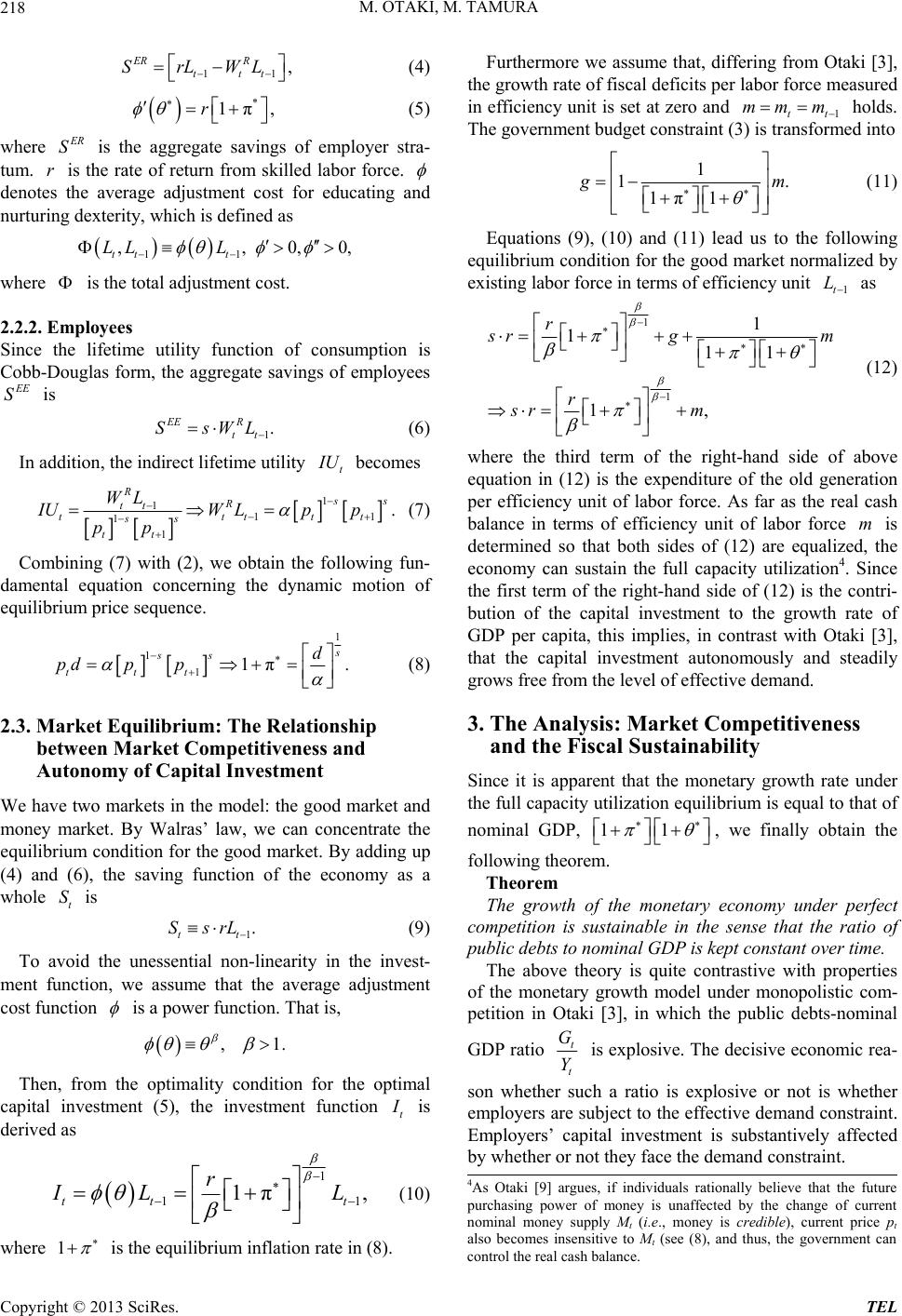 M. OTAKI, M. TAMURA 218 1, ER R ttt SrLWL 1 (4) *,1 πr (5) where E R S r is the aggregate savings of employer stra- tum. is the rate of return from skilled labor force. denotes the average adjustment cost for educating and nurturing dexterity, which is defined as 11 ,,0, tt t LL L 0, where is the total adjustment cost. 2.2.2. Employees Since the lifetime utility function of consumption is Cobb-Douglas form, the aggregate savings of employees E E S is 1. EE R tt SsWL (6) In addition, the indirect lifetime utility t I U becomes 1 1 1 1 1 . R 1 s s R tt tttt ss tt WL IUW Lpp pp t (7) Combining (7) with (2), we obtain the following fun- damental equation concerning the dynamic motion of equilibrium price sequence. 1 1 11π. s ss ttt d pdp p (8) 2.3. Market Equilibrium: The Relationship between Market Competitiveness and Autonomy of Capital Investment We have two markets in the model: the good market and money market. By Walras’ law, we can concentrate the equilibrium condition for the good market. By adding up (4) and (6), the saving function of the economy as a whole is t S 1. tt SsrL (9) To avoid the unessential non-linearity in the invest- ment function, we assume that the average adjustment cost function is a power function. That is, ,1 . Then, from the optimality condition for the optimal capital investment (5), the investment function t I is derived as 1 1 1π, tt r 1t I L L (10) where 1 is the equilibrium inflation rate in (8). Furthermore we assume that, differing from Otaki [3], the growth rate of fiscal deficits per labor force measured in efficiency unit is set at zero and 1tt mm m holds. The government budget constraint (3) is transformed into 1 1. 1π1 g m (11) Equations (9), (10) and (11) lead us to the following equilibrium condition for the good market normalized by existing labor force in terms of efficiency unit 1t L as 1 1 1 111 1, r s rg r sr m m (12) where the third term of the right-hand side of above equation in (12) is the expenditure of the old generation per efficiency unit of labor force. As far as the real cash balance in terms of efficiency unit of labor force is determined so that both sides of (12) are equalized, the economy can sustain the full capacity utilization4. Since the first term of the right-hand side of (12) is the contri- bution of the capital investment to the growth rate of GDP per capita, this implies, in contrast with Otaki [3], that the capital investment autonomously and steadily grows free from the level of effective demand. m 3. The Analysis: Market Competitiveness and the Fiscal Sustainability Since it is apparent that the monetary growth rate under the full capacity utilization equilibrium is equal to that of nominal GDP, 11 , we finally obtain the following theorem. Theorem The growth of the monetary economy under perfect competition is sustainable in the sense that the ratio of public debts to nominal GDP is kept constant over time. The above theory is quite contrastive with properties of the monetary growth model under monopolistic com- petition in Otaki [3], in which the public debts-nominal GDP ratio t t G Y is explosive. The decisive economic rea- son whether such a ratio is explosive or not is whether employers are subject to the effective demand constraint. Employers’ capital investment is substantively affected by whether or not they face the demand constraint. 4As Otaki [9] argues, if individuals rationally believe that the future p urchasing power of money is unaffected by the change of current nominal money supply Mt (i.e., money is credible), current price pt also becomes insensitive to Mt (see (8), and thus, the government can control the real cash balance. Copyright © 2013 SciRes. TEL 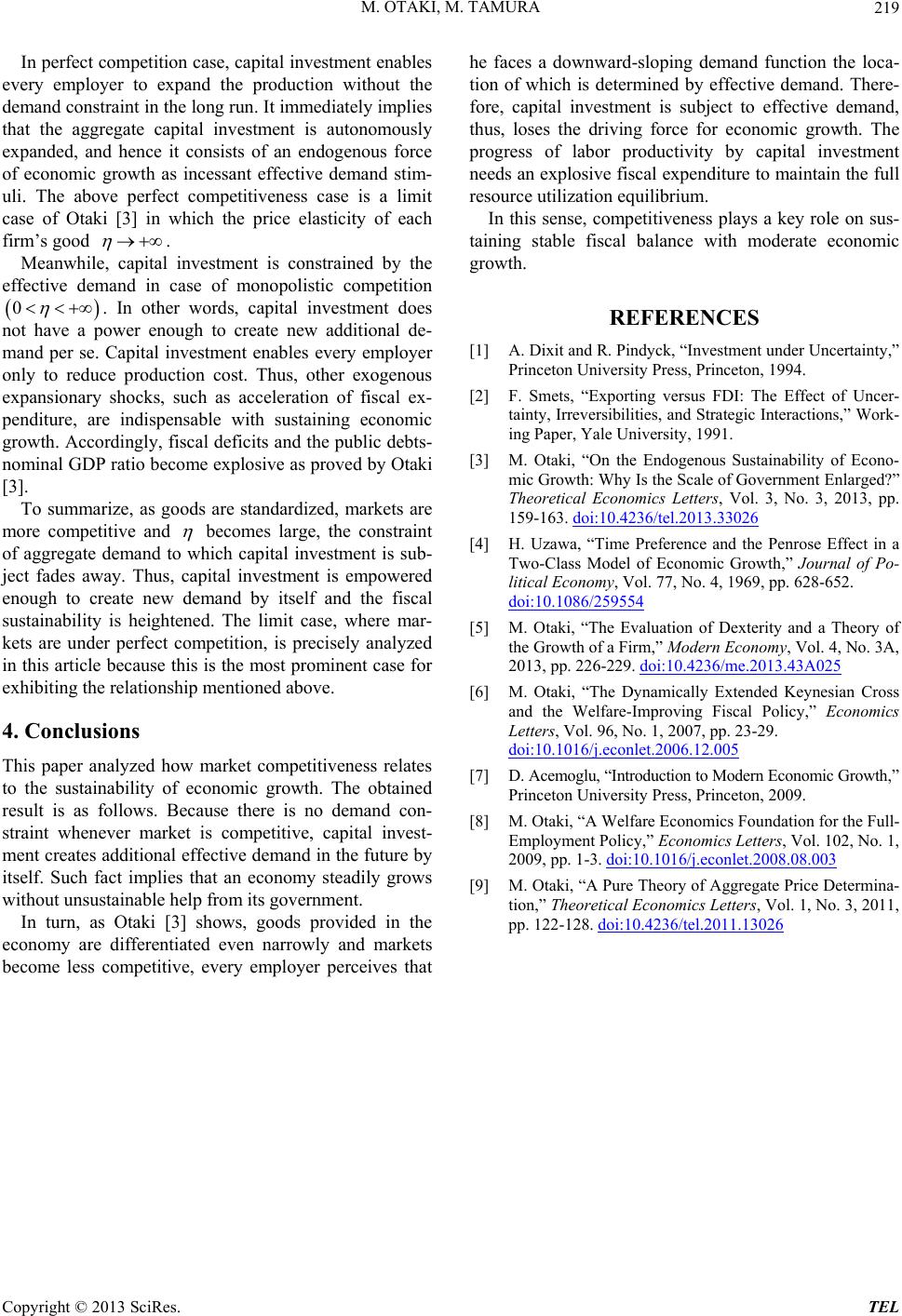 M. OTAKI, M. TAMURA Copyright © 2013 SciRes. TEL 219 In perfect competition case, capital investment enables every employer to expand the production without the demand constraint in the long run. It immediately implies that the aggregate capital investment is autonomously expanded, and hence it consists of an endogenous force of economic growth as incessant effective demand stim- uli. The above perfect competitiveness case is a limit case of Otaki [3] in which the price elasticity of each firm’s good . Meanwhile, capital investment is constrained by the effective demand in case of monopolistic competition . In other words, capital investment does not have a power enough to create new additional de- mand per se. Capital investment enables every employer only to reduce production cost. Thus, other exogenous expansionary shocks, such as acceleration of fiscal ex- penditure, are indispensable with sustaining economic growth. Accordingly, fiscal deficits and the public debts- nominal GDP ratio become explosive as proved by Otaki [3]. 0 To summarize, as goods are standardized, markets are more competitive and becomes large, the constraint of aggregate demand to which capital investment is sub- ject fades away. Thus, capital investment is empowered enough to create new demand by itself and the fiscal sustainability is heightened. The limit case, where mar- kets are under perfect competition, is precisely analyzed in this article because this is the most prominent case for exhibiting the relationship mentioned above. 4. Conclusions This paper analyzed how market competitiveness relates to the sustainability of economic growth. The obtained result is as follows. Because there is no demand con- straint whenever market is competitive, capital invest- ment creates additional effective demand in the future by itself. Such fact implies that an economy steadily grows without unsustainable help from its government. In turn, as Otaki [3] shows, goods provided in the economy are differentiated even narrowly and markets become less competitive, every employer perceives that he faces a downward-sloping demand function the loca- tion of which is determined by effective demand. There- fore, capital investment is subject to effective demand, thus, loses the driving force for economic growth. The progress of labor productivity by capital investment needs an explosive fiscal expenditure to maintain the full resource utilization equilibrium. In this sense, competitiveness plays a key role on sus- taining stable fiscal balance with moderate economic growth. REFERENCES [1] A. Dixit and R. Pindyck, “Investment under Uncertainty,” Princeton University Press, Princeton, 1994. [2] F. Smets, “Exporting versus FDI: The Effect of Uncer- tainty, Irreversibilities, and Strategic Interactions,” Work- ing Paper, Yale University, 1991. [3] M. Otaki, “On the Endogenous Sustainability of Econo- mic Growth: Why Is the Scale of Government Enlarged?” Theoretical Economics Letters, Vol. 3, No. 3, 2013, pp. 159-163. doi:10.4236/tel.2013.33026 [4] H. Uzawa, “Time Preference and the Penrose Effect in a Two-Class Model of Economic Growth,” Journal of Po- litical Economy, Vol. 77, No. 4, 1969, pp. 628-652. doi:10.1086/259554 [5] M. Otaki, “The Evaluation of Dexterity and a Theory of the Growth of a Firm,” Modern Economy, Vol. 4, No. 3A, 2013, pp. 226-229. doi:10.4236/me.2013.43A025 [6] M. Otaki, “The Dynamically Extended Keynesian Cross and the Welfare-Improving Fiscal Policy,” Economics Letters, Vol. 96, No. 1, 2007, pp. 23-29. doi:10.1016/j.econlet.2006.12.005 [7] D. Acemoglu, “Introduction to Modern Economic Growth,” Princeton University Press, Princeton, 2009. [8] M. Otaki, “A Welfare Economics Foundation for the Full- Employment Policy,” Economics Letters, Vol. 102, No. 1, 2009, pp. 1-3. doi:10.1016/j.econlet.2008.08.003 [9] M. Otaki, “A Pure Theory of Aggregate Price Determina- tion,” Theoretical Economics Letters, Vol. 1, No. 3, 2011, pp. 122-128. doi:10.4236/tel.2011.13026 |