

Paper Menu >>
Journal Menu >>
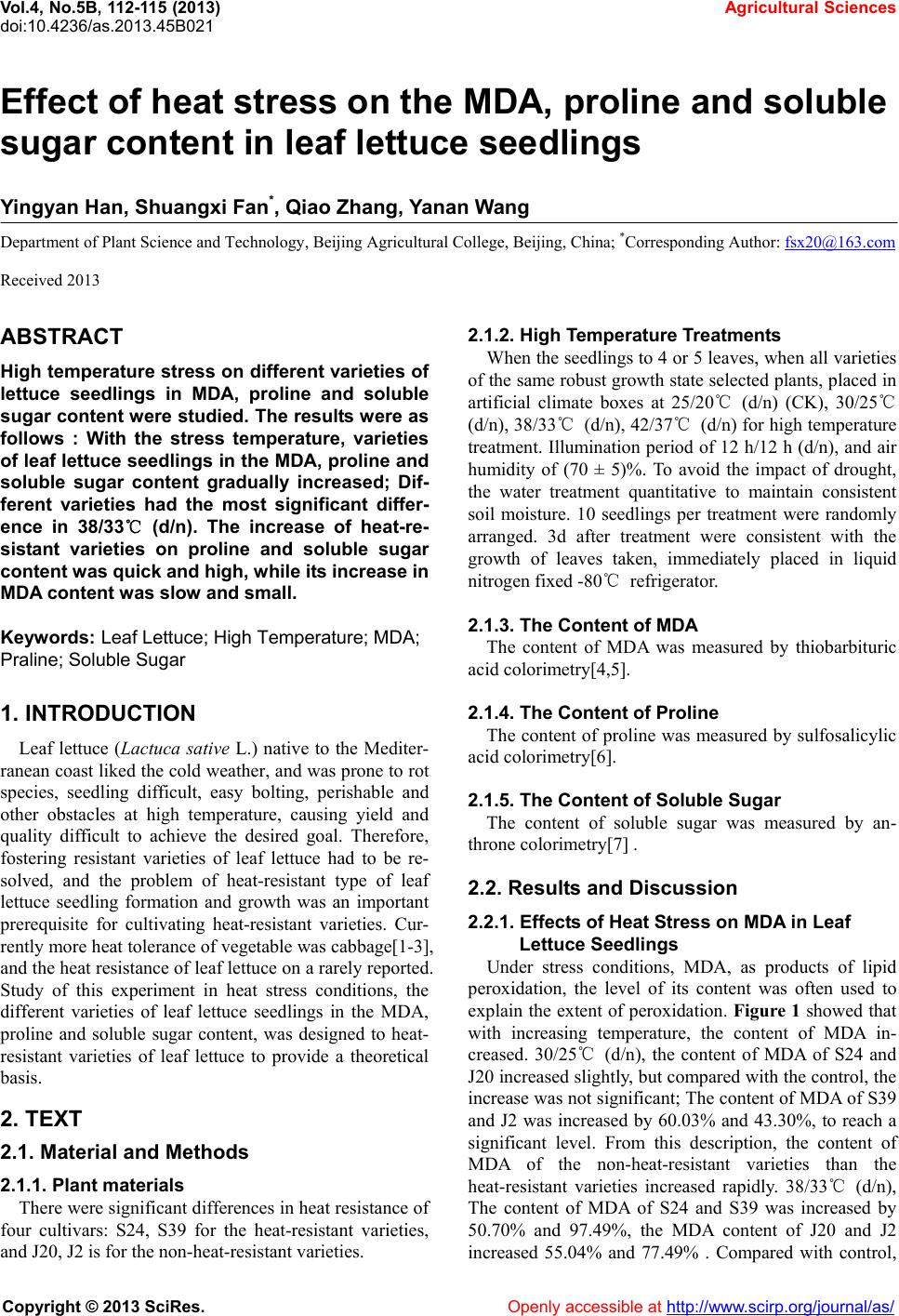 Vol.4, No.5B, 112-115 (2013) Agricultural Sciences doi:10.4236/as.2013.45B021 Effect of heat stress on the MDA, proline and soluble sugar content in leaf lettuce seedlings Yingyan Han, Shuangxi Fan*, Qiao Zhang, Yanan Wang Department of Plant Science and Technology, Beijing Agricultural College, Beijing, China; *Corresponding Author: [email protected] Received 2013 ABSTRACT High temperature stress on different varieties of lettuce seedlings in MDA, proline and soluble sugar content were studied. The results w ere as follows : With the stress temperature, varieties of leaf lettuce seedlings in the MDA, proline and soluble sugar content gradually increased; Dif- ferent varieties had the most significant differ- ence in 38/33℃ (d/n). The increase of heat-re- sistant varieties on proline and soluble sugar content was quick and high, while it s increas e in MDA content was slow and small. Keywords: Leaf Lettuce; High Temperature; MDA; Praline; Soluble Sugar 1. INTRODUCTION Leaf lettuce (Lactuca sative L.) native to the Mediter- ranean coast liked the cold weather, and was prone to rot species, seedling difficult, easy bolting, perishable and other obstacles at high temperature, causing yield and quality difficult to achieve the desired goal. Therefore, fostering resistant varieties of leaf lettuce had to be re- solved, and the problem of heat-resistant type of leaf lettuce seedling formation and growth was an important prerequisite for cultivating heat-resistant varieties. Cur- rently more heat tolerance of vegetable was cabbage[1-3], and the heat resistance of leaf lettuce on a rarely reported. Study of this experiment in heat stress conditions, the different varieties of leaf lettuce seedlings in the MDA, proline and soluble sugar content, was designed to heat- resistant varieties of leaf lettuce to provide a theoretical basis. 2. TEXT 2.1. Material and Methods 2.1.1. Plant materials There were significant differences in heat resistance of four cultivars: S24, S39 for the heat-resistant varieties, and J20, J2 is for the non-heat-resistant varieties. 2.1.2. High Temperature Treatments When the seedlings to 4 or 5 leaves, when all varieties of the same robust growth state selected plants, placed in artificial climate boxes at 25/20℃ (d/n) (CK), 30/25℃ (d/n), 38/33℃ (d/n), 42/37℃ (d/n) for high temperature treatment. Illumin ation period of 12 h/12 h (d/n), and air humidity of (70 ± 5)%. To avoid the impact of drought, the water treatment quantitative to maintain consistent soil moisture. 10 seedlings per treatment were randomly arranged. 3d after treatment were consistent with the growth of leaves taken, immediately placed in liquid nitrogen fixed -80℃ refrigerator. 2.1.3. The Content of MDA The content of MDA was measured by thiobarbituric acid colorimetry[4,5]. 2.1.4. The Content of Proline The content of proline was measured by sulfosalicylic acid colorimetry[6]. 2.1.5. The Content of Soluble Sugar The content of soluble sugar was measured by an- throne colorimetry[7] . 2.2. Results and Discussion 2.2.1. Effects of Heat Stress on MDA in Leaf Lettuce Seedlings Under stress conditions, MDA, as products of lipid peroxidation, the level of its content was often used to explain the extent of peroxidation. Figure 1 showed that with increasing temperature, the content of MDA in- creased. 30/25℃ (d/n), the content of MDA of S24 and J20 increased slightly, but compared with the control, the increase was not significant; The content of MDA of S39 and J2 was increased by 60.03% and 43.30%, to reach a significant level. From this description, the content of MDA of the non-heat-resistant varieties than the heat-resistant varieties increased rapidly. 38/33℃ (d/n), The content of MDA of S24 and S39 was increased by 50.70% and 97.49%, the MDA content of J20 and J2 increased 55.04% and 77.49% . Compared with control, Copyright © 2013 SciRes. Openly accessible at http://www.scirp.org/journal/as/ 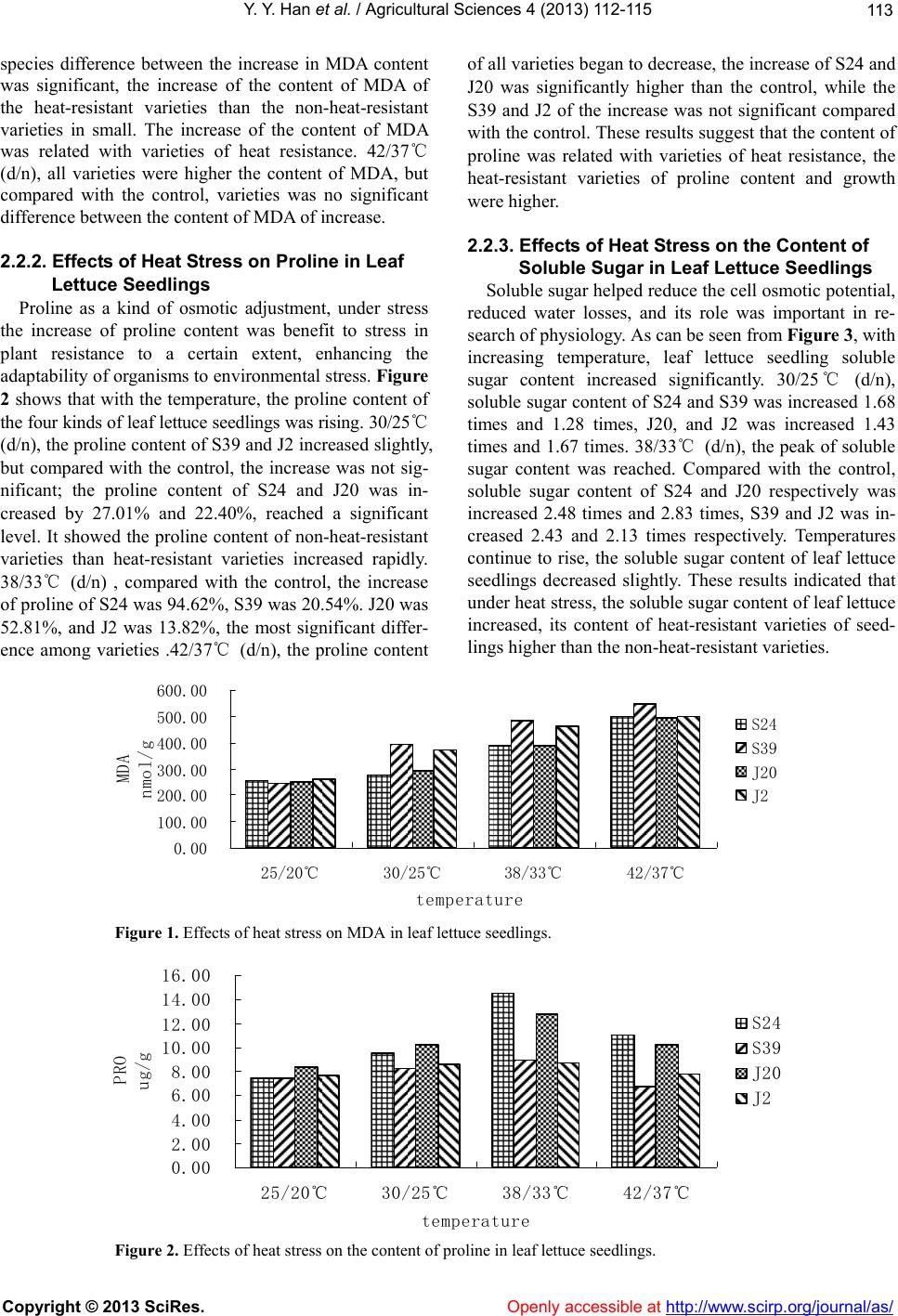 Y. Y. Han et al. / Agricultural Sciences 4 (2013) 112-115 113 species difference between the increase in MDA content was significant, the increase of the content of MDA of the heat-resistant varieties than the non-heat-resistant varieties in small. The increase of the content of MDA was related with varieties of heat resistance. 42/37℃ (d/n), all varieties were higher the content of MDA, but compared with the control, varieties was no significant difference between the content of MDA of increase. 2.2.2. Effects of Heat Stress on Proline in Leaf Lettuce Seedlings Proline as a kind of osmotic adjustment, under stress the increase of proline content was benefit to stress in plant resistance to a certain extent, enhancing the adaptability of organisms to environmental stress. Figure 2 shows that with the temperature, the proline content of the four kinds of leaf lettuce seedlings was rising. 30/25℃ (d/n), the proline con tent of S39 and J2 increased slightly, but compared with the control, the increase was not sig- nificant; the proline content of S24 and J20 was in- creased by 27.01% and 22.40%, reached a significant level. It showed the proline content of non-heat-resistant varieties than heat-resistant varieties increased rapidly. 38/33℃ (d/n) , compared with the control, the increase of proline of S24 w as 94.62%, S39 was 20.54%. J2 0 was 52.81%, and J2 was 13.82%, the most significant differ- ence among varieties .42/37℃ (d/n), the proline content of all varieties began to decrease, the increase of S24 and J20 was significantly higher than the control, while the S39 and J2 of the increase was not significant compared with the control. These resu lts suggest that the content of proline was related with varieties of heat resistance, the heat-resistant varieties of proline content and growth were higher. 2.2.3. Effects of Heat Stress on the Content of Soluble Sugar in Leaf Lettuce Seedlings Soluble sugar h elped reduce th e cell osmotic potential, reduced water losses, and its role was important in re- search of physiology. As can be seen from Figure 3, with increasing temperature, leaf lettuce seedling soluble sugar content increased significantly. 30/25℃ (d/n), soluble sugar content of S24 and S39 was increased 1.68 times and 1.28 times, J20, and J2 was increased 1.43 times and 1.67 times. 38/33℃ (d/n), the peak of soluble sugar content was reached. Compared with the control, soluble sugar content of S24 and J20 respectively was increased 2.48 times and 2.83 times, S39 and J2 was in- creased 2.43 and 2.13 times respectively. Temperatures continue to rise, the soluble sugar content of leaf lettuce seedlings decreased slightly. These results indicated that under heat stress, the soluble sugar content of leaf lettuce increased, its content of heat-resistant varieties of seed- lings higher than th e non-heat-resistant varieties. 0.00 100.00 200.00 300.00 400.00 500.00 600.00 25/20℃ 30/25℃38/33℃ 42/37℃ temperature MDA nmol/g S24 S39 J20 J2 Figure 1. Effects of heat stress on MDA in leaf lettuce seedlings. 0.00 2.00 4.00 6.00 8.00 10.00 12.00 14.00 16.00 25/20℃ 30/25℃ 38/33℃ 42/37℃ temperature PRO ug/g S24 S39 J20 J2 Figure 2. Effects of heat stress on the content of proline in leaf lettuce seedlings. Copyright © 2013 SciRes. Openly accessible at http://www.scirp.org/journal/as/ 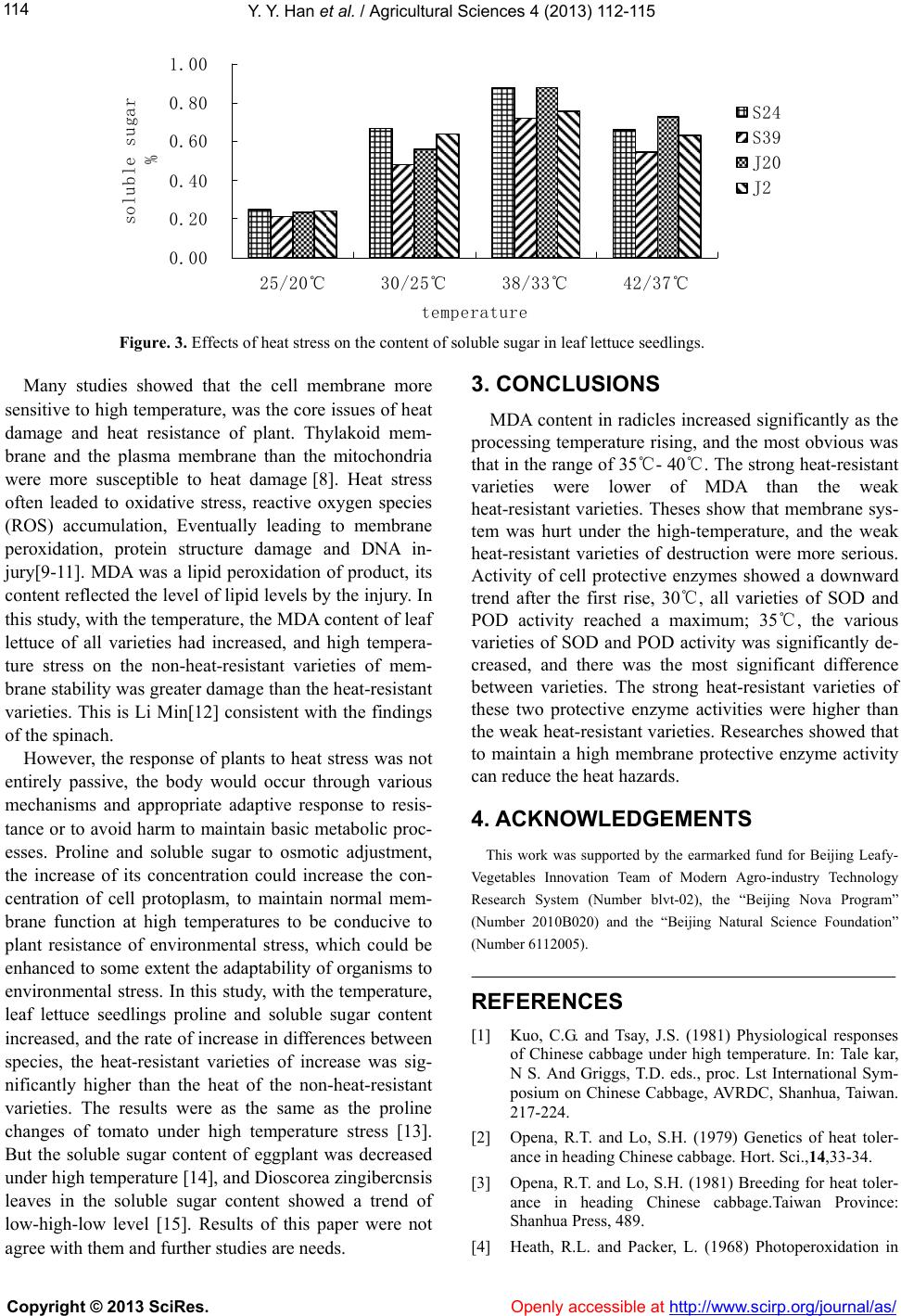 Y. Y. Han et al. / Agricultural Sciences 4 (2013) 112-115 114 0.00 0.20 0.40 0.60 0.80 1.00 25/20℃ 30/25℃ 38/33℃ 42/37℃ temperature soluble sugar % S24 S39 J20 J2 Figure. 3. Effects of heat stress on the content of soluble sugar in leaf lettuce seedlings. Many studies showed that the cell membrane more sensitive to high temperature, was the core issues of h eat damage and heat resistance of plant. Thylakoid mem- brane and the plasma membrane than the mitochondria were more susceptible to heat damage [8]. Heat stress often leaded to oxidative stress, reactive oxygen species (ROS) accumulation, Eventually leading to membrane peroxidation, protein structure damage and DNA in- jury[9-11]. MDA was a lipid peroxidation of product, its content reflected the lev el of lipid levels by the injury. In this study, with the temperature, the MDA content of leaf lettuce of all varieties had increased, and high tempera- ture stress on the non-heat-resistant varieties of mem- brane stability was greater damage than the heat-resistant varieties. This is Li Min[12] consistent with the findings of the spinach. However, the response of plants to heat stress was not entirely passive, the body would occur through various mechanisms and appropriate adaptive response to resis- tance or to avoid harm to maintain basic metabolic pro c- esses. Proline and soluble sugar to osmotic adjustment, the increase of its concentration could increase the con- centration of cell protoplasm, to maintain normal mem- brane function at high temperatures to be conducive to plant resistance of environmental stress, which could be enhanced to some exten t the adaptability of organisms to environmental stress. In this study, with the temperature, leaf lettuce seedlings proline and soluble sugar content increased, and the rate of increase in differences between species, the heat-resistant varieties of increase was sig- nificantly higher than the heat of the non-heat-resistant varieties. The results were as the same as the proline changes of tomato under high temperature stress [13]. But the soluble sugar content of eggplant was decreased under high temperature [14], and Dioscorea zingibercnsis leaves in the soluble sugar content showed a trend of low-high-low level [15]. Results of this paper were not agree with them and further studies are needs. 3. CONCLUSIONS MDA con tent in radicles increased significantly as the processing temperature rising, and the most obvious was that in the range of 35 ℃- 40℃. The strong heat-resistant varieties were lower of MDA than the weak heat-resistant varieties. Theses show that membrane sys- tem was hurt under the high-temperature, and the weak heat-resistant varieties of destruction were more serious. Activity of cell protective enzymes showed a downward trend after the first rise, 30℃, all varieties of SOD and POD activity reached a maximum; 35℃, the various varieties of SOD and POD activity was significantly de- creased, and there was the most significant difference between varieties. The strong heat-resistant varieties of these two protective enzyme activities were higher than the weak heat-resistant varieties. Researches showed that to maintain a high membrane protective enzyme activity can reduce the heat hazards. 4. ACKNOWLEDGEMENTS This work was supported by the earmarked fund for Beijing Leafy- Vegetables Innovation Team of Modern Agro-industry Technology Research System (Number blvt-02), the “Beijing Nova Program” (Number 2010B020) and the “Beijing Natural Science Foundation” (Number 6112005). REFERENCES [1] Kuo, C.G. and Tsay, J.S. (1981) Physiological responses of Chinese cabbage under high temperature. In: Tale kar, N S. And Griggs, T.D. eds., proc. Lst International Sym- posium on Chinese Cabbage, AVRDC, Shanhua, Taiwan. 217-224. [2] Opena, R.T. and Lo, S.H. (1979) Genetics of heat toler- ance in heading Chinese cabbage. Hort. Sci.,14,33-34. [3] Opena, R.T. and Lo, S.H. (1981) Breeding for heat toler- ance in heading Chinese cabbage.Taiwan Province: Shanhua Press, 489. [4] Heath, R.L. and Packer, L. (1968) Photoperoxidation in Copyright © 2013 SciRes. Openly accessible at http://www.scirp.org/journal/as/  Y. Y. Han et al. / Agricultural Sciences 4 (2013) 112-115 115 isolated chloroplasts L Kinetics and stoichiometry of fatty acid peroxidation. Archives of Biochemtry Biophysics, 125, 189-198. doi:10.1016/0003-9861(68)90654-1 [5] Shah, K., Kumar, R.G.. , Verma, S. et a1. (2001) Effect of cadmium on lipid peroxidation, superoxide anion genera- tion an d activities of antioxidant enzymes in growing rice seedlings. Plant Science, 161, 1135-1144. doi:10.1016/S0168-9452(01)00517-9 [6] Zhang, D.Z., Wang, P.H. and Zhao, H.X. (1990) Deter- mination of the content of free proline in wheat leaves. Plant Physiol Commun, 16, 62-65. [7] Li, H.S. (2000) Plant physiology and biochemistry of principles and techniques. Higher Education Press, Bei- jing, 195. [8] Santarius, K.A. (1980) Membrane lipids in heat injury of spinach chloroplasts. Physiologia Plantarum, 49, 1-6. doi:10.1111/j.1399-3054.1980.tb08638.x [9] Burke, J.J. (2001) Identification of genetic diversity and mutations in higher plant acquired thermotolerance. Physiologia Plantarum, 112, 167-170. doi:10.1034/j.1399-3054.2001.1120203.x [10] Inze, D. and Montagu, M.V. (1995) Oxidative stress in plant. Current Opinion in Biotechnology, 6, 153-158. doi:10.1016/0958-1669(95)80024-7 [11] Vranova, E., Inze, D. and Breusegem, F.Van. (2002) Sig- nals transduction during oxidative stress. Experimental Botany, 53, 1227-1236. doi:10.1093/jexbot/53.372.1227` [12] Li, M., Wang, W.H., Wang, R. and Liu, R.J. (2004) In- fluences of high temperature stress on activity of cell de- fense enzymes and membrane permeability in leaves of spinach. Acta Hort. Sin, 31, 99-100. [13] Yin, X.G., Luo, Q.X. and WANG, W.Q. (2001) Studies oil methodlogy for identification of heat tolerance of tomato. Southwest China Journal of Agricultural Science, 14, 62-65. [14] Jia, K.Z. and Chen, G.L. (2005) Torrance of different eggplant varieties at seedling stage to high temperature stress. Chinese Journal of Applied Ecolgy, 24, 398-401. [15] Tu, S.S. and Qin, T.C. ( 2004) Effect of heat stress on the contents of free proline, soluble sugar and malondiade- hyde in Dioscorea zingibercnsis leaves. HuBei Agricul- tural Sciences, 4, 98-100. Copyright © 2013 SciRes. Openly accessible at http://www.scirp.org/journal/as/ |