

Paper Menu >>
Journal Menu >>
 Vol.4, No.5B, 78-83 (2013) Agricultural Sciences doi:10.4236/as.2013.45B015 Survival of encapsulated probiotics through spray drying and non-refrigerated storage for animal feeds application Norfahana Abd-Talib1,2, Siti Hamidah Mohd-Setapar2*, Aidee Kamal Khamis1, Lee Nian-Yian2, Ramlan Aziz1 1Institute Bio Product Development, Universiti Teknologi Malaysia, UTM Johor Bahru, Johor, Malaysia 2Centre of Lipid Engineering and Applied Research (CLEAR), Universiti Teknologi Malaysia, UTM Johor Bahru, Johor, Malaysia; *Corresponding Author: [email protected] Received 2013 ABSTRACT The objective of this study is to verify potential of various types of microorganisms during spray drying and non-refrigerated storage that can be enhanced substantially by selecting suitable pro- tective colloids. Four selected probiotics tested are Lactbacillus plantarum B13 and B18, which are the bacteria probiotics and Kluyveromyces lactis and Saccharomyces blouradii, non-bac- teria probiotics. Two levels of experiment occur starting with formulation study of encapsulation agent followed by the viability study of different probiotics after spray dry and two weeks nonre- frigerated storage. The formulation of 30% of gum Arabic, 15% of gelatin and 45% of coconut oil can homogenize well at least for two hours and can produce acceptable dried product (be- low 4% of moisture content) at low outlet tem- perature (70℃ - 75℃). K. lactis, S. blouradii gives 2.57% and 2.4% of viability percentage after spray drying process and 25.84% and 2.04% after two weeks nonrefrigerated storage respectively. The colonies of non-probiotics bacteria after both conditions are between 1010 and 106 cfu/mL which is among the accepted level for industrial application. However, the survival of probiotics in a spray-dried form dur- ing non-refrigerated storage is higher at low of moisture content compared to others. Keywords: Probiotics; Survival Rate; Spray Drying; Nonrefrigerated Storage 1. INTRODUCTION Probiotics have been recently defined as “live microbes which transit to the gastro-intestinal tract and having posi- tive effect s to th e health for the consu mers [1]. I t have b een applied in aquaculture for controlling diseases, enhancing the immune response, supplementing or even in some cases replacing the use of anti microbial. The use of probiotics as farm animal feed supplements dates back to the 1970' and originally incorporated into feed to increase the animal's growth and to improve its health by increasing its resistance to disease. It was assumed that the effectiveness of probiotics were related to the gastroin-testinal tract and effects on incidence of diarrhea and other gut infection s. According to literatu res show in Table 1, there are some probiotic strains which can give positive effect to various typ es of animals. Some of other probiotics which used in animal feed are microscopic fungi such as strain of yeasts. There are billion strains of yeasts that are supposed to be explored in animal feed study. The strains like Saccharomyces boulardii and Kluveromyces lactis are having high po- tential as a probiotic that can improve animal health. Yeast seemed to facilitate increased mobilization of body reserves and to increase milk fatty acid production of ruminants. Therefore, it was possible to apply yeast’s strain as probiotics strain in powder form of animal feed in line with the effectiveness in animal health. For exam- ple camel calves can improve weight gain, average daily gain and feed utilizations after apply yeast as supple- mentation diet in different forms [9]. It is known that probiotics were very useful for animal but the preparation of animal feed that containing probi- otic especially in powder form are not easy. To ensure the amount of probiotics cu lture required can achiev e the target; some of the factors are to be tested first in order to increase stability or viability of the probiotic products. Encapsulation agent is the formulation of single or com- bination of wall material that can resist the condition along the journey. Encapsulation is a process in which tiny droplets or particles are wrapped with a protective Copyright © 2013 SciRes. Openly accessible at http://www.scirp.org/journal/as/  N. Abd-Ta lib et al. / Agricultural Sciences 4 (2013) 78-83 79 coating yielding capsules for countless application. Sev- eral methods of encapsulation of probiotic have been reported by [10]. The objective of the research is to dem- onstrate the various types of probiotics microorganisms during spray drying and storage at room temperature by selecting suitable protective colloids as an encapsulation agent. 2. MATERIALS AND METHODOLOGY 2.1. Stability of the Feed Composition The stage one of this experiments was conducted by the conventional try and error method. The several feed formulations were choose which with high advantages in spray dryer process and animal feed industry. At the first stage, the homogenize mixture without probiotic cell was hold for 2 hours to test stability of the mixture by using homogenizer (Heidolth, DIAX 900, Germany). This is holding time of the feed formulation in the feed bottle during spray dry (Pilot Spray Drying Plant PSD-00, Hemray Enterprise, Bombay). The homogenized mix- tures were proceed for drying process in the spray dryer at inlet temperature 110℃ and outlet temperature of air 70℃- 75℃ and should give the moisture content below 4%. Details of the various wall materials used are shown in Table 2. Table 1. Some probitiocs strain with the benefits to animals. Animal Probiotics Functions References Fresh water fish Lactobacilli spp. Lactobacillus sakei) Enhance the host protection against pathogens. [2] Broiler chicken Lactobacillus reuteri (33%) Lactobacillus crispatus (18.7%) Lactobacillus salivarius (12.3%) To maintain balanced microbiota and to reduce potential pathogens [3] Pig Enterococcus f aecium Great production of specific antibodies against salmonella enteric [4] Broiler chicken Lactobacillus acidphilus and Streptococcus f aecium Reducing population of Clostridium perfringers which can lead to necrotic enteritis prevention [5] Fish Lactobacillus p lan t arum To promote growth a n d enhance immunity and resistance against Streptococcus sp. and an iridovirus [6] Piglets Lactobacillus p lan t arum Improve gro wt h performance without affecting the gastrointestinal ecology. [7] Young dairy calves Lactobacillus acidophilus and Lactobacillus p lan t arum Body weight increased [8] Table 2. Formulation of emulsion. FormulationsIngredient A 30% gum Arabic, 15% gelatin, 45% coconut oil B 30% gum Arabic, 15% gelatin, 45% lecithin C 30% gum Arabic, 15% lecithin, 45% coconut oil D 15% gelatin, 30% lecithin, 45% coconut oil E 15% gelatin, 30% maltodextrin, 45% coconut oil F 30% maltodextrin, 15% le ci th in , 45% coconut oil G 15% gelatin, 30% maltodextrin, 45% lecithin H 15% gum Arabic, 45% gelatin, 7.5% lecithin, 67.5% coconut oil I 45% gum Arabic, 15% gelatin, 7.5% lecithin, 67.5% coconut oil 2.2. Survival of Different Types of Probiotics During Spray Dry The second stage of stud y was focused on the viability of different type of probiotics on the spray dry condition and storage at 25℃ in two weeks. Four different types of probiotics microorganisms were chosen to investigate the viability, stability with wall material used, condition of spray dry, and two weeks non-refrigerated condition. The chosen probiotics were Lactobacillus plantarum B13 and B18, Kluyveromyces lactis and Saccharomyces blouradii. The mixtures of wall material s were mi xed wi t h deionised water and autoclave a 121℃ for 15 minutes (water phase). The coconut oil was sterilized filter and then the probiotic culture was dispersed into coconut oil using ho- mogenizer at the lowest speed (3000 rpm) for 10 - 15 minutes (Zen tr ifugen , Hettich,D-78532,Tuttlinge n, Ger- many). Then, the coconut oil were mixed up with water phase mixture by using homogenizer at 3000 rpm for 10 minutes in sterilized condition. 2.3. Viability Analysis 1 mL of each formulation was transfer into a universal bottle and 9 mL sterilized water is added. The solution is serially diluted until dilution factor of 1010. 0.01 mL is taken from all the dilution factors and transferred into the petri dish contain medium agar for each type of probiotic respectively. After that, petri dish is incubate for 24 hours at 37℃ for Lactobacillus plantarum and Kluyveromyces lactis and 30℃for 24 hours for Saccharomyces bloura- dii. After 24 hours, the number of colony forming is cal- culated with naked eyes. The moisture content of spray dried powders was determined by oven drying at 102℃ until constant weight was obtained. Copyright © 2013 SciRes. Openly accessible at http://www.scirp.org/journal/as/  N. Abd-Ta lib et al. / Agricultural Sciences 4 (2013) 78-83 80 3. RESULTS AND DISCUSSION 3.1. Formulations study of Encapsulation Agent Try and error method carried out to get the suitable emulsion formulation in order to get the good product. Based on previous studies, four basic materials which can contribute on production of good powder product were selected. After doing some try and error formula- tion and stability checked, the observ ation were shown in Table 3. After doing the observation, the stability test resulted that Formulation A and Formulation D show a highest potential in maintaining the stable characteristics after keeping for two hours. The maximum duration of spray drying is about two hours. So, at least the formulation can homogenized well at the duration time is more than enough. Lecithin was an economic an effective wall ma- terial but unfortunately it cannot homogenize well with other wall material selected. The ability of solid per- centage used in the solution has been checking up after selection of the suitable emulsion formulation successful. Formulation A and Formulation D were the only two formulations that have been selected to the next part of study. Table 3. Stability of different of encapsulation agent formula- tions. Formulations Ingredients Stability Observations A 30% gum Arabic, 15% gelatin, 45% coconut oil After homogenize, milky whit e and stable solution produced B 30% gum Arabic, 15% gelatin, 45% lecithin After homogenize, 70 percent from solution precipitated. C 30% gum Arabic, 15% lecithin, 45% coconut oil After homogenize, 50 percent from solution precipitated. D 15% gelatin, 30% lecithin, 45% coconut oil After homogenize, m ilk y y ell ow and stable solution produced E 15% gelatin, 30% maltodextrin, 45% coconut oil After homogenize, milky whit e and unstable solution produced F 30% maltodextrin, 15% lecithin, 45% coconut oil After homogenize, 70 percent from solution precipitated G 15% gelatin, 30% maltodextrin, 45% lecithin After homogenize, 50 percent from solution precipitated. H 15% gum Arabic, 45% gelatin, 7.5% lecithin, 67.5% coconut oil After homogenize, 30 percent from solution precipitated. I 45% gum Arabic, 15% gelatin, 7.5% lecithin, 67.5% coconut oil 2 layer of milky a n d p l a i n solution produced 3.2. The Effect of Feed Formulation on Moisture Content Formulations A and D were the only two emulsions that can be homogenize well in the long time given. After spray drying process, Formulation A give more positive result than Formulation D but still cannot achieve the target. According to Desmond et al.,[11], the level of moisture content required for prolonged powder storage life and stability are at least four percent. Different of solid percentage selected and being tested to impro ve the dried dairy product and the parameters used also can contribute to the improvement of dried product quality. By increasing the solid percentage used in the solu tion, it shows the positive result for formulation A. The mois- ture content decreased to a very stable value. Because of the suitable outlet temperature have been proven by Meng et al.,[12] which the best value to dry the probiotic culture optimally is around 70℃ - 75℃. Inlet tempera- ture have been controlled based on the outlet temperature selected. The inlet temperature was maintained at 110℃ in order to obtain an outlet air temperature in the range of 70℃ - 75℃. Therefore, the only parameters that can be manipulated here is feed flowrate. Based on previous part of study, wet product produced if using 120 rpm of feed rate. It preferred to decrease the feed rate to produce the better form of powder. By using 100 rpm of feed rate, the product form gives a very low moisture content per- centage that was below four percent. For formulation D, when the amount of the solid par- ticle in the formulation increases, the moisture content was increased up to 15%. The high stickiness of the powder on the walls of drying chamber was observed. The results were unreliable and the formulation D dis- qualified to the n ext part of study automatically. 3.3. Spray Drying of Different Types of Probiotic Microorganisms Different types of microorganisms selected based on the priority in animal health enhancement. Other re- searcher has been proved that Lactobacillus strain and yeast strain can improve animal health. Encapsulations of the entire microorganisms by the best-selected wall material and the best-feed flowrate from the previous part of study have been done. The objective of this part of the study is to check the viability of different probiot- ics such as L. plantarum strain 13 and 18, K.lactis and S.blouradii. Figure 1 shows the viability of the different types of microorganisms through spray dryer condition and two weeks of non-refrigerated storage at 25℃. It directly shows the yeast strain of Kluyveromyces lactis give highest survival rate on both situation. The recom- mended minimum numbers of viable microorganisms in Copyright © 2013 SciRes. Openly accessible at http://www.scirp.org/journal/as/ 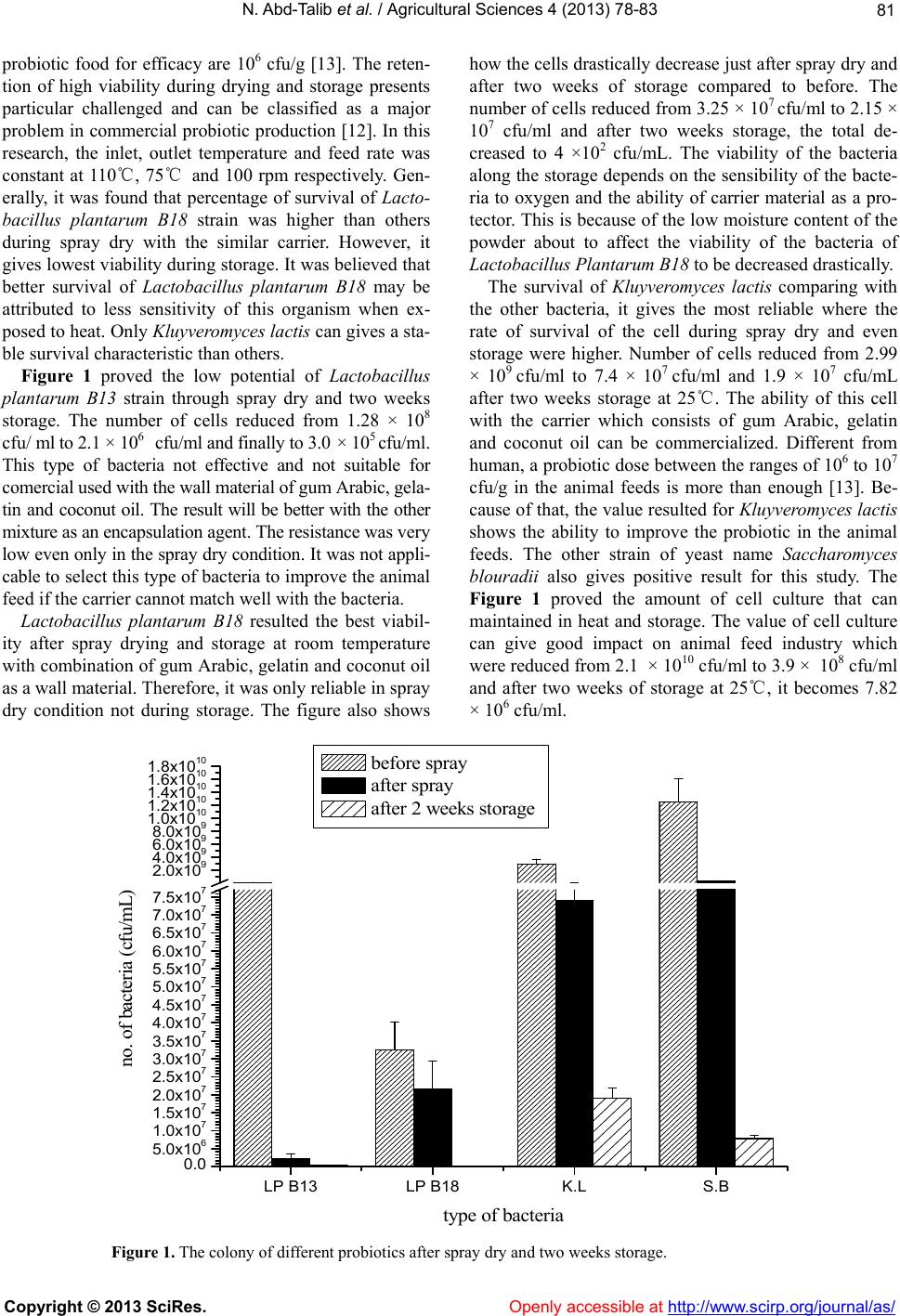 N. Abd-Ta lib et al. / Agricultural Sciences 4 (2013) 78-83 Copyright © 2013 SciRes. http://www.scirp.org/journal/as/ 81 probiotic food for efficacy are 106 cfu/g [13]. The reten- tion of high viability during drying and storage presents particular challenged and can be classified as a major problem in commercial probiotic prod uction [12]. In this research, the inlet, outlet temperature and feed rate was constant at 110℃, 75℃ and 100 rpm respectively. Gen- erally, it was found that percentage of survival of Lacto- bacillus plantarum B18 strain was higher than others during spray dry with the similar carrier. However, it gives lowest viab ility dur ing storag e. It was believed that better survival of Lactobacillus plantarum B18 may be attributed to less sensitivity of this organism when ex- posed to heat. Only Kluyveromyces lactis can gives a sta- ble survival characteristic than others. Openly accessible at Figure 1 proved the low potential of Lactobacillus plantarum B13 strain through spray dry and two weeks storage. The number of cells reduced from 1.28 × 10⁸ cfu/ ml to 2.1 × 10⁶ cfu/ml and final ly to 3.0 × 10⁵ cfu/ml. This type of bacteria not effective and not suitable for comercial used with the wall material of gum Arabic, gela- tin an d coconut oil. The resu lt will be better with the other mi xture as an e ncapsulation agent. The resistance was very low even only in the spray dry condition. It was not appli- cable to select this type of bacteria to improve the animal feed if the carrier cannot match well with the bacteria. Lactobacillus plantarum B18 resulted the best viabil- ity after spray drying and storage at room temperature with combination of gum Arabic, gelatin and co conut oil as a wall material. Therefore, it was only reliable in spray dry condition not during storage. The figure also shows how the cells drastically decrease just after spray dry and after two weeks of storage compared to before. The number of cells reduced from 3.25 × 10⁷ cfu/ml to 2.15 × 10⁷ cfu/ml and after two weeks storage, the total de- creased to 4 ×10² cfu/mL. The viability of the bacteria along the storag e depends on the sensibility of the b acte- ria to oxygen and the ability of carrier material as a pro- tector. This is because of the low moisture content of the powder about to affect the viability of the bacteria of Lactobacillus Plantarum B18 to be decreased drastically. The survival of Kluyveromyces lactis comparing with the other bacteria, it gives the most reliable where the rate of survival of the cell during spray dry and even storage were higher. Number of cells reduced from 2.99 × 10⁹ cfu/ml to 7.4 × 10⁷ cfu/ml and 1.9 × 10⁷ cfu/mL after two weeks storage at 25℃. The ability of this cell with the carrier which consists of gum Arabic, gelatin and coconut oil can be commercialized. Different from human, a probiotic dose between the ranges of 106 to 107 cfu/g in the animal feeds is more than enough [13]. Be- cause of that, the value resulted for Kluyveromyces lactis shows the ability to improve the probiotic in the animal feeds. The other strain of yeast name Saccharomyces blouradii also gives positive result for this study. The Figure 1 proved the amount of cell culture that can maintained in heat and storage. The value of cell culture can give good impact on animal feed industry which were reduced from 2.1 × 10¹⁰ cfu/ml to 3.9 × 10⁸ cfu/ml and after two weeks of storage at 25℃, it becomes 7.82 × 10⁶ cfu/ml. LP B13LP B18K.LS.B 0.0 5.0x10 6 1.0x10 7 1.5x10 7 2.0x10 7 2.5x10 7 3.0x10 7 3.5x10 7 4.0x10 7 4.5x10 7 5.0x10 7 5.5x10 7 6.0x10 7 6.5x10 7 7.0x10 7 7.5x10 7 2.0x10 9 4.0x10 9 6.0x10 9 8.0x10 9 1.0x10 10 1.2x10 10 1.4x10 10 1.6x10 10 1.8x10 10 no. of bacteria (cfu/mL ) type of bacteria before spray after spray after 2 weeks storage Figure 1. The colony of different probiotics after spray dry and two weeks storage. 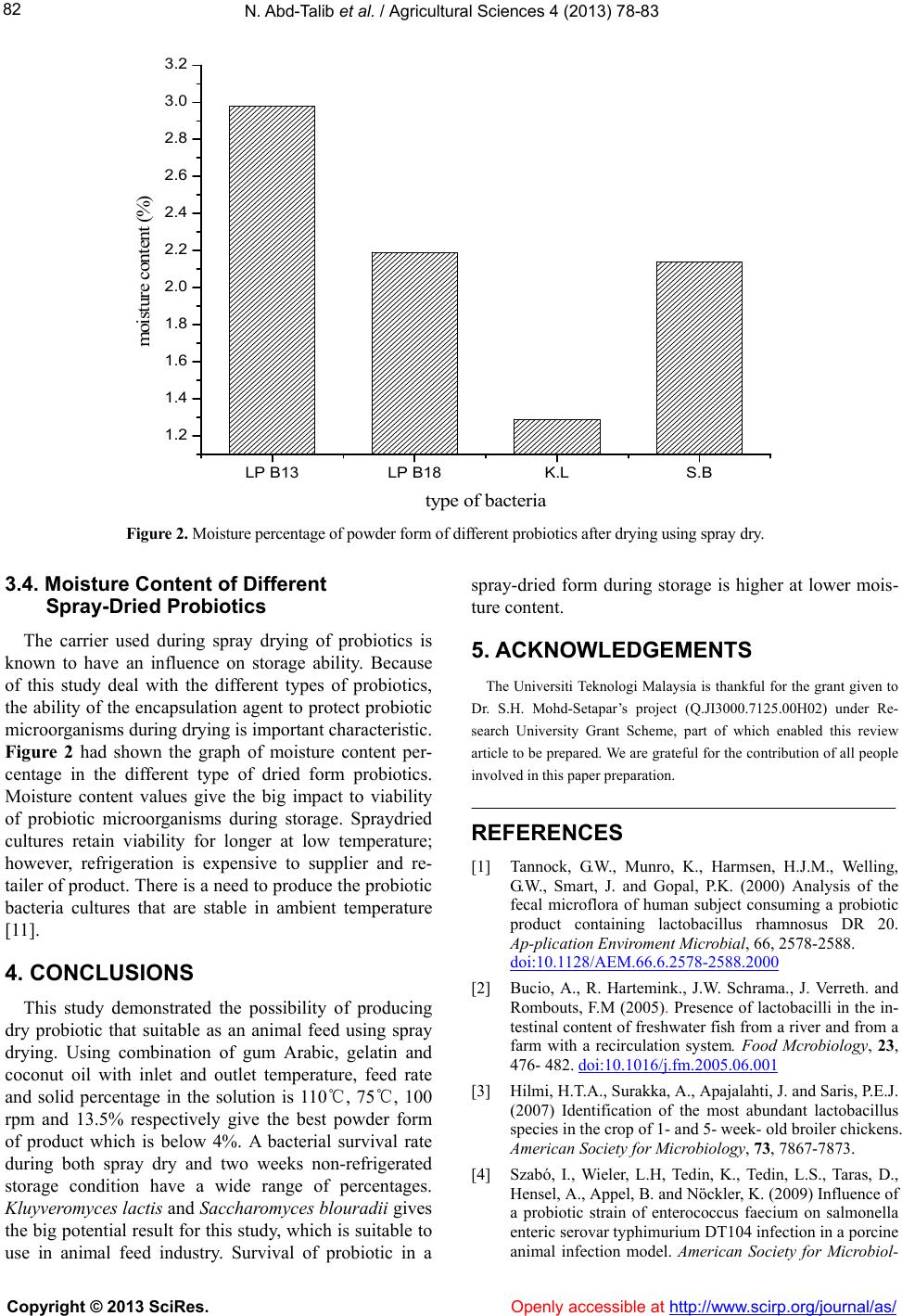 N. Abd-Ta lib et al. / Agricultural Sciences 4 (2013) 78-83 82 LP B13LP B18K.LS.B 1.2 1.4 1.6 1.8 2.0 2.2 2.4 2.6 2.8 3.0 3.2 mo istu r e c o n te n t ( %) type of bacteria Figure 2. Moisture percentage of powder form of different probiotics after drying using spray dry. 3.4. Moisture Content of Different Spray-Dried Probiotics The carrier used during spray drying of probiotics is known to have an influence on storage ability. Because of this study deal with the different types of probiotics, the ability of the encapsu lation agent to protect probiotic microorganisms during drying is important characteristic. Figure 2 had shown the graph of moisture content per- centage in the different type of dried form probiotics. Moisture content values give the big impact to viability of probiotic microorganisms during storage. Spraydried cultures retain viability for longer at low temperature; however, refrigeration is expensive to supplier and re- tailer of product. There is a need to produce the probiotic bacteria cultures that are stable in ambient temperature [11]. 4. CONCLUSIONS This study demonstrated the possibility of producing dry probiotic that suitable as an animal feed using spray drying. Using combination of gum Arabic, gelatin and coconut oil with inlet and outlet temperature, feed rate and solid percentage in the solution is 110℃, 75℃, 100 rpm and 13.5% respectively give the best powder form of product which is below 4%. A bacterial survival rate during both spray dry and two weeks non-refrigerated storage condition have a wide range of percentages. Kluyveromyces lactis and Saccharomyces blouradii gives the big potential result for this study, wh ich is suitable to use in animal feed industry. Survival of probiotic in a spray-dried form during storage is higher at lower mois- ture content. 5. ACKNOWLEDGEMENTS The Universiti Teknologi Malaysia is thankful for the grant given to Dr. S.H. Mohd-Setapar’s project (Q.JI3000.7125.00H02) under Re- search University Grant Scheme, part of which enabled this review article to be prepared. We are grateful for the contribution of all people involved in this paper pr ep aration. REFERENCES [1] Tannock, G.W., Munro, K., Harmsen, H.J.M., Welling, G.W., Smart, J. and Gopal, P.K. (2000) Analysis of the fecal microflora of human subject consuming a probiotic product containing lactobacillus rhamnosus DR 20. Ap-plication Enviroment Microbial, 66, 2578-2588. doi:10.1128/AEM.66.6.2578-2588.2000 [2] Bucio, A., R. Hartemink., J.W. Schrama., J. Verreth. and Rombouts, F.M (2005). Presence of lactobacilli in the in- testinal content of freshwater fish from a river and from a farm with a recirculation system. Food Mcrobiology, 23, 476- 482. doi:10.1016/j.fm.2005.06.001 [3] Hilmi, H.T.A., Surakka, A., Apajalahti, J. and Saris, P.E.J. (2007) Identification of the most abundant lactobacillus species in the crop of 1- and 5- week- old broiler chickens. American Society for Microbiology, 73, 7867-7873. [4] Szabó, I., Wieler, L.H, Tedin, K., Tedin, L.S., Taras, D., Hensel, A., Appel, B. and Nöckler, K. (2009) Influence of a probiotic strain of enterococcus faecium on salmonella enteric serovar typhimurium DT104 infection in a porcine animal infection model. American Society for Microbiol- Copyright © 2013 SciRes. Openly accessible at http://www.scirp.org/journal/as/  N. Abd-Ta lib et al. / Agricultural Sciences 4 (2013) 78-83 83 ogy, 75, 2621- 2628. [5] Dahiya. J.P, Wilkie, D.C., Van-Kessel, A.G. and Drew, M.D. (2005) Potential strategies for controlling necrotic enteritis in broiler chicken in post-antibiotic era. Animal Feed Science and Technology, 129, 60-88. doi:10.1016/j.anifeedsci.2005.12.003 [6] Son, V.M., Chang, C., Wu, M., Guu, Y., Chiu, C. and Cheng, W. (2009) Dietary administration of the probiotic, lactobacillus plantarum, enhanced the growth, innate immune responses, and disease resistance of the grouper epinephelus coioides. Fish & Shellfish Immunology, 26, 691- 698. doi:10.1016/j.fsi.2009.02.018 [7] Canibe, N., Miettinen, H. and Jensen, B.B. (2008) Effect of adding lactobacillus plantarum or a formic acid con- taining-product to fermented liquid feed on gas- troin-testinal ecology and growth performance of piglet. Live-stock Science, 114, 251- 262. doi:10.1016/j.livsci.2007.05.002 [8] Abu-Tarboush, H.M., Al-Saiady, M.Y. and El-Din, A.H.K. (1996) Evaluation of diet containing lactobacilli on per- formance, fecal coliform, and lactobacilli of young dairy calves. Animal Feed Science and Technology, 57, 39- 49. doi:10.1016/0377-8401(95)00850-0 [9] Mohamed, M.I., Maareck, Y.A., Abdel-Majid, S. and Awadalla, I.M. (2009) Feed intake digestibility, rumen fermentation and groeh performance of camels fed diets supplemented with a yeast culture or zinc bacitracin. Animal Feed Science and Technology, 149,341-345. doi:10.1016/j.anifeedsci.2008.07.002 [10] Kailasapathy, K. (2002) Microencapsulation of Probiotic Bacteria: Tecnology and Potential Applications. Current Issues Intestinal, Microbial, 3, 39-48 [11] Desmond, C., Ross, R.P., O'Callaghan, E., Fitzgerald, G. and Stanton, C. (2002) Improve survival of lactobacillus parasei NFBC 338 in spray-dried powders containing gum Acacia. Journal of Applied Microbiology, 93, 1003- 1011. doi:10.1046/j.1365-2672.2002.01782.x [12] Meng, X.C., Stanton, C., Fitzgerald, G.F., Daly, C. and Ross, R.P. (2008). Anhydrobiotics: The challenges of dring probiotics cultures. Food Chemistry, 106, 1406- 1416. doi:10.1016/j.foodchem.2007.04.076 [13] Guillot, J.F. (1998) Les probiotiques er dimenation ani- male. Cahiers Agricultur es, 7, 49-54. Copyright © 2013 SciRes. Openly accessible at http://www.scirp.org/journal/as/ |