

Paper Menu >>
Journal Menu >>
 Vol.4, No.5B, 46-51 (2013) Agricultural Sciences doi:10.4236/as.2013.45B009 Physicochemical and radical scavenging activities of honey samples from Malaysia Norul Liza A-Rahaman, Lee Suan Chua*, Mohamad Roji Sarmidi, Ramlan Aziz Metabolites Profiling Laboratory, Institute of Bioproduct Development, Universiti Teknologi Malaysia, Johor Bahru, Johor, Malaysia; *Corresponding Author: [email protected] Received 2013 ABSTRACT The physical properties, total phenols, total fla- vonoid content and free radical scavenging ac- tivities of honey samples from Malaysia were investigated. The physical properties of Tualang, Gelam and Acacia honey samples, in terms of pH, color, moisture, electrical conductivity and total soluble solid were significantly different (p = 0.000). Gelam honey was reported to have the highest total phenols (606.17 mg GAE/kg honey) and flavonoid content (183.43 mg RE/kg honey). Tualang honey was reported to have the highest free radical scavenging activity with the IC50, 72.75 g/L compared to Gelam (77.41 g/L) and Acacia (90.83 g/L). There is no significant dif- ference has been revealed among honey samples for radical scavenging activity (p = 0.827). Nev- ertheless, strong correlation was obtained be- tween pH, color, electrical conductivity and total soluble solid with the scavenging activity of all honey samples with the correlative coefficient, r = 0.979, 0.902, 0.917 and 0.957, respectively. The establishment of the statistical correlation could be useful for honey related industry. Keywords: Total Phenolic Content; Total Flavonoid Content; Radical Scavenging Activity 1. INTRODUCTION Honey is a natural food source that widely used as a traditional medicine. To the best of our knowledge, more than 200 substances including complex sugar and small amount of other substances have been found in honey. The common types of honey found in lowland rain forest of Peninsular Malaysia are Tualang and Gelam honey, originates from Tualang (Koompassia excels) and Gelam (Melaleuca cajuputi) trees. Another common source of honey in Malaysia is Acacia honey and this honey is easily available all over the world with different physical and chemical characteristics. Honey is widely used as antioxidant to reduce the risk of heart disorder, cancer and to increase the immune system [1]. The antioxidant activity of honey is believed mainly contributed by the presence of phenolic acids, flavonoids, catalases, peroxides, carotenoids and non- peroxidal components. According to Gheldof and Enge- seth [2] and Turkmen et al. [3], the composition of honey is highly dependent on the botanical and geographical origin, as well as the handling process during harvesting and storage. There are also studies reported that the bo- tanical origin is the critical factor influencing the anti- oxidant activity of honey [4,5]. There are several methods commonly used for the measurement of antioxidant activity of honey based on different principles and experimental condition. Accord- ing to Bertoncelj et al. [6], the methods include FRAP assay (ferric reducing antioxidant power), TEAC (Trolox equivalent antioxidant activity), DPPH (1, 1-diphenyl- 2-picrylhydrazyl) and ORAC (oxygen radical absorbance capacity). DPPH method is likely to be the most reliable technique to determine the antioxidant activity of honey, since DPPH produces stable free radicals for testing [7]. Since honey varies according to their origin, the physical properties of honey samples including pH, color, mois- ture, electrical conductivity and total soluble solid were studied and correlated statistically with their total phe- nols, total flavanoids and antioxidant activity. The estab- lishment of the physicochemical correlation enhances the understanding of honey characteristics from tropical country which is beneficial to honey related industry. The findings from this study could be compared to the data reported previously which found the physical prop- erties were highly correlated with the antioxidant activity of honey [6,8,9]. Therefore, this study was investigated the physical properties, phenolic and flavonoid contents, as well as the antioxidant activity of honey samples from Malaysia. 2. MATERIALS AND METHODS 2.1. Honey Samples All honey samples were collected from the West Coast Copyright © 2013 SciRes. Openly accessible at http://www.scirp.org/journal/as/  N. L. A-Raham an et al. / Agricultura l Sciences 4 (2013) 46-51 47 of Peninsular Malaysia, which consist of Tualang, Gelam and Acacia honey. Tualang and Gelam honey was ob- tained from the Federal Agricultural Marketing Author- ity (FAMA), Kedah, whereas MB An-Nur Apiary, Johor, supplied the Acacia honey. Honey samples were stored in glass containers at room temperature (25℃ - 30℃) in the dark place without any processing or treatment prior to analysis. The analyses were carried out within six months after harvesting. 2.2. Reagents and Standard All reagents are of analytical grade otherwise stated. HPLC-grade of methanol from Merck (Darmstadt, Ger- many). Hydrochloric acid, sodium hydroxide and alu- minium trichloride were purchased from Fisher Scien- tific (Pittsburg, USA). Deionized water was produced by Barnstead NANOpure Diamond water purification sys- tem at 18.2 MΩ-cm resistivity (State of Illinois, USA). The standard reagents such as Folin-Ciocalture reagent, 2-2-diphenyl-1-picryhydrazyl and gallic acid were pur- chased from Sigma-Aldrich (Missouri, USA). Ascobic acid (98 %) and rutin (97 %) were obtained from Across Organics (Pittsburg, USA). 2.3. Physical Analysis Determination of pH: The pH value of honey was determined based on the method described by Saxena et al. [9] using a pH meter (Mettler Toledo Delta 320) for the measurement. A 10% w/v of honey solution was prepared in aqueous medium. Determination of color: The color of honey was meas- ured by using Lovibond Honey Photometer based on the AOAC Official Method 985.25 (2000) with minor modi- fication. Honey samples were placed in a 10 mm path- length plastic cuvette. The color values was determined in triplicate and expressed in millimeter Pfund scale. Determination of moisture content: The moisture con- tent was measured based on the AOAC Method 969.38 (2000). A handheld Refractometer (Atago, Japan) was used to determine the water content in honey based on the refractive index. The readings were corrected for a standard temperature of 20℃ by adding the correction factor of 0.00023/℃. The moisture content was calcu- lated by using Wedmore’s table referring to the refractive index. All measurements were carried out in triplicate and the moisture content is expressed in percentage (%). Determination of total soluble solid: The total soluble solid was measured by using a refractometer (Atago Pocket Refractometer) at ambient temperature. The re- sults were expressed in % Brix. Determination of electrical conductivity: The electrical conductivity was determined based on the electrical re- sistance by using a conductivity meter (EcoScan COND 6+ Conductivity Meter from Eutech Instrument) [9]. All honey samples were analyzed in triplicate and the results are expressed in mS/cm. 2.4. Analysis of Chemical and Scavenging Activity Total phenolic content in honey samples was determined by using the Folin-Ciocalteu method described by Sin- gleton et al. [10] with minor modification. A 0.5 mL of honey solution (0.1 g/mL) was mixed with 2.5 mL of 0.2 N Folin-Ciocalteu reagent and incubated for five minutes. Then, 2 mL of sodium carbonate (75 g/L) was added and incubated for two hours. After incubation, the absorbance was measured against methanol as blank at 760 nm using a UV-Vis spectrophotometer (Perkin Elmer, Lamda 25). The calibration curve was constructed using gallic acid (0 - 100 mg/L). The measurement was performed in trip- licate and the total phenolic content was expressed in mg of gallic acid equivalents (GAE) per kg of honey. Total flavonoid content was determined by using the method described by Singleton et al. [10] with minor modification. A 5 mL of honey solution (0.1 g/mL) was mixed with 5 mL of 2% aluminium trichloride (AlCl3). The complex formation (flavonoid-aluminium) was meas- ured at 415 nm by using a UV-Vis spectrophotometer (Perkin Elmer, Lambda 25) after ten minutes incubation. The standard curve for total flavonoids content was plot- ted using rutin (0 - 100 mg/L) as a standard chemical. The measurement was performed in triplicate and the total flavonoids content was expressed in mg rutin equi- valents (RE) per kg of honey. The radical scavenging activity of honey was meas- ured according to the 2, 2-diphenyl-1-picryhydrazyl (DPPH) method as described by Velazquez et al. [11] with minor modification. This method measures the reduction of DPPH purple color to yellow color. A 0.75 mL of honey solution (0.02 - 0.04 g/mL methanol) was mixed with 1.5 mL of 0.02 mg/mL DPPH solution. The complex mixture against DPPH was measured by using a UV-Vis spectro- photometer (Perkin Elmer, Lambda 25) at 517 nm after 15 minutes incubation at 25℃. The sample blank con- sisted of 0.75 mL methanol and 1.5 mL of methanolic DPPH. The ascobic acid standard curve (0 - 10 mg/L) was plotted for calibration. The free radical scavenging activity was expressed as IC50. 2.5. Statistical Analysis The data were analyzed by the analysis of variance (ANOVA) using SPSS software (SPSS 16.0). Correla- tions were carried out by using the Pearson’s correlation coefficient (r) in bivariate linear correlations. Copyright © 2013 SciRes. Openly accessible at http://www.scirp.org/journal/as/ 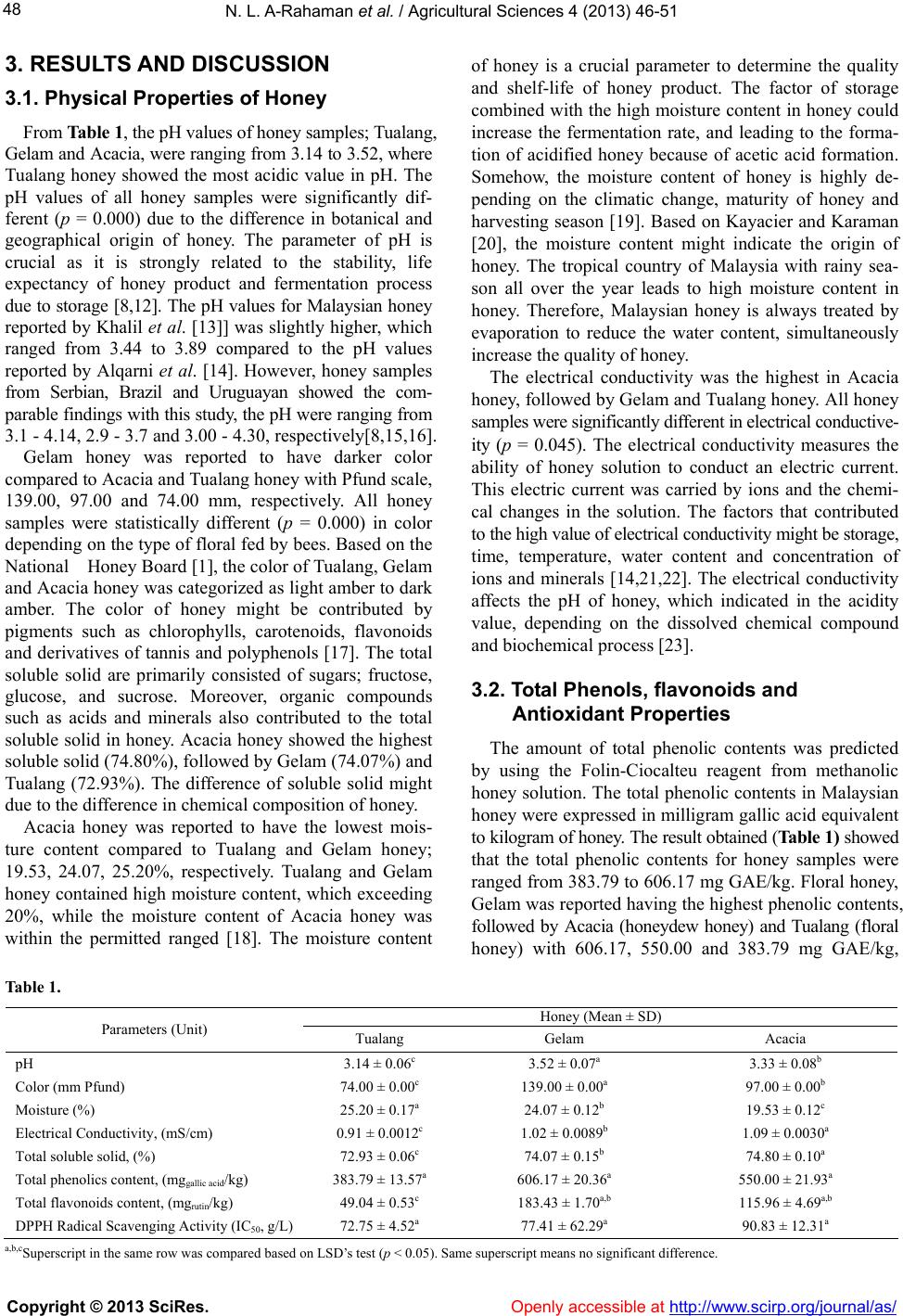 N. L. A-Raham an et al. / Agricultura l Sciences 4 (2013) 46-51 Copyright © 2013 SciRes. http://www.scirp.org/journal/as/Openly accessible at 48 3. RESULTS AND DISCUSSION 3.1. Physical Properties of Honey From Table 1, the pH values of honey samples; Tualang, Gelam and Acacia, were ranging from 3.14 to 3.52, where Tualang honey showed the most acidic value in pH. The pH values of all honey samples were significantly dif- ferent (p = 0.000) due to the difference in botanical and geographical origin of honey. The parameter of pH is crucial as it is strongly related to the stability, life expectancy of honey product and fermentation process due to storage [8,12]. The pH values for Malaysian honey reported by Khalil et al. [13]] was slightly higher, which ranged from 3.44 to 3.89 compared to the pH values reported by Alqarni et al. [14]. However, honey samples from Serbian, Brazil and Uruguayan showed the com- parable findings with this study, the pH were ranging from 3.1 - 4.14, 2.9 - 3.7 and 3.00 - 4.30, respectively[8,15,16]. Gelam honey was reported to have darker color compared to Acacia and Tualang honey with Pfund scale, 139.00, 97.00 and 74.00 mm, respectively. All honey samples were statistically different (p = 0.000) in color depending on the type of floral fed by bees. Based on the National Honey Board [1], the color of Tualang, Gelam and Acacia honey was categorized as light amber to dark amber. The color of honey might be contributed by pigments such as chlorophylls, carotenoids, flavonoids and derivatives of tannis and polyphenols [17]. The total soluble solid are primarily consisted of sugars; fructose, glucose, and sucrose. Moreover, organic compounds such as acids and minerals also contributed to the total soluble solid in honey. Acacia honey showed the highest soluble solid (74.80%), followed by Gelam (74.07%) and Tualang (72.93%). The difference of soluble solid might due to the difference in chemical composition of honey. Acacia honey was reported to have the lowest mois- ture content compared to Tualang and Gelam honey; 19.53, 24.07, 25.20%, respectively. Tualang and Gelam honey contained high moisture content, which exceeding 20%, while the moisture content of Acacia honey was within the permitted ranged [18]. The moisture content of honey is a crucial parameter to determine the quality and shelf-life of honey product. The factor of storage combined with the high moisture content in honey could increase the fermentation rate, and leading to the forma- tion of acidified honey because of acetic acid formation. Somehow, the moisture content of honey is highly de- pending on the climatic change, maturity of honey and harvesting season [19]. Based on Kayacier and Karaman [20], the moisture content might indicate the origin of honey. The tropical country of Malaysia with rainy sea- son all over the year leads to high moisture content in honey. Therefore, Malaysian honey is always treated by evaporation to reduce the water content, simultaneously increase the quality of honey. The electrical conductivity was the highest in Acacia honey, followed by Gelam and Tualang honey. All honey samples were significantly different in electrical conductive- ity (p = 0.045). The electrical conductivity measures the ability of honey solution to conduct an electric current. This electric current was carried by ions and the chemi- cal changes in the solution. The factors that contributed to the high value of electrical conductivity might be storage, time, temperature, water content and concentration of ions and minerals [14,21,22]. The electrical conductivity affects the pH of honey, which indicated in the acidity value, depending on the dissolved chemical compound and biochemical process [23]. 3.2. Total Phenols, flavonoids and Antioxidant Properties The amount of total phenolic contents was predicted by using the Folin-Ciocalteu reagent from methanolic honey solution. The total phenolic contents in Malaysian honey were expressed in milligram gallic acid equivalent to kilogram of honey. The result obtained (Table 1) showed that the total phenolic contents for honey samples were ranged from 383.79 to 606.17 mg GAE/kg. Floral honey, Gelam was reported having the highest phenolic contents, followed by Acacia (honeydew honey) and Tualang (floral honey) with 606.17, 550.00 and 383.79 mg GAE/kg, Table 1. Honey (Mean ± SD) Parameters (Unit) Tualang Gelam Acacia pH 3.14 ± 0.06c 3.52 ± 0.07a 3.33 ± 0.08b Color (mm Pfund) 74.00 ± 0.00c 139.00 ± 0.00a 97.00 ± 0.00b Moisture (%) 25.20 ± 0.17a 24.07 ± 0.12b 19.53 ± 0.12c Electrical Conductivity, (mS/cm) 0.91 ± 0.0012c 1.02 ± 0.0089b 1.09 ± 0.0030a Total soluble solid, (%) 72.93 ± 0.06c 74.07 ± 0.15b 74.80 ± 0.10a Total phenolics content, (mggallic acid/kg) 383.79 ± 13.57a 606.17 ± 20.36a 550.00 ± 21.93a Total flavonoids content, (mgrutin/kg) 49.04 ± 0.53c 183.43 ± 1.70a,b 115.96 ± 4.69a,b DPPH Radical Scavenging Activity (IC50, g/L) 72.75 ± 4.52a 77.41 ± 62.29a 90.83 ± 12.31a a,b,cSuperscript in the same row was compared based on LSD’s test (p < 0.05). Same superscript means no significant difference. 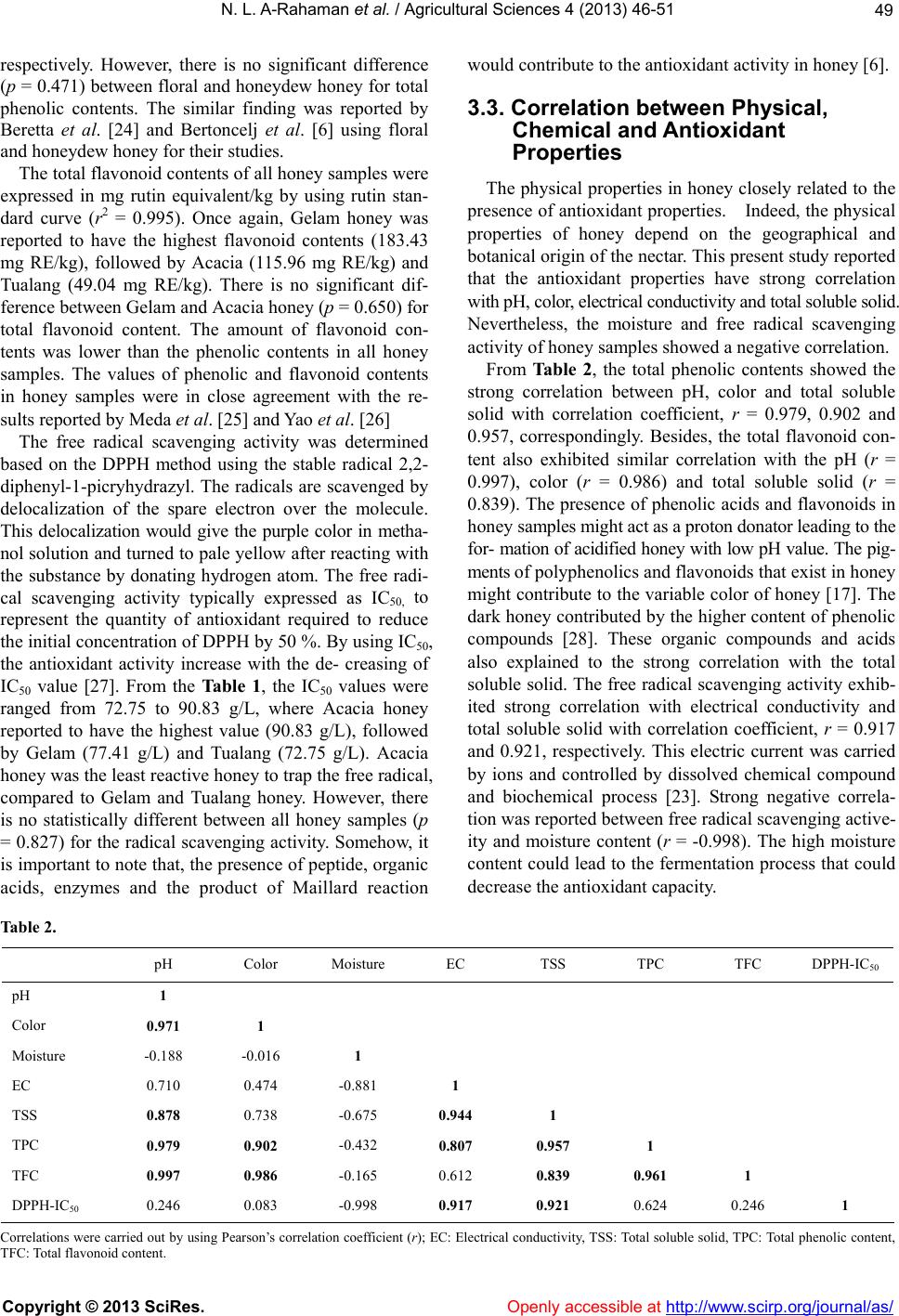 N. L. A-Raham an et al. / Agricultura l Sciences 4 (2013) 46-51 49 respectively. However, there is no significant difference (p = 0.471) between floral and honeydew honey for total phenolic contents. The similar finding was reported by Beretta et al. [24] and Bertoncelj et al. [6] using floral and honeydew honey for their studies. The total flavonoid contents of all honey samples were expressed in mg rutin equivalent/kg by using rutin stan- dard curve (r2 = 0.995). Once again, Gelam honey was reported to have the highest flavonoid contents (183.43 mg RE/kg), followed by Acacia (115.96 mg RE/kg) and Tualang (49.04 mg RE/kg). There is no significant dif- ference between Gelam and Acacia honey (p = 0.650) for total flavonoid content. The amount of flavonoid con- tents was lower than the phenolic contents in all honey samples. The values of phenolic and flavonoid contents in honey samples were in close agreement with the re- sults reported by Meda et al. [25] and Yao et al. [26] The free radical scavenging activity was determined based on the DPPH method using the stable radical 2,2- diphenyl-1-picryhydrazyl. The radicals are scavenged by delocalization of the spare electron over the molecule. This delocalization would give the purple color in metha- nol solution and turned to pale yellow after reacting with the substance by donating hydrogen atom. The free radi- cal scavenging activity typically expressed as IC50, to represent the quantity of antioxidant required to reduce the initial concentration of DPPH by 50 %. By using IC50, the antioxidant activity increase with the de- creasing of IC50 value [27]. From the Ta b l e 1 , the IC50 values were ranged from 72.75 to 90.83 g/L, where Acacia honey reported to have the highest value (90.83 g/L), followed by Gelam (77.41 g/L) and Tualang (72.75 g/L). Acacia honey was the least reactive honey to trap the free radical, compared to Gelam and Tualang honey. However, there is no statistically different between all honey samples (p = 0.827) for the radical scavenging activity. Somehow, it is important to note that, the presence of peptide, organic acids, enzymes and the product of Maillard reaction would contribute to the antioxidant activity in honey [6]. 3.3. Correlation between Physical, Chemical and Antioxidant Properties The physical properties in honey closely related to the presence of antioxidant properties. Indeed, the physical properties of honey depend on the geographical and botanical origin of the nectar. This present study reported that the antioxidant properties have strong correlation with pH, color, electrical conductivity and total soluble solid. Nevertheless, the moisture and free radical scavenging activity of honey samples showed a negative correlation. From Ta bl e 2, the total phenolic contents showed the strong correlation between pH, color and total soluble solid with correlation coefficient, r = 0.979, 0.902 and 0.957, correspondingly. Besides, the total flavonoid con- tent also exhibited similar correlation with the pH (r = 0.997), color (r = 0.986) and total soluble solid (r = 0.839). The presence of phenolic acids and flavonoids in honey samples might act as a proton donator leading to the for- mation of acidified honey with low pH value. The pig- ments of polyphenolics and flavonoids that exist in honey might contribute to the variable color of honey [17]. The dark honey contributed by the higher content of phenolic compounds [28]. These organic compounds and acids also explained to the strong correlation with the total soluble solid. The free radical scavenging activity exhib- ited strong correlation with electrical conductivity and total soluble solid with correlation coefficient, r = 0.917 and 0.921, respectively. This electric current was carried by ions and controlled by dissolved chemical compound and biochemical process [23]. Strong negative correla- tion was reported between free radical scavenging active- ity and moisture content (r = -0.998). The high moisture content could lead to the fermentation process that could decrease the antioxidant capacity. Table 2. pH Color Moisture EC TSS TPC TFC DPPH-IC50 pH 1 Color 0.971 1 Moisture -0.188 -0.016 1 EC 0.710 0.474 -0.881 1 TSS 0.878 0.738 -0.675 0.944 1 TPC 0.979 0.902 -0.432 0.807 0.957 1 TFC 0.997 0.986 -0.165 0.612 0.839 0.961 1 DPPH-IC50 0.246 0.083 -0.998 0.917 0.921 0.624 0.246 1 Correlations were carried out by using Pearson’s correlation coefficient (r); EC: Electrical conductivity, TSS: Total soluble solid, TPC: Total phenolic content, TFC: Total flavonoid content. Copyright © 2013 SciRes. Openly accessible at http://www.scirp.org/journal/as/  N. L. A-Raham an et al. / Agricultura l Sciences 4 (2013) 46-51 50 4. CONCLUSIONS The physical properties of honey are closely related with the chemical composition of honey. The composi- tion is dependent on the botanical and geographical ori- gins, in addition to the shelf life of honey. Gelam was reported to have high phenolic and flavonoid contents. The high scavenging activity was also reported in Tu- alang honey. The physical properties could be used to predict the antioxidant activity in honey based on the strong correlation for pH, color, electrical conductivity and total soluble solid. The establishment of the correla- tion could be the easiest way to determine the quality of honey. 5. ACKNOWLEDGEMENTS The authors would like to thank Ms. Nur Ardawati Adnan and Ms. Norfahana Abd-talib for their support and guidance. This research work was granted by GUP (Tier 1) Fund under the Research Alliance of Biotechnology (7125.00H05), UTM. REFERENCES [1] The National Honey Board. (2003) Honey-Health and Therapeutic Qualities. The National Honey Board, USA. [2] Gheldof, N. and Engeseth, N.J. (2002) Antioxidant ca- pacity of honeys from various floral sources based on the determination of oxygen radical absorbance capacity and inhibition of in vitro lipoprotein oxidation in human se- rum samples. Journal of agricultural and food chemistry. 50, 3050-3055. doi:10.1021/jf0114637 [3] Turkmen, F.N., Sari, E., Poyrazoglu, S. and Velioglu, Y.S. (2006) Effects of prolonged heating on antioxidant activ- ity and colour of honey. Food Chemistry. 95, 653-657. doi:10.1016/j.foodchem.2005.02.004 [4] Gheldof, N., Wang, X.-H. and Engeseth, N .J.(2002)Iden tification and quantification of antioxidant components of honeys from various floral sources. Journal of agricul- tural and food chemistry, 50, 5870-5877. http://dx.doi.org/10.1021/jf0256135PMid:12358452 [5] Gomez-Carvaca, A.M., Gomez-Romero, M., Araez-Roman, D., Segura-Carretero, A. and Fernan- dez-Gutierrez, A.(2006) Advances in the analysis of phe- nolic compounds in products derived from bees. Journal of Pharmaceutical and Biomedical Analysis, 41, 1220-1234. doi:10.1016/j.jpba.2006.03.002 [6] Bertoncelj, J., Dobersek, U., Jamnik, M. and Golob, T. (2007) Evaluation of the phenolic content, antioxidant ac- tivity and colour of Slovenian honey. Food Chemistry, 105, 822-828. doi:10.1016/j.foodchem.2007.01.060 [7] Katalinic, V., Milos, M., Kulisic, T. and Jukic, M. (2006) Screening of 70 medicinal plant extracts for antioxidant capacity and total phenols. Food Chemistry, 94, 550- 557. doi:10.1016/j.foodchem.2004.12.004 [8] Silva, T.M.S., dos Santos, F.P., Evangelista-Rodrigues, A., da Silva, E.M.S., da Silva, G.S., de Novais, J.S., dos San- tos, F.D.A.R. and Camara, C.A.(2013) Phenolic com- pounds, melissopalynological, physicochemical analysis and antioxidant activity of jandaíra (Melipona subnitida) honey. Journal of Food Composition and Analysis, 29,10-18. doi:10.1016/j.jfca.2012.08.010 [9] Saxena, S., Gautam, S. and Sharma, A.(2010) Physical, biochemical and antioxidant properties of some Indian honeys. Food Chemistry, 118, 391-397. doi:10.1016/j.foodchem.2009.05.001 [10] Singleton, V.L., Orthofer, R. and Lamuela-Raventos, R.M. (1999) Analysis of total phenols and other oxidation sub- strates and antioxidant by means of Folin-Ciocalteu re- agent. Methods in Enzymology, 299, 152-178. doi:10.1016/S0076-6879(99)99017-1 [11] Velázquez, E., a Tournier, H., Mordujovich de Buschi- azzo, P., Saavedra, G. and Schinella, G.R.(2003) Antioxi- dant activity of Paraguayan plant extracts. Fitoterapia. 74, 91-97. doi:10.1016/S0367-326X(02)00293-9 [12] Gomes, T., Feás, X., Iglesias, A. and Estevinho, L.M. (2011) Study of organic honey from the Northeast Portu- gal. Molecules, 16, 5374-5386. doi:10.3390/molecules16075374 [13] Khalil, M.I., Sulaiman, S. and Gan, S.H. (2010) High 5-hydroxymethylfurfural concentrations are found in Malaysian honey samples stored for more than one year. Food and chemical toxicology, 48, 2388-2392. doi:10.1016/j.fct.2010.05.076 [14] Alqarni, A. S., Owayss, A. and Mahmoud, A. (2012) Physicochemical characteristics, total phenols and pig- ments of national and international honeys in Saudi Ara- bia. Arabian Journal of Chemistry. In press. doi:10.1016/j.arabjc.2012.11.013 [15] Lazarevic, K.B., Andric, F., Trifkovic, J., Tesic, Z. and Milojkovic-Opsenica, D. (2012) Characterisation of Ser- bian unifloral honeys according to their physicochemical parameters. Food Chemistry, 132, 2060-2064. doi:10.1016/j.foodchem.2011.12.048 [16] Corbella, E. and Cozzolino, D. (2006) Classification of the floral origin of Uruguayan honeys by chemical and physical characteristic combined with chemometrics. LWT-Food Science and Technology, 39, 534-539. doi:10.1016/j.lwt.2005.03.011 [17] Juszczak, L., Socha, R., Roznowski, J., Fortuna, T. and Nalepka, K. (2009) Physicochemical properties and qual- ity parameters of herbhoneys. Food Chemistry, 113, 538-542. doi:10.1016/j.foodchem.2008.07.098 [18] European Union, (2001) Council Directive 2001. EC relating to honey. Official Journal of the European Com- munities, L10, 47-52. [19] Finola, M. S., Lasagno, M. C. and Marioli, J. M. (2007) Microbiological and chemical characterization of honeys from central Argentina. Food Chemistry, 100, 1649-1653. doi:10.1016/j.foodchem.2005.12.046 [20] Kayacier, A., and Karaman, S. (2008) Rheology and some physicochemical characteristic of selected Turkish honeys. Journal of Texture Studies, 39, 17-27. doi:10.1111/j.1745-4603.2007.00127.x [21] Kaptan, B., Kayişoǧlu, S. and Demirci, M. (2011) The relationship between some physico-chemical, microbi- Copyright © 2013 SciRes. Openly accessible at http://www.scirp.org/journal/as/  N. L. A-Raham an et al. / Agricultura l Sciences 4 (2013) 46-51 51 ological characteristic and electrical conductivity of milk stored at different temperature. Journal of Tekirdag Agri- cultural Faculty, 8, 13-22. [22] Guo, W., Liu, Y., Zhu, X. and Zhuang, H. (2011) Sensing the water content of honey from temperature-dependent electrical conductivity. Measurement Science and Tech- nology, 22(085706), 1-5. doi:10.1088/0957-0233/22/8/085706 [23] Deas, M.L. and Orlob, G.T. (1999) Klamath river model- ing project. Report No: 99-04. [24] Beretta, G., Granata, P., Ferrero, M., Orioli, M. and Facino, R. M. (2005). Standardization of antioxidant properties of honey by a combination of spectrophotometric/fluorime- tric assays and chemometrics. Analytica Chimica Acta, 533, 185-191. doi:10.1016/j.aca.2004.11.010 [25] Meda, A., Lamien, C.E., Millogo, J., Romito, M. and Nacoulma, O.G. (2005) Physicochemical analyses of bur- kina fasan honey. Acta Veterinaria Brno, 74, 147-152. doi:10.2754/avb200574010147 [26] Yao, L., Datta, N., Tomas-Barberan, F.A., Ferreres Fede- rico,Martos, I. and Singanusong, R.(2003) Flavonoids, phenolic acids and abscisic acid in Australian and New Zealand Leptospermum honeys. Food Chemistry, 81, 159-168. doi:10.1016/S0308-8146(02)00388-6 [27] Molyneux, P. (2004) The use of the stable free radical diphenylpicrylhydrazyl (DPPH) for estimating antioxi- dant activity. Songlanakarin Journal of Science and Technology, 26, 211-219. [28] Ferreira, I.C.F.R., Aires, E., Barreira, J.C.M. and Este- vinho, L.M. (2009). Antioxidant activity of Portugese honey sample: Different contributuins of entire honey and phenolic extract. Food Chemistry, 114, 1438-1443. doi:10.1016/j.foodchem.2008.11.028 Copyright © 2013 SciRes. Openly accessible at http://www.scirp.org/journal/as/ |