

Paper Menu >>
Journal Menu >>
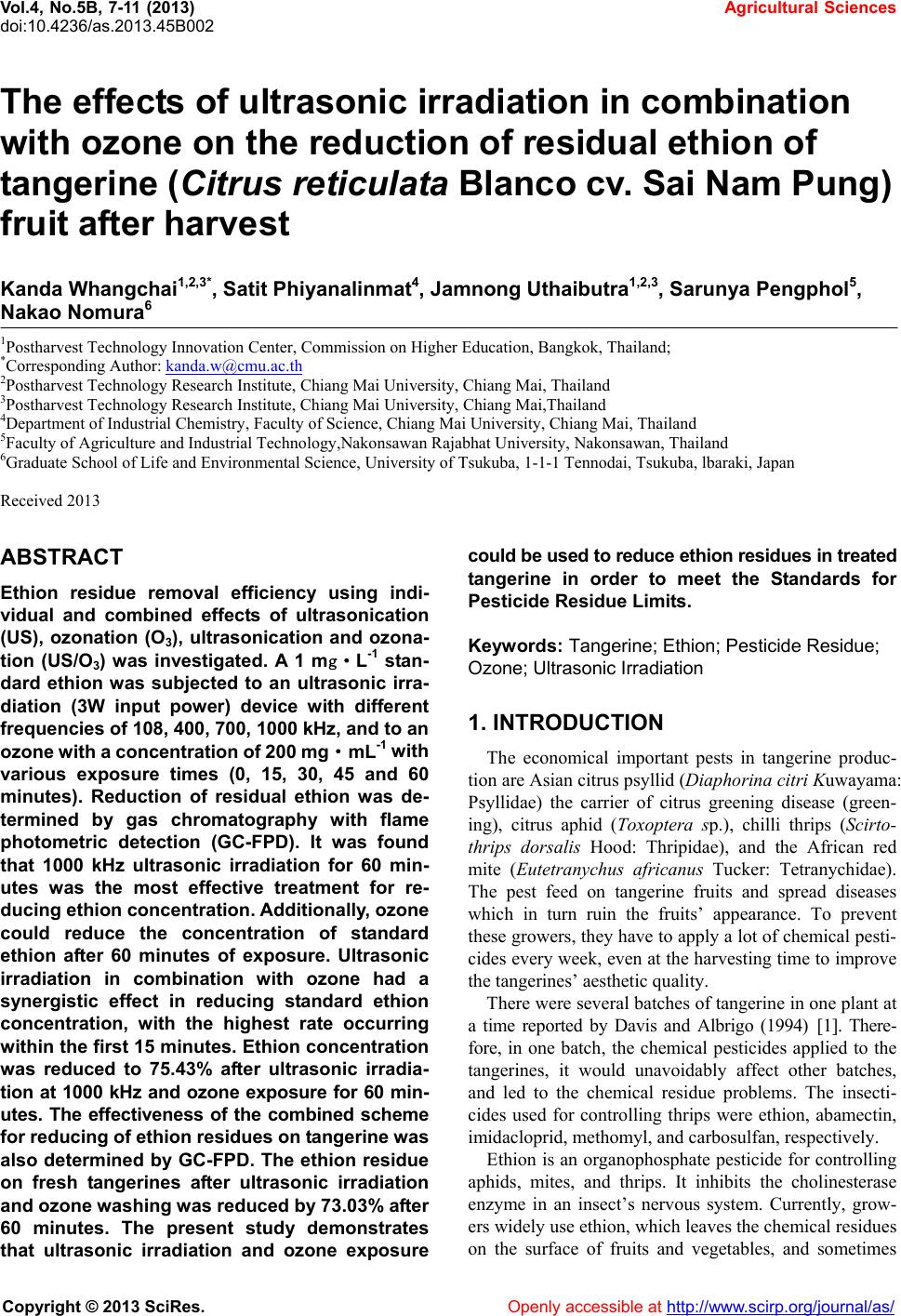 Vol.4, No.5B, 7-11 (2013) Agricultural Sciences doi:10.4236/as.2013.45B002 The effects of ultrasonic irradiation in combination with ozone on the reduction of residual ethion of tangerine (Citrus reticulata Blanco cv. Sai Nam Pung) fruit after harvest Kanda Whangchai1,2,3*, Satit Phiyanalinmat4, Jamnong Uthaibutra1,2,3, Sarunya Pengphol5, Nakao Nomura6 1Postharvest Technology Innovation Center, Commission on Higher Education, Bangkok, Thailand; *Corresponding Author: [email protected] 2Postharvest Technology Research Institute, Chiang Mai University, Chiang Mai, Thailand 3Postharvest Technology Research Institute, Chiang Mai University, Chiang Mai,Thailand 4Department of Industrial Chemistry, Faculty of Science, Chiang Mai University, Chiang Mai, Thailand 5Faculty of Agriculture and Industrial Technology,Nakonsawan Rajabhat University, Nakonsawan, Thailand 6Graduate School of Life and Environmental Science, University of Tsukuba, 1-1-1 Tennodai, Tsukuba, lbaraki, Japan Received 2013 ABSTRACT Ethion residue removal efficiency using indi- vidual and combined effects of ultrasonication (US), ozonation (O3), ultrasonication and ozona- tion (US/O3) was investigated. A 1 mg·L-1 stan- dard ethion was subjected to an ultrasonic irra- diation (3W input power) device with different frequencies of 108, 400, 700, 1000 kHz, and to an ozone with a concentr ation of 200 mg · mL-1 wi th various exposure times (0, 15, 30, 45 and 60 minutes). Reduction of residual ethion was de- termined by gas chromatography with flame photometric detection (GC-FPD). It was found that 1000 kHz ultrasonic irradiation for 60 min- utes was the most effective treatment for re- ducing ethion concentration. Additionally, ozone could reduce the concentration of standard ethion after 60 minutes of exposure. Ultrasonic irradiation in combination with ozone had a synergistic effect in reducing standard ethion concentration, with the highest rate occurring within the first 15 minutes. Ethion concentration was reduced to 75.43% after ultrasonic irradia- tion at 1000 kHz and ozone exposure for 60 min- utes. The effectiveness of the combined scheme for reducing of ethion re sidues on tangerine was also determined by GC-FPD. The ethion residue on fresh tangerines after ultrasonic irradiation and ozone washing was reduced by 73.03% after 60 minutes. The present study demonstrates that ultrasonic irradiation and ozone exposure could be use d to re du ce e thi on resi du es in tre ate d tangerine in order to meet the Standards for Pesticide Residue Limit s. Keywords: Tangerine; Ethion; Pesticide Residue; Ozone; Ultrasonic Irradi ation 1. INTRODUCTION The economical important pests in tangerine produc- tion are Asian citrus psyllid (Diaphorina citri Kuwayama: Psyllidae) the carrier of citrus greening disease (green- ing), citrus aphid (Toxoptera sp.), chilli thrips (Scirto- thrips dorsalis Hood: Thripidae), and the African red mite (Eutetranychus africanus Tucker: Tetranychidae). The pest feed on tangerine fruits and spread diseases which in turn ruin the fruits’ appearance. To prevent these growers, they have to apply a lot of chemical pesti- cides every week, even at the harvesting time to improve the tangerines’ aesthetic quality. There were several batches of tangerine in one plant at a time reported by Davis and Albrigo (1994) ]1[. There- fore, in one batch, the chemical pesticides applied to the tangerines, it would unavoidably affect other batches, and led to the chemical residue problems. The insecti- cides used for controlling thrips were ethion, abamectin, imidacloprid, methomyl, and carbosulfan, respectively. Ethion is an organophosphate pesticide for controlling aphids, mites, and thrips. It inhibits the cholinesterase enzyme in an insect’s nervous system. Currently, grow- ers widely use ethion, which leaves the chemical residues on the surface of fruits and vegetables, and sometimes Copyright © 2013 SciRes. Openly accessible at http://www.scirp.org/journal/as/ 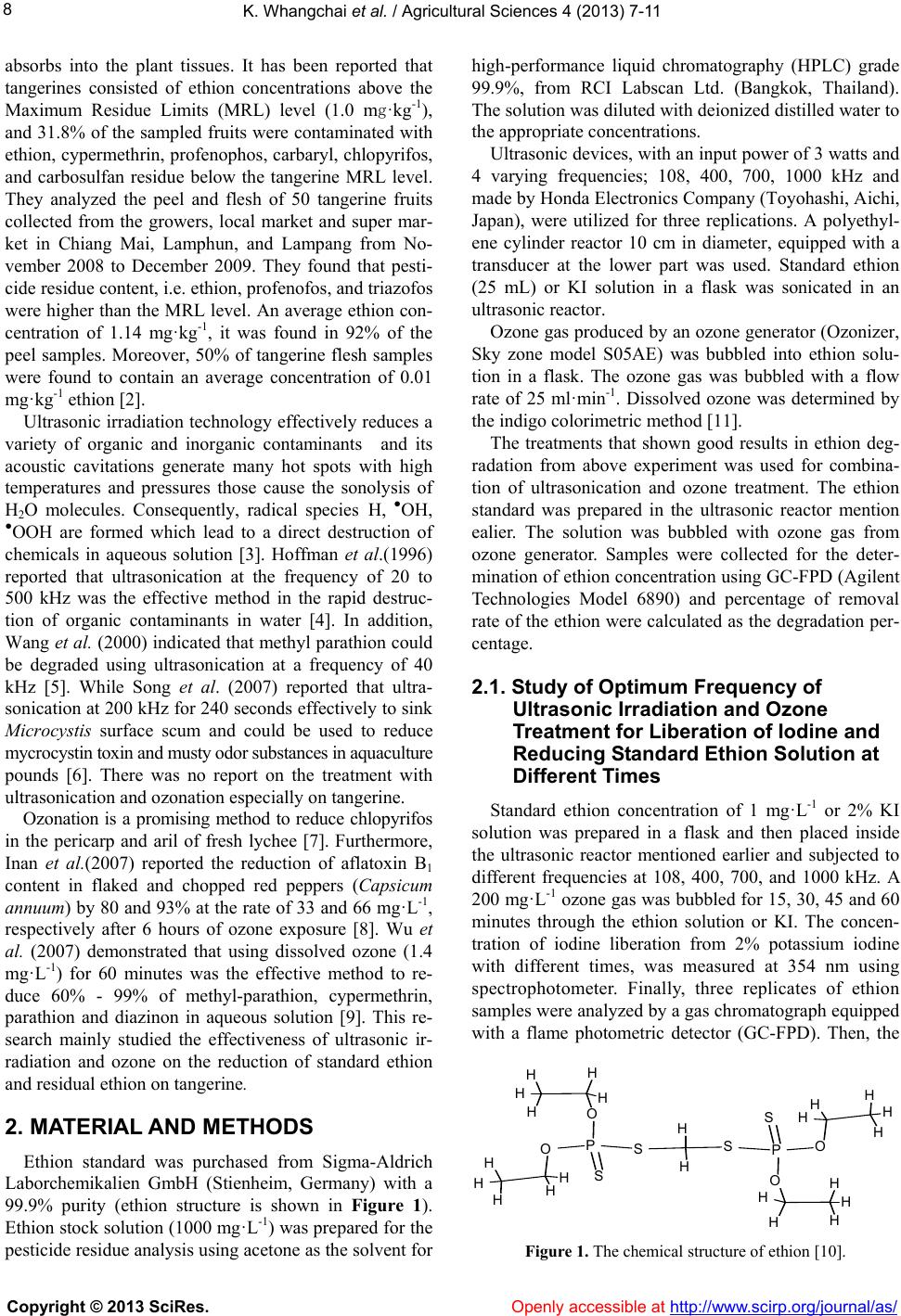 K. Whangchai et al. / Agricultural Sciences 4 (2013) 7-11 8 absorbs into the plant tissues. It has been reported that tangerines consisted of ethion concentrations above the Maximum Residue Limits (MRL) level (1.0 mg·kg-1), and 31.8% of the sampled fruits were contaminated with ethion, cypermethrin, profenophos, carbaryl, chlopyrifos, and carbosulfan residue below the tangerine MRL level. They analyzed the peel and flesh of 50 tangerine fruits collected from the growers, local market and super mar- ket in Chiang Mai, Lamphun, and Lampang from No- vember 2008 to December 2009. They found that pesti- cide residue content, i.e. ethion, profenofos, and triazofos were higher than the MRL level. An average ethion con- centration of 1.14 mg·kg-1, it was found in 92% of the peel samples. Moreover, 50% of tangerine flesh samples were found to contain an average concentration of 0.01 mg·kg-1 ethion [2]. Ultrasonic irradiation technology effectively reduces a variety of organic and inorganic contaminants and its acoustic cavitations generate many hot spots with high temperatures and pressures those cause the sonolysis of H2O molecules. Consequently, radical species H, ●OH, ●OOH are formed which lead to a direct destruction of chemicals in aqueous solution [3]. Hoffman et al.(1996) reported that ultrasonication at the frequency of 20 to 500 kHz was the effective method in the rapid destruc- tion of organic contaminants in water [4]. In addition, Wang et al. (2000) indicated that methyl parathion could be degraded using ultrasonication at a frequency of 40 kHz [5]. While Song et al. (2007) reported that ultra- sonication at 200 kHz for 240 seconds effectively to sink Microcystis surface scum and could be used to reduce mycrocystin toxin and musty odor substances in aquaculture pounds [6]. There was no report on the treatment with ultrasonication and ozonation especially on tangerine. Ozonation is a promising method to reduce chlopyrifos in the pericarp and aril of fresh lychee [7]. Furthermore, Inan et al.(2007) reported the reduction of aflatoxin B1 content in flaked and chopped red peppers (Capsicum annuum) by 80 and 93% at the rate of 33 and 66 mg·L-1, respectively after 6 hours of ozone exposure [8]. Wu et al. (2007) demonstrated that using dissolved ozone (1.4 mg· L -1) for 60 minutes was the effective method to re- duce 60% - 99% of methyl-parathion, cypermethrin, parathion and diazinon in aqueous solution [9]. This re- search mainly studied the effectiveness of ultrasonic ir- radiation and ozone on the reduction of standard ethion and residual ethion on tangerine. 2. MATERIAL AND METHODS Ethion standard was purchased from Sigma-Aldrich Laborchemikalien GmbH (Stienheim, Germany) with a 99.9% purity (ethion structure is shown in Figure 1). Ethion stock solution (1000 mg·L-1) was prepared for the pesticide residue analysis using acetone as the solvent for high-performance liquid chromatography (HPLC) grade 99.9%, from RCI Labscan Ltd. (Bangkok, Thailand). The solution was diluted with deionized distilled water to the appropriate concentrations. Ultrasonic devices, with an input power of 3 watts and 4 varying frequencies; 108, 400, 700, 1000 kHz and made by Honda Electronics Company (Toyohashi, Aichi, Japan), were utilized for three replications. A polyethyl- ene cylinder reactor 10 cm in diameter, equipped with a transducer at the lower part was used. Standard ethion (25 mL) or KI solution in a flask was sonicated in an ultrasonic reactor. Ozone gas produced by an ozone generator (Ozonizer, Sky zone model S05AE) was bubbled into ethion solu- tion in a flask. The ozone gas was bubbled with a flow rate of 25 ml·min-1. Dissolved ozone was determined by the indigo colorimetric method [11]. The treatments that shown good results in ethion deg- radation from above experiment was used for combina- tion of ultrasonication and ozone treatment. The ethion standard was prepared in the ultrasonic reactor mention ealier. The solution was bubbled with ozone gas from ozone generator. Samples were collected for the deter- mination of ethion concentration using GC-FPD (Agilent Technologies Model 6890) and percentage of removal rate of the ethion were calculated as the degradation per- centage. 2.1. Study of Optimum Frequency of Ultrasonic Irradiation and Ozone Treatment for Liberation of Iodine and Reducing Standard Ethion Solution at Different Times Standard ethion concentration of 1 mg·L-1 or 2% KI solution was prepared in a flask and then placed inside the ultrasonic reactor mentioned earlier and subjected to different frequencies at 108, 400, 700, and 1000 kHz. A 200 mg·L-1 ozone gas was bubbled for 15, 30, 45 and 60 minutes through the ethion solution or KI. The concen- tration of iodine liberation from 2% potassium iodine with different times, was measured at 354 nm using spectrophotometer. Finally, three replicates of ethion samples were analyzed by a gas chromatograph equipped with a flame photometric detector (GC-FPD). Then, the O O P S S O O PS S H H H H H HH H H H H H HH HH H HH HH H Figure 1. The chemical structure of ethion [10]. Copyright © 2013 SciRes. Openly accessible at http://www.scirp.org/journal/as/ 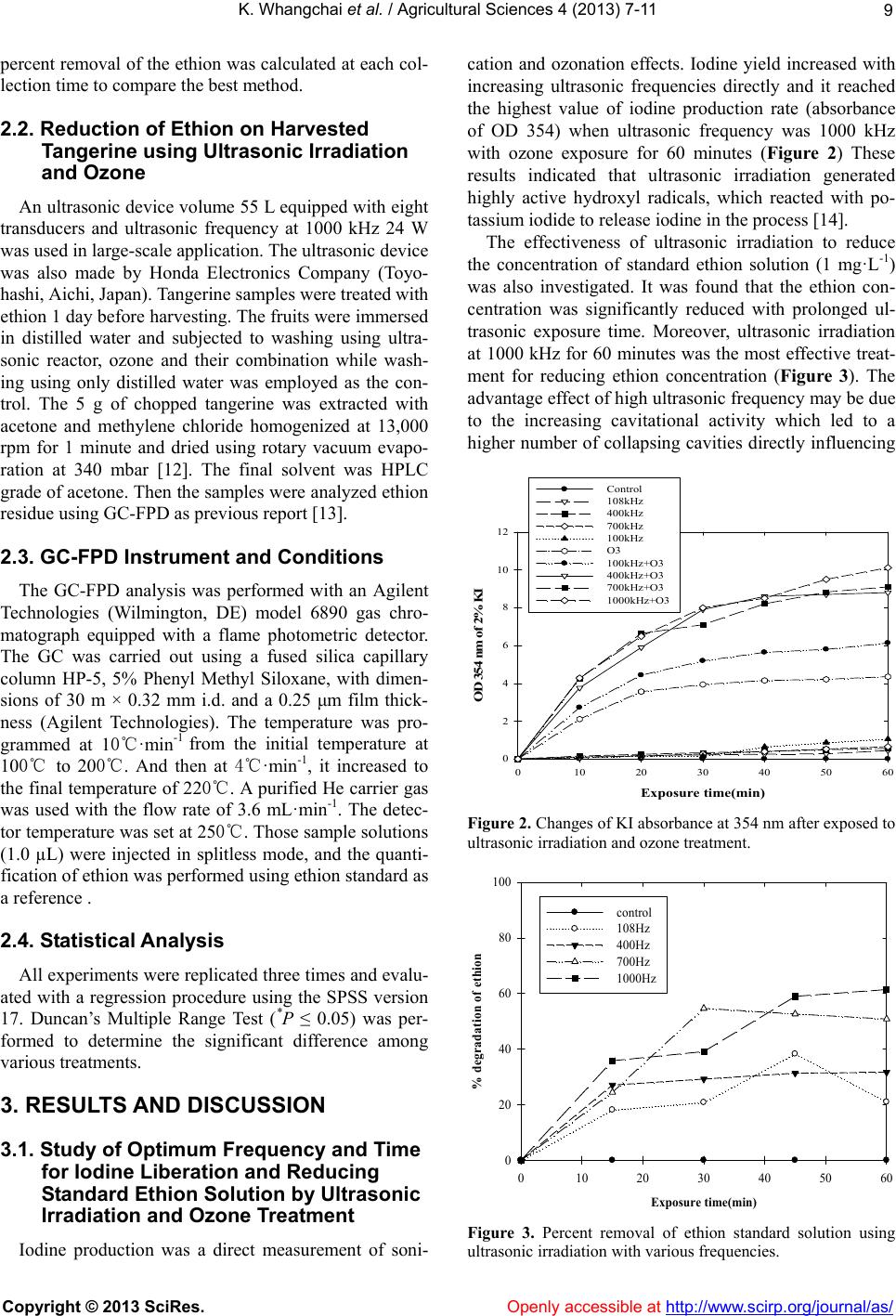 K. Whangchai et al. / Agricultural Sciences 4 (2013) 7-11 9 Copyright © 2013 SciRes. Openly accessible at http://www.scirp.org/journal/as/ percent removal of the ethion was calculated at each col- lection time to compare the best method. 2.2. Reduction of Ethion on Harvested Tangerine using Ultrasonic Irradiation and Ozone An ultrasonic device volume 55 L equipped with eight transducers and ultrasonic frequency at 1000 kHz 24 W was used in large-scale application. The ultrasonic device was also made by Honda Electronics Company (Toyo- hashi, Aichi, Japan). Tangerine samples were treated with ethion 1 day before harvesting. The fruits were immersed in distilled water and subjected to washing using ultra- sonic reactor, ozone and their combination while wash- ing using only distilled water was employed as the con- trol. The 5 g of chopped tangerine was extracted with acetone and methylene chloride homogenized at 13,000 rpm for 1 minute and dried using rotary vacuum evapo- ration at 340 mbar [12]. The final solvent was HPLC grade of acetone. Then the samples were analyzed ethion residue using GC-FPD as previous report [13]. 2.3. GC-FPD Instrument and Conditions The GC-FPD analysis was performed with an Agilent Technologies (Wilmington, DE) model 6890 gas chro- matograph equipped with a flame photometric detector. The GC was carried out using a fused silica capillary column HP-5, 5% Phenyl Methyl Siloxane, with dimen- sions of 30 m × 0.32 mm i.d. and a 0.25 μm film thick- ness (Agilent Technologies). The temperature was pro- grammed at 10℃·min-1 from the initial temperature at 100℃ to 200℃. And then at 4℃·min-1, it increased to the final temperature of 220℃. A purified He carrier gas was used with the flow rate of 3.6 mL·min-1. The detec- tor temperature was set at 250℃. Those sample solutions (1.0 µL) were injected in splitless mode, and the quanti- fication of ethion was performed using ethion standard as a reference . 2.4. Statistical Analysis All experiments were replicated three times and evalu- ated with a regression procedure using the SPSS version 17. Duncan’s Multiple Range Test (*P ≤ 0.05) was per- formed to determine the significant difference among various treatments. 3. RESULTS AND DISCUSSION 3.1. Study of Optimum Frequency and Time for Iodine Liberation and Reducing Standard Ethion Solution by Ultrasonic Irradiation and Ozone Treatment Iodine production was a direct measurement of soni- cation and ozonation effects. Iodine yield increased with increasing ultrasonic frequencies directly and it reached the highest value of iodine production rate (absorbance of OD 354) when ultrasonic frequency was 1000 kHz with ozone exposure for 60 minutes (Figure 2) These results indicated that ultrasonic irradiation generated highly active hydroxyl radicals, which reacted with po- tassium iodide to release iodine in the process [14]. The effectiveness of ultrasonic irradiation to reduce the concentration of standard ethion solution (1 mg·L-1) was also investigated. It was found that the ethion con- centration was significantly reduced with prolonged ul- trasonic exposure time. Moreover, ultrasonic irradiation at 1000 kHz for 60 minutes was the most effective treat- ment for reducing ethion concentration (Figure 3). The advantage effect of high ultrasonic frequency may be due to the increasing cavitational activity which led to a higher number of collapsing cavities directly influencing Exposure time(m in) 0 102030405060 O D 354 nm of 2% KI 0 2 4 6 8 10 12 Control 108kHz 400kHz 700kHz 100kHz O3 100kHz+O3 400kHz+O3 700kHz+O3 1000kHz+O3 Figure 2. Changes of KI absorbance at 354 nm after exposed to ultrasonic irradiation and ozone treatment. Exposure time(min) 0 102030405060 % degradation of ethion 0 20 40 60 80 100 control 108Hz 400Hz 700Hz 1000Hz Figure 3. Percent removal of ethion standard solution using ultrasonic irradiation with various frequencies. 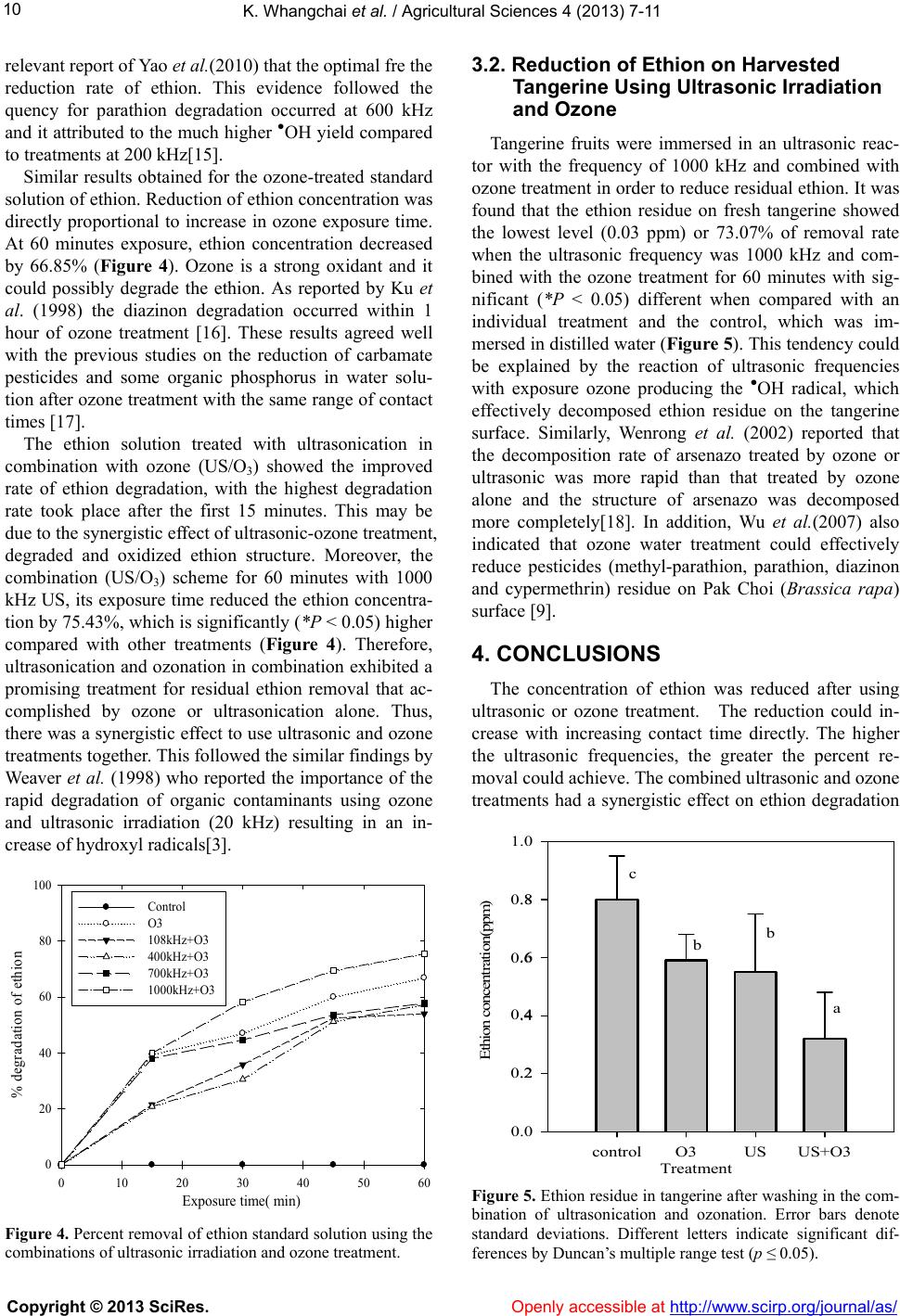 K. Whangchai et al. / Agricultural Sciences 4 (2013) 7-11 10 Copyright © 2013 SciRes. Openly accessible at http://www.scirp.org/journal/as/ relevant report of Yao et al.(2010) that the optimal fre the reduction rate of ethion. This evidence followed the quency for parathion degradation occurred at 600 kHz and it attributed to the much higher ●OH yield compared to treatments at 200 kHz[15]. Similar results obtained for the ozone-treated standard solution of ethion. Reduction of ethion concentration was directly proportional to increase in ozone exposure time. At 60 minutes exposure, ethion concentration decreased by 66.85% (Figure 4). Ozone is a strong oxidant and it could possibly degrade the ethion. As reported by Ku et al. (1998) the diazinon degradation occurred within 1 hour of ozone treatment [16]. These results agreed well with the previous studies on the reduction of carbamate pesticides and some organic phosphorus in water solu- tion after ozone treatment with the same range of contact times [17]. The ethion solution treated with ultrasonication in combination with ozone (US/O3) showed the improved rate of ethion degradation, with the highest degradation rate took place after the first 15 minutes. This may be due to the synergistic effect of ultrasonic-ozone treatment, degraded and oxidized ethion structure. Moreover, the combination (US/O3) scheme for 60 minutes with 1000 kHz US, its exposure time reduced the ethion concentra- tion by 75.43%, which is significantly (*P < 0.05) higher compared with other treatments (Figure 4). Therefore, ultrasonication and ozonation in combination exhibited a promising treatment for residual ethion removal that ac- complished by ozone or ultrasonication alone. Thus, there was a synergistic effect to use ultrasonic and ozone treatments together. This followed the similar findings by Weaver et al. (1998) who reported the importance of the rapid degradation of organic contaminants using ozone and ultrasonic irradiation (20 kHz) resulting in an in- crease of hydroxyl radicals[3]. Exposure time( min) 0 102030405060 % degradation of ethion 0 20 40 60 80 100 Control O3 108kHz+O3 400kHz+O3 700kHz+O3 1000kHz+O3 Figure 4. Percent removal of ethion standard solution using the combinations of ultrasonic irradiation and ozone treatment. 3.2. Reduction of Ethion on Harvested Tangerine Using Ultrasonic Irradiation and Ozone Tangerine fruits were immersed in an ultrasonic reac- tor with the frequency of 1000 kHz and combined with ozone treatment in order to reduce residual ethion. It was found that the ethion residue on fresh tangerine showed the lowest level (0.03 ppm) or 73.07% of removal rate when the ultrasonic frequency was 1000 kHz and com- bined with the ozone treatment for 60 minutes with sig- nificant (*P < 0.05) different when compared with an individual treatment and the control, which was im- mersed in distilled water (Figure 5). This tendency could be explained by the reaction of ultrasonic frequencies with exposure ozone producing the ●OH radical, which effectively decomposed ethion residue on the tangerine surface. Similarly, Wenrong et al. (2002) reported that the decomposition rate of arsenazo treated by ozone or ultrasonic was more rapid than that treated by ozone alone and the structure of arsenazo was decomposed more completely[18]. In addition, Wu et al.(2007) also indicated that ozone water treatment could effectively reduce pesticides (methyl-parathion, parathion, diazinon and cypermethrin) residue on Pak Choi (Brassica rapa) surface [9]. 4. CONCLUSIONS The concentration of ethion was reduced after using ultrasonic or ozone treatment. The reduction could in- crease with increasing contact time directly. The higher the ultrasonic frequencies, the greater the percent re- moval could achieve. The combined ultrasonic and ozone treatments had a synergistic effect on ethion degradation controlO3US US+O3 Ethion concentration(ppm) 0.0 .2 .4 .6 .8 1.0 0.8 0.6 0.4 0.2 Treatment c bb a Figure 5. Ethion residue in tangerine after washing in the com- bination of ultrasonication and ozonation. Error bars denote standard deviations. Different letters indicate significant dif- ferences by Duncan’s multiple range test (p ≤ 0.05).  K. Whangchai et al. / Agricultural Sciences 4 (2013) 7-11 Copyright © 2013 SciRes. http://www.scirp.org/journal/as/ 11 in both aqueous solution and ethion treated tangerines. Therefore, further studies to reduce the toxicity of pesti- cides contaminated agricultural products are also re- quired. Openly accessible at 5. ACKNOWLEDGEMENTS This research was supported by the Postharvest Technology Innova- tion Center, Commission on Higher Education, Bangkok. The authors are also grateful to the Faculty of Science and Postharvest Technology Research Institute, Chiang Mai University, Thailand for providing the laboratory facilities and to Honda Electronics Company Toyohashi, Aichi, Japan for ultrasonic device support. REFERENCES [1] Davis, F. S. and Albrigo, L. G. (1994) Citrus. CAB Interntioal, Walling, Oxon, U.K., p.254. [2] Wongkaew, L. (2009) Survey of the use of pesticides in tangerine in Chiang Mai province Thailand. Annual report of Department of Agriculture. http://it.doa.go.th/pibai/pibai/n13/v-6-july/jakfarm.html [3] Weavers, L.K., Ling, F.H. and Hoffmann, M.R. (1998) Aromatic compound degradation in water using a combi- nation of sonolysis and ozonolysis. Environmental Sci- ence & Technolology,32, 2727-2733. doi:10.1021/es970675a [4] Hoffmann, M.R, Hua, I. and HÖchemer, R. (1996) Application of ultrasonic irradiation for the degradation of chemical contaminants in water. Ultra sonics Sonochemistry, 3, S163-S172. doi:10.1016/s1350-4177(96)00022-3 [5] Wang, J., Pan, Z., Zhang, Z., Zhang, X., Wen, F., Ma, T., Jiang, Y., Wang, L., Xu, L. and Kang, P. ( 2006) Sono- catalytic degradation of methyl parathion in the cvpresence of nanometer and ordinary anatase titanium dioxide catalysts and comparison of their sonocatalytic abilities. Ultrasonics Sonochemistry, 13, 493-500. doi:10.1016/j.ultsonch.2005.11.002 [6] Song, W. and O’Shea, K.E. (2007) Ultrasonically induced degradation of 2-methylisoborneol and geosmin. Water Research, 41, 2672-2678. [7] Whangchai, K., Uthaibutra, J., Phiyanalinmat , S., Peng- phol, S. and Nomura,N. (2011) Effect of ozone treatment on the reduction of chlorpyrifos residues in fresh lychee fruits. Ozone Science and Engineering, 33, 232-236. doi:10.1080/01919512.2011.554313 [8] Inan, F., Pala, M. and Doymaz, I.( 2007) Use of ozone in detoxification of aflatoxin B1 in red pepper. Journal of Stored Product Research, 43, 425-429. doi:10.1016/j.jspr.2006.11.004 [9] Wu, J., Luan, T., Lan, C., Lo, T. W.H. and Chan, G. Y. S. (2007) Removal of residual pesticides on vegetable using ozonated water. Food Control, 18, 466-472. doi:10.1016/j.foodcont.2005.12.011 [10] Ethion.[Online].Available: http://toxipedia.org/display/toxi pedia/Ethion (January 19, 2011). [11] Eaton, A.D., Clesceri, L.S., Rice, E.W., Greenberg, A. E. (2005) Standard Methods for the Examination of Water and Waste-Water 21th ed. Am. J. Public Health. Washing- ton DC, USA. [12] Fenoll, J., P., Hellín, C.M., Martínez, Miguel, M. and Flores, P. (2007) Multiresidue method for analysis of pesticides in pepper and tomato by gas chromatography with nitrogen– phosphorus detection. Food Chemistry, 105, 711-719. doi:10.1016/j.foodchem.2006.12.060 [13] Pengpol,S.,Uthaibutra,J., Arquero, O. A., Nomura,N. (2011) Reduction of residual Chlorpyrifos on harvested bird chillies (Capsicum frutescens) using ultrasonication and ozonation. Thai Journal of Agri cultural Science, 44, 182-187. [14] Hart, E.J. and Henglein, A. (1985) Free radical and free atom reactions in the sonolysis of aqueous iodide and formate solutions. Journal of Physic Chemistry, 89, 4342- 4347. doi:10.1021/j100266a038 [15] Yao, J-J., Gao, N-Y., Li, C. and Xu, B. (2010) Mechanism and kinetics of parathion degradation under ultrasonic ir- radiation. Journal of Hazardous Materials, 175, 138-145. doi:10.1016/j.jhazmat.2009.09.140 [16] Ku, Y., Chang, J.L., Shen, Y.S. and Lin, S.Y. (1998) De- composition of diazinon in aqueous solution by ozonation. Water Research, 32, 1957-1963. doi:10.1016/s0043-1354(97)00353-9 [17] Faust, S.D. and Gomma, H.M. (1972) Chemical hydroly- sis of some organic phosphorus and carbamate pesticides in aquatic environment. Environmental Letters, 3, 171- 201. doi:10.1080/00139307209435465 [18] Wenrong, H. and Haiyan, P. (2002) Decomposed charac- teristic of azo dyes by ozonization with ultrasonic en- hancement. E-Journal of Chinese Science Bulletin, 47, 986-989. |