

Paper Menu >>
Journal Menu >>
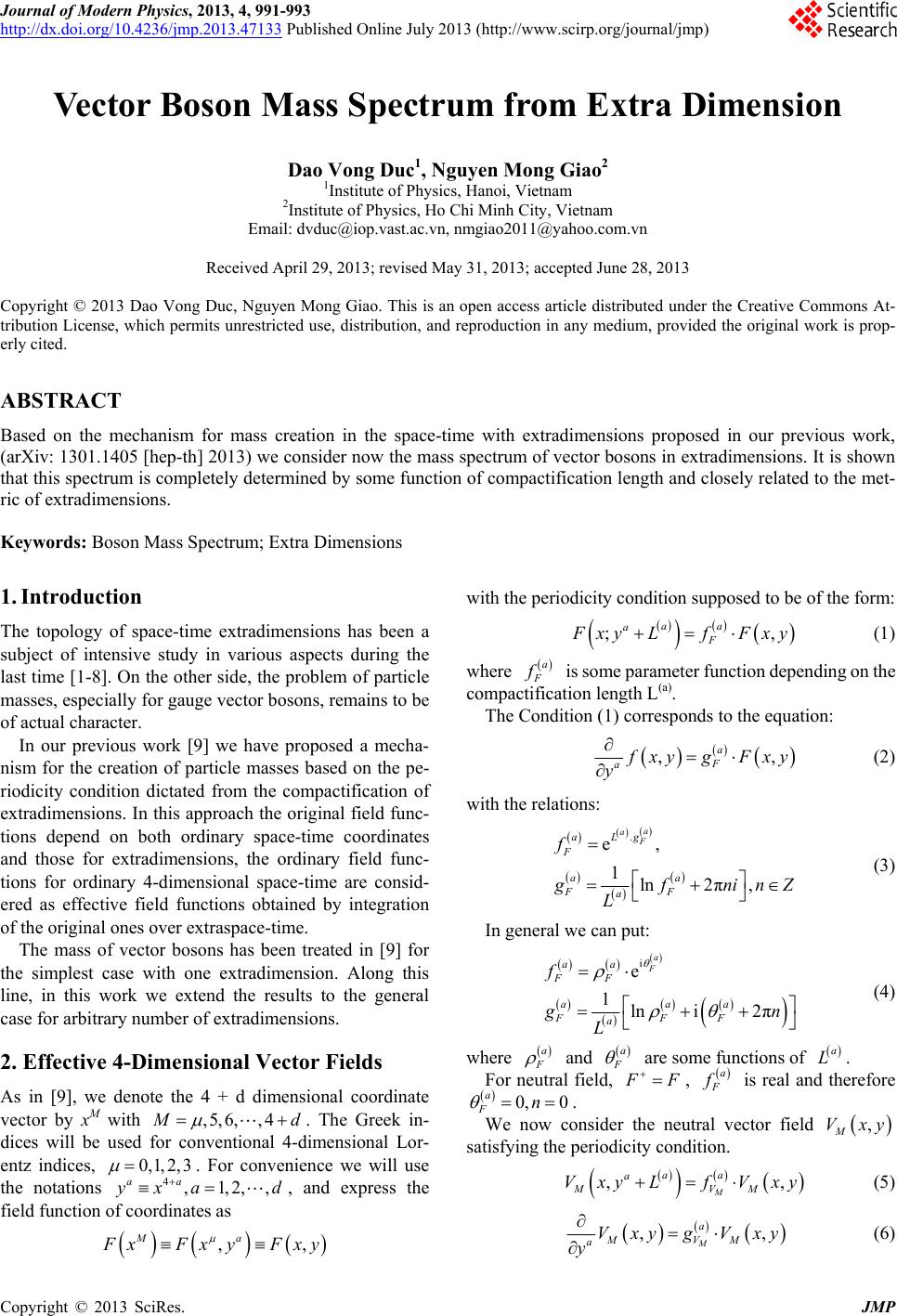 Journal of Modern Physics, 2013, 4, 991-993 http://dx.doi.org/10.4236/jmp.2013.47133 Published Online July 2013 (http://www.scirp.org/journal/jmp) Vector Boson Mass Spectrum from Extra Dimension Dao Vong Duc1, Nguyen Mong Giao2 1Institute of Physics, Hanoi, Vietnam 2Institute of Physics, Ho Chi Minh City, Vietnam Email: [email protected].vn, [email protected] Received April 29, 2013; revised May 31, 2013; accepted June 28, 2013 Copyright © 2013 Dao Vong Duc, Nguyen Mong Giao. This is an open access article distributed under the Creative Commons At- tribution License, which permits unrestricted use, distribution, and reproduction in any medium, provided the original work is prop- erly cited. ABSTRACT Based on the mechanism for mass creation in the space-time with extradimensions proposed in our previous work, (arXiv: 1301.1405 [hep-th] 2013) we consider now the mass spectrum of vector bosons in extradimensions. It is shown that this spectrum is completely determined by some function of compactification length and closely related to the met- ric of extradimensions. Keywords: Boson Mass Spectrum; Extra Dimensions 1. Introduction The topology of space-time extradimensions has been a subject of intensive study in various aspects during the last time [1-8]. On the other side, the problem of particle masses, especially for gauge vector bosons, remains to be of actual character. In our previous work [9] we have proposed a mecha- nism for the creation of particle masses based on the pe- riodicity condition dictated from the compactification of extradimensions. In this approach the original field func- tions depend on both ordinary space-time coordinates and those for extradimensions, the ordinary field func- tions for ordinary 4-dimensional space-time are consid- ered as effective field functions obtained by integration of the original ones over extraspace-time. The mass of vector bosons has been treated in [9] for the simplest case with one extradimension. Along this line, in this work we extend the results to the general case for arbitrary number of extradimensions. 2. Effective 4-Dimensional Vector Fields As in [9], we denote the 4 + d dimensional coordinate vector by xM with ,5,6, ,4 M d . The Greek in- dices will be used for conventional 4-dimensional Lor- entz indices, 0,1, 2, 3 4aa . For convenience we will use the notations ,1,2,, y xa d ,, , and express the field function of coordinates as Ma with the periodicity condition supposed to be of the form: xFxyFxy ;, aa aF F xyLfF xy a (1) where F f is some parameter function depending on the compactification length L(a). The Condition (1) corresponds to the equation: F ,, a F a f xygF xy y (2) with the relations: . e, 1ln 2π, a aF Lg a F aa FF a f fninZ L g (3) In general we can put: i e 1ln i2π a F aa FF aaa FFF a f n L g (4) a a where F and F are some functions of . a L a F For neutral field, F , F f is real and therefore 0, 0 a Fn . We now consider the neutral vector field , My Vx satisfying the periodicity condition. ,, M aa a MVM Vxy LfVxy (5) ,, M a MVM aVxyg Vxy y (6) C opyright © 2013 SciRes. JMP 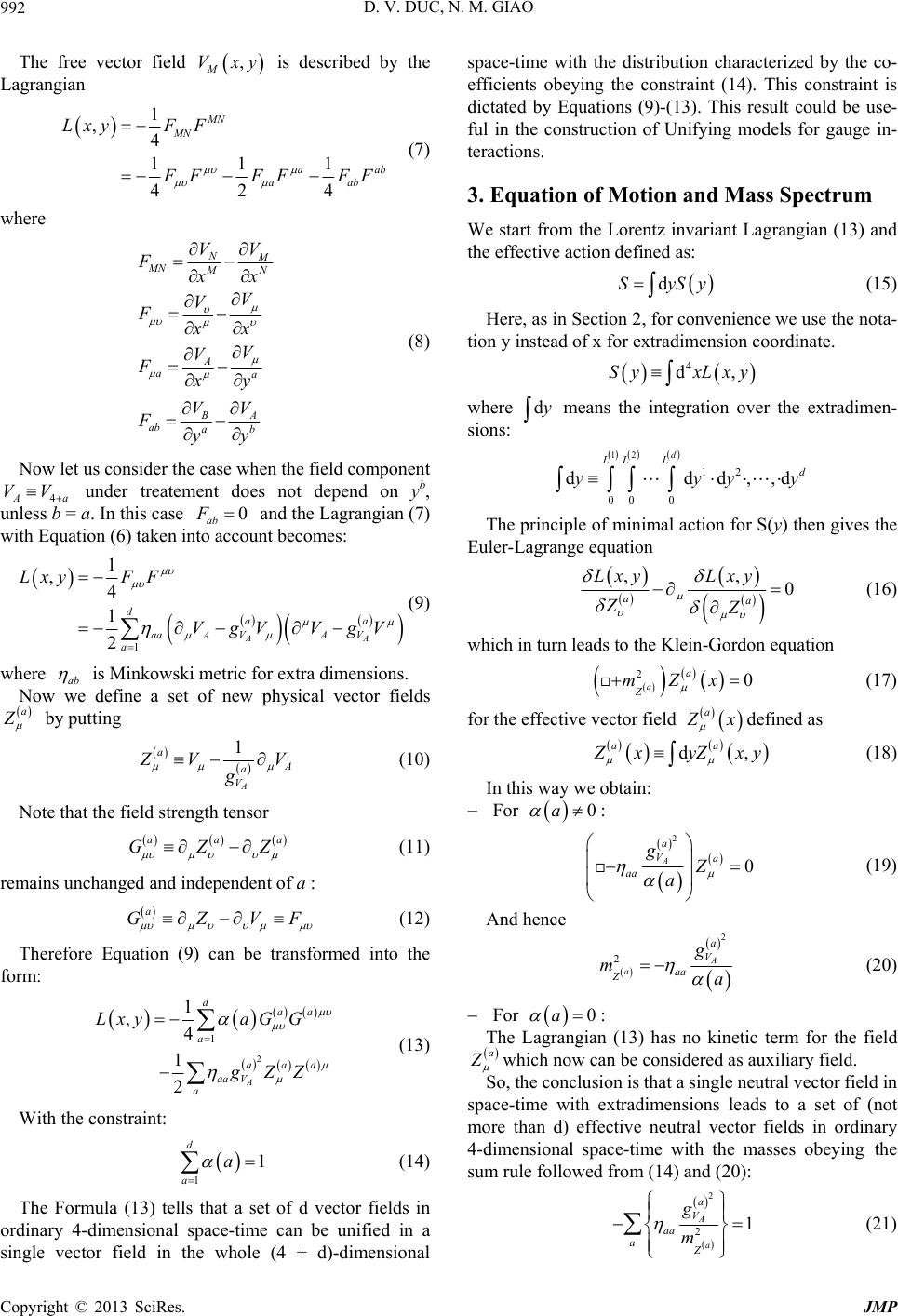 D. V. DUC, N. M. GIAO 992 The free vector field , MyVx is described by the Lagrangian 1 ,4 11 42 MN MN LxyF F 1 4 aa b aab F FF FFF (7) where N M MN M N Aa BA ab VV a ab F x x V V F x x V V F x y VV yy VV 0F F (8) Now let us consider the case when the field component 4Aa under treatement does not depend on yb, unless b = a. In this case ab and the Lagrangian (7) with Equation (6) taken into account becomes: 1 1 ,4 1 2A d aaA V a LxyF F VgV A aa AV VgV (9) where ab is Minkowski metric for extra dimensions. Now we define a set of new physical vector fields a Z by putting 1 A A a V a Z VV g aaa GZZ (10) Note that the field strength tensor V (11) remains unchanged and independent of a : a GZ F (12) Therefore Equation (9) can be transformed into the form: 2 A aa aaa V aG G gZZ 1 1 ,4 1 2 d a aa a Lxy 1 1 d a a dSySy (13) With the constraint: (14) The Formula (13) tells that a set of d vector fields in ordinary 4-dimensional space-time can be unified in a single vector field in the whole (4 + d)-dimensional space-time with the distribution characterized by the co- efficients obeying the constraint (14). This constraint is dictated by Equations (9)-(13). This result could be use- ful in the construction of Unifying models for gauge in- teractions. 3. Equation of Motion and Mass Spectrum We start from the Lorentz invariant Lagrangian (13) and the effective action defined as: (15) Here, as in Section 2, for convenience we use the nota- tion y instead of x for extradimension coordinate. 4 d,Sy xLxy dy where means the integration over the extradimen- sions: 12 12 00 0 ddd,,d d LL Ld yyyy The principle of minimal action for S(y) then gives the Euler-Lagrange equation ,, 0 aa Lxy Lxy ZZ (16) which in turn leads to the Klein-Gordon equation 20 a a Z mZx (17) a Z for the effective vector field x d, aa defined as xyZxy Z (18) In this way we obtain: For 0a : 2 0 A a Va aa gZ a (19) And hence 2 2A a a V aa Z g ma (20) For 0a : The Lagrangian (13) has no kinetic term for the field a Z which now can be considered as auxiliary field. So, the conclusion is that a single neutral vector field in space-time with extradimensions leads to a set of (not more than d) effective neutral vector fields in ordinary 4-dimensional space-time with the masses obeying the sum rule followed from (14) and (20): 2 21 A a a V aa aZ g m (21) Copyright © 2013 SciRes. JMP 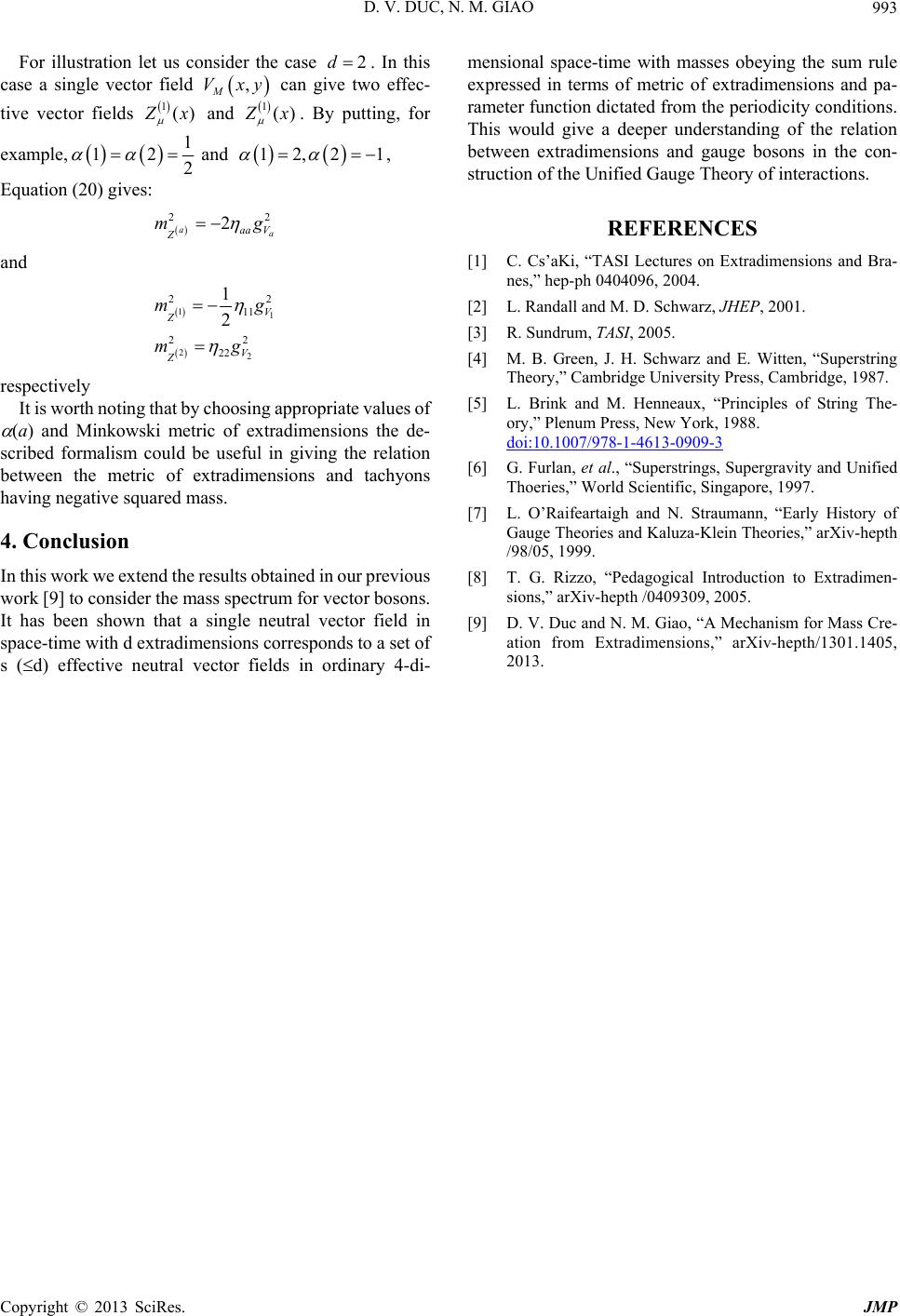 D. V. DUC, N. M. GIAO Copyright © 2013 SciRes. JMP 993 2dFor illustration let us consider the case . In this case a single vector field , M Vxy can give two effec- 1 1 () Z x and Z ()x . By putting, for tive vector fields example, 1 1 2 2 and , 12,2 1 Equation (20) gives: 22 2 aa aa V mg Z and 22 22 22 2 V mg 11 22 11 1 V mg Z Z respectively It is worth noting that by choosing appropriate values of (a) and Minkowski metric of extradimensions the de- scribed formalism could be useful in giving the relation between the metric of extradimensions and tachyons having negative squared mass. 4. Conclusion In this work we extend the results obtained in our previous work [9] to consider the mass spectrum for vector bosons. It has been shown that a single neutral vector field in space-time with d extradimensions corresponds to a set of s (d) effective neutral vector fields in ordinary 4-di- mensional space-time with masses obeying the sum rule expressed in terms of metric of extradimensions and pa- rameter function dictated from the periodicity conditions. This would give a deeper understanding of the relation between extradimensions and gauge bosons in the con- struction of the Unified Gauge Theory of interactions. REFERENCES [1] C. Cs’aKi, “TASI Lectures on Extradimensions and Bra- nes,” hep-ph 0404096, 2004. [2] L. Randall and M. D. Schwarz, JHEP, 2001. [3] R. Sundrum, TASI, 2005. [4] M. B. Green, J. H. Schwarz and E. Witten, “Superstring Theory,” Cambridge University Press, Cambridge, 1987. [5] L. Brink and M. Henneaux, “Principles of String The- ory,” Plenum Press, New York, 1988. doi:10.1007/978-1-4613-0909-3 [6] G. Furlan, et al., “Superstrings, Supergravity and Unified Thoeries,” World Scientific, Singapore, 1997. [7] L. O’Raifeartaigh and N. Straumann, “Early History of Gauge Theories and Kaluza-Klein Theories,” arXiv-hepth /98/05, 1999. [8] T. G. Rizzo, “Pedagogical Introduction to Extradimen- sions,” arXiv-hepth /0409309, 2005. [9] D. V. Duc and N. M. Giao, “A Mechanism for Mass Cre- ation from Extradimensions,” arXiv-hepth/1301.1405, 2013. |