

Paper Menu >>
Journal Menu >>
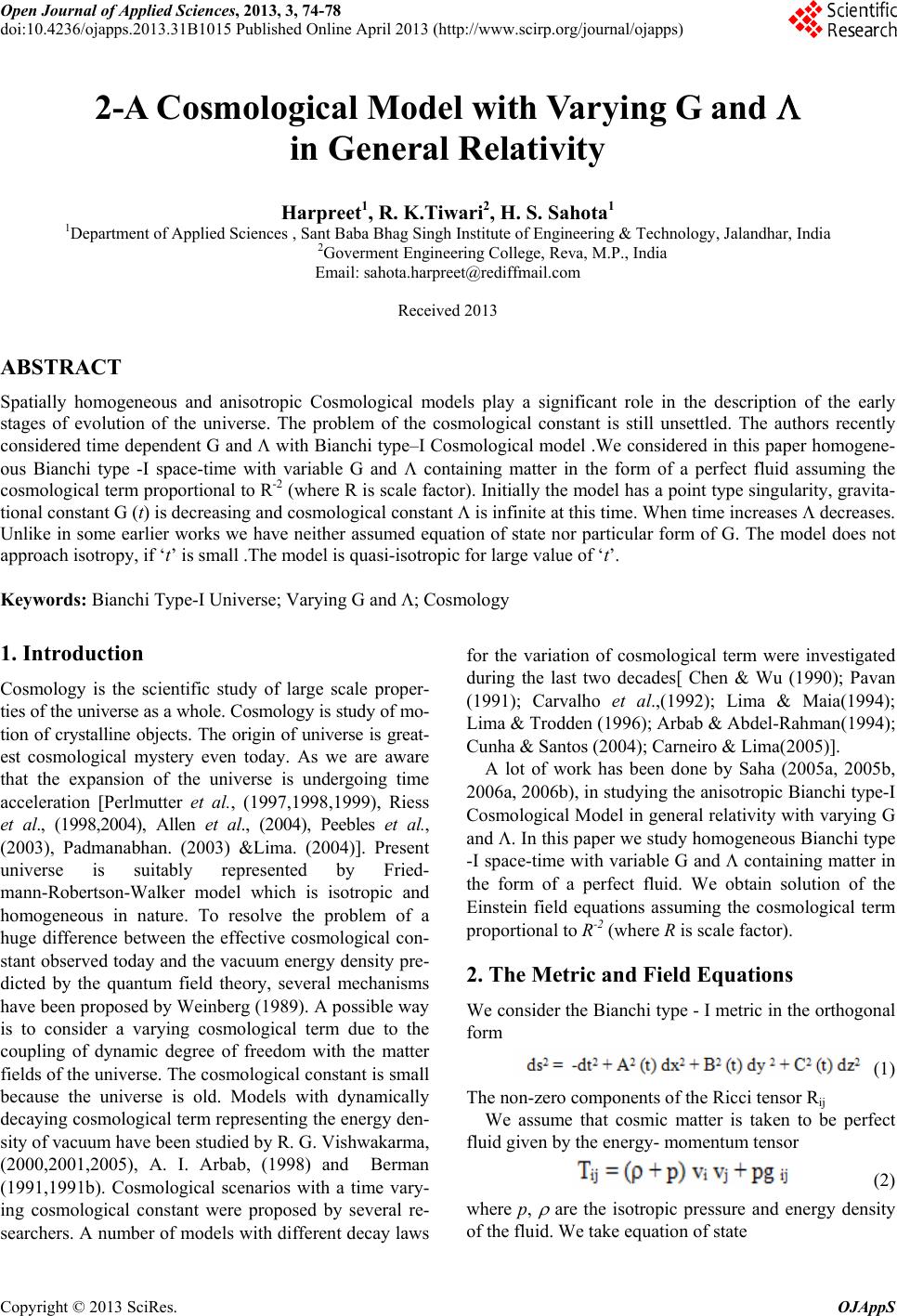 Open Journal of Applied Sciences, 2013, 3, 74-78 doi:10.4236/ojapps.2013.31B1015 Published Online April 2013 (http://www.scirp.org/journal/ojapps) 2-A Cosmological Model with Varying G and in General Relativity Harpreet1, R. K.Tiwari2, H. S. Sahota1 1Department of Applied Sciences , Sant Baba Bhag Singh Institute of Engineering & Technology, Jalandhar, India 2Goverment Engineering College, Reva, M.P., India Email: [email protected] Received 2013 ABSTRACT Spatially homogeneous and anisotropic Cosmological models play a significant role in the description of the early stages of evolution of the universe. The problem of the cosmological constant is still unsettled. The authors recently considered time dependent G and with Bianchi type–I Cosmological model .We considered in this paper homogene- ous Bianchi type -I space-time with variable G and containing matter in the form of a perfect fluid assuming the cosmological term proportional to R-2 (where R is scale factor). Initially the model has a point type singularity, gravita- tional constant G (t) is decreasing and cosmological constant is infinite at this time. When time increases decreases. Unlike in some earlier works we have neither assumed equation of state nor particular form of G. The model does not approach isotropy, if ‘t’ is small .The model is quasi-isotropic for large value of ‘t’. Keywords: Bianchi Type-I Universe; Varying G and ; Cosmology 1. Introduction Cosmology is the scientific study of large scale proper- ties of the universe as a whole. Cosmology is study of mo- tion of crystalline objects. The origin of universe is great- est cosmological mystery even today. As we are aware that the expansion of the universe is undergoing time acceleration [Perlmutter et al., (1997,1998,1999), Riess et al., (1998,2004), Allen et al., (2004), Peebles et al., (2003), Padmanabhan. (2003) &Lima. (2004)]. Present universe is suitably represented by Fried- mann-Robertson-Walker model which is isotropic and homogeneous in nature. To resolve the problem of a huge difference between the effective cosmological con- stant observed today and the vacuum energy density pre- dicted by the quantum field theory, several mechanisms have been proposed by Weinberg (1989). A possible way is to consider a varying cosmological term due to the coupling of dynamic degree of freedom with the matter fields of the universe. The cosmological constant is small because the universe is old. Models with dynamically decaying cosmological term representing the energy den- sity of vacuum have been studied by R. G. Vishwakarma, (2000,2001,2005), A. I. Arbab, (1998) and Berman (1991,1991b). Cosmological scenarios with a time vary- ing cosmological constant were proposed by several re- searchers. A number of models with different decay laws for the variation of cosmological term were investigated during the last two decades[ Chen & Wu (1990); Pavan (1991); Carvalho et al.,(1992); Lima & Maia(1994); Lima & Trodden (1996); Arbab & Abdel-Rahman(1994); Cunha & Santos (2004); Carneiro & Lima(2005)]. A lot of work has been done by Saha (2005a, 2005b, 2006a, 2006b), in studying the anisotropic Bianchi type-I Cosmological Model in general relativity with varying G and . In this paper we study homogeneous Bianchi type -I space-time with variable G and containing matter in the form of a perfect fluid. We obtain solution of the Einstein field equations assuming the cosmological term proportional to R-2 (where R is scale factor). 2. The Metric and Field Equations We consider the Bianchi type - I metric in the orthogonal form (1) The non-zero components of the Ricci tensor Rij We assume that cosmic matter is taken to be perfect fluid given by the energy- momentum tensor (2) where p, are the isotropic pressure and energy density of the fluid. We take equation of state Copyright © 2013 SciRes. OJAppS 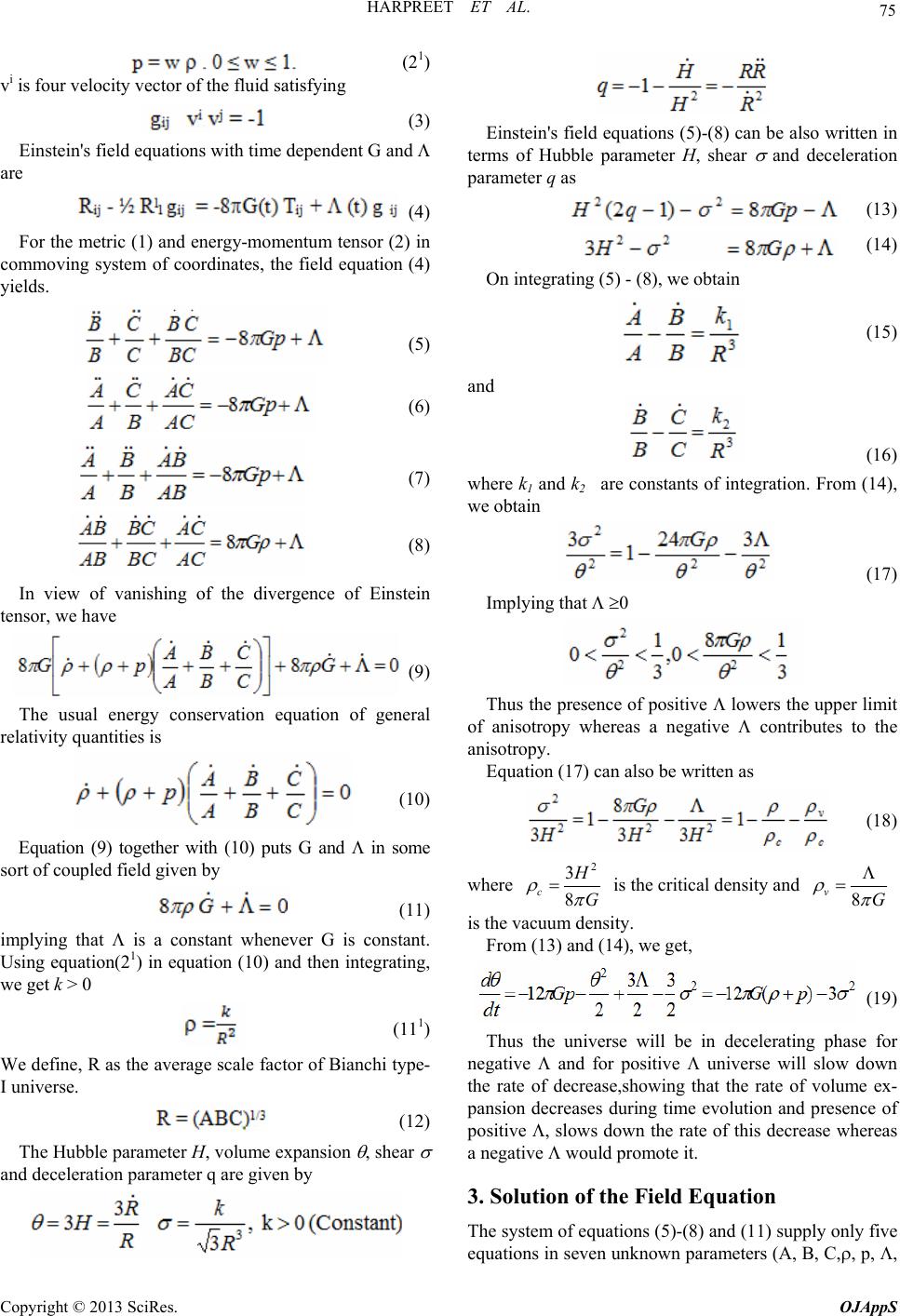 HARPREET ET AL. 75 (2 1) vi is four velocity vector of the fluid satisfying (3) Einstein's field equations with time dependent G and are (4) For the metric (1) and energy-momentum tensor (2) in commoving system of coordinates, the field equation (4) yields. (5) (6) (7) (8) In view of vanishing of the divergence of Einstein tensor, we have (9) The usual energy conservation equation of general relativity quantities is (10) Equation (9) together with (10) puts G and in some sort of coupled field given by (11) implying that is a constant whenever G is constant. Using equation(21) in equation (10) and then integrating, we get k > 0 (11 1) We define, R as the average scale factor of Bianchi type- I universe. (12) The Hubble parameter H, volume expansion , shear and deceleration parameter q are given by Einstein's field equations (5)-(8) can be also written in terms of Hubble parameter H, shear and deceleration parameter q as (13) (14) On integrating (5) - (8), we obtain (15) and (16) where k1 and k2 are constants of integration. From (14), we obtain (17) Implying that 0 Thus the presence of positive lowers the upper limit of anisotropy whereas a negative contributes to the anisotropy. Equation (17) can also be written as (18) where 2 3 8 c H G is the critical density and 8 vG is the vacuum density. From (13) and (14), we get, (19) Thus the universe will be in decelerating phase for negative and for positive universe will slow down the rate of decrease,showing that the rate of volume ex- pansion decreases during time evolution and presence of positive , slows down the rate of this decrease whereas a negative would promote it. 3. Solution of the Field Equation The system of equations (5)-(8) and (11) supply only five equations in seven unknown parameters (A, B, C,, p, , Copyright © 2013 SciRes. OJAppS 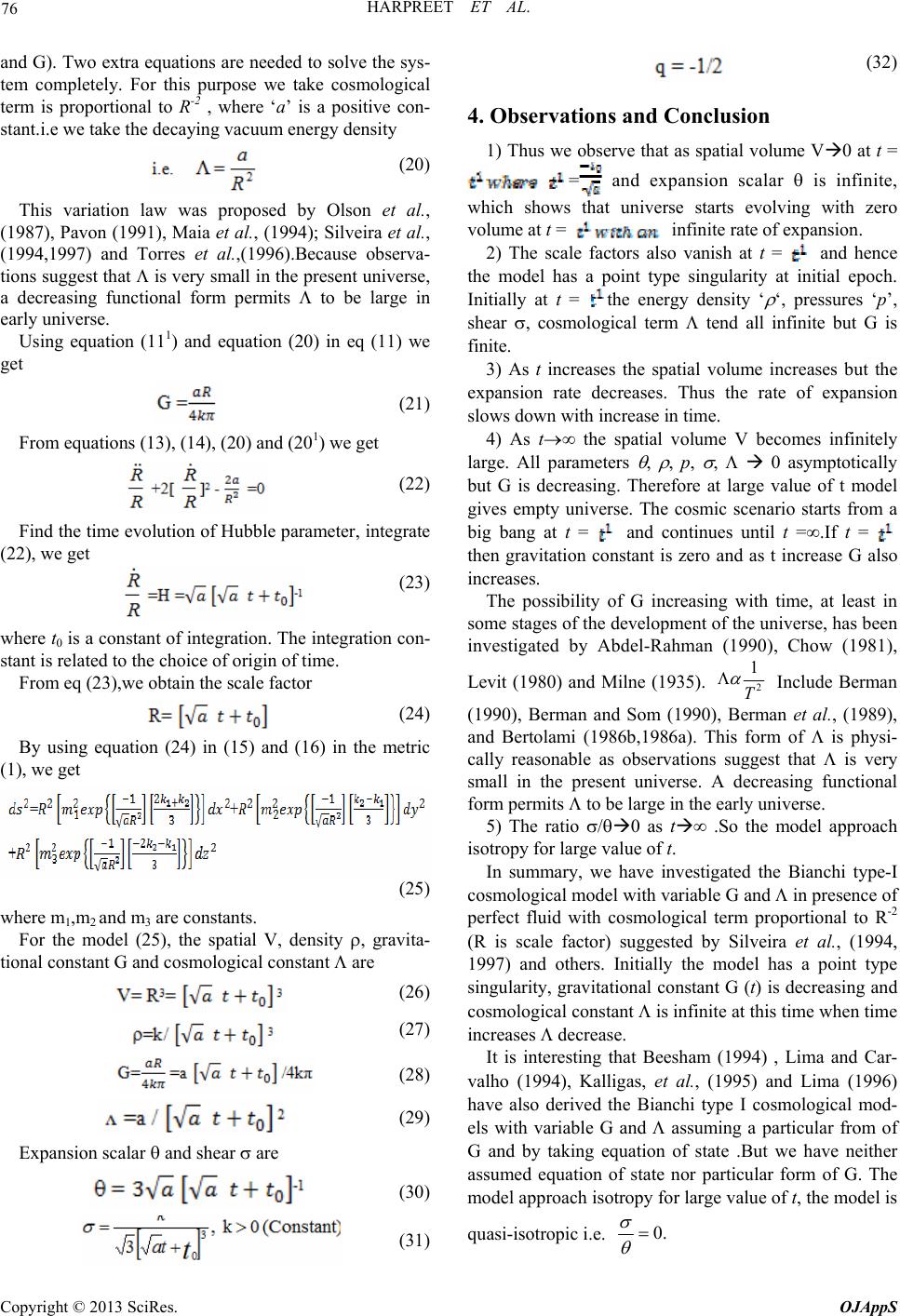 HARPREET ET AL. 76 and G). Two extra equations are needed to solve the sys- tem completely. For this purpose we take cosmological term is proportional to R-2 , where ‘a’ is a positive con- stant.i.e we take the decaying vacuum energy density (20) This variation law was proposed by Olson et al., (1987), Pavon (1991), Maia et al., (1994); Silveira et al., (1994,1997) and Torres et al.,(1996).Because observa- tions suggest that is very small in the present universe, a decreasing functional form permits to be large in early universe. Using equation (111) and equation (20) in eq (11) we get (21) From equations (13), (14), (20) and (201) we get (22) Find the time evolution of Hubble parameter, integrate (22), we get (23) where t0 is a constant of integration. The integration con- stant is related to the choice of origin of time. From eq (23),we obtain the scale factor (24) By using equation (24) in (15) and (16) in the metric (1), we get (25) where m1,m2 and m3 are constants. For the model (25), the spatial V, density , gravita- tional constant G and cosmological constant are (26) (27) (28) (29) Expansion scalar and shear are (30) (31) (32) 4. Observations and Conclusion 1) Thus we observe that as spatial volume V0 at t = = and expansion scalar is infinite, which shows that universe starts evolving with zero volume at t = infinite rate of expansion. 2) The scale factors also vanish at t = and hence the model has a point type singularity at initial epoch. Initially at t = the energy density ‘ ‘, pressures ‘p’, shear , cosmological term tend all infinite but G is finite. 3) As t increases the spatial volume increases but the expansion rate decreases. Thus the rate of expansion slows down with increase in time. 4) As t the spatial volume V becomes infinitely large. All parameters , , p, , 0 asymptotically but G is decreasing. Therefore at large value of t model gives empty universe. The cosmic scenario starts from a big bang at t = and continues until t =.If t = then gravitation constant is zero and as t increase G also increases. The possibility of G increasing with time, at least in some stages of the development of the universe, has been investigated by Abdel-Rahman (1990), Chow (1981), Levit (1980) and Milne (1935). 2 1 T Include Berman (1990), Berman and Som (1990), Berman et al., (1989), and Bertolami (1986b,1986a). This form of is physi- cally reasonable as observations suggest that is very small in the present universe. A decreasing functional form permits to be large in the early universe. 5) The ratio /0 as t∞ .So the model approach isotropy for large value of t. In summary, we have investigated the Bianchi type-I cosmological model with variable G and in presence of perfect fluid with cosmological term proportional to R-2 (R is scale factor) suggested by Silveira et al., (1994, 1997) and others. Initially the model has a point type singularity, gravitational constant G (t) is decreasing and cosmological constant is infinite at this time when time increases decrease. It is interesting that Beesham (1994) , Lima and Car- valho (1994), Kalligas, et al., (1995) and Lima (1996) have also derived the Bianchi type I cosmological mod- els with variable G and assuming a particular from of G and by taking equation of state .But we have neither assumed equation of state nor particular form of G. The model approach isotropy for large value of t, the model is quasi-isotropic i.e. 0. Copyright © 2013 SciRes. OJAppS  HARPREET ET AL. 77 REFERENCES [1] B. Saha, “Anisotropic Cosmological Models with a Per- fect Fluid and a Term,” Astrophysics and Space Science , Vol. 302, No. 1-4, 2006a, pp. 83-91. [2] B. Saha, “Anisotropic Cosmological Models with a Per- fect Fluid and Dark Energy Reexamined,” International Journal of Theoretical Physics, Vol. 45, No. 5, 2006b, pp. 952-964. [3] B. Saha, “Bianchi Type I Universe With Viscous Fluid,” Modern Physics Letters A, Vol. 20, No. 28, 2005, p. 2127. doi:10.1142/S021773230501830X [4] B. Saha, “Anisotropic Cosmological Models with Perfect Fluid and Dark Energy,”Chinese, 2005. [5] R. G. Vishwakarma, “A Model to Explain Varying, G and Simultaneously,” General Relativity and Gravitation, Vol. 37, No. 7, 2005, pp. 1305-1311. doi:10.1007/s10714-005-0113-0 [6] S. Carneiro and J. A. S. Lima, “Time Dependent Cosmo- logical Term and Holography,” Modern International Journal of Physics A, Vol. 20, No. 11, 2005, p. 2465. doi:10.1142/S0217751X0502478X [7] J. V. Cunha, R. C. Santos, “The Existence Of An Old Quasar At Z = 3.91 And Its Implications For Λ(T) Defla- tionary Cosmologies Read,” Modern International Jour- nal of Physics D, Vol. 13, No. 7, 2004, p. 1321. doi.org/10.1142/S0218271804005481 [8] A. G. Riess, et al., Astro nomical Journal, pp. 607- 665. [9] S. W. Allen, et al., “Probing Dark Energy with Constella- tion-X,” Monthly Notices of the Royal Astronomical So- ciety, Vol. 353, No. 2, 2004, pp. 457-467. doi:10.1111/j.1365-2966.2004.08080.x [10] J. A. S. Lima “Alternative Dark Energy Models: An Overview,” Brazilian Journal of Physics, Vol. 34, No. 1a, 2004, pp. 194-200. doi:10.1590/S0103-97332004000200009 [11] T. Padmanabhan, “Cosmological Constant the Weight of the Vacuum,” Physics Report, Vol. 380, No. 5-6, 2003, pp. 235-320. doi:10.1016/S0370-1573(03)00120-0 [12] P. J. E. Peebles and B. Ratra, “The Cosmological Con- stant and Dark Energy,” Reviews of Modern Physics, Vol. 75, No. 2, 2003, pp. 559-606. doi:10.1103/RevModPhys.75.559 [13] R. G. Vishwakarma, “Study of the Magnitude-Redshift Relation for Type Ia Supernovae in a Model Resulting from a Ricci-Symmetry,” General Relativivity and Grav- ity, Vol. 33, 2001, p. 1973. [14] R. A. Vishwakarma, “A Study of Angular Size-redshift Relation for Models in Which ᴧ Decays as the Energy Density,” Class Quantum Gravity, Vol. 17, 2000, pp. 38-33. doi:10.1088/0264-9381/17/18/317 [15] S. Perlmutter, et al., “Measurements of Ω and Λ from 42 High-Redshift Supernovae,” Astrophysical Journal, 1999, pp. 517- 565. [16] I. Arbab, “Bianchi Type I Universe with Variable G and ᴧ,” General Relativity and Gravitation, Vol. 30, No. 9,1998, pp. 1401-1405. doi:0.1023/A:1018856625508 [17] S. Perlmutter, et al., “Discovery of a Supernova Explo- sion at Half the Age of the Universe,” Nature, Vol. 391, 1998. [18] A. G. Riess, et al., “Observational Evidence from Super- novae for an Accelerating Universe and a Cosmological Constant,” the Astronphysical Journal, Vol. 116 , 1998, p. 1009. [19] S. Perlmutter, et al., “Measurements of the Cosmological Parameters Ω and Λ from the First Seven Supernovae at z ≥ 0.35,” the Astrophysical Journal, Vol. 483, No. 2,1997, p. 565.doi:10.1086/304265. [20] V. Silveira and J. Waga, “Cosmological Properties of a Class of ᴧ Decaying Cosmologies,” Physical Review D, Vol. 56, 1997, p. 4625. [21] J. A. S. Lima and M. Trodden, “Decaying Vacuum En- ergy and Deflationary Cosmology in Open and Closed Unverses,” Physical Review D, Vol. 53, No. 8, 1996, pp. 4280-4286. doi: 10.1103/PhysRevD.53.4280 [22] J. A. S. Lima, “Thermodynamics of Decaying Vacuum Cosmologies,” Physical Review D, Vol. 54, p. 2571. [23] L. F. B. Torres and I. Waga, “Decaying Lambda Cos- mologies and Statistical Properties of Gravitational Lens- es,” Monthly Noices of the Royal Astronomical Society, Vol. 279, 1996, pp. 712-726. doi: 10.1093/mnras/279.3.712 [24] D. Kalligas, P. S. Wesson and C. W. F. Everitt, “Bianchi Type I Cosmological Models with VariableG and Λ: A Comment, General Relativity and Gravitivity, Vol. 27, 1995, pp. 645-650. doi:10.1007/BF02108066 [25] A. I. Arbab and A. M. M. Abdel-Rahaman, “Nonsingular Cosmology with a Time-dependent Cosmological Term,” Physical Review D, Vol. 50, 1994, pp. 7725-7728. doi:10.1103/PhysRevD.50.7725 [26] A. Beesham, General Relativity and Gravitivity, Vol. 26 1599. [27] J. A. S. Lima and J. M. F. Maia, Physical Review D, Vol. 49, 1994, p. 5579. [28] J. A. S.Lima and J. C. Carvalho, “Dirac's Cosmology with Varying Cosmological Constant,” General Relativity and Gravitivity, Vol. 26, 1994, pp. 909-916. doi10.1007/BF02107147 [29] M. D. Maia and G. S. Silva, “Geometrical Constraints on the Cosmological Constant,” Physical Review D, Vol. 50 , 1994, pp. 7233-7238. doi:10.1103/PhysRevD.50.7233 [30] V. Silveira and J. Waga, “Decaying ᴧ Cosmologies and Power Spectrum,” Physical Review D, Vol. 50, 1994, pp. 4890-4894. doi:10.1103/PhysRevD.50.4890 [31] J. C. Carvalho, J. A. S. Lima and I. Waga, “Cosmological Consequences of a Time-dependent Term,” Physical Review D, Vol. 46, No. 6, 1992, pp. 2404-2407. doi:10.1103/PhysRevD.46.2404 [32] M. S. Berman, “Cosmological Models with Variable Gravitational and Cosmological Constants,” General Relativity and Gravitation, Vol. 23, 1991a, pp. 465-469. doi:10.1007/BF00756609 [33] M. S. Berman, “Cosmological Models with Variable- Copyright © 2013 SciRes. OJAppS  HARPREET ET AL. Copyright © 2013 SciRes. OJAppS 78 Cosmological Term,” Physical Review D, Vol. 43, 1991b, pp. 1075-1078. [40] M. S. Berman, M. M. Som and F. M. Gomide, “Brans-Dicke Static Universes,” General Relativity and Gravitation, Vol. 21, 1989, pp. 287-292. doi:10.1007/BF00764101 [34] D. Pavon, “Nonequilibrium Fluctions in Cosmic Vacuum Decay,” Physical Review D, Vol. 43, 1991, pp. 375-378. doi:10.1103/PhysRevD.43.375 [41] S. Weinberg, “The Cosmological Constant Problem,” Review Modern Physics, Vol. 61, 1989, pp. 1-23. doi:10.1103/RevModPhys.61.1 [35] A. M. M. Abdel - Rahaman, “A Critical Density Cosmo- logical Model with Varying Gravitation and Cosmologi- cal Constants,” General Relativity and Gravitation, Vol. 22, No. 6, 1990, pp. 655-663. doi:10.1007/BF00755985 [42] T. S. Olson and T. F. Jordan, “Ages of the Universe for Decreasing Cosmological Constants,” Physical Review D, Vol. 35, 1987, pp. 3258-3260. doi:10.1103/PhysRevD.35.3258 [36] M. Berman, “Static Universe in a Modified Brans- dicke Cosmology,” International Journal of Theoretical Phys- ics, Vol. 29, 1990, pp. 567-570. doi:10.1007/BF00672031 [43] O. Bertolami Brans-Dicke, “Cosmology with a Scalar Field Dependent Cosmological Term,” Fortsch Physics, Vol. 34, 1986b, p. 829. [37] M. S. Berman and M. M. Som, “Brans-Dicke Models with Time-dependent Cosmological Term,” International Journal of Theory Physics, Vol. 29, 1990, pp. 1411-1414. doi:10.1007/BF00674120 [44] O. Bertolami, “Time-dependence Cosmological Term,” Nuovo Cimento B, Vol. 93, 1986a, pp. 36-42. doi:10.1007/BF02728301 [38] W. Chen and Y. S. Wu, “Implication of a Cosmological Constant Varying as ,” Physical Review D, Vol. 41, 1990, p. 695. [45] T. L. Chow, “The Variability of the Gravitational Con- stant,” Nuovo Cimento Lettere, Vol. 31, 1981, pp. 119-120. doi:10.1007/BF02822409 [46] L. S. Levitt, “The Gravitational Constraint at Time Zero,” Nuovo Cimento,Lettere, Serie 2, Vol. 29 , 1980, p. 23. [39] E. A. Milne, “Relativity, Gravitation and World struc- ture,” Oxford University Press, Oxford, 1935. |