

Paper Menu >>
Journal Menu >>
 Open Journal of Applied Sciences, 2013, 3, 70-73 doi:10.4236/ojapps.2013.31B1014 Published Online April 2013 (http://www.scirp.org/journal/ojapps) A Modified Augemented Lagrangian Method for a Class of Nonlinear Ill-Posed Problems Mhbm Shariff Department of Applied Mathematics and Sciences, Khalifa University, Sharjah, UAE Email: [email protected] Received 2013 ABSTRACT A class of nonlinear problems with real parameters is defined. Generally, in this class of problems, when the parametric values are very large, the problems become ill-posed and numerical difficulties are encountered when trying to solve these problems. In this paper, the nonlinear problems are reformulated to overcome the numerical difficulties associated with large parametric values. A novel iterative algorithm, which is suitable for large scale problems and can be easily parallelized, is proposed to solve the reformulated problems. Numerical tests indicate that the proposed algorithm gives stable solutions. Convergence properties of the proposed algorithm are investigated. In the limiting case, when the cor- responding constraint is exactly satisfied, the proposed method is equivalent to the standard augmented Lagrangian method. Keywords: Iterative Method; Nonlinear; Ill-conditioned; Large Parameter Values; Large-scale 1. Introduction There are a number of physical problems, where penalty terms (large parameter) occur naturally in the problems. For example, in nonlinear isotropic elasticity, the bulk modulus [1] can be considered as a penalty term for the incompressible constraint. When the penalty term is very large the corresponding constraint is nearly satisfied. Generally, numerical difficulties are encountered, see, e.g., [2], when trying to solve problems with very large penalty values. In this paper we consider a class of parametric prob- lems that can be reformulated in such a way that the nu- merical difficulties mentioned above can be overcome. The reformulated problem generally yields indefinite system of equations. When such a system is solved using an existing iterative method, its convergence properties are generally not as good as an iterative method design for a symmetric positive definite system. Here, we pro- posed a novel iterative algorithm to solve the reformu- lated problem. The proposed algorithm solves a symmet- ric positive definite system in each iteration. The con- vergence properties of the proposed algorithm are inves- tigated and numerical tests are implemented. The algo- rithm is an extension of the algorithm developed by Shariff [3] for quadratic problems with (near) linear con- straints. Our proposed method is suitable for large scale problems in the sense that it only uses a handful of vec- tors in the algorithm. The proposed algorithm is easily parallelized and is especially suitable for sparse system of equations. 2. A Class of Nonlinear Constrained Problems Consider a class of nonlinear problems which is of the form Problem (I): Minimize 1 ()( ()), m i i fx εχhx where is a real constant (can be considered as a pen- alty term), 1 and :RR with the properties (a) is twice continuously differentiable and strictly convex on R (b) ' (0)0, (0)0 limlim( )l and '' (0) 1 '' im( ) (c) .im l tt tt t Examples of the function t ()t . are: 2 9 () [2], 2 ()cosh()1 [2], 1 ln( 1)(( 1)1) 9 () [4], 9 ()ln(1) [5]. t t tt tt t tt t Copyright © 2013 SciRes. OJAppS 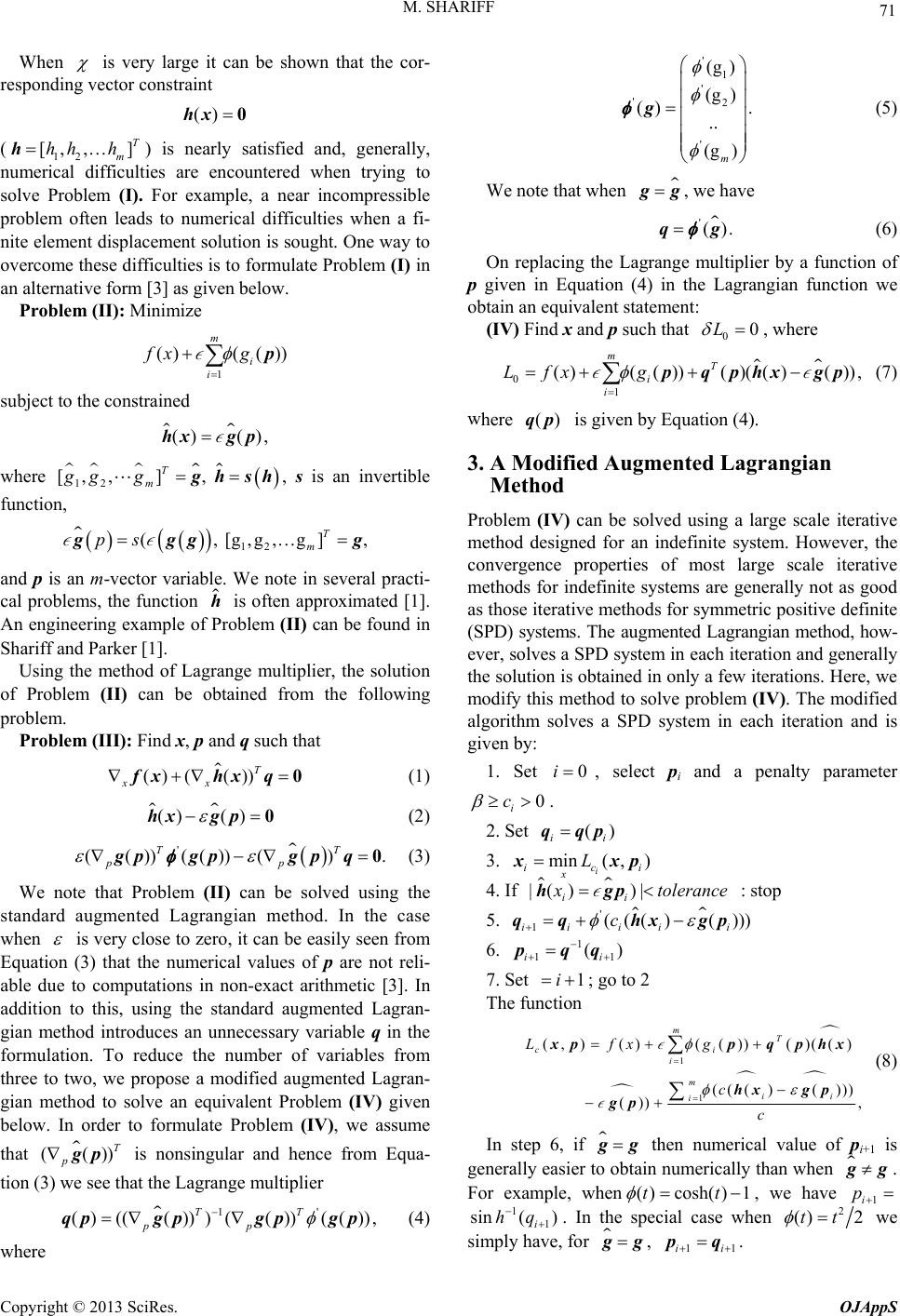 M. SHARIFF 71 When is very large it can be shown that the cor- responding vector constraint ()hx 0 (12 ) is nearly satisfied and, generally, numerical difficulties are encountered when trying to solve Problem (I). For example, a near incompressible problem often leads to numerical difficulties when a fi- nite element displacement solution is sought. One way to overcome these difficulties is to formulate Problem (I) in an alternative form [3] as given below. [, ,]h T m hh h Problem (II): Minimize 1 ()(())p m i i fx g subject to the constrained () (),hxg p where 12 [,,], g hshT m gg g, s is an invertible function, 12 (, [g,g,g]ggg T m ps ,g T and p is an m-vector variable. We note in several practi- cal problems, the function is often approximated [1]. An engineering example of Problem (II) can be found in Shariff and Parker [1]. h Using the method of Lagrange multiplier, the solution of Problem (II) can be obtained from the following problem. Problem (III): Find x, p and q such that () (())fxhx q 0 T xx (1) () ()hxg p0 (2) ' (( ))( ( ))().gpgpg pq 0 T pp (3) We note that Problem (II) can be solved using the standard augmented Lagrangian method. In the case when is very close to zero, it can be easily seen from Equation (3) that the numerical values of p are not reli- able due to computations in non-exact arithmetic [3]. In addition to this, using the standard augmented Lagran- gian method introduces an unnecessary variable q in the formulation. To reduce the number of variables from three to two, we propose a modified augmented Lagran- gian method to solve an equivalent Problem (IV) given below. In order to formulate Problem (IV), we assume that (()) g pT p is nonsingular and hence from Equa- tion (3) we see that the Lagrange multiplier 1' ( )((( )))(( ))(()),qp g p g p g p TT pp (4) where (5) We note that when ' 1 ' '2 ' (g ) (g ) () . .. (g ) g m gg , we have '().q g (6) On replacing the Lagrange mult p iplier by a function of given in Equation (4) in the Lagrangian function we obtain an equivalent statement: (IV) Find x and p such that 00L , where (7) where is given by Equation (4). 3. A Modified Augmented Lagrangian Pr solved using a large scale iterative 0 1 ()(())( )(( )( )),pqphx gp T i i Lfx g m ()qp Method oblem (IV) can be method designed for an indefinite system. However, the convergence properties of most large scale iterative methods for indefinite systems are generally not as good as those iterative methods for symmetric positive definite (SPD) systems. The augmented Lagrangian method, how- ever, solves a SPD system in each iteration and generally the solution is obtained in only a few iterations. Here, we modify this method to solve problem (IV). The modified algorithm solves a SPD system in each iteration and is given by: 1. Set 0 i, select pi and a penalty parameter 0 i c . ()qqp2. Set ii 3. ,xmin ()xp i ic xL i |() )|hgp ii f 4. I x tolerance ' : stop et 5. )))q 1((( )(qhx gp ii iii c 6. 1 11 ()pqq ii 7. S1 i; go nction to 2 The fu 1 1 (, )()(())()(() ( (()())) ()), m T ci i m ii i Lfxg c c xppqp hx hxg p gp (8) In step 6, if gg obta then numerical value of p is ge i+1 nerally easier toin numerically than when gg . For example, when()cosh() 1 tt , we have 1 i p 1 1 sin ( ) i hq . In the sen pecial case wh2 ()tt for gg 2 we simply have, , 11 pq ii . Copyright © 2013 SciRes. OJAppS 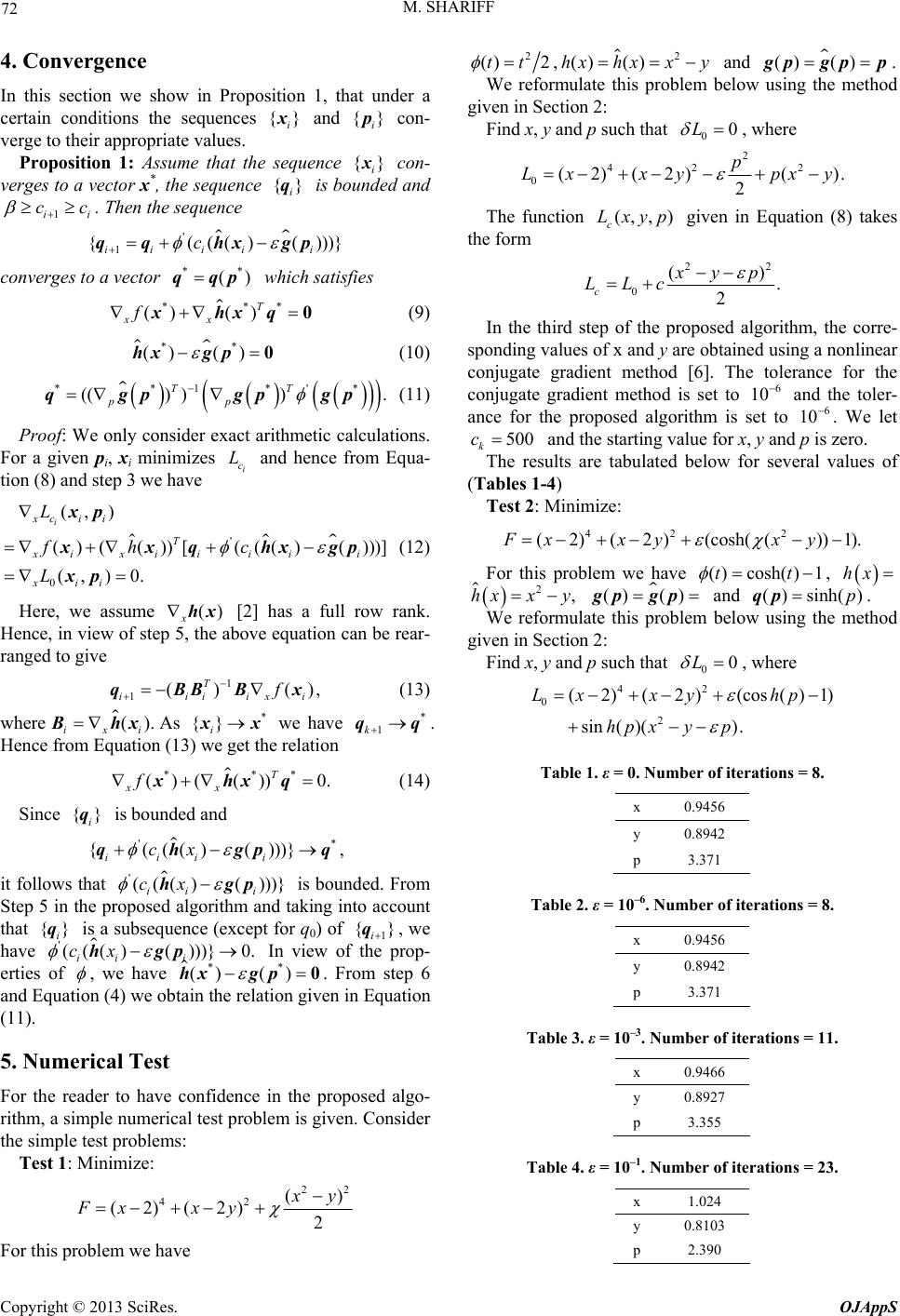 M. SHARIFF 72 4. Convergence how in Proposition 1, that under a e sequences and con- is boed and In this section we s certain conditions th {}xi {}pi verge to their appropriate values. Proposition 1: Assume that the sequence { con- verges to a vector x*, the sequence }xi und{}qi 1 ii cc . Then the sequence ' 1 {(( ())))}qq hx ii ii c (gp i converges to a vector which satisfies (9) ** ()qqp *** ) ()x(xhq 0 T xx f ** () ()hxg p0 Proof: We only consider exact arithmetic calcula For a given pi, xi minimizes and hence from Equa- tio (12) Here, we assume[2] has a full row r Hence, in view of steabove equation can be rear- ra wher (10) **1* (() )qgpgp T pp '* ) .gp T (11) tions. i n (8) and step 3 we have (,)xpi xcii T L c L ' 0 ()(( ))[((( )()))] (, ) 0. xxqhxgp xp xi xiiiii xii fh c L ()hxx p 5, the ank. nged to give 1 1() (),qBBBx T iiiixi f (13) e (). B hx ixi Hence from Equation (13) As we ha relati (14 Since is bounded and q it follows that is boued. From Step 5 in thng to account * {}xx i we get the ve 1 qq k. on * *** ()(())0.xhxq T xx f ) {}qi '* {( )))}qh p i, (( ()g iii cx '((()()))}hgp ii i cx e proposed algorithm and taki ubsequence (except fo nd in that {}qi is a sr q0) of 1 {}qi, we have '(( ()()))}0.hgp ii i cx In view of the prop- erties of , we have ** () ()hxg p 0 . Frep 6 and Eqtion given in Equation (11). 5. Numerical Test om st uation (4) we obtain the rela For the reader to have rithm, a simple numeric confidence in the proposed algo- al test problem is given. Consider the simple test problems: Test 1: Minimize: 22 42 () (2)2 (2) 2 () 2tt , 2 () () hxhx x y ulat and . We reforme this problem below using the m c () ()gp gpp ethod given in Section 2: Find x, y and p suh that00L , where 2 42 2 0(2)(2)( ). p Lx xypxy 2 given i(8) takes the form The function (, ,) c Lxyp n Equation 22 0 () . 2 c x yp c hird step of the proposed algorithm, the corre- sponding values of x and y are obtained us ng a nonlinear conjugate gradient method [6]. The toance for the con LL In the t i ler jugate gradient method is set to and the toler- ance for the proposed algorithm is set to 6 10 6 10 . We let 500 k c and the starting value for x, y and p is zero. The results are tabulated below for several values of (Tables 1-4) Test 2: Minimize: 422 ( 2)(2)(cosh(())1). Fx xyxy For this problem we have ()cosh()1tt , hx 2, xx y ()gph ()gp and () sinqp lem below using th h()p. e meod We reformulate this probth given in Section 2: Find x, y and p such that 00L , where 42 0(2)(2) (cos()1) sin2).( )( Lx xyhp h y p px Table 1. ε = 0. Number of iterations = 8. x 0.9456 y 0.8942 p 3.371 Table 2. ε = 10 Numerations = 8. –6.ber of it x 0.9456 y 0.8942 p 3.371 Table 3. ε = 10Numerations = 11. –3. ber of it x 0.9466 y 0.8927 p 3.355 Table 4. ε = 10erations = 23. –1. Number of it x 1.024 x y xy For this problem we have Fx y 0.8103 p 2.390 Copyright © 2013 SciRes. OJAppS 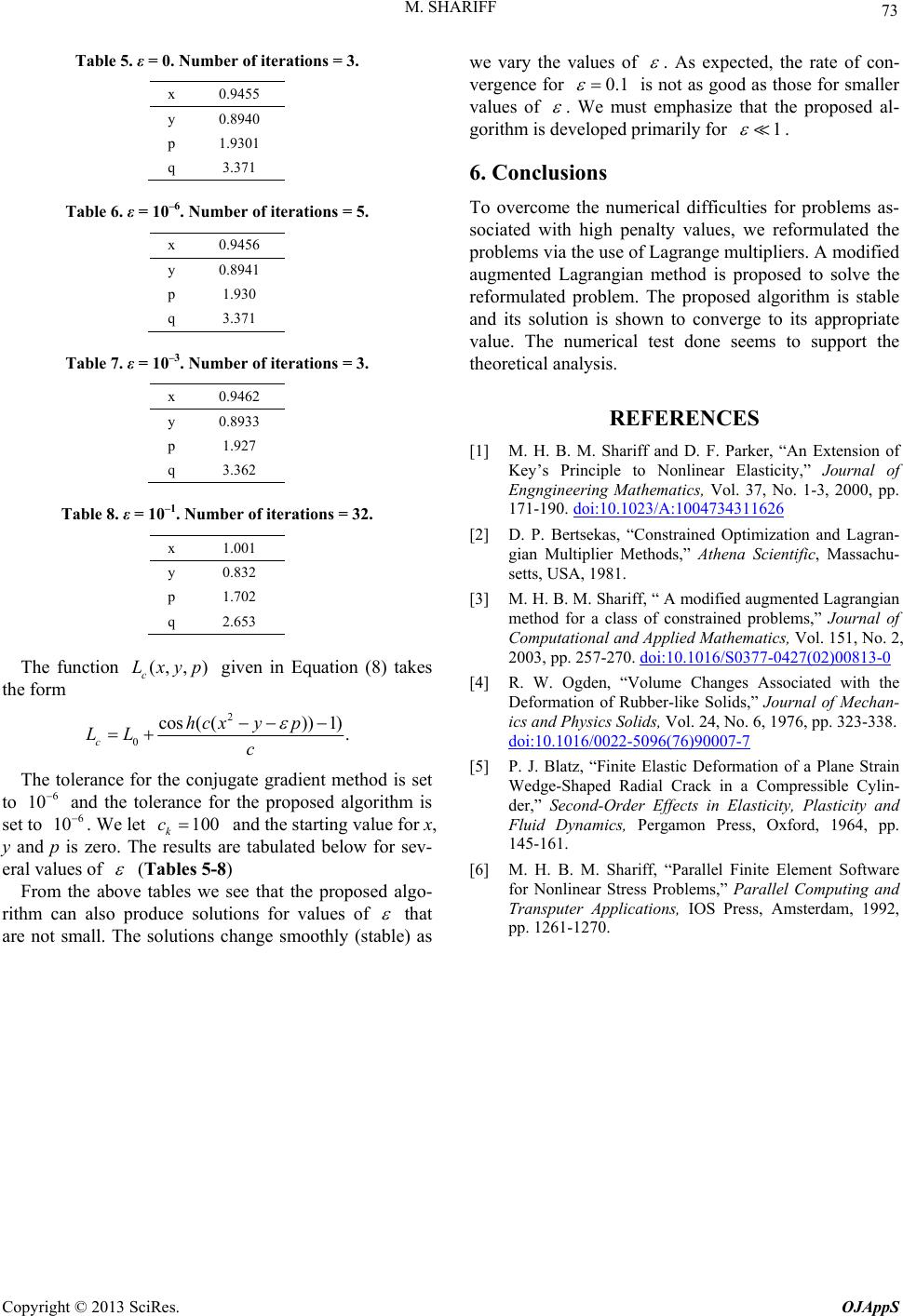 M. SHARIFF Copyright © 2013 SciRes. OJAppS 73 Table 5. ε = erations = 3. 0. Number of it x 0.9455 y 0.8940 we vary the values of . As expected, the rate of con- vergence for 0.1 is not as good as those for smaller values of . We must mphasize that the proposed al- gorithm is devprimarily for 1 e eloped . 6. Conclusions p 1.9301 q 3.371 Table 6. ε = 10 Numerations = 5. To overcome the nu sociated with high m pe E . M. S s Princip e nalty FE rical difficur problems as- formulated the RE [1] M. HAn Extension of Key’y,” Journal of lties fo values, we re NCES , “ icit –6.ber of it x 0.9456 problems via the use of Lagrange multipliers. A modified augmented Lagrangian method is proposed to solve the reformulated problem. The proposed algorithm is stable and its solution is shown to converge to its appropriate value. The numerical test done seems to support the theoretical analysis. R y 0.8941 p 1.930 q 3.371 Table 7. ε = 10 iterations = 3. –3. Number of x 0.9462 y 0.8933 p 1.927 . Bhariff and D. F. Parker le to Nonlinear Elast q 3.362 Engngineering Mathematics, Vol. 37, No. 1-3, 2000, pp. Table 8. ε = 10Numerations = 32. 171-190. doi:10.1023/A:1004734311626 –1. ber of it x 1.001 [2] D. P. Bertsekas, “Constrained Optimization and Lagran- gian Multiplier Methods,” Athena Scientific, Massachu- onstrained problems,” Journal of y 0.832 p 1.702 setts, USA, 1981. [3] M. H. B. M. Shariff, “ A modified augmented Lagrangian method for a class of c q 2.653 Computational and Applied Mathematics, Vol. 151, No. 2, 2003, pp. 257-270. doi:10.1016/S0377-0427(02)00813-0 [4] R. W. Ogden, “Volume Changes Associated with the Deformation of Rubber-like Solids,” Journal of Mechan- The function n Equation (8) takes the form (, ) c Lx p ,ygiven i 2 0 cos(())1). hcx yp lerance for the conjugate gradient method is set to and the tolerance for the proposed algorith . We let and the starting value y c LL c The to ics and Physics Solids, Vol. 24, No. 6, 1976, pp. 323-338. doi:10.1016/0022-5096(76)90007-7 [5] P. J. Blatz, “Finite Elastic Deformation of a Plane Strain Wedge-Shaped Radial Crack in a C ompressible Cylin- ar Parallel Computing and 6 10 set to 10 valu m is for x, der,” Second-Order Effects in Elasticity, Plasticity and Fluid Dynamics, Pergamon Press, Oxford, 1964, pp. 145-161. [6] M. H. B. M. Shariff, “Parallel Finite Element Software for Nonline 6100 k c and p is zero. The results are tabulated below for sev- erales of (Tables 5-8) Frome above tale see that the proposed algo- rithm can also produce solutions for values of Stress Problems,” thbs we that are not small. The solutions change smoothly (stable) as Transputer Applications, IOS Press, Amsterdam, 1992, pp. 1261-1270. |