

Paper Menu >>
Journal Menu >>
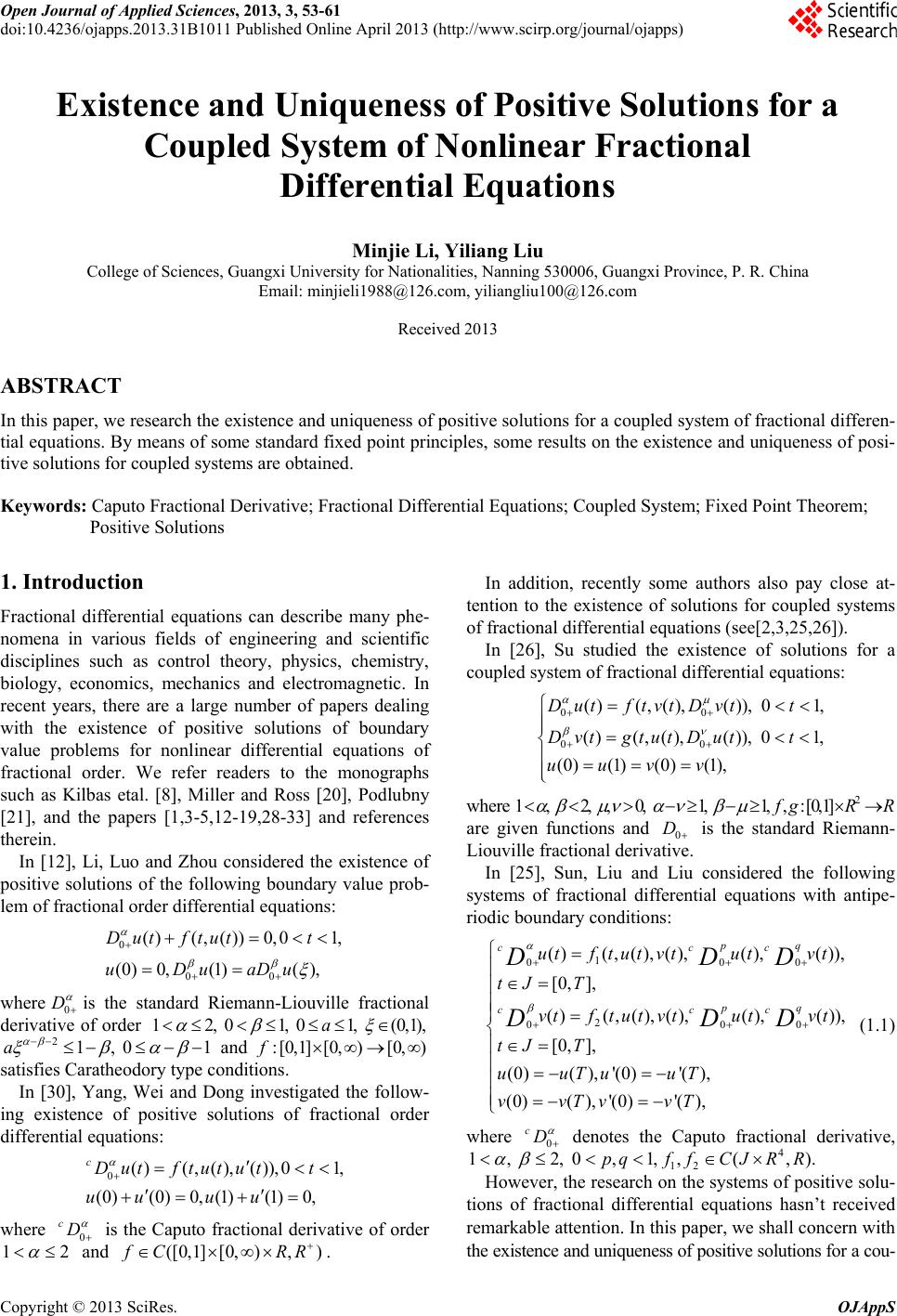 Open Journal of Applied Sciences, 2013, 3, 53-61 doi:10.4236/ojapps.2013.31B1011 Published Online April 2013 (http://www.scirp.org/journal/ojapps) Existence and Uniqueness of Positive Solutions for a Coupled System of Nonlinear Fractional Differential Equations Minjie Li, Yiliang Liu College of Sciences, Guangxi University for Nationalities, Nanning 530006, Guangxi Province, P. R. China Email: [email protected], [email protected] Received 2013 ABSTRACT In this paper, we research the existence and uniqueness of po sitive solu tions for a coupled system of fractional differen- tial equations. By means of some standard fixed point principles, some results on the existence and uniqueness of posi- tive solutions for coupled systems are obtained. Keywords: Caputo Fractional Derivative; Fractional Differential Equations; Coupled System; Fixed Point Theorem; Positive Solutions 1. Introduction Fractional differential equations can describe many phe- nomena in various fields of engineering and scientific disciplines such as control theory, physics, chemistry, biology, economics, mechanics and electromagnetic. In recent years, there are a large number of papers dealing with the existence of positive solutions of boundary value problems for nonlinear differential equations of fractional order. We refer readers to the monographs such as Kilbas etal. [8], Miller and Ross [20], Podlubny [21], and the papers [1,3-5,12-19,28-33] and references therein. In [12], Li, Luo and Zhou considered the existence of positive solutions of the following boundary value prob- lem of fractional order differential equations: 0 00 ()(()) 001 (0)0(1)( ) Dut ftutt uDuaDu where 0 D is the standard Riemann-Liouville fractional derivative of order 12, 01, 01, (0a1), 1 [0 1][0)[0)f and satisfies Caratheodory type conditions. 2 1, 0a In [30], Yang, Wei and Dong investigated the follow- ing existence of positive solutions of fractional order differential equations: 0()(() ())01 (0)(0) 0(1)(1) 0 cDut ftututt uu uu where 0 cD is the Caputo fractional derivative of order 12 and ([0 1][0)) f CR In addition, recently some authors also pay close at- tention to the existence of solutions for coupled systems of fractional differential equations (see[2,3,25,26]). In [26], Su studied the existence of solutions for a coupled system of fractional differential equations: 00 00 ()(()()) 01 ()(()()) 01 (0)(1)(0) (1) Dut ftvtDvtt Dvt gtutDutt uuvv where 2 1 2 0, 1, 1, [01] f gR DR 0 0 c c D D are given functions and 0 is the standard Riemann- Liouville fractional derivative. In [25], Sun, Liu and Liu considered the following systems of fractional differential equations with antipe- riodic boundary cond itions: 1 00 2 00 ( )(,( ),(),( ),()), [0, ], ()(,(), (),(),()), [0, ], (0)( ),'(0)'( ), (0)( ),'(0)'( ), pq cc pq cc utf tutvtutvt tJ T vtftut vtutvt tJ T uuTu uT vvTv vT DD DD (1.1) where 0 cD denotes the Caputo fractional derivative, 4 12 , 01, (1 2). pqffCJRR However, the research on the systems of positive solu- tions of fractional differential equations hasn’t received remarkable attention. In this paper, we shall concern with the existence and uniqueness of positive solutions for a cou- R. Copyright © 2013 SciRes. OJAppS 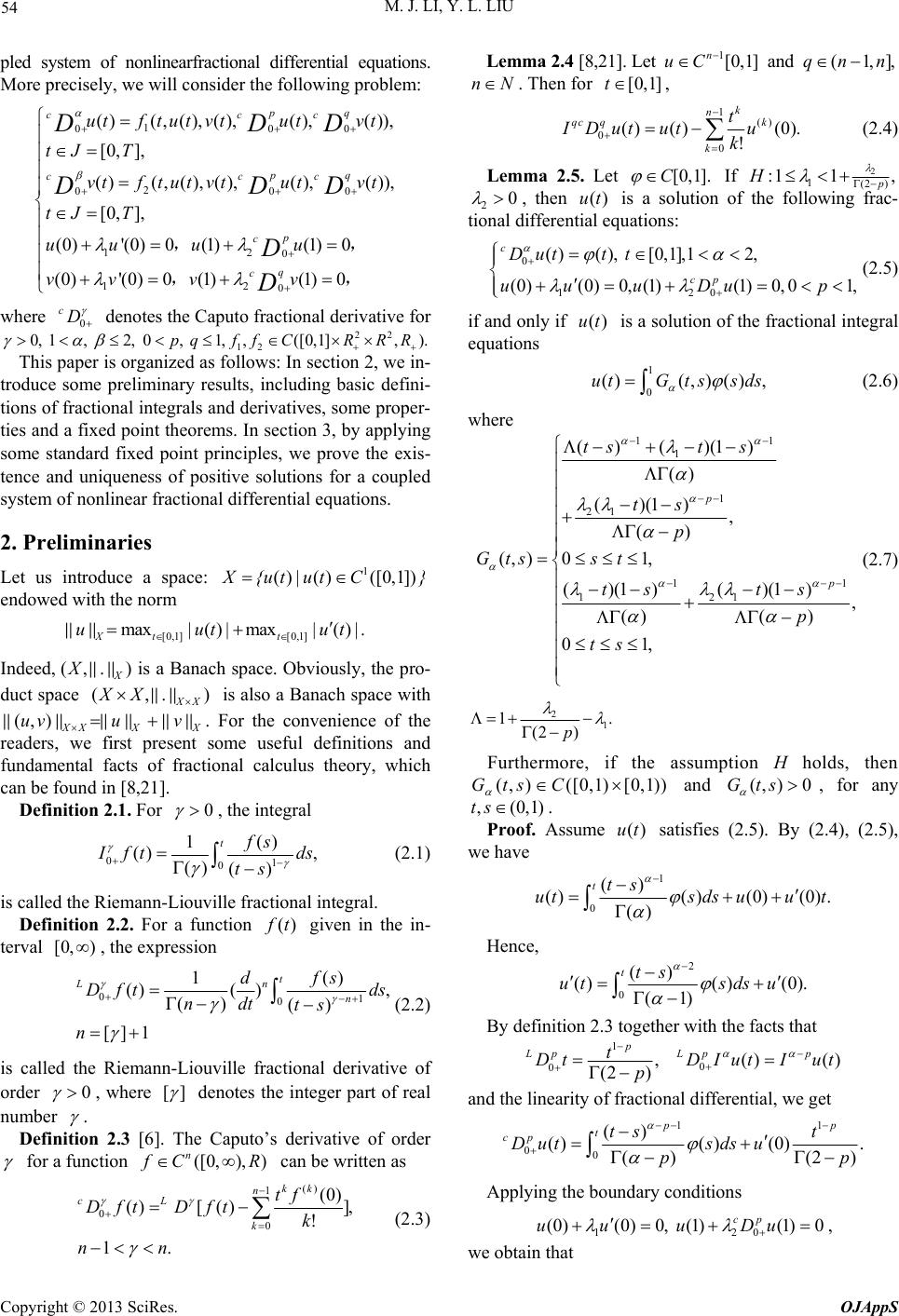 M. J. LI, Y. L. LIU 54 pled system of nonlinearfractional differential equations. More precisely, we will consider the following problem: 1 00 2 00 12 0 12 0 ()(,(), (),(),()), [0, ], ()(,(), (),(),()), [0, ], (0)'(0) 0(1)(1) 0 (0)'(0) 0(1)(1) 0 pq cc pq cc p c q c utftutvtutvt tJ T vtftut vtutvt tJ T uu uu vv vv DD DD D D ,, ,, 0 0 c c D D where 0 cD denotes the Caputo fractional derivative for 22 12 0 12 0 1, ([01]) pqffCRRR Thisis organized as follows: In section 2, we in- paper tro 2. Preliminaries space: duce some preliminary results, including basic defini- tions of fractional integrals an d derivatives, some proper- ties and a fixed point theorems. In section 3, by applying some standard fixed point principles, we prove the exis- tence and uniqueness of positive solutions for a coupled system of nonlinear fractional differential equations. Let us introduce a 1 () ()([01]) X {u tu tC} endowed with the norm [01] max Xt u[01] ( )max( ). t ut ut Indeed is a Banach space. Obviously, the pro- readers, we first present , () X X ce X X u duct spa ) XX X is also a Banach space with () XX uv For the convenience of the some useful definitions and ( X v. fundamental facts of fractional calculus theory, which can be found in [8,21]. Definition 2.1. For 0 , the integral 01 0 1() tfs () () () I ft ds ts (2.1) is called the Riemann-Liouville fractional integral. Definition 2.2. For a function () f t given in the in- terval [0 ) , the expression 01 0 1 () ()( ) () () [] 1 t Ln n dfs Dft ds ndt ts n (2.2) is called the Riemann-Liouville fractional derivative of order 0 , where [] denotes the integer part of real number . Definionti 2.3 [6]. The Caputo’s derivative of order for a function ([0) ) n f CR can be written as () (0) kk cL tf 1 00 () [ ()] 1 n k Df t Dftk nn (2.3) Lemma 2.4 [8,21]. Let 1[01] n uC and (1] qn n nN. Then for [0 1] t, 1() 00 () ()(0) k n qc qk t ID ututu (2.4) Lemma 2.5. Let kk [0 1]. C If 2 1(2 ) 11 p H 20 , then tion of the following frac- fferent equat ()ut ial is a solu ions: tional di 0 120 () ()2 )(0(1)(1)0 01 [01]1 (0 0) c u cp Dutt t u uDup ) if and only if ()ut is a solution (2.5 of the fractional integral equations 1 0 ()() () utG tssds (2.6) where 11 1 1 21 11 121 () ( )(1) () ()(1) () () 01 ()(1) ()(1) ()( ) 01 p p tst s ts p Gtss t tsts p ts (2.7) 21 1(2 )p Furthermore, if the assumption H holds, then ()([0 1)[0 1)) Gts C (0 1) and , for any ()0Gts ts . Proof. Assume ()ut satisfies (2.4), (2.5), we .5). By (2 have 1 0) () ()(0) (0) ( () tts usds uut Hence, t 2 0 () ()() (0) (1) tts utsdsu By definition 2.3 together with the facts that 1 0(2 ) p Lp t Dt p 0() () Lp p DIutI ut and the linearity of fractional differential, we get 11 () 00 () () (0) () (2 ) p cp Du tsds u p tts t pp Applying the boundary conditions 120 (0)(0)0 (1)(1)0 cp uu uDu , we obtain that Copyright © 2013 SciRes. OJAppS 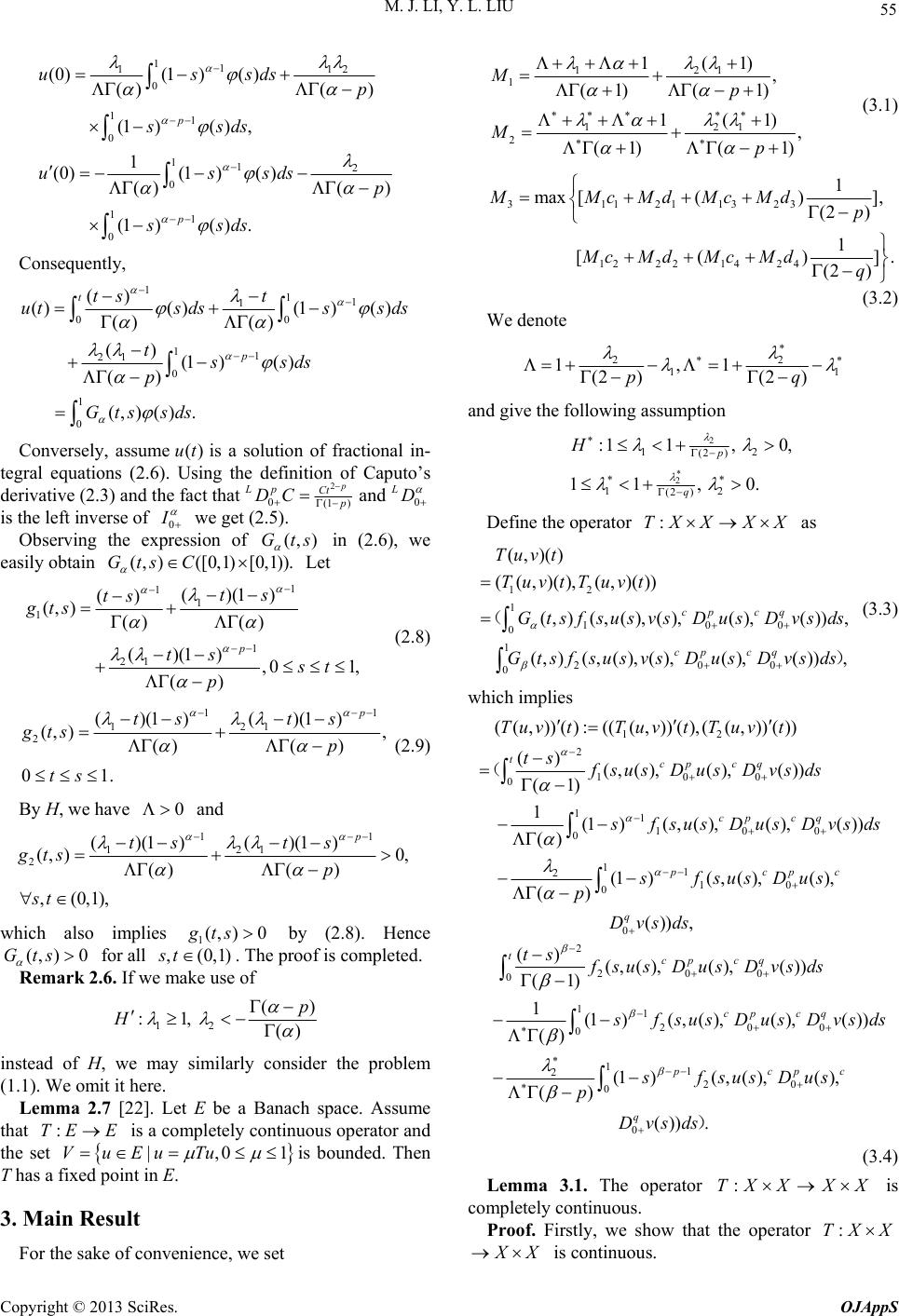 M. J. LI, Y. L. LIU 55 11 1 0 12 112 0 11 0 (0)(1)( ) ()( ) 1(1)() ()( ) (1)() p ussds p sds p ssds Consequently, 11 0 (1)() p ss ds (0) us 111 1 00 11 21 0 1 0 ( Gt s () ()()(1 )() () () () (1)() () )( ) t p t ts utsdss sds tssds p sds Conversely, assumeis a solution of fractional in- tegral equations (2.6e definition of Caputo’s derivative (2.3) and the that ()ut ). Using th fact2 0(1 ) p Lp Ct p DC and 0 LD is the left inverse of 0 I we ession of get (2.5). Observing the expr in (2 easily obtain ()Gts [01)) Let .6), we () ([01)Gts C 1 1 1 21 )(1) () 1 1 ( () 1 t (2.8 () () ()(1) 0 p ts ts gts ts s ) () p 11 121 2()(1))(1) ( () ()( ) 01 p ts ts gtsp ts (2.9) By H, we have and 0 11 121 2()(1) ()(1) () 0 ()( ) (0 1) p ts ts gtsp st which also implies by (2.8). Hence lproof is completed. 6. If w 1 ()0ts for al(0 1). Th ()0gts e ake use of G Remark 2. st e m 12() 1 () p H instead of H, we may simder the problem (1.1). We omit it here. 2.7 [22]. a Banach space. Assume ilarly consi th ntinuous operator and the set s bounded. Then T has a For the sake of convenience, we set Lemma Let E be at TE E is a co mpletely co 01VuEuTu i fixed point in E. 3. Main Result 121 1(1) 1)( 1) 1 2 1 ( 1(1 (1)( 1) 1 2 ) Mp p M (3.1) 3112113 max [( 23 122 2142 4 1 ) ] (2) 1 [()] (2 ) d p Mc MdMc Md (3.2) We denote q MM cMdMcM 22 11 11 (2)(2 ) pq and give the following assumption 2 2 12 (2 ) 12 (2 ) 11 0 11 0. p q H Define the operat or as TX XXX 12 (()( )()( )) 1 10 0 0 1 200 0 ()() ()(()()()()) ()(()()()()) cp cq cp cq Tuv t Gtsfsusvs Dus Dvsds GtsfsusvsDus Dvsds ( ) TuvtTuvt (3.3) which implies 12 2 100 0 11100 0 11 2 10 0 (())()((())()(())()) () (()()()) (1) 1 (1)(()()()) () (1 )(()() () tcpcq cp cq pcpc Tuvt TuvtTuvt ts fsus Dus Dvsds s fsus Dus Dvsds sfsusDus p ( 0 2 200 0 11200 0 11 220 0 ()) () (()()()) (1) 1 (1)(()()()) () (1)(()() () q tcp cq cp cq pcpc Dvsds ts fsus DusDvsds s fsus DusDvsds sfsusDus p 0 ()) q Dvsds) (3.4) Lemma 3.1. The operator is completely continuous. Proof. Firstly, we show that the operator TX XX X TX X X X is continuous. Copyright © 2013 SciRes. OJAppS 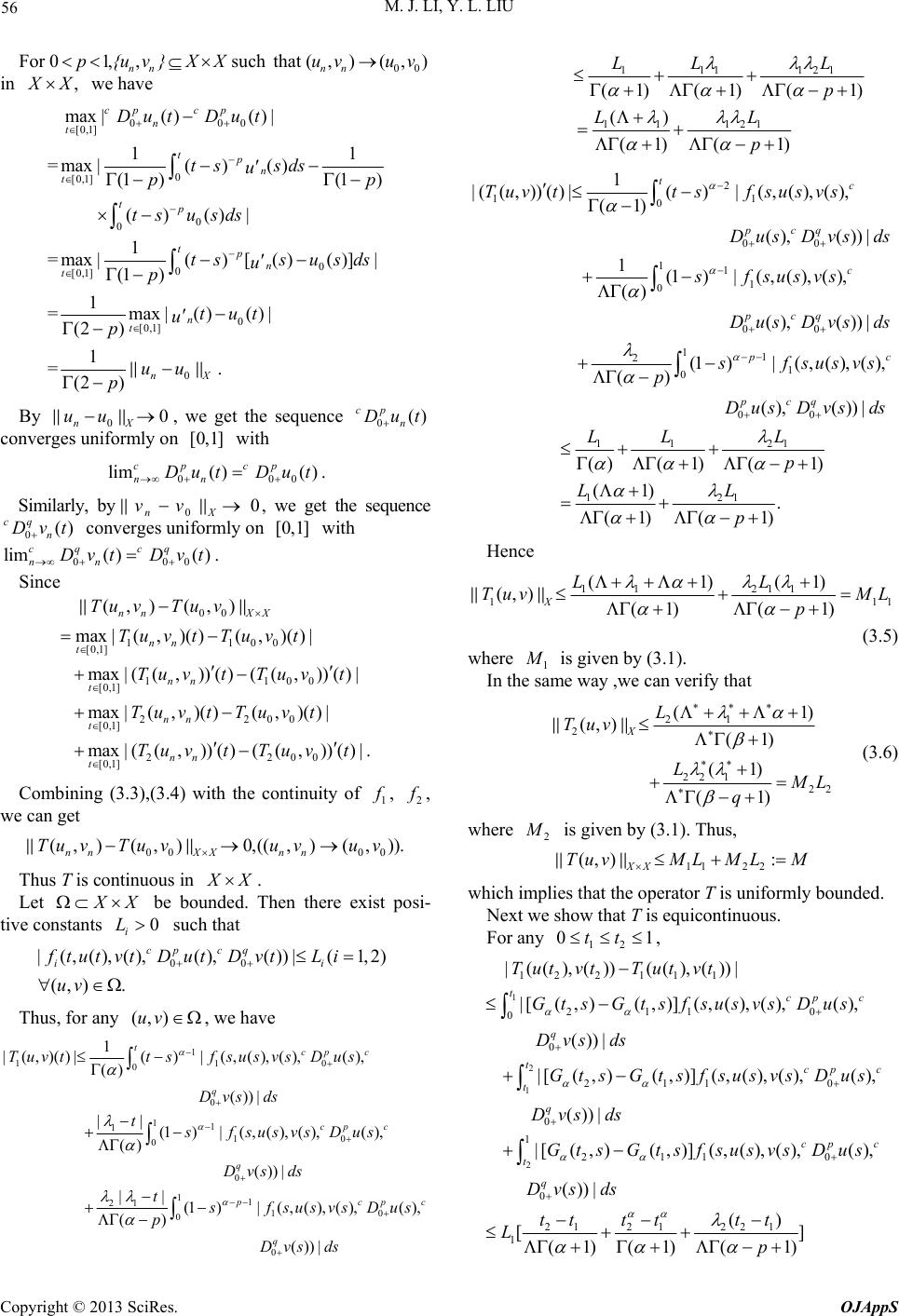 M. J. LI, Y. L. LIU 56 For such that ) in 01 nn p{uv}XX 00 ()( nn uv uv X X we have 000 [01] 0 [01] 0 0 0 0 [01] 0 [01] max()() 11 =max()( ) (1 )(1 ) ()() 1 =max()[( )( )] (1 ) 1 =max()() (2 ) 1 =(2 ) cp cp n t tpn t tp tpn t n t n Dut Dut ts sds u pp ts usds tssusds u p tut u p u p0X u By , we get the sequence conve with 0 we get the sequence with Since Combining (3.3),(3.4) with the continuity of 00 nX uu rges uniformly on 0() cp n Dut [0 1] 00 lim( )( ) cp cp nn Dut Dut. Similarly, by 0nX vv 0() q n Dvt converges uniformly o limcq cq 0, n c[0 1] 000 ( )( ) nn Dvt Dvt. 00 100 [01] 1100 [01] 2200 [01] 2200 [01] ()( )( )()( ) max(())()(())() max()()()() max(())()(() )() nn n t nn t nn t nn t Tu vTu v tTuvt Tu vtTuvt Tuv tTuv t Tuvt Tuvt 1 ) max ( XX n Tu v 1 f , 2 f , we can get ) Thus T is continuous in 00 00 ()() 0(()() nnXX nn TuvTuvuvuv X X. Let X X stants i Lbe bounded. Then there exist posi- tive con such that 0 00 ()()) ( () (()()12) ut DvtLi uv cp cq ii ftutvt D Thus, for any we have ()uv , 1 110 0 1 ()()() () () cp c uvtvs Dus 0 q 11 110 0 ( )(() ()) (1)(()()() () t cpc Tt sfsus Dvsds tsfsusvsDus 111 121 11 121 (1) (1) (1 () (1) (1) ) LL L p LL p 2 11 0 00 1 ()) 1 Du s Dv 11 0 1 (( ))()()(()() (1) () (1)(( )( ) () tc pcq c Tuvtt sfsusvs s ds sfsusvs 0 11 21 10 0 0 ()) (1)(()()() () ()) q p cpc q Dvsds t s fsusvs Dus p Dvsd s 00 00 ( )( )) ( ()() 11 21 0(1)(( )( ) ) pcq p c pcq s DvsdsDu s fsusvs p Du s Dvs 11 21 121 ) )(1) (1) (1) (1) (1) ( ds LLL p p Hence LL 11 211 111 (1)(1) () (1)( 1) X LL TuvML p (3.5) where 1 M In the sam is given by (3.1). e way ,we can verify that 21 2 22 122 (1 () (1) (1) (1) XL Tuv L ) M L q (3.6) where 2 M is given by (3.1). Thus, 112 2 () XX TuvML MLM which implies that the operator T is uniformly bounded. Next we show that T is equicontinuous. For any 12 01 tt, 1 2 1 2 12211 1 211 0 0 0 211 0 0 1 (()())(()()) [( )()](()()() ()) [()()](()()() ()) [( tcp c q tcp c t q t TutvtTut vt GtsGtsfsusvsDus Dvs ds GtsGtsfsusvsDus Dvs ds G 211 0 0 212 1221 1 )()](()() () ()) () [] (1)(1)(1) cp c q tsGtsfsusvs Dus Dvs ds t ttt p tt L Copyright © 2013 SciRes. OJAppS 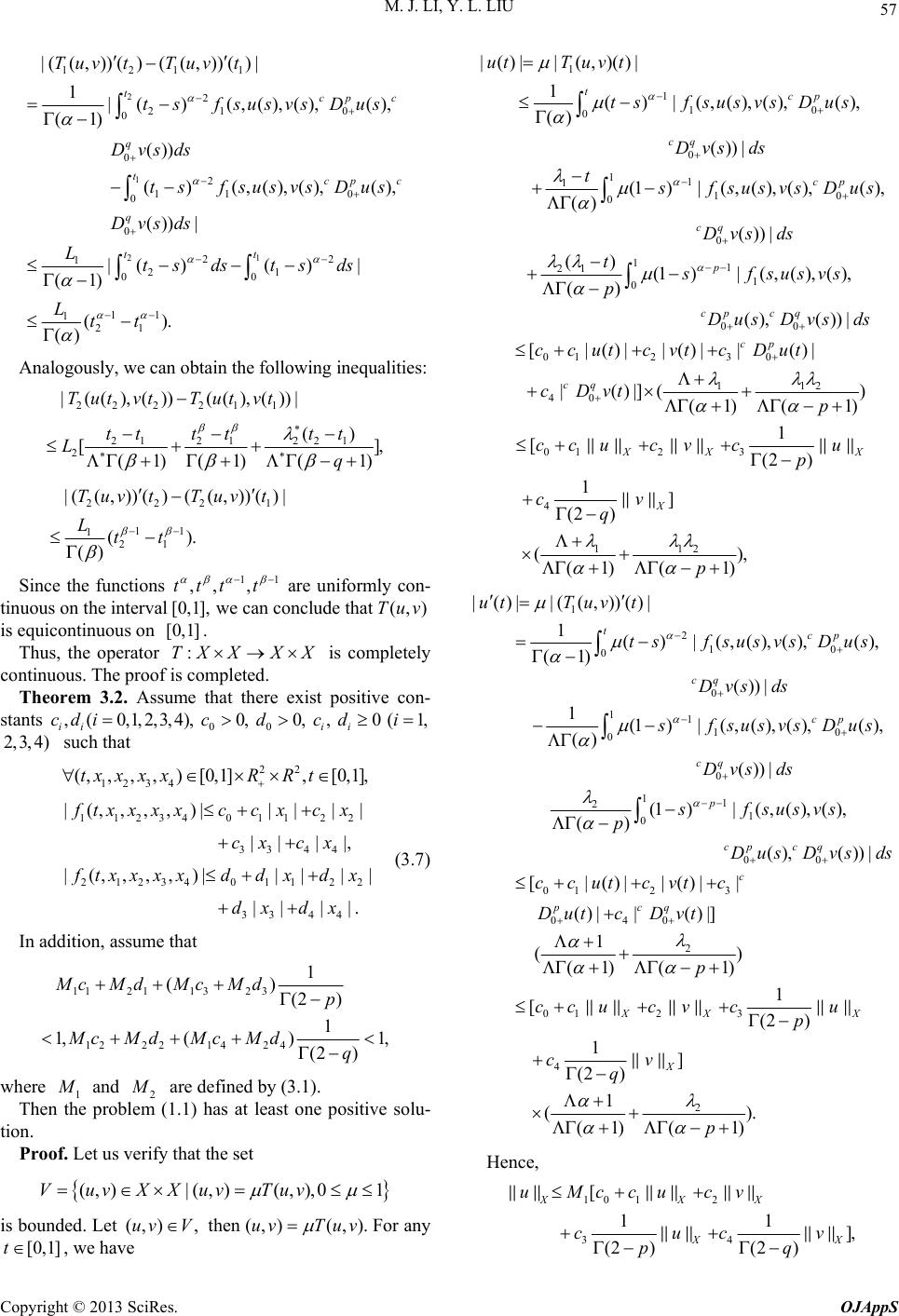 M. J. LI, Y. L. LIU 57 2 1 1211 2 21 0 0 0 ()) t Dv s ds 2 11 0 0 0 1 (())()(())() 1()(()() () (1) ()(()()() ()) tcp c cp c q TuvtTuv t ts fsusvsDus ts fsusvsDus Dvs ds L q 21 22 21 00 121 () () (1) () tt ts dsts ds L 11 () tt Analogously, we can obtain the following inequalities: 2 2 t 2211 (()())(()())TutvtTut vt 21 21221 2() [] (1 ) (1)( 1) ttttt Lq 222 11 121 (())()(())() () () Tuv tTuv t Ltt 11 1 Since the functions tttt [0 1], we can are uniformly con- tinuous on the interval conclude that () Tuv is equicontinuous on Thus, the operator is completely continuous. The proo f is completed. Theorem 3.2. Assume that there exist positive con- stants [0 1]. TXXXX 00 (01234) 0 0 0 (1 iii i cdicdc di ) such that 234 22 1234 ()[0 1][01] tx xxxRRt 1123401122 33 44 2123401122 33 44 () () f tx xxxccxcx cx cx f tx xxxddxdx dx dx (3.7) In addition, assume that 112 1132 3 122 2142 4 1 ()(2 ) 1 1()1 Mc MdMcMdp Mc MdMc Md where (2 )q 1 M and 2 M lem (1 are define d by (3.1). Thenprob.1) has at least one positive solu- tion. Proof. Let us verify that the set is bounded. Let , then. the ()() ()01 VuvXXuvTuv ()uv V ()() uv Tuv For any , we ha [0 1]tve 1 1 0 ()( )() 1( )( tcp utTuvt ts fs 10 10 0 ()()() (1)(( )( )() suvs Dus ds 0 () ()) cq Dv s 11 1 () cp t s fsusvsDus 0 11 21 1 0 00 01230 ()) () (1)(()() () ()()) [()() cq p cpc q c Dvs ds tsfsusvs p Dus Dvs ccut cvt cD ds 112 40 012 3 4 () ()]() (1) (1) 1 [(2) 1 ] (2) () p cq XXX X ut cDvt p ccu cv cu p cv q 11 2 ) (1 (1) p 1 2 1 ()( tts fsu 10 0 110 0 ( )( )( ) (1) ()) (1)(()()() cp cq cp svs Dus s ds 0 1 1 () Dv ()(())()utTuvt s fsusvs Dus 0 11 21 0 00 0 ()) (1)(()() () ()()) [ cq p cpc q Dvs ds sfsusvs p Dus Dvsds c 123 040 2 012 3 4 2 () () ()()] 1 () (1)(1) 1 [(2 ) 1 ] (2) 1 ((1) ( c pcq XXX X cut cvt c Dutc Dvt p ccucvcu p cv q p ) 1) Hence, 10 12 34 [ 11 ] (2)(2) XXX XX uMccucv cucv pq Copyright © 2013 SciRes. OJAppS 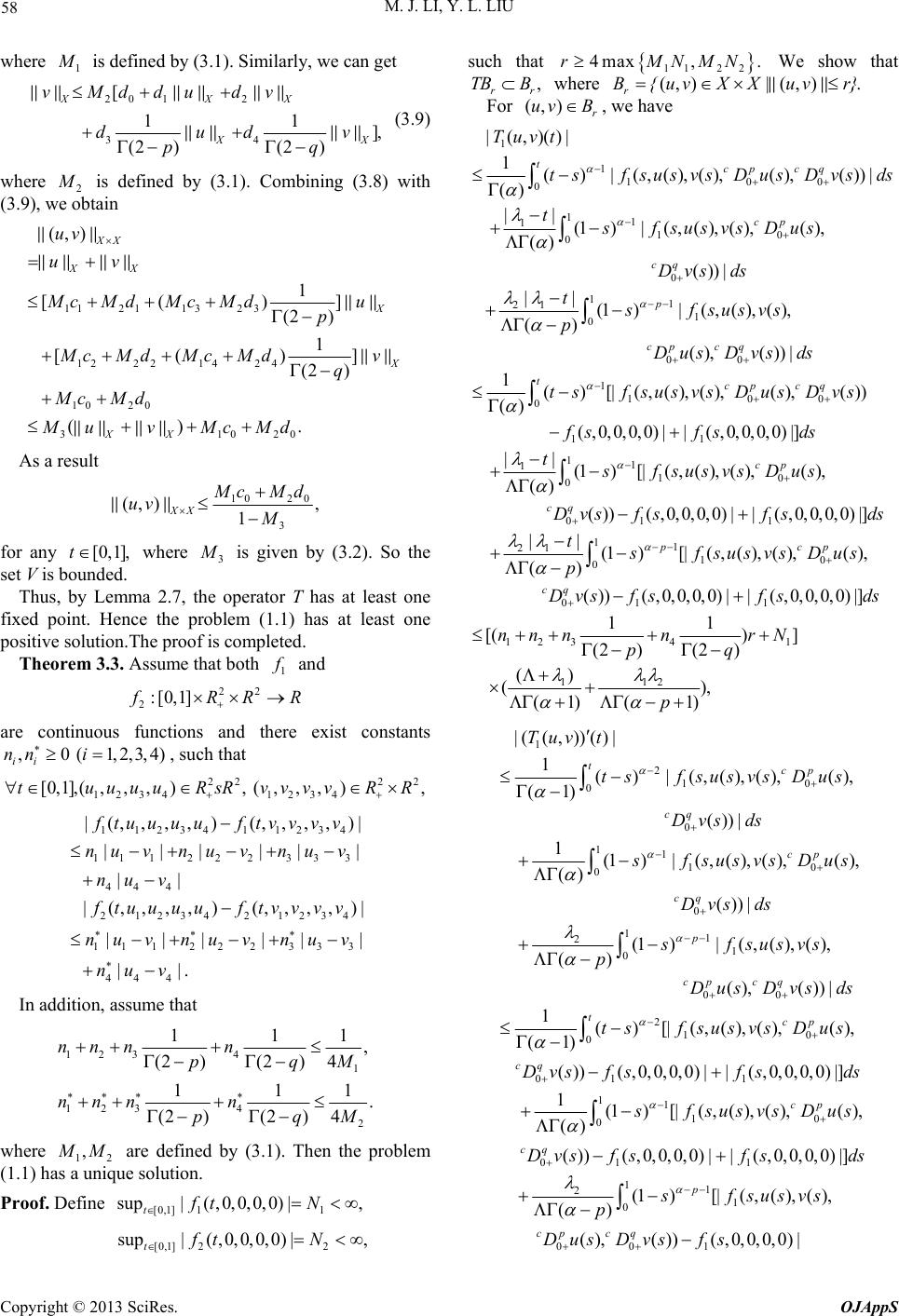 M. J. LI, Y. L. LIU 58 1 M where is defined by (3.1). Similarly, we can get 20 12 34 [ 11 ] (2)(2 ) XXX XX vMddudv dud pq v (3.9) where 2 M ), we obis defined by (3.1). Combining (3.8) with (3.9tain 112 11323 12 2214 24 102 0 31020 () 1 [()] (2 ) 1 [() (2 ) () XX XX X X XX uv uv Mc MdMcMdu p ] M cMd McMdv q Mc Md Muv McMd As a result 102 0 3 () 1 XX M cMd uv M for any where [0 1]t3 M is given by (3.2). So the set V is Thus, by Lemma 2.7, the operator T has at least one fixed point. Hence the problem (1.1) has at least one positive solution.The proof is completed. Theorem 3.3. Assume that both and bounded. 1 f 22 2[0 1] f RR R are continuous functions and there exist constants , such that R ) ) 0 (1234) ii nn i 222 2 1234 1234 [01]() () tuuuuRsRvvvvR 112341 1234 1112223 33 444 2123421234 11 1222333 44 4 ()( ()( f tu uuuftv vvv nu vnuvnuv nuv f tu uuuftv vvv nu vnuvnuv nuv In addition, assume that 123 41 123 42 11 (2)(2) 4 11 (2)(2) 4 nnn n pq nnn n pq 1 1 M M where 12 M M nique are defined by (3.1). Then the problem (1 solution. Proof. Define .1) has a u [01] 11 sup( 0000) tftN [01] 22 sup( 0000) tftN hat such t 112 2 4maxrMNMN We show that rr TBB where () () r B{uvXX () uv r} For B, we have r uv 1 1100 1 )(()()()()) () 0 1 110 0 0 1 21 0 ()() 1( (1)(()()() () ()) (1) () cp cq ts fsusvs Dus Dvsds t t cp cq Tuvt sfsusvsDus Dvs ds ts p 11 00 1100 0 11 (()() ()()) 1()[(() ()()()) () (0000)(0000)] ( p cpc q tcp cq fsusvs Dus Dvsds tsfsusvs Dus Dvs fsfs ds 1 t 1110 0 011 1 1 (1)[(( )( )() ) ())(0000)()] [ 1 210 0 (1)(()()() () 01 ())(0000) 0000 pc p sf susvsDus p cq Dv s fs cp cq sfsusvsDus Dvs fsfsds t 1 123 41 ( 0000)] 11 [() ] (2)(2 ) 11 2 () (1) (1) () f sds nnnnrN pq p 1 210 0 0 1110 0 0 (())() 1()(()()() (1) ()) 1 (1)(()()() () tcp cq cp cq ts fsusvs Dus Dvs ds Tuvt s fsusvs Dus Dv 11 21 0 00 10 0 01 1 ()) (1)(()() () ()()) ()[(() ()() (1) ())(0000)(0000) 2 1 p cpc q cp cq sds sfsusvs p Dus Dvsds tsfsusvs Dus Dvs fsfs t 1110 0 11 0 0 1 1 (1)[(( )( )() () ( (1)[(( )() ) )())(0000) 01 1 1 ))(0000)(0000)] 2 ( 0 ( ] cq cp p cc q s p d s fsusvs Dus Dvs sfsusvs p s Dvsfs fsfs ds Du Copyright © 2013 SciRes. OJAppS 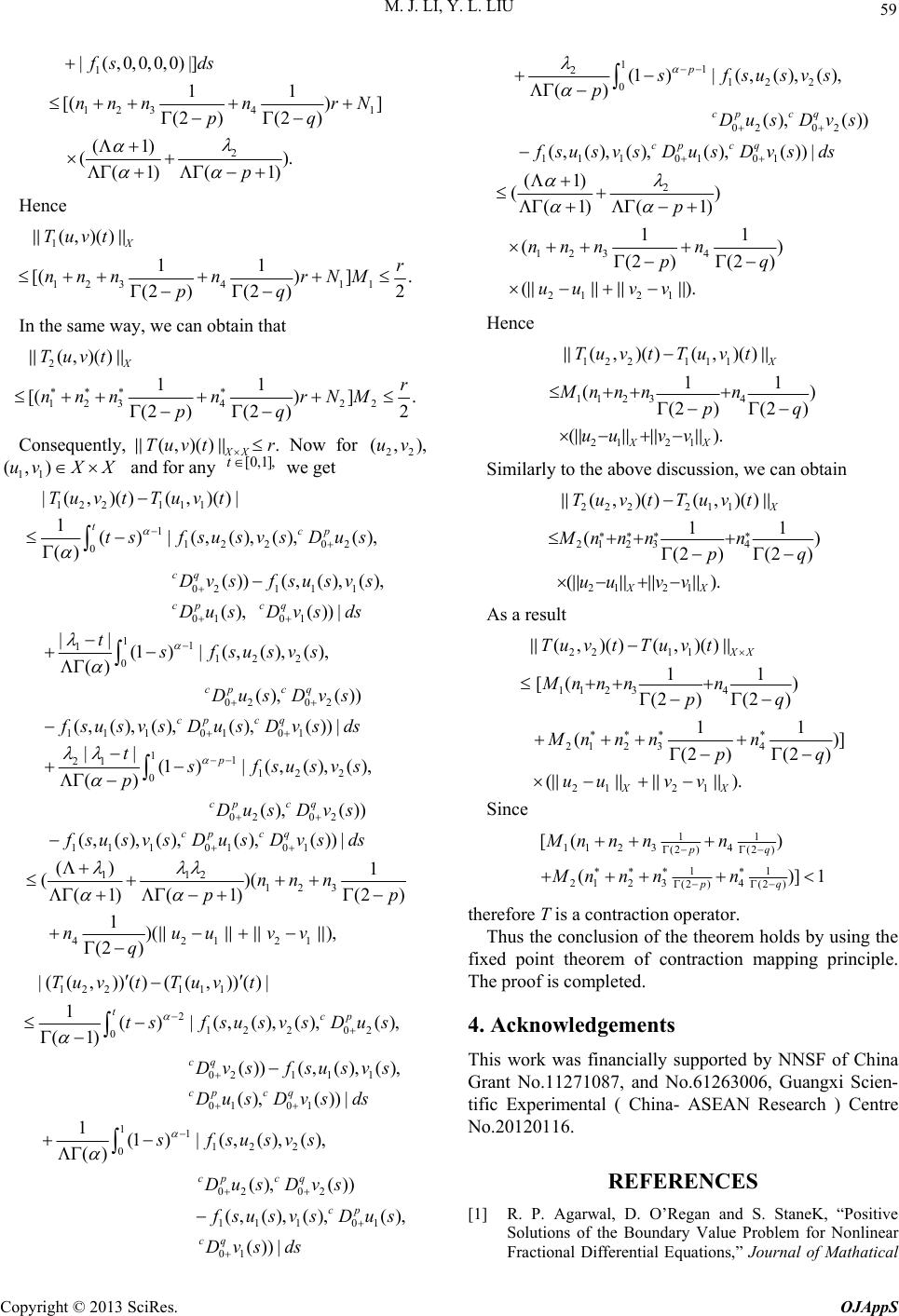 M. J. LI, Y. L. LIU 59 1 fs 12 4 1 2 ( 0000)] [() ] )(2) (1) () (1) (1) ds nnn rN q p Hence 311 (2 np 1 123 411 ()() 11 [() ] (2)(2)2 X Tuvt r nnnn rNM pq In the same way, we can obtain that 2 123 422 ()() 11 [() ] (2)(2)2 X Tuvt r nnnnrNM pq Consequently, Now for ()() XX Tuv tr22 () uv 11 ()uvX X and for any [0 1]t we get 122 111 112 202 0 021 11 01 01 1 ()()()() 1() (()()() () ())(()() () ()) tcp cq cp cq Tu vtTuvt tsfsusvs Dus Dvs fsusvs DusDvs ds 11122 0 02 02 1110101 11 21 12 2 0 (1)(( )( ) () ()()) (()()()()) (1)(()() () cpc q cp cq p tsfsusvs DusDvs fsusvs Dus Dvsds tsfsusvs p 02 02 1110101 112 123 42121 ()()) (()()()()) () 1 ()( (1) (1)(2 1 )() (2) cpc q cp cq Dus Dvs fsusvs Dus Dvsds nnn pp nuuvv q ) 122 111 212 202 0 021 11 01 01 (())()(())() 1() (()()() (1) ())(()() () tcp cq cpc q Tu vtTuvt tsfsusvs Dus Dvs fsusvs Dus Dv 11122 0 02 02 11 101 ()) 1 (1)(()() () ()()) (()()() 11 212 2 0 02 02 11 10101 2 123 (1)(()() () ()()) (()()()()) (1) () (1) (1) 1 ( p cpc q cp cq sfsusvs p DusDvs fsusvs Dus Dvsds p nnn 4 21 21 1) (2)(2 ) () n pq uu vv Hence 122 111 11 2 34 2 ( u he above discu we can ob 121 ()()()() 11 () (2)(2 ) ) X XX Tu vtTuvt Mnn nn pq u vv Similarly to tssion,tain 222 211 212 34 21 21 ()()()() 11 () (2)(2 ) () X XX TuvtTuv t Mnnnn pq uuvv As a result 22 11 11 2 34 212 34 21 21 ()()()() 11 [() (2)(2 ) 11 () (2)(2 ) () XX XX TuvtTu vt Mnn nn pq Mn nnn pq uu vv ] Since 11 11 2 34 (2)(2 ) 11 212 34 (2)(2) [( ) () ]1 pq pq Mn nnn Mn nnn therefore T is a contraction operator. Thus the conclusion of the theorem holds by using the fixed point theorem of contraction mapping principle. The proof is completed. 4. Acknowledgements This work was financially supported by NNSF of China Grant No.11271087, and No.61263006, Guangxi Scien- tific Experimental ( China- ASEAN Research ) Centre No.20120116. REFERENCES [1] R. P. Agarwal, D. O’Regan and S. StaneK, “Positive Solutions of the Boundary Value Problem for Nonlinear Fractional Differential Equations,” Journal of Mathatical cpc q cp sds sfsusvs DusDvs f su svsDu s 01 ()) cq Dvs ds Copyright © 2013 SciRes. OJAppS 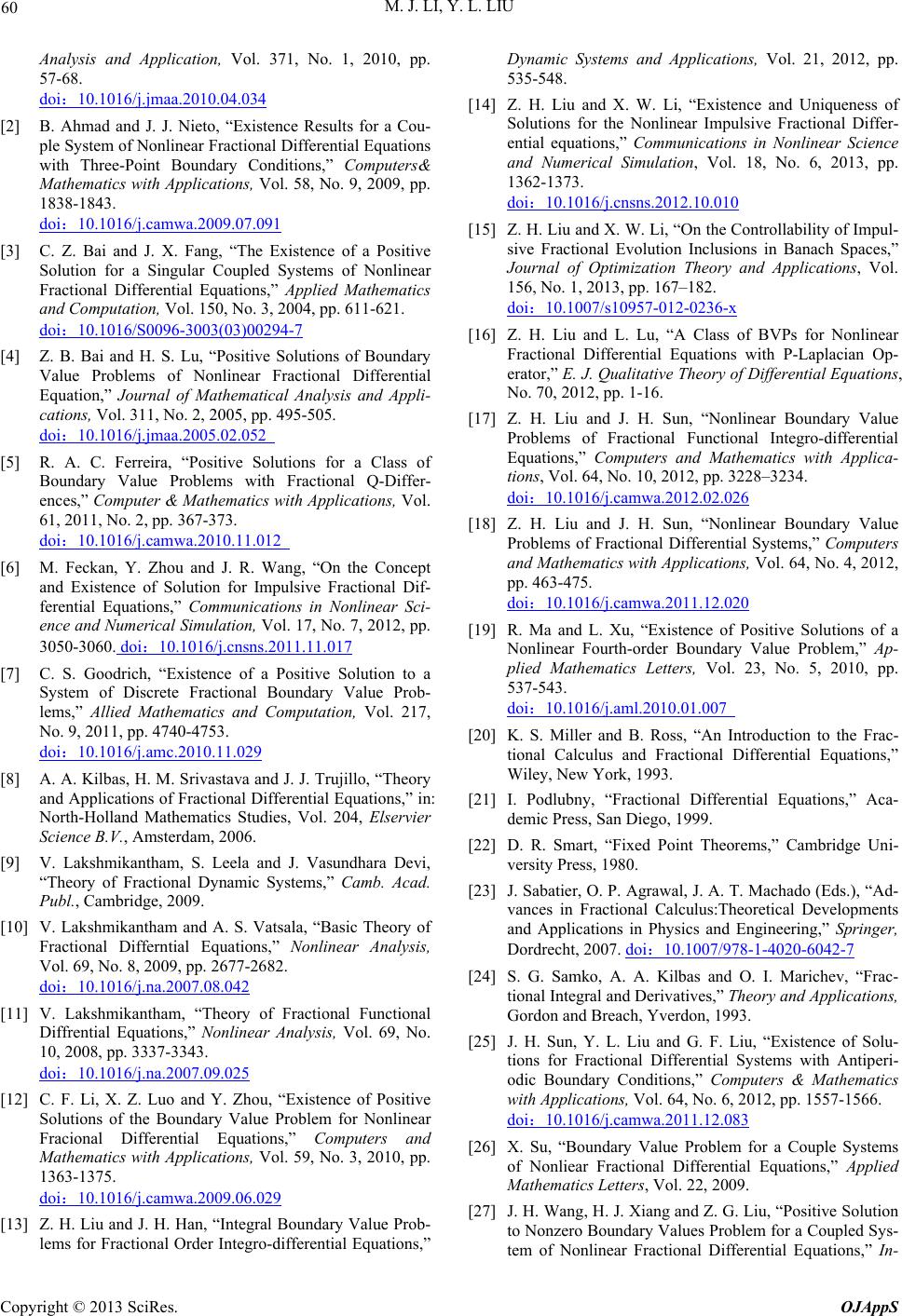 M. J. LI, Y. L. LIU 60 Analysis and Application, Vol. 371, No. 1, 2010, pp. 57-68. doi:10.1016/j.jmaa.2010.04.034 [2] B. Ahmad and J. J. Nieto, “Existence Results for a ple System of Nonlinear Fractional Differential Equations with Three-Point Boundary Conditions,” Computers& Mathematics with Applications, Vol. 58, No. 9, 2009, pp 1838-1843. Cou- . doi:10.1016/j.camwa.2009.07.091 [3] C. Z. Bai and J. X. Fang, “The Existence of a Positive Solution for a Singular Coupled Systems of Nonlinear Fractional Differential Equations,” Applied Mathematics n, Vol. 150, No. 3, 2004, pp. 611-621. and Computatio doi:10.1016/S0096-3003(03)00294-7 [4] Z. B. Bai and H. S. Lu, “Positive Solutions of Boundar Value Problems of Nonlinear Fractional Differential Equation,” Journal of Mathematical Analysis and Appli- cations, Vol. 311, No. 2, 2005, pp. 495-505. y doi:10.1016/j.jmaa.2005.02.052 [5] iffer- ences,” Computer & Mathematics with Applications, Vol. 61, 2011, No. 2, pp. 367-373. R. A. C. Ferreira, “Positive Solutions for a Cl Boundary Value Problems with Fractional Q-D ass of doi:10.1016/j.camwa.2010.11.012 [6] M. Feckan, Y. Zhou and J. R. Wang, “On the Concept and Existence of Solution for Impulsive Fractional Dif- quations,” Communications in Nonlinear Sci- umerical Simulation, Vol. 17, No. 7, 2012, pp ferential E ence and N. 3050-3060. doi:10.1016/j.cnsns.2011.11.017 [7] C. S. Goodrich, “Existence of a Positive Solution to a System of Discrete Fractional Boundary Value Prob- lems,” Allied Mathematics and Computation, V No. 9, 2011, pp. 4740-4753. ol. 217, doi:10.1016/j.amc.2010.11.029 [8] A. A. Kilbas, H. M. Srivastava and J. J. Trujillo, “T Applications of Fractional Differential Equations,” in h-Holland Mathematics Studies, Vol. 204, Elservier Science B.V., Amsterdam, 2006. [9] V. Lakshmikantham, S. Leela and J. Vasundhara D “Theory of Fractional Dynamic Systems,” Camb. Acad. heory : and Nort evi, Publ., Cambridge, 2009. [10] V. Lakshmikantham and A. S. Vatsala, “Basic Theory of Fractional Differntial Equations,” Nonlinear Analysis, Vol. 69, No. 8, 2009, pp. 2677-2682. doi:10.1016/j.na.2007.08.042 eory of Fractional Function nlinear Analysis, Vol. 69, No. [11] V. Lakshmikantham, “Th Diffrential Equations,” Noal 10, 2008, pp. 3337-3343. doi:10.1016/j.na.2007.09.025 [12] C. F. Li, X. Z. Luo and Y. Zhou, “Existence of Positive Solutions of the Boundary Value Problem for Nonlinear Fracional Differential Equations,” Computers and Mathematics with Applications, Vol. 59, No. 3, 2010, pp 1363-1375. . doi:10.1016/j.camwa.2009.06.029 [13] Z. H. Liu and J. H. Han, “Integral Boundary Value Prob- lems for Fractional Order Integro-differential Equations,” Dynamic Systems and Applications, Vol. 21, 2012, pp. 535-548. [14] Z. H. Liu and X. W. Li, “Existen ce and Uniqueness of Solutions for the Nonlinear Impulsive Fractional Differ- ential equations,” Communications in Nonlinear Science and Numerical Simulation, Vol. 18, No. 6, 2013, pp. 1362-1373. doi:10.1016/j.cnsns.2012.10.010 trollability of Impul-[15] Z. H. Liu and X. W. Li, “On the Con sive Fractional Evolution Inclusions in Banach Spaces,” Journal of Optimization Theory and Applications, Vol. 156, No. 1, 2013, pp. 167–182. doi:10.1007/s10957-012-0236-x [16] Z. H. Liu and L. Lu, “A Class of BVPs for Nonlinear ary Value l Integro-differential Fractional Differential Equations with P-Laplacian Op- erator,” E. J. Qualitative Theory of Differential Equations, No. 70, 2012, pp. 1-16. [17] Z. H. Liu and J. H. Sun, “Nonlinear Bound Problems of Fractional Functiona Equations,” Computers and Mathematics with Applica- tions, Vol. 64, No. 10, 2012, pp. 3228–3234. doi:10.1016/j.camwa.2012.02.026 [18] Z. H. Liu and J. H. Sun, “No Problems of Fractional Differential Sy nlinear Boundary Value stems,” Computers and Mathematics with Applications, Vol. 64, No. 4, 2012, pp. 463-475. doi:10.1016/j.camwa.2011.12.020 [19] R. Ma and L. Xu, “Existence of Positive Solutions of a Nonlinear Fourth-order Boundary Value Problem,” Ap- plied Mathematics Letters, Vol. 23, No. 5, 2010, pp. 537-543. doi:10.1016/j.aml.2010.01.007 [20] K. S. Miller and B. Ross, “A tional Calculus and Fractional D n Introduction to the Frac- ifferential Equations,” s,” Cambridge Uni- lus:Theoretical Developments Wiley, New York, 1993. [21] I. Podlubny, “Fractional Differential Equations,” Aca- demic Press, San Diego, 1999. [22] D. R. Smart, “Fixed Point Theorem versity Press, 1980. [23] J. Sabatier, O. P. Agrawal, J. A. T. Machado (Eds.) , “Ad- vances in Fractional Calcu and Applications in Physics and Engineering,” Springer, Dordrecht, 2007. doi:10.1007/978-1-4020-6042-7 [24] S. G. Samko, A. A. Kilbas and O. I. tional Integral and Derivatives,” Marichev, “Frac- Theory and Applications, l Systems with Antiperi- mputers & Mathematics Gordon and Breach, Yverdon, 1993. [25] J. H. Sun, Y. L. Liu and G. F. Liu, “Existence of Solu- tions for Fractional Differentia odic Boundary Conditions,” Co with Applications, Vol. 64, No. 6, 2012, pp. 1557-1566. doi:10.1016/j.camwa.2011.12.083 [26] X. Su, “Boundary Value Problem for a Couple Systems of Nonliear Fractional Differential Equations,” Applied Mathematics Letters, Vol. 22, 2009. [27] J. H. Wang, H. J. Xiang and Z. G. Liu, “Positive Solution to Nonzero Boundary Values Problem for a Coupled Sys- tem of Nonlinear Fractional Differential Equations,” In- Copyright © 2013 SciRes. OJAppS  M. J. LI, Y. L. LIU Copyright © 2013 SciRes. OJAppS 61 ternational Journal of Differential Equations, Vol. 2010, 2010, p. 12. doi:10.1155/2010/186928 [28] X. Xu, D. Jiang and C. Yuan, “Multiple Positive Solu- tions for the Boundary Value Problem of a Nonlinear Fractional Differential Equation,” Nonlinear Analysis, Vol. 71, No. 10, 2009, pp. 4676-4688. doi:10.1016/j.na.2009.03.030 [29] X. Yang, Z. L. Wei and W. Dong, “Existence of Positive Solutions for the Boundary Value Problem of Nonlinear Fractional Differential Equations,” Communications in Nonlinear Science and Numerical [30] X. Yang, Z. Wei and W. Dong, “ Simulation. Existence of Positive . plied Mathematics and C Solutions for the Boundary Value Problem of Nonlineear Fractional Differential Equations,” Communications in Nonlinear Science and Numerical Simulation, Vol. 17, 2012, pp. 85-92. [31] S. Zhang, “Positive Solutions for Boundary Value Prob- lems of Nonlinear Fractional Differential Equations,” Elec. Journal of Differential Equations, Vol. 36, 2006, pp 1-12. [32] Y. G. Zhao, S. R. Sun, Z. L. Han and M. Zhang, “Positive Solutions for Boundary Value Problems of Nonlinear Fractional Differential Equations,” Ap omputations, Vol. 2, No. 17, 2011, pp. 6950-6958. doi:10.1016/j.amc.2011.01.103 [33] Y. Zhao, S. Sun, Z. Han and Q. Li, “Positive Solutions to Boundary Value Problems of Nonlinear Fractional Dif- ferential Equ 2011, 2011, p. 16. ation,” Abstract and Aplied Analysis, Vol. doi:10.1155/2011/390543 [34] Y. Zhou and F. Jiao, “Nonlocal Cauchy Problem for Frac- tional Evolution Equations,” Nonlinear Analysis, Vol. 11, 2010, pp. 4465-4475. |